
What you’ll learn in this article…
- SUNY and CUNY campuses offer psychology master's tuition well under half the cost of most private New York institutions.
- New York State pays master's-level psychology professionals above the national median, but earnings vary sharply by career track.
- Choosing a counseling-eligible master's track is essential if you plan to pursue New York mental health counseling licensure.
- Most ranked programs near Syracuse are campus-based, so online options in the region remain limited for 2026.
Tuition for a psychology master's in New York can swing from under $12,000 to over $58,000 in published rates, and net price after aid varies even more dramatically. That spread, more than any single program feature, shapes who can actually afford to enter the field.
The Syracuse area itself has few dedicated psychology master's options, so most applicants end up weighing programs across the state: CUNY campuses with deep in-state discounts, SUNY research universities, and private institutions whose institutional aid sometimes brings effective cost below the sticker price of public peers. If you are wondering how hard it is to get into grad school for psychology, the answer depends as much on program type as on your credentials.
The rankings that follow lean heavily on net price and financial aid, because in a field where master's-level wages cluster in a relatively narrow band, the debt you take on matters as much as the program you finish.
Best Affordable Master's in Psychology Programs Near Syracuse, NY
New York offers a surprisingly wide range of affordable psychology master's programs, from CUNY and SUNY campuses with low in-state tuition to private universities with generous institutional aid. While most of these schools sit outside the immediate Syracuse metro area, several are reachable through hybrid or flexible scheduling, and all accept New York residents at in-state rates where applicable. The programs below are ranked primarily by cost-effectiveness, factoring in net price, institutional outcomes, and program value.
- Net price after financial aid
- In-state tuition affordability
- Institutional graduation and retention rates
- Graduate debt levels relative to earnings
- Program flexibility and format
- NCES-IPEDS federal institutional data — nces.ed.gov
- College Scorecard graduate earnings — collegescorecard.ed.gov
- Internal program database
- Independent program research

CUNY Queens College
CUNY Queens College delivers one of the lowest net prices of any psychology master's in New York State, backed by the CUNY system's well-established in-state tuition structure. The psychology department offers a flexible curriculum that lets students choose between a thesis track (30 credits) and a non-thesis track (36 credits), with elective paths spanning cognition, neuroscience, developmental psychology, and psychopathology. A 13:1 student-to-faculty ratio and median graduate debt under $10,300 make this campus a standout for cost-conscious New Yorkers.
- 30-credit thesis or 36-credit non-thesis track available
- Elective concentrations in cognition, neuroscience, and psychopathology
- Capstone options include comprehensive exam or original research thesis
- Requires a minimum 3.0 graduate GPA to remain in good standing
- Campus-based format at the Queens, NY location
- Multiple specialization paths within a single degree structure
General MA Program in Psychology — On-Campus

CUNY City College
CUNY City College pairs affordability with academic depth, offering an MA in General Psychology with two distinct pathway options: a 40-credit coursework-intensive track and a 31-credit research-focused thesis option. Intimate seminar-style classes of 15 to 25 students give students meaningful faculty interaction, and the program explicitly supports both career changers and students preparing for doctoral study. Median graduate debt sits just under $12,000, and the institution-wide graduation rate of 56.8% reflects its open-access mission serving a diverse student body.
- Choose between a 40-credit coursework track or 31-credit thesis track
- Seminar classes capped at 15 to 25 students for close faculty engagement
- Part-time and full-time enrollment options available
- Advanced training in experimental psychology and statistical methods
- Teaching assistantship and research involvement opportunities
- Flexible admission criteria accommodate non-traditional academic backgrounds
Masters Program in General Psychology — On-Campus

Stony Brook University
Stony Brook University compresses its MA in General Psychology into a single year, making it one of the fastest and most cost-efficient SUNY options for New York residents. The 30-credit program covers clinical psychology, cognitive science, and neuroscience, and includes a 3-credit internship that bridges classroom theory with applied experience. With a 75.6% institution-wide graduation rate and a 90% retention rate, Stony Brook combines research-university resources with a tight, purposeful timeline.
- One-year, 30-credit program running summer through summer
- Coursework spans clinical psychology, cognitive science, and neuroscience
- 3-credit internship component available in fall or spring
- GRE submissions are optional for applicants
- Minimum 3.25 undergraduate GPA required for admission
- Faculty mentorship and diverse research opportunities built into curriculum
- Professional development focus prepares graduates for workforce entry
MA Program in General Psychology — On-Campus

University at Buffalo
The University at Buffalo offers a mentor-based MA in General Psychology with four distinct concentration areas, including Behavioral Neuroscience, Clinical Psychology, and Cognitive Psychology. This two-year, 30-credit program requires a mentored MA research project, giving students a built-in credential for doctoral applications or applied research roles. UB's 11:1 student-to-faculty ratio is among the best on this list, and SUNY in-state tuition keeps costs manageable for New York residents.
- Two-year, 30-credit mentor-based program structure
- Four concentration areas: Behavioral Neuroscience, Clinical, Cognitive, and General
- Mentored MA research project required for all students
- Advanced graduate statistics course included in curriculum
- 3.0 minimum GPA required to maintain enrollment
- Designed as a pathway to both workforce entry and doctoral programs
- Concentration-specific coursework within the 30-credit framework
- Research-focused learning with faculty collaboration
- Mentored MA project aligned with neuroscience topics
- Preparation for doctoral programs in neuroscience or related fields
- Same two-year timeline and GPA requirements as general track
- Graduate statistics training included
- Clinical focus within the broader 30-credit MA structure
- Research-focused training with doctoral preparation emphasis
- Mentored MA project with clinical research applications
- Four psychology area distribution requirements
- 3.0 GPA maintenance required throughout the program
- Faculty mentorship tailored to clinical research interests
- Cognitive Psychology specialization within the 30-credit MA
- Mentored research project focused on cognitive topics
- Distribution requirements across four psychological areas
- Prepares students for doctoral study or cognitive-science careers
- Same GPA and curricular requirements as other concentrations
- Faculty mentorship in cognitive research domains
MA in General Psychology — On-Campus
MA in General Psychology, Behavioral Neuroscience Concentration — On-Campus
MA in General Psychology, Clinical Psychology Concentration — On-Campus
MA in General Psychology, Cognitive Psychology Concentration — On-Campus

SUNY Brockport
SUNY Brockport offers one of the more accessible SUNY options for upstate New York students, with a research-focused MA in Psychology that runs 30 to 36 credits and culminates in a master's thesis. Located about 80 miles west of Syracuse, Brockport's smaller campus fosters close faculty collaboration and emphasizes scientific methods and empirical research. Out-of-state tuition here is notably low at roughly $14,746, making it one of the more affordable programs even for non-residents.
- 30 to 36 credit track depending on student plan
- Thesis-based capstone required for all graduates
- Direct faculty research collaboration throughout the program
- Explicitly designed to prepare students for doctoral study
- Campus-based format at Brockport's upstate NY location
- Strong emphasis on scientific methods and empirical investigation
Psychology (MA), General Psychology with Research Emphasis — On-Campus

Mercy University
Mercy University stands out as the only program on this list offering true hybrid delivery, blending online, face-to-face, and blended class formats within a single 36-credit MS in Psychology. This flexibility is a real advantage for Syracuse-area working professionals who cannot relocate full-time to the NYC metro. No GRE is required, and the curriculum includes a yearlong research project plus a practicum placement, giving graduates both academic and applied credentials.
- 36-credit program with hybrid delivery (online, in-person, blended)
- No GRE required for admission
- Yearlong research project embedded in the curriculum
- Practicum requirement provides hands-on field experience
- Designed for working professionals seeking career advancement
- Prepares graduates for applied roles or doctoral study
- Accessible admissions process for non-traditional students
MS Psychology — Hybrid

Long Island University
Long Island University's MA in Psychology is a 33 to 36 credit program that prepares graduates for mental health careers, social service roles, and doctoral study. Evening and weekend class scheduling accommodates students who work full-time, and the relatively inclusive 2.75 minimum GPA requirement provides an entry route for applicants who might not meet the stricter thresholds at public universities. Students choose between a thesis or comprehensive examination capstone.
- 33 to 36 credits with thesis or comprehensive exam option
- Evening and weekend classes available for working students
- Minimum 2.75 undergraduate GPA required for admission
- 12 undergraduate psychology credits are a prerequisite
- Advanced research methodology and professional ethics coursework
- Prepares graduates for mental health, social service, and doctoral pathways
MA Psychology — On-Campus

Pace University
Pace University brings a STEM-designated MA in Psychology to midtown Manhattan, offering 36 credits across a 24-month timeline with transparent per-credit pricing at $1,450. Merit scholarships of up to $4,800 help offset the private-school sticker price, and multiple start dates throughout the year reduce wait time for prospective students. The STEM designation can be particularly valuable for international students seeking extended post-graduation work authorization.
- STEM-designated 36-credit graduate degree
- Transparent per-credit tuition of $1,450 (total estimated at $52,200)
- Merit scholarships up to $4,800 available for qualified applicants
- Multiple start dates each academic year
- GRE submission is optional
- In-person format at Pace's New York City campus
- F-1 visa holders eligible with extended OPT under STEM designation
Psychology, MA — On-Campus

St. Francis College
St. Francis College in Brooklyn offers a campus-based MA in General Psychology geared toward students aiming for careers in human services, business, education, or law. The program emphasizes assessment, intervention, ethics, and cognitive neuroscience, and includes a master's thesis opportunity for hands-on research experience. A waived application fee removes one upfront cost barrier, and the college's small size supports predictable scheduling and close faculty interaction.
- Campus-based program at St. Francis College in Brooklyn
- No application fee for prospective students
- Coursework covers assessment, intervention, ethics, and cognitive neuroscience
- Master's thesis opportunity for research experience
- Prepares graduates for mid-level roles or doctoral study
- Small-college environment with a 15:1 student-to-faculty ratio
General Psychology, M.A. — On-Campus

The New School
The New School's MA in General Psychology is a 30-credit program housed within the New School for Social Research in Manhattan, offering both full-time and part-time pacing with fall and spring entry points. An optional Mental Health concentration and an interdisciplinary Applied Psychology and Design track let students customize their degree toward practice or research. A 9:1 student-to-faculty ratio provides personalized advising, though the higher net price makes this option best suited for students who value The New School's distinctive intellectual culture and NYC location.
- 30-credit program with full-time or part-time enrollment
- Fall and spring start terms available
- Optional Mental Health concentration for practice-oriented students
- Interdisciplinary Applied Psychology and Design pathway
- 9:1 student-to-faculty ratio with personalized advising
- Research methods and statistical analysis core training
- Designed as a pathway to PhD studies or applied careers
MA in General Psychology — On-Campus
Tuition & Cost Comparison: Public vs. Private Psychology Programs in New York
How much does a psychology master's cost in New York? The answer depends heavily on whether you attend a public or private institution, and whether you qualify for in-state rates. The table below shows published tuition figures alongside each school's average net price after financial aid. Keep in mind that net price is an institution-wide average for undergraduate aid recipients reported through IPEDS and College Scorecard data. It is not a guaranteed quote for graduate students, but it offers a useful baseline for comparing how much aid each school distributes. Schools with a higher share of Pell Grant recipients tend to serve more financially diverse student bodies, which can signal a stronger institutional commitment to affordability. The spread here is dramatic: the least expensive option (CUNY City College, with an effective net price of $3,776) costs roughly one-fifteenth of what you might pay at The New School ($58,741).
| School | Type | In-State Tuition | Out-of-State Tuition | Avg. Net Price (After Aid) | Pell Grant Share |
|---|---|---|---|---|---|
| CUNY City College | Public | $11,402 | $20,832 | $3,776 | 89.8% |
| CUNY Queens College | Public | $11,612 | $21,042 | $4,195 | 88.2% |
| Mercy University | Private | $19,620 | $19,620 | $14,072 | 72.1% |
| SUNY Brockport | Public | $12,486 | $14,746 | $16,353 | 60.9% |
| St. Francis College | Private | $16,350 | $16,350 | $18,129 | 70.4% |
| Stony Brook University | Public | $14,222 | $29,242 | $18,784 | 63.2% |
| University at Buffalo | Public | $14,530 | $28,210 | $20,995 | 58.6% |
| Pace University | Private | $30,770 | $30,770 | $30,892 | 50.0% |
| Long Island University | Private | $25,990 | $25,990 | $33,062 | 67.0% |
| The New School | Private | $44,423 | $44,423 | $58,741 | 52.6% |
Questions to Ask Yourself
Career Outcomes & Salary Expectations After a Psychology Master's
A psychology master's will improve your earning power, but the size of that gain depends on the specific career track you choose and whether you pursue additional licensure. New York State offers above-national-average wages for master's-level psychology roles, yet outcomes vary widely depending on whether you enter clinical counseling, organizational consulting, or research support positions.
What Graduates Actually Earn in New York
Mental health counselors with a master's degree in New York earned a median annual wage of $62,070 in 2024, slightly above the national median of $59,190 for the same occupation.12 Entry-level counselors (10th percentile) start around $43,160, while experienced professionals (90th percentile) earn up to $101,910 in the state.2 The Bureau of Labor Statistics projects 17 percent job growth for mental health counselors nationally from 2024 to 2034, a significantly faster pace than most occupations.1
Program-level earnings for the general psychology master's degrees listed here are not yet available in federal data, but institution-level outcomes offer a benchmark. Mid-career graduates of institutions in this list who earned bachelor's degrees show median earnings ranging from roughly $52,000 to $74,500 ten years after entry. Master's completers typically see a meaningful boost over bachelor's holders, though the timing and size of that premium depend heavily on licensure status and field of practice.
Common Career Paths and What They Pay
Three pathways dominate for psychology master's graduates in New York:
- Mental health counseling: Requires additional supervised hours and passing the National Counselor Examination (NCE) or National Clinical Mental Health Counseling Examination (NCMHCE) to obtain licensure as a Licensed Mental Health Counselor (LMHC) in New York. Fully licensed counselors earn the $62,070 state median, with private-practice and specialized roles pushing well into the six figures.
- Human resources and industrial-organizational roles: Master's graduates enter talent development, employee relations, and organizational consulting positions. National data show industrial-organizational psychologists earn substantially more than counselors, though these roles typically require targeted I/O coursework or additional certification.
- Research coordinator and program evaluation roles: Universities, hospitals, nonprofits, and government agencies hire psychology master's holders to design studies, manage data collection, and assess intervention outcomes. These positions often serve as stepping stones to doctoral programs or senior program-management roles.
Graduates interested in organizational consulting should explore industrial organizational psychology master's programs to find programs with targeted I/O coursework. Those drawn to clinical work in New York may also want to consider related credentials such as best MFT programs in New York, which open additional licensure tracks.
Is a Psychology Master's Worth the Investment?
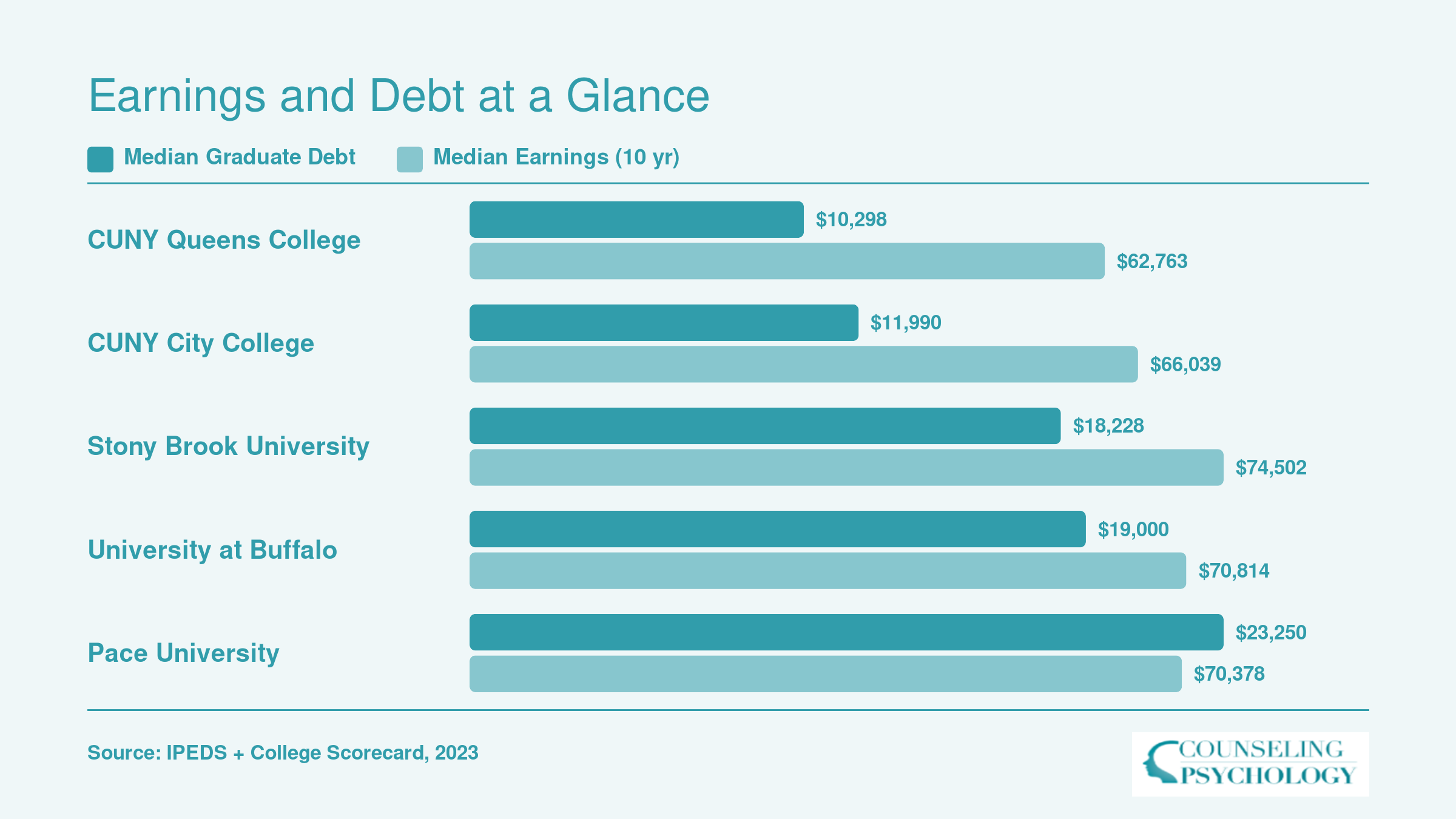
The return depends on your debt load and career timeline. Median debt for graduates across the institutions in this group ranges from roughly $10,300 to $23,600. Public SUNY and CUNY programs deliver the strongest return ratios, with graduates earning four to six times their median debt within the first decade. Private institutions show lower ratios (2.4 to 3.0), reflecting higher tuition and similar early-career wages.
If you plan to pursue licensure and work in clinical roles, the investment typically pays off within five to seven years. If you stop at the master's level without licensure or pivot into adjacent fields, expect a longer payback window and a ceiling on mid-career earnings. Employment outcomes show that the majority of completers are working and earning above the poverty line, but those figures alone do not capture underemployment or whether graduates land in psychology-related roles.
Ultimately, a psychology master's is worth pursuing if you have a clear career goal that requires or strongly benefits from the credential and if you can keep borrowing modest relative to expected wages in your target role.
Earnings and Debt at a Glance
How do the top-ROI psychology master's programs near Syracuse stack up on debt versus long-term earnings? The chart below compares median graduate debt with median earnings ten years after enrollment for each school. Program-level post-completion earnings at the one-year and four-year marks are not yet available for these programs, so institution-wide figures provide the best current benchmark.
Online vs. On-Campus Options in the Syracuse Region
Deciding between online and on-campus study is one of the most consequential choices you will make when selecting a psychology master's program. Among the ranked programs in New York, the vast majority are structured as campus-based experiences, with one offering a hybrid format that blends in-person and remote coursework. No fully online option appears in this particular group, which reflects a broader pattern: general psychology M.A. programs tend to prioritize in-person research mentorship and lab access. Here is how the two main modalities compare on the factors that matter most.
| Factor | Campus-Based Programs | Hybrid or Online Programs |
|---|---|---|
| Availability among ranked programs | The large majority of the ranked schools deliver their psychology master's exclusively on campus | One ranked program uses a hybrid model with flexible class formats; no fully online option is represented in this group |
| Typical net price range | Roughly $3,800 to $58,700 per year (varies widely between public SUNY/CUNY schools and private institutions) | The hybrid program carries an effective net price of about $14,100, which falls in the mid-range for this list |
| Institution-wide graduation rates (not program-specific) | Range from approximately 53% to 76% across the campus-only schools in this ranking | The hybrid institution reports an institution-wide graduation rate of roughly 46%, though this figure reflects all undergraduate and graduate programs, not the psychology master's alone |
| Scheduling flexibility | Most campus programs offer part-time and full-time tracks; some provide evening or weekend sections | A hybrid format adds the option to complete certain coursework remotely, which can be valuable for students balancing employment or family obligations |
| Practicum and field placement access | On-campus students in the Syracuse area can tap local practicum sites such as the Syracuse VA Medical Center (rotations in general mental health, PTSD, substance treatment, primary care, and more) and the Barnes Center at Syracuse University (individual and group counseling, crisis intervention, outreach). City school districts and community mental health agencies also serve as common placement partners. | Hybrid or online students can often arrange practicum placements in their home communities, but they may need to build those site relationships independently rather than relying on an established campus pipeline |
| Employer and networking opportunities | Physical presence on campus connects students with faculty research labs, departmental colloquia, and regional employer networks across Central and Western New York | Remote learners gain geographic independence but may need to be more intentional about attending conferences, joining professional associations, or scheduling campus visits to build peer and faculty networks |
| Research mentorship | Campus programs in this ranking frequently emphasize mentor-based research, thesis projects, and faculty collaboration as core components | Hybrid programs may offer research opportunities, though hands-on lab work and in-person mentorship can be harder to replicate at a distance |
| Best suited for | Students who can relocate or commute, want direct access to Syracuse-area clinical sites, and prioritize face-to-face research training | Working professionals or students with geographic constraints who need a flexible schedule and are comfortable coordinating field placements on their own |
Related Articles
Admissions Requirements & How to Stand Out
Admissions requirements for a psychology master's spell out the baseline credentials each program expects: your undergraduate GPA, test scores, completed courses, and sometimes work or research experience. Meeting the minimum keeps your application in the pile, but standing out often involves uncovering financial support like assistantships, scholarships, or employer tuition benefits that make the degree affordable.
Check GPA, GRE, and Prerequisites
Each program sets its own thresholds, so visit the official admissions page for every school you are considering. Many New York master's programs look for a cumulative undergraduate GPA of 3.0 or higher, though some will review applicants with a lower GPA if accompanied by strong letters or relevant experience. The GRE landscape is mixed: some programs require it, others have made it optional for 2026 entry, and a few have eliminated it entirely. Prerequisites frequently include introductory psychology, statistics, and research methods. If your undergraduate transcript is missing these, you may need to complete them before enrolling, often through a community college or online post-baccalaureate courses.
Tap into NY-Specific Scholarships and Assistantships
National organizations like the American Psychological Association and state-level bodies such as the New York State Psychological Association compile databases of scholarships, fellowships, and graduate assistantships open to psychology students. These awards are not always one-size-fits-all; some target clinical interests, others support diversity in the field, and many are tied to research or teaching roles. An assistantship typically provides a tuition waiver or stipend in exchange for part-time work, reducing the total cost significantly. If you are also weighing best counseling masters programs, many of the same funding sources apply across mental health disciplines. Start your search early, as deadlines often fall months before the academic year begins.
Ask the Financial Aid Office Directly
Not every funding opportunity is listed on a searchable website. Program-specific or donor-funded scholarships may sit quietly in a coordinator's spreadsheet. Contact the financial aid office at your target schools and ask outright: "What internal scholarships, fellowships, or graduate assistantships are available for psychology master's students, and how do I apply?" Also inquire whether these awards stack with federal aid or outside grants. A 15-minute phone call can surface options that your online search missed.
Research Employer Tuition Reimbursement in Syracuse
Many large Syracuse-area employers offer tuition assistance that can cover a substantial portion of your master's degree. Check the human resources policies at institutions like Upstate Medical University, Syracuse University (as an employer, not just a school), Crouse Health, St. Joseph's Health, and other regional healthcare networks. Some require a commitment to stay with the organization for a set period after completing the degree, turning the benefit into a mutual investment. Even smaller nonprofits and government agencies in Onondaga County may have tuition remission programs, so it pays to ask your current employer or a prospective employer about this benefit early in your search.
NY Licensure Pathways for Psychology Master's Graduates
A general MA in psychology and a master's in mental health counseling may look similar on paper, but they lead to very different professional outcomes in New York State. Choosing the wrong track can mean finishing a two-year program and discovering you do not yet qualify for any clinical license.
The 'Psychologist' Title Is Reserved for Doctoral Graduates
New York law reserves the title 'psychologist' for individuals who hold a doctoral degree and meet the state's psychology licensure requirements.1 A master's degree in general psychology, on its own, does not qualify you for psychology licensure and does not authorize independent clinical practice under the psychologist title. If independent psychological assessment and diagnosis is the long-term goal, a doctorate is the required path. For those exploring broader options, a look at careers in psychology can help clarify which roles align with master's-level credentials versus doctoral ones.
For most master's graduates who want to provide counseling and psychotherapy, the realistic and practical route is the Licensed Mental Health Counselor (LMHC) credential.
The LMHC Pathway: What New York Actually Requires
To qualify for LMHC licensure in New York, candidates must meet a specific set of requirements set by the New York State Education Department:
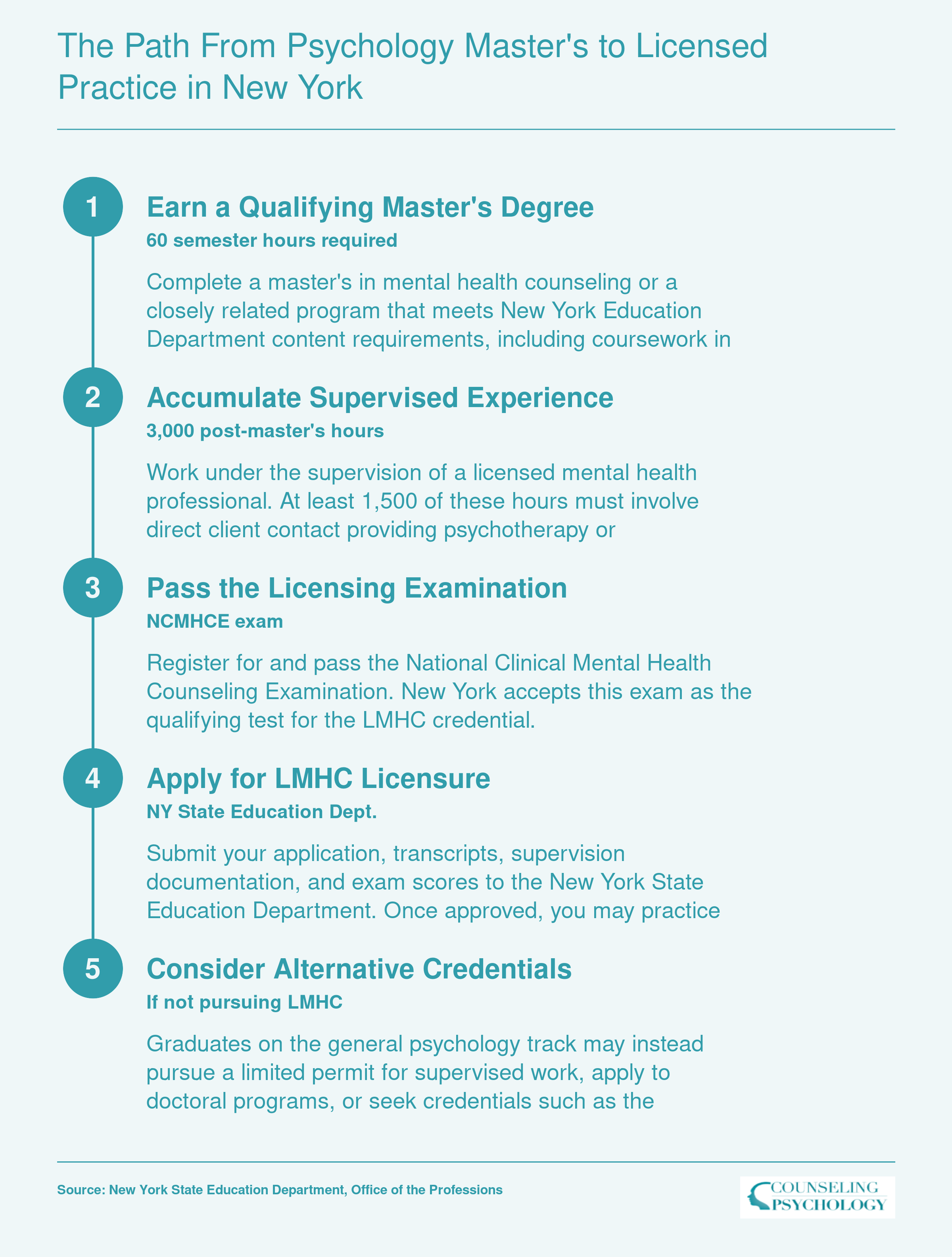
- Degree: A master's or doctoral degree specifically in mental health counseling, comprising at least 60 semester hours of graduate study.
- Supervised practicum: 600 hours of supervised practicum completed during the degree program.
- Post-degree supervised experience: 3,000 hours of supervised experience after graduating, of which at least 1,500 hours must involve direct client contact.
- Examination: Passage of the National Clinical Mental Health Counseling Examination (NCMHCE).
Programs aligned with CACREP accreditation standards, or those meeting NYSED's curriculum requirements, are structured specifically to satisfy these benchmarks. A general psychology master's program almost certainly does not, regardless of how many counseling electives it includes.
The Limited Permit: Practicing While You Complete Requirements
New York offers a Limited Permit that lets qualified graduates practice under clinical supervision while they accumulate the post-degree hours needed for full licensure. The permit is valid for 24 months and carries a $70 application fee.3 For graduates who need to work in a clinical setting immediately after finishing their degree, the Limited Permit creates a structured bridge between graduation and independent practice.
Alternative Credentials Worth Knowing
If your master's degree is in general psychology rather than mental health counseling, a few adjacent pathways remain open depending on your program's specific coursework:
- LMFT (Licensed Marriage and Family Therapist): New York accepts degrees in psychology, social work, mental health counseling, or allied health fields as qualifying backgrounds for MFT licensure, provided the required supervised hours and exam are completed.4 Whether a given general psychology program meets the 'substantially equivalent' standard the state applies is determined case by case.
- School Psychology Certification: Requires a program specifically approved for school psychology preparation. A general psychology master's does not substitute for this credential.
- CASAC (Credentialed Alcoholism and Substance Abuse Counselor): Offered through the New York Office of Addiction Services and Supports, this credential has its own education and supervised experience requirements and can be a practical option for graduates focused on substance use work. Those interested can learn more about how to become a substance abuse counselor.
Why Program Choice Is a Licensure Decision
The clearest takeaway is this: if becoming a licensed professional counselor in New York is your goal, the program you enroll in is effectively a licensure decision, not just an academic one. A 60-credit mental health counseling program designed to meet NYSED requirements puts you directly on the LMHC track. A 30- or 36-credit general psychology program, however strong academically, leaves you without a direct clinical license on graduation day. Before committing to any program in the Syracuse region, confirm whether it is explicitly structured to meet New York's LMHC requirements or another specific credential pathway.
The Path From Psychology Master's to Licensed Practice in New York
Not every psychology master's leads to the same career door. A general psychology M.A. typically prepares you for doctoral study, research roles, or industrial-organizational positions. A counseling-eligible track, by contrast, is designed to meet New York's mental health counseling licensure requirements. Here is the credentialing ladder for the counseling-eligible path.
How to Choose the Right Psychology Master's Program for Your Goals
The core tension most applicants face is not which program is best in the abstract, but which program is best for what they specifically want to do next. A program that excels at doctoral preparation may be a poor fit for someone who wants to start working in two years, and vice versa. Clarifying your goal first makes every other decision easier.
Match the Program Type to Your Intended Path
The programs in this list fall into three broad orientations, even if most carry a general psychology label.
- Research and doctoral prep: Programs like SUNY Brockport, CUNY City College, and St. Francis College emphasize thesis completion, faculty-mentored research, and statistical methods training. If your plan is to apply to PhD programs, these structures give you the writing samples, research experience, and faculty relationships that doctoral admissions committees expect.
- Research-intensive with applied exposure: Stony Brook and University at Buffalo combine research rigor with internship and professional development components. Both suit students who want doctoral preparation but also want some applied experience before committing to a PhD.
- Flexible and workforce-adjacent: Mercy University and The New School offer practicum requirements, interdisciplinary applications, and formats designed around working adults. Pace University's STEM-designated program is structured to attract students interested in quantitative applications of psychology, including paths that touch on organizational and applied fields. Students drawn to that intersection may also want to explore applied psychology masters programs more broadly.
If clinical licensure is your end goal, note that a general psychology master's degree alone does not satisfy New York's requirements for licensure as a mental health counselor or psychologist. You would need a counseling-specific, CACREP-accredited program, or a doctoral degree. Confirming this distinction before enrolling saves significant time and money.
Run the Numbers Before You Commit
Cost differences across these programs are substantial. CUNY Queens College carries in-state tuition around $11,600 and has one of the strongest cost-to-earnings ratios on this list. Long Island University's posted tuition is more than double that figure, with a notably lower ratio. Using the cost and debt figures presented earlier in this article, ask yourself how many years of entry-level earnings it would take to recover your investment at each school. A program that costs $40,000 more than an alternative needs to offer a concrete advantage, whether that is placement rates, research funding, or employer reputation, to justify the gap. For a broader look at tuition benchmarks, our guide to the best online master's in psychology can help you compare costs nationally.
Do the Due Diligence Most Applicants Skip
Before applying, take two steps that most prospective students overlook. First, attend a virtual information session or visit campus. Program websites describe structure; faculty and current students describe culture, advising quality, and what the experience actually looks like. Second, ask each program directly about practicum placement rates and, for research programs, where recent graduates were admitted for doctoral study. Admissions staff are accustomed to these questions, and programs with strong outcomes are generally happy to share the data. Programs that deflect or cannot answer are telling you something too.
Choosing the right program ultimately comes down to aligning the program's strengths with your specific next step, keeping the total cost within a range that your likely salary can support, and verifying claims about outcomes before you sign anything.
Frequently Asked Questions About Psychology Master's Programs in New York
Choosing a psychology master's program raises practical questions about cost, career options, and licensure. Below are straightforward answers drawn from current program data, New York state requirements, and workforce realities for 2026.