

What you’ll learn in this article…
- Seven CACREP-accredited CMHC programs near Louisville range from roughly $7,500 to over $21,000 in estimated net price.
- Clinical practicum hours earned during your master's program count toward Kentucky LPCC post-degree supervision requirements.
- Online options from University of the Cumberlands, Lindsey Wilson, and University of Kentucky let students study from Louisville.
- NHSC loan repayment and graduate assistantships are among the most effective strategies to cut total CMHC tuition costs.
Licensed clinical mental health counselors in the Louisville metro area are in short supply in 2026, with community health centers, private practices, and hospital systems competing for graduates who can bill independently under Kentucky's LPCC credential. Filling that pipeline requires a 60-credit master's degree from a CACREP-accredited program, at least 700 supervised clinical hours, and passing the NCE or NCMHCE. For many prospective students, the single largest obstacle is not admission standards or practicum placement, but the total out-of-pocket cost of graduate school.
Graduate tuition for CMHC programs in Kentucky ranges from around $10,200 to over $36,000 for the full 60-credit sequence, and delivery format plays a decisive role. Clinical mental health counseling online programs can lower indirect costs such as commuting and housing, but not all employers accept fully online degrees for internship placements. Campus-based programs offer tighter faculty mentorship and on-site clinic access, yet they typically require students to reduce paid work hours or relocate.
This article ranks the seven most affordable CACREP-accredited clinical mental health counseling master's programs within commuting distance of Louisville, compares their total costs and institution-level outcomes, maps the Kentucky LPCC licensure timeline, and outlines strategies to lower tuition through federal loan forgiveness, graduate assistantships, and employer tuition benefits.
Best Affordable CMHC Master's Programs Near Louisville for 2026
These seven Kentucky institutions offer CACREP-accredited clinical mental health counseling master's programs within reach of Louisville residents. Programs are ranked primarily by estimated net price, an institution-wide figure that provides a useful, though approximate, affordability signal. Keep in mind that graduate-level net costs can differ from undergraduate averages, so contact each admissions office for the most current CMHC-specific tuition quotes. School-wide graduation rates are included as a general quality indicator but do not reflect CMHC-specific completion data.
- Estimated institutional net price
- In-state and out-of-state tuition
- CACREP accreditation status
- Program format and flexibility
- Institutional graduation and retention rates
- Independent program research
- Internal program database
- NCES-IPEDS federal institutional data — nces.ed.gov
- College Scorecard graduate earnings — collegescorecard.ed.gov

Northern Kentucky University
Northern Kentucky University sits in Highland Heights, just across the Ohio River from Cincinnati, giving Louisville-area students access to a CACREP-accredited CMHC program at one of the lowest estimated net prices among Kentucky public universities. NKU's counseling faculty emphasize hands-on clinical preparation, requiring 600 internship hours that can be completed at agencies throughout Kentucky, including the Louisville metro. The school's overall graduation rate is 52.2%, and it carries a 19-to-1 student-to-faculty ratio.
- CACREP-accredited 60-credit curriculum
- 600 supervised internship hours required
- In-state graduate tuition around $10,788 per year
- Fall, spring, and summer admission cycles
- Minimum 2.75 undergraduate GPA for entry
- Prepares graduates for Kentucky LPCC licensure
- Placements available in diverse counseling settings
Clinical Mental Health Counseling, M.S. — On-Campus

Western Kentucky University
Western Kentucky University in Bowling Green delivers its 60-credit CMHC program through both residential and fully online pathways, making it accessible for Louisville students who prefer synchronous Zoom courses to long commutes. WKU does not require the GRE for admission, lowering an early cost and time barrier. With a school-wide graduation rate of 55.6% and in-state graduate tuition of roughly $12,140, WKU balances affordability with flexible delivery and strong Kentucky licensure alignment.
- CACREP-accredited 60-credit-hour program
- No GRE or GMAT required for admission
- Fully online pathway with live synchronous classes
- Residential option with two mandatory on-campus intensives
- Elective tracks in addiction education and play therapy
- Pathway to Kentucky LPCA and national certification
- Fall semester start for all cohorts
Master of Arts in Education in Clinical Mental Health Counseling — On-Campus

Eastern Kentucky University
Eastern Kentucky University offers a hybrid CMHC master's that blends online coursework with periodic campus sessions in Richmond, about 100 miles southeast of Louisville. EKU stands out for free or low-cost textbooks and a transfer-credit policy that accepts up to 18 graduate hours, both of which can meaningfully reduce total program expense. The school's overall graduation rate is 50%, and in-state graduate tuition runs approximately $10,794 per year.
- CACREP-accredited 60-credit-hour program
- Hybrid format combines online and on-campus learning
- In-state tuition approximately $541 per credit hour
- Free textbooks included for enrolled students
- Up to 18 graduate transfer credits accepted
- 100-hour practicum plus 600-hour internship
- Fall and spring admission deadlines available
- Personalized faculty mentoring throughout the program
Master of Arts in Clinical Mental Health Counseling — On-Campus

University of the Cumberlands
University of the Cumberlands, a private institution in Williamsburg, charges a flat online graduate rate of $449 per credit hour with no out-of-state surcharge, an attractive feature for Louisville residents who want a fully online option without geographic pricing penalties. The 60-credit CMHC program holds CACREP accreditation and allows students to arrange practicum and internship placements near their home communities. The school's overall graduation rate is 50.4%, and median graduate debt is among the lowest on this list at roughly $14,911.
- CACREP-accredited 60-credit online program
- Flat rate of $449 per credit hour, no out-of-state surcharge
- Practicum and internship arranged in student's community
- Multicultural counseling and evidence-based practice focus
- 3.0 GPA required for admission
- Designed for working adults across Kentucky
- Median graduate debt approximately $14,911
Master of Arts in Clinical Mental Health Counseling — Online

Lindsey Wilson College
Lindsey Wilson College in Columbia is a small, mission-driven private institution that delivers its CACREP-accredited M.Ed. in Counseling with a Mental Health Counseling concentration in both online and campus formats. The practitioner-focused curriculum includes nine hours of dedicated clinical instruction covering addiction, diagnosis, and therapeutic techniques. The school's overall graduation rate is 44.1%, the lowest on this list, but its 16-to-1 student-to-faculty ratio supports individualized attention, and graduates are eligible for provisional licensure in most states.
- CACREP-accredited 60-semester-hour program
- Available in both online and campus formats
- Nine hours of clinical instruction included
- Provisional licensure eligible upon graduation
- 3.0 GPA and admissions interview required
- Specialized coursework in addiction and clinical diagnosis
- Strong ties to rural and underserved Kentucky communities
Master of Education in Counseling, Mental Health Counseling Concentration — Online

University of Kentucky
The University of Kentucky's online Master of Arts in Counseling with a Clinical Mental Health Counseling concentration brings the resources of the state's flagship research university to students across Kentucky. UK's CMHC program emphasizes evidence-based, culturally competent practice and does not require the GRE for admission. While its institution-wide estimated net price of roughly $18,851 is higher than several regional alternatives, UK boasts the strongest school-wide graduation rate in this group at 71.4% and the highest median earnings ten years after enrollment.
- CACREP-accredited program at Kentucky's flagship university
- Fully online delivery for statewide accessibility
- No GRE required; 2.75 minimum undergraduate GPA
- Personal interview and three recommendation letters needed
- Emphasis on evidence-based and telehealth-relevant skills
- School-wide graduation rate of 71.4%
- In-state graduate tuition approximately $14,644 per year
Master of Arts in Counseling, Clinical Mental Health Counseling Concentration — Online

Spalding University
Spalding University is the only program on this list located in Louisville itself, giving local students the convenience of campus-based learning without relocation. Its two-year, cohort-based CMHC program enrolls roughly 20 students per cohort, creating an intimate learning community with a 9-to-1 student-to-faculty ratio. Spalding's on-campus counseling clinic serves underserved Louisville residents, so students gain clinical experience directly tied to the community where many will eventually practice. As a private university, Spalding's estimated institutional net price of about $25,491 is the highest here, though institutional scholarships and assistantships may offset that figure.
- CACREP-accredited two-year cohort-based program
- 60 total credit hours with face-to-face delivery
- Small cohorts of approximately 20 students
- On-campus clinic serving Louisville communities
- 9-to-1 student-to-faculty ratio
- Practicum and internship with local agency placements
- Prepares graduates for the National Counselor Exam
- Rooted in a social justice and peace mission
Master of Arts in Clinical Mental Health Counseling — On-Campus
Side-by-Side Cost and Outcomes Comparison
The table below consolidates graduate tuition rates, median debt at graduation, and institution-level median earnings for each program. The debt and earnings figures come from the U.S. Department of Education's College Scorecard and reflect institution-wide medians (not program-specific outcomes for the CMHC degree alone). Program-level earnings and completions data are not yet published for these programs, so the institution-wide figures serve as a general reference point. To gauge quick ROI, divide the median earnings by the median debt: University of the Cumberlands leads with roughly a 3.0 ratio, followed by the University of Kentucky at about 2.6, meaning graduates at those schools earn more relative to the debt they carry. Keep in mind that without program-specific completions counts or earnings, these ratios are directional rather than definitive.
| School | In-State Tuition | Out-of-State Tuition | Median Graduate Debt | Median Earnings (10-Year, Institution-Wide) | Earnings-to-Debt Ratio |
|---|---|---|---|---|---|
| University of the Cumberlands | $3,195 | $3,195 | $14,911 | $45,036 | 3.02 |
| University of Kentucky | $14,644 | $36,238 | $22,500 | $59,025 | 2.62 |
| Lindsey Wilson College | $10,163 | $10,163 | $16,784 | $41,129 | 2.45 |
| Northern Kentucky University | $10,788 | $16,350 | $23,000 | $50,220 | 2.18 |
| Eastern Kentucky University | $10,794 | $14,628 | $22,500 | $45,795 | 2.04 |
| Western Kentucky University | $12,140 | $18,340 | $22,095 | $43,889 | 1.99 |
| Spalding University | $12,530 | $12,530 | $25,250 | $49,438 | 1.96 |
Questions to Ask Yourself
CACREP Accreditation and Why It Matters for Kentucky Licensure
What is CACREP and why does it matter for Kentucky licensure?
CACREP, the Council for Accreditation of Counseling and Related Educational Programs, is the national standard-setting body for master's-level counseling programs. It ensures that the curriculum, faculty, and clinical training in programs like Clinical Mental Health Counseling (CMHC) meet rigorous, evidence-based standards.1 For aspiring licensed professional clinical counselors (LPCCs) in Kentucky, choosing a CACREP-accredited program is one of the most practical steps toward a smooth licensure journey.
CACREP and Kentucky's LPCC Licensure Path
Kentucky's Board of Licensed Professional Counselors recognizes CACREP accreditation as a clear signal that your graduate coursework automatically aligns with the state's educational requirements for LPCC licensure. Graduates from CACREP programs typically submit a straightforward application because their degree is considered pre-approved. In contrast, graduates of non-CACREP programs must often undergo a transcript evaluation where each course is reviewed against Kentucky's content-area standards. If gaps are found (for example, missing credits in assessment or ethics), you may need to complete additional graduate-level coursework before you can even apply for licensure. This extra step adds both time and tuition costs that many students do not anticipate.
Which Programs Near Louisville Are CACREP Accredited?
Several affordable CMHC programs featured in our ranking hold current CACREP accreditation. This group includes the online options from University of the Cumberlands, Lindsey Wilson College (CACREP-accredited since 1996, with accreditation running through March 2029)2, and University of Kentucky3, as well as the on-campus or hybrid programs at Western Kentucky University4, Northern Kentucky University5, and Eastern Kentucky University.6 You can verify any program's current status through the CACREP directory. Because each of these programs has met CACREP's standards, you can compare tuition and format knowing that the core licensing pathway is already built into the degree. If you are also exploring clinical mental health counseling online programs nationally, the same accreditation check applies.
The Consequences of Choosing a Non-CACREP Program
While a non-CACREP degree does not block licensure, it introduces uncertainty. The board may require you to submit detailed syllabi, catalog descriptions, and even a learning-outcomes matrix for every course. An evaluator then decides whether your education is "substantially equivalent" to a CACREP program. This process can delay your application by weeks or months, and if additional credit hours are mandated, the cost of those courses at a regionally accredited institution can easily run into the thousands. For students prioritizing affordability, a non-CACREP program can unexpectedly become the more expensive route.
Portability: Why CACREP Matters Beyond Kentucky
If there is a chance you will practice in another state after graduation, CACREP accreditation offers a valuable head start. Many state licensing boards use graduation from a CACREP-accredited program as a key criterion for license by endorsement or reciprocity. Holding a CACREP-aligned degree simplifies the paperwork and often reduces the number of post-degree supervised hours required in a new jurisdiction. This portability can save significant time and expense if your career takes you across state lines.
Online vs. On-Campus CMHC Options Near Louisville
Among the affordable CMHC programs serving the Louisville area, you will find a genuine mix of delivery formats. University of the Cumberlands, Lindsey Wilson College, and the University of Kentucky offer online pathways, while Northern Kentucky University, Spalding University, and Eastern Kentucky University are primarily campus based. Western Kentucky University splits the difference with both a residential track and a digital program. Understanding the tradeoffs between these formats can save you money, time, or both.
Pros
- Online programs let working professionals complete coursework on their own schedule, which is critical if you are already employed in a clinical or adjacent role.
- Choosing an online option such as University of the Cumberlands or Lindsey Wilson can open access to competitive per-credit tuition rates regardless of where you live in Kentucky.
- On-campus cohorts at schools like Spalding University (capped at roughly 20 students) foster strong peer relationships and direct faculty mentoring throughout the program.
- Campus students typically have easier access to graduate assistantships and tuition waivers that can significantly offset the sticker price of a 60-credit degree.
- Face-to-face instruction at programs like NKU and EKU supports hands-on clinical skill practice, including live role-plays and immediate faculty feedback during counseling labs.
Cons
- Online does not mean fully remote: WKU's digital track requires two mandatory on-campus residency weekends (Friday afternoon through Saturday) for specific courses, and students must arrange their own travel and lodging.
- Most online CMHC programs still expect you to complete practicum and internship hours at an approved site in your local area, so location flexibility has real limits.
- Part-time online tracks can stretch the standard two-year timeline to three years, delaying your entry into supervised practice and, ultimately, full licensure.
- Campus-based programs lock you into a fixed class schedule, which can be difficult to manage alongside employment or family obligations.
- Online learners may find it harder to build the organic peer network that on-campus cohorts develop naturally, which matters in a field built on relational skills.
Related Articles
Kentucky LPCC Licensure Path for CMHC Graduates
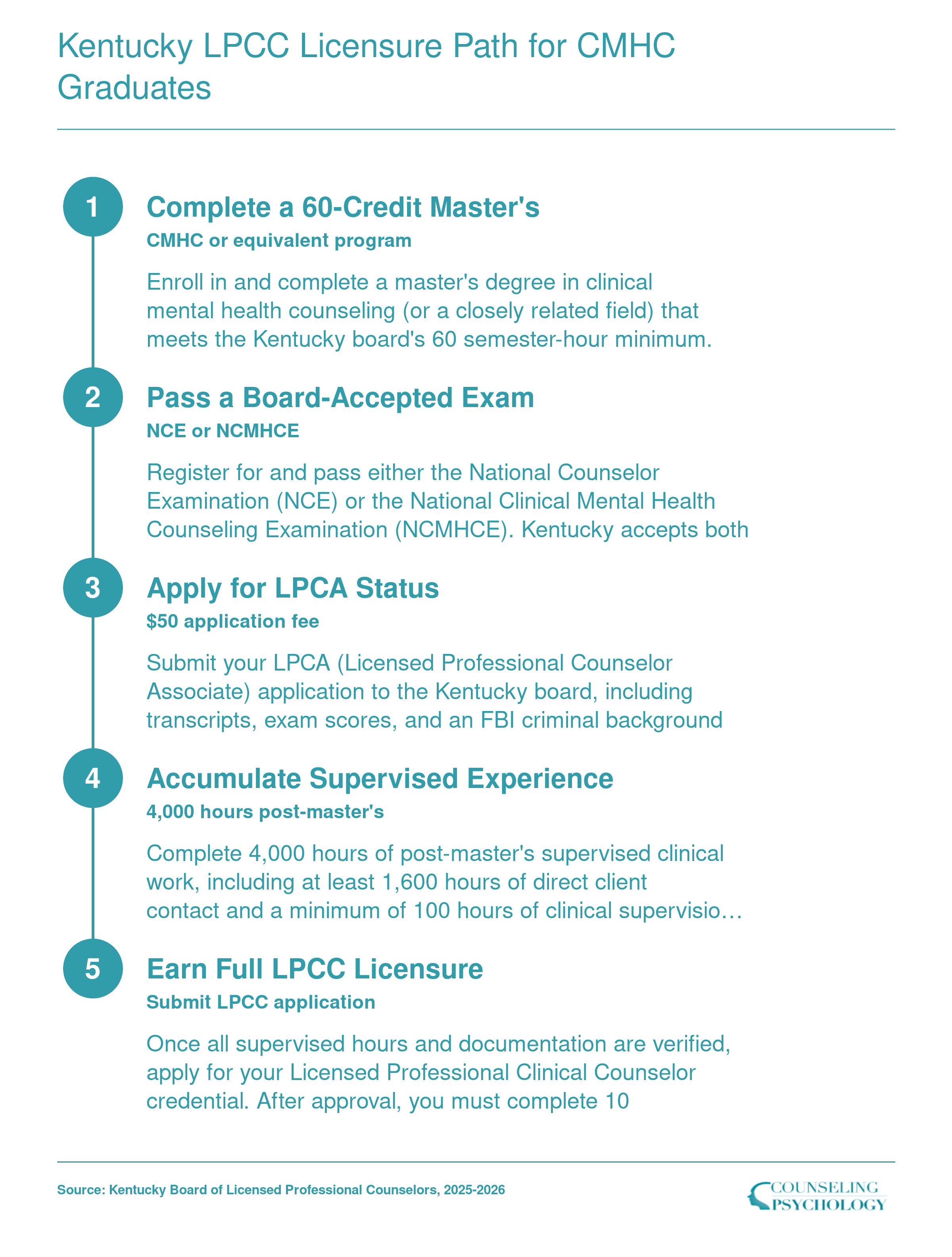
Earning your LPCC in Kentucky follows a structured credentialing ladder. Each stage builds on the last, so understanding the full timeline before you enroll helps you plan finances, supervision arrangements, and career milestones. Here is the current path as outlined by the Kentucky Board of Licensed Professional Counselors.
Practicum and Internship Expectations Across Programs
University of Louisville's M.Ed. in Clinical Mental Health Counseling requires at minimum 700 total clinical hours, including a 600-hour internship split across two semesters.1 That practical foundation is built on a 100-hour practicum that starts at 10 hours per week before stepping up to 20-plus hours per week during internship.1 While CACREP sets the floor at 600 internship hours, programs near Louisville often exceed that baseline, a pattern you will see at other Kentucky institutions as you compare curricula.
CACREP Minimums vs. Program Requirements
All CACREP-accredited counseling programs mandate a 100-hour practicum and a 600-hour internship that includes at least 240 direct client contact hours. University of Louisville aligns with these standards but pushes the direct-service threshold to 280 hours.1 Other nearby programs may structure their requirements differently: some spread the internship across three semesters, others integrate it into a full-year placement. Because published handbooks do not always reflect the most current fieldwork plans, you should contact each program's clinical coordinator directly to confirm exact hour totals and sequencing.
Clinical Hours and Kentucky Licensure
One of the biggest cost-of-time advantages in a CMHC degree is that every supervised hour you log during practicum and internship counts toward Kentucky's LPCC experience requirement. If you are exploring licensed professional clinical counselor degree options, understanding how fieldwork hours transfer to licensure is essential. The state requires 4,000 hours of post-degree supervised experience, but a significant chunk of those hours is already banked by the time you graduate, often 500 to 800 hours, depending on your program. That means your master's fieldwork directly shortens the time you will need to complete after graduation before you can sit for the licensure exam, effectively reducing the opportunity cost of pursuing full licensure.
Placement Opportunities in Louisville
Louisville's dense network of mental health providers gives students access to varied practicum and internship sites. Community mental health centers such as Seven Counties Services, the Robley Rex VA Medical Center, university counseling centers at UofL and Spalding, and specialized practices like Creative Family Counseling all routinely host CMHC trainees.2 This breadth means you can align your clinical hours with a population or setting that matches your career goals, whether that is crisis work, veterans' services, or school-based mental health.
Practicum and internship hours completed in a CACREP-accredited CMHC program typically count toward Kentucky's post-degree supervised experience requirements for LPCC licensure. That means every clinical hour you log as a student is also an hour closer to full licensure. Choosing a program with robust clinical training can meaningfully shorten the timeline between graduation and independent practice.
Strategies to Lower Your CMHC Tuition in Kentucky
Graduate students pursuing clinical mental health counseling degrees in Kentucky have multiple pathways to reduce their total educational costs. The most effective strategies often combine institutional aid with federal programs designed specifically for future behavioral health providers.
Graduate Assistantships and Institutional Aid
On-campus CMHC programs frequently offer graduate assistantships that pair tuition waivers with modest stipends in exchange for teaching assistance, research support, or departmental work. At the University of Louisville, prospective students should contact the financial aid office (502.852.5511) and ask their specific program about departmental scholarship opportunities, as funding structures vary by college.1 Spalding University directs CMHC applicants to reach out through [email protected] or the Center for Behavioral Health for information on program-specific funding.2 Keep in mind that fully online programs rarely offer traditional GA positions, so students prioritizing remote study should weigh that trade-off against potential on-campus funding.
Federal and State-Specific Resources
The Health Resources and Services Administration (HRSA) administers Behavioral Health Workforce Education and Training (BHWET) grants, which fund counseling students who commit to serving in underserved communities. If your program participates in BHWET, you may receive stipends or tuition support in exchange for clinical placements in high-need settings. On the federal loan side, mental health counselors who work in designated Health Professional Shortage Areas (HPSAs) may qualify for loan forgiveness programs similar in structure to TEACH grants for educators. Those interested in community mental health counselor roles should note that HPSA placements can count toward both loan forgiveness and supervised clinical hours.
Kentucky residents attending private institutions should explore the Go Higher Grant, a need-based award for residents aged 24 and older seeking a first bachelor's degree, which does not extend to graduate study but may benefit those completing undergraduate prerequisites.3 For graduate-level state resources, KHEAA (Kentucky Higher Education Assistance Authority) maintains updated listings of scholarships and loan programs, some of which apply to advanced degrees.
Employer Tuition Reimbursement
Louisville's healthcare sector, anchored by hospital systems and behavioral health agencies, commonly offers tuition reimbursement for employees pursuing clinical credentials. If you currently work in a counseling-adjacent role or can secure part-time employment with a healthcare employer, reimbursement programs can offset several thousand dollars annually. Check with human resources departments early, as some programs require pre-approval before you begin coursework.
Combining institutional funding with federal workforce incentives and employer support creates a realistic path to completing your CMHC degree without accumulating excessive debt.
Career Outlook for Clinical Mental Health Counselors in Louisville
Demand for clinical mental health counselors in the Louisville metro area continues to outpace supply, creating favorable conditions for graduates entering the workforce in 2026. Regional healthcare expansions and increased insurance coverage for behavioral health services have pushed employers to compete for licensed clinicians.
What Recent CMHC Graduates Actually Earn
Program-level earnings data for graduates of the Kentucky schools featured in this ranking are not yet published in federal reporting systems. Until those figures become available, prospective students should look to regional wage surveys and employer salary ranges for realistic benchmarks. For broader context on compensation across specialties and degree levels, our counselor salary guide breaks down earnings by state and credential. Anecdotally, entry-level positions at community mental health agencies in the Louisville area typically start in the low-to-mid $40,000s, with supervisory and specialized roles climbing higher after licensure completion.
Louisville-Area Wage Data from BLS
The Bureau of Labor Statistics tracks wages for Substance Abuse, Behavioral Disorder, and Mental Health Counselors (SOC 21-1018).1 The most recent metro-specific data available for Louisville-Jefferson County comes from the May 2023 Metropolitan and Nonmetropolitan Area OEWS Table, as the May 2024 metropolitan tables have not yet been released.2 Updated local figures should appear later in 2026.
At the national level, the BLS projects 20 percent job growth for this occupational category between 2022 and 2032, a rate described as much faster than average.3 That projection translates into thousands of new openings annually, many of them in mid-sized metros like Louisville where community-based mental health infrastructure is expanding.
Major Employers in the Region
Louisville-area CMHC graduates find positions across a range of settings:
- Norton Healthcare: The largest employer in metro Louisville operates multiple outpatient behavioral health clinics and hospital-based programs.
- UofL Health: The academic medical center affiliated with the University of Louisville hires counselors for integrated primary care, crisis stabilization, and specialty clinics.
- Centerstone: A major nonprofit behavioral health organization with deep roots in Kentucky, Centerstone absorbed Seven Counties Services and continues to expand community-based programs.
- Robley Rex VA Medical Center: Federal positions at the Louisville VA offer competitive salaries, loan repayment options, and robust benefits for eligible counselors.
The Bottom Line on ROI
Combining strong regional demand with relatively affordable tuition at Kentucky public universities creates a compelling return on investment. Graduates who secure licensure as an LPCC can expect stable employment prospects and incremental salary growth, particularly those willing to work in underserved communities or specialty populations. The 20 percent national growth projection reinforces that clinical mental health counseling remains one of the faster-growing segments of the healthcare workforce.
Frequently Asked Questions About CMHC Programs Near Louisville
Choosing a clinical mental health counseling program involves weighing cost, accreditation, format, and licensure details. Below are answers to the questions prospective students ask most often about CMHC master's programs in the Louisville, Kentucky area.