
What you’ll learn in this article…
- Pittsburgh school psychologists earn a mean salary near $97,400, with top earners surpassing $110,000 annually.
- Median debt-to-earnings ratios across ranked programs fall below 1.0, signaling strong return on investment.
- Degree type matters: an EdS or PsyD is required for Pennsylvania school psychologist certification, while an MEd costs less.
- Online and hybrid formats at Duquesne, IUP, and other area schools let working professionals cut commuting costs significantly.
Net prices for educational psychology and school psychology programs near Pittsburgh range from roughly $18,250 at Pennsylvania Western University to just over $32,800 at Penn State and Philadelphia College of Osteopathic Medicine, with debt-to-earnings ratios below 1.0 across most schools ranked in this guide. Students can choose from master's degrees (MEd, MS), education-specialist credentials (EdS), and doctorates (PhD, PsyD) delivered on campus, online, or in hybrid formats.
Across Pennsylvania, the biggest cost driver is not tuition alone but how many credits your program requires and whether you qualify for a graduate assistantship or employer tuition benefit. A thirty-credit online MEd in educational psychology can cost less than half what a sixty-four-credit EdS in school psychology does, even at the same institution. Pittsburgh-area programs also differ in whether they prepare you for Pennsylvania school psychologist certification, which requires NASP accreditation, or focus instead on research, instructional design, or higher education roles. Understanding different types of psychology degrees is an important first step before narrowing your options.
Deciding which program fits your budget and career goals requires comparing cost breakdowns, understanding what each credential qualifies you to do, and weighing the trade-offs between online flexibility and campus-based assistantships. Schools within commuting distance of Pittsburgh offer both tracks, but only three of the six ranked programs meet NASP standards for licensure.
Best Affordable Educational Psychology Programs Near Pittsburgh: 2026 Rankings
Pittsburgh-area students pursuing educational psychology have a handful of strong options that span public flagships, regional state universities, and private institutions. The programs below range from fully online master's degrees to research-intensive doctoral tracks, and each one serves a slightly different career goal. Net prices listed are institution-wide averages reported to the federal government; your actual cost will depend on residency, financial aid, and whether you qualify for assistantships or tuition remission. Graduation rates also reflect the full institution, not a single department, so treat them as one indicator of campus-level student support rather than a program-specific completion metric.
- Net price and tuition affordability
- Institutional graduation and retention rates
- Reported graduate earnings outcomes
- Program format and accessibility
- Credential levels offered
- Internal program database
- Independent program research
- NCES-IPEDS federal institutional data — nces.ed.gov
- College Scorecard graduate earnings — collegescorecard.ed.gov

Pennsylvania Western University
Pennsylvania Western University is a regional public institution in California, PA, roughly an hour south of Pittsburgh, making it one of the most geographically convenient and budget-friendly options in Western Pennsylvania. With an average net price of $18,256 and both online and hybrid program formats, PennWest is built for working professionals who need to keep earning while they study. The university offers multiple credential levels in this space, including a fully online MEd in Educational Psychology and a NASP-accredited hybrid School Psychology track that bundles a master's degree with an Ed.S.
- 30-credit, fully online program through PennWest Global Online
- CAEP-accredited curriculum covering cognitive development and assessment
- Courses count toward Pennsylvania Act 48 continuing education hours
- Designed for teachers, counselors, and social workers already in the field
- Focuses on evidence-based approaches for PreK-12 settings
- Flexible pacing for full-time working professionals
- NASP-accredited hybrid program combining online and in-person coursework
- Awards both a master's degree and an Education Specialist credential
- Prepares graduates for Pennsylvania school psychologist certification
- Emphasizes evidence-based intervention and consultation skills
- Addresses the regional and national shortage of school psychologists
- Blends theory with supervised field-based practice
MEd in Educational Psychology — Online
MS and Ed.S. in School Psychology — Hybrid

Millersville University of Pennsylvania
Millersville University, another PASSHE institution, offers a combined MS and Ed.S. in School Psychology that is approved by the National Association of School Psychologists. The 64-semester-hour program includes a 1,200-hour internship and prepares graduates directly for Pennsylvania Department of Education certification. Although the campus is in Lancaster County rather than Western PA, in-state tuition applies to all Pennsylvania residents, and the average net price of $20,787 keeps total cost competitive.
- 64-semester-hour NASP-approved program with dual credentials
- Includes both a practicum and a 1,200-hour internship
- Curriculum covers assessment, intervention, counseling, and consultation
- Emphasizes diversity awareness and the Response to Intervention model
- Prepares candidates for Pennsylvania PDE school psychologist certification
- Combines foundational psychology courses with education coursework
- Field-based experiential learning integrated throughout the program
MS and Ed.S. in School Psychology — On-Campus

University of Pittsburgh-Pittsburgh
The University of Pittsburgh is the only institution on this list located in Pittsburgh proper, and it brings the resources of a major R1 research university to its educational psychology offerings. Pitt's School of Education houses a PhD in Applied Developmental Psychology, a 90-credit, in-person doctoral program focused on child and youth development. Although the institution-wide net price of $30,434 is higher than the regional state universities, doctoral students frequently offset costs through teaching assistantships, research assistantships, fellowships, and tuition remission.
- 90-credit in-person doctoral program, roughly five years to complete
- No GRE required for admission
- Close faculty mentoring with hands-on research from the start
- Concentrates on child and youth development in real-world settings
- Assistantships and tuition remission available to reduce cost
- Graduates pursue careers in academia, research centers, and policy
- Trains students in applied research design and data analytic tools
- Full-time and part-time enrollment options available
PhD in Applied Developmental Psychology — On-Campus

Pennsylvania State University
Penn State's Educational Psychology master's program at University Park offers a rigorous 30-credit curriculum with two distinct tracks: a thesis option that prepares students for doctoral study and a non-thesis path for practitioners who want specialized knowledge without a dissertation. Concentrations in Learning and Instruction or Measurement let students tailor their degree to specific career interests. The institution-wide net price of $32,875 reflects the flagship's broader cost structure, though all Pennsylvania residents qualify for in-state tuition.
- 30-credit campus-based program at University Park
- Thesis track designed to prepare students for PhD programs
- Core coursework in statistical inference and research methodology
- Focuses on advanced learning theories and instructional psychology
- Ideal for educators seeking research-oriented specialization
- Faculty expertise in motivation, cognition, and learning processes
- 30-credit campus-based program at University Park
- Specialization in psychometric and measurement methods
- Advanced statistical training woven throughout coursework
- Non-thesis option available for practicing professionals
- Complements careers in assessment design and program evaluation
- Strong preparation for further doctoral-level study
Educational Psychology Master's Degree (Learning and Instruction concentration) — On-Campus
Educational Psychology Master's Degree (Measurement concentration) — On-Campus

Eastern University
Eastern University, a private institution near Philadelphia, offers a NASP-accredited MS in School Psychology delivered in a hybrid format that mixes online coursework with evening classes on campus in Saint Davids, PA. The program meets Pennsylvania Department of Education requirements and also prepares graduates for licensure as Professional Counselors and Behavior Specialists, broadening career options beyond school settings. At a net price of $26,662, it sits in the middle of this list, and Eastern advertises partner grants, military benefits, and federal financial aid to help manage costs.
- NASP-accredited hybrid program with online and evening components
- Full-time completion in about three years; part-time in four
- Meets PDE requirements for School Psychology certification (PK-12)
- Also prepares students for LPC and Licensed Behavior Specialist credentials
- Emphasizes data-based assessment, consultation, and intervention
- Financial aid includes partner grants and military benefits
- Flexible start terms accommodate working professionals
- Faculty with active expertise in school-based practice
MS in School Psychology — Hybrid

Philadelphia College of Osteopathic Medicine
Philadelphia College of Osteopathic Medicine offers a PhD in Educational Psychology in a hybrid format geared toward mid-career professionals who already hold a master's degree. The program can be completed in as few as three years of full-time study, with late-afternoon and evening classes that accommodate work schedules. Notably, it does not include a formal practicum or internship, which can shorten the timeline and reduce indirect costs. Graduates are prepared for leadership roles in educational systems and higher education rather than clinical psychologist licensure. Net price data is not available for this institution, so prospective students should contact PCOM directly for current tuition and aid details.
- Hybrid format combining online learning with on-campus sessions
- Completable in three years full-time; part-time option also available
- No formal practicum or internship required
- Specialization areas include neuropsychological assessment and CBT
- Classes held in late afternoon and early evening for working professionals
- Prepares graduates for leadership in educational systems and higher ed
- Financial aid options available to offset cost of attendance
PhD in Educational Psychology — Hybrid
Program Cost Breakdown: Tuition, Fees & Net Price Compared
The table below compares graduate tuition rates, institution-wide net prices, and median graduate debt for educational psychology and school psychology programs at Pittsburgh-area and broader Pennsylvania schools. A few important caveats: net price figures from federal data reflect institution-wide averages (primarily for undergraduates receiving aid) and do not isolate graduate program costs. Per-credit rates, where available, give a more accurate picture of what you will actually pay for a specific program. Program-level earnings and debt data are not yet published for most of these programs, so the median graduate debt column reflects institution-wide figures rather than program-specific amounts.
| Institution | Program / Degree Level | Per-Credit Rate (2025-2026) | In-State Annual Tuition | Out-of-State Annual Tuition | Institution Net Price | Median Graduate Debt |
|---|---|---|---|---|---|---|
| Pennsylvania Western University (PennWest) | MEd in Educational Psychology (Online, 30 credits) | N/A | $11,261 | $12,386 | $18,256 | $23,725 |
| Millersville University of Pennsylvania | MS in School Psychology / EdS (Campus, 64 credits) | N/A | $12,479 | $17,339 | $20,787 | $23,507 |
| University of Pittsburgh | PhD in Applied Developmental Psychology (Campus, 90 credits); MEd and other School of Education programs | $1,079 | $27,580 | $46,786 | $30,434 | $24,250 |
| Chatham University | MA in Psychology (36 credits) | $1,194 | N/A | N/A | N/A | N/A |
| Eastern University | MS in School Psychology (Hybrid) | N/A | $14,534 | $14,534 | $26,662 | $25,000 |
| Point Park University | EdD in Education; PsyD | $1,104 (EdD) / $1,248 (PsyD) | N/A | N/A | N/A | N/A |
| Pennsylvania State University | Educational Psychology MS (Campus, 30 credits) | N/A | $26,034 | $45,574 | $32,875 | $25,000 |
Questions to Ask Yourself
MEd vs MS vs EdS vs PsyD: Which Degree Fits Your Budget and Career Goals?
Choosing the right credential in educational psychology depends on how much time and money you can invest, and where you want to end up professionally. In Pennsylvania, the degree level you pursue directly affects whether you qualify for school psychologist certification or are limited to non-clinical roles such as instructional design, curriculum development, or research. Program-level earnings data for most Pittsburgh-area programs are not yet available through federal reporting, but institutional median earnings at ten years offer a useful proxy for comparing the return on investment across degree types.
| Degree Type | Typical Credits | Duration | Estimated Total Cost Range (PA Programs) | Primary Career Pathways | PA School Psychologist Certification Eligible? | Institutional Median Earnings at 10 Years (Examples) |
|---|---|---|---|---|---|---|
| MEd | 30 to 60 | 12 to 24 months | Roughly $11,000 to $28,000 (in-state at public institutions such as Pennsylvania Western University or Penn State) | Instructional coordination, curriculum design, PreK-12 educational support, entry to doctoral study | No (conditional only; does not meet PDE requirements on its own) | Pennsylvania Western University: $47,295; Penn State: $63,435 |
| MS | About 60 | Approximately 24 months | Roughly $14,500 to $46,800 depending on residency and institution (e.g., Eastern University at $14,534/year; Millersville at $12,479 to $17,339/year) | Research, academic positions, applied assessment roles, some school psychology tracks when paired with an EdS | Conditional: typically must be combined with an EdS or equivalent specialist coursework to meet PDE requirements | Millersville University: $55,246; Eastern University: $51,655 |
| EdS (Education Specialist) | 66 to 75 | About 36 months (often follows an MS) | Roughly $18,000 to $35,000 total beyond the master's level at public universities; combined MS plus EdS totals are higher | School psychologist, district-level assessment specialist, educational diagnostician | Yes. The EdS is the standard credential accepted by PDE for school psychologist certification. Programs such as Millersville's NASP-approved track are designed specifically for this pathway. | Program-specific earnings are not yet reported; institutional figures at Millersville: $55,246 |
| PsyD (Doctor of Psychology) | 90 or more | 4 to 6 years | Roughly $97,000 to $160,000 total (e.g., Philadelphia College of Osteopathic Medicine at approximately $32,281/year for a three-year-plus program; University of Pittsburgh doctoral tuition starts at $27,580/year in-state) | Licensed psychologist, clinical or school psychology leadership, higher education faculty, private practice | Yes, and also qualifies for broader psychology licensure in Pennsylvania | PCOM: $138,767; University of Pittsburgh: $66,125 |
Educational Psychology vs School Psychology: Key Differences for Pittsburgh Students
Choosing between educational psychology and school psychology is not just an academic distinction. It shapes the license you can earn, the setting you will work in every day, and the salary trajectory that follows. Pittsburgh-area students have real options across all three related fields, so understanding what each track actually prepares you to do matters before you apply.
What Educational Psychology Prepares You For
Educational psychology centers on the science of learning itself.1 Programs in this track are research-intensive, built around statistics, learning theory, motivation, and instructional design.2 Graduates typically move into roles such as curriculum developer, program evaluator, instructional designer, or higher education researcher.3 Students interested in exploring broader options in this space can review educational psychology degree online offerings to compare curriculum structures. At the University of Pittsburgh, research-oriented programs within this space fall under educational psychology, learning sciences, and measurement. Duquesne and PennWest embed educational psychology content inside broader curriculum and instruction or general psychology programs rather than offering it as a freestanding degree. None of these paths lead directly to a licensed or certified school psychologist credential in Pennsylvania.
What School Psychology Prepares You For
School psychology is a practitioner-focused track built around direct service in K-12 settings.3 The work involves psychoeducational assessment, counseling, crisis intervention, and consultation with teachers and families.1 Pennsylvania requires EdS-level training plus a supervised internship for school psychologist certification, which means a master's degree alone will not qualify you to practice in that role.
Duquesne University offers a combined MS and EdS program in School Psychology that leads to Educational Specialist certification in Pennsylvania. The program includes 1,200 internship hours. PennWest also offers an EdS in School Psychology with a Pennsylvania certification pathway. Both programs are designed to move graduates directly into certified school psychologist positions.
Applied Developmental Psychology: A Third Path
The University of Pittsburgh's School of Education offers a distinct Applied Developmental Psychology program at the BS, MS/MA, and PhD levels. This track blends developmental theory, research methods, and applied fieldwork to prepare graduates for work in community and youth-serving settings rather than school-based clinical roles.1 Typical career paths include program coordination in early childhood and family support organizations, community health, early intervention services, and doctoral study preparation. Students drawn to this area may also want to explore developmental psychology masters programs to compare curricula across institutions. Applied developmental psychology is a strong fit for those interested in child and family policy or community-based program design rather than K-12 assessment work.
Why the Distinction Matters
The practical consequences are direct. If your goal is to work as a school psychologist in a Pennsylvania district, you need an EdS and certification, not a master's in educational psychology. If you want to design training programs, evaluate interventions, or work in higher education and research, an educational psychology certificate or learning sciences path may align better. Applied developmental psychology sits in its own lane, pointing toward community and nonprofit contexts. Knowing which outcome you are working toward will determine which application to submit.
What Educational Psychology and School Psychology Graduates Earn in Pittsburgh
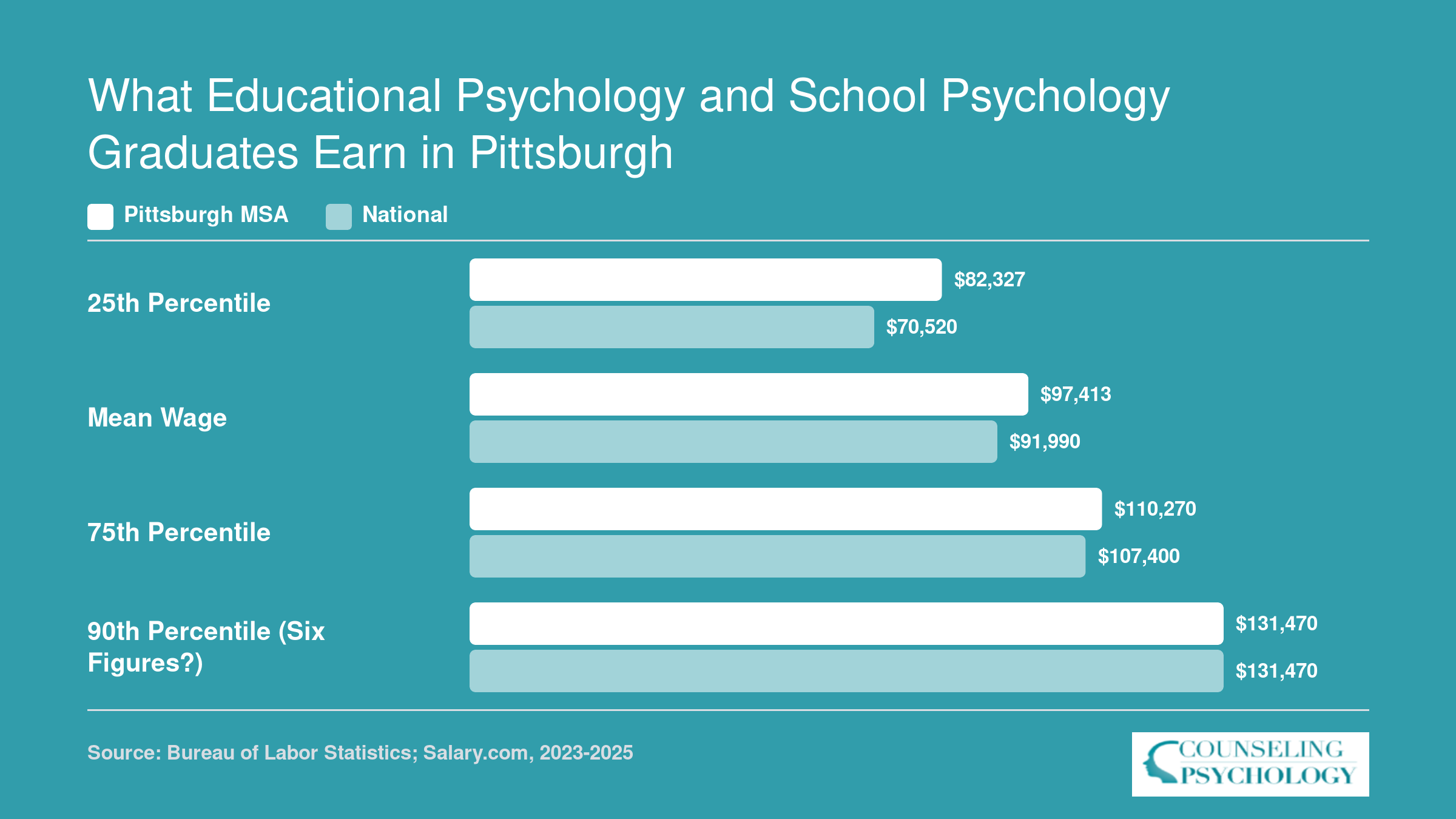
How much do school psychologists make in Pittsburgh? According to 2025 wage estimates, school psychologists in the Pittsburgh metro area earn a mean annual salary of roughly $97,400, with top earners clearing six figures. The 75th percentile reaches about $110,270, meaning experienced practitioners in the region can absolutely break into six-figure territory. Program-level early-career earnings for the ranked programs are not yet published at the individual level, so the chart below compares Pittsburgh-area wages at key career stages against the national median.
Financial Aid, Assistantships & Scholarships That Lower Your Cost
Financial aid for graduate students in educational psychology comes in several forms: assistantships that pair a tuition waiver with a stipend, institutional scholarships, federal grants, and employer tuition benefits. Each funding source has its own application timeline and eligibility rules, so building a clear checklist early in your admissions process is essential.
Graduate Assistantships
Assistantships are often the single most valuable funding mechanism for full-time graduate students. A typical arrangement covers a portion (or all) of tuition and pays a modest living stipend in exchange for 15 to 20 hours per week of teaching, research, or administrative support.
- University of Pittsburgh: Search the PittGrad portal for open assistantship positions posted by the School of Education and affiliated research centers. Positions rotate each semester, so check back frequently.
- Duquesne University: The Graduate Tuition and Funding page lists assistantship availability, eligibility criteria, and application deadlines for School of Education programs.
- PennWest University: Visit the Student Financial Aid site for assistantship and work-study listings. Because PennWest's base tuition is already lower than many regional competitors, even a partial assistantship can make total out-of-pocket costs very manageable.
Stipend amounts and tuition waiver percentages vary by institution and department, so contact the program coordinator directly for current figures.
Named Scholarships and Departmental Awards
Many School of Education departments maintain scholarship funds that are not prominently advertised on public-facing websites. At Pitt, for example, awards such as the Dean's Scholarship and smaller department-specific endowments may be available to incoming or continuing students. The best way to learn about these is to email or call the graduate admissions office of your specific program and ask what merit-based or need-based awards exist. Do this before you apply, because some awards require a separate application or earlier deadline. Students considering a doctorate in educational psychology should pay especially close attention, as doctoral-level funding packages tend to be more generous than those at the master's level.
The TEACH Grant: Worth Investigating, but Confirm Eligibility
The federal TEACH Grant provides up to $4,000 per year for students who commit to teaching in high-need fields at qualifying schools after graduation. However, not all graduate-level education or psychology programs participate. Before counting on this funding, confirm directly with each university's financial aid office that your intended program is TEACH Grant-eligible. If you fail to meet the post-graduation service requirement, the grant converts to an unsubsidized federal loan with interest, so understand the commitment fully.
Additional Resources to Explore
The BLS Occupational Outlook Handbook entry for school psychologists provides useful context on typical funding patterns and career demand, which can help you gauge the return on any investment you make. If you are also weighing clinical psychology programs in Pennsylvania, many of the same state-funded scholarships and assistantship structures apply. State-level professional organizations, such as the Pennsylvania Psychological Association, occasionally list graduate fellowships as well. Finally, do not overlook employer tuition reimbursement: many school districts and mental health agencies in the Pittsburgh area offer partial tuition benefits for employees pursuing advanced degrees in education or psychology.
Pittsburgh-area educational psychology graduates typically carry manageable debt relative to early-career earnings. Across the programs ranked in this guide, median debt-to-earnings ratios fall below 1.0, meaning most graduates owe less than their first-year salary. This compares favorably to Pennsylvania state averages and underscores the region's strong return on investment for advanced degrees in school-based psychology and education.
Online, Hybrid & On-Campus Options for Pittsburgh-Area Students
Choosing how you attend a program, not just where, shapes your total cost, your daily schedule, and how quickly you can finish. For working professionals in the Pittsburgh area, the delivery format can matter as much as tuition rates.
Quick Format Guide
Here is how the programs covered in this article break down by delivery:
- Fully online: PennWest's Educational Psychology MEd runs 100% online, making it the most flexible option for students who cannot relocate or reduce work hours.1
- Blended (online plus required in-person days): PennWest's School Psychology MEd+EdS uses a blended format with Saturday or weeknight sessions, suited to students who want distance convenience but can travel periodically to the California or Edinboro campus.2
- Hybrid (online plus evening/on-campus): Eastern University's MS in School Psychology combines online coursework with evening classes and can be completed in three years full-time or four years part-time.
- On-campus, with part-time and evening options: Duquesne University's School Psychology program is delivered entirely on campus in Pittsburgh, but the program offers part-time and evening/weekend scheduling specifically designed for working students. Distance learning is not available through Duquesne.3
- On-campus, full-time research focus: University of Pittsburgh's PhD in Applied Developmental Psychology is an in-person program. Full-time or part-time enrollment is available, but the research-intensive structure is best suited to students who can commit significant on-site time.
How Format Affects Your Real Cost
Tuition is only part of the cost equation. A fully online program eliminates commuting expenses and lets you keep full-time employment, which can offset tuition far more than a modest scholarship at a residential school. Blended and hybrid formats occupy a middle ground: lower commuting costs than a traditional campus schedule, but you still need flexibility on certain days or evenings.
Part-time tracks at schools like Duquesne and Eastern also reduce opportunity cost by spreading coursework across an extra year, allowing continued employment throughout the program.
Practicum and Internship Hours Still Require In-Person Work
Online or blended delivery does not mean entirely remote training, particularly for school psychology tracks. PennWest's School Psychology MEd+EdS requires a practicum and a 1,200-hour internship, both of which must be completed in person.2 Practicum placements are tied to clinics at the California or Edinboro campuses, so Pittsburgh-area students need to plan for travel or temporary relocation during that phase.
Duquesne places its interns in Pittsburgh-area school districts, a practical advantage for students already living in the region who want field experience close to home.3
Before enrolling in any online or hybrid program, confirm with the admissions office exactly when and where in-person requirements fall. That calendar detail can determine whether a format that looks flexible on paper actually works with your job and family schedule.
How to Choose the Right Program: Accreditation, Licensure & ROI
Choosing between a lower-cost program and one that meets all your professional requirements is a real dilemma for many Pittsburgh-area students. The right choice depends on whether you need state psychology licensure, school psychologist certification, or a research-focused credential, and each pathway carries different accreditation and ROI considerations.
Understanding Accreditation for Psychology and School Psychology Programs
Accreditation is not just a prestige marker. It directly affects whether you can sit for licensing exams and whether your credentials transfer across state lines.
- APA or CPA accreditation: Required for anyone pursuing licensure as a psychologist in Pennsylvania. The state board requires that your doctoral program be accredited by the American Psychological Association (APA), the Canadian Psychological Association (CPA), or designated by the Association of State and Provincial Psychology Boards (ASPPB).1 If your program lacks one of these stamps, you will not qualify for the 3,500 hours of supervised experience and the EPPP and PPLE exams that lead to licensure.2
- NASP approval: If your goal is to work as a school psychologist in Pennsylvania, the National Association of School Psychologists approval signals that a program meets national standards for training. Programs at Eastern University and Millersville University carry NASP approval. Duquesne University's school psychology program is approved by the Pennsylvania Department of Education, which is the minimum requirement for state certification. The University of Pittsburgh's program was not listed in the available PDE documentation, so prospective students should verify current approval status directly with the department.3
- PA Department of Education certification: To work as a school psychologist in Pennsylvania public schools, you must earn the Educational Specialist, School Psychologist Level I credential. This requires passing the Praxis School Psychologist exam (5402) with a minimum score of 147, completing 1,000 internship hours, and maintaining at least a 3.0 GPA. The application fee is $200 for Pennsylvania residents and $260 for out-of-state applicants. Certification is valid for six years and does not require APA or NASP accreditation, but most quality programs hold one or both.3
Can You Become a Licensed Psychologist with an EdD?
Yes, but only if your EdD program holds APA, CPA, or ASPPB designation. Pennsylvania does not bar EdD holders from psychology licensure, but it does require doctoral-level training in a health-service psychology program approved by one of these bodies.1 Licensure further requires 3,500 hours of supervised experience over at least two years, including 1,750 predoctoral internship hours and 1,750 postdoctoral hours, plus two hours per week of individual face-to-face supervision.2 You must also pass the EPPP and PPLE exams, complete a three-hour child abuse recognition course, and pay a $105 application fee.2 If your EdD is from an education department without health-service psychology accreditation, you will not meet the board's education requirement. Students interested in applied psychology careers should pay especially close attention to whether their program's accreditation satisfies the board.
Using ROI to Evaluate Program Value
Return on investment is a straightforward way to compare programs. Divide median earnings by total program cost (tuition plus median debt). The higher the ratio, the faster you recoup your investment.
For example, the Philadelphia College of Osteopathic Medicine's hybrid PhD in Educational Psychology shows median earnings of $138,767 at the tenth year post-graduation. With tuition of approximately $32,281, the ROI ratio is extremely high. The University of Pittsburgh's PhD in Applied Developmental Psychology reports median earnings of $66,125 and tuition of $27,580 (in-state), yielding a ratio of approximately 2.7. At the master's level, Pennsylvania Western University's online MEd costs roughly $11,261 and shows median earnings of $47,295, for a ratio near 2.0. These figures do not include living expenses, books, or opportunity cost, but they offer a snapshot of earning potential relative to sticker price.
When program-level earnings data are missing, consider institutional averages and alumni employment rates. Compare median debt at graduation (available in scorecard data) with starting salaries in your target role. If your debt exceeds one year's salary, scrutinize whether the program offers assistantships, tuition waivers, or employer reimbursement that can lower your net cost.
Verifying State Certification Requirements
If you plan to work in Pennsylvania schools, confirm that your program meets PDE certification standards before you enroll. Not every psychology or educational psychology program is designed to satisfy the 1,000-hour internship, coursework in assessment and intervention, and Praxis 5402 requirements. Programs explicitly labeled "school psychology" and carrying NASP approval are the safest bet. Educational psychology programs, even those with strong research reputations, may not provide the practicum placements or supervised field hours that the state requires for school-based practice.
Frequently Asked Questions About Educational Psychology Programs in Pittsburgh
Prospective students in the Pittsburgh area often have overlapping questions about cost, career outlook, and how different degree types compare. Below are straightforward answers grounded in publicly available data from the Bureau of Labor Statistics, institutional tuition schedules, and Pennsylvania licensure requirements.