

What you’ll learn in this article…
- Phoenix psychology programs range from about $1,400 to nearly $44,000 per year before financial aid, making net price comparisons essential.
- Maricopa Community College transfers save thousands by completing general education locally before finishing at a four-year university.
- Psychology-adjacent roles in the Phoenix metro area generally pay above their respective national medians.
- A bachelor's in psychology alone does not qualify you for independent licensure in Arizona, so plan for graduate study.
Phoenix has emerged as a significant behavioral health hub in the Southwest, driven by population growth, an expanding senior population, and statewide investments in mental health infrastructure. That demand translates directly into opportunities for psychology-trained graduates, particularly those who understand both clinical pathways and the non-clinical roles where behavioral science skills apply.
Seven accredited institutions in the Phoenix metro area now offer bachelor's programs in psychology for 2026, spanning traditional campus formats, fully online degrees, and hybrid models. Published tuition ranges from $1,410 to over $44,000 annually, though net price after aid narrows that gap considerably. Graduation rates span from 13% to 68%, and median early-career earnings vary by more than $50,000 depending on the institution and program structure.
Most Phoenix students face a practical choice between starting at a Maricopa Community College and transferring after two years or committing to a four-year program upfront. Transfer pathways are well-established and cost-effective, but they require early planning to ensure credits align. Meanwhile, the decision between a research-focused Bachelor of Science and an applied Bachelor of Arts shapes not only coursework but also graduate school eligibility and employer perception in Arizona's competitive behavioral health market.
Ranked: The Best Bachelor's in Psychology Programs in Phoenix
These rankings weigh a blend of net price, institution-wide graduation rate, and graduate outcomes to surface the Arizona programs that deliver the strongest return for psychology students. All graduation rates cited are institution-wide figures reported to the federal government, not program-specific completions. A quick note on degree type: a Bachelor of Science (BS) in psychology typically requires more coursework in research methods, statistics, and the natural sciences, which can strengthen applications to research-oriented or clinical graduate programs. A Bachelor of Arts (BA) usually allows more elective flexibility, making it easier to double-major or explore complementary fields such as social work or education.
- Net price after financial aid
- Institution-wide graduation rate
- Graduate earnings and debt outcomes
- Program breadth and concentrations
- Delivery format flexibility
- Independent program research
- NCES-IPEDS federal institutional data — nces.ed.gov
- College Scorecard graduate earnings — collegescorecard.ed.gov
- Internal program database

Arizona State University
Arizona State University anchors the Phoenix metro's psychology landscape with multiple BS tracks spanning counseling, forensic psychology, industrial-organizational psychology, and sport and performance counseling. The university's Maricopa Community College transfer partnership makes it particularly accessible for Phoenix-area students who start at a two-year school. With a net price of roughly $14,967 and an institution-wide graduation rate of 68%, ASU balances affordability and completion at a scale few Arizona schools can match. Online options carry the same diploma as on-campus programs, a practical advantage for working adults across the Valley.
- Online BS covering motivation, confidence, and injury recovery
- 120 credit hours across 40 classes, each 7.5 weeks long
- Required internship in a sport or mental health setting
- Prepares for behavioral health specialist and counselor roles
- Housed in the College of Integrative Sciences and Arts
- Financial aid and an Earned Admission pathway available
- Available online and on campus for scheduling flexibility
- Builds critical thinking and statistical analysis skills
- Focus on criminal justice and mental health intersections
- Strong foundation for graduate studies in forensic fields
- Real-world applications integrated into coursework
- Emphasizes research design and ethical reasoning
- Campus-based program with research-driven quantitative focus
- No second language requirement for the BA track
- Accelerated bachelor's-plus-master's pathway option
- Study abroad opportunities available
- Multiple career pathways in HR and consulting
- Workplace empowerment and performance strategies emphasized
- Campus-based program emphasizing cultural diversity
- Internship placements with licensed therapists
- Covers addictions, trauma, and professional ethics
- Designed to prepare students for graduate study
- Hands-on experience embedded throughout the curriculum
- Focus on psychological well-being across populations
BS in Counseling and Applied Psychological Science, Sport and Performance Counseling — Online
BS in Psychology, Forensic Psychology — Online
BA in Psychology, Industrial and Organizational Psychology — Online
BS in Counseling and Applied Psychological Science — Online

University of Arizona
The University of Arizona offers a BA in Psychology through both its Tucson campus and a fully online format, giving Phoenix-area students access to a research-intensive College of Science program without relocating. The curriculum requires 33 psychology credits, including 18 at the upper-division level, and spans domains from clinical science to cognitive neuroscience. At a net price of roughly $16,674 and an institution-wide graduation rate of about 68%, UArizona pairs strong academic depth with statewide transfer pathways through the AZTransfer system. Students are required to declare a minor, which broadens career versatility.
- 33 credits required with 18 at the upper-division level
- Domains include clinical science and cognitive neuroscience
- Independent study, internship, and practicum options built in
- Online format at $525 per credit with no campus requirement
- Requires declaration of a minor for degree completion
- Prepares graduates for counseling, social work, and education paths
- Award-winning advising support for online learners
BA in Psychology — Online

Embry-Riddle Aeronautical University-Prescott
Embry-Riddle Aeronautical University's Prescott campus stands out for two specialized BS psychology programs: forensic psychology and industrial-organizational psychology. Both are STEM-oriented, campus-based, and built around small classes with direct faculty mentorship. The I-O track reports a 96% placement rate, an unusual metric for undergraduate psychology. The institution-wide graduation rate sits near 68%, but the net price of about $40,287 reflects its status as a private university, making scholarship and aid packages an important consideration.
- 120-credit campus program blending psychology and forensic science
- Small class sizes with faculty-led instruction
- Courses in perception, cognition, personality, and profiling
- Hands-on research opportunities throughout the program
- U.S. legal system training integrated into the curriculum
- Prepares for careers in law enforcement and criminal justice
- STEM-designated program with 121 credit hours
- 96% placement rate reported by the university
- Focuses on employee well-being and workplace performance
- Leadership, health, and organizational development coursework
- Direct preparation for HR, training, and consulting roles
- Student research embedded alongside practical applications
BS in Forensic Psychology — On-Campus
BS in Industrial-Organizational Psychology — On-Campus

Prescott College
Prescott College delivers a BA in Psychology through a hybrid format that blends online and on-campus learning, framed around social justice, environmental awareness, and community well-being. The 8-to-1 student-faculty ratio is the smallest on this list, offering close mentorship that larger institutions rarely match. An accelerated pathway into a master's program is available for qualified students. The institution-wide graduation rate of about 56% is worth weighing against the school's mission-driven model; median graduate debt of $16,300 is among the lowest here.
- Hybrid format combining online and on-campus coursework
- Strong social justice and ethical applications emphasis
- Accelerated master's degree pathway available
- 8-to-1 student-faculty ratio for close mentorship
- Integrates diverse cultural and scientific perspectives
- Financial aid options available for eligible students
- Holistic approach blending emotional, cognitive, and social study
BA in Psychology — On-Campus

Arizona Christian University
Arizona Christian University, located in Glendale within the Phoenix metro, offers a campus-based BS in Psychology with concentrations in sport psychology and industrial-organizational psychology. The curriculum integrates a biblical worldview, and students must maintain a 3.0 GPA to remain in the program. Original research opportunities and a 16-to-1 faculty ratio provide meaningful mentorship. The institution-wide graduation rate of roughly 40% and net price near $32,839 are factors prospective students should evaluate carefully alongside the school's faith-based mission.
- 46 core credits plus 12 concentration credits required
- Courses in kinesiology and introduction to sport psychology
- Campus-based with biblical worldview integration
- 3.0 GPA and two prerequisite PSY courses for admission
- Separate concentration application required
- Prepares for sport psychologist and exercise physiologist careers
- 17-to-1 faculty-student ratio with hands-on mentorship
- Original research opportunities embedded in the curriculum
- Aligns with APA learning objectives
- Broad foundation for graduate study or direct employment
- Focus on practical application alongside theory
- Biblical worldview woven through coursework
- 12 concentration credits in I-O psychology topics
- Career paths span HR, consulting, and leadership roles
- Scientific principles applied to organizational performance
- Biblically integrated curriculum throughout
- 3.0 GPA requirement to remain in the program
- Focus on management skills and workplace dynamics
BS in Psychology, Sport Psychology — On-Campus
BS in Psychology — On-Campus
BS in Psychology, Industrial and Organizational Psychology — On-Campus

University of Phoenix-Arizona
University of Phoenix offers a fully online BS in Industrial-Organizational Psychology designed for working adults in the Phoenix area and beyond. Open-access admissions (no SAT or ACT required) and frequent start dates lower the barrier to entry. The 120-credit curriculum aligns with APA and SIOP standards, and transfer credits or prior-experience assessments can shorten time to completion. However, the institution-wide graduation rate of about 21% and median graduate debt of roughly $31,553 deserve serious scrutiny. Importantly, this program does not prepare graduates for licensure as psychologists or counselors.
- Fully online with flexible scheduling for working adults
- 120 credits across 14 core and 12 general education courses
- No SAT, ACT, or application essay required
- Transfer credits and prior experience credits accepted
- Aligned with APA and SIOP professional standards
- Prepares for HR, training, and organizational development roles
- Does not lead to psychology or counseling licensure
BS in Industrial-Organizational Psychology — On-Campus

Dine College
Diné College is a tribally controlled institution in Tsaile, Arizona, offering a BA in Psychology with concentrations in Navajo Psychology and Counseling and Clinical Psychology. The program blends traditional Diné knowledge with contemporary psychological practices, preparing graduates to serve Navajo Nation communities. At a net price of roughly $6,057, it is by far the most affordable option on this list. The institution-wide graduation rate of about 13% reflects the unique challenges facing tribal colleges, not necessarily the quality of instruction. Phoenix-area Native students seeking a culturally grounded pathway may find this program especially meaningful, though it requires relocation to the Navajo Nation.
- Campus-based program serving primarily Navajo Nation students
- Tuition among the lowest of any four-year college in Arizona
- Hands-on internship and research opportunities included
- Prepares graduates for service in indigenous communities
- Financial aid available for eligible students
- Blends traditional and contemporary psychology practices
- Concentration grounded in Diné cultural knowledge
- Indigenous research methods integrated into coursework
- Designed for students committed to Navajo community service
- Courses explore identity, healing, and cultural resilience
- Prepares students for graduate study or community roles
- Campus-based learning in a tribal college setting
- Focus on clinical skills within an indigenous context
- Covers health psychology and social-cultural psychology
- Internship opportunities tied to community placements
- Blends clinical and cultural therapeutic approaches
- Pathway toward graduate counseling or clinical programs
- Serves students planning careers in behavioral health
BA in Psychology — On-Campus
BA in Psychology, Navajo Psychology — On-Campus
BA in Psychology, Counseling and Clinical Psychology — On-Campus
Phoenix Psychology Program Cost and Outcomes at a Glance
Sticker prices for a bachelor's in psychology in Arizona range from roughly $1,400 to nearly $44,000 per year, but the net price after financial aid tells a more useful story. The table below compares published tuition, average net price, median debt at graduation, and institution-wide median earnings ten years out. Keep in mind that the net price shown is an institution-wide average for aided students, not a guaranteed quote; your actual cost will depend on your financial aid package, enrollment status, and course load. Among these schools, Arizona State University stands out for return on investment: its graduates earn a median of $62,668 ten years after enrollment against a median debt of $19,500, yielding roughly $3.21 in earnings for every dollar of debt. Embry-Riddle Aeronautical University (Prescott) posts the highest raw earnings at $84,131 but also carries the steepest net price.
| School | In-State Tuition | Out-of-State Tuition | Avg. Net Price After Aid | Median Debt at Graduation | Median Earnings (10 yr) | Graduation Rate |
|---|---|---|---|---|---|---|
| Dine College | $1,410 | $1,410 | $6,057 | N/A | $29,188 | 12.6% |
| University of Phoenix (Arizona) | $9,552 | $9,552 | $13,520 | $31,553 | $37,752 | 20.8% |
| Arizona State University | $12,223 | $33,139 | $14,967 | $19,500 | $62,668 | 68.0% |
| University of Arizona | $13,573 | $39,903 | $16,674 | $19,620 | $59,979 | 67.5% |
| Prescott College | $34,490 | $34,490 | $22,583 | $16,300 | $42,359 | 55.6% |
| Arizona Christian University | $35,098 | $35,098 | $32,839 | $23,000 | $51,612 | 39.9% |
| Embry-Riddle Aeronautical University (Prescott) | $43,974 | $43,974 | $40,287 | $23,666 | $84,131 | 67.8% |
Questions to Ask Yourself
Online vs. On-Campus Psychology Programs in Phoenix
Not every student can show up to a lecture hall five days a week, and not every learner thrives behind a screen. The good news is that the ranked Phoenix-area psychology programs span all three delivery formats: fully online, traditional campus, and hybrid. Below is a side-by-side look at what each format offers so you can match your lifestyle and learning goals to the right program.
| Factor | Online Programs | Campus Programs | Hybrid Programs |
|---|---|---|---|
| Schools in this ranking | Arizona State University (BS in Counseling and Applied Psychological Science), University of Phoenix (BS in Industrial-Organizational Psychology) | University of Arizona (BA in Psychology), Embry-Riddle Aeronautical University (BS in Forensic Psychology), Arizona Christian University (BS in Psychology), Diné College (BA in Psychology) | Prescott College (BA in Psychology) |
| Tuition structure | Often a flat per-credit or per-course rate regardless of residency. ASU lists $12,223 in-state and $33,139 out-of-state; University of Phoenix charges $9,552 for all students. | Residency matters at public schools. University of Arizona is $13,573 in-state vs. $39,903 out-of-state. Private campuses like Embry-Riddle ($43,974) and Arizona Christian ($35,098) charge one rate. | Prescott College charges $34,490 for all students, with an average net price of about $22,583 after aid. |
| Flexibility for working adults | Strongest option. ASU uses 7.5-week course blocks; University of Phoenix offers rolling starts and no set class times. Both let you hold a full-time job while earning your degree. | Least flexible. Most courses meet during weekday hours, though some evening sections may be available. Research practica and labs add fixed time commitments. | A middle ground. Prescott College blends online coursework with periodic on-site intensives, giving working students more scheduling room than a purely campus program. |
| Access to research labs and practicum | Limited direct lab access. ASU's program requires an internship component, but hands-on lab research is harder to arrange remotely. | Strongest access. University of Arizona and Embry-Riddle emphasize faculty-led research, independent study, and practicum placements built into the curriculum. | Prescott College integrates fieldwork and community-based practicum into its hybrid model, offering more experiential learning than a fully online format. |
| Student-to-faculty ratio | Varies widely. ASU averages 18:1 institution-wide; University of Phoenix reports 147:1, reflecting its large online enrollment model. | Generally tighter. Embry-Riddle sits at 17:1, University of Arizona at 20:1, Arizona Christian at 16:1, and Diné College at 8:1. | Prescott College boasts an 8:1 ratio, among the smallest in this group. |
| Accreditation | Regionally accredited. ASU holds HLC accreditation; University of Phoenix is also HLC-accredited. Diplomas do not distinguish between online and on-campus completion. | All campus schools carry regional accreditation (HLC for Arizona institutions, WSCUC or equivalent for others). The same accrediting standards apply. | Prescott College is HLC-accredited. Its hybrid courses carry the same institutional accreditation as any on-campus offering. |
Related Articles
Transferring from Maricopa Community Colleges to a Phoenix Psychology Program
Starting at a Maricopa Community College and finishing a psychology bachelor's degree at a Phoenix university is one of the most cost-effective routes available to Arizona students. The two-year-plus-two-year model lets you complete general education and introductory coursework locally, then transfer into a four-year program with your credits fully counted toward your degree.
The MAPP MyPath2ASU Pathway
The Maricopa to ASU Pathways Program, known as MAPP, pairs each Maricopa student with a specific plan that travels with them from enrollment through graduation.1 Through MyPath2ASU, students work with a Pathway Tracker tool and can connect with ASU transfer specialists who are physically located on Maricopa campuses.2 Completing 60 to 64 Maricopa credits under an approved MAPP plan earns you guaranteed general admission to ASU and, if you meet major-specific criteria, direct admission into your chosen program.3 That guarantee takes the uncertainty out of the transfer process at a point when most students are still deciding whether the move is worth it.
The Arizona General Education Curriculum (AGEC)
The AGEC is the statewide transfer framework that makes all of this work. Completing the AGEC-A or AGEC-S (35 credits total) signals to any Arizona public university that your general education requirements are finished.4 For psychology transfers, that typically means your courses in statistics, biological sciences, social and behavioral sciences, and composition are accepted without re-evaluation. An associate's degree built on the AGEC protects those 35 credits regardless of which Arizona university you choose.
GCU and Other Phoenix Universities
Grand Canyon University evaluates transfer credits on a course-by-course basis and accepts between 60 and 90 transfer credits depending on your program.5 A completed AA or AS in psychology, behavioral science, or a related field from any Maricopa college generally satisfies GCU's lower-division psychology prerequisites, including introductory psychology, developmental psychology, and research methods. Students interested in concentrations like developmental psychology degree options should verify that their Maricopa coursework aligns with upper-division requirements at the receiving school. Check directly with GCU's transfer admissions team to confirm how specific Maricopa courses map to your intended program, since articulation details can shift between catalog years.
The 2+2 Timeline and What It Saves
A straightforward 2+2 path looks like this: two years at a Maricopa college at in-district tuition rates, followed by two years at ASU, GCU, or another Phoenix university. Maricopa's in-district tuition runs well below the per-credit cost at any four-year institution. Students who complete two full years at Maricopa before transferring commonly save several thousand dollars compared with enrolling at a university from the start, even after accounting for the additional semester sometimes needed to finish upper-division requirements. If you are still exploring whether a bachelor's degree in psychology is the right fit, the 2+2 route lets you test foundational coursework at a lower cost before committing. The exact savings depend on which Maricopa campus you attend, your residency status, and the receiving school's tuition rate, but the gap is meaningful enough to make the 2+2 route worth serious consideration.
How to Choose a Psychology Bachelor's Program in Phoenix
Choosing between a research-oriented Bachelor of Science and an applied-focused Bachelor of Arts sets the trajectory for your entire psychology career. Phoenix institutions structure these pathways differently, so understanding curriculum distinctions before you apply saves time and positions you for graduate work or direct entry into the workforce.
Compare BS and BA Curriculum Requirements
The BS in psychology typically requires more coursework in statistics, biological sciences, and research methodology. At Arizona State University, the BS track includes laboratory courses and advanced quantitative methods designed for students planning doctoral programs in experimental or clinical psychology. Grand Canyon University offers both degree types, with the BS emphasizing empirical research design and the BA allowing greater flexibility through liberal arts electives and applied psychology degree courses. Ottawa University's psychology program leans toward the BA model, integrating counseling and human services applications.
Contact academic advisors or admissions offices directly to confirm how each program balances research versus applied training. This conversation often reveals capstone requirements, thesis options, and internship placements that course catalogs do not fully explain.
Review Concentration and Emphasis Options
Phoenix programs vary widely in specialization tracks. Navigate to each university's psychology department page and look for concentration labels such as clinical, developmental, industrial organizational psychology, or cognitive psychology. Some programs list these as emphasis areas within a single degree, while others offer distinct majors. Comparing required courses across catalogs helps you identify whether a program prioritizes lab-based research, community fieldwork, or workplace applications.
Capstone and internship requirements signal hands-on learning opportunities. Programs requiring supervised practicum hours or senior research projects prepare you for competitive graduate admissions or entry-level roles in behavioral health settings.
Align Your Choice with Career Goals
The Bureau of Labor Statistics publishes career outlook data for psychology-related occupations, and the American Psychological Association offers guidelines on undergraduate education that clarify which competencies graduate programs expect. Reviewing these resources helps you match program features with long-term plans. If you intend to pursue licensure as a counselor or clinical psychologist, prioritize programs with strong research foundations and clear pathways to graduate study, including an eventual master's degree in psychology. If you plan to enter human resources, case management, or community services immediately after graduation, an applied BA with relevant internship connections may serve you better.
What a Psychology Graduate Earns in the Phoenix Metro Area
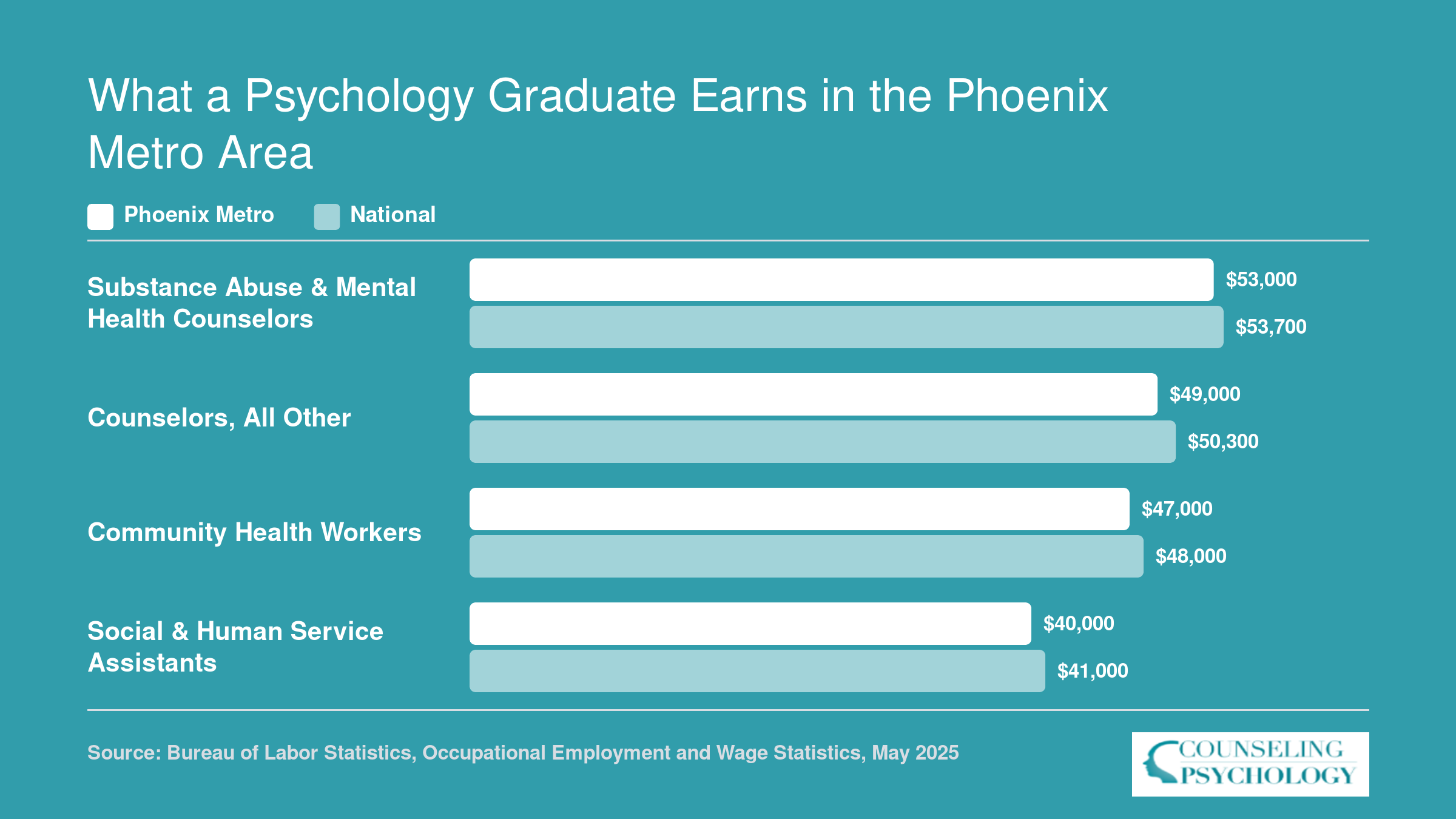
Bachelor's-level psychology graduates in the Phoenix metro area can enter several psychology-adjacent occupations right away, though wages vary significantly by role. The chart below compares Phoenix-Mesa-Chandler median annual wages with national medians across four common entry-level positions. Across the board, Phoenix-area wages trail the national median by roughly $1,000 to $1,300, a modest gap that is largely offset by Arizona's lower cost of living relative to many coastal markets.
Career Paths with a Bachelor's in Psychology in Phoenix
A psychology bachelor's degree opens more doors in Phoenix than most students expect, but the real challenge is knowing where to look and how to position yourself before graduation.
Finding Employers Before You Graduate
The Arizona Department of Health Services maintains a public registry of licensed behavioral health facilities in Maricopa County. Browsing that list is one of the most practical things a psychology student can do early in their program. It reveals the scale of the local market, from large inpatient psychiatric hospitals to small community-based outpatient clinics, and it tells you which organizations are licensed to employ behavioral health staff at the bachelor's level. Many students are surprised by how many facilities are operating within a reasonable commute of the Phoenix metro core.
For wage and employment data, the Bureau of Labor Statistics publishes Occupational Employment and Wage Statistics specific to the Phoenix-Mesa-Scottsdale metropolitan area. Two roles worth looking up directly are Psychiatric Technician and Social and Human Service Assistant. Both commonly hire candidates with a bachelor's in psychology, and the metro-level data gives you a realistic local picture rather than a national average that may not reflect Arizona's labor market. If you are still wondering what can you do with a psychology degree, the answer in Phoenix is broader than you might think.
Checking Career Pages Directly
Job boards are useful, but going straight to employer career pages often surfaces openings that aggregate sites miss or delay. Large healthcare systems with a significant Phoenix presence, including Banner Health, Dignity Health, and Valleywise Health, post bachelor's-level behavioral health positions on a rolling basis. National providers such as Terros Health and Arizona Complete Health also operate extensively in the region and frequently hire case managers, community health workers, and behavioral health technicians who hold a four-year psychology degree. Reading the listed requirements carefully will help you tailor your coursework and practicum choices while you are still enrolled.
Building Connections That Lead to Unlisted Opportunities
Some of the best entry-level positions in Phoenix's behavioral health sector never appear on a job board at all. The Arizona Psychological Association hosts networking events and professional development opportunities that connect students with practitioners who know about workforce expansion initiatives before they are publicly announced. University alumni events serve a similar function, particularly at programs with strong local ties in the Maricopa County area. Showing up to these events while you are still a student, not just in your final semester, is what tends to produce referrals and inside information that accelerates a job search considerably. Students who plan to continue their education after gaining field experience may also want to explore MFT programs in Arizona as a next step toward advanced clinical licensure.
From Bachelor's to Licensure: Next Steps After Your Psychology Degree
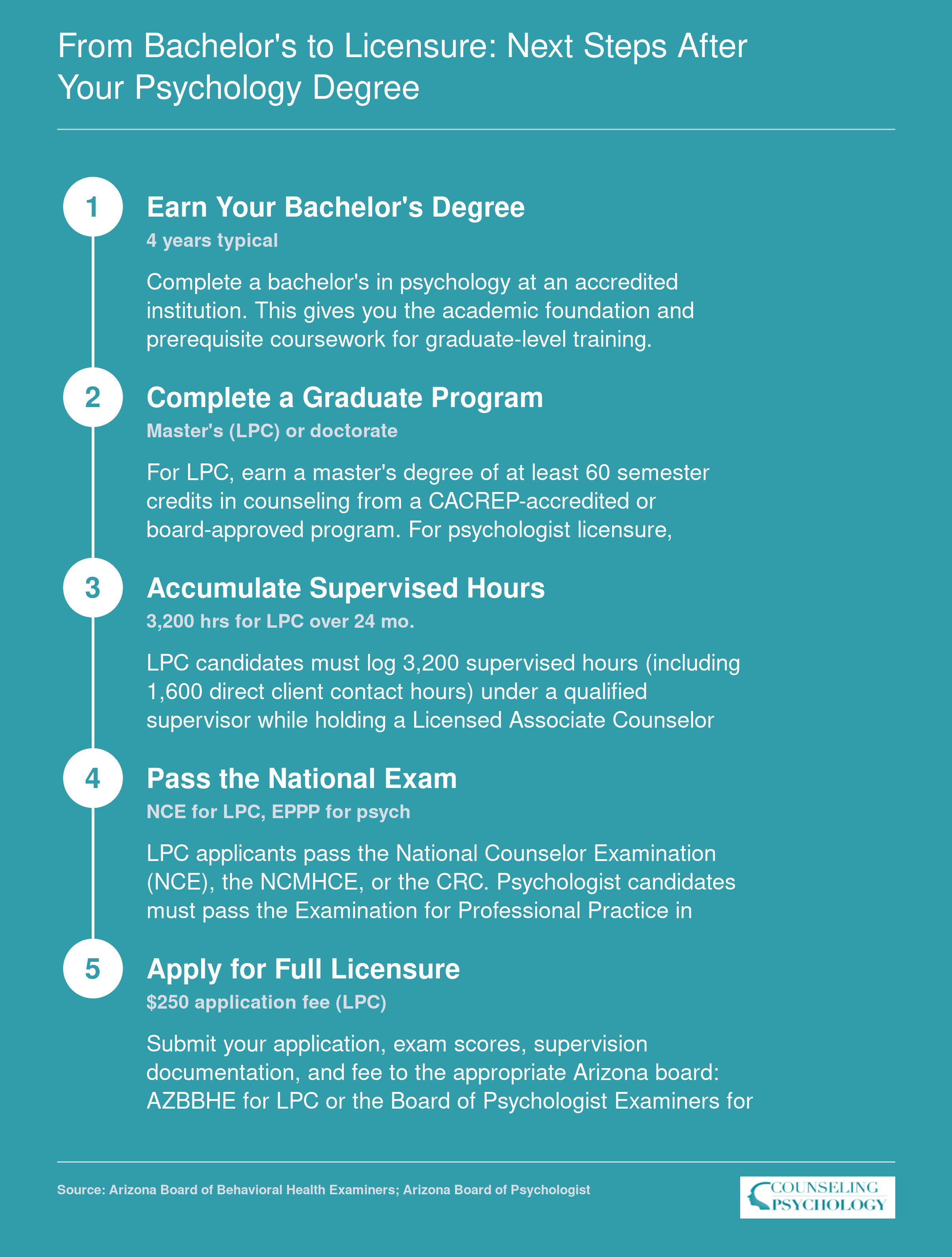
A bachelor's in psychology is the essential foundation, but it does not qualify you for independent licensure in Arizona. Whether you pursue the Licensed Professional Counselor (LPC) credential or aim for licensure as a psychologist, you will need additional graduate education, supervised clinical experience, and a national exam.
Psychology ranks among the most popular bachelor's degrees in the United States. In the 2021–2022 academic year, colleges and universities conferred approximately 129,600 bachelor's degrees in psychology, representing 6% of all bachelor's completions nationwide, according to the National Center for Education Statistics.
Frequently Asked Questions About Phoenix Psychology Programs
These are the questions prospective psychology students in the Phoenix area ask most often. Each answer draws on program data, cost figures, and career outcomes covered earlier in this guide.