
What you’ll learn in this article…
- A structured two month schedule of roughly one hour a day across four days per week is enough to pass the ASWB Clinical exam.
- The EAPIET clinical reasoning sequence outperforms rote memorization for answering first, next, and best question types.
- Reading the NASW Code of Ethics multiple times is essential because ethics questions appear across all four exam domains.
- Combining paid practice tests from providers like Social Work Test Prep with free resources such as Pass With Ayo covers every content area.
The LCSW exam is the final credentialing hurdle standing between a supervised clinical social worker and independent practice, and every year a significant share of first-time candidates underestimate how sharply it differs from graduate coursework. The exam rewards applied clinical judgment, not memorization of DSM criteria or treatment modalities in isolation.
That distinction matters practically. One candidate on Reddit's r/socialwork community, posting under the name FataMirage, scored 132 out of 150 after roughly two months of structured preparation, well above the 102 needed to pass.1 The approach: timed practice tests, disciplined use of a clinical reasoning framework, and multiple readings of the NASW Code of Ethics rather than passive review of lecture notes.
For most candidates, the gap between feeling prepared and actually passing comes down to how they practice, not how many hours they log.
Understanding the ASWB Clinical Exam: Format, Domains, and Passing Score
The ASWB Clinical exam tests your ability to apply professional knowledge to real-world practice scenarios, not simply recall textbook definitions. Before you begin studying, you need a clear picture of what the exam actually measures and how it is scored. This foundational understanding shapes every decision you make about your preparation strategy.
Exam Structure and Timing
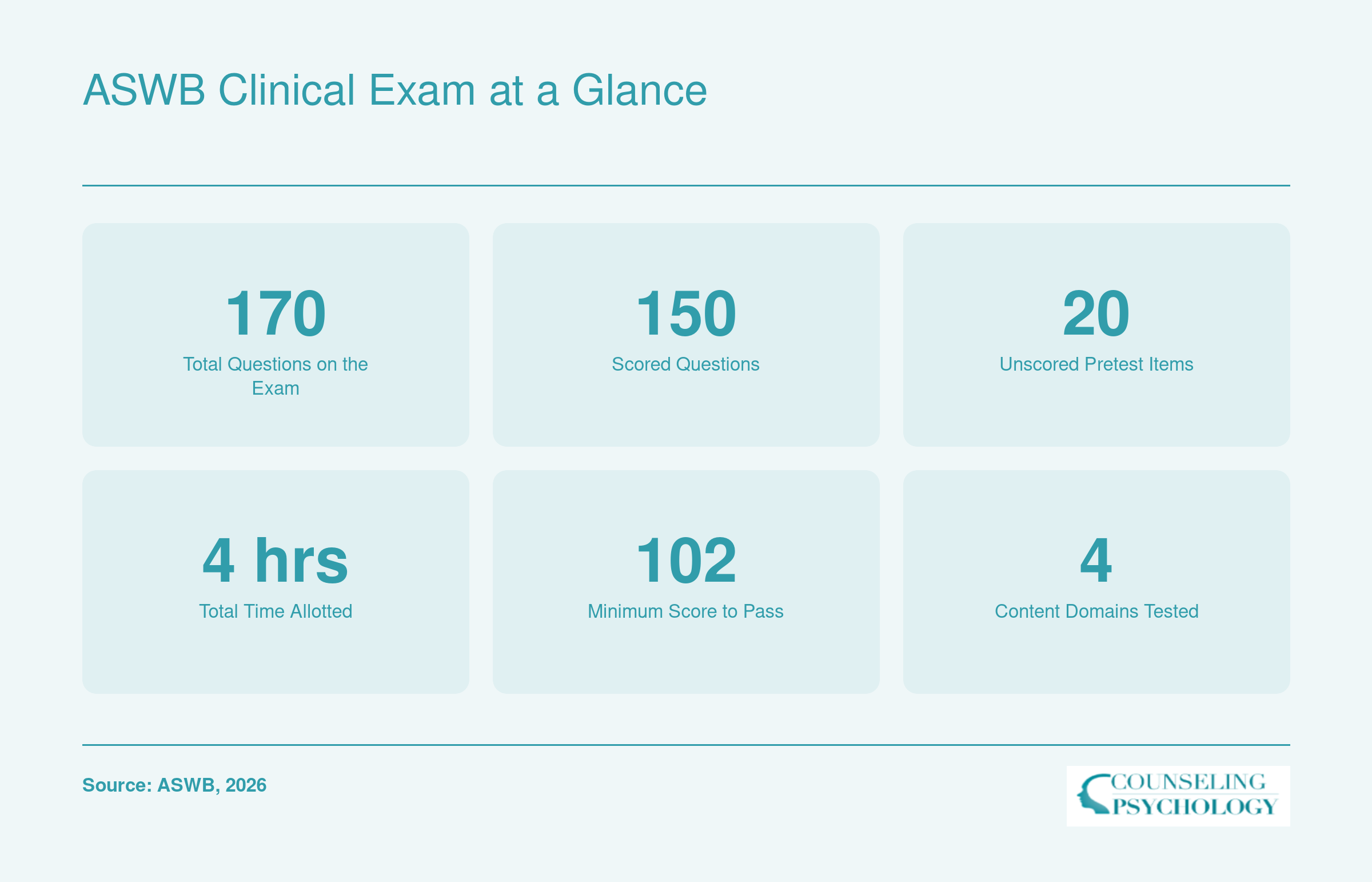
The Clinical exam consists of 170 multiple-choice questions, though not all of them count toward your final score. A portion of these items are pretest questions that ASWB uses to evaluate for future exams. You will not know which questions are scored and which are pretest items, so approach every question with equal focus.
You are typically given 170 minutes to complete the exam, which works out to roughly one minute per question. Candidates who have taken the exam report using most or nearly all of the allotted time, so plan accordingly. The exam is administered by computer at Pearson VUE testing centers, and you should review your registration materials or the ASWB candidate handbook to confirm the exact time allotment for your testing window.
Content Domains and Weights
The Clinical exam blueprint organizes content into several major domains covering areas such as human development, assessment and diagnosis, psychotherapy and clinical interventions, and professional ethics. Each domain carries a specific percentage weight that determines how many questions you will see from that topic area.
The exact domain names and percentage breakdowns are updated periodically by ASWB. For the most authoritative and current information, check the official exam content outline on the ASWB website. This document is your study roadmap, telling you precisely where to focus your energy. If you are unclear about any recent changes to the blueprint, ASWB customer service can clarify details about the current exam version. Candidates preparing for other licensing exams, such as the LMFT exam, will find a similar domain-based structure in their respective blueprints.
The Scaled Passing Score
The Clinical exam uses a scaled scoring system. While the raw passing threshold is commonly cited around 110 on a scale, ASWB adjusts this through a statistical process that accounts for slight variations in exam difficulty across different test forms. This means your scaled score reflects your competency level rather than simply how many questions you answered correctly.
First-time pass rate data for the Clinical exam is not always publicly available at the state level. If you want context on how candidates typically perform, consult your school's social work department or professional associations like NASW, which sometimes compile aggregated outcome data.
Where to Find Official Information
Your single most reliable source is the ASWB website itself. Download the current exam content outline, review the candidate handbook, and confirm all logistical details through your registration materials. Relying on secondhand summaries or outdated blog posts can lead you astray, especially given that ASWB periodically updates its blueprint and scoring processes.
ASWB Clinical Exam at a Glance
Before you map out your study plan, get familiar with the numbers that define the ASWB Clinical (LCSW) exam. This snapshot covers the essentials so you know exactly what you are preparing for.
How to Build a Realistic LCSW Study Schedule
A realistic LCSW study schedule is a written, week-by-week plan that allocates a fixed number of study hours across the four-month exam content outline, ending with timed full-length practice tests. It is not a vague intention to "study most nights." It is a calendar with content blocks, practice test dates, and a final ethics review window.
For reference, one recent test-taker who passed with a 132 out of 150 (well above the 102 needed to pass) studied seriously for about two months: one hour per day, roughly four days per week, ramping up to five days in the final stretch.1 That works out to 40 to 50 total hours. Most candidates do not need more than that if the hours are spent on the right activities.
Three Schedule Templates
Pick the template that matches your life, not the one that sounds most ambitious.
- 12-week plan (4 to 5 hours/week): Best for full-time clinicians or parents. Two weekday evenings of 60 to 90 minutes plus one longer weekend block. Total: roughly 50 to 60 hours.
- 8-week plan (6 to 8 hours/week): The middle path, and the closest match to the schedule described above. Four weekdays at one hour, plus a two-hour weekend session for practice questions. Total: roughly 50 hours.
- 4-week intensive (10 to 15 hours/week): Designed for retakers, recent graduates with time off, or candidates with a firm test date. Two hours most weekdays plus a half-day weekend block. Total: roughly 50 to 60 hours, compressed.
Allocating Hours Across Domains
Weight your hours to match the ASWB Clinical content outline. The Psychotherapy, Clinical Interventions, and Case Management domain carries the largest share of questions, followed by Assessment and Diagnosis, then Human Development, then Professional Values and Ethics. Spend proportionally more hours on the heaviest domains, but never shortchange ethics: it is small in question count and outsized in scoring impact because ethics questions often appear inside clinical vignettes.
Sequencing Within Any Plan
Front-load content review in weeks one and two: DSM categories, theories of change, developmental stages, and ethical standards. Shift to practice questions in the middle weeks, reviewing every rationale, not just the ones you missed. Reserve the final week for a full re-read of the NASW Code of Ethics and at least one timed, full-length practice exam taken in one sitting to build stamina. Whether you are preparing for the LCSW or studying for a different credential like the MFT exam, the same principle holds: structured repetition beats last-minute cramming every time.
Your Study Schedule Checkpoint
Domain-by-Domain Study Strategies for the Clinical Exam
How should you organize your preparation across the four major content domains tested on the ASWB Clinical exam?
The Clinical exam divides its 170 questions across Human Development, Diversity, and Behavior in the Environment; Assessment and Diagnosis; Psychotherapy, Clinical Interventions, and Case Management; and Professional Values and Ethics. Each domain demands a different study approach because the exam tests clinical judgment and application, not textbook recall. You will encounter case vignettes that describe real clinical scenarios, and you must choose the best next step or most appropriate intervention based on professional standards, ethical principles, and evidence-based practice.
Human Development, Diversity, and Behavior in the Environment
For this domain, focus on developmental theories that inform clinical assessment: Erikson's psychosocial stages, Piaget's cognitive development, attachment theory (Bowlby, Ainsworth), and family systems concepts. Know how developmental tasks and stage-specific presentations guide your clinical formulation. For example, recognize when a client's presenting problem reflects an unresolved Erikson crisis (identity vs. role confusion in adolescence, generativity vs. stagnation in middle adulthood) or an insecure attachment pattern manifesting in adult relationships. Study these frameworks by working through case vignettes that ask you to identify developmental factors contributing to the client's current functioning, rather than memorizing definitions on flashcards.
Assessment and Diagnosis
Practice differential diagnosis using DSM-5-TR criteria. The exam expects you to distinguish between similar diagnoses (major depressive disorder vs. persistent depressive disorder vs. adjustment disorder with depressed mood) and to recognize when symptoms meet threshold criteria versus subclinical presentations. Understand when to use standardized assessment instruments (PHQ-9, GAD-7, AUDIT) versus clinical interview, and when collateral information or medical consultation is indicated. Build this skill by reviewing case vignettes and asking yourself: What additional information do I need? What diagnoses am I ruling in or out? What is the most likely diagnosis given the symptom cluster and duration?
Psychotherapy, Clinical Interventions, and Case Management
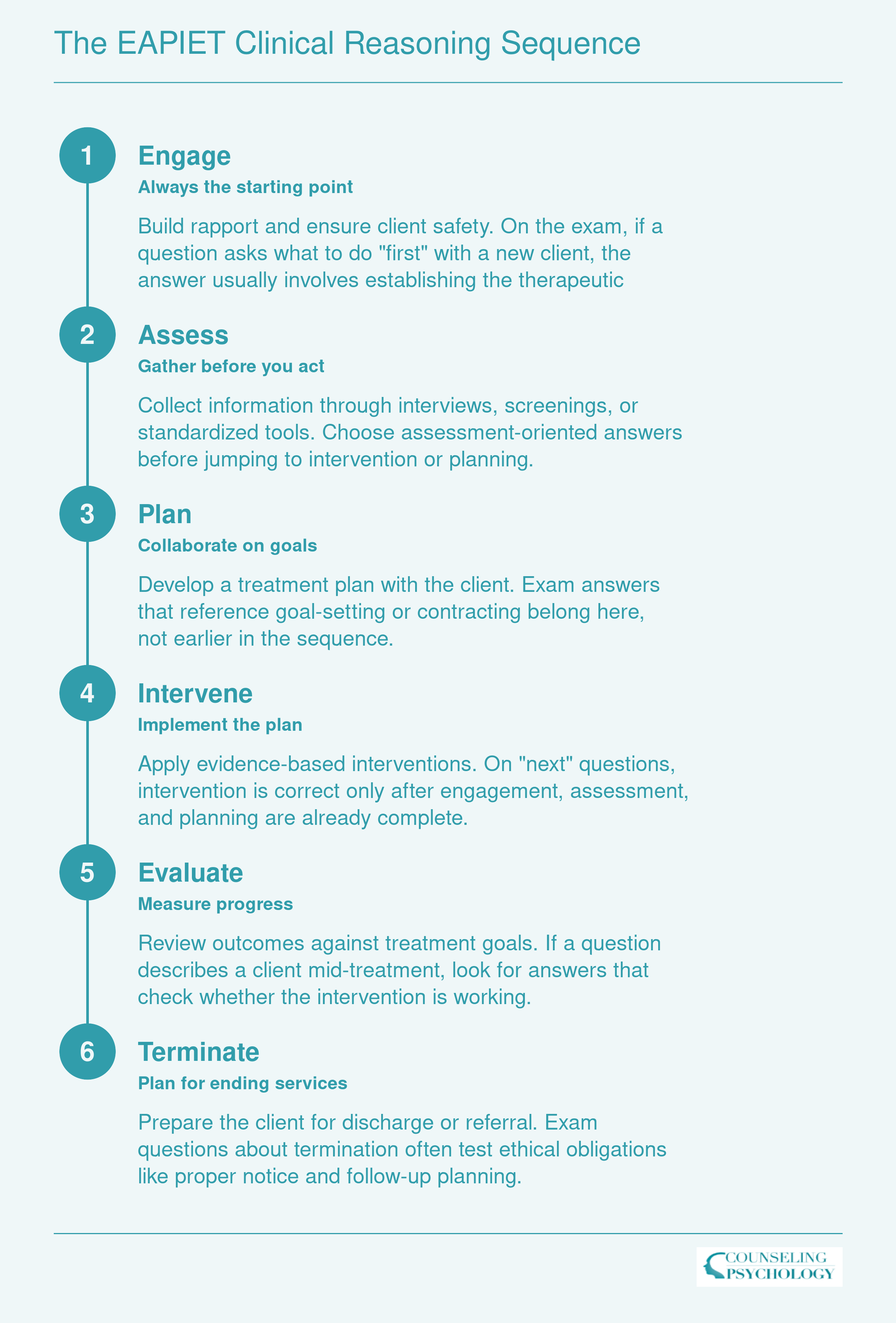
Know the evidence base and clinical indications for major therapeutic modalities: cognitive-behavioral therapy (CBT) for anxiety and depression, dialectical behavior therapy (DBT) for emotion dysregulation and borderline personality disorder, motivational interviewing for ambivalence about change, and trauma-focused interventions (prolonged exposure, EMDR) for PTSD. The exam tests whether you can match the intervention to the client's presenting problem, readiness for change, and treatment goals. Use the EAPIET framework from Agents of Change (Engage, Assess, Plan, Intervene, Evaluate, Terminate) as a clinical reasoning scaffold. This sequence mirrors how the exam expects you to think through cases: first establish rapport and safety (Engage), then gather information (Assess), collaboratively set goals (Plan), implement evidence-based techniques (Intervene), monitor progress (Evaluate), and prepare for closure (Terminate). Many exam questions test your ability to identify the correct phase of treatment and the intervention appropriate for that phase. Clinicians exploring broader career options after licensure may also find value in reviewing non-traditional careers in counseling.
Professional Values and Ethics
Learn the NASW Code of Ethics and its decision hierarchy thoroughly: client safety and well-being come first, followed by legal mandates (duty to warn, mandatory reporting), then professional standards, and finally client self-determination. Study dual relationships, boundary scenarios, confidentiality limits, and informed consent. FataMirage confirmed that the actual exam included a question about bartering with clients, a specific scenario addressed in the Code of Ethics.1 Ethics questions are not abstract; they present concrete dilemmas and ask you to apply the ethical hierarchy to choose the best course of action. Practice by reviewing ethics case vignettes and identifying which principle takes precedence when values conflict.
How to Answer ASWB Question Types: First/Next, BEST, MOST, and EXCEPT
The ASWB Clinical exam tests your ability to make sound clinical decisions under time pressure, using four distinct question types that each demand a different analytical approach. Understanding how these stems function, and what the test writers reward, is the difference between choosing the intervention you like and choosing the one the exam will score as correct.
Recognizing the Four Core Question Types
The exam relies on predictable question structures:
- FIRST/NEXT questions: Ask you to sequence clinical actions. Example: "What should the social worker do FIRST?" or "The NEXT step is to..."
- BEST questions: Present multiple plausible options and ask for the single best response. Example: "Which of the following is the BEST intervention?"
- MOST LIKELY questions: Test diagnostic and assessment reasoning. Example: "This client is MOST LIKELY experiencing..."
- EXCEPT questions: Require you to identify the outlier. Three or four answers are correct; one is not. Example: "All of the following are appropriate EXCEPT..."
Each type demands a different elimination strategy, and conflating them is a common source of wrong answers.
The EAPIET Sequence for FIRST/NEXT Questions
For questions asking what comes first or next, apply the EAPIET clinical reasoning framework: Engagement, Assessment, Planning, Intervention, Evaluation, Termination. The correct answer is almost always the next logical step in this sequence, not the most advanced or sophisticated intervention you know.
Safety and assessment always precede treatment. If a client presents in crisis, your first action is to assess immediate safety, not to explore childhood trauma or refer to a support group. The exam rewards methodical clinical process over therapeutic creativity.
Worked Example: A FIRST Question
*A client calls the social worker and reports feeling suicidal. What should the social worker do FIRST?*
- A) Refer the client to a psychiatrist for medication evaluation.
- B) Assess the client's current safety and intent.
- C) Explore the client's history of suicidal ideation.
- D) Schedule an emergency session to develop a safety plan.
Elimination process: Options A, C, and D are all reasonable interventions, but they assume you already know the client is safe enough to schedule, explore, or refer. Option B is the only answer that follows EAPIET: you must assess before you can plan or intervene. The correct answer is B.
Choosing the BEST Among Good Options
BEST questions are designed to offer two or three defensible answers. The exam rewards the response that is most clinically appropriate, least restrictive, and best aligned with the client's stated needs and autonomy. When in doubt, choose the answer that empowers the client, respects self-determination, and addresses the immediate presenting concern rather than a hypothetical future issue.
Avoid answers that leap to high-intensity interventions (hospitalization, mandatory reporting, termination) unless the stem explicitly justifies them. The exam penalizes over-intervention as much as under-intervention. This kind of nuanced clinical judgment is something you develop throughout your social work career journey, from your MSW program through supervised practice.
Answer-Change Strategy: Stick With Your First Instinct
One test-taker who scored 132 out of 150 reported rarely changing answers on the actual exam, and only doing so when they had a clear, articulable reason.1 Research on standardized testing supports this approach: first instincts are correct more often than second-guesses, especially when test anxiety drives the change.
If you find yourself wavering between two answers, return to the question stem. Which option directly answers what is being asked? Which follows the clinical sequence? Mark your choice and move forward. Revisit only if you catch a factual error in your reasoning, not because an answer "feels" better on a second read.
The EAPIET Clinical Reasoning Sequence
Many ASWB clinical exam questions test whether you can identify the correct phase of treatment. The EAPIET framework, popularized by the Agents of Change podcast, gives you a reliable sequence for choosing the best answer on "first," "next," and "most appropriate" questions.
The Ethical Reasoning Hierarchy
When tackling ethics questions on the ASWB clinical exam, prioritize in this exact order: client safety, legal obligations, the NASW Code of Ethics, agency policy, and only then personal values. If two ethical principles clash, the one higher on this hierarchy determines the correct answer.
Top LCSW Exam Prep Resources Compared
Paid comprehensive courses versus free targeted resources: your budget and learning style will determine which combination works best for LCSW exam preparation. The good news is that successful candidates have passed using both approaches, and mixing paid practice tests with free content often provides the most effective balance.
Comparing the Leading Prep Resources
The following comparison covers the most widely recommended resources for the ASWB Clinical exam in 2026:1
- ASWB Official Practice Test: Online practice exam for $85. Uses retired ASWB questions, providing the most realistic simulation of actual exam conditions.2 Best for candidates who want a final benchmark before their test date.
- Social Work Test Prep Practice Tests: Individual practice exams with detailed rationales for $39 each. Known for exam-like difficulty and thorough explanations of why answers are correct or incorrect. Best for those who want multiple realistic practice opportunities.
- Agents of Change Course: Video-based course with community support, ranging from $125 to $225.3 Offers access until you pass, with the popular EAPIET clinical reasoning framework taught through podcasts and blog posts. Best for visual and auditory learners who benefit from structured video content.
- Therapist Development Center LCSW Course: Audio-based guided program at $295. Provides a structured step-by-step plan that fits into busy schedules. Best for working professionals who prefer audio learning during commutes or downtime.
- Dawn Apgar's Social Work ASWB Clinical Exam Guide: Print or ebook format for $40 to $60. Well-organized content review that covers all exam domains systematically. Best as a content backbone for those who prefer reading and self-paced study.
A Proven Resource Stack
One candidate who scored 132 out of 150 (with 102 needed to pass) shared their specific combination: the ASWB official practice test and guide, three Social Work Test Prep practice tests, the Agents of Change EAPIET framework from their free podcasts and blog posts, the Pass With Ayo YouTube channel, and a community Google Doc from the r/socialwork subreddit. This mix combined official materials, practice test repetition, a clinical reasoning framework, and free community resources.
Free Resources for Budget-Conscious Preppers
You do not need to spend hundreds of dollars to prepare effectively. Several quality resources cost nothing:
- Pass With Ayo YouTube Channel: Free video content walking through question strategies and exam concepts
- r/socialwork Google Doc: Community-compiled study notes and tips from recent test-takers
- NASW Code of Ethics: Available free online, and essential reading that directly appears on the exam
- Pocket Prep ASWB LCSW App: Offers a free tier with limited questions, with premium access at $15 to $30 for over 2,000 practice questions on mobile4
The most successful approach typically combines at least one source of practice questions with detailed rationales, one resource for clinical reasoning frameworks, and thorough review of the NASW Code of Ethics. If you are still weighing LPC vs. LCSW career paths, keep in mind that each credential has its own licensing exam, so choosing your direction early helps you focus your prep materials. Whether you invest in a full course or build your own stack from lower-cost options, consistent practice with realistic questions matters more than the price tag on your materials.
Mastering the NASW Code of Ethics for the LCSW Exam
What ethical principle takes priority when the NASW Code of Ethics requires both confidentiality and protection of client safety? The ASWB Clinical exam tests your ability to navigate these conflicts across every domain, not just in dedicated ethics questions. One test-taker who scored 132 out of 150 read the full NASW Code of Ethics more than once and still encountered a bartering question on exam day that required precise knowledge of Standard 1.13.1 Ethics questions are woven throughout the exam because clinical judgment inherently involves ethical reasoning, making the Code one of your highest-yield study resources.
Why the Code of Ethics Appears Across All Domains
The ASWB does not isolate ethics into a single section. Questions about informed consent appear in assessment scenarios, confidentiality exceptions surface in crisis intervention items, and dual relationship boundaries show up in treatment planning vignettes. The exam assumes you have internalized ethical standards as the foundation of clinical decision-making. Reading the Code passively once will not prepare you for application questions that ask which action is MOST aligned with social work values when multiple options seem defensible.
Highest-Yield Ethics Topics for the Clinical Exam
Focus your study on the sections that appear most frequently in practice tests and candidate reports:
- Informed consent (1.03): What must be disclosed, when, and exceptions for involuntary clients
- Confidentiality and its limits (1.07): Duty to warn, duty to protect, mandatory reporting, and releases of information
- Dual relationships and boundary issues (1.06): When personal or professional overlap creates harm or exploitation risk
- Bartering (1.13): The narrow conditions under which bartering is ethically acceptable
- Cultural competence and social diversity (1.05): Responsiveness to client identity and power dynamics
- Self-determination (1.02): Honoring client autonomy unless imminent danger exists
- Conflicts of interest (1.06c): Managing competing loyalties to clients, agencies, and third parties
The Priority Hierarchy for Ethics Conflicts
When exam questions pit two ethical principles against each other, apply this hierarchy: client safety and legal mandates override confidentiality and agency policy. Self-determination governs clinical decisions unless the client's choice creates imminent risk to self or others. When both options are ethically sound, choose the one that maximizes client autonomy and minimizes social worker power. The Code prioritizes protection of vulnerable populations over professional convenience.
How to Study the Code Strategically
Read the full NASW Code of Ethics at least twice, the second time with the exam lens of application rather than familiarity. Create a one-page reference sheet covering Standards 1.01 through 1.16 on responsibilities to clients, 2.01 through 2.06 on colleague relationships, and Section 5 on ethical responsibilities to the broader society. For each standard, write one concrete example of a question scenario that might test it. Professionals preparing for other licensing exams, such as those studying how to pass the MFT exam, will find that this same active-synthesis approach transforms a compliance document into a clinical reasoning tool you can deploy under exam pressure. If you plan to maintain your license long-term, building strong habits around continuing education for psychologists and social workers starts with the ethical foundation you establish during exam prep.
Managing Test Anxiety and Exam-Day Logistics
Reducing test anxiety starts with eliminating uncertainty about what happens on exam day. The more familiar you are with Pearson VUE logistics and your own stress-management toolkit, the more mental energy you can devote to clinical reasoning instead of procedural surprises.
What to Expect at the Pearson VUE Testing Center
Arrive 15 minutes before your scheduled appointment with two forms of valid, government-issued identification bearing your signature. One must be a primary ID with a photograph and signature (driver's license, passport, or state-issued ID). Both IDs must display the name under which you registered. You cannot bring personal items into the testing room. Pearson VUE provides a secure locker for phones, wallets, keys, jackets, bags, and study materials. You will not have access to these items during the exam, including during breaks.
The check-in process includes identity verification, a palm-vein scan (in most locations), and a review of the rules. You will receive a dry-erase booklet and marker for scratch work, which the proctor collects at the end. The testing environment is monitored by video and proctors. You are permitted to take an optional untimed break after completing the first 85 questions.1 During this break, you may access your locker, use the restroom, and consume snacks or water you brought. The break does not count against your four-hour exam time, but you must signal the proctor to resume.
Requesting Accommodations for Disabilities or Health Conditions
If you have a documented disability, health condition, or English as a second language that may affect your exam performance, you may request nonstandard testing arrangements through ASWB.2 Eligible conditions include learning disabilities, ADHD, vision or hearing impairments, mobility limitations, chronic health conditions, and language barriers. Your state licensing board approves your eligibility to sit for the exam, but ASWB handles accommodation requests separately.3
Submit your accommodation request online via ASWBCentral.4 You will complete a candidate statement describing your condition and how it affects testing, and you must submit a practitioner form completed by a licensed professional with relevant expertise (psychologist, physician, or other qualified diagnostician).5 For learning disabilities, attach a current psychoeducational evaluation. For ADHD, the practitioner form alone is sufficient, not a full LD evaluation.5 ASWB reviews requests within three weeks.2 Do not register for an exam date or pay the exam fee until you receive your accommodation decision.
Common accommodations include extended time (typically time-and-a-half or double time), stop-the-clock breaks (brief pauses that do not consume exam time), a separate or reduced-distraction room, assistive technology such as screen magnification or color adjustments, and language supports like extended time for non-native English speakers.2 After August 3, 2026, pencil-and-paper testing will no longer be available as an accommodation option.1
Evidence-Based Anxiety Management Techniques
Box breathing is a portable tool you can use at your workstation without attracting attention. Inhale for four counts, hold for four, exhale for four, hold for four, and repeat. This activates your parasympathetic nervous system and slows your heart rate within 60 seconds. Use it whenever you notice tension building or when a difficult question triggers a stress response.
The skip-and-return strategy reduces decision fatigue and prevents time loss. If a question feels overwhelming or unclear after one read, mark it for review and move on immediately. Return to flagged questions during the final 30 minutes. Often, later questions prime your thinking or jog your memory, making earlier items easier to answer the second time.
Progressive muscle relaxation before entering the center can lower baseline anxiety. While sitting in your car or in the waiting area, tense each muscle group (feet, calves, thighs, abdomen, hands, shoulders, jaw) for five seconds, then release. Work from your feet to your head. This discharge of physical tension signals your brain that the environment is safe.
Cognitive reframing reinterprets anxiety as a performance asset rather than a threat. The physiological arousal you feel (faster heartbeat, sharper focus, heightened alertness) is your body preparing to meet a challenge. Labeling the sensation as "I'm alert and ready" instead of "I'm panicking" can shift your subjective experience and improve task performance. If you are preparing for a different licensure track, similar anxiety-management principles apply when studying for the MFT exam.
Pacing and Time Management During the Exam
One test-taker who scored 132 out of 150 reported using nearly all of the four-hour window. Rushing through questions to finish early does not improve your score and often leads to careless errors. You have approximately 96 seconds per question. If you finish with time remaining, use it to review flagged items and double-check answers where you felt uncertain. Resist the urge to change answers unless you have a clear rationale grounded in the question stem or a principle you initially overlooked. Second-guessing based on anxiety alone is counterproductive.
Common Exam Mistakes to Avoid
When preparing for the ASWB LCSW exam, steer clear of these four common mistakes: overthinking and changing answers without a clear rationale can erode confidence; choosing the most advanced clinical intervention instead of the most appropriate next step derails your response; neglecting ethics review because it seems common sense leads to surprising gaps; and skipping full-length timed practice tests leaves you unprepared for exam stamina and pacing.
What to Do If You Don't Pass: Retake Strategy and Score Analysis
Failing the ASWB clinical exam can feel like a major setback, but it's a temporary one. The majority of candidates who don't pass on their first attempt succeed on a second try after adjusting their approach. The key is to avoid rushing back in without a plan.
Understanding the ASWB Retake Policy
After a failed attempt, you must wait 90 days before you can retest.1 This mandatory waiting period is designed to give you time to strengthen your knowledge. The retake fee is $260 for the clinical exam, and you must re-register and pay each time you retake.2 Some states, like California, also impose a deadline: you may need to retake the exam within one year of your original failure date.3 Always check your state licensing board's specific rules, as attempt limits and timeline restrictions vary.
If you were very close to passing (within 10 correct answers of the cut score), you may be eligible for a 90-day waiting period waiver, which can shorten the turnaround. The ASWB allows up to two such waivers within a 12-month period. However, not all states participate in the waiver program (California and North Dakota are two examples that do not), so verify your state's stance before applying.4
Decoding Your Score Report
Your ASWB score report provides more than a pass/fail result. It includes a domain-level breakdown showing the number of questions and the number you answered correctly in each content area.2 As of 2026, the clinical exam has 110 scored questions distributed across three major domains.5 Pay close attention to the domains where your performance was weakest. Rather than focusing on the overall number of missed questions, zero in on the specific topics that need the most work. For example, if you struggled with intervention planning or ethics, those areas should become your priority in restudy.
Building a Targeted Retake Study Plan
Use your domain scores to reallocate your study time. If you spent 60% of your prep on content review and only 40% on practice tests, shift toward more active recall and simulated exam sessions. Many first-time test takers who relied heavily on reading materials find that adding realistic practice tests, like those from Social Work Test Prep or Pass With Ayo's YouTube walkthroughs, improves their pacing and clinical reasoning skills.
Incorporate the EAPIET framework (from Agents of Change) if you haven't already. It structures clinical decision-making and helps you prioritize ethical considerations before addressing practical steps, which is critical for the "first/next" question types. Re-reading the NASW Code of Ethics multiple times, as one successful Reddit test taker (FataMirage) did, ensures you can spot ethical dilemmas quickly. If you're also preparing for related licensing exams in other disciplines, you'll find similar strategies in our MFT exam study guide.
Addressing Test Anxiety and Mindset
Sometimes underperformance stems from test-day anxiety rather than knowledge gaps. If you felt overwhelmed, incorporate timed drills and full-length simulations into your study routine. A commenter on the same Reddit thread, Special_Art_0716, shared that they passed on their first try in 2023, but many qualified social workers need two or even three attempts. Normalize this: a failed attempt is feedback, not a verdict on your competence. Take the allotted time on test day, avoid second-guessing answers without a clear rationale, and arrive with a written plan for managing nerves.
Treat the retake as a reset. A methodical, data-driven study plan built from your score report is your best strategy for earning a passing score next time.
Frequently Asked Questions About the ASWB LCSW Exam
Related Articles
Ultimately, the ASWB Clinical exam rewards clinical judgment, not memorized facts. Anchor your study plan in practice tests that mirror the real format, the EAPIET reasoning sequence for "first/next" and "best" questions, and a deep rereading of the NASW Code of Ethics. As one r/socialwork member confirmed, the exam tested bartering ethics explicitly.1
Your next move: pick a 4-, 8-, or 12-week study schedule, grab two or three resources from our comparison (such as the ASWB official practice test and Social Work Test Prep), and take a baseline practice test this week to identify your weakest domains. If you are still weighing counseling vs psychology vs social work as a career path, settle that question first so you can commit fully to your LCSW prep. The community shows that strategic, manageable preparation really does lead to passing.