
What you’ll learn in this article…
- Counselors can close the gap between Americans valuing brain health and knowing how to protect it through routine clinical conversations.
- The Alzheimer's Association 24/7 Helpline at 800-272-3900 gives counselors an immediate referral pathway to master's-level clinicians.
- Culturally responsive approaches to brain health reduce disparities by adapting language, framing, and resources to each client's lived experience.
- A lightweight, year-round conversation plan keeps brain health on the counseling agenda long after June's awareness month ends.
Eighty-eight percent of Americans say they value brain health, but only one in ten can name a specific action they take to protect it, according to the Alzheimer's Association. That gap, millions of people who care deeply but don't know what to do, is a signal to every counseling professional.
June's Alzheimer's & Brain Awareness Month offers a natural entry point, but the real work is year-round. Counselors are uniquely positioned to bridge the education gap because brain health conversations cut across mental health, aging, caregiving, and stigma, all areas where clinical rapport already exists.
For many clients, the distance between valuing brain health and living it is filled with misinformation, cultural silence, and a shortage of trusted guidance. Narrowing that distance is not a one-month campaign but a professional discipline that rewards counselors with better outcomes across every part of their practice.
Why Brain Health Deserves Its Own Conversation in Counseling
Brain Health and Mental Health Are Not Interchangeable
Most counseling professionals are fluent in the language of mental health: anxiety, depression, trauma, coping skills, emotional regulation. Yet brain health, a distinct but overlapping domain, often goes unaddressed in clinical practice. Brain health encompasses cognitive function, neurological resilience, and proactive risk reduction for conditions like Alzheimer's disease and other dementias. Mental health, by contrast, centers on emotional well-being and psychiatric conditions. While the two domains interact (depression can impair cognition, for example), conflating them creates blind spots. A client who sleeps well, exercises, and manages anxiety may still carry unaddressed risk factors for cognitive decline, such as social isolation, untreated hearing loss, or lack of cognitive stimulation. Similarly, an older adult experiencing memory lapses may be dismissed as "just depressed" when neurological assessment is warranted.
The Education Gap in Clinical Practice
Many clients, and even some clinicians, lack a clear framework for discussing cognitive health proactively. Unlike conversations about diet, exercise, or sleep hygiene, brain health often remains invisible until a crisis emerges. The Alzheimer's Association has documented a significant education gap: while most Americans say they value brain health, far fewer can name concrete actions to maintain it.1 This gap leaves clients without the language or confidence to raise concerns about memory, concentration, or cognitive changes, and it leaves clinicians without structured prompts to introduce the topic before problems escalate. For practitioners interested in working with aging populations, pursuing geriatric counseling can provide specialized training in exactly these kinds of conversations.
Counselors as Bridge-Builders
Counselors are uniquely positioned to close this gap. You already hold therapeutic relationships built on trust, regular contact, and skilled communication. You normalize difficult conversations about grief, trauma, and identity; normalizing brain health as a wellness topic is a natural extension of that work. Just as you might ask about sleep or movement, you can ask about cognitive stimulation, social connection, or family history of dementia. These conversations do not require a neurology degree. They require curiosity, a few evidence-based talking points, and the willingness to treat brain health as part of holistic wellness.
Herzing University's recent blog post, 10 Ways to Love Your Brain, offers an accessible public-facing introduction to brain-healthy habits, from challenging your mind with puzzles and learning new skills to staying socially connected. That resource is an excellent starting point for clients and families. This article extends that concept into clinical practice: how do you, as a counselor, introduce these ideas in session, adapt them to diverse populations, address resistance or skepticism, and connect awareness to actionable referrals and support systems? The following sections provide the frameworks and language to make brain health a year-round part of your practice, not just a June awareness campaign.
June Is Alzheimer's & Brain Awareness Month: What Counselors Should Know
Why should you pay attention to Alzheimer's & Brain Awareness Month as a counseling professional? Because June offers a nationally coordinated moment to connect millions of Americans to resources, language, and actions they need right now. The Alzheimer's Association launched Alzheimer's & Brain Awareness Month to spotlight a growing public health crisis and mobilize communities toward prevention, early detection, and care.1 For 2026, the campaign theme centers on taking charge of brain health through healthy habits and early detection, paired with the messaging framework Everyday Actions. Lifelong Impact.2
The Scale of the Challenge
The numbers demand attention. Currently, 6.9 million Americans aged 65 and older live with Alzheimer's disease, and that figure is projected to double approximately every five years as the population ages.1 Among adults 85 and older, the annual incidence rate reaches 6 percent per year, with women disproportionately affected after age 85.3 Yet only about half of people with Alzheimer's receive a diagnosis, creating a vast gap between disease burden and clinical recognition.1 Meanwhile, 90 percent of Americans agree brain health is important, but only 10 percent know how to maintain it.1 This education gap is precisely where counselors can make an outsized impact, particularly given the broader mental health workforce shortage already straining the system.
Four Concrete Actions for June
You do not need to overhaul your practice to participate meaningfully. Consider these four starting points:
- Host a brain health psychoeducation session: Dedicate one group or community session in June to brain health basics, using the (re)think your brain 6-Step Challenge toolkit from the Alzheimer's Association. Cover physical activity, nutrition, sleep, social connection, cognitive stimulation, and cardiovascular risk management.1
- Share validated screening tools: Introduce clients and families to the Memory and Thinking Checklist or point them to their primary care provider for cognitive assessments. Normalize early screening as routine, not catastrophic.
- Display awareness materials: Go purple in your waiting room. Print fact sheets, place brain health tip cards near sign-in areas, and use the #ENDALZ campaign hashtag in any social channels you manage professionally.1
- Incorporate brain health check-ins: Add one or two brain health questions to your intake forms or wellness reviews, asking about memory concerns, family history, sleep quality, or physical activity levels. These brief prompts signal that brain health belongs in the conversation.
Beyond June
June is a launchpad, not the finish line. The Alzheimer's Association provides free live learning webinars, volunteer opportunities, and program pages year-round.2 Later in this article, we will outline how to build a sustainable, year-round brain health conversation plan that meets clients where they are and connects awareness to action.
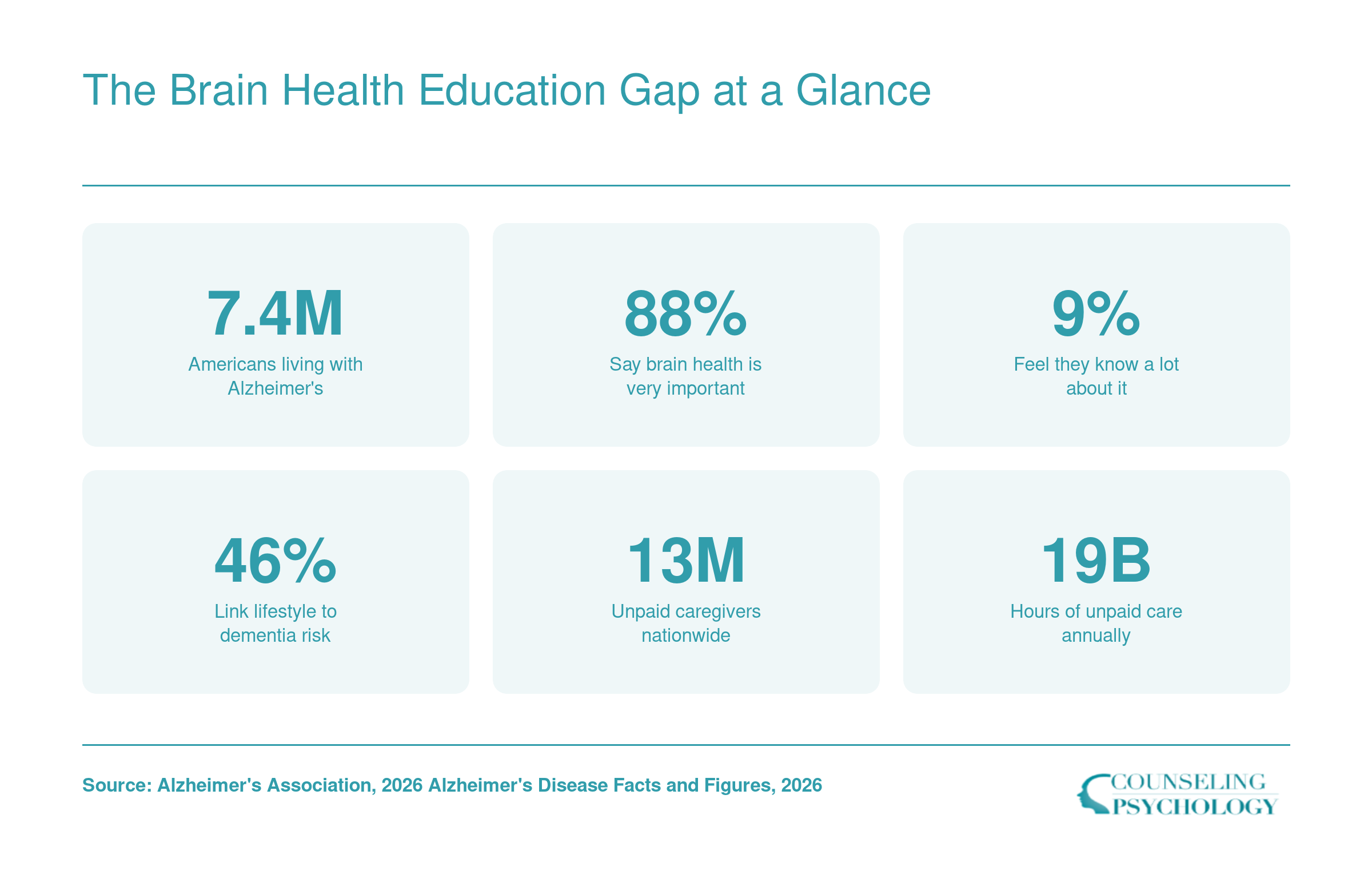
The Brain Health Education Gap at a Glance
The numbers tell a striking story: Americans overwhelmingly value brain health, yet very few feel equipped to protect it. This gap between awareness and action is precisely where counseling professionals can make the greatest difference. Consider these figures from the Alzheimer's Association's 2026 Facts and Figures report.
How to Talk About Brain Health With Clients and Families
Talking about brain health in a counseling session means raising topics like memory, cognitive habits, sleep, physical activity, and family history of conditions such as Alzheimer's disease, then helping clients decide what, if anything, they want to do about those topics. For many counselors, these conversations feel unfamiliar because they sit at the intersection of mental health and medical care. The good news is that several well-tested communication frameworks translate directly to brain health discussions.
Three Frameworks That Work for Brain Health Conversations
You do not need a new clinical model to introduce brain health. Consider adapting approaches you may already use.
- Motivational Interviewing (MI): MI is particularly effective when clients are ambivalent about lifestyle changes such as increasing physical activity, improving sleep, or adjusting diet, all of which the Alzheimer's Association identifies as modifiable risk factors for cognitive decline.1 Open-ended questions like "What have you noticed about your energy or focus lately?" invite reflection without triggering defensiveness. Rolling with resistance is essential when clients dismiss brain health as irrelevant to their age or situation.
- Psychoeducation for Cognitive Health: Brief, normalizing education segments can be woven into existing sessions. The Alzheimer's Association's Brain Health Advancement Institute, launched in 2026, offers patient-facing resources including the "10 Healthy Habits for Your Brain" guide and a Brain Health Habit Builder tool.1 Sharing a resource like this repositions brain health as a wellness practice rather than a disease conversation.
- ASK-TELL-ASK: This three-step technique works well for sensitive disclosures. First, ask permission ("Would it be okay if we talked about cognitive wellness for a moment?"). Then share a focused piece of information. Finally, ask for the client's reaction. This structure respects autonomy and keeps the conversation collaborative.
Language That Normalizes the Topic
How you introduce brain health matters more than when. Phrases that connect brain health to familiar wellness concepts lower the emotional stakes.
- "Just like we talk about heart health or stress management, brain health is something everyone benefits from thinking about."
- "Have you noticed any changes in memory, focus, or how quickly you process information? These are normal things to check in on."
- When a client expresses fear, reframe the conversation toward agency: "Knowing more about your brain health gives you options, not a diagnosis. There are steps people take at every age to support cognitive function."
Avoid clinical jargon such as "cognitive screening" or "neurodegeneration" unless the client introduces those terms first. Use concrete, everyday language.
Including Family Members
Brain health conversations often expand beyond the individual client, especially when a loved one's cognitive changes are part of the presenting concern.
- When to invite family: Consider including family members when a client reports worry about a parent's or partner's memory, when planning for future care needs, or when a family member's cognitive changes are affecting the client's mental health.
- Navigating readiness differences: Family members may be at very different stages of acceptance. One person may want immediate action while another minimizes concerns. Using MI techniques with the family unit, reflecting each person's perspective without judgment, helps prevent the session from becoming an argument.
- Handling disclosures: If a client reveals that a loved one is showing signs of cognitive change, validate the difficulty of that observation before problem-solving. Rushing to referrals can feel dismissive.
Proactive Promotion Versus Responsive Conversations
Not every brain health discussion is prompted by a concern. Counselors benefit from distinguishing two modes of engagement.
Proactive brain health promotion is appropriate with all clients, regardless of age or presenting issue. It might look like integrating a brief lifestyle check-in (sleep, movement, cognitive engagement) into routine sessions, or distributing resources from the Alzheimer's Association's Brain Health Advancement Institute during awareness events.1
Responsive conversations apply when a client presents with cognitive concerns, reports a family history of Alzheimer's or related conditions, or discloses caregiving stress. These sessions require more clinical sensitivity, a clearer referral plan, and often a longer time frame.
Drawing this line helps you calibrate tone. Proactive conversations can be light and educational. Responsive conversations call for deeper empathy, careful pacing, and a plan for follow-up.
Culturally Responsive Brain Health Conversations
A one-size-fits-all psychoeducation handout versus a conversation shaped by a client's cultural context, language, and lived experience: these two approaches produce very different outcomes, and the gap between them helps explain why brain health disparities persist across racial and ethnic lines.
The Disparities Counselors Need to Understand
Brain health risks and diagnostic experiences are not distributed equally. Black older adults are roughly twice as likely as non-Hispanic white older adults to develop Alzheimer's disease or a related dementia, while Hispanic and Latino older adults face about one-and-a-half times the risk.1 Prevalence data reinforces the pattern: among adults 65 and older, an estimated 13.8 percent of Black Americans and 12.2 percent of Hispanic Americans live with Alzheimer's, compared to 10.3 percent of non-Hispanic white Americans.2 By 2030, approximately 40 percent of all Americans living with Alzheimer's are projected to be Black or Latino.3
Disparities extend beyond prevalence into detection. Research shows that Black older adults are about 35 percent less likely to receive a formal diagnosis.4 Hispanic older adults experience diagnostic delays at significantly higher rates as well, with one study finding that 40 percent of Hispanic beneficiaries faced delays compared to 11 percent of Black beneficiaries.5 These gaps are driven by intersecting factors: unequal access to primary and specialty care, lower health literacy around cognitive changes, language barriers, and deeply rooted mistrust of medical institutions stemming from historical harm. Counselors trained in multicultural counseling are better equipped to navigate these complexities.
Strategies for Culturally Responsive Practice
Counselors who want to bridge the brain health education gap across communities can draw on several evidence-informed strategies.
- Adopt family-centered framing. Many clients from collectivist cultural backgrounds understand health decisions as family or community matters rather than purely individual ones. Shifting language from "your brain health plan" to "how your family can support brain health together" often resonates more authentically and increases engagement.
- Address medical mistrust directly. For Black, Indigenous, and other communities that have experienced exploitation in medical research and care settings, mistrust is rational, not irrational. Acknowledge this history openly rather than dismissing hesitancy. Build trust incrementally by centering transparency, consent, and client autonomy in every conversation.
- Partner with community and faith-based organizations. Community health worker models and partnerships with churches, tribal health programs, and local advocacy groups allow counselors to meet people where they already feel safe. These trusted settings can normalize brain health conversations in ways a clinical office may not.
- Learn cultural beliefs about aging and cognition. In some communities, memory loss is viewed as a normal part of aging, a spiritual matter, or a private family concern rather than a medical issue. Understanding these frameworks is not about correcting them; it is about building a bridge between cultural meaning-making and evidence-based information.
Language Access Is Not Optional
Brain health materials available only in English fail the communities at highest risk. Counselors should advocate within their organizations for translated and culturally adapted resources in Spanish, Mandarin, Vietnamese, Haitian Creole, Navajo, and other languages spoken by the populations they serve. When bilingual counseling professionals are unavailable, trained medical interpreters, not family members pressed into service, should support sessions that involve cognitive screening discussions or care planning.
Moving Beyond Generic Approaches
The bottom line is that counselors cannot effectively promote brain health awareness without examining who their message reaches and who it misses. Generic brochures and standard screening protocols were largely developed around white, English-speaking populations and may carry implicit assumptions about family structure, health literacy, and trust in providers. Before introducing brain health topics, take time to learn about the specific cultural beliefs regarding aging and cognition held by the communities you serve. Ask clients what brain health means to them. Listen before you educate. That sequence matters more than any particular resource you hand across the table.
Addressing Stigma, Skepticism, and Misinformation About Brain Health
Clients hear the words "brain health" and many immediately think "dementia diagnosis." That fear, along with deeply ingrained skepticism and pervasive misinformation, creates three major barriers counselors must navigate when opening these conversations.
Three Barriers Counselors Encounter
The first barrier is stigma. Clients worry that any discussion of brain health means they are being evaluated for dementia, or that acknowledging cognitive concerns will label them as impaired. The second is skepticism rooted in fatalism: many people believe nothing can be done to protect brain health, so why bother? The third is misinformation, ranging from myths about miracle supplements to the belief that dementia is simply "normal aging" and therefore inevitable.
These barriers are not trivial. They prevent clients from engaging in conversations that could lead to meaningful behavior change.
De-Stigmatization Techniques
Start by normalizing brain health as wellness, not diagnosis. Frame it alongside physical fitness and nutrition: "We all know exercise helps our heart. Let's talk about what helps our brain." Use empowerment language that emphasizes agency rather than deficit. Instead of "preventing decline," try "building cognitive reserve" or "supporting long-term brain function."
In initial conversations, separate brain health promotion from dementia screening. Make it clear you are discussing habits that benefit everyone, not conducting a diagnostic interview. This lowers defenses and opens space for honest dialogue.
Evidence-Based Rebuttals to Common Myths
When clients express skepticism, respond with data. The Lancet Commission on dementia prevention identified up to 14 modifiable risk factors and estimates that approximately 40 percent of dementia cases worldwide could be prevented or delayed through lifestyle and environmental interventions.1 Brain health habits can begin at any age, and even small changes matter.
Address misinformation directly but gently. If a client mentions a supplement with no evidence base, acknowledge their initiative ("I'm glad you're thinking about this") before redirecting to proven strategies like physical activity, social connection, and blood pressure management.
Handling Resistance Without Dismissing Concerns
When clients resist, validate the emotion first. "It makes sense you'd feel overwhelmed by one more thing to worry about." Then introduce one small, actionable habit rather than overwhelming them with clinical information. Suggest a single walk per week, one new social activity, or a blood pressure check at their next physical. Small steps build confidence and momentum without triggering shutdown. Counselors who specialize in areas like addiction counseling work life balance already understand how to introduce incremental change; the same patience applies to brain health conversations.
Building a Year-Round Brain Health Conversation Plan
How can counselors keep brain health on the agenda after Alzheimer's and Brain Awareness Month ends in June?
The honest answer: you do not need a separate program or a new specialty credential. You need a lightweight, repeatable structure that keeps brain health visible across your existing clinical work. A four-season framework offers exactly that, giving you natural entry points without overhauling your schedule.
A Four-Season Framework
- June (Q2 launch): Use Awareness Month as your catalyst. Share psychoeducation materials with clients, host a brief workshop or lunch-and-learn for colleagues, and set your own professional development goals around brain health literacy for the coming year.
- Q3 (July through September): Weave brain health into routine wellness check-ins and any group sessions you facilitate. Ask about sleep quality, physical activity, social engagement, and cognitive concerns. These questions fit naturally into discussions about anxiety, depression, and life transitions.
- Q4 (October through December): Holiday stress, family gatherings, and caregiver burnout create organic openings. Clients often notice cognitive changes in aging relatives during the holidays. Be ready to normalize those observations and guide next steps.
- Q1 (January through March): New Year goal-setting invites conversations about brain-healthy habits, from diet and exercise commitments to digital wellness and stress management. Frame brain health as part of whole-person flourishing rather than disease prevention alone.
Embedding Brain Health Into Existing Workflows
You do not have to reinvent your intake process. Small adjustments create meaningful change:
- Add one or two screening questions to intake forms, such as asking whether clients have concerns about memory or cognitive changes in themselves or a family member.
- Where clinically appropriate, include brain health objectives in treatment plans. For example, a client managing chronic stress might set a goal around sleep hygiene, which directly supports cognitive function.
- Schedule periodic psychoeducation refreshers, perhaps quarterly, so information stays current for both you and your clients.
Low-Effort, High-Impact Tactics
Sustainability matters more than intensity here. Consider these steps:
- Curate a brain health resource shelf in your office or a shared digital folder with vetted handouts, local referral contacts, and links to trusted organizations.
- Join the Alzheimer's Association's professional network to stay informed about research updates, training opportunities, and community campaigns.
- Co-host one community event per year with a neurologist, geriatrician, or local aging services agency. Shared events distribute the planning workload and introduce your practice to new referral partners. Counselors working in community mental health counselor roles are especially well positioned to organize these collaborations.
Consistency Over Expertise
The goal is not to become a neuropsychologist or a brain health specialist. It is to be a consistent conversation starter, someone who normalizes brain health the same way you normalize discussions about mood, relationships, or substance use. This approach fits naturally alongside the growing range of counseling specialties most in demand, reinforcing that brain health advocacy does not require a new credential. When counselors treat brain health as an ongoing thread rather than a once-a-year awareness campaign, clients are far more likely to act on what they learn. Small, sustained efforts compound over time, and that is exactly the kind of change counseling professionals are trained to support.
Referral Pathways: Connecting Awareness to Action
The Alzheimer's Association 24/7 Helpline (800-272-3900) provides free, round-the-clock access to master's-level clinicians who can offer emotional support, information, and referral guidance for any brain health concern.1 For counselors, this number is the quickest way to move a client from worry to action.
Effective counseling often means serving as a navigator, not a diagnostician. When cognitive changes emerge, whether in an older client, a caregiver under stress, or an individual with a family history of dementia, the core clinical skill is knowing where to refer. The section below outlines the essential referral pathways every counselor should have on hand and offers a strategy for building a local network of brain health partners. Professionals interested in deepening this clinical focus may want to explore counseling specialties that align with aging and neurocognitive populations.
Core National Referral Resources
- Alzheimer's Association 24/7 Helpline (800-272-3900): Free, 24-hour support line staffed by master's-level clinicians. Provides information about Alzheimer's and dementia, personalized care planning, and referrals to local resources.2 When to refer: A client or family member is unsure where to start, needs immediate emotional support, or faces a care crisis. How to connect: Call 800-272-3900, or invite the client to call during a session. Counselors can also use the Association's online Community Resource Finder to locate nearby services.3
- Eldercare Locator, Area Agencies on Aging: A nationwide directory that connects callers to their local Area Agency on Aging (AAA). AAAs provide information and assistance, benefits counseling, and referrals to community-based aging and dementia services.4 When to refer: When a client needs ongoing case management, home- and community-based services, or assistance navigating Medicare and long-term care options. How to connect: Call 1-800-677-1116 or visit eldercare.acl.gov. Request "Information & Assistance" for a personalized referral.
- Neuropsychological evaluation providers: Comprehensive assessments to differentiate between normal aging, mild cognitive impairment, dementia subtypes, and other conditions.3 When to refer: Cognitive changes interfere with daily functioning or therapy progress, diagnostic uncertainty persists, or legal/financial capacity is in question. How to connect: Most evaluations require a referral from the client's primary care provider or neurologist. Counselors can guide clients to request a referral and provide a written summary of observed concerns to support the process. Local memory clinics and professional neuropsychology directories can help identify qualified providers.
- Caregiver support programs: Practical and emotional resources for family members, including support groups, respite care, and coaching. When to refer: A caregiver reports burnout, sleep disruption, or emotional distress, or when the care plan needs reinforcement between medical visits. How to connect: The Alzheimer's Association Helpline can match callers to in-person and virtual support groups. Area Agencies on Aging can connect families to respite vouchers, adult day programs, and caregiver counseling.
Cultivating a Local Referral Network
Beyond these national lines, counselors strengthen their practice by knowing local resources. Start by identifying nearby memory clinics, geriatric psychiatry practices, and community brain health programs. The Alzheimer's Association Community Resource Finder and the Eldercare Locator both produce geographically tailored lists. Introduce yourself to intake coordinators at clinics you plan to refer to; a short conversation smooths the handoff and ensures you understand their wait times and insurance requirements. Many communities also host brain health workshops through senior centers, libraries, or public health departments. Attending one signals your investment and can lead to reciprocal referrals.
Remember, your role is navigator, not diagnostician. When you know where to send clients and how to help them get there, the awareness-to-action gap narrows significantly. Keep these numbers saved, update your local network annually, and normalize referral as part of the care continuum.
Supporting Caregivers Through Brain Health Conversations
Caregivers of individuals with cognitive decline are, in many respects, the hidden clients in counseling practice. Research consistently shows that family caregivers experience higher rates of depression, anxiety, and chronic stress than the general population. The Alzheimer's Association has reported that caregivers of people with dementia are themselves at elevated risk for cognitive decline, in part because the chronic stress, sleep disruption, and social isolation that accompany caregiving directly undermine the caregiver's own brain health. Counselors who recognize this dynamic can intervene early, protecting both the caregiver and the quality of care they provide.
Screening for the Caregiving Role
Caregivers frequently present in counseling for generalized anxiety, depressive symptoms, or relationship conflict without ever naming their caregiving responsibilities as a central stressor. This "hidden client" pattern means counselors should routinely screen for caregiving duties during intake and ongoing assessment. A simple question, such as "Are you currently helping a family member or friend manage a health condition or daily living tasks?" can open a conversation the client may not have thought to raise. Once the caregiving role is identified, the clinical picture often shifts considerably, and treatment planning can address root causes rather than surface symptoms.
Strategies for Working With Caregivers
Counselors can draw on several evidence-informed approaches when supporting this population:
- Validating grief and ambiguous loss: Caregivers often grieve the person their loved one used to be while that person is still alive. Naming this ambiguous loss and normalizing the complex emotions it generates can reduce shame and isolation. Clinicians with training in grief counseling are especially well positioned to guide clients through this process.
- Teaching stress-reduction techniques that also protect brain health: Mindfulness practices, sleep hygiene education, and encouragement of regular physical activity serve a dual purpose. They lower cortisol and inflammation while reinforcing the very habits that support long-term cognitive function.
- Facilitating family communication about care roles: Resentment builds quickly when caregiving responsibilities fall unevenly across a family. Counselors can guide structured conversations that distribute tasks more equitably and set realistic expectations.
- Connecting caregivers to respite and support groups: Even highly engaged caregivers need breaks. Linking clients to local respite services and peer support networks transforms counseling from a solo intervention into a sustainable support system.
Recommended Resources
The Alzheimer's Association offers a robust library of caregiver resources, including a 24/7 helpline, online support communities, and local chapter programming. Keeping these materials as standard handouts in your practice ensures that every caregiver who walks through your door leaves with at least one concrete next step. Local Area Agencies on Aging can also connect families with in-home respite, adult day programs, and caregiver training workshops. Professionals interested in healthcare social work may find additional pathways for coordinating these community-based supports.
By treating the caregiver's well-being as a clinical priority rather than a footnote, counselors reinforce a core message: protecting brain health is not a solo endeavor, and the people doing the hardest work of caregiving deserve proactive support of their own.
Frequently Asked Questions About Brain Health in Counseling
Counselors frequently encounter questions about where brain health fits within their scope of practice and how to broach the topic with clients. Below are answers to some of the most common questions, grounded in current best practices and awareness efforts.
Related Articles
Brain health conversations are not just about dementia awareness. They are about empowering clients to connect daily habits to cognitive well-being. Counselors stand exactly where public understanding meets individual change, making every session an opportunity to shrink the education gap.
Start this June by weaving brain health into one client conversation. Then sustain the dialogue with a simple year-round plan, and know your referral pathways, like the Alzheimer's Association 24/7 Helpline, so you can move from talk to action. Pick one strategy from this article and implement it before the month ends. Small shifts in how you ask and listen can build lasting resilience in the people you serve.