

What you’ll learn in this article…
- Industrial-organizational psychologists earned a national median wage of $109,840 in 2024, making I-O one of the highest-paying applied tracks.
- Regional accreditation is essential, but master's-level licensure often requires additional programmatic approval from bodies like CACREP or ABAI.
- Online applied psychology programs span bachelor's through doctoral levels, with concentrations in I-O psychology, behavior analysis, and health psychology.
- Net price after aid varies dramatically across ranked programs, so comparing actual cost against post-graduation earnings is critical.
What can you actually do with an applied psychology degree, and which online programs are worth the investment?
Applied psychology sits at the intersection of behavioral science and real-world problem-solving, drawing on research methods to address challenges in workplaces, clinical settings, schools, and technology design. Unlike pure academic psychology, the field is explicitly practice-oriented: graduates work as organizational consultants, behavior analysts, human factors specialists, counselors, and program evaluators. The ranked list on this page covers 44 program listings across 28 schools, spanning bachelor's through doctoral levels, with tuition ranging from under $7,500 per year at public Texas institutions to over $70,000 at private research universities.
The practical tension most prospective students face is not finding a program but filtering for the right combination of accreditation status, specialization, cost, and licensure alignment. An online applied psychology degree that does not meet state licensing board prerequisites can leave a graduate credential-eligible on paper but ineligible to practice. That gap between degree completion and licensure readiness is one of the defining career risks in this field right now.
Best Online Applied Psychology Programs
This ranking evaluates online and hybrid applied psychology programs using a composite of institutional accreditation, net price, graduation rates, and post-completion earnings rather than any single metric. The list spans bachelor's through master's degrees, with concentrations ranging from industrial/organizational psychology and positive psychology to human services and institutional research. Whether you are a working professional finishing an undergraduate degree or seeking a research-oriented master's, the programs below represent strong options across price points and career goals.
- Institutional accreditation status
- Net price after financial aid
- Graduation and retention rates
- Post-completion earnings data
- Online or hybrid delivery availability
- NCES-IPEDS federal institutional data — nces.ed.gov
- Internal program database
- College Scorecard graduate earnings — collegescorecard.ed.gov
- Independent program research

Texas A&M University-Central Texas
Texas A&M University-Central Texas delivers a fully online, thesis-based M.S. in Applied Psychology with four distinct emphasis areas, including Industrial/Organizational Psychology, Experimental Psychology, Institutional Research, and Educational Psychology. The 36-credit-hour program is quantitatively oriented and designed to prepare graduates for doctoral study or applied careers in research, higher education, and organizational settings. With a remarkably low net price of $1,300 for aid-eligible students and rolling admissions across fall, spring, and summer terms, it stands out as one of the most affordable graduate options on this list.
- Fully online, 36-credit-hour thesis-based program
- Four emphasis areas: I/O, Experimental, Institutional Research, Educational Psych
- Quantitative research project required for graduation
- No GRE required; minimum 2.5 GPA in last 60 hours
- Admits students for fall, spring, and summer start dates
- Designed as preparation for doctoral programs or applied careers
- Net price as low as $1,300 for qualifying students
- 16:1 student-to-faculty ratio
Master of Science in Applied Psychology — Online

California Institute of Integral Studies
The California Institute of Integral Studies offers a distinctive M.A. in Applied Psychology delivered entirely online and completed in roughly two years of asynchronous coursework. This San Francisco-based program emphasizes whole-person learning, personal growth, and the integration of diverse cultural perspectives. It is specifically designed for Mandarin-speaking students, making it a rare niche offering in the applied psychology landscape. A 15:1 student-to-faculty ratio supports individualized mentorship throughout the program.
- Fully online, asynchronous two-year program
- Designed specifically for Mandarin-speaking students
- Emphasizes personal, spiritual, and professional growth
- Whole-person learning philosophy with diverse perspectives
- 15:1 student-to-faculty ratio
- Aligns coursework with individual career and research goals
M.A. in Applied Psychology — Online

University of Massachusetts-Amherst
UMass Amherst's Interdisciplinary Studies program lets adult learners build a bachelor's degree with an applied psychology focus, choosing sub-concentrations in areas like Educational and Social Psychology or Abnormal Psychology. The program accepts up to 105 transfer credits and offers credit for prior learning through portfolios, certifications, and work experience, which can significantly shorten time to completion. The school's overall graduation rate of 83.3% and a 92% retention rate reflect strong institutional support, while a 100% online delivery format accommodates students nationwide.
- 100% online bachelor's completion program
- Sub-concentrations in Educational/Social and Abnormal Psychology
- Accepts up to 105 transfer credits from prior institutions
- Credit for prior learning via portfolio and work experience
- Cross-disciplinary coursework blends psychology with other fields
- Asynchronous format built for working adults
- School-wide graduation rate of 83.3%
- Net price of $22,383 for aided students
Interdisciplinary Studies with a focus in Applied Psychology — Online

University of Pennsylvania
The University of Pennsylvania's Master of Applied Positive Psychology, founded by Dr. Martin Seligman, is a one-year hybrid program that blends periodic on-campus weekend residencies in Philadelphia with online coursework. Students in this lockstep cohort model study the science of human flourishing and design interventions for workplaces, schools, and nonprofit organizations. Penn's school-wide graduation rate of 96.5% and median earnings of $111,371 at ten years post-enrollment underscore the institutional pedigree, though sticker tuition is high at $47,844 (net price drops to $28,699 with aid).
- Hybrid format: periodic Philadelphia residencies plus online coursework
- One-year lockstep cohort model for working professionals
- Founded by positive psychology pioneer Dr. Martin Seligman
- Applied capstone projects in students' own organizations
- Draws a global, cross-industry student body (ages 21 to 73)
- 8:1 student-to-faculty ratio
- School-wide 96.5% graduation rate
Master of Applied Positive Psychology — Hybrid

Ottawa University-Online
Ottawa University's fully online B.A. in Applied Psychology provides a science-grounded curriculum spanning clinical psychology, neurosciences, and criminal psychology. The program prepares graduates for entry-level roles in child protective services, law enforcement, and clinical case management, while also serving as a stepping stone to graduate study in counseling or related fields. A 7:1 student-to-faculty ratio is among the smallest on this list, supporting close faculty interaction. Corporate and organizational tuition partnerships may further reduce costs for working adults.
- Fully online bachelor's degree with scientific research focus
- Covers clinical, neuro, and criminal psychology domains
- 7:1 student-to-faculty ratio for close mentorship
- Accredited by the Higher Learning Commission
- Employer partnership discounts may apply
- Prepares for graduate study or direct career entry
- Experiential learning integrated into coursework
Bachelor of Arts in Applied Psychology — Online

Vermont State University
Vermont State University pairs applied psychology with human services in a hybrid bachelor's program that requires two mandatory field placements alongside online coursework. The curriculum centers on social justice, systemic analysis, and professional development, and the university reports an 80% job placement rate within two months of graduation. A built-in bridge pathway lets qualified students begin master's-level coursework before finishing the bachelor's, which can shorten time to a graduate credential.
- Hybrid format combining online courses with in-person components
- Two required field placements with regional agencies
- Social justice and systemic analysis curriculum focus
- Bridge pathway to begin master's coursework early
- In-state tuition of $11,952; net price of $18,212 with aid
- 80% job placement rate within two months of graduation
- 13:1 student-to-faculty ratio
Applied Psychology and Human Services B.S. — Hybrid

University of Southern California
USC's M.S. in Applied Psychology bridges psychological theory and organizational practice, training students to tackle challenges in consumer behavior, talent management, and workplace dynamics. The program offers both online and residential tracks, and its curriculum is squarely aimed at business-oriented applications rather than clinical work. With a school-wide graduation rate of 91.8% and median institutional earnings of $92,498 at ten years, USC brings a strong outcomes profile, though its net price of $32,740 places it at the higher end of this ranking.
- Online and residential format options available
- Focus on organizational and consumer psychology applications
- Research methods tied to real-world business challenges
- 9:1 student-to-faculty ratio
- School-wide 91.8% graduation rate
- Net price of $32,740 after financial aid
- Practicum projects often conducted with partner organizations
Master of Science in Applied Psychology — Online

Oregon Institute of Technology
Oregon Tech's fully online B.S. in Applied Psychology follows APA undergraduate guidelines and uses a skills-based curriculum covering developmental, social, and counseling psychology. A distinctive externship component lets students gain hands-on experience with agencies, schools, or healthcare providers in their home communities, removing the need to relocate. With an in-state net price of $15,706 and personalized elective tracks, the program offers solid value for students in Oregon and the western United States.
- 100% online with APA-aligned curriculum standards
- Externship program arranged in the student's home community
- Personalized elective tracks for career customization
- Covers developmental, social, and counseling psychology
- In-state net price of $15,706
- 17:1 student-to-faculty ratio
- School-wide graduation rate of 53.8%
Bachelor of Science in Applied Psychology — Online

Elmhurst University
Elmhurst University's hybrid Applied Psychology bachelor's degree combines evening on-campus classes with online coursework, making it practical for working adults in the Chicago metropolitan area. Students explore industrial/organizational psychology, psychopathology, and health psychology while accessing internship placements across the greater Chicago region. Admission requires at least 30 transfer credit hours and a 2.5 GPA, so the program is structured as a degree-completion pathway rather than a four-year start.
- Hybrid evening and online format for working professionals
- Chicago-area internship placements in social services and healthcare
- Requires 30 transfer credit hours and 2.5 GPA for admission
- Coursework in I/O psychology, psychopathology, and health psychology
- Net price of $24,185 after institutional aid
- School-wide 70% graduation rate and 80% retention rate
- 15:1 student-to-faculty ratio
- Prepares graduates for counseling, HR, or graduate study
Applied Psychology B.A. — Hybrid

Angelo State University
Angelo State University's fully online M.S. in Applied Psychology emphasizes practical research and flexible degree planning within the Texas Tech University System. The program is non-clinical, targeting careers in research, education, business, and government. A notable feature is the optional teaching certificate, which lets students pair applied psychology training with eligibility for Texas teaching roles. Paid graduate assistantships may be available even for online students, an uncommon perk that can offset the already-affordable net price of $15,091.
- 100% online master's within the Texas Tech University System
- Non-clinical focus: research, education, business, government careers
- Optional teaching certificate for Texas school-based roles
- Paid graduate assistantships available for online students
- Practical research projects in students' own workplaces
- Net price of $15,091 for aided students
- 19:1 student-to-faculty ratio
- In-state tuition of $7,509; out-of-state $14,889
Applied Psychology M.S. — Online
How We Ranked These Applied Psychology Programs
Every program in this ranking publishes data to the Integrated Postsecondary Education Data System (IPEDS) and appears in the U.S. Department of Education's College Scorecard, two federal repositories that power our composite methodology. The primary filter is online delivery capacity: programs must offer substantial coursework through distance formats to qualify. From there, we score each school on a weighted composite of accreditation status, net price after aid, institution-wide graduation rate, and program-level median earnings where available.
Data Sources and Degree-Aware Tuition
We pull tuition figures directly from IPEDS, using graduate-level published prices for online master's in psychology programs and doctoral programs, and undergraduate rates for bachelor's offerings. Net price represents the sector-conditional average a student pays after federal, state, and institutional aid, not the sticker price. Graduation rates come from the six-year cohort completion metric IPEDS collects for first-time, full-time students. Earnings data reflect the median wage of graduates working and not enrolled one year after completion, sourced from the College Scorecard's program-specific records when disclosed. When earnings data are not yet available for a given program, we note that gap rather than extrapolate or omit the school.
Important Caveats and Limitations
Graduation rates are institution-wide, not program-specific, so a university with strong engineering outcomes may show the same rate for its applied psychology cohort. Net price is an average that varies by income bracket, dependency status, and financial aid package; your actual cost may differ substantially. Median earnings capture only graduates in the federal wage-reporting system and exclude those who are self-employed, working in certain public-sector roles, or residing in non-reporting states. We do not impute missing values or rely on self-reported salary surveys.
Full Transparency
Unlike proprietary ranking systems that obscure weights or blend subjective peer assessments, we disclose every metric, every source, and every limitation. You see the same data we use to compute each school's composite score. This transparency lets you prioritize what matters most to your situation, whether that is cost, completion rates, or early-career earnings, and verify the numbers independently through the federal Scorecard site.
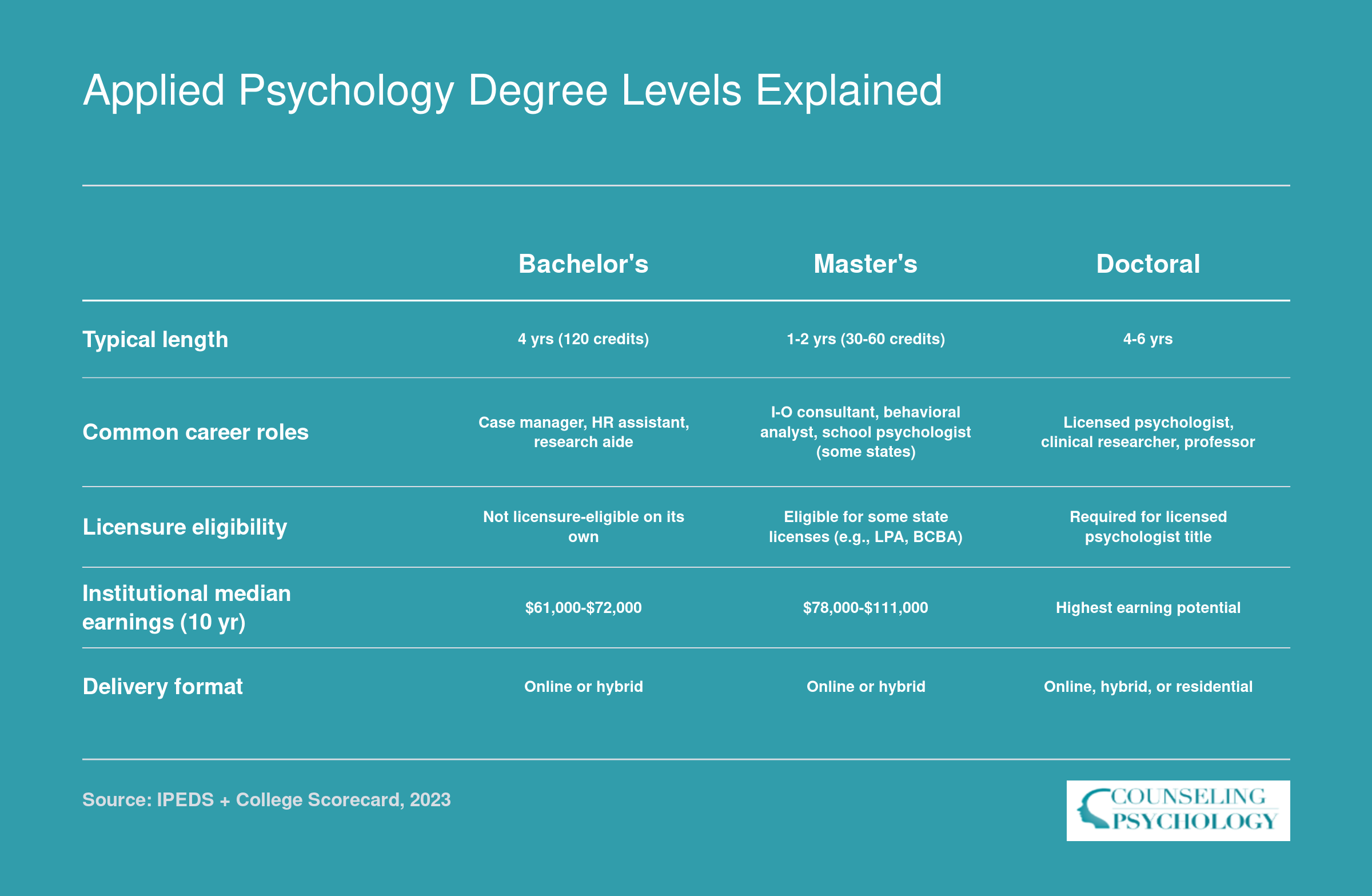
Applied Psychology Degree Levels Explained
Applied psychology programs span three degree tiers, each opening different career doors and requiring a different time commitment. The table below compares key attributes so you can match the right level to your professional goals. Program-level earnings data is not yet available for most applied psychology programs, so the earnings ranges shown reflect broad institutional medians reported by College Scorecard rather than program-specific figures.
Applied Psychology Specializations and Concentrations
Choosing a concentration early can fast-track your applied psychology career into a targeted, high-demand niche. The online programs ranked here offer distinct tracks that align with real-world workforce needs.
Organizational Psychology and Human Factors
Industrial-organizational (I-O) psychology drives corporate consulting and HR analytics. Several ranked programs lean into this space: Loyola University Chicago offers an Organizational Track within its Applied Psychology BA, while the University of Southern California's online MS emphasizes business and organizational psychology. Marquette University's hybrid MS in Applied Psychology Data Analytics blends I-O principles with data science, a combination that employers increasingly value. Students interested in this career path can learn more about how to become an industrial organizational psychologist.
Human factors and UX psychology, a field focused on how people interact with technology, remains underrepresented in explicit program concentrations but is an emerging demand area.1 If you target research roles in AI or product design, look for curricula heavy in research design and statistics, the two marketable skills most cited in 2025 and 2026 industry reports.2
Clinical and Counseling Applications
For students aiming toward licensure-eligible counseling roles, applied psychology programs often serve as a stepping stone. Northeastern University's online MS offers a Child, Adolescent, and Family Psychology concentration that maps to LPC or LMHC tracks in many states. Vermont State University's hybrid BS in Applied Psychology & Human Services includes field placements and addictions coursework, while SUNY Canton's program embeds a CASAC-T credential pathway. These concentrations don't grant licensure directly; you'll still need post-master's supervised hours. However, they build the required academic foundation.
Behavioral and Developmental Specialties
Applied behavior analysis (ABA) is the most direct route to Board Certified Behavior Analyst (BCBA) certification, though none of the ranked programs list ABA as a standalone concentration. Still, schools like The Chicago School offer seven career concentrations within their MA, often including ABA-related options. Alternatively, Florida Institute of Technology's BA in Applied Psychology with a Child Advocacy concentration and Texas A&M Central Texas's MS with Experimental Psychology both emphasize research methodologies applicable to developmental settings.
Positive psychology is another distinctive path: the University of Pennsylvania's hybrid Master of Applied Positive Psychology (MAPP) is one of only a few global programs focused entirely on strengths-based interventions, well-being, and resilience research.
Emerging Frontiers in Applied Psychology
The applied psychology landscape is shifting fast. Behavioral health integration in primary care settings is expanding roles for master's-level practitioners, while the AI and large-language-model explosion is creating demand for psychology-trained UX researchers who can evaluate human-machine interaction.1 Post-pandemic, organizational psychology has surged as companies rebuild culture and employee well-being strategies. Programs that weave statistics, research design, and technology applications into their core, like Marquette's data analytics emphasis, position graduates to capture these opportunities.
Accreditation: What to Look For in an Applied Psychology Program
Accreditation is the single most consequential filter you can apply to any applied psychology program, and the rules differ sharply depending on which degree level you're pursuing and which career path you have in mind.
Institutional vs. Programmatic Accreditation
There are two layers, and you need both. Institutional accreditation, granted by regional accreditors recognized by the U.S. Department of Education, applies to the entire college or university. It governs whether your credits will transfer, whether federal financial aid flows to the school, and whether other institutions will recognize your degree at all.
Programmatic (or specialized) accreditation is layered on top and applies to a specific program of study. It signals that the curriculum, faculty, and training experiences meet field-specific standards set by a professional body. A school can be regionally accredited while a particular program inside it carries no programmatic seal, so checking the institution alone is not enough.
Which Body Matters at Which Level
- Doctoral clinical and counseling psychology: Look for accreditation from the APA Commission on Accreditation, recognized by the U.S. Department of Education and CHEA.1 APA accreditation is widely treated as the gold standard for doctoral training, covers doctoral programs, internships, postdoctoral residencies, and selected master's programs, and is required or strongly preferred for VA, DoD, hospital, and most postdoctoral positions.2 States including Georgia, Hawaii, Massachusetts, Oklahoma, Pennsylvania, Tennessee, and Texas require APA-accredited training for psychologist licensure, while California, New Jersey, New York, and Wisconsin do not.2
- Master's-level counseling tracks: Look for CACREP accreditation, which is the dominant standard for clinical mental health, school, and related counseling specializations.
- Applied Behavior Analysis pathways: Look for an ABAI Verified Course Sequence, which is the route to BCBA exam eligibility.
The Risk of Skipping This Step
An unaccredited program is the biggest avoidable mistake in this field. Graduates of unaccredited programs may be ineligible to sit for licensure exams, unable to transfer credits to a regionally accredited institution, and locked out of federal student aid. The APA review cycle runs every 7 to 10 years and involves self-study, peer review, and an on-site visit, so an accredited program has been independently vetted on training quality, evidence-based practice, diversity, and resources.3 If you are considering a master's-level counseling track, exploring online counseling degree programs can help you compare CACREP-accredited options side by side. Verify the program's status directly on the APA accreditation public directory before you apply, not after you enroll.
Online vs. Hybrid vs. On-Campus: Which Format Fits?
Choosing the right delivery format is just as important as choosing the right program. Each mode of study brings tradeoffs in flexibility, cost, networking depth, and practicum logistics. Many programs listed as fully online still require short residencies, intensive weekends, or local practicum placements, so read the fine print before enrolling.
Pros
- Fully online, asynchronous formats let working adults and part-time students complete coursework on their own schedule without relocating.
- Online tuition is often lower than on-campus rates, and students save on commuting, housing, and campus fees.
- Hybrid programs combine online convenience with periodic in-person sessions that strengthen peer networking and faculty mentorship.
- On-campus programs typically offer the strongest access to research labs, career services, and supervised clinical training sites.
- Students in hybrid or on-campus formats may find it easier to secure local practicum placements through established university partnerships.
Cons
- Online students can feel isolated and may need to be proactive about building professional networks through virtual events or local associations.
- Clinical and counseling specializations almost always require in-person supervised hours, regardless of how coursework is delivered.
- Hybrid schedules with mandatory campus visits can be difficult for students who live far from the university or have unpredictable work obligations.
- On-campus programs demand the highest time and financial commitment, often making them impractical for students balancing full-time employment.
- Some licensing boards scrutinize online credit hours differently, so students should verify that their chosen format meets the requirements in their state.
Career Outcomes and Salary Expectations for Applied Psychology Graduates
Industrial-organizational psychologists earned a national median annual wage of $109,840 in 2024, according to the Bureau of Labor Statistics, placing this applied psychology track among the highest-paying career paths available to graduates.1 But I-O psychology is only one slice of the field. Applied psychology opens doors across behavioral health, human factors, organizational consulting, and research, and each pathway carries a different earnings profile worth understanding before you commit to a program.
What Program Completers Actually Earn
Program-level earnings data from the federal College Scorecard offers a ground-level view of what graduates from specific schools take home after finishing their degrees. For the programs ranked on counselingpsychology.org, detailed post-completion earnings at the one-year and four-year marks are not yet reported for most applied psychology tracks. That gap is common for newer or smaller programs and does not reflect poorly on the schools themselves. What is available at the institutional level shows that graduates from top-ranked schools in our list, such as the University of Pennsylvania and Northeastern University, go on to earn strong mid-career wages, with 10-year median earnings at the institutional level exceeding $90,000 at both schools. These figures cover all graduates from those institutions, not just applied psychology completers, so treat them as context rather than a precise forecast for your concentration.
BLS Occupation-Level Wages and Growth
National wage data from the BLS fills in the picture by occupation rather than by program. Here are four careers commonly pursued by applied psychology graduates, all based on 2024 figures:1
- Industrial-Organizational Psychologists (SOC 19-3032): $109,840 median annual wage nationally, with 6.3% projected job growth from 2024 to 2034.
- Psychologists, All Other (SOC 19-3039): $117,580 median annual wage nationally. The broader psychologists category is projected to grow about 6% over the same decade.
- Substance Abuse, Behavioral Disorder, and Mental Health Counselors (SOC 21-1018): $53,710 median annual wage nationally, but with a striking 18% projected growth rate, much faster than average, driven by expanding demand for behavioral health services.
- Human Factors Engineers and Ergonomists (SOC 17-2112): $99,380 median annual wage nationally, with 8% projected growth. Note that BLS groups this role within the broader industrial engineers category.
These are national medians. Your actual salary will depend on your state, employer, degree level, and years of experience. For a deeper look at compensation in clinical and counseling roles, see our breakdown of counselor salary data by degree and specialty.
Is Applied Psychology a Good Career?
Yes, and the data supports that answer from multiple angles. The behavioral health counseling sector alone employs roughly 429,000 professionals and is expanding at nearly three times the average rate for all occupations.2 I-O psychology, while a smaller field with about 1,030 practitioners nationally, commands six-figure wages and is growing faster than average.1 Human factors roles sit comfortably in the high five figures and are similarly on the rise.
The key distinction for prospective students: a bachelor's in applied psychology typically qualifies you for entry-level roles in human services, organizational support, or research assistance. Graduate-level training, especially a master's or doctorate, is what unlocks the higher-earning tracks like I-O psychology and licensed counseling. Students weighing advanced credentials can explore counseling doctoral programs or a range of counseling degrees at various levels. Programs in our ranking that blend analytics or organizational behavior with psychology coursework, such as Marquette University's data analytics concentration, position graduates for roles where demand is climbing and salaries reflect that trend.
Understanding the Two Data Lenses
Scorecard earnings and BLS wages answer different questions. Scorecard data tells you what real graduates of a specific program earned after leaving school, factoring in geographic location, industry placement, and whether they work full time. BLS occupational data tells you what an entire profession pays nationally at the midpoint. Neither is the complete picture on its own. When evaluating a program, look at both: the Scorecard for program-specific outcomes (when available) and BLS projections for the long-term trajectory of your target occupation. Together, they give you a realistic foundation for deciding where an applied psychology degree fits into your career plan.
Tuition, Financial Aid, and Return on Investment
Applied psychology degree cost varies dramatically across programs, so comparing what you actually pay versus what you earn after graduation is critical. The "net price" column below reflects each school's sector-conditional average cost after institutional aid, federal grants, and scholarships have been applied. It is not a guaranteed quote; your actual out-of-pocket figure could be lower if you qualify for Pell Grants, state aid, or employer tuition reimbursement. Among these programs, three stand out for return on investment: the University of Pennsylvania posts the strongest ROI ratio at roughly 7.1, meaning graduates earn about seven times their median debt within ten years. The University of Southern California follows at 5.1, and Northeastern University rounds out the top three at 3.8. Even bachelor's programs like Oregon Institute of Technology and Vermont State University deliver solid returns relative to modest debt loads.
| School | Degree Level | Net Price (Annual) | Median Debt at Completion | Median Earnings (10 Yr) | ROI Ratio |
|---|---|---|---|---|---|
| University of Pennsylvania | Master's | $28,699 | $15,715 | $111,371 | 7.09 |
| University of Southern California | Master's | $32,740 | $18,000 | $92,498 | 5.14 |
| Northeastern University | Master's | Not available | $24,250 | $92,538 | 3.82 |
| Vermont State University | Bachelor's | $18,212 | $15,000 | $50,331 | 3.36 |
| Marquette University | Master's | $31,487 | $23,940 | $78,257 | 3.27 |
| Oregon Institute of Technology | Bachelor's | $15,706 | $22,500 | $72,273 | 3.21 |
| UMass Amherst | Bachelor's | $22,383 | $22,763 | $71,631 | 3.15 |
| Elmhurst University | Bachelor's | $24,185 | $20,489 | $61,462 | 3.00 |
| Loyola University Chicago | Bachelor's | $36,079 | $24,157 | $71,530 | 2.96 |
| Regis University | Bachelor's | $18,397 | $25,000 | $72,105 | 2.88 |
Licensure and Certification Pathways for Applied Psychology Graduates
The licensure landscape for applied psychology graduates is defined by clear degree thresholds: a bachelor's degree opens limited doors, a master's degree unlocks master's-level counseling and behavior analysis credentials, and a doctorate is required to become a licensed psychologist. Overlooking the fine print of your state's licensing rules before enrolling in a program is the single most costly mistake you can make.
Licensure at the Master's Level: LPC and LMHC
The most common licensure route for master's-level applied psychology graduates is the Licensed Professional Counselor (LPC) or Licensed Mental Health Counselor (LMHC), depending on the state. While a master's is mandatory, not all degrees are treated equally. Some states require a degree specifically in counseling; others accept a related applied psychology degree if it includes core counseling coursework and supervised clinical hours. Regardless, you will need to complete a predetermined number of post-master's supervised experience hours, often in the 2,000 to 4,000 range (exact figures vary by state), and pass a national exam like the NCE or NCMHCE. Because degree field specificity differs, researching your state board's educational prerequisites early is essential.
Doctoral Pathways to Licensed Psychologist
To practice independently as a psychologist, you must earn a doctoral degree (PhD or PsyD) from an APA-accredited program, which signals to licensing boards that your education meets rigorous standards.2 After graduation, you will complete a one-year predoctoral internship, followed by postdoctoral supervised hours. For example, the Georgia Board of Psychology requires 1,500 hours of postdoctoral supervised experience. All states require you to pass the Examination for Professional Practice in Psychology (EPPP).2 The total number of required supervised hours varies significantly; some states set a lower threshold, while others demand up to 4,000 hours. Exploring careers in psychology early can help you understand which doctoral track best fits your goals. Verifying your state's specific practice act before committing to a doctoral program can prevent costly delays later.
The BCBA Certification Route
Applied behavior analysis (ABA) is one of the most popular applied psychology concentrations, and its primary credential is the Board Certified Behavior Analyst (BCBA). This pathway requires a graduate degree with behavior-analytic coursework, typically completed through an ABAI-verified course sequence, along with supervised fieldwork (either 1,500 concentrated hours or 2,000 intensive hours, as outlined by the Behavior Analyst Certification Board).4 After meeting these requirements, you sit for the BCBA certification exam. It is crucial to understand that BCBA certification alone does not automatically authorize practice; many states have separate licensure laws for behavior analysts. If you are considering this route, our guide on how to become a BCBA covers the full step-by-step process. Before enrolling in a BCBA-track program, confirm that both the coursework and the credential align with your target state's regulations.
Why State-Specific Requirements Matter
Licensure is governed by individual state boards, not a single national body. This means the same degree can lead to different outcomes depending on where you intend to work. An online applied psychology program based in one state may not meet the coursework or supervision disclosure requirements of another. You should always contact the licensing board in your intended state of practice before enrolling, and ask directly whether the program's curriculum and field experience components satisfy their rules. Taking this step early can save thousands of dollars and years of misdirected effort.
Frequently Asked Questions About Applied Psychology Degrees
Choosing the right applied psychology program involves weighing format, cost, accreditation, and career fit. Below are answers to some of the most common questions prospective students ask when exploring online applied psychology degrees in 2026.
More Online Applied Psychology Programs to Consider
Beyond our top ten, the following schools offer accredited applied psychology programs at the bachelor's and master's levels. These programs range from fully online to hybrid formats, each with unique strengths in curriculum design, flexibility, and student support. Browse the directory below to find additional options that align with your career goals and educational needs.
- Applied Psychology
- Master of Science in Applied Psychology (Thesis)
- Master of Science in Applied Psychology
- Master of Science in Applied Psychology (Teaching)
- B.S. in Applied Psychology
- Master of Science in Applied Psychology Data Analytics
- Master of Arts in Applied Psychology
- Applied Psychology
- Master of Science in Applied Psychology
- Master of Science in Applied Psychology
- Applied Psychology
- Bachelor of Science in Applied Psychology
- M.A. Applied Psychology
- Bachelor of Arts in Applied Psychology
- Applied Psychology
- Applied Psychology
- Master of Science in Applied Psychology
- Master of Science in Applied Psychology (Addiction Studies)
- Master of Science in Applied Psychology (Behavioral Specialist)
- Applied Psychology BA (Organizational Track)
- Applied Psychology BA (Counseling Track)
Explore Programs
Explore Programs
- Best Online Applied Behavior Analysis
- Best Online Associate Degrees in Psychology
- Best Online Autism Spectrum Disorders
- Best Online Bachelor's in Psychology
- Best Online Child Psychology Degree
- Best Online Clinical Psychology
- Best Online Cognitive Psychology Degree
- Best Online Counseling Psychology
- Best Online Developmental Psychology
- Best Online Educational Psychology Degrees
- Best Online Forensic Psychology Degree
- Best Online Graduate Certificate in Psychology
- Best Online Health Psychology
- Best Online I/O Psychology
- Best Online International Psychology
- Best Online Master's in Psychology
- Best Online Neuropsychology
- Best Online Ph.D. in Psychology
- Best Online Positive Psychology
- Best Online Psychopharmacology Programs for
- Best Online PsyD
- Best Online School Psychology
- Best Online Social Psychology
- Best Online Sports Psychology
- Engineering Psychology Degrees
- Online Geropsychology