

What you’ll learn in this article…
- Net prices among ranked online forensic psychology programs range from roughly $14,000 to over $36,000 per year.
- Full licensure as a forensic psychologist requires a doctoral degree and typically takes 8 to 12 years total.
- BS tracks emphasize research methods and statistics, while BA paths allow broader liberal arts electives.
- Entry-level roles include victim advocacy, probation work, and correctional case management.
Forensic psychology ranks among the fastest-growing undergraduate specializations in the behavioral sciences, driven by expanding demand for professionals who understand both criminal behavior and psychological assessment. The field is genuinely interdisciplinary: coursework blends abnormal psychology, criminal law, and research methods in ways that neither a straight psychology degree nor a criminal justice degree replicates on its own.
Most careers with "forensic psychologist" in the title require a doctoral degree and state licensure, a pipeline that typically stretches 8 to 12 years beyond the bachelor's. That reality makes the undergraduate program you choose consequential. A well-structured bachelor's in forensic psychology builds the research literacy, statistical skills, and applied experience that graduate admissions committees expect, while also qualifying you for entry-level roles in victim advocacy, corrections, and probation. For students weighing graduate options early, understanding the master's degree in psychology landscape can help clarify what comes next.
Best Online Bachelor's in Forensic Psychology Programs
The programs below represent some of the strongest online options for earning a bachelor's in forensic psychology in 2026. Each one delivers coursework at the intersection of psychology and the legal system, though they differ in degree title, net price, and institutional profile. Graduation rates listed are institution-wide figures reported to IPEDS, not specific to the forensic psychology program. Program-level earnings data is not yet available for these concentrations, so we include each school's overall median earnings ten years after enrollment as a broader reference point.
- Institutional graduation and retention rates
- Net price and student debt levels
- Program specificity and curriculum depth
- Online delivery flexibility
- Graduate earnings outcomes
- NCES-IPEDS federal institutional data — nces.ed.gov
- College Scorecard graduate earnings — collegescorecard.ed.gov
- Internal program database
- Independent program research

Arizona State University
Arizona State University pairs a large research university's resources with a fully online forensic psychology concentration within its BS in Psychology. The curriculum emphasizes statistical analysis, critical thinking, and real-world application of psychological principles to criminal behavior and legal proceedings. ASU's institution-wide graduation rate sits at 68%, with a median graduate debt of $19,500 and median earnings of $62,668 ten years after enrollment, placing it among the stronger outcomes profiles in this list.
- Fully online with no campus residency required
- Concentration specifically targets forensic psychology topics
- Builds skills in statistical analysis and research methods
- Prepares students for graduate study in forensic or clinical psych
- Net price of approximately $14,967 after aid
- 18:1 student-to-faculty ratio supports accessible instruction
- Flexible learning format suited to working students
BS in Psychology, Forensic Psychology Concentration — Online

Maryville University
Maryville University is one of a small number of institutions that awards a named Bachelor of Arts in Forensic Psychology rather than housing it as a concentration under general psychology. The 128-credit program integrates psychology, criminal justice, and social sciences, and it includes a required 135-hour internship alongside a capstone project. With no application fee or SAT requirement and an institution-wide graduation rate of 66.2%, Maryville balances accessibility with solid outcomes: median earnings reach $62,105 at the ten-year mark.
- Named forensic psychology degree, not just a concentration
- 128-credit curriculum blending psychology and criminal justice
- Required 135-hour internship for experiential learning
- Capstone project integrates classroom knowledge
- No application fee or standardized test scores required
- Accepts transfer credits to shorten time to completion
- 100% online with multiple start dates throughout the year
- Net price of roughly $22,066 after financial aid
BA in Forensic Psychology — Online

Louisiana State University and Agricultural & Mechanical College
Louisiana State University offers a BS in Psychology with a forensic psychology concentration through LSU Online, giving students access to a flagship public university's academic reputation at a public-school price point. The program requires Introduction to Forensic Psychology (PSYC 2080) as a core course and provides 28 credits of approved electives that students can steer toward justice, corrections, or legal-system topics. LSU posts a 68.8% institution-wide graduation rate and $61,251 in median earnings ten years out.
- Flagship public university with broad name recognition
- Required forensic psychology introductory course
- 28 credits of approved electives for career customization
- Prepares graduates for forensic interviewing and victim advocacy roles
- Net price of approximately $19,151 after aid
- Flexible online format designed for working students
- Strong foundation for graduate-level forensic or clinical programs
BS in Psychology, Forensic Psychology Concentration — Online

Bay Path University
Bay Path University delivers a fully online BA in Psychology with an explicit forensic psychology focus, and its curriculum aligns with American Psychological Association guidelines. Covering criminal behavior, mental illness, and substance use in legal contexts, the program spans roughly 120 credits at $410 per credit. Despite a sticker price above $38,000, the net price after aid drops to about $14,271, making it one of the most affordable options on this list. The 8:1 student-to-faculty ratio supports one-on-one faculty instruction.
- APA-aligned curriculum covering criminal behavior and mental illness
- $410 per credit; net price approximately $14,271 after aid
- Fully asynchronous online format with no campus visits
- Accepts up to 90 transfer credits
- 8:1 student-to-faculty ratio for personalized attention
- Approximately 3.5-year completion timeline
- Prepares students for careers in criminal justice and victim services
- Institution-wide median earnings of $55,383 at ten years
BA in Psychology, Forensic Psychology Focus — Online

Florida Institute of Technology
Florida Institute of Technology's online BA in Applied Psychology with a forensic psychology track takes an applied, justice-system-oriented approach rather than a purely research-heavy path. The program covers criminal behavior analysis, investigative techniques, and psychological assessment within legal proceedings. At $532.50 per credit with up to 90 transfer credits accepted, it can be cost-effective for students bringing prior coursework. The 6:1 student-to-faculty ratio is the smallest on this list, which supports close faculty interaction.
- Applied orientation toward criminal justice and behavioral analysis
- $532.50 per credit hour; accepts up to 90 transfer credits
- Flexible 8-week course format for working adults
- 6:1 student-to-faculty ratio, smallest among ranked programs
- 121 total credit hours required for graduation
- Net price of approximately $18,405 after aid
- Designed as a stepping stone to graduate forensic programs
BA in Applied Psychology, Forensic Psychology Track — Online

Touro University Worldwide
Touro University Worldwide's 100% online BA in Psychology with a Forensic Psychology concentration is built for flexibility: six annual start dates, 8-week sessions, and no residency requirement. Students can transfer up to 90 credits, which can significantly shorten time to degree. As a nonprofit accredited institution with a 10:1 student-to-faculty ratio, TUW provides a more intimate learning environment than many large online programs. The institution-wide graduation rate is 28.6%, so prospective students should weigh that against the program's convenient structure and faculty accessibility.
- 100% online with no residency or campus visits required
- Six start dates per year with 8-week sessions
- Transfer up to 90 previously earned credits
- 10:1 student-to-faculty ratio for close faculty engagement
- Nonprofit, regionally accredited university
- Covers criminal behavior, psychological assessments, and legal dynamics
- Net price of approximately $19,058 after aid
BA in Psychology, Forensic Psychology Concentration — Online

Southern New Hampshire University
Southern New Hampshire University's BA in Psychology with a forensic psychology concentration is one of the most widely recognized online options in this space, frequently appearing in national roundups of criminal and forensic psychology programs. At $330 per credit with no application fee, no required test scores, and 24/7 online support, SNHU prioritizes accessibility. The institution-wide graduation rate is 42.8%, and median earnings reach $50,318 ten years after enrollment. The program is positioned as a stepping stone to graduate forensic or counseling study rather than a terminal credential for licensed practice.
- $330 per credit with no application fee or essay required
- 8-week terms with 24/7 online academic support
- Includes courses like Fundamentals of Forensic Psychology
- No standardized test scores needed for admission
- Prepares students for criminal justice and victim advocacy careers
- Widely recognized in national forensic psychology program lists
- Institution-wide median earnings of $50,318 at ten years
- Designed as an undergraduate foundation for graduate study
BA in Psychology, Forensic Psychology Concentration — Online
How We Ranked These Forensic Psychology Programs
A ranking is only as useful as the criteria behind it. Too many program lists in higher education are built on reputation surveys, self-reported data, or criteria that favor prestige over practicality. This ranking works differently: every decision in the methodology is visible, and affordability sits at the center of it.
Affordability as the Primary Filter
Net price after financial aid carries the most weight here. Sticker tuition tells students very little about what they will actually pay. What matters is the out-of-pocket cost after grants and scholarships are applied, because that is the number that determines whether a student can realistically finish the degree without crushing debt. Programs that serve a high proportion of Pell Grant recipients also score better, since Pell eligibility is a reliable proxy for financial access.
Student Outcomes Data
Affordability alone is not enough. A cheap program that few students finish is not a good deal. The ranking draws on federal College Scorecard data to evaluate outcomes at both the program and institution levels. On the program side, that means looking at typical earnings after graduation and typical debt levels. At the institution level, the ranking considers graduation rates and first-year retention, both of which reflect whether a school actually supports its students through to completion.
Online and Hybrid Programs Only
This list covers only online or hybrid programs. That is not an arbitrary constraint. Working adults, career changers, and students without access to a campus nearby need formats that accommodate real-life schedules. On-campus-only programs, however rigorous, are simply not built for that audience.
Why Transparency Matters
Many competing rankings use a black-box approach: a school gets a number, but the reader cannot trace how it was calculated. When the criteria are hidden, prestige tends to fill the vacuum. Publishing the methodology openly lets readers weigh the factors themselves and decide whether the ranking's priorities match their own.
BS vs BA vs Criminal Justice: Which Forensic Psychology Degree Is Right for You?
A science-heavy bachelor's versus a liberal arts track versus a criminal justice degree: three paths lead to the forensic psychology field, and choosing the right one now can shape where you land in five years.
The BS in Forensic Psychology
This degree sits at the intersection of core psychology and forensic applications. Students typically take courses in abnormal psychology, criminal behavior, psychological assessment, and legal systems alongside the research methods and statistics courses that graduate programs require. The blend makes it a natural fit for students who already know they want to work at the psychology-law intersection. One caveat: quality varies by institution. A BS from a program rooted in a strong psychology department carries more weight with doctoral admissions committees than one housed primarily in a criminal justice school with limited research infrastructure.
The BA in Psychology with a Forensic Concentration
For students targeting doctoral programs, this is often the safest and strongest route. The major builds on broad psychological science, covering developmental, cognitive, social, and clinical foundations, then layers in forensic electives. Admissions committees for clinical and forensic PhD programs are accustomed to this profile: a solid psychology GPA, demonstrated research experience, and a few targeted electives that signal genuine interest in forensic work. The liberal arts breadth is rarely a liability. It signals intellectual range and satisfies the foundational coursework most doctoral programs list as prerequisites.
The Criminal Justice Degree with a Psychology Focus
This path offers deep knowledge of law enforcement, courts, corrections, and criminology, and it opens real doors in policy analysis, probation, corrections administration, and victim advocacy.2 What it typically lacks is the statistical rigor and psychological research depth that psychology doctoral programs expect. Applicants from this background are not automatically disqualified from graduate study, but they often need to supplement their transcript with additional psychology and methods coursework before applying. For students drawn to the operational side of the justice system rather than clinical or research roles, a criminal justice degree is genuinely well suited to the work. Those interested in the clinical track may want to review the forensic psychologist education requirements to understand what doctoral programs expect.
Choosing Based on Your End Goal
The decision comes down to what you plan to do after graduation:
- Doctoral program in psychology: A BA or BS grounded in psychology coursework, combined with undergraduate research experience, is the most competitive foundation.
- Non-clinical forensic roles: A criminal justice degree with psychology electives provides practical system knowledge valued by employers in corrections, law enforcement consulting, and policy.
- Flexibility: A BA in psychology with forensic concentration keeps the most options open, covering both graduate school prerequisites and applied career readiness.
Related Articles
What You'll Learn in a Forensic Psychology Bachelor's Program
A forensic psychology bachelor's degree asks you to build two distinct skill sets simultaneously: the psychological foundations that every clinician and researcher needs, and the legal and criminal justice knowledge that makes this field distinct.1 How those two tracks are balanced varies by program, so understanding the typical curriculum helps you spot the programs that will prepare you most thoroughly.
Core Coursework
Most programs open with the standard psychology foundation: general, developmental, social, cognitive, and personality psychology.2 From there, coursework turns toward the forensic application. You can expect classes in abnormal psychology, criminal behavior, criminology, law and justice, and forensic psychology itself.2 Research training runs throughout: statistics, research methods, and quantitative analysis are not electives in serious programs. They are central requirements, and for good reason. Doctoral admissions committees consistently rank statistics and research methods among the courses they weigh most heavily when reviewing undergraduate transcripts.3
Many programs also require a capstone, senior seminar, or independent research project.4 These culminating experiences ask you to synthesize what you have learned and, at the best programs, produce original work that can anchor a graduate school application.
Electives That Strengthen Your Profile
Beyond the core, the elective structure reveals a program's depth. Courses in psychopathology, victimology, juvenile delinquency, substance abuse, correctional psychology, and the treatment of offenders and victims move you closer to the realities of the field.5 Graduate admissions in forensic and clinical psychologist programs favor applicants who have already engaged with psychopathology and applied clinical topics at the undergraduate level, so choosing electives strategically matters.
Internships and Practicum Placements
Hands-on fieldwork is where a forensic psychology program either earns its reputation or reveals its limits. Look carefully at the practicum and internship options a program actively maintains. The strongest placements include correctional facilities, juvenile detention centers, court settings, victim services agencies, probation and parole offices, and substance use or mental health clinics.6 These are not decorative resume lines. They are the environments where classroom concepts become professional competencies, preparing you for the forensic psychologist requirements you will face at the graduate level.
When comparing programs, ask specifically whether internships are required or merely encouraged, and whether the school maintains formal agreements with placement sites. Programs that leave fieldwork entirely to the student are asking you to do institutional work on your own time.
Questions to Ask Yourself
Online vs. On-Campus Forensic Psychology Degrees
Choosing between an online and on-campus forensic psychology bachelor's program depends on your schedule, career goals, and how you plan to pursue graduate study. Both formats can deliver a strong foundation, but each comes with trade-offs worth weighing before you commit.
Pros
- Online programs offer scheduling flexibility that lets working students and caregivers complete coursework on their own timeline.
- Studying online often carries a lower net price once you factor in savings on housing, commuting, and campus fees.
- Geography stops being a barrier online, giving you access to well-regarded forensic psychology programs anywhere in the country.
- Regionally accredited online degrees are broadly accepted by employers in the criminal justice system and by graduate admissions committees.
- On-campus students benefit from face-to-face faculty mentorship, which can strengthen letters of recommendation for doctoral applications.
- In-person settings make it easier to secure practica and internships at local courts, correctional facilities, and forensic units.
- Campus life creates organic networking opportunities with peers and visiting professionals that can pay off during graduate school admissions.
Cons
- Even fully online programs may require you to arrange in-person fieldwork or practicum placements near your home, adding logistical complexity.
- Bachelor's programs (online or on-campus) are not eligible for APA accreditation, so online students should verify their school holds regional accreditation at minimum.
- Doctoral programs in forensic psychology may scrutinize applicants from lesser-known online institutions more closely than those from established campuses.
- On-campus programs typically cost more when you include room, board, and transportation, which can reduce your overall return on investment.
- Campus-based schedules are less forgiving for students who need to work full-time or manage family responsibilities alongside their studies.
Forensic Psychology Bachelor's Degree Cost and ROI
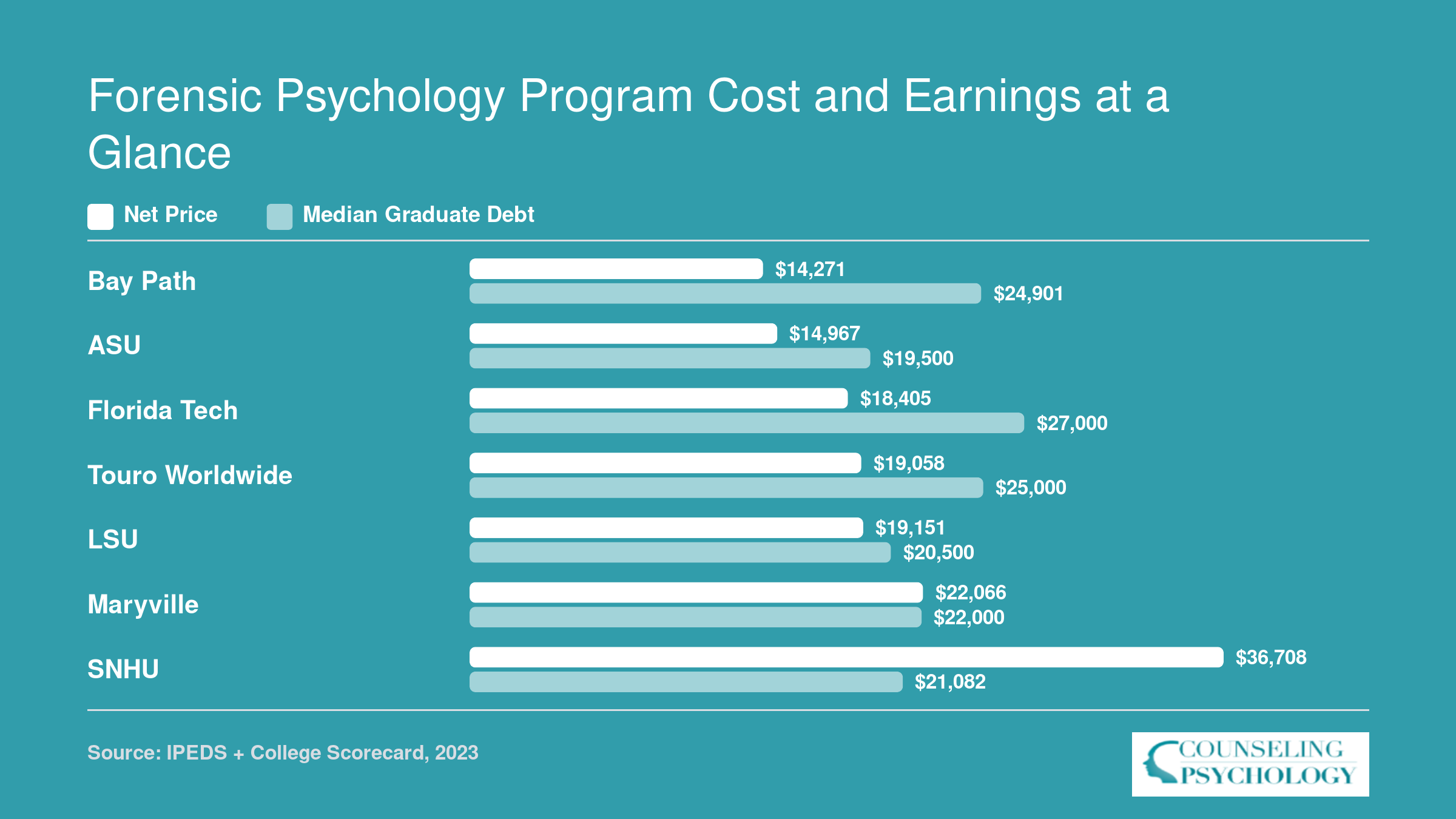
Paying sticker price versus leveraging financial aid creates dramatically different ROI scenarios for forensic psychology students. Among the ranked programs, net prices after aid range from roughly $14,000 to over $36,000 annually, and that spread shapes how quickly graduates can expect to recoup their investment.
Net Price and Debt Across Top Programs
The most affordable options on this list cluster around public flagships and smaller private institutions with generous aid packages. Arizona State University posts an effective net price of approximately $14,967 for in-state students, while Bay Path University, despite a sticker price above $38,000, brings the typical student's net cost down to around $14,271 through institutional grants. Louisiana State University lands near $19,151, and Maryville University averages $22,066 after aid.
On the higher end, Southern New Hampshire University's net price reaches roughly $36,708, reflecting its heavy enrollment of adult learners who may not qualify for need-based aid. Touro University Worldwide and Florida Institute of Technology's online division fall in the middle, near $19,000 and $18,400 respectively.
Median debt at graduation tells a tighter story. Most programs on the list produce graduates owing between $19,500 and $27,000. ASU sits at the low end with a median of $19,500, while Florida Tech graduates carry closer to $27,000. These figures translate to estimated monthly payments of roughly $200 to $280 over a standard 10-year repayment plan.
Early Earnings and Debt Serviceability
Program-level earnings data for these specific forensic psychology concentrations are not yet published through federal reporting channels. Institution-wide figures show 10-year median earnings ranging from about $40,800 at Touro University Worldwide to over $62,600 at ASU, but those numbers reflect all graduates across every major, not forensic psychology students specifically.
What we do know: entry-level roles accessible with a bachelor's in forensic psychology, such as victim advocate, case manager, or correctional treatment specialist, typically start in the $35,000 to $45,000 range nationally. Against a median debt of $20,000 to $25,000, monthly payments would consume around 6 to 9 percent of gross income, generally considered manageable but not comfortable.
The Real ROI Calculation
Bachelor's-level earnings in this field remain modest compared to other psychology tracks, and the honest answer is that short-term ROI often depends less on your undergraduate program's sticker price than on what comes next. Graduates who move directly into funded master's or doctoral programs, particularly those offering stipends or tuition waivers, effectively transform their bachelor's into a stepping stone rather than a standalone credential.
If you plan to work with only a bachelor's degree, prioritize programs with lower net costs and minimal debt accumulation. If graduate school is the goal, focus on programs with strong research opportunities and faculty connections that can help you secure funding for the next stage.
Forensic Psychology Program Cost and Earnings at a Glance
Net price and median graduate debt vary significantly across the forensic psychology programs in our ranking. Program-level earnings one year after completion are not yet available for these schools, so the chart below pairs each program's net price with median graduate debt to ground your cost planning. Ten-year institutional median earnings range from roughly $40,800 to $62,700, depending on the school.
Admissions Requirements for Forensic Psychology Programs
The entry bar for undergraduate forensic psychology programs differs markedly across institutions, and requirements you see published today may shift by next cycle. Visiting the official admissions page of each program on your list is the only reliable way to confirm minimum GPA thresholds, test policies, and prerequisite courses. Many schools update policies annually, and what was mandatory in 2025 may be optional or waived in 2026.
Minimum GPA and Academic Records
Most bachelor's programs in forensic psychology set a minimum cumulative GPA between 2.5 and 3.0 for freshman applicants, though competitive programs frequently admit cohorts closer to 3.3 or higher. Transfer students often face a separate GPA floor for college-level coursework, typically 2.75 or above. High school transcripts, college transcripts (for transfers), and official test scores form the documentary core of your application. If your GPA sits near a program's published minimum, strong letters of recommendation and a well-crafted personal statement can tip the scale.
Standardized Test Policies
Standardized testing remains in flux. A growing share of undergraduate programs have adopted test-optional or test-flexible policies, particularly since 2020. Some schools accept SAT or ACT scores but do not require them; others waive tests entirely for applicants meeting alternate criteria such as class rank or weighted GPA. To track which institutions have gone test-optional, check FairTest's database or search each school's admissions page directly. When scores are submitted, competitive programs typically look for composite SAT scores above 1100 or ACT composites above 22, though thresholds vary.
Prerequisite Courses and Background Expectations
Undergraduate forensic psychology programs rarely impose formal prerequisite courses at admission, but they do expect a college-preparatory curriculum that includes English, mathematics (algebra II or higher), laboratory science, and social studies. A handful of schools recommend or prefer introductory psychology or statistics completed in high school or dual enrollment. Contact program admissions offices directly to confirm whether any recent changes, such as new mathematics or writing requirements, have been adopted but not yet reflected on the website.
Accreditation Checks
Regional accreditation is the baseline for any legitimate bachelor's program. Use the Council for Higher Education Accreditation (CHEA) or U.S. Department of Education databases to verify an institution's standing before you apply. Programmatic accreditation from the American Psychological Association applies only to doctoral programs in psychology, not undergraduate degrees, but knowing which graduate programs hold APA accreditation helps you plan your trajectory if licensure as a psychologist is your long-term goal. For specialized guidance on forensic credentials, consult the American Board of Forensic Psychology, which outlines educational pathways for board certification at the doctoral level.
From Bachelor's to Licensed Forensic Psychologist: The Full Pathway
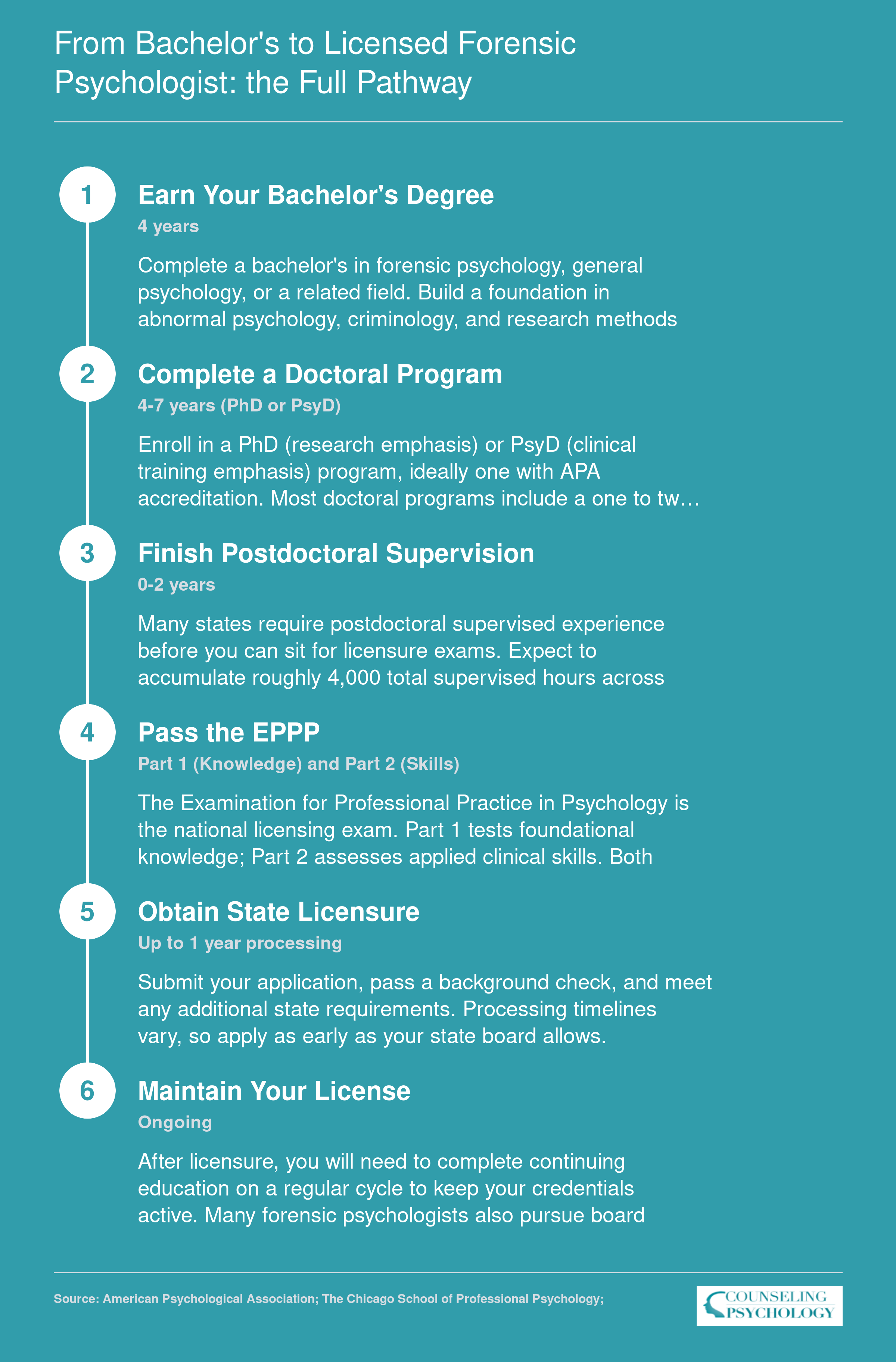
Becoming a licensed forensic psychologist is a marathon, not a sprint. The full pathway from your first undergraduate course to independent practice typically spans 8 to 12 years. Here is what each stage looks like and how long you should expect to spend at each level.
Jobs You Can Get With a Bachelor's in Forensic Psychology
A bachelor's degree in forensic psychology opens the door to several entry-level positions at the intersection of psychology, criminal justice, and social services. However, it's essential to understand that this degree alone does not qualify you to practice as a forensic psychologist. That career path requires a doctoral degree (Ph.D. or Psy.D.) and state licensure. What a bachelor's does provide is access to rewarding roles where you apply psychological principles in legal, correctional, and community settings while gaining the experience often required for graduate study.
Understanding Criminal Psychology vs. Forensic Psychology Career Paths
Though the terms are often used interchangeably, criminal psychology and forensic psychology differ in scope and application. Criminal psychology focuses specifically on understanding criminal behavior, offender profiling, and the psychological aspects of crime. If that specialization appeals to you, our guide on how to become a criminal psychologist outlines the full pathway. Forensic psychology is broader, encompassing any application of psychological principles to legal contexts, including civil matters, child custody evaluations, competency assessments, and victim services. Your bachelor's degree prepares you for entry roles in both domains, but your career trajectory will depend on whether you pursue graduate training in clinical, counseling, or research-focused forensic work.
Entry-Level Career Options
Graduates with a bachelor's in forensic psychology typically enter the workforce in the following roles:
- Probation Officer or Correctional Treatment Specialist: Monitor offenders on probation or parole, assess risk, and connect clients with rehabilitation services. The national median annual wage is $61,800 (2024), though the field is projected to decline by 2 percent through 2034 as states shift toward alternative sentencing models.1
- Substance Abuse Counselor: Work with individuals recovering from addiction, often in correctional or community settings. The national median wage is $59,190 (2024), with 18 percent job growth projected through 2034.2 Note that many employers prefer or require a master's degree for independent practice, but bachelor's-level positions exist in residential treatment centers and support roles.
- Victim Advocate: Support crime victims through the legal process, connecting them with resources and providing emotional assistance. Salaries vary widely by employer (nonprofit, government, or hospital-based), but many roles fall within the broader category of social and community service managers, which earn a median of $77,030 nationally (2024) and are growing at 8 percent through 2034.1 Entry-level advocate positions typically require a bachelor's degree and related experience.
- Social or Community Service Assistant: Help social workers, case managers, and counselors by coordinating services, maintaining case files, and conducting initial client intakes in mental health clinics, juvenile justice agencies, or victim services organizations.
- Crime Analyst: Analyze crime patterns, prepare reports for law enforcement, and support investigative efforts. While forensic science technicians (a related field) earn a median of $67,440 (2024) with 13 percent growth projected, crime analyst roles often sit within police departments and require strong data skills alongside your psychology background.3
- Juvenile Caseworker: Work with at-risk youth in the child welfare or juvenile justice systems, coordinating services, monitoring placements, and advocating for rehabilitation. These roles blend social work and psychology, often requiring a bachelor's degree and field experience.
The Path to Licensed Practice
If your goal is to become a licensed forensic psychologist practicing independently in clinical or forensic settings, plan for six to eight additional years of graduate education and supervised practice. The national median wage for psychologists is $94,310 (2024), with 6 percent growth projected through 2034, but that career tier requires a master's or doctoral degree.2 Your bachelor's is the essential first step, providing the foundation and credentialing needed for graduate admission. For a detailed look at the substance abuse counselor degree requirements, or to explore broader counseling careers, those resources can help you weigh your options before committing to a graduate track.
A bachelor's in forensic psychology opens doors to meaningful entry-level roles in criminal justice and social services. However, to practice independently as a forensic psychologist, you must earn a doctoral degree: plan your graduate pathway from the start.
Is a Bachelor's in Forensic Psychology Worth It?
The honest calculus behind a forensic psychology bachelor's degree depends almost entirely on what you plan to do after graduation. A bachelor's alone will not qualify you to call yourself a forensic psychologist. In nearly every state, the "psychologist" title is legally protected and requires a doctoral degree plus licensure.1 Master's-level practitioners cannot use it either. That reality should shape every dollar and year you invest at the undergraduate level.
The Bachelor's as a Strategic Foundation
Think of this degree less as a destination and more as a launchpad. Doctoral programs in forensic and clinical psychology want applicants who arrive with strong research methods training, a solid GPA in upper-level psychology coursework, and some form of supervised field experience. A well-chosen forensic psychology bachelor's program checks all three boxes. If you are serious about eventually conducting forensic evaluations, serving as an expert witness, or working in forensic treatment settings, the undergraduate years are where you build the transcript and skill set that competitive PhD programs expect. Understanding the full path to becoming a psychologist early on helps you make smarter decisions at each stage.
Entry-Level Earnings vs. Debt
If you enter the workforce right after graduation, realistic starting salaries fall in the $38,000 to $55,000 range. Roles like probation officer, victim advocate, case manager, or research assistant are common landing spots. Across the programs ranked in this article, median graduate debt generally falls between roughly $19,500 and $27,000. That debt-to-income ratio is manageable for most borrowers, especially with income-driven repayment options, but it is not the kind of salary that repays $80,000 or $100,000 in loans quickly. Keeping undergraduate costs low matters. For a broader look at what these roles pay over time, explore our guide to careers in psychology.
The Grad-School Factor That Changes Everything
Here is the detail that reshapes the long-term ROI picture: most forensic psychology PhD programs fully fund their students.2 Admitted candidates typically receive a full tuition waiver plus a stipend in the $20,000 to $35,000 range. Acceptance rates hover between 5% and 13%, with cohorts of just 4 to 10 students drawn from pools of 100 to 400-plus applicants. PsyD programs are generally self-pay or offer only partial aid, though a small minority do provide full funding with stipends around $18,000.4 The takeaway is that if you earn admission to a funded PhD program, your total out-of-pocket cost for the entire bachelor's-through-doctorate pipeline can be limited mostly to what you spent on the undergraduate degree.
A Clear Decision Framework
A forensic psychology bachelor's degree is worth the investment if you fall into one of two camps:
- Committed to the doctoral pathway. You plan to pursue a PhD or PsyD, and you are choosing an undergraduate program deliberately to strengthen your application. Keeping bachelor's-level debt low gives you flexibility during the five to seven years of doctoral training ahead.
- Targeting entry-level justice or social service work. You want a career as a probation officer, juvenile justice specialist, victim advocate, or behavioral health technician, and you find the $38K to $55K starting range acceptable for your cost of living.
The degree is a harder sell if you expect to perform clinical assessments or therapy with only a bachelor's credential. Those roles require graduate training and licensure, full stop. Go in with clear expectations, keep borrowing modest, and this degree becomes either a productive career credential on its own or the first leg of a much longer, and ultimately well-compensated, professional journey.
Frequently Asked Questions About Forensic Psychology Bachelor's Degrees
Choosing a forensic psychology bachelor's degree raises plenty of practical questions, from program quality to long-term career payoff. Below are answers to the questions prospective students ask most often, drawn from program data, accreditation standards, and labor market research.