
Key Takeaways
- UT Austin, Concordia University Texas, and Texas State lead our 2026 Austin psychology program rankings based on federal outcome data.
- Austin psychology graduates in Texas typically earn in the mid-$30,000 range during their first year after completing a bachelor's degree.
- Becoming a licensed forensic psychologist in Texas requires 10 to 14 years of education and supervised training after high school.
- Austin offers uncommon undergraduate fieldwork access through county forensic placements, state hospitals, and university research labs.
Austin sits at the intersection of state government, criminal justice infrastructure, and academic research, a position that creates distinct pathways for psychology undergraduates. The Texas Department of Criminal Justice maintains a major presence here, alongside Travis County courts and agencies that employ case managers, victim advocates, and forensic specialists. UT Austin anchors the region's research capacity, while smaller public and private universities extend access through campus-based, hybrid, and fully online formats.
Texas psychology programs vary sharply in cost and structure. In-state tuition at UT Austin runs roughly $11,500 per year, while private options like Rice University charge over $60,000. Net price after financial aid narrows that gap considerably, but program format (campus, hybrid, or online) shapes both cost and access to local internships. Students interested in forensic psychology face an especially long credentialing path, typically requiring a doctorate in forensic psychology and supervised hours before licensure, but Austin's ecosystem of courts, correctional facilities, and research labs provides undergraduate fieldwork opportunities that few metro areas can match.
Graduation rates span from 42 percent at the University of North Texas at Dallas to 95 percent at Rice, and median debt at graduation ranges from $11,000 to $21,000. Those outcomes matter more than program reputation alone when you weigh the real cost of a four-year degree against entry-level wages in human services, case management, and corrections, fields where bachelor's-level psychologists typically start.
Top Bachelor's in Psychology Programs in Austin, TX
Texas is home to a broad range of psychology programs that serve Austin-area students, from elite private research universities to affordable public institutions with fully online options. The programs below were selected for their combination of academic quality, graduate outcomes, and accessibility to Central Texas residents. Graduation rates listed are institution-wide figures, not specific to the psychology department, and median earnings reflect all graduates of the institution ten years after enrollment.
- Graduate earnings and debt levels
- Institutional graduation and retention rates
- Program format and flexibility
- Net price after financial aid
- Regional accessibility for Austin students
- Internal program database
- NCES-IPEDS federal institutional data — nces.ed.gov
- Independent program research
- College Scorecard graduate earnings — collegescorecard.ed.gov

Texas State University
Located just 30 miles south of Austin in San Marcos, Texas State University offers a fully online BA in Psychology that is purpose-built for working adults and transfer students across Central Texas. Students can transfer up to 90 credits, making it one of the most transfer-friendly options for those completing associate degrees at Austin Community College or other area institutions. The curriculum covers psychopathology, lifespan development, and cognitive processes with no on-campus requirements, giving Austin-area professionals the flexibility to earn a psychology degree without relocating.
- 100% online format with no on-campus requirements
- Up to 90 transfer credits accepted
- 120 total credit hours at roughly $404 per credit
- Covers psychopathology, cognitive processes, lifespan development
- Emphasizes ethical standards and research methods
- Designed for working professionals and nontraditional students
- Strong articulation agreements with Central Texas community colleges
Bachelor of Arts in Psychology — Online

Texas A&M University-Central Texas
Texas A&M University, Central Texas sits in the Austin-Killeen-Temple corridor and operates as an upper-division, transfer-friendly institution with a hybrid BS in Psychology. The program blends online coursework with on-campus sessions, making it especially practical for students commuting from the Austin metro or those connected to Fort Cavazos. Its net price of $1,300 is among the lowest in the state, and annual student research symposiums often address behavioral health issues specific to Central Texas military and veteran communities.
- Hybrid format combining online and on-campus delivery
- 120 credit hours with career-focused curriculum
- Designed as upper-division program for transfer students
- Strong partnerships with Central Texas community colleges
- Annual student research symposiums on regional topics
- Faculty mentorship and supportive academic advising
- Military and veteran community research opportunities
Bachelor of Science in Psychology — On-Campus

Rice University
Rice University in Houston pairs a 6:1 student-faculty ratio with a research-intensive BA in Psychology that requires 47 credit hours in the major and 120 total for the degree. The program draws on Houston's large, diverse urban population for research on culture, health, and inequality, giving students fieldwork experience that translates well to practice in other Texas metros like Austin. Despite a sticker price above $61,000, generous need-based aid brings the median net price down to $13,370, and graduates report median earnings of $89,718 ten years after enrollment.
- 47 credit hours in the major within a 120-credit degree
- 6:1 student-faculty ratio for personalized mentorship
- Honors program option for advanced undergraduates
- Faculty-led research opportunities across psychology subfields
- No transfer credits accepted for core psychology courses
- Campus-based program in Houston's diverse urban setting
- Strong post-graduation earnings among Texas psychology programs
Bachelor of Arts in Psychology — On-Campus

Texas A & M University-College Station
Texas A&M University, College Station offers both a BA and a BS in Psychology, each requiring 120 credit hours but diverging in emphasis. The BA path includes foreign language and additional humanities coursework suited to students eyeing counseling, social work, or law, while the BS leans into neuroscience, biological sciences, and clinical psychology. All Texas residents, including those from Austin, receive in-state tuition, and the university's extensive Aggie Network supports internship placement and job searches across every major Texas city.
- 120 credit hours with foreign language requirement
- Extra humanities coursework for counseling or law preparation
- Core content spanning clinical, cognitive, and social psychology
- Emphasis on global and cultural diversity issues
- Campus-based with statewide Aggie Network career support
- Prepares for graduate study or entry-level employment
- 120 credit hours emphasizing physical and biological sciences
- Focus on neuroscience and clinical psychology foundations
- Rigorous training in critical thinking and problem-solving
- Designed for students targeting competitive graduate programs
- Campus-based program at a Texas public flagship
- Research opportunities with faculty across psychology subfields
Bachelor of Arts in Psychology — On-Campus
Bachelor of Science in Psychology — On-Campus

The University of Texas at Dallas
UT Dallas delivers a BS in Psychology with a distinctly scientific and quantitative orientation, training students in empirical research methods, data analysis, and lab techniques across 120 semester credit hours. Internship and directed-research options connect students with the Dallas-Fort Worth health care and tech sectors, and the university's automatic admission policy for top Texas high school graduates extends to Austin-area applicants. Median earnings for graduates reach $68,227 a decade after enrollment.
- 120 semester credit hours with upper-division focus
- Strong emphasis on empirical research and lab training
- Hands-on internship and directed-research options
- Scientific and quantitative curriculum orientation
- Prepares graduates for competitive Texas graduate programs
- Faculty research mentorship across cognitive and social domains
- Top-10% automatic admission for Texas high school grads
Bachelor of Science in Psychology — On-Campus

University of Houston
The University of Houston's BS in Psychology requires 36 credit hours in the major and centers on a senior capstone experience that pairs students with faculty for research or community service projects. Electives span health psychology, industrial-organizational psychology, and cognitive psychology, allowing students to tailor their studies. Houston's proximity to the Texas Medical Center and a wide network of social-service agencies creates practicum possibilities that few other programs can match.
- 36 credit hours in the major with 21-hour core
- Senior capstone combining research or community service
- Electives in health, I-O, and cognitive psychology
- 2.0 GPA minimum with C or above in required courses
- Campus-based in Houston near Texas Medical Center
- Faculty-mentored research opportunities available
- Community-engaged projects addressing Texas urban issues
Bachelor of Science in Psychology — On-Campus

Texas Woman's University
Texas Woman's University in Denton offers two distinct psychology tracks: a general psychology major grounded in liberal arts and a BS with a health psychology concentration requiring 122 to 123 semester hours. The health psychology path is particularly well suited to students planning careers in hospitals, community clinics, or wellness programs, sectors that are growing rapidly in Austin. Faculty mentorship, early field experiences, and statistical consulting support round out a program designed for applied impact.
- Campus-based liberal arts psychology curriculum
- Faculty mentorship and early field experiences
- Statistical consulting and research support
- Active student organizations in psychology
- Prepares for counseling, research, and diverse careers
- Critical thinking and ethical reasoning emphasis
- 122 to 123 semester hours with 47 in the major
- Health psychology career focus across Texas settings
- Requires 3.0 GPA maintenance in major coursework
- Professional development and experimental psychology courses
- Multiple psychology elective options
- Research training aligned with health-related occupations
General Psychology Major — On-Campus
Bachelor of Science in Psychology, Health Psychology — On-Campus

The University of Texas at San Antonio
UTSA awards a BA in Psychology with 120 credit hours spanning cognitive, developmental, clinical, and social psychology. Its structured gateway course sequence and experimental lab requirements are designed to prepare students for graduate school, including programs at UT Austin and other Texas institutions. Located along the I-35 corridor between Austin and San Antonio, UTSA draws heavily from Central and South Texas and provides internship partnerships with area social-service agencies, schools, and health care providers.
- 120 total credit hours with structured gateway courses
- Research-focused experimental and lab course sequence
- Internship and independent study opportunities available
- Multiple specialization tracks within psychology
- Interdisciplinary elective options across campus
- Strong preparation for Texas graduate programs
- Serves the I-35 Austin-San Antonio corridor student base
Bachelor of Arts in Psychology — On-Campus

University of St Thomas
The University of St. Thomas in Houston is a private Catholic institution offering a BA in Psychology that emphasizes counseling preparation and ethical understanding alongside research methods. The program requires 120 credit hours, including 36 at the upper-division level, and features laboratory courses in experimental psychology and biopsychology. Students interested in pursuing an LPC or counseling psychology pathway in Texas will find the program's ethics-centered curriculum directly relevant to state licensure standards.
- 120 credit hours with 36 upper-division credits required
- Laboratory courses in experimental and biopsychology
- Ethics and counseling orientation throughout curriculum
- 2.0 GPA required in psychology coursework
- Diverse electives to tailor study interests
- Campus-based with small class environment
- Prepares students for LPC or counseling grad programs
Bachelor of Arts in Psychology — On-Campus

University of North Texas at Dallas
UNT Dallas offers both a BA and a BS in Psychology, with the BS featuring a neuroscience concentration that sets it apart from many Texas peers. Small class sizes and personalized faculty attention support students through coursework in abnormal child psychology, psychology of women, and other applied topics. Internships placed throughout the Dallas-Fort Worth area provide hands-on learning, and a net price of $6,420 makes it one of the most affordable options among Texas public universities.
- BA and BS pathways with neuroscience concentration on BS
- Small class sizes with personalized faculty attention
- Internships placed across the Dallas-Fort Worth metro
- Courses in abnormal child psychology and psychology of women
- Focus on scientific reasoning and communication skills
- Among the most affordable net prices in Texas publics
- Prepares for graduate studies or immediate workforce entry
Psychology (BA and BS options) — On-Campus
How We Ranked Austin Psychology Programs
Transparent, data-driven evaluation separates genuinely strong programs from those that simply market well.
The Scorecard Approach
Our ranking methodology relies on four weighted factors drawn directly from the U.S. Department of Education's College Scorecard:
- Median earnings after completion: What graduates actually earn one year after finishing provides the clearest signal of labor market value.
- Median graduate debt: The total borrowed amount at graduation reveals the financial burden students carry into their careers.
- Completion rates: Institution-wide graduation percentages indicate whether a school supports students through to degree conferral.
- Net price: The average cost after scholarships and grants, not the published sticker price, reflects what typical students pay out of pocket.
These factors combine into a composite score that balances both the investment required and the outcomes achieved.
Why ROI Ratio Matters
Sticker price alone tells you very little. A program costing $45,000 might leave graduates earning $38,000, while a $25,000 option could yield $42,000 salaries. We calculate a 10-year earnings-to-median-debt ratio that reveals which programs deliver genuine value over time. This ratio exposes programs where debt burdens outpace earning potential, a trap that is easy to fall into when focusing only on tuition.
Important Caveats
Graduation rates reported here reflect institution-wide figures, not psychology-specific completions. Similarly, net price represents an average after financial aid and varies based on your family's income bracket and merit awards. These numbers offer useful benchmarks, not guaranteed quotes for your individual situation.
Data Transparency at the Local Level
Program-level earnings and debt data from College Scorecard give this ranking a specificity that broader "best colleges" lists rarely achieve. Rather than relying on reputation surveys or self-reported statistics, we use federal data that schools cannot manipulate. For Austin students comparing options across town, this granularity reveals meaningful differences that institutional prestige rankings tend to obscure. If you are considering how a bachelor's degree could lead into advanced study, exploring clinical psychology doctorate programs can help you map longer-term career trajectories.
Austin Psychology Program Costs and ROI Comparison
Sticker price tells only part of the story. The table below compares published tuition, average net price after financial aid, typical graduate debt, and median earnings ten years after enrollment for each program on our list. Net price is the figure most students actually pay, making it the best starting point for apples to apples cost comparisons across public and private institutions.
| School | In-State Tuition | Net Price (After Aid) | Median Grad Debt | Graduation Rate | Median Earnings (10 Yr) | Student-to-Faculty Ratio |
|---|---|---|---|---|---|---|
| Rice University | $61,247 | $13,370 | $11,000 | 94.6% | $89,718 | 6:1 |
| Texas A&M University, College Station | $12,995 | $21,315 | $17,804 | 83.9% | $72,097 | 20:1 |
| UT Dallas | $14,644 | $18,267 | $18,000 | 75.7% | $68,227 | 23:1 |
| University of Houston | $9,717 | $14,276 | $18,194 | 64.6% | $62,377 | 22:1 |
| UT Tyler | $9,512 | $13,323 | $17,137 | 54.1% | $57,053 | 17:1 |
| UH Clear Lake | $8,346 | $15,563 | $17,831 | 51.6% | $59,004 | 15:1 |
| Texas A&M International University | $7,894 | $3,637 | $15,000 | 46.5% | $48,386 | 21:1 |
| UT Permian Basin | $9,607 | $12,723 | $17,750 | 39.7% | $56,073 | 19:1 |
| University of St. Thomas | $34,634 | $19,359 | $19,928 | 68.8% | $59,224 | 16:1 |
| Texas Woman's University | $8,640 | $11,963 | $19,218 | 49.1% | $56,544 | 16:1 |
Questions to Ask Yourself
Career Outcomes and Salaries for Austin Psychology Graduates
A bachelor's in psychology opens doors to a range of meaningful roles in Austin, but it is worth being direct about what those doors look like. The degree positions you for entry-level positions in human services, case management, corrections, and behavioral health support. Licensed clinical or forensic psychologist roles require graduate-level training, typically a doctoral degree. Understanding that distinction shapes how you evaluate any program's outcomes.
What Program-Level Earnings Data Shows
Program-level earnings data for the psychology bachelor's programs featured on this page are not yet available through federal reporting sources. That gap is common across undergraduate psychology programs nationally, partly because graduates scatter across so many different industries and occupations. The absence of a single earnings figure does not reflect poorly on any program; it reflects the genuinely wide range of paths psychology majors follow.
What Austin's Job Market Actually Looks Like
The Bureau of Labor Statistics publishes occupation-level wage data for the Austin-Round Rock-Georgetown metro area, and that paints a clearer picture of where bachelor's holders land. Figures below come from the May 2023 Occupational Employment and Wage Estimates.1
- Social and human service assistants: median annual wage of $38,870, with roughly 3,020 positions in the metro. This is one of the most common entry points straight out of a bachelor's program.
- Substance abuse and mental health counselors: median annual wage of $49,840 across approximately 2,230 local positions. Note that many roles in this category require state licensure, which typically means additional supervised hours and a relevant graduate credential, though some entry-level support positions are accessible to bachelor's holders.
- Probation officers and correctional treatment specialists: median annual wage of $64,910, with about 670 positions locally. A psychology bachelor's pairs well with criminal justice coursework for this pathway.
Wage data for psychologists in the Austin metro is suppressed by BLS due to low reported employment counts in that category, so no local figure is available.
Setting Realistic Expectations
The range above, from roughly $39,000 to $65,000, reflects the realistic span of early-career earnings for Austin psychology graduates depending on the role, employer, and whether additional licensure is involved. Human services and behavioral health support positions are plentiful but tend to sit at the lower end of that range. Roles in corrections and case management tied to the criminal justice system typically pay more and often reward the forensic-focused electives some Austin programs offer. For a broader look at compensation across the field, our counselor salary guide breaks down earnings by degree level and specialty.
If your goal is independent clinical practice or a psychologist title, plan for graduate school. Students interested in substance abuse or behavioral health counseling at the graduate level may want to explore addiction counseling online program options. The bachelor's is the foundation, not the finish line, and the strongest Austin programs are built around that reality.
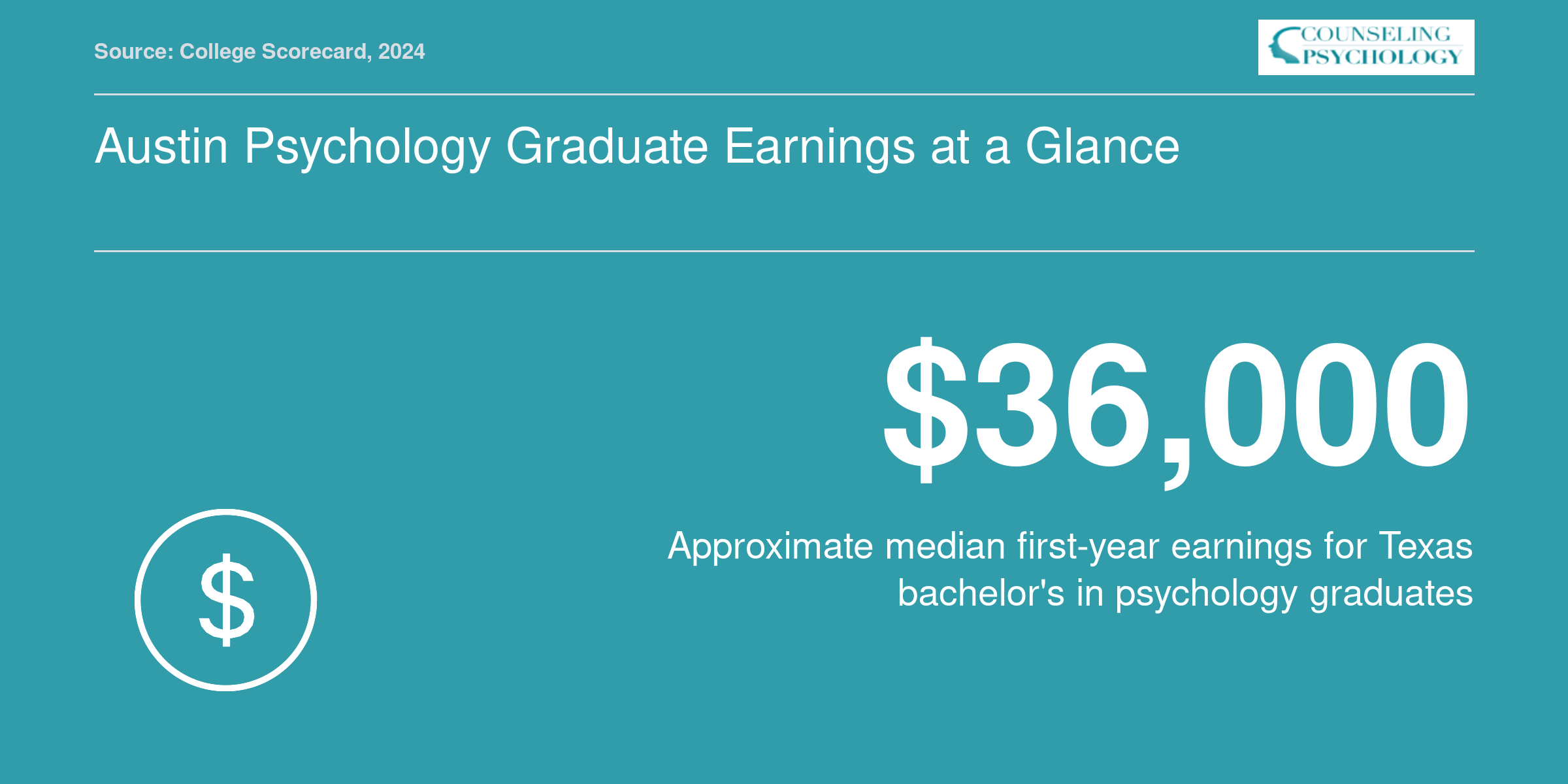
Austin Psychology Graduate Earnings at a Glance
Program-level earnings data for Austin's top psychology programs are not yet available through federal reporting. As a general benchmark, bachelor's in psychology graduates in Texas typically earn in the mid-$30,000 range during their first year after graduation, according to College Scorecard data for the state's larger programs. Earnings vary by employer, specialization, and whether graduates pursue entry-level roles or continue to graduate school.
Forensic Psychology Pathways Starting in Austin
A bachelor's degree in psychology from an Austin university is the starting point of a long but achievable path toward a career in forensic psychology, not the finish line.
What UT Austin Offers at the Undergraduate Level
UT Austin does not offer a dedicated forensic psychology concentration or track at the undergraduate level. That is a realistic expectation to set early. What the program does offer are forensic-relevant courses, including abnormal psychology, social psychology, and coursework on behavior and the law. Students with forensic interests can also pursue a criminal justice minor through the College of Liberal Arts, which pairs well with a psychology major. The combination builds foundational knowledge across behavior, crime, and the legal system without requiring a specialized concentration that simply does not exist at the bachelor's level. Students who want a more focused undergraduate experience may want to explore a bachelor in forensic psychology at other institutions.
Graduate Programs Texas Bachelor's Holders Feed Into
After completing a bachelor's in Austin, students typically pursue graduate study elsewhere in Texas or nationally to specialize in forensic psychology. Three programs that Austin-area graduates commonly consider include:
- Sam Houston State University: Offers graduate programs in forensic and clinical psychology with strong connections to the Texas criminal justice system.
- Texas A&M University-Victoria: Has developed graduate-level forensic psychology coursework and resources, including a forensic psychology handbook that outlines the field's scope.2
- University of Houston: Provides doctoral training in clinical psychology with research and practicum opportunities relevant to forensic populations in a major urban center.
Students should confirm current program availability and accreditation status directly with each institution before applying. Those considering the doctoral route can review forensic psychologist requirements to map out the full credential pathway.
The Texas Licensure Timeline
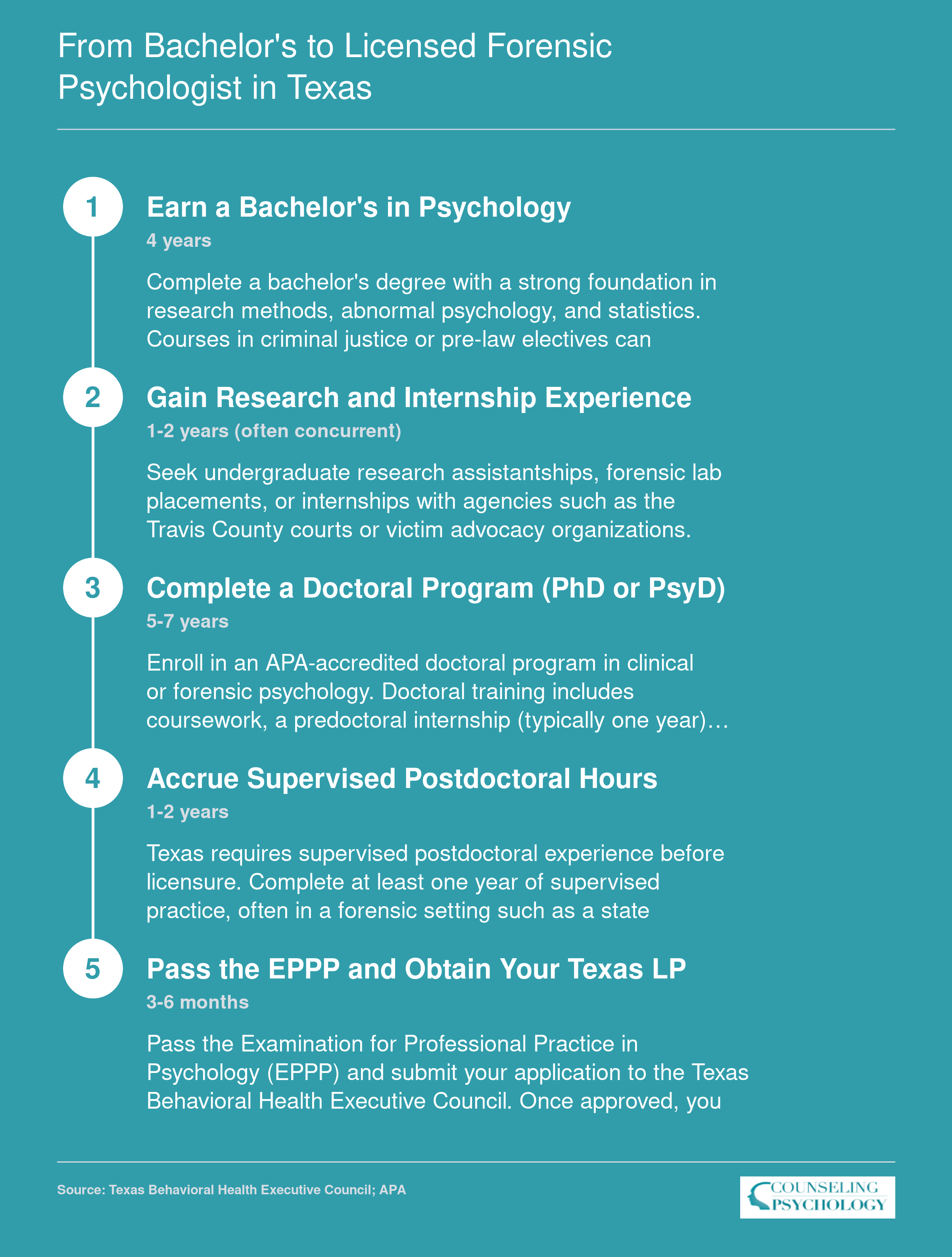
Becoming a Licensed Psychologist in Texas requires a doctoral degree, either a PhD or PsyD, from an APA-accredited or board-approved program. The supervised experience requirement totals 3,500 hours, split evenly: 1,750 hours completed pre-doctorally and 1,750 hours completed post-doctorally. Candidates must also pass the EPPP (Examination for Professional Practice in Psychology) and a Texas Jurisprudence Examination.
From bachelor's degree to full licensure, the realistic timeline is 10 to 12 years. That includes doctoral training, internship, and post-doctoral supervision. Forensic psychology is not a separate license in Texas. Psychologists who work in forensic settings hold the standard Licensed Psychologist credential and develop forensic competency through training and supervised practice. For a deeper look at each stage of preparation, our guide on how to become a forensic psychologist breaks down every requirement in detail.
Starting with a solid undergraduate foundation in Austin is the right first step. Just go in with clear eyes about how many steps remain.
From Bachelor's to Licensed Forensic Psychologist in Texas
Becoming a licensed forensic psychologist in Texas is a multi-stage process that typically spans 10 to 14 years after high school. Each step builds on the last, so understanding the full credentialing ladder early helps you plan coursework, finances, and career milestones with realistic expectations.
Internship and Practicum Opportunities in Austin
Classroom learning alone versus hands-on fieldwork represents one of the clearest divides in psychology education. Austin's concentration of government agencies, hospitals, and research institutions creates unusual access to real-world experience for undergraduate psychology students.
County and City Forensic Placements
Travis County offers semester-long internships across multiple departments relevant to psychology students.1 The District Attorney's Office and Juvenile Court Psychology unit both accept interns, with positions available as paid or unpaid depending on funding and role. Students must be actively enrolled and pass a background check to participate. Applicants can apply through posted positions or department internship webpages.1
The City of Austin Forensic Science Department runs a competitive summer internship lasting 10 to 12 weeks.2 Undergraduate and graduate students rotate through areas including case management, evidence control, quality assurance, latent prints, toxicology, and seized drugs. While interns do not perform independent casework on evidence, they gain exposure to the intersection of psychology, criminal investigation, and legal proceedings.
Research Opportunities at Local Universities
UT Austin's psychology department houses dozens of research labs studying everything from cognitive development to clinical interventions. Many labs accept undergraduate research assistants who help with data collection, literature reviews, and participant recruitment. These positions typically require a minimum GPA and a commitment of at least one semester, though competitive labs may expect longer involvement. Students at other Austin institutions can sometimes arrange cross-enrollment or collaborative placements, though access depends on faculty relationships and program policies.
Clinical and Community Settings
Austin State Hospital, one of the state's largest psychiatric facilities, has historically provided observation and volunteer opportunities for students exploring clinical pathways. Community mental health centers throughout Travis County also partner with local universities to place students in intake, case coordination, and peer support roles.
What Placement Access Depends On
Campus-based students typically have more local placement options than fully online students. On-ground programs often maintain formal agreements with Travis County agencies, Austin hospitals, and nonprofit organizations. Online programs may require students to secure their own placements, which can limit access to competitive sites.
Forensic-relevant placements carry particular weight for graduate school applications. Experience in juvenile justice settings, victim advocacy organizations, or probation departments signals genuine interest in the field and provides concrete examples for personal statements and interviews. Students drawn to the courtroom side of the discipline may also want to explore a forensic psychology degree online as a next step after completing their bachelor's.
How to Choose the Right Psychology Program in Austin
What is the actual difference between a BA and a BS in psychology, and does the choice really matter for your career?
The short answer: yes, it matters, and the distinction is more than cosmetic. Picking the right program format, degree type, and coursework track can shape your graduate school options and early career trajectory in meaningful ways.
BA vs. BS: Which Track Fits Your Goals?
A Bachelor of Arts in psychology typically builds in more liberal arts electives, foreign language requirements, and interdisciplinary coursework. Students drawn to counseling, social work, or community mental health roles often find the BA path a natural fit because it cultivates broad communication and critical thinking skills valued in those fields.
A Bachelor of Science in psychology leans harder into research methods, statistics, and laboratory-based coursework. If you plan to pursue a research-focused graduate program, a PhD in clinical or experimental psychology, or a career in data-driven behavioral science, the BS track gives you a stronger quantitative foundation from day one.
Neither degree is inherently superior. The right choice depends on where you want to land after graduation.
Accreditation: What Actually Matters at the Bachelor's Level
One of the most common misconceptions prospective students carry is that their undergraduate psychology program needs APA accreditation. The American Psychological Association accredits doctoral programs, not bachelor's degrees. What you should verify instead is that any program you consider holds regional accreditation. All of the ranked Austin programs on this list meet that standard, which means your credits transfer cleanly and graduate admissions committees will recognize your degree without question.
If a school lacks regional accreditation, walk away, regardless of how appealing the tuition looks.
Online vs. On-Campus: Practical Trade-Offs
Online psychology programs offer scheduling flexibility, but campus-based programs in Austin provide advantages that are hard to replicate through a screen:
- Lab access: Hands-on experience with research equipment and participant pools strengthens graduate applications.
- Local networking: Austin's mental health community, nonprofit sector, and state agencies are easier to tap into when you are physically present.
- Internship placement: Programs with dedicated field placement coordinators can connect you with supervised experiences at local clinics, juvenile justice facilities, and counseling centers.
If you are a working adult or live outside the metro area, a hybrid format that pairs online coursework with periodic on-campus intensives can offer a reasonable middle ground.
Coursework for Forensic Psychology Aspirations
Students who want to pursue forensic psychology at the graduate level should be intentional about their undergraduate electives. Look for programs that offer coursework in abnormal psychology, criminal behavior, and advanced research methods. These three areas form the academic backbone that forensic psychology master's and doctoral programs expect incoming students to have. Programs that also include a senior thesis or capstone research project give you a tangible credential to reference in graduate applications. For a broader look at career preparation in this specialty, our guide on how to become a criminal psychologist outlines the full degree pathway.
Choosing a psychology program is not just about rankings or price. It is about aligning the degree structure, delivery format, and available coursework with where you realistically want to be in five years. Students already eyeing graduate study may also want to explore master's degree in psychology options early, so they can reverse-engineer an undergraduate plan that feeds directly into their target programs.
Frequently Asked Questions
Choosing a psychology program in Austin raises plenty of practical questions. Below are answers drawn from current program data, Texas licensure requirements, and local labor market information.
More Psychology Programs in Austin to Consider
Beyond our top-ranked programs, many other Texas institutions offer quality psychology degrees. Below is a directory of additional options across the state, with net price and graduation rate data for each.
Austin Area
- Psychology (BA)
DFW Metroplex
- Psychology
Central Texas
- Psychology
Greater Houston
- Psychology B.S.
- Addictions Counseling B.S.
- B.S. in Psychology
- Psychology
East Texas
- Bachelor of Arts in Psychology
- Bachelor of Science in Psychology
- Bachelor of Science in Psychology
- Counseling Psychology, B.S.
San Antonio Area
- Psychology
South Texas
- Bachelor of Arts with a Major in Psychology
- B.S. in Kinesiology (Exercise Science/Performance Psychology)
- Psychology-Health Psychology
West Texas
- Sport and Exercise Psychology
- Psychology (Sport Psychology)
- Bachelor of Science in Psychology (General Psychology)
- Bachelor of Science in Psychology
- Bachelor of Arts in Psychology