
Key Takeaways
- South Carolina MFTs earned a median salary below the national figure, but Columbia's lower cost of living narrows the gap.
- COAMFTE and CACREP accreditation both satisfy SC licensure requirements, though each shapes your career flexibility differently.
- All LMFT candidates in South Carolina must complete at least 500 supervised clinical hours, which cannot be done remotely.
- A graduate certificate in MFT can work for students who already hold a related master's degree, saving time and tuition.
What accredited MFT programs are actually available to students in the Columbia, South Carolina area? That question has a shorter answer than most prospective students expect. Columbia sits in a state with a thin roster of accredited marriage and family therapy programs, which means many local students weigh options that require commuting, relocating, or completing significant coursework online.
The practical tensions here are real: COAMFTE versus CACREP accreditation affects licensure portability across state lines, program format affects how you complete required clinical hours, and total program cost varies enough to shift your debt load by tens of thousands of dollars. For students still weighing the broader landscape, exploring master of counseling degree programs in South Carolina can help contextualize where MFT fits among related credentials.
South Carolina's LMFT licensure requirements set a fixed floor regardless of which accredited program you choose, so the differentiating factors come down to cost, format, and how efficiently a program positions you for supervised post-degree hours. Both master's degrees and graduate certificates are addressed here, though only the master's qualifies you to sit for LMFT licensure in South Carolina.
Top-Ranked MFT Programs Within Reach of Columbia, SC
Students in the Columbia area have limited but high-quality options for COAMFTE-accredited marriage and family therapy training in South Carolina. The program below earned its position through a weighted composite of graduate earnings, median debt at graduation, and the institution's overall completion rate. Because South Carolina's Board of Examiners recognizes COAMFTE-accredited programs as meeting the education requirement for MFT licensure, Columbia-area students who choose this path can expect a streamlined route to their MFT Associate credential and, eventually, full LMFT status.
- Graduate earnings after completion
- Median student debt at graduation
- Institutional graduation rate
- Accreditation and licensure alignment
- Clinical training depth
- Independent program research
- NCES-IPEDS federal institutional data — nces.ed.gov
- Internal program database
- College Scorecard graduate earnings — collegescorecard.ed.gov

Converse University
Converse University, a private institution in Spartanburg, offers one of the few COAMFTE-accredited Master of Marriage and Family Therapy programs in South Carolina. The school's overall graduation rate sits at about 62%, and the median debt for Converse graduates is $27,000, with institution-wide median earnings reaching roughly $40,867 ten years after enrollment. With a 12:1 student-to-faculty ratio and small cohorts of 15 students, the program delivers an intimate training environment built around substantial supervised clinical practice at the on-site EMERGE Family Therapy Center.
- COAMFTE-accredited, meeting SC licensure education requirements
- 60-credit, full-time curriculum with fall-only start dates
- 500 supervised clinical hours at EMERGE Family Therapy Center
- 15-month clinical practicum integrated into the program
- Cohort model limited to 15 students per entering class
- No GRE required; 3.0 minimum GPA for admission
- Financial aid and graduate assistantships available
- Offered at two South Carolina campus locations
Master of Marriage and Family Therapy (MMFT) — On-Campus
Frequently Asked Questions About MFT Programs Near Columbia
Prospective MFT students near Columbia, South Carolina, often share a common set of concerns about salary expectations, degree requirements, accreditation, and clinical training logistics. The answers below draw on Bureau of Labor Statistics wage data, South Carolina Board of Examiners licensing standards, and general knowledge about MFT program structures to help you plan with confidence.
Related Articles
COAMFTE or CACREP? How Accreditation Shapes Your SC Licensure Path
If you plan to practice as a Licensed Marriage and Family Therapist in South Carolina, your program's accreditation matters more than most applicants realize. The South Carolina Board of Examiners for Licensure of Professional Counselors, Marriage and Family Therapists, and Psycho-Educational Specialists (SC LLR) accepts graduates from both COAMFTE and CACREP accredited programs, but the two credentials are not interchangeable in scope or convenience. COAMFTE remains the gold standard for MFT training specifically, while CACREP covers a broader counseling umbrella. Understanding the differences can save you extra coursework, licensing delays, and headaches if you ever relocate.
| Dimension | COAMFTE | CACREP |
|---|---|---|
| Focus and Scope | Designed exclusively for marriage and family therapy programs, emphasizing systemic and relational practice | Covers a broad range of counseling specialties (clinical mental health, school counseling, rehabilitation, etc.), not MFT specific |
| Clinical Hour Requirements | Minimum 500 direct client contact hours, including at least 200 relational (couples and family) hours | 600 total practicum and internship hours, with at least 240 direct service hours across all client types |
| Core Curriculum Mandates | MFT theories, systemic assessment, couples and family interventions, diversity, and ethics | General counseling core: theories, human growth and development, group work, career development, assessment, plus a specialty area |
| SC LMFT Licensure Eligibility | Meets the state's education requirements by definition, providing the smoothest path to licensure | Not automatically sufficient for LMFT; graduates may need to document additional MFT coursework or supervised relational hours to satisfy SC LLR |
| License Portability to Other States | Highly portable for LMFT licensure nationwide, particularly in states that require or prefer COAMFTE graduation | Strong portability for LPC (Licensed Professional Counselor) credentials, but may not qualify graduates for LMFT licensure in states with stricter requirements |
| Columbia Area Program Alignment | Pfeiffer University's Columbia campus offers a COAMFTE accredited MFT program within the metro area | Several regional universities, including programs at the University of South Carolina, hold CACREP accreditation for their counseling tracks, though these are not MFT specific |
Questions to Ask Yourself
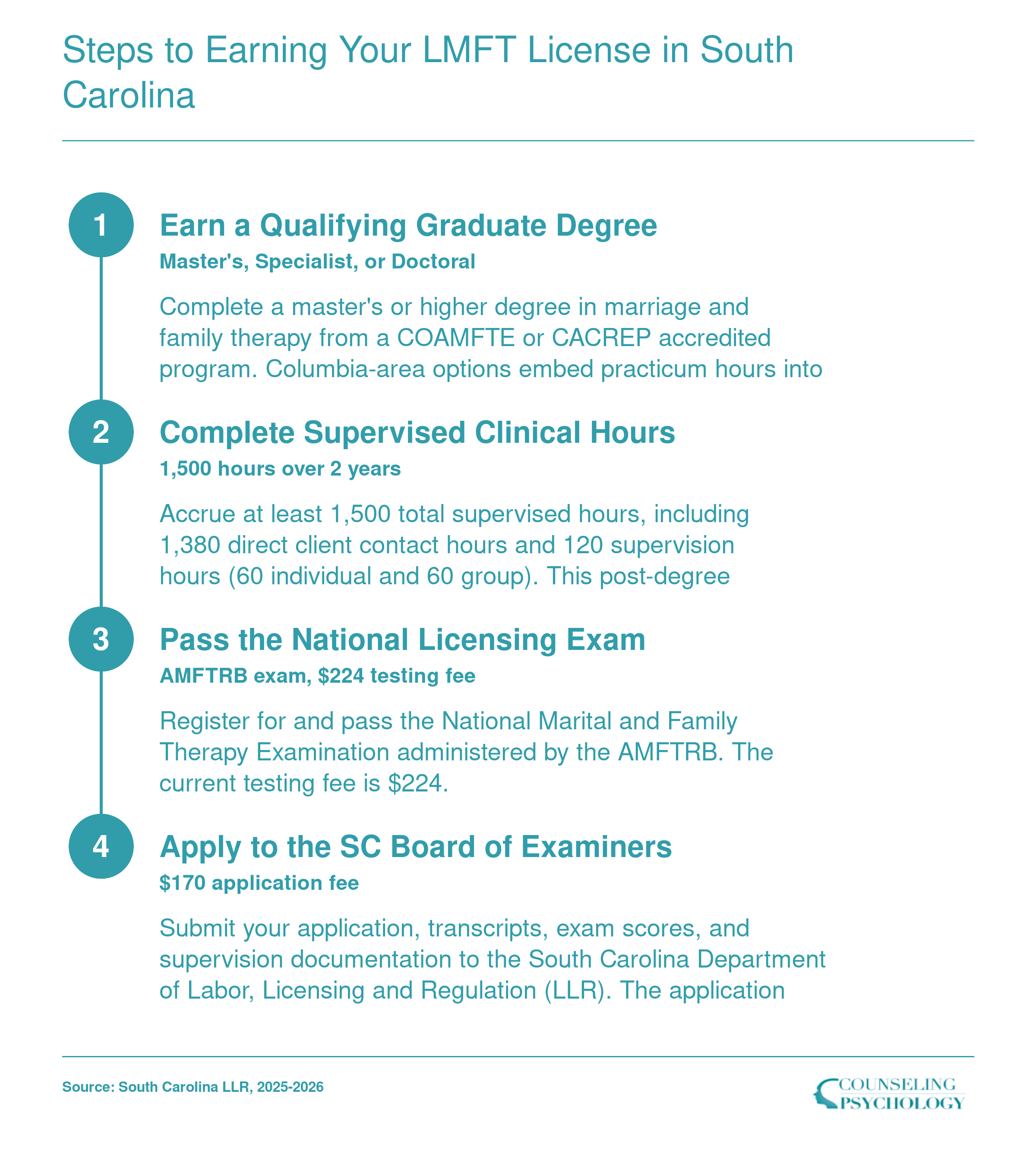
Steps to Earning Your LMFT License in South Carolina
South Carolina's LMFT licensure path is straightforward once you understand the sequence. Programs near Columbia, whether COAMFTE or CACREP accredited, are structured to satisfy the degree and practicum requirements in the first two steps, giving you a head start on supervised hours before you even graduate.
Online, Hybrid, and On-Campus MFT Formats: What Works for Columbia Students
South Carolina requires a minimum of 500 supervised clinical hours for LMFT licensure, and those hours cannot be completed remotely. That single requirement shapes every format decision a Columbia-area student needs to make.
How Online MFT Programs Actually Work
Online MFT programs deliver their didactic content, lectures, and theory coursework through video platforms and asynchronous modules. The clinical practicum is a different matter. Students must physically show up at an approved site, log their client contact hours in person, and receive supervision that meets state board standards. This means an online program's flexibility only stretches so far: you still need a local practicum placement, and not every agency in the Columbia area explicitly accepts MFT students.
That distinction matters when evaluating programs. An online degree from a program based in another state is only practical if it maintains partnerships with South Carolina-approved supervisors or can help you secure a placement in the Midlands independently. If you are weighing online options nationally, our guide to the best online MFT programs provides a useful starting point for comparing COAMFTE- and CACREP-accredited offerings.
Campus Programs and the Commute Question
Converse University's Master of Marriage and Family Therapy, the one COAMFTE-accredited campus-based program in this regional guide, is located in Spartanburg. There is no online option. Students complete their 500 clinical hours at Converse's on-site EMERGE Family Therapy Center, which means the practicum site comes built into the program structure. For a Columbia resident, that convenience trades against a roughly 90-minute round-trip commute, since the program runs classes Monday through Thursday.
Whether that tradeoff works depends on your schedule, employment situation, and family obligations. The cohort model (15 students, fall start only, full-time only) leaves little room for flexibility once you are enrolled.
Columbia-Area Practicum Options for Online Students
If you pursue a program that requires you to arrange your own local placement, the Columbia and Richland County area does have a working ecosystem of behavioral health and counseling sites. A few worth researching:
- LRADAC: This substance use and behavioral health agency accepts graduate counseling and social work interns.1 Placement as an MFT-specific intern is not explicitly confirmed, so direct outreach to their training coordinator is advisable.
- South Carolina Department of Mental Health: A regional placement partner for counseling graduate students across the Midlands.
- Richland County school districts: School-based clinical training opportunities exist, though these tend to suit school counseling tracks more directly than MFT.
- Lexington Medical Center: Commonly cited as a regional practicum partner for behavioral health students.
- Local nonprofit and private counseling agencies: Columbia has a layer of smaller agencies and group practices that regularly host interns; Psychology Today's therapist directory for Columbia can surface practice names worth contacting.
- VA Columbia: The facility runs a Mental Health Counseling Graduate Student Internship Program, though it is not labeled as MFT-specific.2
- Prisma Health: Behavioral health internship opportunities exist, though the most publicly documented track is music therapy, not MFT.3
The honest caveat: as of 2026, no verified public list of Columbia-area sites explicitly designated for MFT practicums exists.4 Most sites accept broader counseling or behavioral health interns. Students choosing an online program should contact potential sites before enrolling to confirm MFT student eligibility and supervisor licensure, since your practicum supervisor must meet SC board requirements regardless of where the agency is located.
Matching Format to Your Life
If you need geographic flexibility and can manage the legwork of arranging local clinical placements, an online program from a COAMFTE- or CACREP-accredited school may serve Columbia students well. If you prefer a structured, practicum-included environment and can commit to regular travel to Spartanburg, Converse University's campus model removes much of that coordination burden. Neither format is objectively better; the right choice depends on how much logistical independence you want to take on during the clinical phase of your training.
Graduate Certificate vs. Master's in MFT: Choosing the Right Credential
Not every path into marriage and family therapy requires starting from scratch. If you already hold a master's degree in a related field, a graduate certificate in MFT can add specialized training in less time. But before you commit, understand what South Carolina's licensing board will and will not accept. The distinction matters more than most applicants realize.
Pros
- A graduate certificate typically runs 12 to 21 credits, often completable in about a year, versus 48 to 63 credits for a full master's program.
- Certificate tuition is substantially lower overall because you are completing far fewer credit hours than a full master's degree requires.
- For professionals who already hold a qualifying master's in a related counseling field, a certificate can add MFT specialization without repeating foundational coursework.
- South Carolina's Board of Examiners does offer an educational equivalency review, so combined credentials (related master's plus MFT certificate) may be assessed on a case by case basis.
Cons
- A graduate certificate alone does not meet South Carolina's LMFT licensure requirements; the state mandates a qualifying master's degree as the foundational credential.
- Certificates include fewer built in clinical hours, meaning you may need to arrange additional supervised experience independently to satisfy state requirements.
- Financial aid options for certificate programs are more limited; federal loans and assistantships are typically reserved for degree seeking students.
- If you pursue a combined master's plus certificate path, there is no automatic acceptance by the SC board. Each application undergoes individual review, adding uncertainty and processing time.
What MFTs Earn in South Carolina: Salary Data and Program ROI
Marriage and family therapists in South Carolina earn below the national median, but a lower cost of living in Columbia can stretch your paycheck further than the raw numbers suggest.
South Carolina and National Salary Benchmarks
Nationally, MFTs earned a median annual wage of $58,510 in 2023.1 The top 10% made over $104,710, while the bottom 10% earned $39,090 or less. In South Carolina, the mean annual wage is just $46,000, with a typical range of $35,000 to $95,000.2 Even the upper end of that range falls below the national 90th percentile, reflecting a more modest earnings landscape across the state. If you are still exploring broader counseling careers, comparing salary benchmarks across specializations can help you decide whether the MFT path aligns with your financial goals.
Program-Specific Earnings and Return on Investment
Broad occupational averages don't tell you how a graduate of a specific program will do. At Converse University, program-level median earnings one and four years after completion aren't published yet. What is available, a favorable debt-to-earnings ratio, hints that alumni manage their loan payments effectively, an encouraging sign for anyone weighing the cost of a degree. When program-level earnings become available, comparing them directly to the state's overall MFT salary picture will help you gauge the value of each credential. For a wider view of options, review the best MFT programs in South Carolina.
Purchasing Power in Columbia
Columbia's cost of living runs about 6% below the national average, with particularly affordable housing. A therapist earning $46,000 here can achieve a lifestyle comparable to earning roughly $52,000 in a higher-cost metro. South Carolina's low state income tax further boosts take-home pay, enhancing the real value of your salary.
Job Market Outlook
The BLS projects a 13% national growth rate for MFTs from 2024 to 2034, much faster than average, translating to about 7,700 job openings each year.3 In South Carolina, population growth in the Midlands, expanded mental health insurance mandates, and wider telehealth use drive steady demand. These factors point to reliable job opportunities for new graduates near Columbia.
Columbia students face a clear decision tree: choose between COAMFTE or CACREP accreditation based on where you plan to practice, then select the format (online, hybrid, or on-campus) that fits your schedule. These two choices determine how quickly you reach licensure and whether your credential transfers easily if you relocate after graduation.