
What you’ll learn in this article…
- ASU’s online MS in Clinical Psychology launches Fall 2026 with a flat tuition rate of $605 per credit.
- The 57-credit program is completable in two years using 7.5-week courses and requires 600 practicum hours.
- Graduates meet Arizona’s LAC and LPC educational prerequisites, with potential pathways in other states.
Arizona State University will launch a fully online Master of Science in Clinical Psychology in fall 2026, delivering a 57-credit, two-year degree track designed to meet Arizona's LAC and LPC educational requirements. The program arrives amid a deepening mental health workforce crisis, with Arizona projected to need 23% more substance abuse, behavioral disorder, and mental health counselors by 2030. For many students, the appeal of online flexibility runs up against the hard requirement of 600 supervised clinical hours that must be completed in-person at community sites. Prospective applicants weighing this program against other accredited online masters in mental health counseling should note that graduates will still face the patchwork of state licensure rules, where portability beyond Arizona is not guaranteed.
Why ASU Is Launching an Online MS in Clinical Psychology
Why is Arizona State University rolling out a brand-new online Master of Science in Clinical Psychology right now? The answer lies in a critical shortage of mental health providers that is hitting communities across the country, and especially in Arizona.
A Growing National Shortage of Health Service Psychologists
The U.S. is facing a severe and worsening deficit in the mental health workforce shortage. Federal projections show the nation was already short about 15,000 health service psychologists in 2024.1 Without significant intervention, that gap is expected to swell to approximately 80,000 by 2037, leaving the country with only around 55% of the psychologists needed to meet expected demand.1 Master's-level training is key to closing this gap, yet the pipeline is producing far too few graduates. In 2023, master's programs in health service psychology turned out roughly 22,700 graduates, while doctoral programs added only about 3,900, a combined output that barely chips away at the spiraling shortfall.1 This imbalance is especially acute in rural regions and federally designated shortage areas, where recruiting and retaining professionals has long been a challenge.
Online Delivery Expands Access to a Broader Student Pool
ASU's decision to launch an online MS in Clinical Psychology is a direct response to this workforce crisis. By offering the degree in a fully online format, the university can reach students who otherwise could not relocate to the Tempe campus. That includes working professionals, parents, and career changers who need the flexibility of asynchronous coursework while staying in their home communities. ASU Online already serves more than 200,000 students and has a long track record of delivering rigorous degrees at scale. Adding clinical psychology to its portfolio aligns with the university's charter mission to increase access to higher education and address pressing societal needs. The program's structure allows students outside Arizona to train for master's-level licensure in their own states, a critical advantage given that 32 states do not yet offer a direct licensure pathway for master's-prepared health service psychologists.1
Arizona's Own Behavioral Health Workforce Crisis
Arizona itself is at the center of this provider shortage. Statewide demand for behavioral health services routinely outpaces supply, with unfilled positions in community mental health counselor roles, hospitals, schools, and private practices. The need is particularly stark in rural and tribal areas, where residents may drive hours to reach their nearest clinician. By preparing graduates who can enter supervised clinical practice quickly, ASU's new online MS helps build a talent pipeline that directly serves Arizona communities. The program's accelerated two-year timeline means students can transition from the classroom to a practicum placement and then into the workforce faster than through traditional on-campus routes, making it a practical solution for both students and the communities that need them.
Program Overview: Curriculum, Credits, and Format
The ASU Online MS in Clinical Psychology requires 57 credits and consists of 19 courses.1 Full-time students can complete the degree in two years, with the inaugural class beginning in Fall 2026 on August 20.2 The curriculum is designed to be completed sequentially, ensuring that foundational concepts are mastered before advancing to applied work.
Accelerated Session Format
All courses run in accelerated 7.5-week terms.1 This format lets students focus on one or two courses at a time, minimizing context switching and enabling deeper engagement. Over two years, students move through a series of these sessions, accumulating credits efficiently without sacrificing depth. A typical term includes two courses, and advisors provide a recommended sequence to maintain the timeline.
Synchronous and Asynchronous Balance
The online learning experience combines live, synchronous class meetings with asynchronous coursework. Synchronous sessions allow real-time interaction with instructors and peers, think case discussions, role-plays, or Q&A on complex topics. Asynchronous components, such as recorded lectures, readings, and discussion forums, provide flexibility to complete work within weekly deadlines. This blend aims to replicate the collaborative environment of an on-campus program while accommodating working adults.
Core Courses and Specialty Tracks
The curriculum builds from a core of four foundational courses:3 - PSY 530 (Foundations of Clinical Psychology): Introduces the history, theories, and roles within clinical psychology. - PSY 534 (Psychopathology): Covers diagnostic classification and the etiology of mental disorders. - PSY 572 (Psychological Assessment): Trains students in test administration, interpretation, and ethical use of assessments. - PSY 589 (Research Methods): Equips learners to critically evaluate and conduct clinical research.
After the core, students complete a set of lifespan-focused courses (PSY 574, 578, 588, 591) that address both adult and child/adolescent clinical populations. Additional required courses cover ethics (PSY 587), psychopharmacology (PSY 596), and diversity in clinical practice (PSY 597).
Practicum and Applied Project
The clinical practicum (PSY 680, 6 credits) requires 600 supervised hours in a real-world setting, integrated throughout the program.4 The capstone experience is an Applied Project (PSY 593, 6 credits) rather than a thesis.3 Students design and execute a project that addresses a practical clinical problem, demonstrating their synthesis of theory, research, and practice. For those wondering how hard it is to get into grad school for psychology, this program's structured sequence and applied focus are worth weighing against admission expectations. The project serves as a tangible demonstration of clinical competency for employers or doctoral program applications.
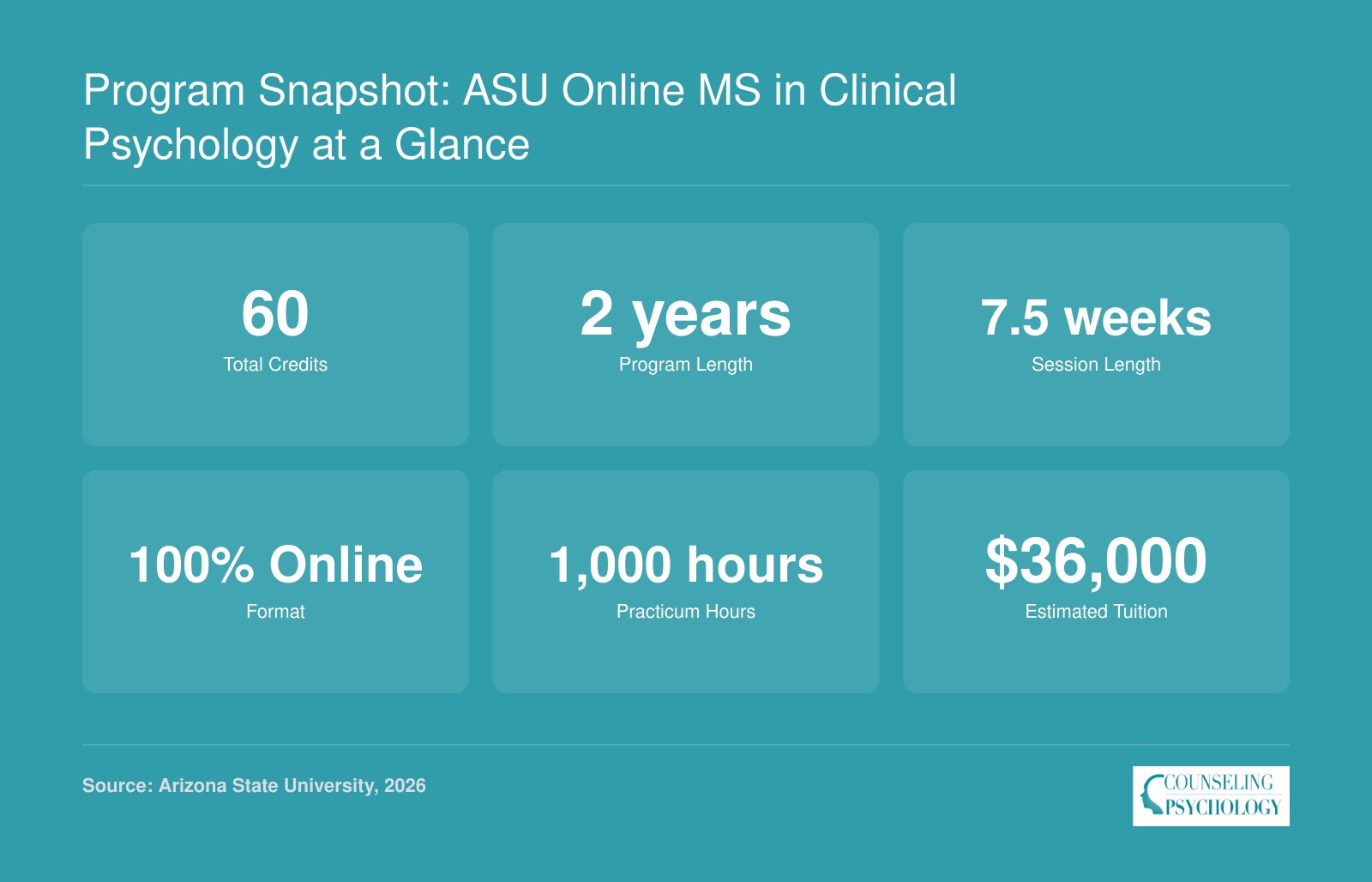
Program Snapshot: ASU Online MS in Clinical Psychology at a Glance
Arizona State University's new online MS in Clinical Psychology is designed for working professionals seeking flexibility. The program can be completed in just two years with accelerated 7.5-week courses and includes a required clinical practicum.
Admission Requirements and How to Apply
Admission to the online MS in Clinical Psychology program requires the following materials and qualifications.
- Bachelor’s DegreeA bachelor’s degree in psychology or a behavioral health-related field from a regionally accredited institution.
- Minimum GPAA cumulative GPA of 3.00 or higher (on a 4.00 scale) is required.
- GRE Not RequiredNo standardized test scores (GRE) are required for admission.
- Letters of RecommendationTwo letters of recommendation are required, ideally from academic or professional references who can speak to your potential for graduate study.
- Personal StatementA personal statement of up to 800 words is required, outlining your background, interests, and career goals in clinical psychology.
- Resume or CVA current resume or curriculum vitae detailing your educational and professional experience is required.
- Work ExperienceNo prior clinical or work experience is required, though relevant experience may strengthen your application.
- Application DeadlineThe priority deadline for the fall 2026 cohort is August 1, 2026. Late applications may be considered on a space-available basis.
- English ProficiencyApplicants whose native language is not English must submit proof of English proficiency through TOEFL, IELTS, or equivalent scores.
Practicum and Supervised Clinical Hours
The ASU Online MS in Clinical Psychology requires a substantial 600 hours of supervised clinical practicum,1 designed to be completed in-person at a site near your own community.
Practicum Structure and Weekly Commitment
The 600-hour total is spread across multiple semesters, typically beginning after foundational coursework is complete. During the practicum sequence, students average around 15 to 20 hours per week at their site, though exact pacing depends on the site and semester credit load. The program expects consistent weekly engagement, with direct client contact hours making up a meaningful portion of the total. Before starting practicum, students must complete required core courses that provide the theoretical and ethical grounding for clinical work.
Finding and Approving a Practicum Site
Students take the lead in identifying a practicum site, but ASU provides active placement assistance.2 Once a potential site is found, it goes through a program-approval process to ensure it meets clinical training standards. Sites must be able to offer appropriate supervision and a range of clinical experiences. ASU's clinical placement team helps verify that the setting, whether a community mental health center, hospital, or private practice, aligns with licensure requirements in the student's state.
Supervision Format and Frequency
Supervision during practicum follows a blended model. On-site, a qualified clinical supervisor provides regular direction and oversight consistent with state regulations. In addition, all students participate in a weekly live virtual group supervision session led by ASU faculty.3 This remote component ensures consistent mentoring, peer consultation, and integration of academic concepts with real-world practice, regardless of where a student is located.
Out-of-State Practicum Considerations
Because the program is fully online, many students will complete practicum outside Arizona. ASU expressly allows practicum placements in a student's home state, with site approval still required.3 This flexibility is critical for distance learners, but students must confirm their state's licensing rules and ensure that ASU's program meets all practicum-hour specifications for that jurisdiction. State authorization is also necessary for enrollment from certain locations, so prospective students should verify eligibility early in the application process. When local in-person opportunities are limited, a remote practicum may be approved on a case-by-case basis, providing additional flexibility.2
Questions to Ask Yourself
Licensure Pathways: Arizona and Other States
Arizona Licensure: LAC and LPC
The ASU online MS in Clinical Psychology aligns with Arizona's educational requirements for the Licensed Associate Counselor (LAC) and licensed professional counselor (LPC) credentials, governed by the Arizona Board of Behavioral Health Examiners. Graduates can apply for the LAC after completing the 60-credit degree, as Arizona does not mandate CACREP accreditation (though it is preferred). The LAC itself requires no post-master's supervised hours, allowing graduates to begin accruing clinical experience under supervision immediately. To upgrade to the independent LPC, clinicians must complete 1,600 supervised clinical hours, including at least 100 direct client hours, over a minimum of 24 months. Candidates must also pass one of three national exams: the NCE, NCMHCE, or CRC. The MS degree satisfies the coursework threshold, but non-CACREP graduates may need to provide additional documentation demonstrating curriculum equivalency.
This degree does not lead to licensure as a psychologist in Arizona , that path requires a doctoral degree. Master's-level clinical psychology graduates are limited to counselor licensure or behavioral health specialist roles.
Licensed Behavioral Health Professional (LBHP) Status
In Arizona, the LBHP designation is often used in agency and community mental health settings. The Arizona Board of Behavioral Health Examiners evaluates LBHP eligibility based on education and supervised experience, not a separate exam. Because the ASU program includes substantial clinical coursework and a practicum, graduates may qualify for LBHP status, but this is not guaranteed. You must submit transcripts and supervised experience documentation for board review. Many employers accept LBHP as a sufficient credential for entry-level behavioral health positions, but it does not substitute for the LPC pathway if you plan to enter private practice.
Licensure Portability: Practicing Outside Arizona
Online students often live in other states, and portability is where things get complex. While Arizona is a member of the Counseling Compact, which can ease interstate practice for LPCs, not every state accepts a clinical psychology MS for counseling licensure.3 Some states explicitly require a degree titled "Counseling" or "Clinical Mental Health Counseling," often from a CACREP-accredited program. Since ASU's MS is not CACREP-accredited and is housed in psychology rather than counseling, graduates may face additional scrutiny or outright ineligibility in certain jurisdictions. Always contact your intended state's counseling licensure board before enrolling, and request a degree audit or pre-approval review.
Post-Graduation Steps and Continuing Education
Beyond the exam and supervision hours, Arizona mandates ongoing continuing education for license renewal, typically 30 hours every two years, including ethics training. If you pursue licensure in another state, expect similar or greater requirements. Plan for an additional 2-3 years after the master's to complete supervised hours and examinations before you can practice independently.
Related Articles
Tuition, Costs, and Financial Aid Options
How much will ASU's online master's in clinical psychology actually cost you, and what financial aid options can help reduce the bill?
Tuition and Fees Breakdown
ASU Online's 2026-2027 graduate tuition rate is $605 per credit.1 The MS in Clinical Psychology requires 57 credits, bringing total program tuition to $34,485.2 Because the degree is delivered entirely online, there are no on-campus housing or meal plan expenses, but students do pay a technology fee each term. The exact fee varies by session and is posted on ASU's tuition site before enrollment.
Additional Costs to Budget For
Beyond direct tuition, budget for practicum-related out-of-pocket costs. These commonly include background checks, professional liability insurance, and any travel to an approved clinical site. Textbook costs vary by course; many instructors use open educational resources, but some required texts can add $200-$600 per semester. Arizona does not currently require a practicum fee charged by the university, but students should confirm site-specific requirements with their advisor.
Financial Aid and Funding Opportunities
ASU participates in all major federal aid programs. Eligible U.S. students can apply for Direct Unsubsidized Loans and Graduate PLUS Loans by completing the FAFSA. ASU's scholarship portal lists university-wide awards as well as department-specific scholarships that can reduce tuition. The Graduate College offers a limited number of assistantships to online students; these provide a stipend and partial tuition remission. Working learners should check with their employer's HR department about tuition reimbursement or partnership discounts, as ASU has agreements with many corporations. Active-duty military, veterans, and dependents can use GI Bill® benefits, and ASU's Pat Tillman Veterans Center helps coordinate those funds.
How ASU's Costs Compare Nationally
At $605 per credit, ASU sits on the lower end of the public-university spectrum.3 Private online clinical psychology master's programs often charge $1,000-$1,600 per credit, pushing total costs beyond $60,000. For context: - Pepperdine University's online clinical psychology master's: credits cost roughly $1,200-$1,500, bringing its 60-credit total to approximately $72,000-$100,000. - Northwestern University's online MA in Counseling: per-credit rates run $1,200-$1,600, making a typical 60-credit program $72,000-$96,000. - University of Hartford's online counseling master's: at $900-$1,300 per credit, a 60-credit plan falls between $54,000 and $78,000.
ASU's $34,485 total is thus less than half the sticker price of many private alternatives, without sacrificing accreditation or the university's reputation. For Arizona residents and out-of-state learners alike, the fully online format also eliminates relocation costs.
ASU Online often charges a flat per-credit rate for all students, eliminating out-of-state tuition surcharges. This means you'll pay the same as an Arizona resident, potentially saving thousands compared to other public universities. This flat-rate policy is a significant cost advantage for out-of-state students considering the new online MS in Clinical Psychology.
How ASU's Clinical MS Compares to Other ASU Online Psychology Degrees
Selecting the right online psychology master's at Arizona State University hinges on one essential question: Do you need a degree that leads to clinical licensure? ASU offers several online psychology master's programs, but only the new MS in clinical psychology is designed to prepare students for state licensure as a mental health provider. Here's how it stacks up against the general psychology MS, forensic psychology MS, and the university's other psychology-focused offerings.
Program Focus and Ideal Candidate
- Clinical Psychology MS: Focuses on assessment, diagnosis, and treatment of mental health disorders. Ideal for students who want to become licensed therapists, counselors, or clinical practitioners working directly with clients.
- General Psychology MS: Provides a broad foundation in psychological theory and research methods. Suits those aiming for nonclinical roles in education, social services, human resources, or management, or as a stepping stone to doctoral study.
- Forensic Psychology MS: Blends psychology with the legal and criminal justice systems. Designed for careers in correctional facilities, victim advocacy, law enforcement, or legal consulting.
- Positive Psychology MS (and related programs): Emphasizes well-being, resilience, and human flourishing. Typically does not include clinical training and leads to roles in coaching, organizational development, or wellness consulting.
Credit Hours and Practicum Requirements
The clinical psychology MS requires 57 credit hours and a 600-hour supervised practicum, reflecting the hands-on clinical training needed for licensure.1 In contrast, the general psychology MS is 36 credits with no clinical hours2, and the forensic psychology MS is 33 credits, also without a practicum component.3 Other online psychology master's at ASU, such as the MS in positive psychology, usually have similarly compact, nonclinical curricula, though specific credit and practicum requirements vary by program and are best confirmed on ASU's online degree page.
Licensure Eligibility and Career Paths
The clinical psychology MS is the only ASU online master's in psychology built explicitly for licensure eligibility.1 Understanding the full educational requirements for psychology careers can help you decide which track aligns with your goals. Graduates can pursue mental health provider roles, such as licensed professional counselor (LPC) or licensed clinical mental health counselor (LCMHC), depending on state requirements. The general psychology MS does not lead to licensure; common job titles include program coordinator, research assistant, or case manager. The forensic psychology MS targets nonclinical forensic and legal-adjacent roles, like victim advocate, jury consultant, or probation officer. The positive psychology MS and similar tracks are also non-licensure, with alumni often becoming certified coaches, wellness directors, or organizational consultants.
Which Degree Fits Your Goals?
If your career plan includes delivering therapy or clinical mental health services, the clinical psychology MS is your best fit. If you prefer research, administration, or education without patient contact, the general psychology MS may be more efficient. A passion for the justice system points toward the forensic psychology bachelor's degree pathway and beyond, while a focus on human strengths and optimal functioning aligns with positive psychology, but none of these alternatives meet the training standards for clinical licensure. Always verify the specific licensure rules in the state where you intend to practice, as requirements vary.
Frequently Asked Questions About ASU's Online Clinical Psychology Master's
If you’re considering Arizona State University’s new online MS in Clinical Psychology, you likely have questions about licensure, costs, admissions, and how it stacks up against other programs. Here are answers to some of the most common inquiries.