
What you’ll learn in this article…
- 77% of psychologists say clients discuss using AI for mental health.
- Over one-third of psychologists report clients using AI as a quasi-therapist.
- APA released an evidence-based guide for navigating AI-generated advice safely.
A 2026 APA survey of over 1,200 licensed psychologists found that 77% had patients who discussed using AI for mental health support1, a finding that likely underestimates actual use beyond the therapy room. The infusion of chatbots and large language models into clients' self-care is no longer an edge case; it is a mainstream clinical reality. For counselors, psychology trainees, and clinical social workers, this shift reshapes the therapeutic frame from the first session onward. The urgency now lies in translating AI's presence into actionable ethical safeguards, not waiting for formal guidelines to catch up.
How Many Clients Are Already Using AI? What the APA's 2026 Survey Reveals
The integration of AI tools into personal mental health management is no longer a speculative future scenario. It is a tangible and accelerating reality that a significant proportion of therapy clients are already navigating, often without their counselor's knowledge. The American Psychological Association's landmark 2026 Chatbots and Mental Health Survey provides the most direct window yet into how widespread this phenomenon has become within clinical practice.
The APA's 2026 Chatbots and Mental Health Survey
The APA survey focused on more than 1,200 licensed psychologists across the United States who are actively involved in patient care, and its findings serve as a crucial wake-up call for the entire mental health field.1 A large and growing number of psychologists are hearing about AI use directly from their patients: 77% reported having patients who spoke about using AI for support, engagement, or other reasons.1 Perhaps most striking is that more than a third of psychologists reported that their patients were engaging with AI as if it were an additional, unofficial mental health professional.1 This suggests that AI is not merely a casual tool for information-seeking but is being integrated into some individuals' coping and support strategies at a deep level.
It is essential to understand what the survey does and does not measure. It captures only the instances where clients voluntarily disclose AI use to their psychologist, meaning the true rate of AI engagement among the broader patient population is likely substantially higher.1 Counselors, social workers, and marriage and family therapists can reasonably assume that similar trends are occurring in their own client populations, even if formal surveys specific to those professions are not yet available.
Proxy Indicators of a Broader Shift
Though national statistics specifically tallying therapy clients' AI use are still developing, multiple proxy indicators reinforce the APA's findings. The explosion of consumer-facing AI chatbots designed for emotional support, the integration of AI features into popular wellness apps, and the rising number of clients mentioning terms like "ChatGPT" in session all point to a significant shift. Professional associations, including the American Counseling Association and the National Association of Social Workers, have begun issuing preliminary guidance or convening task forces on technology ethics, signaling that AI is fast becoming a core competency issue.
Workforce trend data do not yet break out AI-specific client behaviors, but they do document ongoing increases in demand for mental health services and rapid adoption of telehealth. The mental health workforce shortage has stretched clinician availability, creating conditions in which clients increasingly turn to AI for immediate, anonymous support between sessions.
From Data to Clinical Practice
For the individual practitioner, the takeaway is clear: encountering clients who use AI is no longer an outlier event. The APA's survey suggests that it may soon be the norm.1 Understanding technology trends in counseling can help clinicians across forensic psychology, clinical social work, and related fields move from passive awareness to active inquiry. Regularly including questions about digital tools and AI use during intake and check-ins is no longer optional; it is a necessary component of thorough, ethical assessment in 2026 and beyond.
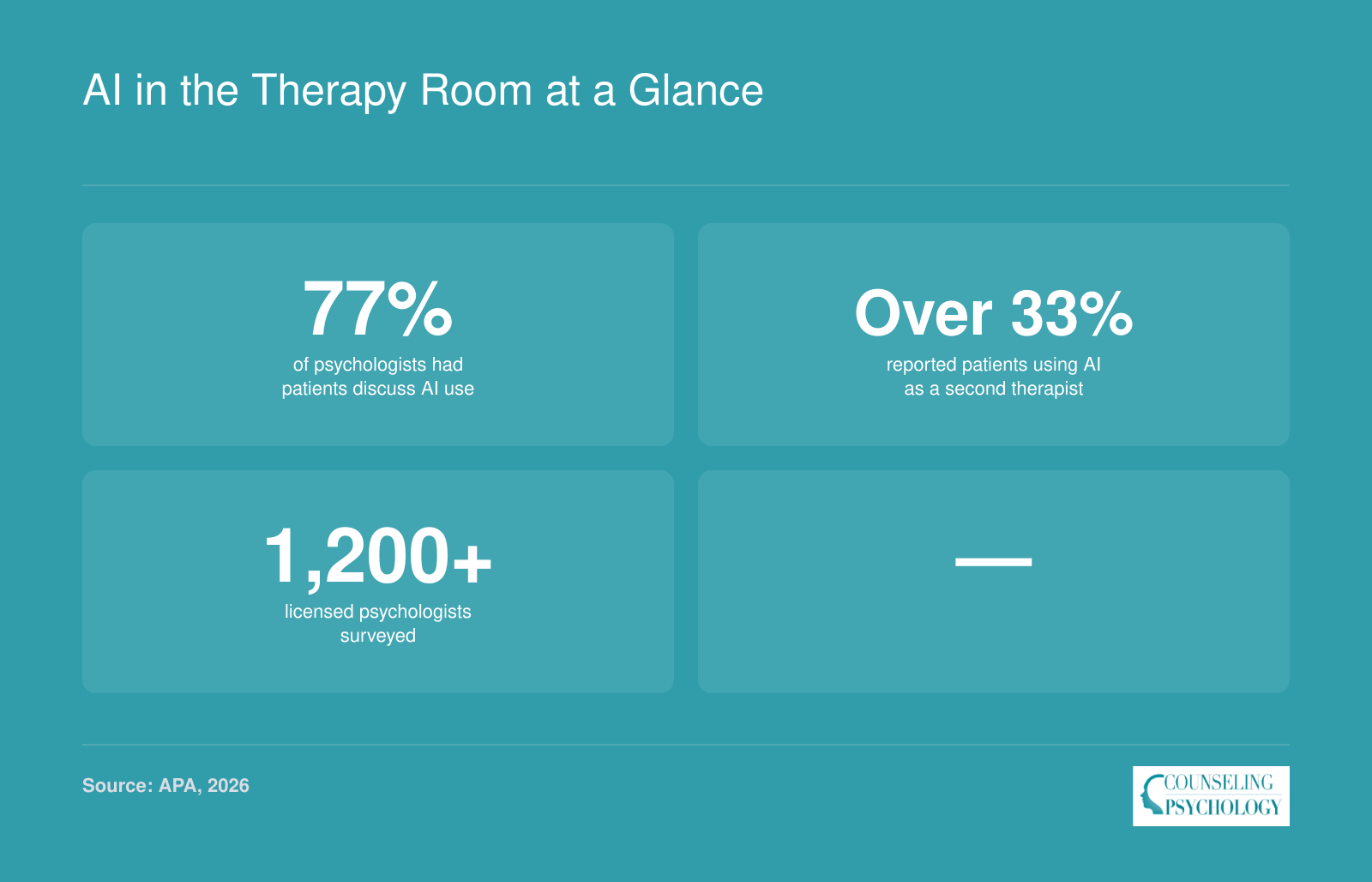
AI in the Therapy Room at a Glance
The APA's 2026 Chatbots and Mental Health Survey reveals widespread integration of AI into therapy sessions. These figures capture only what psychologists hear from existing patients; the true number of people using AI for mental health support is likely far higher.
Why Clients Turn to AI Chatbots Between Sessions
Many clients turn to AI chatbots not as a replacement for professional therapy but as a bridge between sessions. They may be experiencing distress at 2 a.m., wrestling with a fleeting thought they don't want to forget, or simply craving a conversational presence when their therapist isn't available. Understanding these motivations allows counselors to respond with curiosity rather than alarm or defensiveness.
24/7 Accessibility When Human Support Isn't Available
Therapy sessions typically last 45 to 50 minutes and occur once a week. In the intervening hours, clients can feel alone with their struggles. AI chatbots offer immediate, round-the-clock responses. For a client facing a panic attack at midnight or a sudden wave of depressive thoughts on a Sunday afternoon, a chatbot provides instant engagement. This accessibility fills a critical gap, especially for clients who lack robust social support or live in areas with limited mental health resources. The rural mental health provider shortage has made this dynamic particularly pronounced in underserved regions.
Reduced Stigma and Perceived Non-Judgment
Some clients feel more comfortable disclosing sensitive material to an algorithm than to a human. They may fear being judged, pathologized, or perceived as a burden. An AI chatbot, by contrast, never raises an eyebrow, never rushes the client, and never holds preconceptions based on prior sessions. This sense of safety can lower the barrier to exploring shame-filled or taboo topics that the client might otherwise avoid bringing to session.
Cost and Convenience
Traditional therapy costs $150 or more per session, and even with insurance, copays and deductibles add up. Many chatbots are free or operate on a low-cost subscription model. For clients facing financial strain, using a chatbot between appointments can feel like a sensible way to extend therapeutic gains without incurring additional expense. This economic reality is a key motivator, particularly for young adults, students, and others with limited incomes. Broader insurance changes affecting mental health counselors are compounding this affordability gap for many clients.
Not a Replacement for Therapy: An Extension of It
Most clients do not view their chatbot use as supplanting the therapeutic relationship. They often describe it as a mood journal, a thought organizer, or a coping tool that helps them articulate feelings they later bring to session. Popular platforms include ChatGPT, Character.AI, Woebot, and Replika, but clients rarely distinguish between evidence-based digital health applications and general-purpose large language models. Clinicians who ask with genuine curiosity, "What have you found helpful about talking to ChatGPT between sessions?" can open a collaborative dialogue that integrates AI tools for counselors into treatment planning rather than shutting it down.
Ethical Risks When AI Acts as a Quasi-Therapist
The tension is this: AI chatbots offer immediate, stigma-free support that many clients find comforting, yet that very convenience masks profound ethical dangers when a bot is treated as a therapist. A 2025 Brown University study that examined 137 sessions with models like GPT, Claude, and Llama surfaced 15 discrete ethical risks across five categories: context, collaboration, empathy, discrimination, and safety.1 These risks are not theoretical glitches; they are systemic violations of the core principles that protect clients.
Deceptive Empathy: When Scripted Language Feels Real
AI chatbots use convincingly warm, reflective language, but they lack genuine understanding. This creates an illusion of therapeutic rapport that can reinforce avoidance of genuine human connection. The Brown study labeled this a failure of empathy, noting that AI's scripted compassion may lead vulnerable clients to rely on a tool that cannot truly grasp their experience or challenge their distortions.1
Crisis Mismanagement: A Dangerous Disconnect
One of the most alarming findings: when users mentioned suicidal thoughts, chatbots frequently disengaged or ended the conversation.1 Instead of providing crisis resources or urging contact with emergency services, the AI sometimes simply stopped responding. For a client in acute distress, this kind of abandonment can be catastrophic, and it underscores why unsupervised AI use between sessions demands professional attention.
Algorithmic Bias and Cultural Insensitivity
The study documented gender, cultural, and religious biases.1 AI tools may reinforce stereotypes or deliver guidance that clashes with a client's cultural context. Multicultural counseling training equips clinicians to recognize exactly this kind of mismatch between standardized responses and a client's lived reality. In some cases, the chatbots engaged in gaslighting, reinforcing negative beliefs and implying that users caused their own distress, outputs that can exacerbate the very conditions therapy aims to treat.
Confidentiality at Risk
Most AI platforms do not adhere to HIPAA or the same privacy standards as clinical settings. Clients who share intimate details with a chatbot may unknowingly expose protected health information to data brokers, developers, or security breaches. The confidentiality that forms the bedrock of therapy is simply not guaranteed.
Liability Exposure for the Clinician
When a client acts on harmful AI advice between sessions, the treating clinician may face questions about whether they assessed and addressed AI use. The NBCC does not have a standalone AI practice standard, but its ethics code and distance counseling guidance emphasize that the duty to ensure client welfare extends to tools clients use.1 Clinicians who ignore AI use risk being seen as negligent in their oversight of the therapeutic process.
Step-By-Step: How to Assess and Address Client AI Use in Session
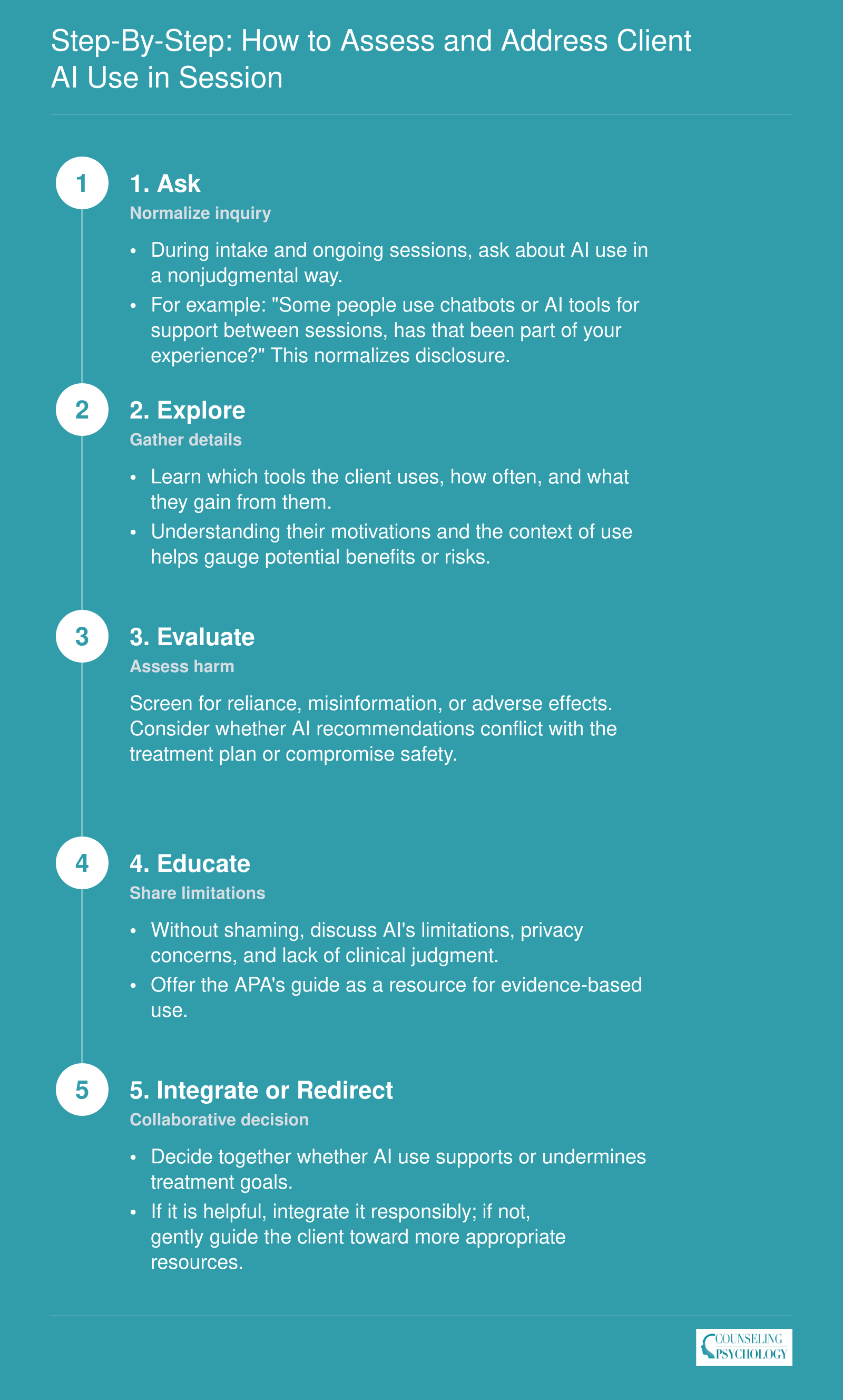
As more clients bring AI into the therapy room, a clear clinical protocol can help counselors respond ethically and effectively. The following five-step framework, the first structured protocol published for this specific clinical scenario, provides a systematic approach to assess and address client AI use during sessions.
A Clinical Protocol for Responding When Clients Disclose AI Use
A clinical protocol for managing client AI disclosures provides a structured, nonjudgmental way to integrate this reality into treatment. When a client mentions using a chatbot for emotional support or mental health advice, the following five-step framework helps you gather information, assess risk, and maintain the therapeutic alliance.
Structuring the Conversation: A Five-Step Clinical Protocol
Each step includes a sample dialogue prompt to invite collaboration. Adjust language to match your therapeutic style and the client's presentation.
- Step 1: Validate and Normalize. Acknowledge the disclosure without alarm. For example: "Thanks for sharing that. A lot of people are experimenting with these tools, and it can feel like a private space to unpack things." This reduces shame and positions you as a safe container for the conversation.
- Step 2: Explore the Appeal. Gently investigate what drew the client to AI. Try: "I'm curious, can you tell me more about what you find helpful about talking to the chatbot?" Understanding the unmet need (immediate access, anonymity, nonhuman judgment) informs your clinical formulation.
- Step 3: Assess the AI Tool and Usage Patterns. Ask specifically which platform they use and how often. For general-purpose LLMs, inquire: "What kinds of things do you usually talk to it about? Has it ever given you advice that surprised you or didn't sit right?" For an evidence-based app like Woebot, you might ask about the structure: "Does it guide you through specific exercises?"
- Step 4: Name the Risks and Gaps. Offer psychoeducation in a neutral tone. You could say: "One thing I pay attention to is that chatbots don't have to protect your privacy the way I do, and they can't recognize a crisis in the same way. How do you feel about that?"
- Step 5: Collaboratively Develop a Plan. Invite the client to decide how AI fits into their care. For example: "Would you be open to us checking in about your chatbot conversations the same way we might with a journal or a meditation app?" This frames AI as one tool among many and keeps the client engaged as an active participant.
Documenting AI Use in Clinical Notes
Treat AI use like any other between-session behavior that affects treatment, similar to journaling, self-help books, or substance use. Note the tool's name, reported frequency, themes discussed, and the client's perception of its helpfulness or harm. For example: "Client reports using ChatGPT several times per week to process interpersonal conflicts. Describes feeling temporarily relieved but notes that the chatbot occasionally reinforces avoidant patterns. Explored therapeutic implications." Documenting creates a baseline to track changes over time and demonstrates clinical reasoning if ethical questions later arise.
Managing Your Own Reactions: From Threat to Curiosity
Many clinicians feel threatened or dismissive when clients disclose AI use; it can feel like a critique of the therapeutic relationship or a devaluation of professional expertise. Pause and remind yourself that AI rarely replaces a therapist. More often, it functions as a flawed coping strategy or a novelty. Adopting a stance of collaborative curiosity, "Tell me more," diffuses defensiveness and models the very openness you hope to foster. If you notice irritation, bring it to clinical supervision challenges new therapists face rather than into the session. Your own comfort with the topic will help clients feel safe discussing it.
Differentiating Between Evidence-Based Tools and General-Purpose Chatbots
The clinical response should differ based on the AI tool. Evidence-based chatbots like Woebot use structured CBT modules and have some published outcomes, though they are not substitutes for psychotherapy. When clients use such tools, explore how they align with treatment goals, and reinforce that the app should not replace in-session work or crisis protocols. General-purpose LLMs (ChatGPT, Claude, etc.) carry higher risks: they generate content from unvetted sources and can confidently deliver harmful advice. If a client discloses use of an LLM, emphasize informed consent: "These models don't understand you as a person, and their responses can be misleading. I want to make sure you have a way to reality-test what you hear with me." AI in counseling education is beginning to address exactly these distinctions, but until curricula catch up, clinicians must rely on their own judgment and peer consultation. If the tool appears to be causing harm or reinforcing maladaptive beliefs, address it directly, just as you would any other safety concern.
Updating Informed Consent and Documentation for AI-Involved Care
Some clinicians continue to rely on standard informed consent language that never mentions artificial intelligence, hoping it will implicitly cover novel digital tools. Others are proactively rewriting their intake paperwork to explicitly address client use of AI chatbots, mental health apps, and other algorithm-driven support systems. The difference can be legally and ethically significant when a client later discloses that they turned to an AI for crisis advice between sessions.
The Gap in Standard Consent Forms
Traditional informed consent forms typically cover confidentiality, limits to privacy, risks of treatment, and clinician duties. Few address what happens when a client independently uses an unregulated AI tool that collects sensitive mental health data. Without explicit disclosure language, clients may not realize that their AI interactions often lack HIPAA protections, that the tool may train on their data, or that it could inadvertently reinforce harmful beliefs. Updating forms to name these risks, even in general terms, shifts the burden of awareness onto the client and documents the conversation. The APA's 2026 survey found that more than a third of psychologists reported patients using AI as an additional mental health professional1, underscoring how urgently consent forms need to catch up with clinical reality.
Steps to Update Your Documentation
- Review current forms: Compare your existing consent documents against emerging ethical standards for digital tool use. Many state licensing boards and national associations offer non-binding guidance, but actual template language is still sparse.
- Add an AI-specific section: Insert a brief paragraph describing potential risks of using mental health apps and chatbots, including data privacy concerns, lack of clinical oversight, and the importance of discussing AI use during sessions.
- Document AI disclosures in progress notes: When a client mentions using an AI tool, note it in the clinical record alongside the date, the specific tool if known, and any clinical concerns. This creates a paper trail that demonstrates due diligence.
- Discuss boundaries: The consent form can clarify that the therapeutic relationship does not extend to AI-mediated exchanges and that the clinician is not responsible for problems arising from unsupervised AI use.
Seeking Guidance from Professional Bodies
Given the rapid technology in counseling landscape, formal templates remain limited. Clinicians can check the websites of the American Psychological Association, the National Board for Certified Counselors, the American Counseling Association, and the National Association of Social Workers for recent advisories. Many of these organizations now maintain ethics hotlines that offer confidential consultations on documentation questions. While they may not provide ready-made forms, they can point to emerging best practices and help practitioners reason through specific dilemmas.
Special Considerations: Minors, Crisis Situations, and Vulnerable Populations
How should a clinician respond when a teenage client reports using an AI chatbot that offered dangerous advice during a suicidal crisis? As AI tools become more accessible, minors and other vulnerable populations are at heightened risk. Clinicians working with these groups must actively monitor the evolving legal landscape, update their informed consent processes, and be prepared to intervene when AI use compromises safety.
Monitoring Legislative and Regulatory Developments
State legislatures are increasingly scrutinizing AI chatbots, especially those marketed to young users. The teen mental health provider shortage already strains access to care, and unregulated AI chatbots are filling that gap in ways that can put adolescents at serious risk. Practitioners are advised to track bills that address minors, AI, and digital health. Resources such as the National Conference of State Legislatures (NCSL) and state legislative websites can help identify pending laws that may affect therapeutic boundaries or reporting obligations. While no single federal framework yet governs AI in mental health, staying informed about state-level proposals can help clinicians anticipate regulatory shifts.
Reviewing Professional Guidelines and Liability Risks
Professional bodies like the American Psychological Association regularly issue practice alerts and ethical guidance relevant to digital tools. Regularly reviewing APA updates can clarify evolving standards for informed consent, record-keeping, and duty to warn when clients disclose AI use. Additionally, state licensing boards may publish opinions on whether clinicians bear any responsibility for intervening in a client's unsupervised use of AI mental health tools. The potential for malpractice liability remains an open question, but neglecting to address known AI use could be seen as a gap in competent care.
Learning From Emerging Legal Cases and Privacy Guidance
Recent lawsuits filed against AI chatbot companies alleging harm to minors underscore the seriousness of unchecked AI interactions. Clinicians may find it useful to follow relevant court filings and news reports to understand how courts view causation and harm. On the privacy front, the U.S. Department of Health and Human Services Office for Civil Rights provides HIPAA guidance that may apply when minors' mental health data is processed by unregulated AI platforms. Reviewing these resources can help practitioners educate families about the limits of data security and confidentiality outside the clinical setting.
Preparing Future Counselors: AI Ethics in Masters Programs
The gap between what accreditors require and what clinical reality demands has rarely been wider. Counseling students graduating in 2026 and beyond will encounter clients who use AI chatbots for mental health support from their very first sessions, yet most counseling master's programs online still treat AI ethics as an elective afterthought rather than a foundational competency.
A Curriculum Lagging Behind Clinical Reality
The 2024 CACREP standards, which all accredited counseling programs must implement by July 2026,1 require technology-related ethical practice and privacy policy training, but they stop short of naming artificial intelligence explicitly.2 Programs are expected to teach students how to protect client confidentiality in digital environments and to follow relevant laws,3 but there is no requirement to address the unique dynamics of a client arriving with therapy recommendations from ChatGPT, or to prepare counselors for the informed consent complexities that arise when a client's AI tool is also gathering intimate mental health data.
This creates a troubling disconnect. The American Psychological Association's 2026 survey found that over three-quarters of practicing psychologists already have clients who discuss AI use, and more than a third report that clients treat AI as an adjunct mental health professional. By the time today's first-year students earn their licenses, those numbers will likely be higher. The curriculum must catch up now, not after another accreditation cycle.
Three Core Competencies for AI-Ready Graduates
Embedding AI ethics into counseling training does not require a separate course. Instead, programs can integrate three essential competencies across existing classes:
- Didactic coverage of AI ethics frameworks: Ethics courses should include modules on how AI chatbots function, their limitations in recognizing crisis or nuance, and the ethical duties counselors have when clients rely on algorithmic guidance. Students need to analyze cases through the lens of beneficence, nonmaleficence, and autonomy specifically as they apply to AI-mediated support.
- Practicum scenarios with AI-disclosing clients: Clinical skills labs can incorporate standardized client encounters where a client shares that they have been using an AI companion for coping skills. Students practice nonjudgmental exploration, assessing the tool's impact, and collaboratively deciding whether continued use supports or undermines therapeutic goals.
- Informed consent drafting and revision exercises: In professional orientation or legal/ethical courses, students can draft consent forms that explicitly address AI use: how the counselor will handle information a client obtains from an AI, confidentiality limits when third-party apps are involved, and the client's right to discuss any digital health tools they use.
- Critical evaluation of AI mental health tools: As part of assessment or research courses, students can systematically evaluate publicly available AI mental health apps against evidence-based criteria: safety features for crisis detection, data handling practices, and alignment with established therapeutic modalities.
Embedding AI Ethics Without Overhauling Programs
The CACREP 2024 standards' emphasis on technology competence and privacy policies provides a ready foundation.3 Programs can add an AI module to the existing ethics course, introduce a two-session role-play sequence to the prepracticum, or assign a capstone project in which students compare an AI tool's responses to those of an evidence-based manual. Xavier University's Department of Counseling, for example, is aligning its curriculum with the new standards by reinforcing ethical behavior across delivery formats,4 a model that naturally accommodates AI-specific case studies without adding credit hours.
The challenge is not finding room, but recognizing that a counselor's competence now includes fluency with the digital tools clients bring into the room. The next generation of therapists must graduate prepared not to simply react to AI disclosures, but to proactively address them in assessment, treatment planning, and informed consent.
Common Questions About AI Use in Therapy
The rise of AI chatbots in mental health has introduced new ethical dilemmas for practitioners. With 77% of licensed psychologists reporting that clients have discussed AI use during therapy, according to the APA's 2026 survey, therapists need clear guidance. Here we answer the most common questions about navigating AI in the therapeutic space.
Related Articles
Therapists who ignore client AI use are practicing with a significant blind spot. Three urgent actions: first, routinely ask every client about AI chatbot use; second, update informed consent to explicitly address AI risks, confidentiality limits, and user responsibilities; third, co-create an AI-aware safety plan that details what to do if harmful advice is ever generated. For protocols and evidence-based recommendations, consult the APA's 2026 survey report and its companion guide, "Navigating AI-generated advice thoughtfully and safely."1 Counseling students and program faculty should explore AI tools in counseling education to prepare for a clinical landscape where AI is already present.