
What you’ll learn in this article…
- Fully online neuropsychology doctorates are extremely rare; nearly every program requires in-person practica and internship hours.
- Board certification through ABCN typically takes 10 to 13 years from your first psychology course.
- APA accreditation is critical because many state licensing boards will not accept degrees from unaccredited programs.
- Expect total program costs ranging from roughly $100,000 to over $250,000, offset by strong long-term neuropsychologist earnings.
Neuropsychology sits at the intersection of clinical psychology and neuroscience, requiring doctoral-level training in cognitive assessment, brain-behavior relationships, and rehabilitation. Board certification through the American Board of Clinical Neuropsychology typically demands a decade or more of education, supervised practice, and post-doctoral fellowship hours.
For working professionals or those with geographic constraints, the appeal of online doctoral study is obvious. The reality is less straightforward: truly online neuropsychology doctorates are scarce. Most programs offering coursework remotely still require hundreds to thousands of in-person clinical hours, practica rotations, and APA-accredited internships that cannot be completed virtually. Students already exploring online doctoral programs in psychology will find that neuropsychology tracks add even more in-person requirements on top of that baseline.
Understanding which programs exist, what hybrid really means, and how accreditation affects licensure eligibility is essential before committing to a five-to-seven-year program.
Best Online Neuropsychology Doctorate Programs
Fully online doctoral programs with a dedicated neuropsychology concentration are exceptionally rare. Most programs that touch on brain-behavior relationships, cognitive assessment, or neurodevelopmental disorders deliver coursework through hybrid or online formats but still require substantial in-person components for practica, clinical residencies, and predoctoral internships. The programs below represent online-delivery-eligible doctoral options in psychology and education whose curricula overlap with neuropsychology-relevant content, including cognitive and behavioral neuroscience, clinical assessment, school-based neuropsychological evaluation, and learning science. Students aiming for board certification in clinical neuropsychology should expect to layer postdoctoral training onto any of these degrees.
Details
- NCES-IPEDS federal institutional data — nces.ed.gov
- College Scorecard graduate earnings — collegescorecard.ed.gov
- Independent program research
- Internal program database

University of Southern Maine
The University of Southern Maine prepares doctoral-level school psychologists through a PsyD that emphasizes comprehensive cognitive, academic, and socio-emotional assessment, making it one of the most functionally relevant pathways to school neuropsychology-type practice on this list. Training meets both NASP and APA guidelines, and graduates can pursue professional credentialing in multiple states. An optional MS in Educational Psychology earned en route strengthens the foundation in learning, cognition, and educational assessment that underpins pediatric neuropsychology work. Practica and the 1,500-hour predoctoral internship span schools and mental health agencies across Maine and New England.
- Hybrid format with New England practicum sites
- 111 graduate credits including dissertation research
- 600 hours of supervised practica required
- 1,500-hour predoctoral internship built into plan
- Meets NASP and APA credentialing standards
- Optional MS in Educational Psychology en route
- In-state tuition approximately $9,918 per year
School Psychology, PsyD — Hybrid

Northern Arizona University
Northern Arizona University's PsyD in Clinical Psychology is a hybrid doctoral program housed at the North Valley campus in Phoenix, training students across 107 credit hours that integrate evidence-based assessment, intervention, and interprofessional collaboration. The program is oriented toward Southwest practice, with clinical placements in Arizona medical centers, VA settings, and community agencies where neuropsychological assessment populations (brain injury, older adults, chronic illness) are common. NAU explicitly prepares graduates for Arizona psychologist licensure, a useful stepping stone for postdoctoral neuropsychology fellowships in the region. In-state tuition runs roughly $13,023 per year, keeping costs well below many private PsyD alternatives.
- Hybrid format, 107 total units required
- 2,000 hours of supervised clinical practice
- Training at Arizona medical and VA settings
- Prepares graduates for Arizona psychologist licensure
- Strong interprofessional healthcare emphasis
- Minimum 3.0 undergraduate GPA for admission
- Median graduate debt of $19,000 institution-wide
Doctor of Psychology in Clinical Psychology — Hybrid

University of the Pacific
University of the Pacific offers a four-year PsyD in Counseling Psychology through a hybrid model that pairs online coursework with one to two days of weekly on-campus sessions in Stockton, California. Students receive guaranteed internship placements, typically at California and West Coast sites that include hospitals and rehabilitation centers where neuropsychological assessment skills can be developed. The program is structured to meet California Board of Psychology licensure requirements, an important detail for students who plan to pursue postdoctoral neuropsychology specialization in one of the country's largest markets for the field. Institutional median earnings ten years after enrollment reach approximately $78,445.
- Hybrid format with 1-2 in-person days weekly
- Four-year program with guaranteed internship
- Aligned with California Board of Psychology standards
- Comprehensive clinical training in diverse settings
- Expert practitioner faculty
- Sticker tuition $55,452; net price around $25,447
- Program-level earnings data not yet available
PsyD in Counseling Psychology — Hybrid

George Mason University
George Mason University sits within a broader neuroscience ecosystem that includes a separate PhD in Psychology with a Cognitive and Behavioral Neuroscience concentration, giving Education PhD students access to cross-college expertise in brain-behavior research. The hybrid PhD in Education with an Educational Psychology specialization focuses on research methodologies, learning science, and human development, areas that intersect with cognitive and educational neuropsychology. Personalized study plans and practical internships let students tailor their doctoral work toward cognition or assessment topics. The university also publishes state-by-state licensure disclosures, a transparency signal that matters for students planning regulated neuropsychology practice later.
- Hybrid delivery with personalized study plans
- Requires a completed master's degree for admission
- Emphasis on research methodologies and learning science
- Practical internships beyond traditional coursework
- Access to Mason's Cognitive and Behavioral Neuroscience faculty
- In-state tuition roughly $17,964; out-of-state $40,308
- Financial aid options available for doctoral students
PhD in Education, Educational Psychology Specialization — Hybrid

University of Memphis
The University of Memphis delivers its PhD in Educational Psychology and Research in both online and face-to-face formats, offering 54 credit hours of training in human development, cognition, motivation, and advanced research methods. The program's flexibility supports part-time enrollment and assistantship-funded study. Memphis participates in the Academic Common Market, potentially allowing students from certain Southern states to pay in-state rates if their home state lacks a comparable program. Research groups in cognitive science and learning processes provide natural overlap with educational neuropsychology topics such as reading disorders, language processing, and learning disabilities.
- Available fully online or face-to-face
- 54 credit hours including dissertation
- Part-time and full-time enrollment options
- Assistantship funding opportunities
- Academic Common Market may reduce out-of-state cost
- Faculty apprenticeship model for research training
- In-state tuition approximately $11,628 per year
- Fall and spring admission deadlines
PhD in Educational Psychology and Research — Online

Wichita State University
Wichita State University's EdD in Educational Leadership with an Educational Psychology track is a hybrid, three-year program requiring 55 graduate hours and no GRE. The curriculum covers advanced research methodology, cognition, and data-driven decision making, topics that align with the assessment and evaluation skill set used in school-based neuropsychological practice. Bordering-state and Midwest tuition discount programs can make the degree affordable for regional students, with in-state tuition starting around $7,986. While the program does not include a formal neuropsychology concentration, its emphasis on customizable interdisciplinary electives lets students direct coursework toward cognition or assessment.
- Hybrid delivery designed for three-year completion
- 55 total graduate hours with dissertation
- No GRE required for admission
- Customizable interdisciplinary emphasis areas
- Advanced research methodology training
- Mentorship and collaborative learning model
- In-state tuition around $7,986; out-of-state $16,873
EdD in Educational Leadership, Educational Psychology Track — Hybrid

Regent University
Regent University offers a fully online PhD in Counseling and Psychological Studies with an Industrial-Organizational concentration, spanning 51 credit hours and 150 hours of field experience. The program integrates a Christian worldview with scientific research on workplace behavior and organizational performance. Importantly, this degree does not qualify graduates for clinical psychologist or counselor licensure in any state, so it is not a direct pathway to clinical neuropsychology practice. It may appeal to students whose interest in neuropsychology is research-oriented or who plan to pair it with a separate licensure-bearing credential.
- 100% online doctoral program
- 51 total credit hours required
- 150 hours of supervised field experience
- Christian worldview integrated into curriculum
- Does not lead to clinical or counselor licensure
- Workplace psychology and organizational focus
- Tuition approximately $17,869 per year
PhD in Counseling & Psychological Studies, Industrial-Organizational Concentration — Online

Liberty University
Liberty University's fully online PhD in Psychology is available in several concentrations, including Industrial/Organizational, Developmental Psychology, and Behavioral Health Leadership, each requiring 60 credit hours delivered in eight-week course blocks. The programs are research and leadership oriented and explicitly do not meet state licensure requirements for clinical, counseling, or school psychology practice. Developmental Psychology coursework touches on neurodevelopmental topics conceptually relevant to pediatric neuropsychology research, though no formal neuropsychology track exists. Military tuition discounts and the option to transfer up to 50% of credits add financial flexibility.
- 100% online, 60 credit hours
- 8-week course blocks for scheduling flexibility
- No standardized testing required for admission
- Tuition listed at $595 per credit hour
- Transfer up to 50% of credits from prior programs
- Does not lead to psychologist licensure
- 100% online with optional on-campus intensives
- 60 credit hours focused on lifespan development
- Covers neurodevelopmental and behavioral topics
- Military discounts available
- Biblical worldview integration
- Non-licensure research doctorate
- 100% online, SACSCOC-accredited institution
- 60 credit hours in leadership and research
- Prepares for academic and administrative roles
- Focus on health behavior and policy
- No tuition increase reported for nine years
- Non-licensure doctoral pathway
PhD in Psychology, Industrial/Organizational Concentration — Online
PhD in Psychology, Developmental Psychology Concentration — Online
PhD in Psychology, Behavioral Health Leadership Concentration — Online

Western Michigan University
Western Michigan University's PhD in Industrial Organizational Behavior Management is a hybrid program rooted in the university's nationally recognized behavior analysis tradition. The curriculum covers personnel selection, training development, systems analysis, and ethical research, totaling 30 credit hours of coursework plus 12 dissertation hours. While not a clinical or neuropsychology degree, WMU's depth in behavior analysis can intersect with neurorehabilitation and functional assessment contexts. Applicants need a related graduate degree and a minimum 3.0 GPA.
- Hybrid format at Kalamazoo campus
- 30 credit hours of coursework plus 12 dissertation hours
- Strong behavior-analytic research tradition
- Prepares for consulting, teaching, and leadership
- Minimum 3.0 graduate GPA required
- In-state tuition approximately $20,103 per year
- Organizational performance and systems focus
PhD in Industrial Organizational Behavior Management — On-Campus

Simmons University
Simmons University's fully remote PhD in Behavior Analysis is a 48-credit, research-intensive program that positions graduates for the BCBA-D credential and advanced roles in experimental behavior research. The faculty lead projects in stimulus equivalence and behavioral medicine, areas that overlap with neuropsychology in populations such as individuals with autism spectrum disorder, intellectual disability, or acquired brain injury. Admission requires a master's degree in a related field plus active licensure or certification, drawing a cohort of experienced practitioners who often already work in neurodevelopmental or rehabilitation settings. The 9:1 student-to-faculty ratio ensures close research mentorship.
- Fully remote online program
- 48 credit hours with experimental research focus
- Pathway to BCBA-D credential
- Requires master's degree and active certification
- Faculty research in behavioral medicine
- 9:1 student-to-faculty ratio
- Graduates pursue roles in research, education, and clinical work
PhD in Behavior Analysis — Online
Psyd Vs. PHD in Neuropsychology: Key Differences
The real tension here is not prestige versus practicality. It is figuring out which degree structure fits how you learn, how you want to work, and what you can realistically afford over a five-to-seven-year program.
Training Philosophy and Research Intensity
The PhD follows a scientist-practitioner model. Roughly half your training centers on producing original research, and the degree culminates in a traditional dissertation based on empirical work you design and defend. The PsyD follows a practitioner-scholar model: clinical training takes priority, and the capstone is typically a clinical research project or applied dissertation rather than novel experimental research. Neither approach is inherently more rigorous, but they develop different professional strengths. A PhD graduate may be better positioned for academic or research-heavy roles, while a PsyD graduate often enters direct clinical practice with more accumulated supervised hours. For a broader look at how these credentials compare across the discipline, see our overview of clinical psychology doctorate programs.
Program Length and Funding
PhD programs in neuropsychology typically run five to seven years and frequently include funding packages, teaching or research assistantships, and tuition waivers. PsyD programs, especially those at professional schools or private universities, are more likely to operate on a tuition-driven model, meaning you pay out of pocket and graduate carrying significantly more debt. Funding is not guaranteed in either track, but the gap is real and worth investigating before you apply.
APPIC Internship Match Rates
The APPIC internship year is a required step toward licensure, and match rates differ by degree type. According to Division 54 survey data, clinical PhD applicants match at roughly 97 percent, while clinical PsyD applicants match at around 85 percent.1 That gap has persisted across more than a decade of APPIC match data.2 The difference reflects several factors: program prestige, research productivity of applicants, and the sheer number of PsyD graduates competing for the same internship slots each year. If you pursue a PsyD, go in with a realistic plan for the internship match cycle.
Board Certification Eligibility
One misconception worth clearing up directly: the American Board of Professional Neuropsychology and the American Board of Clinical Neuropsychology (ABCN) do not treat the PsyD as a lesser credential. Both the PhD and PsyD qualify for ABPP/ABCN board certification in neuropsychology, provided your training meets Houston Conference guidelines. What licensing boards and certifying bodies evaluate is whether your program was APA-accredited and whether your supervised experience meets the required benchmarks. Degree type matters less than training quality and accreditation status.
Choosing Between the Two
If you want a research career, tenure-track faculty positions, or neuroimaging lab leadership, the PhD is the expected credential. If your goal is full-time clinical neuropsychological assessment in hospital, rehabilitation, or outpatient settings, a well-accredited PsyD from a program with strong practicum placements is a legitimate path. Our guide on how to become a neuropsychologist walks through the full licensure and training timeline for both tracks. Either way, APA accreditation is non-negotiable if you plan to pursue licensure and board certification in the United States.
Questions to Ask Yourself
Does your career goal lean toward clinical assessment and patient care, or toward academic research and publishing?
Can you relocate or travel periodically for required in-person practica, internship, or residency rotations?
Are you prepared to invest five to seven years, including pre- and post-doctoral supervised hours, to earn board certification?
Online Vs. Hybrid Format: What to Expect
Online courses offer flexibility, but neuropsychology doctoral programs cannot be completed entirely from a laptop. Every program, whether labeled online or hybrid, mandates substantial in-person clinical training. The coursework may be delivered through virtual classrooms, but the practical competencies required to work with patients must be developed on site under supervision. If you are considering an online path, it is essential to understand that you are not signing up for a fully remote degree. Instead, you are enrolling in a program that combines online academic work with intensive, face-to-face clinical experiences and occasional on-campus residencies.
Where Online Ends: In-Person Clinical Hours Are Non-Negotiable
A doctorate in neuropsychology requires hands-on practice to master assessment, diagnosis, and intervention. All accredited programs include at least two to three practicum experiences, totaling 600 to 1,500 hours of direct clinical work. These placements typically begin in the first or second year and must include a neuropsychology-specific practicum. The supervisor must be a board-certified or fellowship-trained neuropsychologist, and supervision occurs weekly. After practica, you will complete a one-year, full-time pre-doctoral internship (often 1,500 to 2,000 hours) that is usually secured through the national APPIC Match. For those pursuing board certification, an additional two-year postdoctoral fellowship in clinical neuropsychology follows the doctorate. All of these components happen in clinics, hospitals, or other health care settings, meaning you must be physically present.
Securing a Clinical Site Near You
Because online programs serve students across multiple states, they rarely assign everyone to a single training site. Instead, students often find their own local placements, though some schools offer program-arranged or centralized networks to assist. The site must meet the program's clinical standards and, ideally, align with APA accreditation expectations. You will need to work with your program's director of clinical training to ensure the site offers appropriate neuropsychological assessment and therapy hours. Living in a rural area or a region with few board-certified neuropsychologists can make this process harder, so you may need to travel or even temporarily relocate.
On-Campus Residencies: The Hybrid Commitment
Apart from clinical placements, most hybrid programs require periodic in-person residencies on the institution's campus. These are typically scheduled annually and total two to four over the length of the program. Each residency lasts three to seven days and involves intensive skill-building workshops, supervision, cohort meetings, and sometimes proctored examinations. Travel, lodging, and meals are the student's financial responsibility. While these residencies are brief compared to full-time on-campus study, they are mandatory and demand careful planning, especially for those with jobs or family obligations.
The Time Commitment: 4 to 7 Years Is Normal
Programs are designed to take five to seven years of full-time study, but observed completion times often stretch to six to eight years. Several factors can extend your timeline: part-time enrollment, difficulty securing a local practicum, or a delay in matching for internship. The internship itself is a full-year, full-time commitment that cannot be accelerated. If you continue to postdoctoral training, you should budget roughly a decade from entry into the doctoral program to eligibility for board certification in clinical neuropsychology. The online coursework component can offer geographic and scheduling flexibility, but the clinical training milestones are rigid and time-intensive. Students exploring related clinical psychology PhD programs will find a similar hybrid structure and clinical hour requirements.
Related Articles
Accreditation and Licensure: What Online Graduates Need to Know
Will graduating from an online neuropsychology doctoral program affect your ability to get licensed as a psychologist? The short answer is: it depends heavily on the program and the state where you plan to practice.
Why APA Accreditation Matters So Much
APA accreditation is the recognized standard for doctoral psychology training in the United States. Programs that carry it have met rigorous benchmarks in curriculum, supervision, and training quality. That status has real downstream consequences: many state psychology boards use APA accreditation as a shortcut for vetting applicants, most internship sites give preference (and some give exclusivity) to students from accredited programs, and the path to board certification in neuropsychology through ABPP becomes more straightforward.
The complication for prospective students is that very few online or hybrid neuropsychology-specific doctoral programs currently hold APA accreditation. Graduates of non-accredited programs often face additional scrutiny from state boards, including coursework audits, extra supervised hours, or case-by-case review.1 This is not an automatic disqualification, but it adds time, cost, and uncertainty to an already long training path.
State Licensure: Not a Uniform Process
Licensure requirements are set at the state level, and the variation is significant. Some states operate with relatively flexible standards regarding accreditation status. Texas and Colorado, for example, do not require APA accreditation outright and have historically been more accessible for graduates of non-accredited programs. Arizona, Nevada, and Utah tend to fall in a similar category.
Other states are considerably more restrictive. New York requires programs to be registered by the state or substantially equivalent, a standard that can be difficult for online-only programs to meet without additional documentation. Massachusetts strongly prefers APA-accredited programs. New Jersey and Oregon also apply heightened scrutiny to applicants from non-accredited programs. Washington state has similarly been flagged as a more restrictive jurisdiction.
California sits in an interesting middle ground. APA accreditation is not formally required for licensure there, but applicants must log 3,000 hours of supervised experience overall, and at least 1,500 of those hours must be completed before you are eligible to sit for the licensing exam.3 That volume of required supervision is worth factoring into your planning timeline.
EPPP Eligibility and Online Graduates
The Examination for Professional Practice in Psychology (EPPP) is the licensing exam all psychologists must pass. The good news here is straightforward: there is no difference in EPPP eligibility between graduates of online programs and graduates of campus-based programs.1 Eligibility is determined by your state board based on your degree, supervised hours, and whether your program meets the jurisdiction's educational standards. The exam itself does not distinguish by delivery format.
That said, if your state board determines that your program does not meet its educational standards, you may not be cleared to sit for the EPPP at all, regardless of format. Accreditation status and program recognition remain the gatekeeping factor.
Before You Enroll, Contact Your State Board
The most practical step any prospective student can take is to contact the psychology licensing board in the state where they intend to practice, before enrolling. Ask directly whether the specific program you are considering would make you eligible for licensure. Do not rely on the program's marketing materials alone, and do not assume that licensure in one state guarantees portability to another. Students navigating related fields face similar state-level complexity, as our overview of counseling licensure requirements illustrates.
If you are weighing multiple programs, the APA's licensure guidance resources and state-specific psychology board websites are the authoritative sources. The Student Doctor Network forums also contain detailed firsthand accounts from applicants navigating this process in specific states, which can surface practical nuances that official documentation leaves out.3
The Path to Board Certification in Neuropsychology
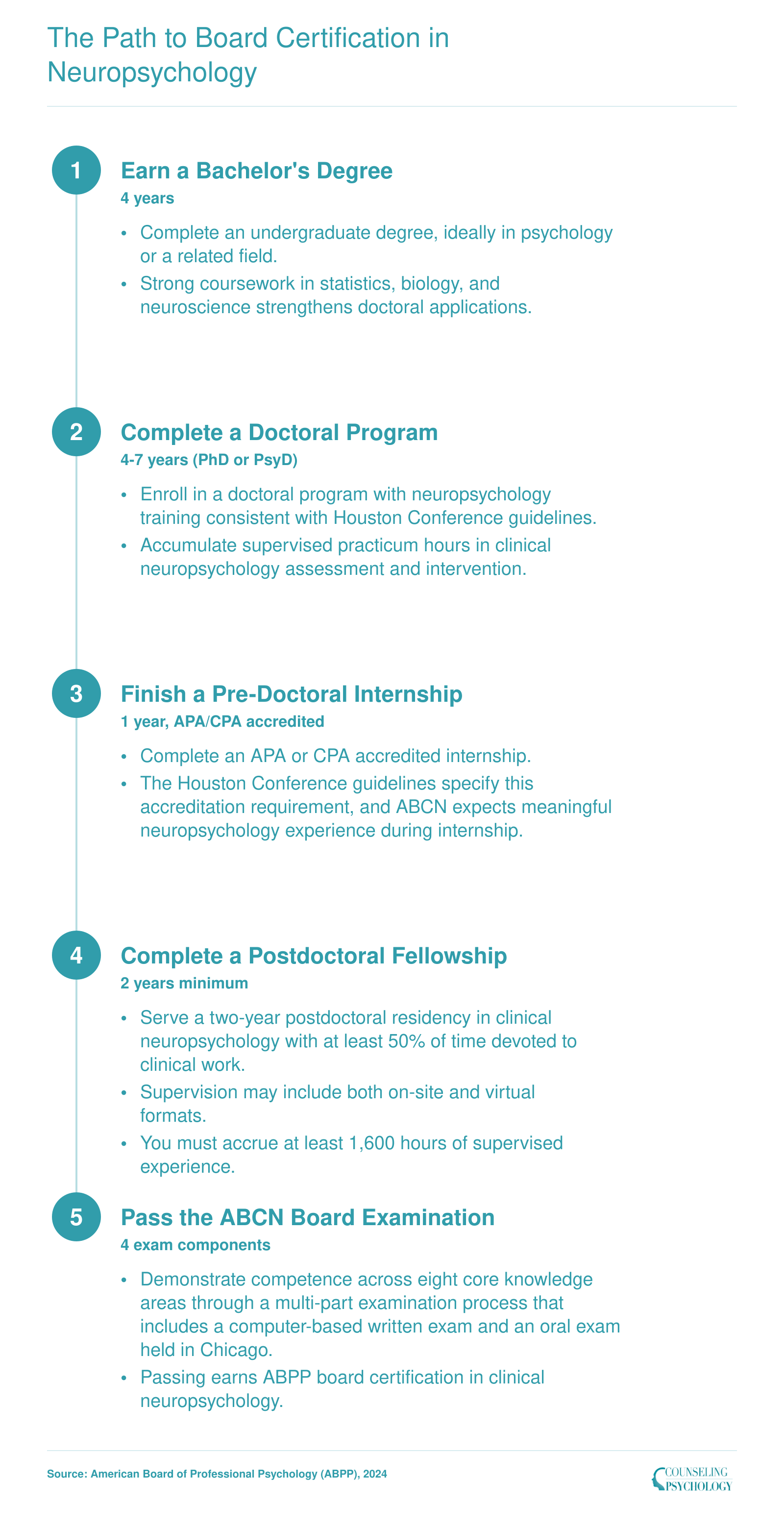
From your first psychology course to ABCN board certification, the journey to becoming a board-certified clinical neuropsychologist typically spans 10 to 13 years. The American Board of Clinical Neuropsychology evaluates candidates against training standards consistent with the Houston Conference guidelines, established in 1997, regardless of whether your doctorate is a PhD or PsyD, or whether it was earned online or on campus.
Cost, Debt, and ROI of Online Neuropsychology Doctorates
Doctoral psychology programs rank among the most expensive graduate degrees in higher education, and neuropsychology tracks are no exception. However, neuropsychologist earnings tend to be strong relative to many other psychology subfields, which can make the long-term return worthwhile. The table below uses institution-level data from IPEDS and the College Scorecard to compare tuition, median graduate debt, and median earnings ten years after enrollment. Note that net price figures reflect an institution-wide average for aid-receiving students and will vary based on individual financial circumstances. Program-level earnings data for these specific doctoral tracks is not yet available, so the earnings column reflects the broader institutional median.
| Institution | In-State Tuition | Out-of-State Tuition | Median Graduate Debt | Median Earnings (10 Yr) | Approx. ROI Ratio |
|---|---|---|---|---|---|
| Alliant International University, San Diego | $19,690 | $19,690 | $12,878 | $66,666 | 5.18 |
| University of the Pacific | $55,452 | $55,452 | $19,500 | $78,445 | 4.02 |
| George Mason University | $17,964 | $40,308 | $19,500 | $76,343 | 3.92 |
| Golden Gate University | $17,070 | $17,070 | $29,875 | $87,434 | 2.93 |
| Northern Arizona University | $13,023 | $19,306 | $19,000 | $54,384 | 2.86 |
| The Chicago School at Chicago | $35,328 | $35,328 | $20,000 | $56,899 | 2.84 |
| Capella University | $15,092 | $15,092 | $14,968 | $42,189 | 2.82 |
| National University | $16,416 | $16,416 | $25,000 | $67,548 | 2.70 |
| Concordia University, Irvine | $8,895 | $8,895 | $24,247 | $65,083 | 2.68 |
| University of Southern Maine | $9,918 | $26,676 | $19,060 | $49,958 | 2.62 |
Neuropsychology Curriculum and Houston Conference Training Standards
Online coursework and in-person clinical training are two sides of the same coin in neuropsychology. While digital platforms excel at delivering foundational knowledge, the hands-on mastery of assessment tools demands a different set of resources.
The Houston Conference Training Model
The 1997 Houston Conference on Specialty Education and Training in Clinical Neuropsychology established a consensus framework that still shapes doctoral curricula.1 The guidelines call for integrated training across three tiers: general psychology core, general clinical psychology competencies, and neuropsychology-specific expertise. The model identifies seven competency domains (assessment, intervention, consultation, supervision, research and inquiry, consumer protection, and professional development) that a neuropsychologist must develop.2 Although the Houston statement did not mandate a fixed number of supervised hours or a required list of assessment batteries, it outlined the breadth of knowledge and skill expected before independent practice.1 Board certification bodies like the American Board of Clinical Neuropsychology (ABCN) later operationalized these expectations, specifying eight core knowledge areas and a two-year postdoctoral residency with at least 50 percent of time spent in neuropsychology activities and 50 percent of evaluations involving integrative report writing.3
Core Doctoral Coursework
A neuropsychology doctoral curriculum typically weaves together neuroscience, clinical practice, and research. Foundational courses include neuroanatomy, cognitive neuroscience, and functional neuroanatomy to map brain-behavior relationships. Students then progress into neuropsychological assessment, learning to administer, score, and interpret comprehensive batteries. The Halstead-Reitan Neuropsychological Battery, Wechsler Adult Intelligence Scale (WAIS), and Wechsler Memory Scale (WMS) are standard tools, often supplemented with measures like the Boston Naming Test or the Delis-Kaplan Executive Function System. Psychopharmacology and neuropathology courses explain how medications and disease processes affect cognition and behavior. Clinical interviewing and psychopathology classes build differential diagnosis skills, while research design and statistics courses underpin the scientific rigor expected of a neuropsychologist.
Practicum Hours and Hands-On Training
Required supervised clinical hours vary by program, but many online or hybrid doctoral tracks now mandate at least 600 practicum clock hours in neuropsychological assessment settings before the pre-doctoral internship. This hands-on component is where the online delivery model confronts its limits. Didactic content, such as lectures on brain dissections, case seminars, or ethics discussions, transfers smoothly to virtual classrooms and recorded modules. However, training on assessment batteries requires repeated, observed practice with real or simulated patients, immediate feedback on administration nuances, and exposure to diverse clinical populations. For this reason, reputable online programs partner with local hospitals, VA clinics, or private practices where students complete in-person practica under licensed supervision. The Houston model's emphasis on multiple competency domains reinforces that no amount of remote coursework can replace the supervised, face-to-face learning essential for reliable neuropsychological assessment. Students planning this neuropsychologist pathway should expect substantial time in clinical settings throughout their doctoral training.
Online neuropsychology doctorates provide scheduling flexibility for coursework, but the total clinical training commitment remains identical to campus programs. Practica, internship, and post-doctoral fellowship requirements do not shrink because your classes are virtual. Budget five to seven years for the degree itself, plus two or more years of post-doctoral training before you can practice independently.
Admissions Requirements and How to Apply
Applying to an online or hybrid doctoral program in neuropsychology means navigating prerequisites that differ sharply from one university to the next, and many policies have shifted in the past two years. Your first task is to verify the most current standards directly from the source rather than relying on outdated forum posts or third-party summaries.
Visit Program Websites for Current GPA, GRE, and Prerequisite Details
Start at the official admissions pages of APA-accredited clinical or counseling psychology PhD and PsyD programs that offer neuropsychology tracks or concentrations. Look for minimum GPA thresholds (typically 3.0 to 3.5 on a 4.0 scale), GRE score expectations, and prerequisite course lists. As of the 2025-2026 application cycle, a growing number of programs have adopted test-optional or test-flexible GRE policies, but others still require the exam. Some schools publish median GRE scores for admitted cohorts; others provide only minimums or none at all. Prerequisite coursework commonly includes statistics, research methods, and foundational psychology courses such as abnormal psychology, developmental psychology, and biological bases of behavior. A few programs specify neuroscience or cognitive psychology as additional requirements. Because these policies change annually, checking the program's current admissions bulletin or FAQ is the only reliable way to confirm what applies to you.
Contact Admissions Offices to Clarify Master's Degree Policies
Whether a master's degree is required, preferred, or optional varies widely. Some PhD programs admit students with a bachelor's degree directly; others give preference to applicants who already hold a master's in psychology or a related field. PsyD programs may lean more heavily toward applicants with graduate-level training. Policies also shift over time as faculty composition and cohort size targets change. Email or call the program coordinator or admissions office to ask explicitly whether prior graduate work is expected and whether it affects competitiveness or curriculum sequencing.
Use Professional Associations to Verify Accreditation and Gather Guidance
The American Psychological Association maintains an online directory of accredited doctoral programs in clinical, counseling, and school psychology. Cross-reference your target programs against that list to confirm APA accreditation status, which is essential for licensure eligibility in most states. Understanding the full scope of psychologist education requirements can also help you contextualize where neuropsychology fits within the broader profession. The National Academy of Neuropsychology offers resources on training pathways and can help clarify whether specific programs align with Houston Conference guidelines for postdoctoral neuropsychology training. Neither organization publishes exhaustive admissions criteria for individual schools, but both provide context on what constitutes adequate preparation for eventual board certification.
Review the BLS Occupational Outlook Handbook for Broader Educational Context
The Bureau of Labor Statistics Occupational Outlook Handbook entry for clinical and counseling psychologists describes the typical educational trajectory (doctoral degree, internship, licensure) but does not list program-specific prerequisites or GPA cutoffs. It is useful for understanding the pipeline from degree to practice, not for determining whether you need a master's degree before applying to a particular program. For that, return to the program websites and direct outreach to admissions staff.
Career Paths and Salary Outlook for Neuropsychologists
Neuropsychologists work across a range of settings, including hospitals, inpatient rehabilitation centers, academic medical centers, VA health systems, forensic consultation practices, and private practice. Compensation varies significantly by setting and specialization. The Bureau of Labor Statistics reports the following national wage data for psychologist categories most relevant to neuropsychology practice (2024 figures). Neuropsychologists who focus on private practice or forensic evaluation often earn well above these medians, driven by specialized assessment fees and expert testimony rates. With the BLS projecting 6% job growth for psychologists from 2024 to 2034 and roughly 12,900 annual openings nationwide, the long term return on a doctoral investment remains strong, particularly for those who pursue board certification in clinical neuropsychology.
| BLS Occupation Category | National Median Wage | 25th Percentile | 75th Percentile | Mean Wage | Total Employment |
|---|---|---|---|---|---|
| Psychologists (broad category) | $94,310 | $71,140 | $126,340 | $102,100 | 154,860 |
| Clinical and Counseling Psychologists | $95,830 | $67,470 | $131,510 | $106,850 | 72,190 |
| Psychologists, All Other | $117,580 | $73,820 | $145,200 | $111,340 | 17,790 |
Frequently Asked Questions About Online Neuropsychology Doctorates
Prospective students often have overlapping questions about format, accreditation, cost, and career outcomes for online neuropsychology doctorates. The answers below pull together the most common concerns and reference details covered throughout this article.
- Can you get a PsyD in neuropsychology fully online?
- Not entirely. Coursework in several PsyD programs can be completed online, but clinical practica, the predoctoral internship, and certain intensive residency weekends must be done in person. Programs typically describe themselves as 'online' or 'hybrid,' yet every legitimate doctorate in neuropsychology requires supervised, face to face clinical hours. Expect to travel for on campus intensives at least a few times per year.
- Are there any APA-accredited online neuropsychology doctoral programs?
- APA accredits clinical psychology doctoral programs rather than neuropsychology concentrations specifically. A handful of APA-accredited clinical psychology programs offer coursework online with a neuropsychology emphasis or concentration. Because APA standards require in-person practicum and internship training, no program meeting those standards is 100 percent online. Always verify a program's current accreditation status directly through the APA website.
- How long does it take to get a doctorate in neuropsychology online?
- Most online or hybrid doctoral programs in neuropsychology take between five and seven years to complete. That timeline includes coursework, practicum rotations, a dissertation or doctoral project, and a one-year predoctoral internship. Students who enter with a relevant master's degree may shorten the coursework phase, but clinical training requirements and the dissertation still set a practical floor of roughly five years.
- What is the difference between a PhD and PsyD in neuropsychology?
- A PhD emphasizes research methodology, original scholarship, and a traditional dissertation. A PsyD prioritizes clinical training and applied practice, often substituting a clinical dissertation or doctoral project. PhD programs tend to be smaller, more competitively funded, and longer. PsyD programs generally accept larger cohorts, rely more heavily on tuition, and focus on producing practitioners rather than researchers. Both can lead to licensure and board certification.
- How much does an online neuropsychology doctoral program cost?
- Total tuition for an online or hybrid neuropsychology doctorate typically ranges from roughly $80,000 to over $200,000, depending on the institution, program length, and residency requirements. PsyD programs often sit at the higher end because fewer funded assistantship positions are available. Factor in additional costs for travel to on-campus intensives, clinical placement fees, and examination expenses when estimating total investment.
- What can you do with a doctorate in neuropsychology?
- Graduates work in hospital-based neuropsychology clinics, rehabilitation centers, academic medical centers, private assessment practices, forensic settings, and research institutions. Common roles include clinical neuropsychologist, pediatric neuropsychologist, rehabilitation neuropsychologist, and university faculty positions. Many neuropsychologists specialize further in areas such as traumatic brain injury, epilepsy, or neurodegenerative disease. Earning potential varies by setting and geography, with the field generally commanding salaries above the broader clinical psychology median.
- Do online PsyD graduates qualify for ABCN board certification?
- Yes, provided they meet all American Board of Clinical Neuropsychology requirements. Those include holding a doctorate from an APA-accredited program (or equivalent), completing a two-year postdoctoral fellowship in clinical neuropsychology, and passing the ABCN examination. The delivery format of coursework does not disqualify a candidate. What matters is that the program, internship, and postdoctoral training align with the Houston Conference training guidelines.
Additional Online Neuropsychology Doctoral Programs to Consider
The following programs represent more options worth exploring beyond our top 10 list. While not ranked, each offers unique strengths and formats that may align with your professional goals. We encourage you to research each program thoroughly to find the best fit for your career path in neuropsychology or related fields.
- Doctor of Education in Educational Psychology (Mental Health Counseling)
- Doctor of Education in Educational Psychology (School Psychology)
- Doctoral Program in Counseling Psychology (Social Justice)
- School Psychology, Psy.D.
- PhD in Psychology, General Psychology
- PhD in Psychology, Educational Psychology
- PhD in Developmental Psychology
- Health Science Doctorate (Behavior Analysis)
- PhD Specialization in Sport and Performance Psychology
- PhD-PSY in General Psychology
- Doctor of Philosophy in Psychology (Counseling Psychology)
- PhD in Psychology – specialization Health Psychology
- PhD in Industrial/Organizational Psychology
- Ph.D. Counselor Education & Supervision
- Counseling & Psychology: Transformative Leadership, Education, & Applied Research
- Counselor Education & Supervision, PhD
- Doctor of Philosophy in Applied Behavior Analysis
- Doctor of Psychology in Educational Psychology
- Psy.D. in Counseling and School Psychology
- Doctor of Philosophy in Counseling (Marital, Couple, and Family Counseling/Therapy)
- Doctor of Education in Educational Psychology