
What you’ll learn in this article…
- Becoming a board-certified neuropsychologist typically requires 10 to 13 years of education and supervised training after high school.
- No single undergraduate major is required, though psychology coursework strengthens doctoral program applications.
- BLS projects 6 percent growth for psychologists through 2034, driven by aging populations and rising TBI awareness.
- National salary ranges for the closest BLS proxy category span roughly $78,000 to $145,000 at the 25th to 75th percentiles.
Neuropsychologists sit at the intersection of clinical psychology and neuroscience, diagnosing how brain injuries, diseases, and developmental conditions alter cognition and behavior. Reaching that level of specialization takes 10 to 13 years of post-secondary training: a bachelor's degree, a doctoral program (PhD or PsyD), an APA-accredited internship, and a two-year postdoctoral fellowship before licensure and board certification become possible.
The payoff is substantial but unevenly distributed. National compensation for psychologists in this classification spans roughly $78,000 to $145,000 depending on setting and geography, and demand is projected to grow through 2034. The real bottleneck is not the job market. It is the length and cost of training relative to when independent practice income actually begins. As one of the nation's most needed psychology specialists, neuropsychologists occupy a field where workforce shortages persist even as the pipeline slowly expands.
What Does a Neuropsychologist Do?
A full neuropsychological evaluation typically runs 4 to 8 hours of face-to-face testing per patient, followed by another 4 to 10 hours of scoring, interpretation, and report writing behind the scenes. That ratio (roughly one billable testing hour for every hour of analysis) shapes the daily rhythm of the profession.
A Typical Clinical Day
Most clinical neuropsychologists divide their week between direct patient contact and interpretive work. A morning might begin with a referral review from a neurologist asking whether a 68-year-old patient's memory complaints reflect early Alzheimer's or depression. The neuropsychologist then administers a standardized battery, which can include components of the Halstead-Reitan, the Wechsler Adult Intelligence Scale (WAIS-IV), the Boston Naming Test, the Rey Auditory Verbal Learning Test, and validity measures. Afternoons are often reserved for scoring, integrating data with imaging and medical history, writing diagnostic reports, and consulting with referring physicians, psychiatrists, speech-language pathologists, or occupational therapists.
Conditions Commonly Assessed
Neuropsychologists diagnose brain-behavior conditions within their scope. Frequent referral questions include:
- Traumatic brain injury (TBI), including concussion and post-concussive syndrome
- Stroke and post-stroke cognitive recovery
- Dementias: Alzheimer's, Lewy body, frontotemporal, vascular
- ADHD in adults and children
- Epilepsy, including pre-surgical mapping for temporal lobectomy candidates
- Learning disabilities and intellectual disability
- Cognitive effects of chemotherapy, autoimmune disease, and psychiatric conditions
How the Role Differs from Adjacent Specialties
The lines between similar-sounding titles matter for both patients and prospective trainees.
- Clinical psychologist: Treats a broad range of mental health concerns through therapy and assessment. May administer some cognitive tests but does not specialize in brain-behavior relationships.
- Neuropsychologist: A clinical psychologist with advanced training in brain-behavior relationships who uses standardized cognitive and behavioral testing to localize and characterize dysfunction.
- Neuropsychiatrist: A physician (MD or DO) who diagnoses and prescribes medication for psychiatric conditions with neurological underpinnings.
- Neurologist: A physician who diagnoses and treats diseases of the nervous system, often ordering imaging and prescribing medication, but generally does not administer cognitive test batteries.
Where Neuropsychologists Work
Primary practice settings include academic medical centers, general and rehabilitation hospitals, Veterans Affairs (VA) systems, private group and solo practices, epilepsy and memory disorder clinics, and forensic consulting. Many split time across two settings, for example a hospital appointment paired with a private practice day, which keeps the work varied and the referral streams diversified.
How Long Does It Take to Become a Neuropsychologist?
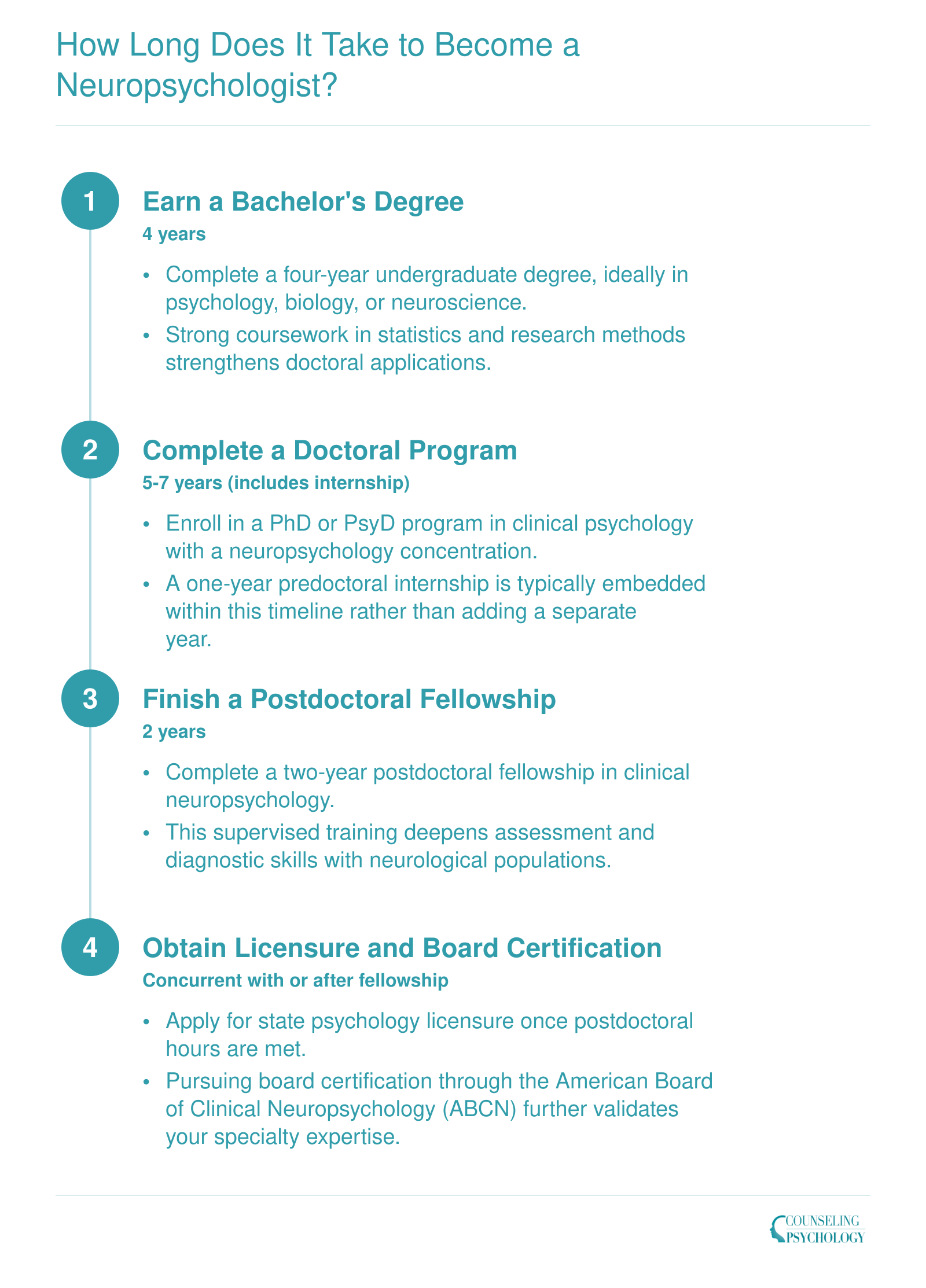
The path from freshman year to board-certified neuropsychologist typically spans 10 to 13 years. PsyD programs often run a year or two shorter than PhD programs, which accounts for most of the range. Here is how the major milestones stack up.
Step 1: Earn a Bachelor's Degree
What undergraduate degree do you need to get into a neuropsychology doctoral program?
The short answer: there is no single required major. Psychology is the most common choice, and for good reason. It gives you direct exposure to the theoretical foundations you will draw on throughout your career. Neuroscience, biology, and cognitive science are equally respected by admissions committees, provided you pair them with strong quantitative and research coursework. If you are still exploring the broader landscape of careers in psychology, settling on a major that blends clinical and scientific preparation will serve you well.
Coursework That Signals Readiness
Doctoral programs are less concerned with your major title than with the specific courses behind it. Admissions committees in 2026 consistently look for preparation in:
- Biopsychology or behavioral neuroscience: demonstrates early exposure to the brain-behavior relationship
- Statistics and research methods: doctoral training is research-intensive, and programs want evidence you can handle data
- Abnormal psychology: foundational for any clinical neuropsychology track
- Anatomy and physiology: particularly valued by programs with a strong biomedical orientation
Howard University's doctoral program, for instance, explicitly notes that applicants benefit from background in biological or life sciences and experimental psychology.2 That signals the kind of preparation these programs expect even before graduate coursework begins.
GPA Benchmarks Worth Knowing
Across competitive clinical psychology PhD programs nationally, the realistic GPA range for admitted students runs from roughly 3.5 to 3.9. Programs set their own minimums, which are often lower than what actually gets you in: Nova Southeastern University and Howard University both list a 3.0 minimum, while Brigham Young University recommends 3.5 and reports a median admitted GPA of 3.89.3 The University of Florida's program, which draws over 350 applicants annually for 15 to 25 seats, averages around 3.8 among admitted students.4
As a practical benchmark, aim for a 3.5 or higher overall and 3.7 or higher in psychology and science coursework. The closer you are to the top of that range, the more options you will have.
On the GRE front, the landscape has shifted. BYU still requires it, but many programs, including the University of Florida and Howard, no longer do, and Nova Southeastern treats it as optional.1 Confirm each program's current policy before applying.
Research Experience Is Not Optional
GPA and coursework open the door; research experience is what separates competitive applicants from the rest. Joining a cognitive neuroscience or clinical psychologist lab as an undergraduate gives you the hands-on exposure doctoral faculty are looking for. BYU explicitly recommends at least one year of research experience.3 Across top programs, applicants without any lab involvement are at a significant disadvantage regardless of grades.
Pursue independent research hours, co-author a poster if the opportunity arises, and ask a faculty supervisor for a strong letter of recommendation rooted in direct observation of your work.
A Note for Career Changers
If your bachelor's degree is in an unrelated field, a post-baccalaureate psychology program is the most direct route to filling prerequisite gaps. These programs are designed specifically for people making a career transition and can position you for doctoral admissions within one to two years of focused coursework and lab experience.
Step 2: Complete a Doctoral Program (PHD or Psyd)
Two doctoral degrees dominate the path to neuropsychology: the research-focused PhD and the clinically intensive PsyD. Both can lead to licensure, but their philosophies, funding structures, and career trajectories differ sharply.
Two Degrees, Two Philosophies
The PhD in clinical psychology is a research-heavy degree designed to produce scientist-practitioners. Programs typically last 5 to 8 years and culminate in a dissertation based on original research. Students in these programs are often fully funded, receiving tuition waivers and stipends in exchange for teaching or research assistantships. The PsyD, by contrast, prioritizes direct clinical practice. These programs run 4 to 6 years and require roughly half the research load of a PhD, focusing instead on patient contact and assessment skills. Acceptance rates reflect the different landscapes: PhD programs are highly selective, admitting around 13% of applicants, while PsyD programs accept roughly 40%.
Specialization in Neuropsychology
Aspiring neuropsychologists can enter the field through two common routes. One option is a dedicated neuropsychology doctoral program, which embeds the specialty from day one. The other, more common path is to enroll in an APA-accredited clinical psychology PhD or PsyD with a formal concentration or track in neuropsychology. Those interested in the broader landscape of becoming a clinical psychologist will find that many of these same programs serve multiple career endpoints. Both routes are viable, provided the program offers rigorous coursework in neuroanatomy, psychopharmacology, cognitive neuroscience, and neuropsychological assessment, as well as supervised clinical practica in neuropsychological settings.
Why APA Accreditation Is Essential
Accreditation from the American Psychological Association (APA) is non-negotiable. State licensing boards almost universally require an APA-accredited doctoral program for psychology licensure. Moreover, postdoctoral fellowships in neuropsychology, necessary for board certification, strongly prefer (and often require) graduates of APA-accredited programs. Without this credential, the road to becoming a licensed, board-certified neuropsychologist is virtually closed.
Funding Realities and Debt
A critical practical difference lies in how students finance their education. PhD programs in clinical psychology are typically fully funded, meaning students receive a tuition waiver and a living stipend. PsyD programs, on the other hand, are overwhelmingly self-funded; tuition waivers are rare. The financial consequence is stark: the median graduate debt for PsyD holders is approximately $200,000, compared to far lighter debt burdens for PhD graduates. This disparity often shapes career choices later, with many PsyD clinicians working in higher-volume practice settings to manage loan repayment.
PHD vs Psyd for Neuropsychology: Key Differences
Both the PhD and PsyD are doctoral degrees that can lead to a career in neuropsychology, but they are built around different priorities. Choosing between them comes down to how much research training you want, how you plan to finance your education, and how quickly you want to reach the postdoctoral stage.
Research Emphasis and Program Structure
PhD programs in clinical psychology are research-intensive by design. Graduates are expected to produce original scholarship, and the dissertation is a major undertaking. That focus extends the timeline: most PhD programs run five to eight years before the degree is conferred, putting total training time (including internship and postdoc) at roughly seven to nine years.
PsyD programs shift the balance toward clinical skill-building. Research requirements exist but are lighter, which allows many students to finish the degree itself in four to six years, with a total path of six to eight years. For someone whose goal is direct patient care rather than academic research, the PsyD timeline can be appealing.
Admissions, Class Size, and Cost
The two degree types also differ sharply in how selective they are and how they are funded.
- Acceptance rates: PhD programs typically admit 10 to 15 percent of applicants; PsyD programs admit closer to 40 percent.
- Cohort size: A PhD cohort often has five to ten students, while PsyD cohorts commonly range from 30 to over 100.
- Funding: Stipends and tuition waivers are common in PhD programs, where students often contribute to faculty research. PsyD programs less frequently offer stipends, which can mean higher out-of-pocket costs over the program's run.
Those funding differences matter over a multi-year program. Before committing, compare the full cost of attendance against any assistantship or fellowship support offered.
Board Certification: No Advantage Either Way
One thing that does not differ is eligibility for board certification. The American Board of Clinical Neuropsychology (ABCN) accepts candidates from both PhD and PsyD backgrounds on equal terms. Your degree type will not determine whether you can pursue the ABPP credential in clinical neuropsychology; what matters is the quality of your supervised training and your performance on the examination process.
In practice, the PhD remains more common among neuropsychologists employed in academic medical centers, while the PsyD appears more frequently in hospital-based and outpatient clinical roles. Neither path closes doors to the other setting, but it is worth understanding where each tends to lead as you explore the broader landscape of becoming a psychologist.
Questions to Ask Yourself
Step 3: Finish Your Internship and Postdoctoral Fellowship
Balancing the desire to start practicing against the reality of extended supervised training is one of the defining tradeoffs in neuropsychology. Unlike many psychology specializations where you can begin independent work shortly after your doctoral internship, neuropsychology requires additional postdoctoral years before you qualify for board certification. Understanding what each training phase demands helps you plan financially and professionally for the long road ahead.
The Predoctoral Internship
The predoctoral internship is a one-year, full-time clinical placement typically completed during your final year of doctoral training. Most programs require an APA-accredited internship, and you will secure your position through the APPIC Match process, a centralized system that pairs applicants with training sites based on mutual rankings.
During this year, you accumulate supervised clinical hours across diverse settings and patient populations. While some internships offer rotations in neuropsychology, the predoctoral year is designed to build broad clinical competence rather than deep specialization. Expect to work in hospitals, outpatient clinics, VA medical centers, or university counseling centers depending on where you match.
Competition for APA-accredited internships with neuropsychology tracks is significant. Strong applicants typically have prior neuropsychological assessment experience, relevant research publications, and letters from faculty who specialize in the field.
The Postdoctoral Fellowship: Where Specialization Happens
The postdoctoral fellowship is the training phase most competitor resources underexplain, yet it is not optional for anyone pursuing board certification in neuropsychology. You will complete two years of supervised, specialized training focused exclusively on brain-behavior relationships.
The Houston Conference Guidelines, established in 1997 and still the benchmark for neuropsychology training, outline what fellowship programs should cover:
- Assessment: Comprehensive neuropsychological evaluations for conditions including traumatic brain injury, dementia, epilepsy, and neurodevelopmental disorders
- Intervention: Cognitive rehabilitation strategies and psychotherapy for patients with neurological conditions
- Research: Opportunities to contribute to clinical studies or publish in peer-reviewed journals
- Consultation: Collaboration with neurologists, neurosurgeons, rehabilitation specialists, and primary care teams
Fellowship positions are competitive and often based in academic medical centers, VA hospitals, or rehabilitation facilities. These settings provide access to complex cases, advanced neuroimaging, and interdisciplinary teams that community clinics rarely offer.
Why the Two-Year Requirement Matters
The American Board of Clinical Neuropsychology requires two years of postdoctoral training for board certification eligibility. This is not a soft recommendation. Without completing this phase at a program that meets Houston Conference standards, you cannot sit for the board examination regardless of how much neuropsychology exposure you had during your doctoral program or internship.
Plan for at least three years of supervised training after completing coursework and your dissertation: one year for the predoctoral internship plus two years for the fellowship. Some candidates extend this timeline if they pursue additional subspecialty experience in areas like pediatric neuropsychology or forensic psychologist qualifications. Factor this into your financial planning, as fellowship stipends, while improving, remain modest compared to what you could earn in independent practice.
Step 4: Obtain Licensure and Board Certification
Finishing your postdoctoral fellowship does not automatically clear you to practice independently. Two distinct hurdles remain: state licensure, which is legally required, and board certification, which is technically optional but increasingly treated as a professional baseline by the institutions most neuropsychologists want to work for.
State Licensure: The Legal Requirement
Before you can see patients on your own, you must hold an active state psychology license. The core requirement in every state is passing the Examination for Professional Practice in Psychology (EPPP). A score of 500 out of 800 is the standard passing threshold, though a handful of states set the bar slightly differently. Beyond the EPPP, requirements vary considerably. Some states ask for a jurisprudence examination covering state-specific law and ethics. Others mandate a fixed number of supervised hours beyond what you completed during your postdoc. If you are weighing practice locations, it pays to check each state's psychology licensing board early, because those extra requirements can add months to your timeline.
ABCN Board Certification: The Career Differentiator
Once licensed, many neuropsychologists pursue board certification through the American Board of Clinical Neuropsychology, which operates under the American Board of Professional Psychology (ABPP). The credential is formally called ABPP Board Certification in Clinical Neuropsychology.1 It is not a legal requirement, but hospitals, academic medical centers, and insurance panels increasingly list it as preferred or expected, particularly for senior and academic roles.
The certification process moves through four stages:2
- Credential review: ABCN confirms you hold a doctoral degree in psychology, completed an APA- or CPA-accredited internship with neuropsychology training, and finished at least 24 months of postdoctoral fellowship, plus hold a state license for independent practice.3
- Written examination: A 150-minute, computer-based, multiple-choice exam offered during four testing windows each year. The fee is $510, and candidates have up to three attempts. Results are typically returned within four weeks.4 Content is organized around the Houston Conference core knowledge framework.3
- Practice sample: A clinical work sample you submit for review on a rolling basis, demonstrating real-world neuropsychological assessment and report-writing competency.4
- Oral examination: Conducted in person (with virtual options available for documented travel restrictions), this is a structured review of your practice sample and clinical reasoning by a panel of board-certified neuropsychologists.4
From initial application to receiving the credential, the process typically takes 18 to 36 months, with a maximum window of seven years to complete all components.2
ABCN does not publicly release pass-rate data, so there is no official figure to cite.5 Anecdotally, candidates who complete structured preparation and have strong mentorship report higher confidence going into the oral examination.
Why Certification Matters Practically
Beyond the credential itself, board certification correlates with stronger compensation. National wage data for clinical neuropsychologists shows an hourly range of roughly $69 to $97 (these are national figures; state-level data varies).6 Board-certified candidates consistently report more competitive offers and access to positions that are closed to non-certified applicants, particularly in academic medical centers and neurological subspecialty programs. Even if your immediate employer does not require it, completing the ABCN process signals a depth of expertise that distinguishes you within a field where advanced assessment demands are only growing.
Neuropsychologist Salary by State and Setting
The Bureau of Labor Statistics tracks neuropsychologist compensation under the broader category "Psychologists, All Other" (SOC 19-3039), which serves as the closest available proxy. Nationally, the 25th to 75th percentile range spans roughly $78,000 to $145,000, with considerable variation by state. California leads all states with a median of $147,650, while West Virginia sits at the bottom at $41,900. For those wondering what the highest salary looks like: the 75th percentile in California reaches $169,330, and several states top $150,000 at that threshold.
| State | Median Salary | 25th Percentile | 75th Percentile | Mean Salary | Estimated Employment |
|---|---|---|---|---|---|
| California | $147,650 | $78,310 | $169,330 | $130,940 | 1,780 |
| Oklahoma | $147,010 | $103,330 | $161,350 | $126,730 | N/A |
| Nevada | $144,390 | $131,250 | $153,890 | $130,120 | 100 |
| Nebraska | $137,990 | $93,790 | $163,880 | $125,420 | 50 |
| North Carolina | $137,130 | $90,440 | $157,190 | $122,490 | 480 |
| South Carolina | $135,950 | $115,090 | $152,960 | $127,190 | 140 |
| Tennessee | $135,570 | $103,790 | $148,120 | $123,640 | 240 |
| Alabama | $134,370 | $114,670 | $150,010 | $126,770 | 100 |
| Kansas | $133,540 | $108,510 | $152,960 | $127,940 | 110 |
| Connecticut | $132,040 | $92,180 | $141,730 | $117,500 | 170 |
| Ohio | $131,310 | $112,050 | $145,140 | $123,170 | 380 |
| South Dakota | $128,560 | $89,190 | $155,360 | $121,650 | 30 |
| Massachusetts | $128,180 | $79,680 | $153,300 | $123,810 | 510 |
| Arizona | $128,040 | $65,110 | $144,580 | $111,330 | 270 |
| Missouri | $127,230 | $89,780 | $148,700 | $114,990 | 250 |
| Pennsylvania | $126,460 | $78,200 | $145,480 | $114,620 | 520 |
| Virginia | $125,630 | $102,490 | $151,550 | $121,130 | 510 |
| New Jersey | $124,800 | $93,600 | $125,900 | $114,860 | 470 |
| Kentucky | $124,550 | $116,560 | $143,690 | $122,270 | 220 |
| Indiana | $123,880 | $72,000 | $142,130 | $111,440 | 190 |
| Iowa | $123,740 | $59,460 | $144,460 | $104,670 | 80 |
| Florida | $123,610 | $86,940 | $145,560 | $117,450 | 1,120 |
| Maryland | $123,490 | $77,290 | $152,840 | $118,410 | 710 |
| Idaho | $122,720 | $91,060 | $134,640 | $111,820 | 60 |
| Washington | $120,080 | $100,610 | $138,940 | $115,620 | 380 |
| Colorado | $118,640 | $84,810 | $141,930 | $113,940 | 350 |
| Arkansas | $118,600 | $55,990 | $134,430 | $101,380 | 90 |
| District of Columbia | $117,960 | $107,900 | $148,350 | $120,880 | 190 |
| New York | $113,730 | $72,450 | $136,790 | $107,470 | 870 |
| Georgia | $113,730 | $53,500 | $147,470 | $107,680 | 420 |
| Louisiana | $113,620 | $66,070 | $145,000 | $114,240 | 150 |
| Mississippi | $111,430 | $48,210 | $143,400 | $104,180 | 60 |
| Rhode Island | $111,310 | $108,280 | $149,820 | $111,420 | 130 |
| Minnesota | $110,190 | $78,960 | $131,310 | $103,820 | 400 |
| Wisconsin | $107,540 | $77,030 | $137,880 | $110,320 | 910 |
| Utah | $90,270 | $82,220 | $129,810 | $99,720 | N/A |
| Oregon | $82,960 | $79,380 | $130,520 | $102,460 | 630 |
| Texas | $81,830 | $61,740 | $133,240 | $96,040 | 2,160 |
| Illinois | $81,270 | $51,700 | $137,820 | $92,810 | 960 |
| Michigan | $78,670 | $56,490 | $131,140 | $91,060 | 330 |
| Vermont | $76,490 | $63,540 | $95,710 | $85,670 | 100 |
| New Hampshire | $75,990 | $67,630 | $133,970 | $93,840 | 80 |
| Maine | $63,490 | $63,490 | $92,740 | $80,140 | 270 |
| West Virginia | $41,900 | $33,470 | $77,410 | $63,650 | 240 |
Highest-Paying Metro Areas for Neuropsychologists
The table below ranks the top 10 highest-paying metropolitan areas by median annual salary for psychologists classified under BLS SOC code 19-3039 (Psychologists, All Other), which includes neuropsychologists. These figures reflect May 2024 BLS data. Because the BLS does not maintain a standalone neuropsychologist category, actual neuropsychologist compensation in these metros may differ. Notably, the New York and Chicago metros combine high pay with large workforces (over 700 positions each), signaling strong and sustained demand. By contrast, some metros like Los Angeles and San Diego report very high median salaries but employ fewer professionals, which may reflect a concentration of specialized hospital or research roles rather than broad market demand.
| Metro Area | Median Annual Salary | Total Employment |
|---|---|---|
| Los Angeles, Long Beach, Anaheim, CA | $160,640 | 500 |
| San Diego, Chula Vista, Carlsbad, CA | $146,350 | 240 |
| Riverside, San Bernardino, Ontario, CA | $146,060 | 120 |
| Miami, Fort Lauderdale, West Palm Beach, FL | $132,160 | 220 |
| Baltimore, Columbia, Towson, MD | $132,060 | 270 |
| Atlanta, Sandy Springs, Roswell, GA | $131,020 | 240 |
| Denver, Aurora, Centennial, CO | $130,520 | 120 |
| Virginia Beach, Chesapeake, Norfolk, VA/NC | $129,310 | 110 |
| Philadelphia, Camden, Wilmington, PA/NJ/DE/MD | $128,400 | 320 |
| Kansas City, MO/KS | $127,460 | 110 |
The Bureau of Labor Statistics projects 6 percent growth for psychologists through 2034, a trend fueled by an aging population and increased awareness of traumatic brain injury. These same factors are driving robust demand specifically for neuropsychological services across clinical, research, and rehabilitation settings.
Neuropsychology Career Outlook and Subspecialties
Neuropsychology is in the middle of a generational shift: the first wave of clinicians trained under the 1997 Houston Conference guidelines is now mentoring a cohort that increasingly works across telehealth platforms, integrated medical teams, and concussion clinics that barely existed twenty years ago. That broader footprint has opened genuine subspecialty choices, and the path you pick during fellowship will shape your patient population, your referral sources, and your earning ceiling for decades.
The Four Main Subspecialty Tracks
Most neuropsychologists settle into one of four practice areas, each with its own fellowship focus and clinical rhythm.
- Pediatric: Two-year fellowships housed in children's hospitals or academic medical centers. You'll assess learning disabilities, ADHD, autism, epilepsy, and the cognitive effects of childhood cancer treatment. Schools and pediatricians drive the referral stream.
- Forensic: Often a second fellowship or post-fellowship specialization layered on a clinical or adult track. Work centers on competency evaluations, traumatic brain injury litigation, and criminal responsibility cases. Hourly rates are the highest in the field, but the work is adversarial and deposition-heavy.
- Rehabilitation: Embedded in inpatient and outpatient rehab settings serving stroke, TBI, and spinal cord injury patients. Fellowships emphasize interdisciplinary work with physiatrists, speech pathologists, and occupational therapists.
- Geriatric: Growing fastest as the population ages. Focus on dementia differential diagnosis, capacity evaluations, and pre-surgical assessment for procedures like deep brain stimulation. Medicare reimbursement structures the practice economics. If aging populations interest you more broadly, you may also want to explore what it takes to become a geriatric counselor.
Where the Demand Is
The Bureau of Labor Statistics groups neuropsychologists under broader psychologist categories, so subspecialty-level demand data has to come from elsewhere. The American Academy of Clinical Neuropsychology (AACN) and the National Academy of Neuropsychology (NAN) both publish periodic salary and workforce surveys that break down compensation by setting, region, and years of experience. These are the most reliable numbers for comparing, say, a hospital-based pediatric position against a private-practice forensic caseload. Forensic and private-practice work consistently top the compensation tables; academic medical center positions pay less but offer research time and institutional stability.
How to Pressure-Test Your Choice
Program websites and Houston Conference documentation tell you what training looks like on paper. They don't tell you what a Tuesday feels like. Before committing to a fellowship track, set up three or four informational interviews with practicing neuropsychologists in different settings. Ask about caseload size, report-writing hours per evaluation, insurance versus self-pay mix, and what they wish they had known before specializing. Thirty minutes on the phone with a working clinician will reshape your assumptions more than any program brochure.
Frequently Asked Questions About Becoming a Neuropsychologist
Below are some of the most common questions prospective neuropsychologists ask as they plan their education and career. Each answer draws on current training standards, licensure frameworks, and labor market data to give you a realistic picture of the path ahead.
Explore Careers
- Become a Behavior Interventionist
- BCaBA
- BCBA
- Biogerontologist
- Child Psychologist
- Clinical Psychologist
- Cognitive Neuroscientist
- Cognitive Psychologist
- Comparative Psychologist
- Consumer Psychologist
- Counseling Psychologist
- Criminal Psychologist
- Cultural Psychologist
- Forensic Psychologist
- Air Force Psychologist
- Applied Psychologist
- Army Psychologist
- Educational Psychologist
- Engineering Psychologist
- Environmental Psychologist
- Experimental Psychologist