
What you’ll learn in this article…
- Nashville offers five ABAI-verified ABA programs ranging from graduate certificates to doctoral degrees.
- Tennessee requires both national BCBA certification and a separate state license through the Applied Behavior Analyst Licensing Committee.
- Most candidates complete the BCBA pathway in roughly two to three years, including supervised fieldwork.
- Tuition varies widely across Tennessee ABA programs, making financial aid comparison essential before enrolling.
Tennessee's licensure mandate for applied behavior analysts restricts clinics, schools, and hospitals in the Nashville metro to hiring only state-licensed and board-certified practitioners. That regulatory requirement, paired with the rapid growth of autism service providers, has tightened the local labor market.
In response, several universities near Nashville now offer verified course sequences in online, hybrid, or campus-based formats, letting students balance full-time study with ongoing RBT work. Many programs embed supervised fieldwork inside large regional autism networks, so candidates can build experience hours before graduation. Students weighing broader program options may also want to explore applied behavior analysis masters programs nationwide for comparison.
The result: Nashville increasingly functions as a pipeline, where graduates who complete fieldwork locally often secure job offers from those same sites, making the city a strategic launch point for a BCBA career.
Best ABA Programs Near Nashville, Tennessee
Tennessee is home to a growing number of applied behavior analysis programs that prepare graduates for BCBA certification and careers in behavioral health, education, and clinical settings. The five schools below span master's degrees, doctoral programs, and graduate certificates, with formats ranging from fully on-campus to online and hybrid. Program-level earnings data one year after completion is not yet available for these ABA programs, so we have included institution-wide outcome figures to help you compare value across schools.
- Program alignment with BACB standards
- Degree levels and delivery formats
- Institutional graduation and retention rates
- Graduate debt and net price
- Faculty ratio and fieldwork depth
- College Scorecard graduate earnings — collegescorecard.ed.gov
- Internal program database
- Independent program research
- NCES-IPEDS federal institutional data — nces.ed.gov

Vanderbilt University
Vanderbilt University houses one of the most selective ABA programs in the Southeast, embedded in the nationally recognized Peabody College of Education. The campus-based M.Ed. offers three distinct concentration tracks in behavior analysis, and an online post-master's certificate lets practicing professionals add ABA credentials without relocating. With an 8:1 student-to-faculty ratio, a 93.5% graduation rate, and fieldwork placements across school, clinic, and home settings throughout Nashville, Vanderbilt provides an intensive, research-rich environment.
- Early Childhood Special Education concentration
- Meets BACB certification requirements
- Combines classroom and field-based learning
- Includes two semester-long internships
- Coursework in behavior management and analysis
- Focus on early childhood instruction and assessment
- Campus-based program at Peabody College
- Focus on High Incidence Disabilities
- Meets BACB coursework requirements
- Includes field-based internships
- Prepares for BCBA certification
- Combines theory and practice in special education
- Designed for special education professionals
- Hands-on learning approach with verified course sequence
- Focus on Severe Disabilities population
- BACB-verified coursework included
- Field-based internships built into curriculum
- Prepares students for BCBA certification
- Advanced classroom management strategies covered
- No prerequisite courses required for admission
- Practical training emphasized throughout
- Online format for working professionals
- Requires a related master's degree for admission
- Advanced ABA training beyond the master's level
- Covers ethical ABA practices in depth
- Prepares graduates for leadership roles
- Financial aid available for eligible students
Applied Behavior Analysis M.Ed., Early Childhood Special Education Concentration — On-Campus
Applied Behavior Analysis M.Ed., High Incidence Disabilities Concentration — On-Campus
Applied Behavior Analysis M.Ed., Severe Disabilities Concentration — On-Campus
Online Post-Master's Certificate in Applied Behavior Analysis — On-Campus

The University of Tennessee-Knoxville
The University of Tennessee-Knoxville delivers its ABA concentration through a Master of Science in Teacher Education, blending special education pedagogy with behavior-analytic coursework. Full-time students can finish in roughly 15 months, while a two-year part-time track accommodates working professionals. Schools offering this program have graduation rates of 73.9%. In-state graduate tuition of approximately $15,972 and a median graduate debt of $20,500 make it a cost-effective public-university option for Tennessee residents.
- Focus on ABA principles for learning and behavior
- Prepares graduates for BCBA certification exam
- Full-time option completable in 15 months
- Part-time option spans approximately two years
- 30 hours of coursework required
- Courses meet current BCBA requirements
- Includes Special Education and School Psychology courses
- Ethical and legal issues in ABA covered
Teacher Education M.S., Applied Behavior Analysis Concentration — On-Campus

University of Memphis
The University of Memphis offers both a 36-credit-hour M.S. in Applied Behavior Analysis and a 60-credit-hour Ed.D. with an ABA concentration, making it the only Tennessee school on this list with a doctoral pathway housed in the same department. A cohort model fosters close peer collaboration at both levels. In-state graduate tuition sits near $11,628, among the lowest on this list. Schools offering these programs have graduation rates of 50.9%, and the median graduate debt is $23,300.
- 36-credit-hour master's program
- Cohort model for collaborative learning
- Includes practicum opportunities for hands-on training
- Aligns with BCBA certification requirements
- Focus on ethical practices in behavior analysis
- Covers key ABA principles and intervention strategies
- 60-credit-hour doctoral program
- Cohort model with fall semester start
- Field placement options in multiple settings
- Prepares for BCBA certification at an advanced level
- Diverse faculty expertise across ABA domains
- Focus on leadership, research, and professional ethics
Applied Behavior Analysis M.S. — On-Campus
Instruction and Curriculum Leadership Ed.D., Applied Behavior Analysis Concentration — On-Campus

Lipscomb University
Lipscomb University, located in Nashville, offers a hybrid Graduate Certificate in Applied Behavior Analysis geared toward educators and clinicians who already hold a master's degree and want to add BCBA exam eligibility. The program blends synchronous online sessions with in-person intensives and required school-based practicum experiences. A 40% in-service discount brings tuition down to roughly $572 per credit hour for qualifying educators, and Yellow Ribbon benefits are available for eligible veterans. Schools offering this program have graduation rates of 72.2%, with a median graduate debt of $19,500.
- Hybrid format with synchronous online sessions
- Located in Nashville with local practicum sites
- $953 per credit hour at standard rate
- 40% in-service discount available for educators
- Prepares graduates for the BACB certification exam
- Practical, supervised experience included
- Yellow Ribbon and veteran aid accepted
Certificate in Applied Behavior Analysis — Hybrid

Tennessee Tech
Tennessee Tech's ABA offerings include a Master of Arts in Curriculum and Instruction with an ABA concentration and a Ph.D. in Exceptional Learning with multiple ABA-focused tracks. All programs use a hybrid delivery model, making them accessible to Nashville-area students roughly 80 miles east in Cookeville. The master's curriculum is verified by the Association for Behavior Analysis International and aligns with BCBA examination requirements. In-state graduate tuition of about $12,386 and a median graduate debt of $15,650 position Tennessee Tech as the most affordable multi-level ABA pathway in the state.
- Hybrid or fully online delivery available
- BCBA exam-eligible verified course sequence
- Data-driven approach to behavior intervention
- Focus on autism spectrum disorders
- Positive behavior interventions emphasized
- Requires a minimum 2.75 undergraduate GPA
- Innovative curriculum with supportive learning environment
- Hybrid delivery with on-campus components
- Concentrations in Young Children and Families or School-Aged and Adults
- Nationally accredited ABAS strand
- Requires 3.0 GPA and GRE scores
- Scholarly writing sample and faculty interview required
- Prepares for board certification and leadership roles
- Practical skills development paired with rigorous research
Master of Arts in Curriculum and Instruction, ABA Concentration — Hybrid
Ph.D. in Exceptional Learning, Applied Behavior Analysis Concentration — Hybrid
How to Choose the Right ABA Program in Nashville
The choice often comes down to a trade-off between schedule flexibility and built-in supervision support. Some aspiring behavior analysts need to keep working as an RBT during graduate school, while others can relocate or attend full-time and want the structure of an on-campus cohort. The right program aligns your career goals, timeline, and learning style with concrete program features, not just reputation.
Verify ABAI and BACB Alignment
The most critical filter is whether the program's course sequence is verified by the Association for Behavior Analysis International (ABAI) or recognized as a pre-approved curriculum by the Behavior Analyst Certification Board (BACB). Without this, you cannot sit for the BCBA exam, even after completing a degree. A program may be regionally accredited and still lack the specific coursework grid the BACB requires. Do not assume that a master's in psychology or special education includes the right behavior-analytic content. Confirm directly on the ABAI website or the BACB's list of approved programs. For a thorough overview of BCBA certification requirements, consult a dedicated guide before you apply. Also check that the degree level matches your target credential: a BCaBA requires a bachelor's-level sequence, a BCBA a master's, and doctoral programs prepare you for the BCBA-D designation.
Compare Delivery Formats: Online, Campus, and Hybrid
- Online programs: Offer maximum flexibility for working RBTs who log hours in the field. Many online tracks are asynchronous, letting you complete coursework on your own schedule around session times. The downside is that you must independently find and secure a qualified supervisor and practicum site.
- Campus-based programs: Typically embed practicum supervision within the program structure. Faculty often have existing partnerships with local clinics, schools, and hospitals in the Nashville area, which can streamline fieldwork placement. The trade-off is a fixed schedule and geographic commitment.
- Hybrid models: Combine online coursework with occasional in-person seminars or supervision intensives. Several Nashville-area programs now offer this middle ground, giving you both flexibility and face-to-face mentorship. Review the specific program-type data for the schools ranked in this guide to see which format each offers.
Ensure Fieldwork Support Fits Your Pathway
The BACB currently requires 2,000 hours of supervised unrestricted fieldwork, or 1,500 hours if you pursue the concentrated supervised fieldwork pathway. Ask whether the program maintains formal practicum partnerships that can provide these hours in a cohesive experience. Some programs assign you to a site; others offer a list of approved supervisors but expect you to secure the placement. If you are already employed as an RBT, verify that your workplace qualifies as a site and that your supervisor meets the BACB's qualifications. Programs that bundle supervision are often faster to complete but may limit your exposure to a single setting.
Match the Program to Your Desired Credential Level
Be precise about the credential you intend to earn. A BCaBA program is typically an undergraduate major or minor sequence (explore best bachelor's in applied behavior analysis options if that is your starting point), not a master's degree, and has different supervision hour requirements. A BCBA program is a master's-level course sequence, or a standalone graduate certificate in applied behavior analysis added to a qualifying master's. A doctoral program leads to the BCBA-D, which does not grant additional clinical privileges but may affect teaching, research, and supervision roles. Check that the program's curriculum and supervised experience structure are built for that specific level, not a one-size-fits-all approach. If you later decide to pursue a higher credential, you may need to repeat coursework, so planning ahead saves time and tuition.
Online vs In-Person ABA Programs: Key Trade-offs
Choosing between an online and an in-person ABA program is one of the first decisions prospective students face, and neither format is inherently superior. Both can lead to BCBA exam eligibility, provided the program holds verification from the Association for Behavior Analysis International (ABAI). The real question is which delivery model fits your life, learning style, and professional goals.
Pros
- Online programs offer schedule flexibility that lets working professionals in Tennessee complete coursework evenings and weekends.
- Tuition for online ABA programs is often lower overall because you avoid campus fees, commuting costs, and relocation expenses.
- Students anywhere in the state, not just the Nashville metro, can access top verified programs without moving.
- In-person programs typically include built-in practicum supervision, reducing the burden of arranging your own fieldwork site.
- Campus-based cohorts create stronger peer networking, which often translates into job referrals and study partnerships after graduation.
- Hands-on clinical training in a classroom lab setting can accelerate skill development for students new to behavior analysis.
Cons
- Online students must still complete all required fieldwork hours locally, which means independently securing a qualified supervisor in the Nashville area or elsewhere in Tennessee.
- Without a structured campus cohort, online learners may feel isolated and need to be more proactive about building professional connections.
- In-person programs demand a fixed class schedule that can be difficult to manage alongside full-time employment or family obligations.
- Campus-based tuition, parking, and associated fees can raise the total cost of attendance well above comparable online options.
- Geographic limitations of in-person programs may restrict your choices to only one or two ABAI-verified options within commuting distance of Nashville.
Related Articles
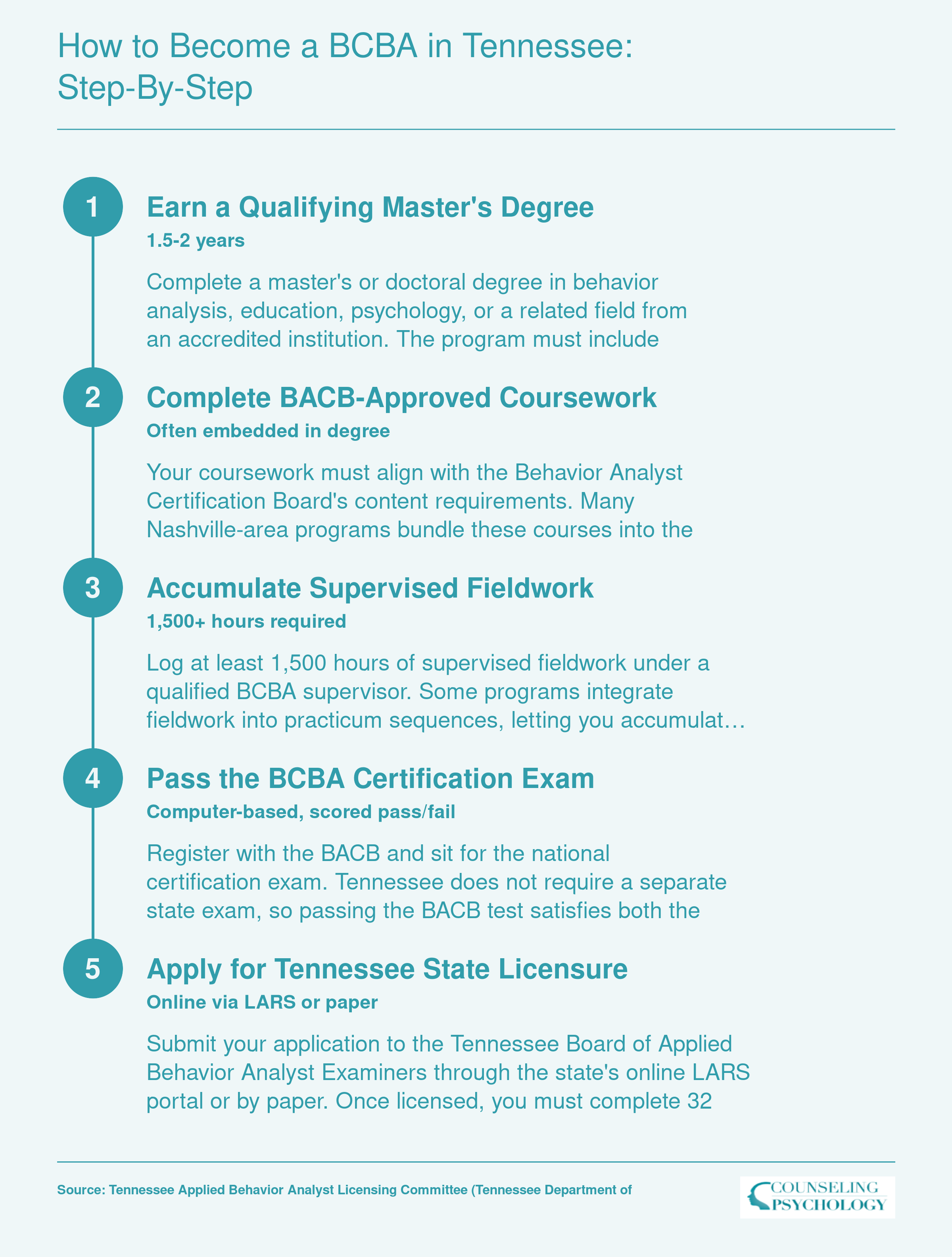
How to Become a BCBA in Tennessee: Step-by-Step
Earning your Board Certified Behavior Analyst credential in Tennessee follows a clear, sequential path. Most candidates complete the journey in roughly two to three years, and several Nashville-area programs embed supervised fieldwork directly into the degree so you can finish faster.
Tennessee ABA Licensure and Certification Requirements
What steps must you complete to legally practice as a behavior analyst in Tennessee?
Understanding the distinction between national certification and state licensure is essential before you start practicing. Tennessee regulates behavior analysts through the Applied Behavior Analyst Licensing Committee, operating under the Tennessee Department of Health.1 This state-level credential is separate from, but directly tied to, national certification through the Behavior Analyst Certification Board.2
Understanding the Two-Layer System
Tennessee requires national BACB certification as a prerequisite for state licensure. Holding a BCBA credential alone does not authorize you to practice in the state; you must also obtain state licensure through the Tennessee board. The governing statute, T.C.A. 63-11-301 through 63-11-311, establishes this requirement and outlines the full scope of practice regulations.2
Applications can be submitted online through the LARS system or by paper.1 One notable transition: the BACB's Verified Course Sequence system ends December 31, 2025, with university-based verification taking its place starting in 2026.3 For prospective candidates still evaluating their educational path, exploring online applied behavior analysis programs can help clarify which coursework meets both BACB and university-verification standards.
Credential Tiers Available in Tennessee
Tennessee offers two licensure tiers for behavior analysts:
- Licensed Behavior Analyst (LBA): Requires active BCBA certification. This is the fully independent practice credential.1
- Licensed Assistant Behavior Analyst (LABA): Requires active BCaBA certification. LABAs must work under the supervision of an LBA.1
Registered Behavior Technicians do not require state licensure in Tennessee. RBTs maintain their credential through the national BACB registry and work under appropriate supervision, but the state does not issue a separate RBT license.2
Renewal Cycles and Continuing Education
Both LBA and LABA licenses renew on a biennial cycle. Renewal fees are $160 for LBAs and $110 for LABAs, with fee reductions implemented as of May 7, 2025.1
Continuing education requirements differ by credential level:
- LBA holders: 32 CEUs per renewal period, including 4 hours in ethics, 3 hours in supervision, and 3 hours in cultural diversity12
- LABA holders: 20 CEUs per renewal period, including 4 hours in ethics, 3 hours in supervision, and 3 hours in cultural diversity12
Tennessee uses CE Broker as its official tracking system for continuing education compliance.1 Licensees should maintain their records through this platform to ensure seamless renewal processing.
Supervision Requirements
Tennessee does not mandate specific supervision ratios at the state level.2 However, LABAs must practice under the direction of an LBA, and all practitioners must adhere to BACB supervision standards for any services billed or delivered. Employers and insurance payers may impose additional supervision requirements beyond what the state specifies.
Questions to Ask Yourself
ABA Program Costs and Financial Aid Options in Tennessee
Tuition variation across Tennessee's ABA programs is wide enough that the program you choose can shape your financial picture for years. Understanding the real cost, not just the sticker price, is the first step toward making a sound decision.
What Programs Actually Cost
Public institutions in Tennessee offer meaningful savings for in-state students. The University of Memphis charges approximately $10,700 in annual tuition for Tennessee residents, compared to roughly $15,400 for out-of-state students. Tennessee Tech sits in a similar range, with in-state tuition near $11,400 and out-of-state tuition around $15,600. UT Knoxville's gap is sharper: about $13,800 for in-state students versus over $33,200 for out-of-state students, so residency status matters considerably there.
Private institutions set a different baseline. Vanderbilt's program lists tuition near $57,900 per year regardless of where you live, though the institution-wide average net price after grants and scholarships works out to roughly $15,800. That figure reflects all enrolled students at Vanderbilt, not a guaranteed quote for any individual, and your own aid package will depend on financial need, program level, and available funding in a given year. Lipscomb University, which offers a graduate certificate in ABA, carries a per-credit rate of $953 with a published net price around $24,700 at the institution level.
Median graduate debt also varies. Tennessee Tech graduates carry the lowest reported institutional debt, around $15,650, while Memphis graduates report a median closer to $23,300. UT Knoxville sits at about $20,500, and Vanderbilt at roughly $14,000, again reflecting robust institutional aid for those who qualify.
Financial Aid Avenues Worth Pursuing
Federal Direct Unsubsidized Loans and Graduate PLUS Loans are available to students in eligible degree programs and remain the most widely used financing tool. Campus-based programs at public universities sometimes offer graduate assistantships that cover tuition in exchange for research or teaching work, so it pays to contact program coordinators directly about those openings.
Registered Behavior Technicians already employed at ABA clinics or school districts should ask their employers about tuition reimbursement. Many mid-size ABA providers actively encourage RBTs to pursue their master's degrees and structure reimbursement as part of retention benefits. Students exploring related graduate options in the state may also want to review counseling masters programs Tennessee for programs with overlapping financial aid resources.
Tennessee's Insurance Mandate and What It Means for Your Career
For students planning to work in ABA therapy after graduation, Tennessee's insurance landscape is an indirect signal of career demand. State-regulated commercial health plans in Tennessee are required to cover ABA therapy for individuals with autism spectrum disorder, with no dollar cap and no hour cap, as of 2025-2026.1 There is no specific age limit attached to this coverage, a significant expansion from the original law passed in 2006, which capped coverage at age 12.4 Mental health parity is also required, meaning insurers cannot impose stricter limits on ABA benefits than they apply to other medical services.1
TennCare, the state's Medicaid program, covers ABA therapy for children under age 21, which broadens the population of clients who can access services.2 One caveat: self-funded employer health plans regulated under federal ERISA law are exempt from Tennessee's state mandate, so coverage for clients on those plans is not guaranteed.1
Pending legislation, specifically House Bill 455 and Senate Bill 325, may further modify coverage terms in the 2025-2026 legislative cycle, so it is worth monitoring updates from the Tennessee Department of Commerce and Insurance bulletin as those bills move forward.3
The practical takeaway for students: robust insurance coverage requirements mean clinics and schools can bill for more clients, which sustains demand for credentialed BCBAs across the state. That demand, in turn, supports the career outcomes that justify the cost of graduate training.
Career Outcomes and Salary for ABA Graduates in Nashville
ABA graduates in Tennessee typically enter roles classified under several behavior analyst-adjacent occupations tracked by the Bureau of Labor Statistics. The table below presents Tennessee statewide median wages for the most relevant categories alongside national medians for comparison. Because the BLS does not publish a standalone "behavior analyst" category, these adjacent classifications offer the closest available benchmarks for what ABA-trained professionals can expect to earn.
| Occupation | Tennessee Median Salary | Tennessee 25th Percentile | Tennessee 75th Percentile | National Median (for reference) |
|---|---|---|---|---|
| Substance Abuse, Behavioral Disorder, and Mental Health Counselors | $48,170 | $36,910 | $60,900 | $53,710 |
| Clinical and Counseling Psychologists | $92,320 | $81,790 | $120,450 | $96,100 |
| Psychologists, All Other | $135,570 | $103,790 | $148,120 | $112,760 |
| Psychology Teachers, Postsecondary | $73,360 | $60,410 | $100,710 | $80,370 |
Practicum and Fieldwork Opportunities in the Nashville Area
Hopebridge Autism Therapy Centers actively advertises BCBA-in-training positions across Tennessee, which signals the kind of supervised fieldwork pipeline that makes Nashville a practical place to accumulate your required experience hours.1 But Hopebridge is far from the only option. The metro area supports a dense network of ABA providers spanning center-based, in-home, school-based, and telehealth models, giving candidates flexibility in how they structure their fieldwork.
Locating Approved Supervision Providers
The Behavior Analyst Certification Board (BACB) maintains a registry of approved supervision providers searchable by location. Before committing to any practicum arrangement, confirm that your prospective supervisor appears on that list and holds an active credential. Filtering by Nashville or surrounding ZIP codes will surface supervisors affiliated with both large organizations and independent practices.
Clinical Sites Across the Nashville Metro
Nashville's ABA landscape includes providers operating in a variety of service models, each offering distinct fieldwork experiences:
- Center-based: Ascend Autism operates a 5,000-square-foot early intervention center serving the Nashville metro, including Clarksville, Murfreesboro, Franklin, and Hendersonville.2 ABS Kids runs two Nashville locations (Southeast Nashville and East Nashville) combining ABA therapy with autism diagnosis.3 Proud Moments ABA and Hopebridge also deliver center-based services in the area.4
- In-home and community-based: Key Autism Services provides in-home, community-based, school-based, and telehealth ABA in Nashville.5 Grateful Care ABA covers Nashville and Middle Tennessee with in-home therapy and community support.6 Behavioral Framework expanded into Nashville in March 2026 through its acquisition of Autism ETC's four greater Nashville clinics, focusing on home-based ABA.7
- Additional providers: Athena Care offers ABA therapy and autism testing in Nashville.8 Magnet ABA also serves the Nashville area.9
Each setting develops different competencies. Center-based placements tend to emphasize structured programming and data collection with young children, while in-home and community models build skills in naturalistic teaching and caregiver collaboration. Students exploring broader program options may also want to review best online autism master's programs to complement their clinical training.
School-Based Fieldwork
Metro Nashville Public Schools employs behavior analysts and support staff within its special education department. Review the MNPS careers page or contact their special education office directly to ask about practicum or fieldwork arrangements for BCBA candidates. School-based placements expose trainees to IEP-driven goals, classroom consultation, and interdisciplinary collaboration with teachers and speech-language pathologists.
Networking Through Professional Associations
The Tennessee Association for Behavior Analysis (TABA) is the state's primary professional organization for behavior analysts. TABA conferences and local chapter events connect students with practicing BCBAs who may serve as supervisors or can point toward open fieldwork slots. Membership also provides access to job boards and internship postings that rarely appear on general employment sites.
A Practical Approach
The Vanderbilt Kennedy Center is one of the most recognized disability research and training hubs in the Southeast. Contact them directly to ask about practicum opportunities for BCBA candidates, as their programs may offer access to specialized populations and research-informed supervision that complement clinical placements elsewhere in the city. Combining a university-affiliated experience with hours at a community clinic gives you breadth that licensing boards and future employers both value.
Frequently Asked Questions About ABA Programs in Tennessee
Choosing the right ABA program involves weighing logistics, cost, and career outcomes. Below are the questions prospective students ask most often, with answers drawn from the details covered earlier in this article.