
What you’ll learn in this article…
- Indianapolis-area public school counseling programs can cost under $20,000 in total net price for in-state graduate students.
- Indiana school counselors in the Indianapolis metro earned a median wage of $57,590 as of May 2023.
- CACREP accreditation is not required for Indiana licensure but makes credentials portable across most other states.
- Career changers without a teaching background can enter Indiana school counseling programs if they meet standard admissions criteria.
Eleven school counseling programs within driving distance of Indianapolis post annual graduate tuition ranging from roughly $6,600 at Purdue University Northwest to over $22,800 at Marian University, a spread wide enough that program selection alone can shift your total degree cost by tens of thousands of dollars. Most are master's-level, 48 to 60 credit hours, and four hold CACREP accreditation, a credential that smooths the path to Indiana's school counselor license and simplifies reciprocity if you relocate.
Indiana's demand for school counselors continues to outpace supply, particularly in suburban and rural districts surrounding Indianapolis. That labor-market pressure gives graduates real leverage, but only if the degree doesn't saddle them with disproportionate debt relative to a median salary in the high $50,000s. Below, we break down net price, accreditation status, licensure steps, and career outcomes so you can compare counseling degree programs with confidence.
Most Affordable School Counseling Programs Near Indianapolis, Indiana
Indiana offers a strong selection of master's-level school counseling programs at public and private institutions, several of which rank among the most affordable in the Midwest. The programs below are ordered primarily by net price, the best single indicator of what students actually pay after institutional aid and grants. Because public universities set different tuition rates for residents and non-residents, Indiana residents will find the biggest savings at regional public campuses, while private institutions charge a flat rate regardless of where you live. All net price, tuition, and graduation rate figures come from federal data sources and reflect institution-wide averages, not program-specific costs.
- Net price after financial aid
- In-state versus out-of-state tuition
- Institution-wide graduation rate
- CACREP accreditation status
- Return on investment indicators
- NCES-IPEDS federal institutional data — nces.ed.gov
- College Scorecard graduate earnings — collegescorecard.ed.gov
- Independent program research
- Internal program database

Indiana University-South Bend
Indiana University-South Bend is one of the most cost-effective paths into school counseling in the state, with an institution-wide net price of $8,653. As part of the IU system, IUSB extends regional campus pricing that keeps graduate study accessible for Indiana residents. The 15:1 student-to-faculty ratio and campus-based delivery give students regular face time with faculty mentors, while the broader IU network opens doors to practicum sites across northern Indiana and beyond.
- Master's-level program with a school counseling focus
- Campus-based format at IU South Bend
- Bachelor's degree required for admission
- Financial aid options available to eligible students
- Prepares graduates for Indiana school counselor licensure
- Covers academic, career, and personal development counseling
Master of Arts in Counseling and Human Services, School Counseling Concentration — On-Campus

Indiana State University
Indiana State University's Master of Education in School Counseling is a 48-credit program built around the skills needed for an Indiana K-12 School Counselor Initial Practitioner License. Coursework spans techniques of counseling, career development, and multicultural counseling, and students complete both a practicum and an internship for real-world application. At a net price of $10,873, ISU serves a high proportion of Pell Grant recipients (roughly 66%), reflecting its commitment to accessible graduate education.
- 48 credit hours minimum for completion
- Requires a cumulative 3.25 GPA
- Includes supervised practicum and internship
- Multicultural counseling coursework embedded in curriculum
- Directly prepares students for Indiana K-12 licensure
- Campus-based program in Terre Haute
Master of Education in School Counseling — On-Campus

Purdue University Fort Wayne
Purdue University Fort Wayne pairs a CACREP-accredited M.S.Ed. in Counselor Education with a dedicated School Counseling concentration, all at a net price of $13,171. Students gain clinical hours through a live-supervised practicum at the on-campus Community Counseling Center and internship placements across the state. The program's multicultural awareness and advocacy emphasis, combined with a 13:1 student-to-faculty ratio, creates a closely mentored learning experience.
- CACREP-accredited program with school counseling track
- Live-supervised practicum at campus counseling center
- Internship sites available across Indiana
- Strong focus on multicultural awareness and advocacy
- Prepares graduates for Indiana school counselor licensure
- Affiliation with university research institute
M.S.Ed. in Counselor Education, School Counseling Concentration — On-Campus

Ball State University
Ball State University's 60-credit Master of Arts in School Counseling is one of the more rigorous options on this list, requiring over 800 hours of field experience across diverse PreK-12 settings. The program aligns with both Indiana licensure requirements and ASCA national standards, with an explicit social justice and equity lens woven through the curriculum. Ball State's school-wide graduation rate of 62.3% and a net price of $14,940 place it in the mid-range for Indiana public universities.
- 60 credit hours with social justice emphasis
- More than 800 hours of supervised field experience
- Aligns with Indiana licensure and ASCA standards
- On-campus delivery in Muncie
- Close faculty mentorship throughout the program
- Covers PreK through 12th grade counseling competencies
- Diverse practicum and internship placements
Master of Arts in School Counseling — On-Campus

Indiana Wesleyan University-National & Global
Indiana Wesleyan University's National & Global campus delivers a fully online, CACREP-accredited Master of Arts in School Counseling at $602 per credit hour, with completion possible in 24 to 36 months. A dual-track option lets students add a Clinical Mental Health Counseling concentration within the same 60-credit framework. As a private institution, IWU charges the same tuition whether you live in Indiana or elsewhere, and its net price of $16,898 reflects institutional aid available to most enrollees.
- CACREP-accredited, 60-credit online program
- $602 per credit hour with financial aid options
- Completable in 24 to 36 months
- Supervised practicum included in curriculum
- Multicultural counseling and social justice focus
- Prepares candidates for Indiana school counselor licensure
- Dual-track covering school and clinical mental health counseling
- Same 60-credit, online, CACREP-accredited framework
- Flexible format designed for working professionals
- Christ-centered curriculum with servant leadership training
- Multicultural counseling competency embedded throughout
- 24 to 36 month expected timeline
Master of Arts in School Counseling — Online
Master of Arts in School Counseling/Clinical Mental Health Counseling — Online

Marian University
Marian University is one of only two Indianapolis-based campuses on this list, giving local students immediate access to central-Indiana K-12 districts for practicum and internship placements. The 48-credit Master of Science in Counseling with a School Counseling concentration includes 700 hours of supervised clinical experience and aligns with both CACREP core competencies and Indiana REPA standards. As a private institution, Marian's net price of $24,018 is higher than most public competitors, but its urban location can reduce commuting and relocation costs for Indianapolis residents.
- 48-credit curriculum with 700 supervised clinical hours
- On-campus program in Indianapolis
- Prepares for K-12 school counselor licensure in Indiana
- Aligns with CACREP core competencies
- Meets Indiana REPA standards for educators
- Graduates eligible to sit for CORE Assessments
- 13:1 student-to-faculty ratio
Master of Science in Counseling, School Counseling Concentration — On-Campus

Purdue University Northwest
Purdue University Northwest carries the lowest net price on this list at $6,079, and it has been recognized as the most affordable counseling program in Indiana in statewide comparisons. The CACREP-accredited M.S.Ed. in School Counseling reports a 100% licensure pass rate and 85% job placement among recent graduates. Located in Hammond, PNW is within driving range of Indianapolis, though students should factor in commute or relocation logistics since the program is campus-based. Despite its strong affordability, the school's overall graduation rate of 42.9% is worth noting as context for the broader student body.
- CACREP-accredited with 100% licensure pass rate
- Reported 85% job placement for recent graduates
- Evidence-based, multicultural counseling curriculum
- Includes practicum and internship field experiences
- Preferred 3.0 GPA for admission
- Campus-based delivery in Hammond, Indiana
- Prepares for K-12 school counselor licensure
M.S.Ed. in School Counseling — On-Campus

Butler University
Butler University, located in Indianapolis, offers its CACREP-accredited Master of Science in School Counseling entirely online, pairing the convenience of remote coursework with access to the city's extensive network of K-12 field sites. The 60-credit program costs $700 per credit hour (roughly $42,000 total) and requires no GRE, lowering one barrier to entry. A dual-licensure pathway in clinical mental health counseling is available for students who want broader career flexibility. Butler's school-wide graduation rate of 80.4% is the second highest on this list, though its net price of $36,041 reflects the premium associated with a well-resourced private university.
- CACREP-accredited, fully online, 60 credit hours
- $700 per credit, no GRE required
- 700 hours of hands-on clinical experience
- Minimum 3.0 undergraduate GPA for admission
- Coursework covers trauma response, diversity, and career planning
- High reported job placement rate for graduates
- Adds clinical mental health counseling licensure eligibility
- Same 60-credit online CACREP-accredited framework
- No GRE required for admission
- 700 hours of supervised field experience
- Three-year expected completion timeline
- Focus on diversity, inclusion, and crisis response
Master of Science in School Counseling — Online
Master of Science in School Counseling, Dual Licensure in Mental Health Counseling — Online

Purdue University
Purdue University in West Lafayette stands out on this list because its relevant offering is a Counseling Psychology doctoral program rather than a master's in school counseling. The PhD follows a scientist-practitioner model and prepares graduates for licensure in Indiana, with competitive assistantships and tuition waivers that can substantially offset the $14,600 net price. This path is best suited for students who want to pursue research alongside clinical practice, and applicants should confirm the degree meets Indiana school counselor licensure requirements if K-12 work is the primary goal.
- PhD-level, campus-based in West Lafayette
- Scientist-practitioner training model
- Competitive assistantships and teaching positions available
- Minimum 3.0 undergraduate GPA for admission
- Practicum placements for clinical experience
- December 1 application deadline
- Research and publication opportunities throughout program
Counseling Psychology Doctoral Program — On-Campus

Oakland City University
Oakland City University is a small private institution in southwestern Indiana whose 48-credit M.S.Ed. with a School Counseling concentration aligns with CACREP standards and Indiana REPA 3 requirements. The program includes 700 hours of supervised internship and prepares graduates for both the National Counselor Exam and Indiana's CORE School Counseling Assessment. At a net price of $15,210 and a 13:1 student-to-faculty ratio, Oakland City offers a personalized, campus-based experience, though applicants should note that a valid teaching license and 2.75 GPA are required for admission.
- 48-credit program aligned with CACREP standards
- 700 hours of supervised internship included
- Prepares for National Counselor Exam and CORE Assessment
- Meets Indiana REPA 3 licensure standards
- Requires valid teaching license for admission
- Minimum 2.75 GPA and professional recommendations required
- Emphasis on trauma, crisis counseling, and career guidance
Master of Science in Education, School Counseling Concentration — On-Campus

Indiana Wesleyan University
Indiana Wesleyan University's residential Marion campus offers the same CACREP-accredited, 60-credit online Master's in School Counseling found at its National & Global division, priced at $602 per credit hour. A dual-concentration option pairing school counseling with clinical mental health counseling gives graduates two licensure pathways from a single degree. At a net price of $22,866, IWU's residential campus carries a higher sticker than its National & Global counterpart, but the 12:1 student-to-faculty ratio and 66.7% graduation rate signal a more traditional, closely supported campus experience.
- CACREP-accredited, 60 credit hours, online delivery
- $602 per credit hour with financial aid available
- Integrates Christian principles with counseling theory
- Multicultural competence and social justice emphasis
- Prepares for Indiana school counselor licensure
- Bachelor's degree and background check required
- Dual-concentration covering school and clinical tracks
- Online, flexible format completable in 24 to 36 months
- Same 60-credit, CACREP-accredited curriculum
- $602 per credit hour across all 20 courses
- Multicultural counseling focus throughout
- Licensure preparation for both school and clinical roles
Master's Degree in School Counseling — Online
Master's Degree in School Counseling/Clinical Mental Health Counseling — Online
How Much Do School Counseling Programs in Indiana Cost?
How much does a school counseling degree cost near Indianapolis? The answer depends on whether you choose a public or private institution, whether you live in-state, and how much financial aid you qualify for. Based on the schools ranked in this guide, total program costs for a master's in school counseling range from approximately $9,000 to $47,560 in published tuition. However, what you actually pay will likely be different.
Published Tuition Versus Net Price
Published tuition is the sticker price a school advertises, while net price reflects the average cost after grants and scholarships are applied. For example, Indiana State University lists in-state tuition at $10,258 per year, but its institution-wide net price is $10,873 after aid. Butler University publishes tuition of $47,560 but has an institutional net price of $36,041. These net-price figures are institution-wide averages for all undergraduates and graduates, not a guaranteed quote for your program. Your personal net price depends on your financial aid eligibility, family income, and the specific aid packages available in the year you enroll. Always request a personalized financial aid estimate from the financial aid office.
Public Versus Private Program Costs
Public universities in Indiana offer the lowest published tuition. Purdue University Northwest charges $6,638 in-state and $11,960 out-of-state. Purdue Fort Wayne lists $7,052 in-state and $15,962 out-of-state. Indiana State University charges $8,596 in-state and $16,642 out-of-state. Ball State University sits higher at $12,342 in-state and $30,052 out-of-state. If you hold Indiana residency, public schools deliver the clearest tuition savings.
Private institutions charge the same tuition to all students regardless of residency. Oakland City University lists $9,000, Indiana Wesleyan University (online) charges $10,926, and Butler University (online) charges $14,460 for its master's program. Marian University lists $22,860. At first glance, private schools appear more expensive, but their net prices after institutional aid can be competitive, especially for students who do not qualify for in-state rates at public universities.
What Graduates Actually Owe
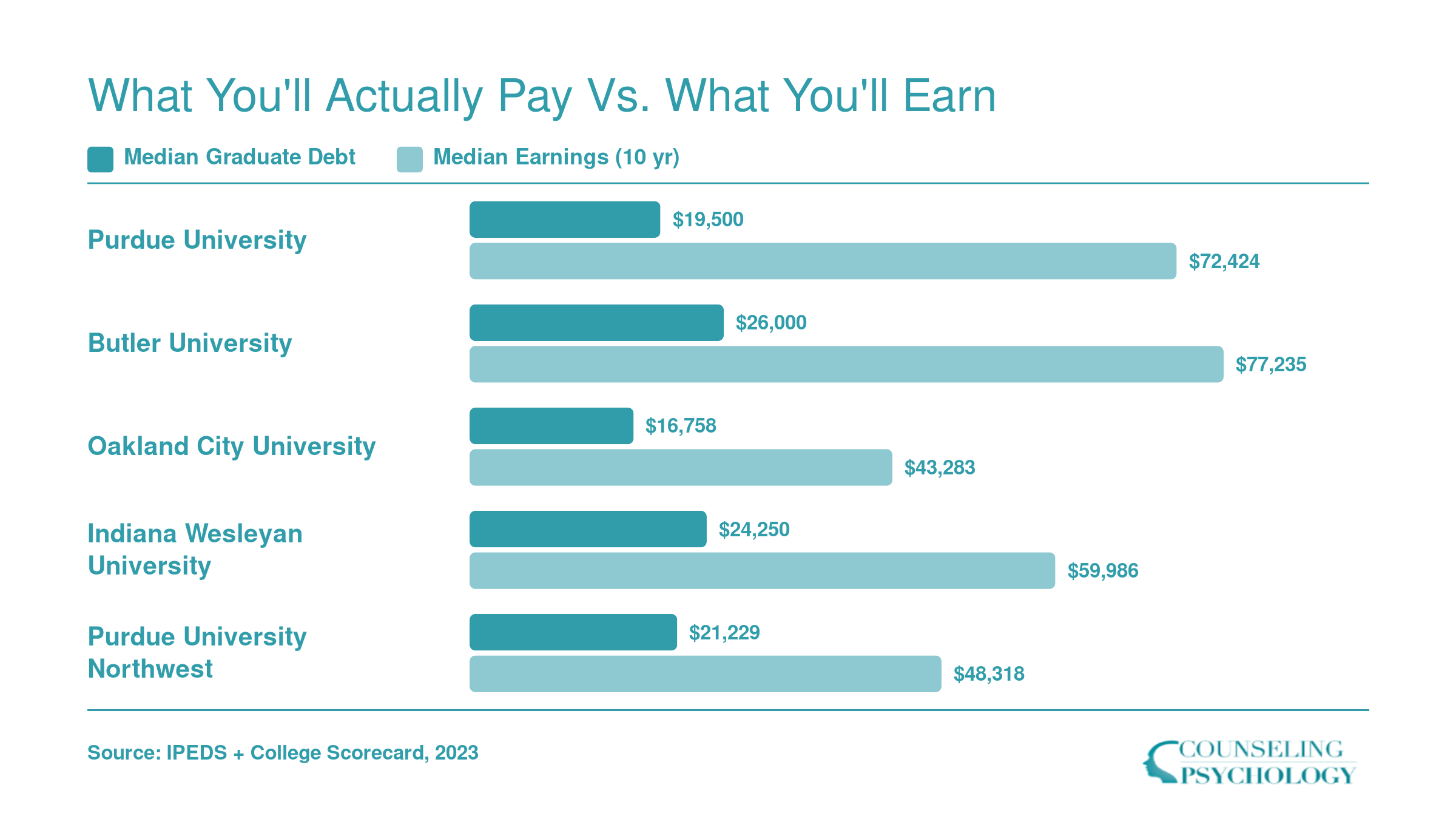
Median debt at completion offers a concrete snapshot of what students borrow to finish their degrees. Among the schools with available data, Oakland City University graduates carry a median debt of $16,758, Purdue graduates owe $19,500, Purdue Northwest graduates owe $21,229, Indiana State graduates owe $24,000, and Butler graduates owe $26,000. Marian University graduates carry $27,000 in median debt. These figures encompass all borrowing, undergraduate and graduate combined, so your individual debt will depend on whether you enter with existing loans and how much you borrow during the program.
Graduate Certificates Cost Less
If you already hold a master's degree in a related field or want to add school counseling credentials without committing to a full master's program, graduate certificate in psychology options (typically 18 to 24 credits) cost proportionally less. Certificates are not a substitute for the master's degree required for Indiana school counselor licensure, but they can serve as stepping stones or add-on credentials for career changers.
What You'll Actually Pay vs. What You'll Earn
Program-level debt and first-year earnings figures are not yet published for these school counseling programs, so the chart below uses each institution's median graduate debt alongside median earnings ten years after enrollment. These institution-wide numbers give you a useful ballpark for comparing long-term return on investment across the most affordable options near Indianapolis.
CACREP Accreditation and Indiana School Counselor Licensure Requirements
What CACREP Accreditation Means for Your Career
CACREP (Council for Accreditation of Counseling and Related Educational Programs) accreditation signals that a school counseling program meets rigorous national standards for curriculum, faculty, and student support. For students, this accreditation matters in three ways: it eases the path to licensure in many states, it enhances the portability of your credentials, and it often gives you a hiring edge. Indiana specifically aligns its school counselor licensure rules with nationally recognized programs, so choosing a CACREP-accredited degree can streamline your process.1 Employers, particularly public school districts, frequently look for candidates from accredited programs because they trust the training quality. Additionally, many states accept CACREP credentials more readily for interstate reciprocity, which is valuable if your career might take you beyond Indiana.2
Indiana School Counselor Licensure: Step by Step
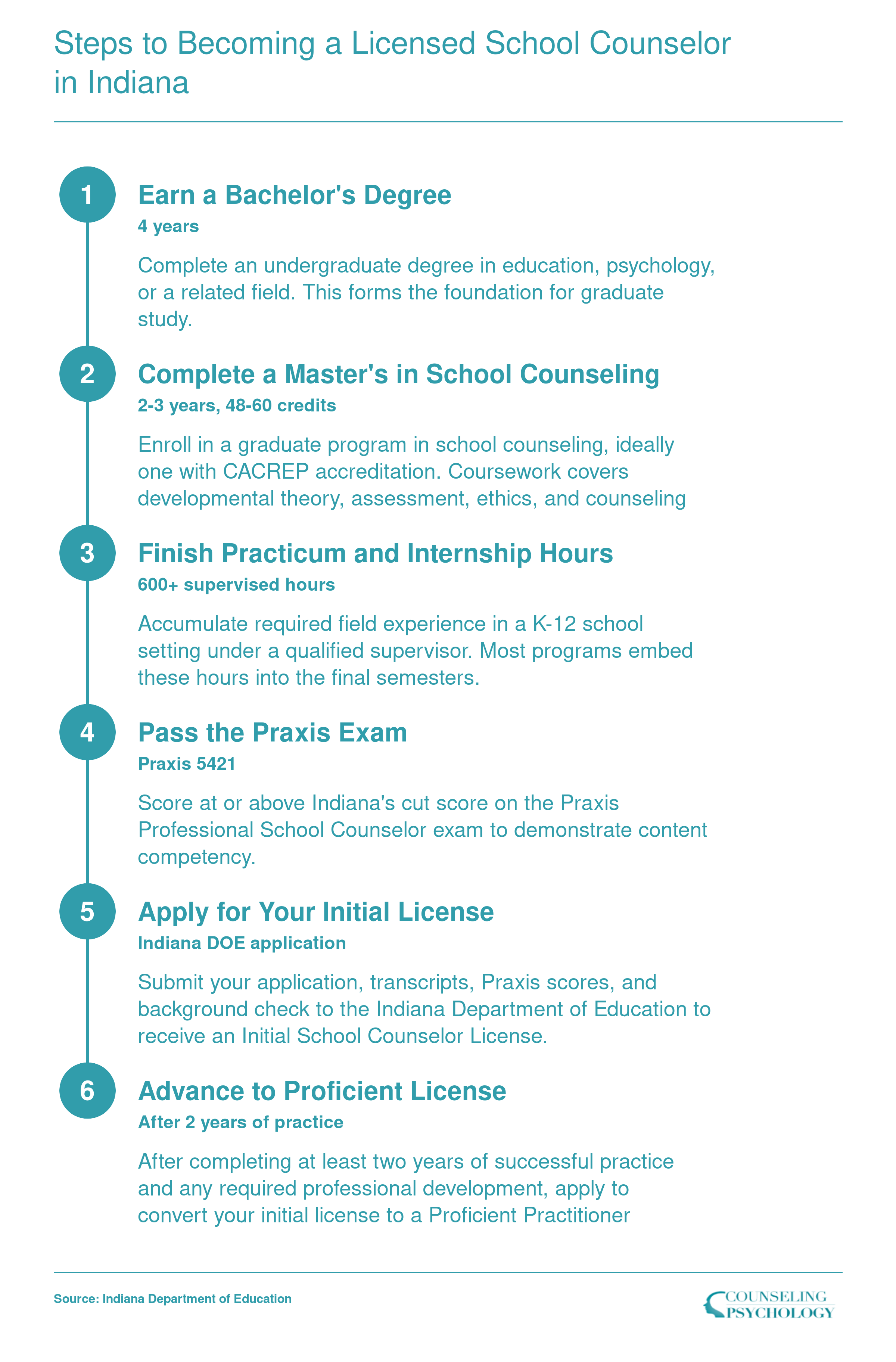
The Indiana Department of Education issues three tiers of school counselor credentials: Initial Practitioner (the entry-level license), Proficient Practitioner (after residency and assessment), and Accomplished Practitioner (requiring two years of experience and renewal documentation for a 10-year license).1 To qualify for the Initial Practitioner license, you must:
- Earn a master's degree in school counseling or an approved related field.3
- Complete required coursework in areas such as human development, counseling theories, ethics, career development, and group work, all typically embedded in a CACREP-aligned program.
- Pass the Praxis School Counselor exam (test code 5422). The passing score set by Indiana is subject to change; confirm current requirements on the Indiana DOE website.3
- Fulfill state-mandated training in CPR/AED use, suicide prevention, human trafficking awareness, and child abuse/neglect reporting. These can often be completed online or through your graduate program.3
- Document supervised practicum and internship hours (see below).
Once you hold the Initial Practitioner license, it is valid for five years.2 You can then advance to Proficient and Accomplished levels as you gain experience and complete professional development.
CACREP-Accredited School Counseling Programs in Indiana
A key step often overlooked by applicants is verifying that a program holds current CACREP accreditation. In Indiana, several universities offer CACREP-accredited school counseling tracks. For example, Ball State University's MA in School Counseling and Indiana State University's MS in School Counseling are both CACREP-accredited. Other institutions may also hold accreditation; always check the CACREP directory (cacrep.org) for the most up-to-date list. If you are exploring broader counseling master's programs online, keep in mind that only programs specifically approved for school counseling will satisfy Indiana's licensure pathway. Choosing an accredited program ensures that your course content, field experience, and faculty qualifications align with state licensure expectations, potentially saving you from extra coursework later.
Graduate Certificate vs. Master's Degree: Which Path Is Right?
Some professionals considering a career shift already hold a master's in a related field, such as clinical mental health counseling or social work, and wonder whether a graduate certificate in school counseling suffices. In Indiana, the core licensure requirement is a master's degree in school counseling or an approved program.1 A certificate alone typically does not meet this standard unless it is part of an approved transition plan that the Indiana DOE accepts. Earning a full master's in school counseling is the safest route because it covers all required content areas and the substantial fieldwork hours. A certificate might supplement existing credentials for a licensed professional counselor seeking to add school counseling, but you must verify with the DOE that your combined education meets the rules. The career implications are straightforward: only a qualifying degree leads to licensure; a certificate without the degree leaves you ineligible to work as a school counselor in Indiana public schools.
Field Experience Hours: A Critical Requirement
Indiana mandates that aspiring school counselors complete a supervised practicum and internship as part of their approved program. While the Indiana DOE does not publish a single fixed hour total, practically all CACREP-accredited programs require at least 600 hours of field experience, with a typical split of 100 hours of practicum and 600 hours of internship. Some Indiana programs may require more; Ball State, for instance, structures 100 practicum and 600 internship hours. This hands-on training takes place in K-12 school settings under the supervision of a licensed school counselor and a university supervisor. The hours build your competence in individual counseling, classroom guidance, and crisis response, and they directly fulfill Indiana's experience requirement for licensure.1
Steps to Becoming a Licensed School Counselor in Indiana
Indiana requires a specific sequence of education, supervised experience, and testing before you can work as a licensed school counselor. Here is the credentialing ladder from start to finish.
Questions to Ask Yourself
Online vs. On-Campus School Counseling Programs in Indianapolis
Choosing between online and on-campus delivery is one of the most consequential decisions you will make when selecting a school counseling program. Both formats can lead to Indiana licensure, but they differ in cost structure, scheduling flexibility, and how you will build professional relationships. Among the programs ranked on this list, the majority are campus based, while Indiana Wesleyan University and Butler University offer fully online options.
Pros
- Online programs like Indiana Wesleyan (CACREP accredited, $602 per credit) and Butler give working professionals the flexibility to complete coursework around existing job schedules.
- Online delivery often carries a lower net cost because you avoid commuting, relocation, and on-campus fees, which matters when tuition alone can range from roughly $6,600 to over $22,000 per year.
- Enrolling online opens access to CACREP accredited programs beyond your immediate geography, widening your choices without uprooting your life.
- On-campus programs at schools like Purdue Fort Wayne, Purdue Northwest, and Ball State provide a structured cohort experience where you progress through coursework alongside the same peers, building lasting professional networks.
- Campus based programs typically maintain established practicum partnerships with local K-12 districts, simplifying the process of securing and supervising your required field hours.
- Face to face faculty mentoring, available at institutions like Indiana University South Bend and Marian University in Indianapolis, lets you build advising relationships that often translate into strong licensure recommendations and job referrals.
Cons
- Online students usually must locate and arrange their own practicum and internship placements, which can be time consuming and stressful without a program coordinator handling local school partnerships.
- Virtual formats tend to offer fewer organic networking opportunities with classmates and local practitioners, so you may need to be more intentional about attending professional events.
- Some online programs still require periodic in person intensives or residencies, adding travel costs that are easy to overlook during the application stage.
- On-campus schedules at programs like Ball State (60 credits) or Indiana State (48 credits) can be rigid, with evening or daytime class blocks that conflict with full time employment.
- When you factor in housing, transportation, and parking near urban campuses such as Marian University or Butler University in Indianapolis, the total cost of an on-campus program can climb well beyond posted tuition.
Related Articles
Admission Requirements and Career-Changer Pathways
One of the most persistent misconceptions about school counseling programs is that applicants need a teaching background to get in. That is not the case in Indiana, and understanding what programs actually require helps career changers plan a realistic timeline.1
What Most Programs Require
The baseline across master's programs near Indianapolis is a bachelor's degree in any major. Education credentials are not a prerequisite.1 Beyond that, programs typically look for:
- GPA: A minimum undergraduate GPA around 3.0 is common. Indiana State University's M.Ed. in School Counseling, for example, sets this threshold at 3.0.2
- Letters of recommendation: Most programs ask for two or three, often from academic or professional supervisors who can speak to your capacity for graduate-level work.
- Personal statement: Expect to write about your professional goals, why school counseling specifically, and how your background prepares you for the field.
- Interview: Indiana State University and IU South Bend both require an interview as part of the admissions process, so come prepared to discuss your motivation and experience.23
Standardized Testing: Less Required Than It Used to Be
The GRE and MAT requirements have softened considerably at many programs. Indiana State University offers a GRE waiver, and Indiana Wesleyan University only requires GRE scores if an applicant's undergraduate GPA falls below 3.0.4 Some programs have dropped standardized testing requirements altogether. Because policies shift, verify current testing requirements directly with each program before you apply. If you are curious about how competitive graduate admissions can be across related fields, our overview of how hard it is to get into grad school for psychology provides useful context.
Pathways for Career Changers
Professionals coming from social work, psychology, human resources, education, or community health are genuinely well-positioned for school counseling graduate programs. No teaching license is required to enter a master's program in Indiana, and none is required before you graduate either.1 Licensure as a school counselor in Indiana follows a separate state credentialing process after you complete the degree. For a broader look at that process, our guide on how to become a school counselor walks through degree and credentialing steps nationwide.
If a full master's program feels like a large commitment before you are certain about the field, some institutions offer graduate certificates in school counseling with lighter admission requirements. These can serve as a lower-stakes entry point, though a certificate alone will not qualify you for Indiana school counselor licensure.
IU South Bend accepts applications on a rolling, year-round basis, which gives career changers more flexibility than programs with a single annual deadline like Indiana State University's December 1 cutoff.23 Matching your timeline to program deadlines is a practical first step once you have identified programs that fit your background.
Career Outcomes and Salary for Indiana School Counselors
In the Indianapolis-Carmel-Anderson metropolitan area, the median annual wage for school and career counselors was $57,590 as of May 2023, according to Bureau of Labor Statistics occupational employment data.1 That translates to roughly $27.69 per hour. With approximately 1,450 counselors employed in the metro area at that time, the field maintains a meaningful presence in the regional labor market.
Understanding the Full Wage Range
Median figures tell only part of the story. The BLS Occupational Employment and Wage Statistics (OEWS) tool lets you look up the 10th and 90th percentile wages for SOC 21-1012 (School and Career Counselors) in both the Indianapolis-Carmel-Anderson MSA and Indiana statewide. Counselors near the lower end of the distribution are often newer to the field or working in smaller districts, while those at the upper end typically combine years of experience with advanced credentials or administrative responsibilities. Checking the full spread gives you a realistic picture of where your earning trajectory could land over a career.
Keep in mind that the MSA figure above is specific to that metro area as of 2023. State-level and national medians are separate figures and should not be treated as interchangeable with the Indianapolis metro data.
State-Level Employment Projections
For the longer-term outlook, the Indiana Department of Workforce Development (in.gov/dwd) publishes occupational projections under its Data and Analytics section. These projections cover expected job growth over multi-year periods and can help you gauge demand for school counselors across the state, not just in the Indianapolis area. District consolidations, population shifts, and legislative changes to student-to-counselor ratio requirements all influence hiring trends, so state projections are worth reviewing before you commit to a program.
What the Job Actually Looks Like Day to Day
Salary is only one dimension of career fit. The American School Counselor Association (ASCA) National Model recommends that school counselors spend at least 80 percent of their time on direct and indirect student services, with the remaining 20 percent on program management and school support. This 80/20 guideline shapes how districts structure counselor roles and is worth understanding before you enter the field. Counselors who want to deepen their expertise beyond the master's level may also explore an online doctorate in school counseling, which can open doors to leadership and supervisory positions. ASCA's website (schoolcounselor.org) explains the model in full.
Finding Actual Pay Scales in Local Districts
Published salary data from BLS reflects broad occupational categories. For district-level specifics, check individual school district HR pages or the Indiana Department of Education's salary transparency resources. Many Indiana districts post salary schedules publicly, and those documents show exactly how years of experience and degree level affect a school counselor's placement on the pay scale. Comparing several districts in the metro area before you accept a position can make a meaningful difference in your starting salary.
Financial Aid and Tuition-Saving Strategies for School Counseling Students
Graduate school counseling programs in Indiana carry substantial costs, but a mix of federal aid, institutional support, and employer benefits can reduce your out-of-pocket burden significantly. Because graduate students do not qualify for most need-based grants, smart borrowing and strategic program selection become critical.
Federal Loans and Graduate Aid
All school counseling students are eligible for federal Direct Unsubsidized Loans, which carry fixed interest rates and income-driven repayment options. Grad PLUS loans fill the gap between your cost of attendance and other aid, though they require a credit check and carry slightly higher rates. Unlike undergraduate borrowers, graduate students do not qualify for Pell Grants. However, if you are a teacher transitioning into school counseling, check whether your district offers tuition reimbursement; districts often budget $3,000 to $5,000 annually for employees pursuing advanced degrees aligned with district needs.
School counseling programs are not eligible for the federal TEACH Grant, which is reserved for teacher-preparation programs and requires a 3.25 GPA, a 75th-percentile entrance exam score, and a four-year service commitment in a high-need field.12 Similarly, the Indiana Transition to Teaching Scholarship, which awards $10,000 for the 2026-2027 academic year (application deadline April 15, 2026), is limited to alternative licensure pathways in teacher education and does not extend to school counseling candidates.3
Institutional Aid and Assistantships
Many Indiana universities offer graduate assistantships that pair tuition remission with a modest stipend in exchange for 10 to 20 hours per week of research, teaching support, or administrative work. Indiana State University, Purdue Fort Wayne, and Ball State all maintain competitive assistantship pools for counseling students. Priority typically goes to full-time students who apply early and demonstrate strong academic records. Tuition remission can cover half to all of your graduate tuition, turning a $30,000 degree into a manageable $10,000 to $15,000 commitment.
The share of undergraduate students receiving Pell Grants at each institution offers a rough proxy for how well the school serves students with financial need. Indiana State (65.9 percent Pell recipients) and IU South Bend (64.7 percent) enroll high proportions of lower-income undergraduates and often extend affordability-minded practices to their graduate cohorts, such as flexible payment plans and smaller program fees. Butler (27.7 percent) and Marian (27.2 percent) enroll wealthier undergraduate populations and may rely more heavily on merit aid and private loans at the graduate level.
Public Service Loan Forgiveness and Career Benefits
School counselors employed full-time in public K-12 schools qualify for Public Service Loan Forgiveness after making 120 qualifying monthly payments under an income-driven repayment plan. Because most Indiana public school districts are eligible PSLF employers, this path can erase tens of thousands of dollars in federal loan balances after ten years of on-time payments. PSLF does not forgive private loans, so prioritize federal Direct and Grad PLUS borrowing over private alternatives.
Compare Net Price, Not Sticker Price
When evaluating programs, calculate your true cost after tuition remission, assistantships, and employer contributions. A $40,000 private program with a $15,000 annual assistantship may cost less than a $20,000 public program with no aid. Request detailed financial aid estimates from each admissions office and model your total debt under different repayment scenarios before you commit.
When choosing a school counseling program, prioritize three factors: first, verify CACREP accreditation to ensure your Indiana license transfers if you move; second, compare net price after financial aid rather than published tuition, since actual cost varies widely; third, confirm the practicum structure fits your location and schedule, especially if you need to stay employed or live outside Indianapolis during fieldwork.
Frequently Asked Questions About School Counseling Programs in Indiana
These are the questions prospective school counseling students near Indianapolis ask most often. Each answer draws on program data, accreditation standards, and Indiana licensure requirements discussed throughout this article.