What you’ll learn in this article…
- CSWE accreditation is required in Oklahoma to sit for the ASWB licensing exam and pursue any social work license.
- Tulsa Community College's Pre-Social Work track covers 61 to 64 credits and transfers directly into area BSW programs.
- BSW graduates qualify for Oklahoma's Licensed Social Work Associate credential and can enter advanced-standing MSW programs in about one year.
- Tulsa metro social workers earn modest starting salaries, but long-term job security and career growth reward those who stay in the field.
Every CSWE-accredited BSW program in Oklahoma requires graduates to hold that credential before sitting for the ASWB licensing exam, making accreditation the first filter, not an afterthought. Tulsa-area child welfare agencies, community mental health centers, and tribal social services have all expanded hiring in recent years, and the demand for licensed bachelor-level practitioners is outpacing the local supply of qualified graduates.
This article ranks CSWE-accredited BSW programs within commuting or transfer distance of Tulsa, compares in-state tuition from under $6,000 per year at Northwestern Oklahoma State to $35,470 at Oral Roberts University, and maps the credential steps from initial licensure through advanced standing MSW pathways. Readers who started at Tulsa Community College will also find specific transfer guidance here, along with salary context drawn from metro-level labor market data.
The practical tension most Tulsa-area students face is not finding a program, but choosing between cost, location, and institutional fit while keeping the licensure clock in mind. A BSW from a non-accredited program resets that clock entirely.
Best BSW Programs Near Tulsa, Rankings
Every CSWE-accredited BSW on this list qualifies graduates for Oklahoma's Licensed Social Work Associate (LSWA) credential, the entry-level license for bachelor-level practice. Because program-level earnings data is not yet available for these social work programs, the institution-wide figures below offer a broader financial picture. Keep in mind that graduation rates shown are school-wide, not specific to BSW students.
- CSWE accreditation status
- Institutional graduation and retention rates
- Net price and student debt levels
- Field education and practicum quality
- Regional workforce alignment
- Independent program research
- NCES-IPEDS federal institutional data — nces.ed.gov
- Internal program database
- College Scorecard graduate earnings — collegescorecard.ed.gov

University of Oklahoma-Norman Campus
The University of Oklahoma's Anne and Henry Zarrow School of Social Work delivers a Bachelor of Arts in Social Work on the Norman campus, in Tulsa, and online. With a 75.3% institution-wide graduation rate, a 90% retention rate, and a net price of roughly $15,300 for in-state students, OU combines research-university resources with flexible delivery. Graduates who want to stay in the Tulsa region can transition directly into OU's advanced-standing MSW, offered in hybrid Tulsa-based and fully online formats through the same school.
- Available on campus in Norman, in Tulsa, and fully online
- Includes structured field education placements across Oklahoma
- 90% student recommendation rate reported by the program
- CSWE-accredited with focus on equitable community practice
- Innovative research opportunities through the Zarrow School
- Median institution-wide graduate debt of approximately $20,654
- Seamless advanced-standing MSW pathway at OU in Tulsa or online
Bachelor of Arts in Social Work — On-Campus

Oral Roberts University
Oral Roberts University, located in Tulsa itself, offers a CSWE-accredited Baccalaureate of Social Work in both residential and fully online formats. The program integrates a Christian worldview with a liberal arts core, emphasizing Whole Person Education and spirit-empowered leadership alongside professional social work competencies. ORU's Tulsa location gives students direct access to local field agencies, hospitals, and nonprofits for practicum placements, which is a practical advantage for students planning to build a career in the metro area.
- Residential program on ORU's Tulsa campus
- CSWE accredited with a 50-hour academic core
- Field practicum embedded in Tulsa-area agencies
- Integrates Christian worldview with professional training
- Prepares graduates for generalist practice and LSWA licensure
- Scholarships and financial aid options available
- Fully virtual with interactive live lectures and video conferencing
- Taught by the same on-campus ORU faculty
- CSWE-accredited curriculum mirrors the residential program
- Whole Person Education focus maintained in online delivery
- Flexible format ideal for working students statewide
- Access to ORU campus resources and Tulsa networking
Baccalaureate of Social Work (Campus) — On-Campus
Baccalaureate of Social Work (Online) — On-Campus

Northeastern State University
Northeastern State University in Tahlequah holds the distinction of offering both a CSWE-accredited BSW and one of only two MSW programs in the state. Its Child Welfare Leadership concentration is particularly well suited for students drawn to Oklahoma's tribal child welfare and rural service systems. With a net price around $12,710 and a 16:1 student-to-faculty ratio, NSU is a cost-effective choice that feeds directly into advanced-standing MSW study for those who want to continue their education.
- CSWE accredited with a generalist practice curriculum
- Blends liberal arts foundation with professional content
- Admission requires a 1,000-word essay and background check
- Coursework covers HBSE, social policy, and case management
- Prepares students for public and private agency roles
- Institution-wide median graduate debt near $17,367
- Specialized concentration emphasizing Native American populations
- Hands-on field education in child welfare settings
- CSWE accredited, same as the generalist BSW track
- Focus on ethical practice, diversity, and human rights
- Strong alumni network in northeastern Oklahoma agencies
- Scholarships available for qualifying students
Bachelor of Social Work — On-Campus
Bachelor of Social Work, Child Welfare Leadership — On-Campus

East Central University
East Central University in Ada has maintained CSWE accreditation since 1984, making its BSW one of the longest-running accredited programs in Oklahoma. With a net price of approximately $8,683, ECU stands out as the most affordable option on this list. The curriculum places particular emphasis on rural community practice and social justice, preparing graduates who frequently return to serve smaller towns across eastern and central Oklahoma or transition into the Tulsa-area workforce.
- CSWE accredited continuously since 1984
- Lowest net price on this list at roughly $8,683
- Generalist practice curriculum with rural community focus
- Admission requires a minimum 2.25 GPA in prerequisite courses
- Fall and spring admission cycles available
- Scholarship opportunities for social work majors
- Institution-wide median graduate debt near $17,671
- Transfer-friendly for Oklahoma community college students
Bachelor of Social Work — On-Campus

Northwestern Oklahoma State University
Northwestern Oklahoma State University in Alva is one of only five CSWE-accredited BSW programs in the state, offering a smaller-campus experience with a 15:1 student-to-faculty ratio. The program requires a minimum of 420 field education hours and grounds its curriculum in ethical leadership, social justice, and service to diverse communities. While Alva is a significant drive from Tulsa, NWOSU graduates carry the same CSWE credential and LSWA eligibility as peers from larger institutions, making them fully competitive for Tulsa-area positions.
- CSWE accredited, one of five such BSW programs in Oklahoma
- Minimum 420 hours of supervised field education
- Smallest student-to-faculty ratio on this list at 15:1
- Emphasis on ethical leadership and social justice
- Financial aid and scholarship options available
- Generalist practice preparation for licensure-eligible graduates
- Institution-wide median graduate debt near $17,355
Bachelor of Social Work — On-Campus
What to Look for in a Tulsa-Area BSW Program
Where will you actually spend your 400+ practicum hours, and who runs the program that places you there? That is the single most useful filter when comparing BSW options near Tulsa, because field education is where classroom theory turns into the work you will do on day one as a social worker.
Start with CSWE Accreditation, Then Read the Fieldwork Manual
Every BSW program you seriously consider must be accredited by the Council on Social Work Education (CSWE). The CSWE directory at cswe.org lists accredited Oklahoma programs, including the University of Oklahoma, Oklahoma State University, and Oral Roberts University. Once you have that short list, go to each program's website and find the field education manual or BSW student handbook. These documents spell out the practicum hour requirement (Oklahoma BSW programs typically land in the 400 to 480 hour range), the timing in the curriculum (usually senior year), and the supervision structure.
Ask the Field Education Coordinator About Tulsa Placements
The field coordinator is the person who actually matches students to agencies, and a quick email or phone call will tell you more than a glossy brochure. Ask specifically which Tulsa-metro sites the program has placed students at in the last two years. Strong programs will name agencies like:
- Oklahoma DHS regional offices (child welfare, adult protective services)
- Family and Children's Services (one of the largest behavioral health providers in Tulsa)
- CREOKS Health Services
- Saint Francis Health System (medical social work)
- ODMHSAS-contracted behavioral health agencies
If the coordinator cannot produce a current placement list, that is a signal worth noting. BSW graduates who gain child welfare practicum experience, for example, may later pursue specialized roles such as becoming a child abuse counselor.
Cross-Reference Provider Directories
The Oklahoma Department of Human Services (okdhs.org) and the Oklahoma Department of Mental Health and Substance Abuse Services (oklahoma.gov/odmhsas) both publish provider directories. Skimming these gives you a realistic picture of the behavioral health landscape your future internship, and eventually your first job, will sit inside. Programs with established memoranda of understanding with these agencies tend to place students faster and into roles with better supervision. Students interested in continuing their education after a BSW may also want to explore counseling masters programs Oklahoma as a next step.
Verify Standards Against Federal and Accreditor Sources
Finally, sanity-check what programs tell you against the BLS Occupational Outlook Handbook entry for social workers (bls.gov/ooh) and the CSWE Educational Policy and Accreditation Standards. If a program's claims about hours, licensure prep, or career outcomes do not line up with those baseline references, ask why.
Tuition and Financial Aid Comparison
The table below compares published tuition, average net price after financial aid, and median graduate debt for each BSW program near Tulsa. Keep in mind that net price figures reflect an institution-wide average for all undergraduates receiving aid, so actual out-of-pocket costs for BSW students may be higher or lower depending on individual aid packages. The share of students receiving Pell Grants at each school is a useful indicator of affordability and access: the higher the percentage, the more the institution serves students with significant financial need. Beyond institutional aid, Oklahoma residents should explore the Oklahoma Tuition Aid Grant (OTAG), which is awarded automatically through the FAFSA on a first-come, first-served basis. OTAG awards reach up to $2,000 at regional universities and up to $3,000 at research universities (Pell eligibility required). Students with tribal citizenship should investigate education benefits offered by their nation, many of which can be combined with other aid. BSW students interested in child welfare careers may also qualify for Title IV-E stipends through partnerships between Oklahoma DHS and participating universities, which cover tuition in exchange for a post-graduation work commitment in public child welfare.
| School | In-State Tuition | Out-of-State Tuition | Avg. Net Price (All Students) | Median Graduate Debt | Pell Grant Recipients |
|---|---|---|---|---|---|
| East Central University | $8,032 | $17,842 | $8,683 | $17,671 | 75.8% |
| Northwestern Oklahoma State University | $5,970 | $11,664 | $10,104 | $17,355 | 65.8% |
| Northeastern State University | $7,810 | $17,290 | $12,710 | $17,367 | 73.1% |
| University of Oklahoma (Norman) | $9,797 | $27,377 | $15,300 | $20,654 | 51.1% |
| Oral Roberts University | $35,470 | $35,470 | $25,365 | $27,000 | 61.6% |
Questions to Ask Yourself
Career Outcomes and Social Worker Salaries in the Tulsa Metro
Choosing a social work career often means balancing a passion for helping others with financial realities. In the Tulsa metro, the numbers show that while starting salaries are modest, the long-term payoff, both financially and in job security, can make a BSW a worthwhile investment.
What Social Workers Earn in Tulsa
According to the Oklahoma Employment Security Commission, social workers in the Tulsa metropolitan area earned a median annual wage of $51,750 as of the most recent data.1 The bottom 10 percent of earners made approximately $34,000, while the top 10 percent reached nearly $87,000.1 These figures cover social workers across all specializations and experience levels, so new BSW graduates typically start closer to the lower end of the range.
For context, the national median for social workers (all other) was $61,420 in May 2023, suggesting that Tulsa's wages fall below the national average but remain competitive for the region. Oklahoma's statewide median tends to track closely with Tulsa's figures, reflecting similar living costs and demand across the state. Those interested in related helping professions can compare these numbers with counselor salary data to understand the broader landscape.
How Program Choice Affects Earnings
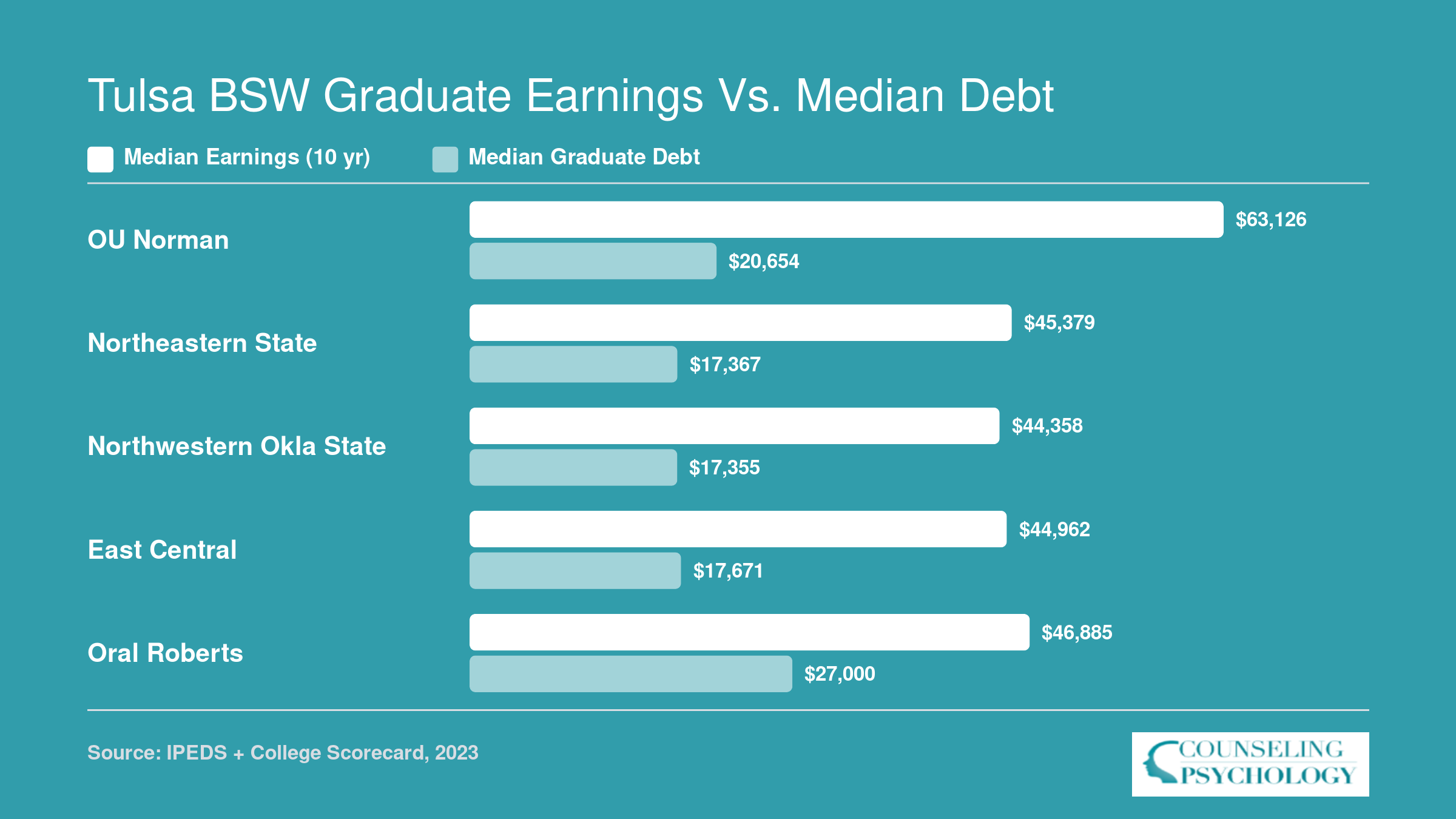
Program-specific early-career earnings data for BSW graduates in Tulsa are limited, but institution-wide earnings profiles offer insight into long-term potential. The University of Oklahoma-Norman Campus reports median earnings of $63,126 ten years after entry for all graduates, while Oral Roberts University shows $46,885. Regional publics like Northeastern State University, East Central University, and Northwestern Oklahoma State University report ten-year earnings in the $44,000 to $45,000 range. Keep in mind these numbers span all majors; social work graduates may initially earn less but can advance with experience and licensure.
Job Growth and Long-Term Demand
The U.S. Bureau of Labor Statistics projects employment for social workers to grow 7 percent from 2022 to 2032, faster than the average for all occupations. In Oklahoma, demand is fueled by aging populations, increased mental health awareness, and expanded social services. This steady need means BSW holders are well-positioned for stable employment, even if starting salaries are moderate. Graduates who enjoy working in community settings may also explore paths like becoming a community mental health counselor.
Weighing Debt Against Starting Salaries
Median student debt for the programs reviewed ranges from $17,355 at Northwestern Oklahoma State University to $27,000 at Oral Roberts University. With even entry-level social work positions in Tulsa paying around $34,000, the debt-to-income ratio is manageable under income-driven repayment plans. Additionally, many social workers qualify for Public Service Loan Forgiveness (PSLF) because they work in government agencies, schools, or nonprofit organizations. This can significantly reduce the net cost of the degree over time.
Tulsa BSW Graduate Earnings vs. Median Debt
Program-level early earnings are not yet published for these BSW programs, so the chart below uses institution-wide median earnings at 10 years after entry alongside median federal loan debt at graduation. These figures cover all program completers at each school, not social work graduates specifically, and debt reflects federal loans only.
Licensure and Advanced Standing MSW Pathways in Oklahoma
How long does it take to go from your first day of BSW classes to holding a social work license in Oklahoma? The answer depends on which credential you pursue, but most graduates can map out a realistic timeline before they even finish their junior year.
The LSWA: Oklahoma's Entry-Level License for BSW Graduates
If you earn a BSW from a CSWE-accredited program, the credential you will apply for is the Licensed Social Work Associate (LSWA), not the LSW.1 This is an important distinction that catches some students off guard. The LSW (Licensed Social Worker) in Oklahoma actually requires a master's degree.2 The LSWA is the bachelor's-level license, and it allows you to practice social work under certain conditions right after graduation.
Here is what the LSWA process looks like:
- Degree: A BSW from a CSWE-accredited program is required.2
- Exam: You must pass the ASWB Bachelor's examination.2
- Application fee: $150, submitted to the Oklahoma State Board of Licensed Social Workers.2
- Fingerprinting fee: $51.25 for a background check.2
- Supervised practice hours: None are required before licensure at the LSWA level.2
- Continuing education: 16 hours per year once licensed, including 3 hours in ethics.2
Because no post-degree supervised hours are required, most applicants move from graduation to LSWA licensure in roughly one to three months.2 That window accounts for processing time, scheduling the ASWB exam, and completing the background check.
Mapping the Full Timeline
A traditional full-time BSW takes four years. Add one to three months for LSWA licensure, and you are looking at approximately four years and a few months from enrollment to practicing as a licensed social work associate. If you entered with transfer credits from Tulsa Community College or another institution, you could shave a year or more off the front end.
For students who want to advance further, the path branches. Moving from the LSWA to the LSW, LCSW, or LSW-ADM requires earning an MSW, passing a higher-level ASWB exam (Advanced Generalist or Clinical, depending on the credential), and completing 3,000 hours of supervised practice with at least 100 face-to-face supervision hours.2 That supervised practice period typically spans about two years.
Advanced Standing MSW: Saving a Full Year of Graduate Study
A CSWE-accredited BSW opens the door to advanced standing MSW programs, which condense the typical two-year master's into roughly 12 months by waiving foundation coursework you already completed as an undergraduate.2
In the Tulsa area, the University of Oklahoma's Tulsa campus (OU-Tulsa) offers an Advanced Standing MSW program. Applicants need a CSWE-accredited BSW, and a GPA of at least 3.0 is generally recommended. The program runs about 12 months, meaning a student who finishes a BSW in May could potentially hold an MSW by the following spring or summer.
Northeastern State University, which offers a well-regarded BSW program in Tahlequah (within commuting distance of Tulsa), does not currently offer its own MSW.3 However, NSU BSW graduates are eligible to apply to OU-Tulsa's advanced standing track or MSW programs at other Oklahoma institutions.
Putting It All Together
Here is a consolidated look at the fastest realistic path from BSW enrollment to full clinical licensure in Oklahoma:
- Years 1 through 4: Complete your BSW at a CSWE-accredited program.
- Months 1 through 3 after graduation: Obtain the LSWA through the state board and the ASWB Bachelor's exam.
- Year 5: Complete an advanced standing MSW (12 months at OU-Tulsa, for example).
- Years 6 and 7: Accumulate 3,000 supervised practice hours, then pass the ASWB Clinical exam to earn LCSW status.
So the full journey from freshman orientation to LCSW licensure is roughly seven years if everything proceeds without gaps. The LSWA alone, though, puts you in the workforce in just over four years, which is a meaningful distinction for students weighing their options. Oklahoma's licensure structure, as outlined by the Oklahoma State Board of Licensed Social Workers, rewards early planning, so understanding these steps now gives you a real advantage.
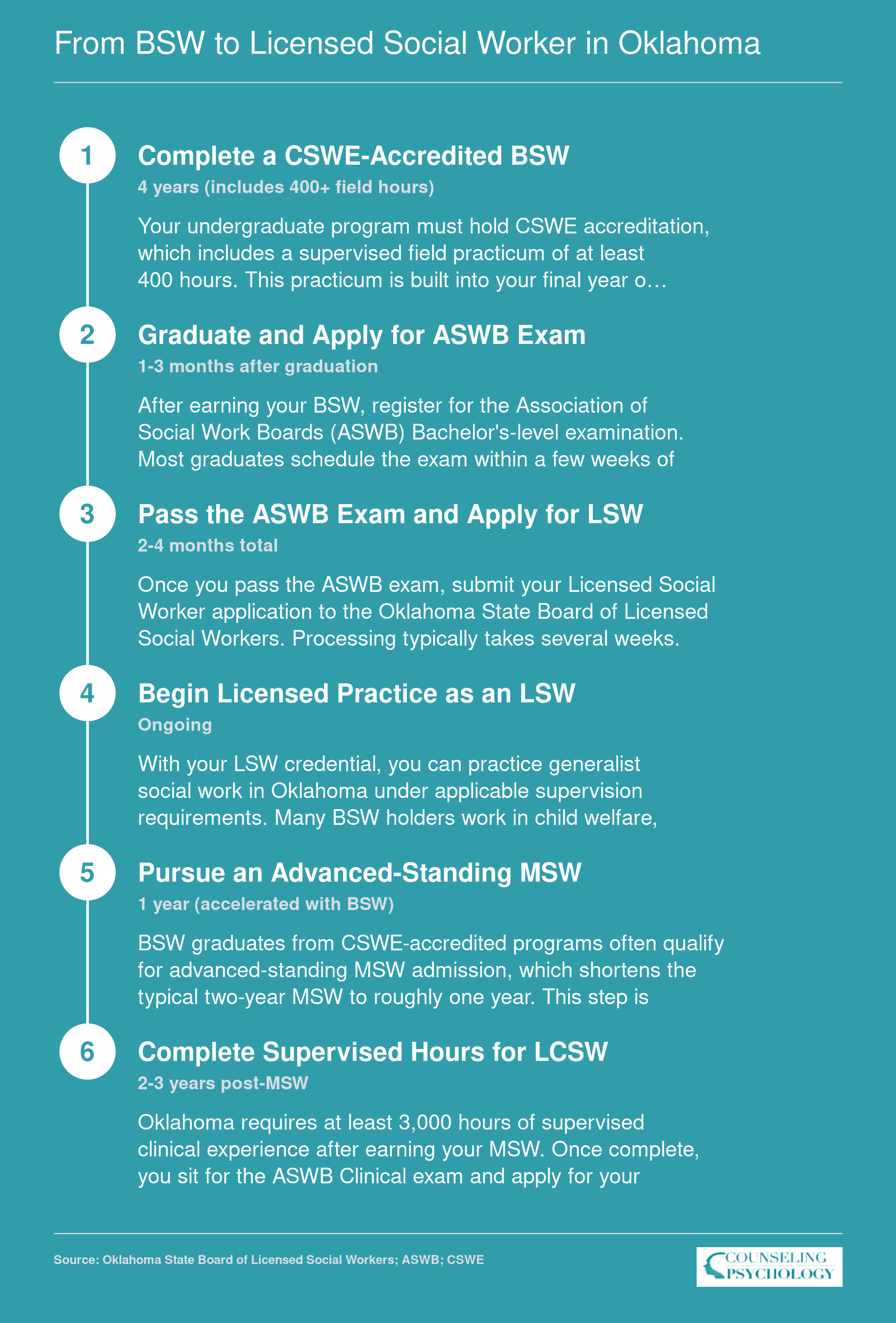
From BSW to Licensed Social Worker in Oklahoma
Earning your BSW is just the starting point. Oklahoma's credentialing ladder moves through a clear sequence, and understanding each milestone helps you plan realistic timelines. The LCSW designation requires completion of an MSW plus additional supervised clinical hours beyond initial licensure.
Transfer Pathways: TCC to a Tulsa BSW
Tulsa Community College's Associate in Science in Human Services, Pre-Social Work track requires 61 to 64 credits and is designed specifically to feed into bachelor's-level social work programs in the metro area.1 If you plan your coursework carefully, this route can cut your total time to a BSW down to roughly four years: two at TCC, then two at a receiving university.
How the TCC Associate Degree Articulates
TCC has published transfer maps that align its Pre-Social Work curriculum with the BSW programs at two nearby institutions:
- OU-Tulsa BA in Social Work: Accepts 61 to 64 transfer credits from TCC. The university requires a minimum of 60 residency hours and a total of 121 to 124 credits for the degree, so a TCC graduate transferring in at the maximum enters roughly at the halfway mark.2
- NSU Broken Arrow BSW: Accepts up to 64 transfer credits. The program totals 124 credits, and transfer coursework must carry a minimum grade of C to count toward degree requirements.3
Both programs estimate about 24 months of full-time study after transfer to complete the BSW, assuming prerequisite courses were finished at TCC. That timeline includes the required field practicum, which is typically scheduled in the final year.
Course Prerequisites and GPA Considerations
TCC's Pre-Social Work track covers general education requirements, introductory social science courses, and foundational human services content that the receiving universities expect. Specific course-to-course equivalencies are detailed in each school's transfer map, and advisors at TCC can walk you through the alignment.
Keep in mind that meeting minimum transfer requirements does not guarantee admission to the social work major at either institution. OU-Tulsa and NSU each have their own application processes for upper-division social work coursework, and competitive applicants typically present GPAs above the bare minimum. Check directly with each program's admissions office for the most current criteria.
Are There Guaranteed Admission Agreements?
Oklahoma's public higher education system encourages transfer through statewide course equivalency frameworks, but guaranteed admission to a specific BSW program is not the same as guaranteed transfer of credits. As of 2026, the published transfer maps between TCC and both OU-Tulsa and NSU Broken Arrow outline which courses transfer and how they apply, but students should verify whether any formal guaranteed admission provisions exist by contacting each program directly. Policies can shift year to year, and relying on outdated information is a common and avoidable mistake.
Practical Tips for a Smooth Transfer
- Meet with a TCC advisor early, ideally during your first semester, to map out the exact sequence of courses your target BSW program requires.
- Complete all math, English composition, and social science prerequisites at TCC rather than deferring them. Gaps in prerequisite completion are the most frequent cause of delayed graduation after transfer.
- Keep copies of syllabi for key courses. Receiving universities occasionally request them to confirm equivalency.
- Apply to the BSW program well before you finish at TCC. Both OU-Tulsa and NSU have application deadlines that may fall a semester or more before your intended start date.
Starting at TCC is one of the most cost-effective ways to reach a BSW in the Tulsa area, but the savings only pay off if every credit transfers cleanly. A little front-end planning goes a long way.
In Oklahoma, you must graduate from a CSWE-accredited BSW program to sit for the ASWB licensing exam. There are no exceptions: without that accreditation, licensure is off the table, and every reputable advanced-standing MSW program in the country will also require it before admitting you.
Frequently Asked Questions About Tulsa BSW Programs
Choosing the right BSW program raises a lot of practical questions about cost, timelines, and career outcomes. Below are answers to the most common questions prospective students ask about earning a Bachelor of Social Work near Tulsa, Oklahoma.