
What you’ll learn in this article…
- Wright State University offers the lowest net price among Cincinnati-area forensic psychology programs.
- Tiffin University awards up to $17,000 per year in merit scholarships for undergraduate forensic psychology students.
- Ohio requires either doctoral licensure or master's level LPC credentialing with a forensic specialization to practice.
- Cincinnati-area psychologist salaries track close to the national median according to BLS occupational data.
Ohio's courts, correctional facilities, and forensic mental health units increasingly rely on psychologists trained to assess competency, evaluate risk, and testify as expert witnesses, creating steady demand for forensic psychology practitioners across the state. Cincinnati-area students have three viable options within reasonable commuting or relocation distance: Wright State University's doctoral program in Dayton, Tiffin University's undergraduate degree in Tiffin, and John Carroll University's undergraduate concentration in University Heights. Net prices range from approximately $15,400 at Wright State to $28,700 at John Carroll after institutional aid, offering a meaningful cost spread for students at different degree levels.
The sections ahead detail the ranked programs, tuition and cost breakdowns, admission requirements, online versus on-campus trade-offs, Ohio's licensure pathway, and career outlook data specific to the state. Wright State is the only doctoral option in the region, making it the primary pipeline for students who want to practice as licensed psychologists in forensic settings. The two undergraduate programs serve students planning to continue into graduate work or enter adjacent roles in criminal justice and mental health. Students weighing graduate options beyond this region may also want to review forensic psychology master's programs for a broader national picture.
Program depth varies considerably. Wright State's Psy.D. includes forensic assessment coursework, forensic practica, and internship placements in legal settings. Tiffin and John Carroll offer foundational coursework that prepares students for graduate admission rather than direct forensic practice, a distinction that matters when evaluating total time to licensure and first-year earnings.
Best Affordable Forensic Psychology Programs Near Cincinnati
Ohio offers a small but distinctive set of forensic psychology programs within driving distance of Cincinnati, spanning bachelor's through doctoral levels. The three schools below were evaluated on net price, institutional graduation rates, program depth, and post-graduation earnings potential. Because forensic psychology is a specialized niche, program availability is limited, so weigh each school's degree level, format, and cost carefully against your career timeline.
- Net price and tuition affordability
- Institution-wide graduation rate
- Program depth and experiential training
- Post-graduation earnings potential
- Degree level and delivery format
- Internal program database
- NCES-IPEDS federal institutional data — nces.ed.gov
- College Scorecard graduate earnings — collegescorecard.ed.gov
- Independent program research

Wright State University
Wright State University, based in Dayton, houses a Doctor of Psychology (Psy.D.) program with a dedicated forensic psychology concentration. The program blends clinical training with specialized forensic coursework, including assessment and intervention, and places students in practicum sites such as prisons and courtrooms. With a net price of roughly $15,415 and in-state tuition of $15,771, it is the most affordable doctoral pathway on this list. The institution-wide graduation rate sits at about 41.7%, so prospective students should look closely at doctoral cohort completion data during their campus visit.
- Campus-based Psy.D. with a forensic psychology concentration
- Coursework in forensic assessment, intervention, and legal systems
- Practicum placements in prisons, courts, and forensic facilities
- Emphasizes critical thinking and applied forensic scholarship
- Admission follows School of Professional Psychology (SOPP) standards
- Designed to prepare graduates for competitive forensic internships
- Program-level earnings data not yet available from federal sources
Doctor of Psychology (Psy.D.) in Forensic Psychology — On-Campus

Tiffin University
Tiffin University pairs psychology with criminal justice in a way few Ohio schools do, offering both a bachelor's and a master's in forensic psychology on its residential campus about two hours north of Cincinnati. The master's program is a 42-credit, 18-month track with Saturday-only classes, a practical schedule for working professionals. Net price comes in at $26,500, and graduates often continue to law school or doctoral programs, making Tiffin a cost-effective stepping stone. The institution-wide graduation rate is approximately 39.9%, so students should inquire about support services and cohort retention within the forensic programs specifically.
- Blends psychology and criminal justice coursework on campus
- Small class sizes with individualized faculty attention
- Internships and field experiences in applied forensic settings
- Start dates in January and August each year
- Prepares graduates for entry-level careers or graduate study
- Financial aid and scholarship opportunities available
- Opportunities for research and conference presentations
- Described as the only forensic psychology master's in Ohio
- 42-credit, 18-month program with Saturday-only scheduling
- Research-based curriculum with clinical and experimental focus
- Graduates may qualify for CDCA certification in Ohio
- Strong alumni network across forensic and justice fields
- Program-level earnings data not yet reported by federal sources
Bachelor's in Forensic Psychology — On-Campus
Master of Science in Forensic Psychology — On-Campus

John Carroll University
John Carroll University, a private Jesuit institution near Cleveland, offers a bachelor's-level forensic psychology concentration within its psychology major. Though its sticker price of $50,500 is high, generous institutional aid brings the average net price down to about $28,746. JCU boasts the strongest institution-wide graduation rate in this group at 78.6%, paired with a 13-to-1 student-faculty ratio. The curriculum requires 42 credit hours in psychology and includes a practicum, and the school recommends pairing it with a statistics or data science minor for stronger graduate school prospects.
- Forensic psychology concentration within the psychology major
- Requires 42 credit hours in psychology and 120 total to graduate
- Includes a hands-on mental health practicum component
- Covers psychopathology, criminology, ethics, and psychobiology
- Statistics or data science minor recommended for graduate prep
- Campus-based program with a 13-to-1 student-faculty ratio
- Internship opportunities to build applied forensic experience
- Institution-wide median earnings of $62,860 ten years after entry
Bachelor's in Psychology, Forensic Psychology Concentration — On-Campus
How We Ranked These Forensic Psychology Programs
A ranking is only as useful as the criteria behind it. These rankings are built around a single practical question: which forensic psychology programs near Cincinnati give students the most educational value for the least financial burden?
What We Weighted Most Heavily
Affordability sits at the center of this methodology. The data inputs that carry the most weight are:
- Net price: The actual average cost students pay after grants and scholarships are applied, drawn from College Scorecard figures.
- Pell grant share: The proportion of enrolled students receiving Pell grants, used as a signal of how accessible a program is to lower- and middle-income applicants.
- Graduation rate: A proxy for institutional support. Programs where students actually finish what they start tend to deliver more reliable returns on tuition dollars.
- Earnings and debt outcomes: Where program-level data is available, we consider typical early-career earnings and median debt at graduation together, because a low tuition price that pairs with poor employment outcomes is not truly affordable.
What These Rankings Do Not Measure
This methodology has real limits, and transparency about those limits matters. The ranking does not evaluate curriculum depth, the credentials of individual faculty members, the quality of practicum or internship partnerships, or how well a program prepares students for licensure in Ohio specifically. Those factors vary considerably from program to program and are difficult to quantify fairly across institutions. Students interested in advancing beyond a master's degree should also explore doctorate in forensic psychology options separately, as doctoral programs involve different selection criteria.
Many competing ranking sites list programs in a numbered order without explaining how or why schools ended up where they did. This list takes a different approach: every factor described above is applied consistently, and the weighting reflects the affordable-program focus stated upfront.
How to Use This Ranking
Treat these rankings as a shortlist, not a final answer. A program that scores well here on cost and completion metrics may still be a poor personal fit depending on your schedule, your intended licensure path, or the specific concentration you want to pursue. Use this page to narrow your options, then dig into each program's own materials before applying.
Tuition and Cost Comparison by Program
Sticker price only tells part of the story. The net price column below reflects the average cost after institutional aid, grants, and scholarships, which is the figure most students actually pay. Wright State University stands out as the most affordable option on a net-price basis, while John Carroll University's higher sticker price is offset substantially by generous financial aid. Note that Wright State offers a doctoral-level program, while Tiffin and John Carroll offer bachelor's-level concentrations, so direct cost comparisons should factor in degree level and total time to completion.
| School | Degree Level | Published Tuition (In-State) | Published Tuition (Out-of-State) | Average Net Price | Median Graduate Debt | Graduation Rate | Student-to-Faculty Ratio |
|---|---|---|---|---|---|---|---|
| Wright State University | Doctorate (Psy.D.) | $15,771 | $25,759 | $15,415 | $22,750 | 41.7% | 16:1 |
| Tiffin University | Bachelor's | $34,790 | $34,790 | $26,500 | $27,000 | 39.9% | 22:1 |
| John Carroll University | Bachelor's | $50,500 | $50,500 | $28,746 | $26,000 | 78.6% | 13:1 |
Questions to Ask Yourself
Admission Requirements for Cincinnati-Area Forensic Psychology Programs
Getting into a forensic psychology program near Cincinnati means balancing academic readiness against the flexibility you need, especially if you are switching fields or have been out of school for a while. Requirements vary between master's and doctoral programs, and between criminal justice tracks with a forensic psychology focus and standalone psychology degrees. Here is what to expect as of the 2025-2026 admissions cycle.
GPA and Standardized Tests
Most graduate programs in the Cincinnati region ask for a minimum cumulative GPA of 3.0 on a 4.0 scale. The University of Cincinnati's MS in Criminal Justice, for example, requires a 3.0 minimum.1 Tiffin University's MS in Criminal Justice with a Forensic Psychology concentration sets the same threshold.2 Some doctoral programs, like Wright State University's Psy.D. with a forensic emphasis, may look for a somewhat higher GPA in practice, even when published minimums appear similar.
On the testing front, a notable shift has taken hold across Ohio. Since 2023, a growing number of graduate programs have moved to GRE-optional or test-free admissions. Neither the University of Cincinnati's MS in Criminal Justice nor Tiffin University's forensic psychology master's track requires the GRE.12 Doctoral programs are more varied: some still expect GRE scores while others have dropped them. Always confirm directly with the admissions office, because policies can change year to year.
Prerequisite Coursework
Forensic psychology sits at the intersection of behavioral science and the legal system, so admissions committees generally want to see undergraduate coursework in a few core areas:
- Abnormal psychology: Provides the diagnostic foundation forensic work demands.
- Statistics: Demonstrates your ability to interpret research data and assessment results.
- Research methods: Signals readiness for thesis or capstone projects that most programs require.
- Introductory psychology: Expected even if your bachelor's degree is in another discipline.
Doctoral programs tend to be stricter about these prerequisites, sometimes requiring six or more upper-level psychology courses. Master's programs are often more forgiving, occasionally allowing you to complete prerequisites as bridge coursework during your first semester.
Can You Apply With a Non-Psychology Degree?
Yes, and this is one of the most common questions career changers ask. Both the University of Cincinnati and Tiffin University accept applicants holding a bachelor's degree in any discipline.12 Criminal justice, sociology, pre-law, and even unrelated fields like business are well represented in entering cohorts. If your undergraduate transcript is light on psychology courses, expect to add prerequisite classes, but you will not be turned away at the door.
Letters of Recommendation and Additional Materials
Programs near Cincinnati typically require two to three letters of recommendation.1 Academic references carry weight, though professional references from supervisors in related fields (corrections, social services, victim advocacy) are often valued equally at the master's level. Beyond letters, plan on submitting:
- A personal statement explaining your interest in forensic psychology and your career goals.
- A current resume or CV highlighting relevant work, volunteer, or research experience.
- Official transcripts from all institutions attended.
Doctoral programs may add a writing sample or research statement. Relevant experience, whether that is volunteering at a crisis center, working in a correctional facility, or conducting undergraduate research, can meaningfully strengthen an application, especially when your GPA falls near the minimum threshold.
Because requirements shift frequently, verify every detail on the program's own admissions page before you apply.
Related Articles
Online vs. On-Campus Forensic Psychology Programs Near Cincinnati
Choosing between online and on-campus delivery is one of the most consequential decisions you will make when selecting a forensic psychology program. Both formats have genuine strengths, and several Cincinnati-area programs now offer hybrid models that blend the two. Your ideal format depends on your work schedule, your need for hands-on forensic training, and how far you are willing to travel.
Pros
- Online programs typically cost less overall because you avoid relocation, commuting, and campus fees, stretching a limited budget further.
- Flexible scheduling lets working professionals in criminal justice or mental health continue earning while completing coursework.
- Studying online removes geographic barriers, giving Cincinnati students access to accredited programs well beyond the local metro area.
- Hybrid options at some ranked programs combine online coursework with periodic on-campus intensives, offering a practical middle ground.
- On-campus students benefit from direct access to practicum placements at Hamilton County courts, forensic treatment centers, and local correctional facilities.
- In-person cohort models foster stronger peer networking and mentorship relationships with faculty who are active forensic practitioners.
Cons
- Online students may face extra effort securing local practicum or internship sites without the built-in partnerships that campus programs maintain.
- Fully online formats can feel isolating, making it harder to build the professional relationships that often lead to forensic job referrals.
- On-campus programs usually carry higher total costs once you factor in housing, parking, and commuting across the Cincinnati metro.
- Rigid class schedules at traditional campuses can be difficult to manage alongside full-time employment or family responsibilities.
- Hybrid programs may require periodic travel to campus for intensive weekends or lab sessions, adding unpredictable scheduling and travel expenses.
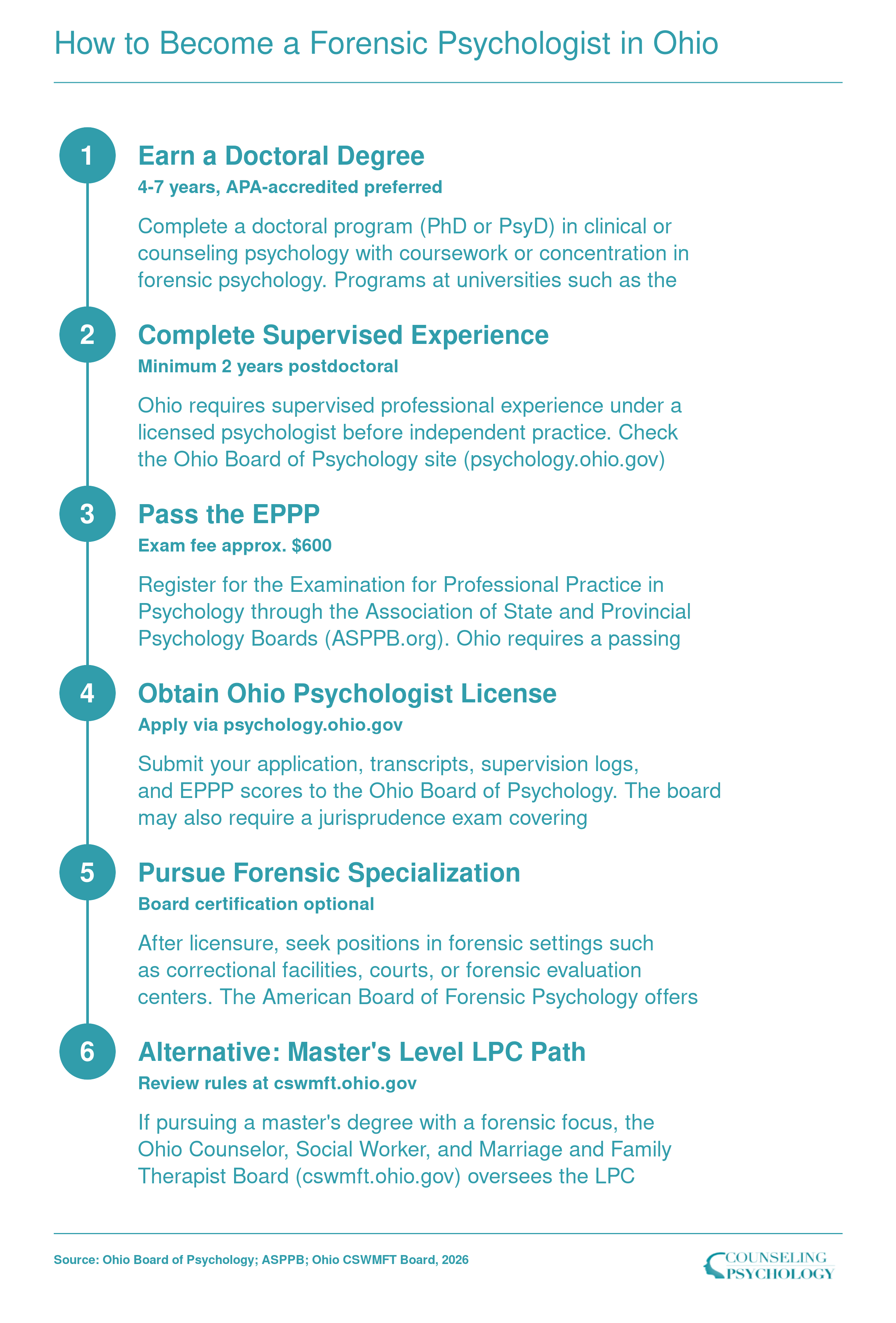
How to Become a Forensic Psychologist in Ohio
Ohio offers two primary pathways into forensic psychology practice: a doctoral route leading to full psychologist licensure, or a master's level route through Licensed Professional Counselor (LPC) credentialing with a forensic specialization. Both paths require supervised experience and a licensing exam. Here is the general progression for the doctoral track, which is the standard route to the title of forensic psychologist in Ohio.
Financial Aid and Scholarships for Forensic Psychology Students in Ohio
Tiffin University awards up to $17,000 per year to undergraduate forensic psychology students through its merit-based scholarships, a useful benchmark for what institutional aid in Ohio can look like before you layer on state and federal sources.1 Funding for forensic psychology study comes from four distinct buckets, and most graduate students stack two or three of them.
Start with the School's Own Funding
The psychology department is almost always the right first stop, not the central financial aid office. At the University of Cincinnati and Xavier University, graduate assistantships, teaching assistantships, and departmental scholarships are awarded directly by faculty committees, and availability shifts year to year based on enrollment and grant activity. Email the graduate program coordinator and ask specifically about tuition remission, stipend levels, and whether assistantships are tied to specific labs or open to incoming students. Wright State University runs a Forensic Emphasis Area within its Professional Psychology program, and assistantships there are typically attached to faculty research lines.
Apply for Ohio-Specific Grants
The Ohio College Opportunity Grant is need-based and requires the FAFSA, so file early. Choose Ohio First targets STEM and STEM-related fields and is administered through participating institutions, meaning eligibility depends on whether your specific program is enrolled. Confirm both with your school's financial aid office before assuming you qualify.
Tap National Forensic Psychology Awards
The American Psychology-Law Society (APA Division 41) and the American Academy of Forensic Psychology both offer student awards, dissertation grants, and research stipends that are competitive but specifically scoped to this subfield.3 The broader APA also funds graduate students through its Minority Fellowship Program, dissertation research awards, and early graduate student research awards.
Use Search Engines as a Last Layer
Fastweb and Peterson's are reasonable supplements, but treat their listings as leads, not gospel. Verify every deadline, eligibility rule, and award amount with the granting organization directly before you spend time on an application.
Career Outlook and Earnings for Forensic Psychology Graduates in Ohio
The integration of psychological services into Ohio's legal and correctional systems is creating steady demand for professionals who can bridge mental health and criminal justice. This section walks you through wage data, job growth, and how to connect with employers and training sites in the Cincinnati area.
Wages in Ohio and the Cincinnati Metro
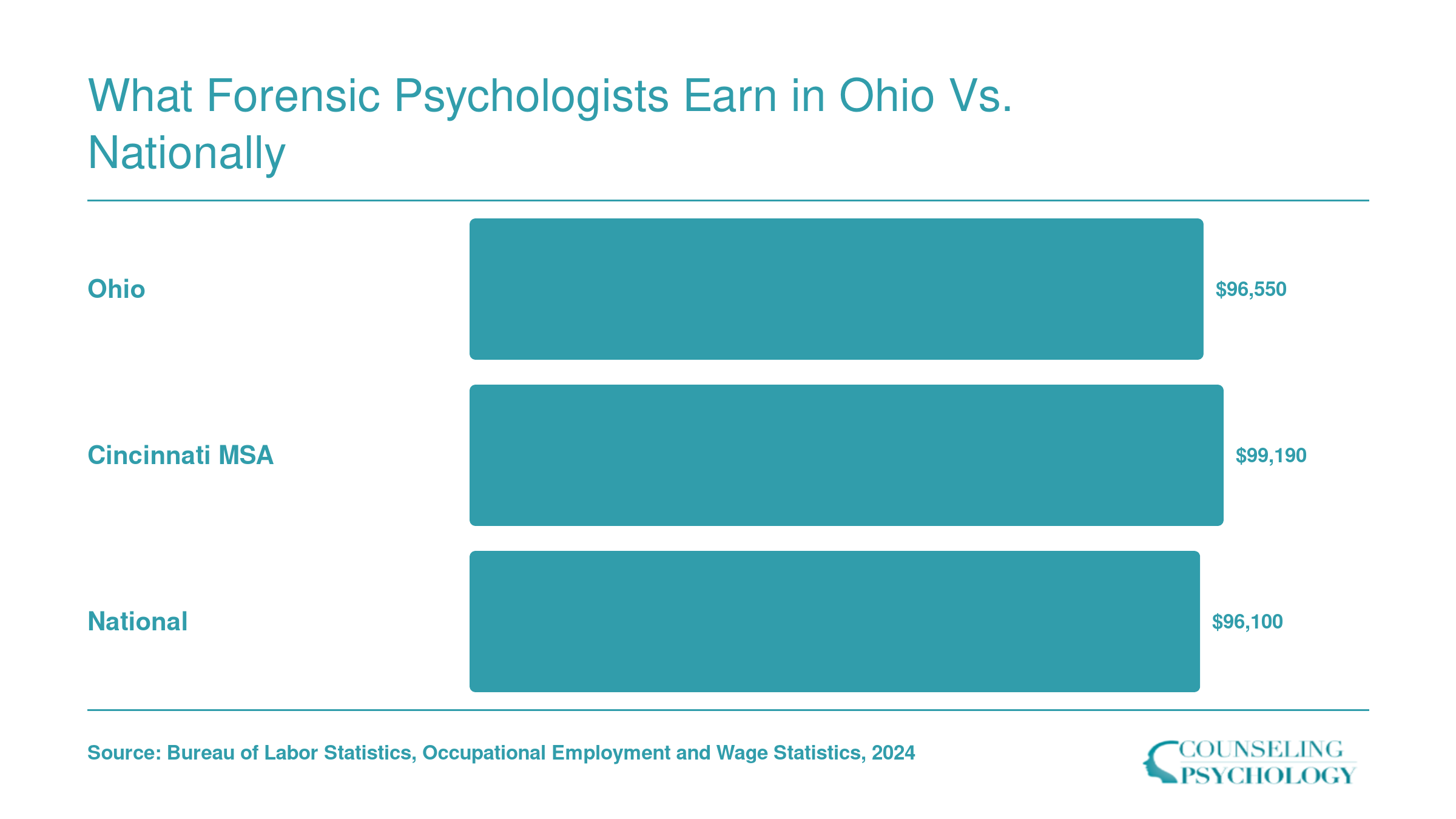
Salaries for clinical and counseling psychologists (SOC 19-3033) in Ohio reflect a range of settings and experience levels. The Cincinnati-Middletown metropolitan statistical area often posts figures near or above the state median, though local wages vary by employer type and caseload. To access current numbers with percentile breakdowns (10th, 25th, 75th, and 90th), use the BLS Occupational Employment and Wage Statistics (OEWS) tool at bls.gov. Select Ohio and the Cincinnati-Middletown MSA for metro-specific detail. Keep in mind that national medians for this occupation are not a substitute for state or local data; always specify the scope when comparing figures across regions.
Job Growth Projections
Nationally, employment of psychologists is projected to grow over the 2024 to 2034 decade, according to the BLS Occupational Outlook Handbook. For Ohio-specific forecasts, the state's labor market information site (ohiolmi.com) provides long-term projections that account for regional needs in corrections, mental health courts, and forensic hospitals. While broad psychologist growth rates are a useful benchmark, forensic specialization may see sharper demand in juvenile justice and competency restoration programs. If you are still weighing your pathway, reviewing the full forensic psychologist requirements can help you map the steps between your degree and licensure.
Where Forensic Psychologists Work
Major employers in the Cincinnati area include the Hamilton County Justice Center, the Ohio Department of Mental Health and Addiction Services, and the Cincinnati VA Medical Center, which offers psychology training tracks. Professional associations such as the American Psychology-Law Society (AP-LS) and the Ohio Psychological Association (OPA) maintain directories of practitioners and agencies. University career pages, particularly the University of Cincinnati's psychology department, often highlight local internship partners and employer connections worth exploring. Students interested in related law-enforcement roles may also want to explore criminal psychologist requirements for comparison.
Finding Practicum and Internship Sites
Competitive practicum and internship placements build the clinical hours required for licensure. Start with the APA's internship matching program (APPIC) to search for forensic-focused sites by location. LinkedIn can surface current openings at courts and correctional facilities, while direct outreach to the Hamilton County Justice Center, the Cincinnati VA Medical Center, or regional forensic hospitals may uncover unposted opportunities. Professional memberships in AP-LS and OPA also give access to job boards and networking events where supervisors and trainees connect.
What Forensic Psychologists Earn in Ohio vs. Nationally
Ohio's compensation for clinical and counseling psychologists, the occupational category that includes most forensic psychology practitioners, generally tracks close to the national median. The Cincinnati metropolitan area offers figures that are competitive within the state, though exact MSA-level data for this specific occupation can fluctuate with annual BLS releases.
Frequently Asked Questions About Forensic Psychology in Cincinnati
Prospective students exploring forensic psychology near Cincinnati tend to have similar questions about program requirements, costs, and career timelines. Below are answers grounded in current Ohio licensing standards and program details covered earlier in this article.