What you’ll learn in this article…
- Denver metro counselors earn a meaningful premium over both Colorado and national median salaries across specialties.
- CACREP accredited programs dominate Denver's top rankings, with CU Denver accepting only 12 percent of applicants.
- Colorado's counselor job growth outpaces the national 22 percent projection through 2032, driven by state funding expansions.
- Expect roughly 4 to 5 years from your first master's semester to full LPCC licensure through Colorado DORA.
Colorado added more than 1,200 licensed professional counselor candidates in 2024 alone, yet behavioral health provider shortages persist across the Denver metro area. That gap is driving enrollment growth at every CACREP-accredited counseling master's program in the region, from CU Denver's clinical mental health track to the University of Denver's online school counseling degree and MSU Denver's dual-licensure addictions program.
The real challenge for applicants is not finding a program; it is choosing among formats, price points, and specializations that vary dramatically. In-state tuition starts below $6,000 per year at Adams State and climbs past $42,000 at DU. Acceptance rates at the most competitive programs dip into the low teens. Colorado's LPC licensure path requires a 60-credit master's degree plus 2,000 hours of post-graduate supervised practice, so the program you pick today shapes your timeline, debt load, and career trajectory for years. Students also considering marriage and family therapy programs in Colorado will find overlapping faculty and practicum sites but a distinct licensure track worth understanding early.
Top-Ranked Master's in Counseling Programs in Denver
Colorado's Front Range is home to some of the strongest counseling graduate programs in the Mountain West, spanning clinical mental health counseling, school counseling, marriage and family therapy, and addiction specializations. The schools below were evaluated using federal institutional data, graduate outcomes, and verified program details. Program-level earnings data is not yet available for most of these programs, so we include institution-wide median earnings and median graduate debt as a broad financial reference point. Likewise, the graduation rates listed reflect each university overall, not the counseling department specifically.
- Accreditation and licensure alignment
- Graduate debt and earnings outcomes
- Breadth of counseling specializations
- Delivery format and accessibility
- Institutional graduation and retention rates
- NCES-IPEDS federal institutional data — nces.ed.gov
- College Scorecard graduate earnings — collegescorecard.ed.gov
- Internal program database
- Independent program research

University of Colorado Denver/Anschutz Medical Campus
CU Denver's School of Education and Human Development houses CACREP-accredited clinical mental health counseling and school counseling programs alongside a COAMFTE-accredited couple and family therapy degree, giving students three distinct licensure pathways on one urban campus. In-state graduate tuition starts at roughly $9,298, making it one of the most affordable options in the Denver metro, and the institution reports a median graduate debt of $20,500 against median earnings of $64,270 ten years after enrollment. The clinical mental health counseling track includes a required half-day group interview on campus, and programs are open to international students on F-1 or J-1 visas.
- COAMFTE-accredited, 54-credit campus program
- Prepares graduates for the National MFT Exam
- Systemic, relational clinical approach emphasized
- Evening and weekend class scheduling available
- Clinical field placements in community settings
- Completion timeline of 2.5 to 3.5 years
- CACREP-accredited 63-credit program
- Focus on equity and diversity in school settings
- Late afternoon and evening course options
- Completion in 3 to 4 years
- Letters of recommendation and group interview required
- Includes practicum and real-world counseling hours
- CACREP-accredited with 63 credit hours
- On-campus counseling clinic for supervised practice
- Prepares graduates for Licensed Professional Counselor
- Culturally responsive training framework
- Competitive admissions with group interview component
- Diverse client population training settings
Master of Arts in Couple and Family Therapy — On-Campus
Master of Arts in Counseling, School Counseling — On-Campus
Master of Arts in Counseling, Clinical Mental Health — On-Campus

Regis University
Regis University, a private Jesuit institution in northwest Denver, offers both a CACREP-accredited Clinical Mental Health Counseling M.A. and a COAMFTE-accredited Marriage and Family Therapy M.A. with notably small class sizes and an 11:1 student-to-faculty ratio. The CMHC program reports a 100% national exam pass rate and a 95% job placement rate. Median graduate debt sits at $25,000 while institution-wide median earnings reach $72,105 at ten years, the highest among the schools on this list. Tuition is $24,300 regardless of residency, and evening and weekend scheduling makes both programs accessible to working professionals.
- CACREP-accredited 60-credit program
- 100% national counselor exam pass rate reported
- 95% job placement rate for graduates
- Evening and weekend class schedule
- Onsite counseling training clinic included
- Social justice emphasis woven through curriculum
- Meets Colorado LPC academic requirements
- COAMFTE-accredited 60-credit hybrid program
- Completion in approximately 2.5 to 3 years
- Practicum at Regis Center for Counseling and Play Therapy
- Intensive format with sessions 4 days per month
- Prepares graduates for Colorado LMFT licensure
- Experiential learning with small class sizes
- On-campus interview required for admission
Master of Arts in Counseling: Clinical Mental Health Counseling — On-Campus
Master of Arts in Marriage and Family Therapy — Hybrid

Colorado State University-Fort Collins
Colorado State University in Fort Collins stands out for the sheer breadth of its counseling offerings: CACREP-accredited clinical mental health counseling and school counseling tracks, a COAMFTE-accredited marriage and family therapy specialization, and two distinct addiction counseling master's programs (one offering dual licensure in psychology and social work at 83 credits). In-state tuition of about $14,125 pairs with a median graduate debt of $20,000 and institution-wide ten-year median earnings of $60,543. All programs are campus-based with supervised clinical experience at the university's Centers for Counseling, Assessment, and Mentoring.
- CACREP-accredited 60-credit program
- Licensure-eligible for Colorado LPC
- National Certified Counselor exam preparation
- 600-hour internship in community settings
- Culturally responsive and ethical counseling focus
- Campus-based with practicum component
- CACREP-accredited specialization for K-12 settings
- Emphasis on advocacy and educational leadership
- Clinical practicum and internship included
- Prepares for National Certified Counselor credential
- On-campus program in Fort Collins
- Focuses on equitable educational access
- COAMFTE-accredited campus program
- Supervised clinical work at Center for Family and Couple Therapy
- Training in trauma, resilience, and youth mentoring
- Evidence-based practices with diversity focus
- Research and clinical training combined
- Prepares for Colorado LMFT licensure
- Two-year campus-based program
- Covers motivational interviewing and ethics
- Internship component supports Colorado licensure
- Focus on addiction-specific counseling skills
- Minimum 3.0 GPA required for admission
- High employability reported post-graduation
- 83-credit dual licensure preparation program
- Focus on co-occurring disorders and trauma-informed care
- Advanced standing option may reduce credits
- Evidence-based treatment and neuropharmacology training
- Family and group therapy components
- Social justice advocacy integrated throughout
Master of Arts in Counseling and Career Development, Clinical Mental Health Counseling — On-Campus
Master of Arts in Counseling and Career Development, School Counseling — On-Campus
Master of Science in Human Development and Family Studies, Marriage and Family Therapy — On-Campus
Master of Addiction Counseling in Psychology — On-Campus
Master of Addiction Counseling in Psychology and Social Work — On-Campus

University of Denver
The University of Denver delivers two distinct counseling master's programs through its Morgridge College of Education: an online CACREP-accredited school counseling M.A. completable in as few as 22 months, and an on-campus clinical mental health counseling concentration within the MPCAC-accredited M.A. in Counseling Psychology (90 credits). The school counseling program's online format includes rolling admissions with three start dates per year. Tuition is $42,173, but the institution-wide median graduate debt of $21,844 suggests robust financial aid; ten-year median earnings reach $71,155. The 9:1 student-to-faculty ratio is the lowest on this list.
- CACREP-accredited fully online program
- Completable in as few as 22 months
- No GRE required for admission
- Rolling admissions with January, June, and September starts
- 100-hour practicum plus 600-hour internship
- Social justice focus with live class technology
- Meets Colorado school counselor credential requirements
- MPCAC-accredited 90-credit on-campus program
- 24-month completion timeline
- Practicum placements in community settings
- 100% tuition assistance opportunities noted
- Research and clinical tracks available
- Prepares graduates for LPC licensure in Colorado
Master of Arts in School Counseling (Online) — Online
Master of Arts in Counseling Psychology, Clinical Mental Health Counseling — On-Campus

University of Colorado Colorado Springs
UCCS offers CACREP-accredited master's degrees in both clinical mental health counseling and school counseling through its College of Education. Both are 60-credit on-campus programs with day or evening cohort options beginning each summer semester. In-state tuition of about $15,704 and a median graduate debt of $20,000 make UCCS one of the more affordable CU system options. No prior teaching experience is needed for the school counseling track, which widens access for career changers.
- CACREP-accredited 60-credit curriculum
- Meets Colorado LPC licensure requirements
- National Counselor Exam preparation included
- Focus on psychotherapy and group dynamics
- Fieldwork in diverse mental health settings
- Core courses with available electives
- CACREP-accredited 60-credit program
- Day and evening cohort scheduling
- Summer semester start required
- No prior teaching experience necessary
- Potential LPC credential eligibility
- Practical practicum and internship hours
Clinical Mental Health Counseling, MA — On-Campus
Counseling, MA, School Counseling — On-Campus

University of Northern Colorado
The University of Northern Colorado in Greeley provides three CACREP-accredited counseling master's tracks: clinical mental health counseling (hybrid, 60 credits), school counseling (campus-based, 63 to 75 credits with Greeley and Denver site options), and marriage, couples, and family counseling/therapy (campus, 66 to 75 credits). In-state tuition of roughly $15,376 and median graduate debt of $20,470 keep costs moderate. UNC's Psychological Services Clinic offers live supervision during clinical training, and the MFT track prepares graduates for LMFT licensure.
- CACREP-accredited 60-credit hybrid program
- Multiple campus delivery options available
- Flexible weekend and semester formats
- Live supervision at Psychological Services Clinic
- Prepares for national counselor certification
- Training with diverse client populations
- CACREP-accredited with 63 to 75 credit hours
- Greeley and Denver location options
- 600-hour internship in school settings
- Small class sizes with experienced faculty
- National Certified Counselor eligible upon completion
- Hands-on training in diverse school environments
- CACREP-accredited 66 to 75 credit program
- Prepares for Licensed Marriage and Family Therapist
- Systems theory and relational focus
- Pre-admission workshop is required
- Includes core courses, practicum, and internship
- Two years of work experience recommended
Clinical Mental Health Counseling, MA — Hybrid
School Counseling, MA — On-Campus
Marriage, Couples, and Family Counseling/Therapy, MA — On-Campus

Metropolitan State University of Denver
Metropolitan State University of Denver's M.S. in Clinical Behavioral Health with an Addictions Counseling concentration is a niche program targeting students who want dual licensure as both a Licensed Addiction Counselor and a Licensed Professional Counselor. The 61-credit curriculum is offered evenings and weekends in a hybrid format, and no GRE is required. In-state tuition of about $11,017 and a total estimated cost of $35,100 to $38,610 place MSU Denver among the most budget-friendly options in the metro area, though the institution-wide graduation rate (31.5%) is lower than peers. Median graduate debt is $21,500.
- Dual LAC and LPC licensure preparation
- 61-credit skills-based curriculum
- No GRE required for admission
- Evening and weekend hybrid class schedule
- Approximately $585 per credit hour
- Full-time track takes 2.5 to 3 years
- Practicum and internship components included
Master of Science in Clinical Behavioral Health, Addictions Counseling — On-Campus

Colorado Christian University
Colorado Christian University offers a CACREP-aligned online M.A. in School Counseling (60 credits) and an online M.A. in Clinical Mental Health Counseling with a Substance Use Disorders concentration (69 credits). Both programs integrate a Christian worldview and require three summer residencies in Colorado. The school counseling track can be completed in as few as 30 months. Tuition is $15,394 regardless of residency, but net price averages $29,500. Median graduate debt of $28,312 is the highest on this list, and ten-year median earnings stand at $50,416 institution-wide.
- 60-credit online program with three residencies
- Completable in as little as 30 months
- Biblical truth integrated with clinical competence
- Aligned with ASCA counseling domains
- Minimum 2.5 GPA and background check required
- Prepares for professional school counselor licensure
- CACREP-accredited 69-credit online or hybrid program
- Prepares for both LPC and LAC licensure in Colorado
- Evidence-based addiction treatment training
- Trauma-informed care focus throughout curriculum
- Up to 12 graduate credits may transfer
- Christian worldview integration in coursework
Master of Arts in School Counseling (Online) — Online
Master of Arts in Clinical Mental Health Counseling, Substance Use Disorders — Online

Adams State University
Adams State University in Alamosa delivers two counseling master's tracks that are especially accessible for students outside the Denver metro: a hybrid M.A. in Counseling with a School Counseling concentration (requiring just two campus visits) and an online M.A. in Clinical Mental Health Counseling. In-state tuition of $5,898, the lowest on this list, pairs with a median graduate debt of only $19,500. The institution-wide graduation rate (39.4%) is modest, so prospective students should inquire about program-specific completion data. Ten-year median earnings are $44,372.
- 60-credit hybrid program with two campus visits
- Covers ethics, diversity, and crisis intervention
- Includes practicum and internship experiences
- Designed for flexibility around work schedules
- Accredited curriculum with specialized courses
- Practical skills development for K-12 settings
- Fully online format for Colorado LPC preparation
- Diverse career placement settings upon graduation
- Specialized internship opportunities included
- Colorado state licensure track
- Affordable tuition at approximately $5,898 in-state
- Accessible for rural and remote students
Master of Arts in Counseling, School Counseling (Hybrid) — Hybrid
Master of Arts in Clinical Mental Health Counseling (Online) — Online

Red Rocks Community College
Red Rocks Community College in Lakewood partners with The Chicago School of Professional Psychology to offer a clinical mental health counseling pathway that begins at the associate level and extends to a master's degree completed online. This pipeline model suits students who need an on-ramp from a two-year college to a graduate credential. Median graduate debt is just $9,500, the lowest on this list, though the institution-wide graduation rate (32%) and ten-year median earnings ($46,288) are also the lowest among these programs. Students should confirm current partnership terms and accreditation status directly with both institutions.
- Associate-to-master's seamless pathway model
- Online master's completion through The Chicago School
- Minimum 2.3 GPA required for entry
- Community service and internship components
- Small class sizes with mentorship focus
- Prepares for LPC licensure in Colorado
Clinical Mental Health Counseling (Partnership with The Chicago School) — On-Campus
How We Ranked Denver Counseling Programs
School-reported claims versus verified federal data: one approach relies on what institutions say about themselves, the other on what the Department of Education publishes about graduate outcomes. Our ranking builds on the latter. We prioritized measurable, comparable metrics that matter to prospective students facing real tuition bills and career timelines.
Cost and Net Price
We evaluated both published tuition and net price, the average annual cost students actually pay after grants and scholarships. Net price gives a clearer picture of affordability than sticker rates alone, especially when comparing public institutions to private nonprofits. Programs with lower net cost ranked higher, all else equal.
Program-Level Earnings and Debt
Earnings data comes from the College Scorecard's program-level outcomes, not self-reported alumni surveys. These figures represent median earnings one, two, and four years after graduation for students who completed a specific degree program and appear in federal tax or employment records. We also examined median graduate debt at completion. Programs that combine lower debt loads with stronger early-career earnings scored better on our return-on-investment ratio.
Graduation Rates and Institutional Quality Signals
Graduation rates in our analysis are institution-wide, not program-specific, because the Department of Education does not publish completion rates at the individual master's program level. While a university-wide rate does not isolate counseling students, it still reflects institutional support structures, advising capacity, and academic rigor. Schools with higher overall completion rates tend to offer better student services and retention infrastructure, which benefits counseling graduate students as well.
CACREP Accreditation Status
We noted whether each program holds accreditation from the Council for Accreditation of Counseling and Related Educational Programs. CACREP recognition aligns curriculum with national counseling standards and often satisfies state licensure education requirements. If you are comparing options beyond Denver, our broader guide to the best clinical mental health counseling programs applies a similar methodology at the national level. However, accreditation statuses can change. Always verify current CACREP standing directly with the program before applying, especially if you plan to pursue licensure as a Licensed Professional Counselor in Colorado or another state.
Cost Comparison: Tuition, Debt, and ROI Across Denver Programs
The table below compares annual tuition rates, institution-level average net price, median debt at graduation, and a simple ROI ratio (median earnings ten years after enrollment divided by median debt) for each ranked program. Adams State University stands out as the most affordable option with in-state tuition of just $5,898, while Regis University delivers the highest ROI ratio at 2.88, pairing moderate debt with the strongest median earnings in the group. Keep in mind that net price figures reflect an institution-wide average after grants and scholarships; your individual aid package may be higher or lower depending on your financial profile, residency status, and program-specific funding.
| School | Tuition (In-State) | Tuition (Out-of-State) | Avg. Net Price | Median Debt at Completion | Median Earnings (10 yr) | ROI Ratio |
|---|---|---|---|---|---|---|
| Red Rocks Community College (partnership pathway) | $11,084 | $14,240 | $9,044 | $9,500 | $46,288 | 4.87 |
| University of Colorado Denver / Anschutz | $9,298 | $27,154 | $11,900 | $20,500 | $64,270 | 3.14 |
| Adams State University | $5,898 | $5,898 | $12,980 | $19,500 | $44,372 | 2.28 |
| Metropolitan State University of Denver | $11,017 | $13,033 | $15,327 | $21,500 | $52,093 | 2.42 |
| University of Colorado Colorado Springs | $15,704 | $27,218 | $15,788 | $20,000 | $54,659 | 2.73 |
| University of Northern Colorado | $15,376 | $26,446 | $17,760 | $20,470 | $52,231 | 2.55 |
| Regis University | $24,300 | $24,300 | $18,397 | $25,000 | $72,105 | 2.88 |
| Colorado State University, Fort Collins | $14,125 | $30,813 | $21,279 | $20,000 | $60,543 | 3.03 |
| Colorado Christian University | $15,394 | $15,394 | $29,500 | $28,312 | $50,416 | 1.78 |
| University of Denver | $42,173 | $42,173 | $36,131 | $21,844 | $71,155 | 3.26 |
Related Articles
Questions to Ask Yourself
Online vs. On-Campus vs. Hybrid: Comparing Denver Counseling Program Formats
Choosing a delivery format is one of the most practical decisions you will make when selecting a counseling master's program in Denver. Each format offers distinct trade-offs in flexibility, networking, and clinical training access. Importantly, CACREP accreditation standards apply equally regardless of whether a program is delivered online, on campus, or in a hybrid model, so format alone does not determine program quality.
Pros
- Online programs like the University of Denver's MA in School Counseling offer maximum scheduling flexibility with no required on-campus visits or residency intensives.
- On-campus programs such as CU Denver's Clinical Mental Health Counseling track provide practicum training in an on-site clinic with live faculty supervision, a meaningful advantage for hands-on skill development.
- Hybrid formats at schools like Regis University blend online coursework with periodic campus sessions, letting working professionals maintain employment while still engaging face to face with peers and faculty.
- CACREP-accredited online programs must meet the same fieldwork and supervision standards as their on-campus counterparts, so students earn an equally rigorous credential regardless of format.
- In-person and hybrid cohorts tend to foster stronger peer networking through regular classroom interaction, study groups, and campus events that can translate into professional referral networks after graduation.
Cons
- Nearly every Denver-area counseling program requires in-person practicum and internship hours, so even online students must secure a local supervised placement within the United States.
- On-campus programs like CU Denver and Naropa offer no fully online option, which means students must plan for regular commuting to the Denver or Boulder metro area.
- Hybrid formats often include mandatory residency weekends or intensive sessions on a set schedule, reducing some of the flexibility students expect from partially online delivery.
- Online learners may have fewer organic opportunities to build relationships with classmates and local clinical supervisors compared to students who attend classes on campus regularly.
- Cost differences across formats can be misleading: online tuition may appear lower, but additional fees for technology, proctoring, and travel to practicum sites can narrow the gap.
Specializations and Career Paths for Denver Counseling Graduates
The counseling field offers multiple graduate pathways, but not all lead to the same career outcomes. Choosing between a broad clinical mental health counseling (CMHC) degree and a specialized track like school counseling or addictions counseling determines your future licensure, work settings, and earning potential. Understanding the landscape now helps you select a program that aligns with the role you want after graduation.
Specialization and Licensure Pathways
Each specialization tracked in Denver's CACREP-accredited programs maps to a distinct Colorado regulator. CMHC graduates pursue the Licensed Professional Counselor (LPC) credential, and after completing post-degree supervised hours they can upgrade to the Licensed Professional Counselor Candidate (LPCC) status that authorizes independent practice. This is the standard route into private practice. Addiction-focused tracks prepare you for the Licensed Addiction Counselor (LAC) credential, often in combination with an LPC for broader clinical scope. Marriage and family therapy programs feed into LMFT licensure, and students exploring that track can review MFT career paths to understand the range of roles available. School counseling degrees lead to a Colorado Department of Education special services license required to work in K-12 settings. If your primary goal is a private therapy practice, the CMHC-to-LPCC pipeline offers the most straightforward and versatile path.
Denver's Counseling Job Market: Settings and Demand
Where you work is shaped as much by your specialization as by your license. In the Denver metro, major providers stretch across public and private sectors. Community mental health centers like WellPower (formerly the Mental Health Center of Denver) and Jefferson Center are consistent employers of LPCs and LACs, serving diverse populations. Denver Public Schools maintains a steady need for licensed school counselors; the district employs among the highest numbers in the state. Integrated health systems, including UCHealth, the former SCL Health (now part of Intermountain Health), and Denver Health, increasingly embed mental health clinicians in primary care teams.
CMHC remains the most common and adaptable track, opening doors across all these settings. However, specialized demand is strong in two areas. Substance abuse and mental health counselor roles are projected to grow roughly 17% nationally over the decade ending in 2034, and Colorado's ongoing addiction crisis fuels local need for LACs.1 School counseling, while growing more slowly nationwide at about 3 to 4%, is a stable niche in Denver, where school counselors earn a median of $63,200 annually according to the most recent metro-area data. Mental health counselors in the Denver metro earn a median of $56,700, close to the national figure of $59,190.2 Marriage and family therapy, with a national growth forecast of 12.6%, also presents opportunities, particularly in practices focused on relational health. For a broader look at counselor salary with masters credentials across states and specialties, compare your expected Denver earnings against national benchmarks. Aligning your specialization with these local hiring patterns can give you an edge in a market that is expanding faster than the national average.
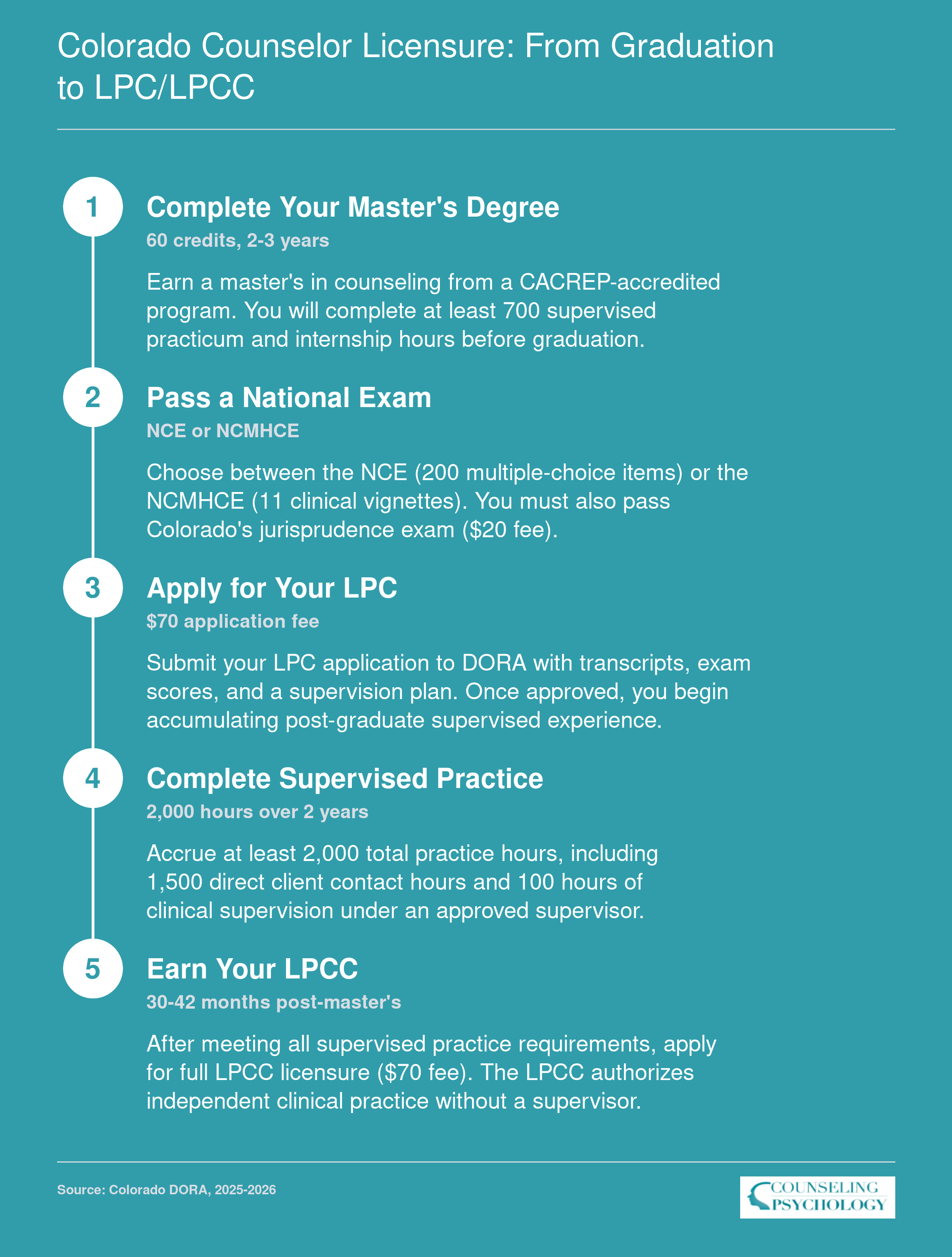
Colorado Counselor Licensure: From Graduation to LPC/LPCC
Earning your full clinical license in Colorado is a structured, multi-year process overseen by the Department of Regulatory Agencies (DORA). Most graduates can expect 4-5 years from the start of their master's program to LPCC status. Here is what each stage requires.
Denver Counselor Salaries: What You Can Expect to Earn by Specialty
Counselors working in the Denver-Aurora-Lakewood metro area earn a meaningful premium over both state and national averages, making the region one of the stronger markets in the Mountain West for mental health professionals. Understanding how salaries break down by specialty helps you weigh program costs against realistic earning potential once you are licensed and practicing.
Mental Health and Substance Abuse Counselors
Substance abuse, behavioral disorder, and mental health counselors (SOC 21-1018) represent the largest employment category for master's-level counseling graduates in Denver. According to BLS Occupational Employment and Wage Statistics for the Denver-Aurora-Lakewood MSA, the mean hourly wage across all occupations in this metro area is $36.50, compared to $31.48 nationally.1 While program-level earnings data for specific Denver counseling degrees are not yet published by the Department of Education, the metro's overall wage advantage suggests clinical mental health and substance abuse counselors here can expect compensation above national medians. National BLS figures place the median annual wage for SOC 21-1018 around $53,000, so Denver-area counselors likely fall in the mid-$50,000s to low $60,000s, depending on employer type and years of experience.2
School Counselors
Educational, guidance, and career counselors (SOC 21-1012) working in K-12 settings or higher education tend to earn slightly more than their clinical counterparts at the entry and mid-career stages. Denver-area school districts and colleges compete for talent against private-sector behavioral health employers, which pushes starting salaries higher. Nationally, school counselors earn a median near $60,000, and Denver's public school systems often exceed that figure, particularly for counselors with several years of experience or administrative responsibilities.
Marriage and Family Therapists
Marriage and family therapists (SOC 21-1013) represent a smaller but growing segment of the Denver counseling workforce. National median wages for MFTs hover around $56,000, and Denver-area practitioners typically match or exceed that benchmark. Programs like the M.A. in Couple and Family Therapy at CU Denver or Regis University's Marriage and Family Therapy degree prepare graduates for LMFT licensure, and both programs' estimated tuition falls between $24,000 and $54,000 depending on residency status. With median institutional earnings at 10 years post-enrollment ranging from $52,000 to $72,000 across Colorado counseling programs, most graduates can expect to recover their educational investment within five to seven years of full-time practice. For a broader look at statewide options, explore clinical mental health counseling masters programs Colorado.
Framing ROI Realistically
Tuition for Denver-area counseling master's programs ranges from under $10,000 at public institutions like CU Denver (in-state) to over $40,000 at private universities like DU or Regis. When you compare these costs against the metro's wage premium, the math generally favors programs with lower debt loads. A graduate entering the workforce at $55,000 with $20,000 in student loans faces a very different financial trajectory than one starting at the same salary with $40,000 in debt. If salary is a primary concern, factor in not just starting pay but the metro's cost of living and the time required to reach licensed professional clinical counselor status.
The Bureau of Labor Statistics projects 22 percent growth for substance abuse, behavioral disorder, and mental health counselors nationally through 2032. Colorado's demand is outpacing that average, fueled by ongoing state behavioral health funding expansions, workforce shortage initiatives, and Denver's rapid population growth, creating strong hiring conditions for newly licensed graduates.
Admissions Tips: GPA, GRE Policies, and What Denver Programs Look For
CU Denver's MA in Counseling accepted just 52 students from 429 applicants in the most recent cycle, a 12 percent acceptance rate that makes it one of the most selective counseling programs in Colorado.1 If you are planning to apply, understanding what each Denver program expects well before the deadline is essential. For context on selectivity across the discipline, see our guide on how hard is it to get into grad school for psychology.
GPA Expectations
A 3.0 undergraduate GPA is the de facto floor across most Denver-area counseling programs. CU Denver, the University of Denver, and Regis University all use this benchmark as a general minimum, though competitive applicants typically come in higher. Naropa University tends to prioritize holistic review, so a slightly lower GPA paired with strong experiential background can still yield admission. Programs like Metropolitan State University of Denver and Colorado Christian University set their minimums closer to 2.5, which broadens access for career-changers who have been out of school for some time.
GRE Requirements
The GRE has largely disappeared from Denver counseling admissions. CU Denver currently requires no standardized entrance exam.2 The University of Denver's online school counseling program is explicitly GRE-free, and MSU Denver likewise does not require it. If you are applying to any program in this region, confirm directly with the graduate admissions office, since policies have shifted quickly since 2022 and can change between cycles.
Application Components
Every program covered here requires some version of the same core package:
- Personal statement: Most programs want 2 to 3 pages describing your clinical interests, relevant experience, and reasons for choosing the counseling field. Specificity matters more than polish.
- Letters of recommendation: Expect two to three letters. Academic references are preferred at research-focused programs like CU Denver; professional supervisors carry weight at practice-oriented programs.
- Resume or CV: Relevant work, volunteer, or research experience in mental health or education settings strengthens every application.
- Interview: CU Denver and Regis both require an in-person or virtual interview.2 Naropa's process emphasizes interpersonal presence and self-awareness rather than academic credentials.
- Prerequisite coursework: An introductory psychology course is commonly expected, and some programs ask for statistics or human development.
Deadlines and Admissions Windows
CU Denver's counseling application opens November 1 with a January 15 deadline for fall entry.2 This is a fixed deadline, not rolling, so late applications are generally not reviewed. The University of Denver's online program uses rolling admissions with start dates in January, June, and September, giving more flexibility to applicants who miss a cycle. Regis and Naropa typically follow a priority deadline model in January or February for fall cohorts, with later review possible if seats remain. Build in four to six weeks before any deadline to gather transcripts and secure recommendation letters.
Frequently Asked Questions About Denver Counseling Master's Programs
Choosing a counseling master's program raises practical questions about cost, accreditation, and licensure timelines. Below are answers to the questions prospective Denver students ask most often, drawing on program data and Colorado licensing requirements covered earlier in this article.