
What you’ll learn in this article…
- Charlotte's metro area employs roughly 5,670 social workers, making it North Carolina's largest social work job market.
- Seven CSWE-accredited MSW programs serve Charlotte residents through on-campus, hybrid, and fully online formats.
- Median graduate debt across ranked North Carolina programs ranges from approximately $19,500 to $28,250.
- North Carolina's clinical licensure path from LCSWA to full LCSW typically spans two to three years post-graduation.
North Carolina's social work vacancy rate ranks among the highest in the Southeast, with hospitals, child welfare agencies, and community mental health centers in and around Charlotte competing for MSW-prepared candidates. For Charlotte residents, the trade-off is access versus proximity: no single university offers a full on-campus MSW inside city limits, but a mix of online, hybrid, and weekend formats from CSWE-accredited North Carolina schools puts the degree within reach without relocating.
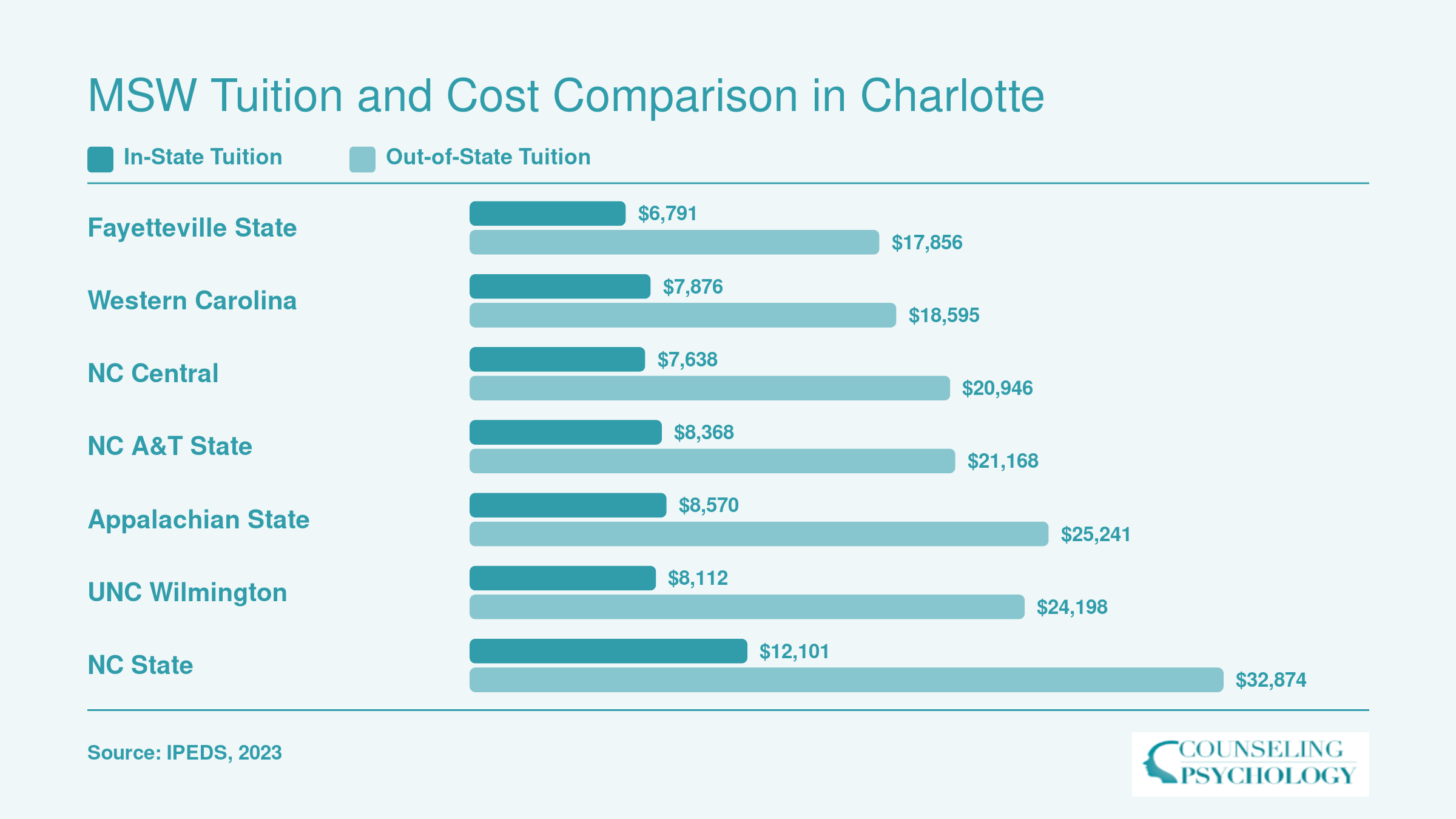
In-state tuition spans roughly $6,800 to $12,100 per year depending on the institution and track length. Clinical licensure in North Carolina requires supervised post-graduate hours before you can sit for the LCSW exam, so program choice affects how quickly you enter independent practice. Understanding the broader counselor salary landscape can also help you weigh the financial return on your MSW investment.
Ranked: The Best MSW Programs in Charlotte for 2026
Charlotte does not have a large cluster of local MSW programs, but several CSWE-accredited options across North Carolina deliver online, hybrid, or weekend formats that put a quality master of social work within reach of Charlotte residents. The seven schools below were evaluated on tuition affordability, graduate debt levels, institution-wide completion rates, available concentrations, and how accessible each program is to students in the Charlotte metro. Program-level earnings data is not yet available for these MSW tracks, so we include institution-wide median earnings and debt figures as broader context.
- In-state and out-of-state tuition
- Median graduate debt load
- Institution-wide graduation rate
- Program delivery flexibility
- Concentration and specialization breadth
- Internal program database
- NCES-IPEDS federal institutional data — nces.ed.gov
- Independent program research
- College Scorecard graduate earnings — collegescorecard.ed.gov

University of North Carolina Wilmington
UNC Wilmington's CSWE-accredited MSW program offers Clinical Practice and Macro Practice concentrations through a hybrid format that works well for Charlotte-area students who want a UNC System degree without relocating. The program requires 62 credit hours and 900 field placement hours, with an Advanced Standing track (39 credits, 600 hours) available for BSW holders. No GRE is required, and the institution carries a 70.6% school-wide graduation rate, the second highest among schools on this list. Median graduate debt sits at $19,500, and institution-wide median earnings reach $54,967 ten years after enrollment.
- 62 credit hours with 900 hours of field placement
- Hybrid delivery, accessible statewide including Charlotte
- No GRE required; 3.0 undergraduate GPA minimum
- Prepares graduates for LCSW, CMSW, or CSWM licensure in NC
- Full-time (2-year) and extended part-time (3-year) options
- CSWE-accredited curriculum emphasizing evidence-based interventions
- Focuses on organizational leadership, policy analysis, and advocacy
- Same 62-credit, 900-hour field placement structure as clinical track
- Hybrid format with full-time and part-time enrollment paths
- No GRE required; three letters of recommendation needed
- Crossover electives allow exposure to clinical coursework
- Qualifies graduates for multiple NC social work certifications
- Accelerated pathway: 39 credit hours in approximately one year
- Requires a conferred BSW from a CSWE-accredited program
- 600 hours of field internship across clinical or macro domains
- Available in campus-based and hybrid formats
- Competitive admission with 3.0 GPA threshold
- Virtual information sessions offered for prospective applicants
Master of Social Work, Clinical Practice — Hybrid
Master of Social Work, Macro Practice — Hybrid
Master of Social Work, Advanced Standing — Hybrid

Fayetteville State University
Fayetteville State University delivers one of the most affordable MSW options in North Carolina, with in-state tuition around $6,791 and a fully online format that eliminates commuting from Charlotte. Concentrations in Children and Family Services and Mental Health and Substance Abuse cover two of social work's highest-demand sectors, and the curriculum includes 960 field practicum hours. As an HBCU, FSU brings a strong multicultural competence lens, along with graduate certificate add-ons in Military Behavioral Health, Substance Abuse Studies, and Advanced Clinical Practice. The institution-wide graduation rate is 38.5%, which reflects the broader undergraduate population rather than MSW cohort performance specifically.
- 61 credit hours with 960 hours of field practicum
- Fully online delivery, ideal for Charlotte-based professionals
- Advanced Standing, full-time, and part-time enrollment options
- Minimum 3.0 GPA for Advanced Standing admission
- Stackable certificates in Military Behavioral Health and more
- January 15 application deadline; CSWE-accredited
- Intensive training in clinical intervention for diverse populations
- 960-hour field practicum across community settings
- Online format with advanced standing and part-time tracks
- Emphasizes social justice and multicultural competence
- Graduate certificate in Substance Abuse Studies available
- Three professional references and 3.0 GPA required
- Broad curriculum covering poverty, mental health, and community well-being
- 61 credit hours; 960 field practicum hours required
- Three flexible enrollment pathways accommodate working students
- CSWE-accredited with weekend class availability
- Prepares graduates for urban, rural, and military practice settings
- Foundation-year and advanced-year academic structure
Master of Social Work, Children and Family Services — Online
Master of Social Work, Mental Health and Substance Abuse — Online
Master of Social Work, Generalist — Online

Appalachian State University
Appalachian State's MSW features Individuals and Families and Community and Organizational Practice concentrations, with a crossover curriculum design that lets students sample coursework from both tracks. Online delivery for the Advanced Standing option and select coursework makes the program accessible to Charlotte residents, while the on-campus generalist track appeals to those who prefer face-to-face learning. The institution posts a 74.5% school-wide graduation rate, the third highest here, with median graduate debt of $20,231 and institution-wide median earnings of $51,836 at ten years.
- CSWE-accredited with clinical assessment and family systems focus
- Full-time (2-year) and part-time (4-year) schedules available
- Online delivery option expands access for Charlotte students
- GRE scores required but may be waived on a case-by-case basis
- Integrated field education woven throughout the curriculum
- Prepares graduates for NC clinical social work licensure
- Emphasizes social justice advocacy and organizational leadership
- Available on campus and online; full-time or part-time
- Crossover design allows electives in the clinical concentration
- Interprofessional collaboration opportunities built into coursework
- Two required graduate electives support specialization
- 3.0 GPA minimum; three professional letters of recommendation
- Campus-based program housed in the Beaver College of Health Sciences
- Advanced Standing track available for BSW graduates within 7 years
- Integrated practicum with face-to-face field hours during business days
- CSWE-accredited; December 1 application deadline
- Application fee waiver periods offered
- Prepares graduates for advanced clinical and community roles
Master of Social Work, Individuals and Families — Online
Master of Social Work, Community and Organizational Practice — Online
Master of Social Work, Generalist (Campus) — Online

North Carolina State University at Raleigh
NC State's MSW is a campus-based program in Raleigh that consistently ranks among the top 100 graduate social work programs nationally. An advanced generalist practice model prepares students for roles across individual, family, and community domains. The traditional track requires 60 credit hours (some sources note up to 66 with electives) and the Advanced Standing option condenses coursework to 39 credits over 12 months. At 84.8%, NC State has the highest institution-wide graduation rate on this list, and its median graduate debt of $20,121 is among the lowest. Because the program is on-campus only, Charlotte students should plan for the Raleigh commute or temporary relocation.
- Two-year, full-time program requiring 60 to 66 credit hours
- 24 weekly internship hours in the advanced year
- Biology and statistics prerequisites; 3.0 GPA minimum
- Specialization electives in child welfare, veteran services, mental health
- CSWE-accredited and ranked among top 100 MSW programs
- Capstone project and advanced research components included
- Accelerated 12-month track for BSW graduates
- 39 credit hours; 3.5 GPA required for admission
- Summer start date with intensive practicum schedule
- Emphasizes cultural competence and interdisciplinary collaboration
- Campus-based in Raleigh; no online option currently
- Qualifies graduates for NC LCSW licensure pathway
Master of Social Work (Traditional) — On-Campus
Master of Social Work (Advanced Standing) — On-Campus

North Carolina Central University
NCCU's MSW cultivates advanced generalist practitioners through a hybrid format with evening and Saturday classes, a schedule designed for working professionals who can commute periodically to Durham from Charlotte. The traditional two-year track and a one-year Advanced Standing option (35 credits) both operate without a GRE requirement. As an HBCU with a deep social justice and cultural competence emphasis, NCCU prepares graduates for leadership roles spanning micro through macro practice levels. Median graduate debt is $28,250, the highest on this list, so prospective students should weigh loan forgiveness and stipend options carefully.
- Two-year full-time hybrid program; no GRE required
- Evening and Saturday classes suit working professionals
- 16 weekly field hours in year one, 24 in year two
- Minimum 2.75 GPA for traditional admission
- CSWE-accredited with advanced generalist practice focus
- Some online classes available alongside campus instruction
- Application deadline: March 1
- One-year accelerated track requiring 35 credit hours
- BSW degree required; 3.00 cumulative and 3.25 major GPA minimums
- Summer bridge courses precede the full academic year
- Hybrid delivery with field practicum included
- Focuses on social, economic, and environmental justice
- Application deadline: February 1
Social Work, M.S.W. (Traditional) — Hybrid
Social Work, Advanced Standing, M.S.W. — Hybrid

Western Carolina University
Western Carolina's MSW stands out for its specialized concentrations in Substance Abuse Studies and School Social Work, two areas with strong workforce demand in the Charlotte region. Classes meet in Cullowhee and Asheville in a hybrid format, and the program advertises $10,000 stipends for students in integrated healthcare and substance abuse tracks. The 62-credit curriculum includes an Advanced Standing option for BSW graduates, and no GRE is required. Institution-wide median graduate debt is $21,868, with a 60.3% school-wide graduation rate.
- Hybrid program completable in 2 to 4 years
- Potential $10,000 stipend for substance abuse focus students
- 62 credit hours; no GRE required; 3.0 GPA for last 60 hours
- CSWE-accredited with evidence-based addiction intervention training
- Classes offered at Cullowhee and Asheville campuses
- Advanced Standing available for BSW holders
- Graduate assistantships and additional financial aid options
- Prepares graduates for NC School Social Work Certification
- Hybrid format with diverse field placement opportunities
- $10,000 HRSA stipend may be available
- Participation in Child Welfare Education Collaborative
- Full-time (2-year) and part-time (3 to 4-year) schedules
- Application deadlines: February 1 and April 1
Master of Social Work, Substance Abuse Studies — Hybrid
Master of Social Work, School Social Work — Hybrid

North Carolina A & T State University
NC A&T's MSW is a joint program with UNC Greensboro that gives students access to faculty, libraries, and field networks at two universities. The multicultural clinical practice curriculum is especially relevant for graduates planning to serve Charlotte's diverse population. Delivered in a hybrid format from Greensboro, the program carries in-state tuition of $8,368 and a median graduate debt of $27,000 institution-wide. The school-wide graduation rate is 57.2%, and as an HBCU with CSWE accreditation since 2000, NC A&T brings a longstanding commitment to equity-centered social work education.
- Joint program lets students study across two campuses
- CSWE-accredited since 2000 with multicultural clinical focus
- Hybrid delivery combines on-campus and online elements
- Access to resources, practicum sites, and faculty at both universities
- Emphasizes cultural competence and interdisciplinary collaboration
- Military-friendly institution recognized as an HBCU
Master of Social Work (Joint with UNC Greensboro) — Hybrid
How We Ranked These Charlotte MSW Programs
The MSW programs in this guide were evaluated using a blend of public data sources to give you a clear, student-centered picture of value and outcomes. We did not rely on reputation or prestige alone; instead, we emphasized metrics that directly impact your financial and professional future.
Data Sources and Key Metrics
We drew from the U.S. Department of Education's College Scorecard, institutional disclosures, and program websites to assess each school. The primary factors included:
- Net price: The average cost of attendance after grants and scholarships, based on the most recent institution-wide data. This gives a realistic starting point for cost comparison.
- Graduate earnings: Median earnings one year and two years after graduation, sourced from College Scorecard program-level outcomes. These figures reflect individuals who received federal aid and are reported at the program level for master's recipients.
- Median debt: The median federal loan debt accumulated by graduates, which helps gauge typical borrowing levels.
- ROI ratio: A simple earnings-to-debt comparison that highlights how quickly a graduate's salary may offset educational borrowing.
- Graduation rate: The share of full-time, first-time students completing a degree within 150% of normal time, again institution-wide. We included this as a sign of institutional support, but it is not specific to the MSW program.
- Program format availability: Whether the program offers part-time, full-time, online, or hybrid options, which can make a significant difference for working students.
Understanding the Numbers
It is important to know that net price and graduation rate data reflect the entire institution, not the MSW program alone. For example, an MSW cohort may have a different cost structure or completion timeline than the undergraduate population. Use these figures as context rather than precise program guarantees. Earnings data from College Scorecard, however, are tied to the master's level and are more directly relevant to your post-MSW career.
Accreditation as the Starting Point
All programs included in this ranking hold accreditation from the Council on Social Work Education (CSWE). This is non-negotiable for licensure eligibility in North Carolina and nearly every state. If you are also exploring related helping professions in the region, our guide to masters in counseling programs in North Carolina covers comparable options. A program's CSWE status ensures it meets rigorous educational standards, and we treated it as a baseline requirement. Only programs satisfying this criterion were considered for the list.
Questions to Ask Yourself
Online vs. On-Campus MSW Options in Charlotte
Charlotte's MSW landscape includes on-campus, fully online, and hybrid program formats, giving students real flexibility in how they earn their degree. The ranked programs in this article reflect that variety, with multiple delivery modes represented. Your best fit depends on your work schedule, learning style, and how much you value in-person connections with Charlotte's social service community.
Pros
- Online MSW programs offer scheduling flexibility that lets working professionals complete coursework on evenings and weekends without commuting.
- Fully online formats can reduce total costs by eliminating commuting, parking, and sometimes carrying lower per-credit tuition rates.
- Online enrollment opens the door to accredited programs well beyond the Charlotte metro, expanding your options significantly.
- Hybrid models combining weekend intensives with online coursework offer a practical middle ground, blending face-to-face clinical skills training with remote convenience.
- On-campus programs tend to build stronger field placement networks with Charlotte-area agencies, hospitals, and community organizations.
- In-person clinical practice labs let students rehearse assessment, interviewing, and intervention techniques with real-time faculty feedback.
- The cohort bonds formed in on-campus programs often translate into lasting professional networks across the Charlotte social work community.
Cons
- Online students may find it harder to secure competitive local field placements without the built-in agency partnerships that on-campus programs maintain.
- Fully online formats require strong self-discipline; students who thrive on structured classroom interaction sometimes struggle with asynchronous coursework.
- On-campus programs demand a fixed schedule that can conflict with full-time employment, making them less accessible for career changers already in the workforce.
- Hybrid models, while flexible, may still require travel to campus for weekend intensives, which adds time and cost for students living outside the Charlotte area.
- In-person tuition and associated campus fees can raise total program cost compared to equivalent online options.
MSW Tuition and Cost Comparison in Charlotte
Sticker price is only part of the picture. The figures below show published in-state tuition for each ranked Charlotte-area MSW program. Keep in mind that the institution-wide average net price (what students actually pay after grants and scholarships) can differ significantly from the posted rate, and graduate-specific aid packages vary by program. Always confirm MSW-specific costs and financial aid directly with each school's graduate admissions office.
Related Articles
Scholarships, Assistantships, and Loan Forgiveness for MSW Students
Funding an MSW is one of the most practical concerns you will face, but the good news is that social work students have access to a wider range of financial supports than many graduate disciplines. Between institutional aid, professional association awards, and federal loan forgiveness programs, the net cost of your degree can drop substantially if you plan ahead.
Graduate Assistantships and Institutional Funding
Assistantship structures vary across North Carolina MSW programs. At NC State, for example, graduate assistantships are awarded upon admission to full-time students who begin in the fall semester, which can offset tuition and provide a modest stipend.1 Charlotte-area programs at UNC Charlotte and Johnson C. Smith University may offer their own departmental scholarships or tuition remission, though availability fluctuates year to year.2 If you are comparing programs, ask each admissions office directly about assistantship funding timelines, because some awards are bundled with admission decisions while others require a separate application.
Professional and State-Specific Scholarships
Several organizations provide targeted scholarships for social work students at both the BSW and MSW levels:
- NASW North Carolina Chapter: Offers student awards and scholarships specifically for BSW and MSW students in the state. Application cycles typically open in the spring.3
- CSWE minority fellowships: The Council on Social Work Education administers fellowships aimed at increasing diversity in the profession, with stipends that can meaningfully reduce out-of-pocket costs.
- Employer-sponsored tuition benefits: Many healthcare systems and nonprofits in the Charlotte metro area offer tuition assistance for employees pursuing an MSW, especially when the degree aligns with workforce development goals.
Cast a wide net. National databases like the NASW Foundation and state chapter websites are good starting points, but do not overlook smaller, local foundations that award grants to students entering human services.
Public Service Loan Forgiveness as an ROI Lever
Public Service Loan Forgiveness (PSLF) is arguably the most significant financial planning tool available to MSW graduates. The program forgives the remaining balance on federal Direct Loans after 120 qualifying monthly payments (roughly 10 years) made while working full-time for an eligible employer. Nonprofits, government agencies, hospitals, and school districts all qualify, and those are precisely the sectors where the majority of MSW holders build their careers.
What this means in practice: even if you carry a meaningful loan balance at graduation, enrolling in an income-driven repayment plan and making consistent payments while employed in a PSLF-qualifying role can erase tens of thousands of dollars in remaining debt. Your debt-to-income ratio improves steadily over that decade, and the forgiven amount is not treated as taxable income under current federal rules. MSW graduates who go on to work in community mental health counselor roles at nonprofits or county agencies are especially well positioned for PSLF.
To position yourself for PSLF success, submit an Employment Certification Form early and resubmit it each year or whenever you change employers. Waiting until you are close to the 10-year mark to verify your qualifying payments is one of the most common, and most avoidable, mistakes borrowers make.
Putting It All Together
The smartest approach combines multiple funding streams. Apply for assistantships and scholarships before you enroll, minimize borrowing where possible, and then leverage PSLF once you enter the workforce. Charlotte's concentration of healthcare systems, county agencies, and nonprofits makes it one of the more favorable metros for landing a PSLF-qualifying position right out of your program.
Career Outcomes and Salary for MSW Graduates in Charlotte
The Charlotte-Concord-Gastonia metro area employs roughly 5,670 social workers across three core specializations, making it the largest social work job market in North Carolina. The table below draws from Bureau of Labor Statistics data (May 2024) for the Charlotte MSA specifically. Charlotte's child, family, and school social workers earn a median of $60,670, which is competitive among North Carolina metros and generally tracks close to or slightly above statewide figures. Healthcare social workers in Charlotte command higher pay, with a median of $66,850, reflecting the demand driven by the region's expanding hospital systems. Mental health and substance abuse social workers fall in between, with a median of $56,750. Keep in mind that national median wages for these occupations may differ from Charlotte-specific figures; the numbers below are local to this metro area. Earning an LCSW after your MSW typically opens the door to clinical roles and private practice, both of which tend to push compensation toward the 75th percentile and above.
| Occupation | Total Employment (Charlotte MSA) | 25th Percentile | Median Salary | 75th Percentile | Mean Salary |
|---|---|---|---|---|---|
| Child, Family, and School Social Workers | 4,000 | $49,780 | $60,670 | $68,440 | $62,340 |
| Healthcare Social Workers | 1,100 | $57,500 | $66,850 | $78,320 | $65,540 |
| Mental Health and Substance Abuse Social Workers | 570 | $47,000 | $56,750 | $63,190 | $55,730 |
Is an MSW Worth It Financially? ROI Breakdown
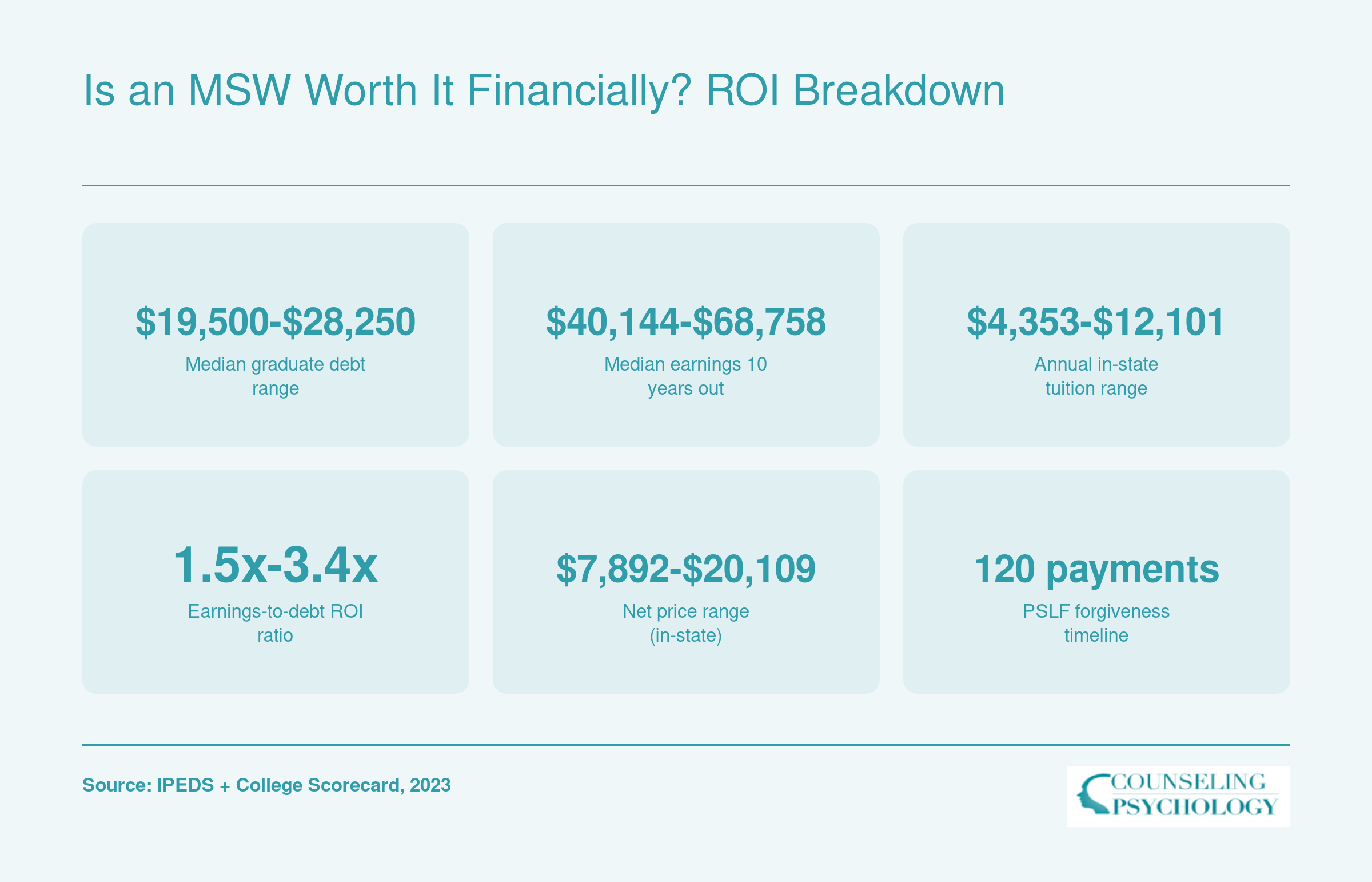
The financial payoff of an MSW depends heavily on program cost, residency status, and whether you pursue loan forgiveness. Across the North Carolina programs in our ranking, median graduate debt ranges from roughly $19,500 to $28,250, while institution-wide median earnings ten years after enrollment span $40,144 to $68,758. Students who work for qualifying nonprofits or government agencies can accelerate their ROI through Public Service Loan Forgiveness, potentially eliminating remaining federal loan balances after 120 qualifying payments.
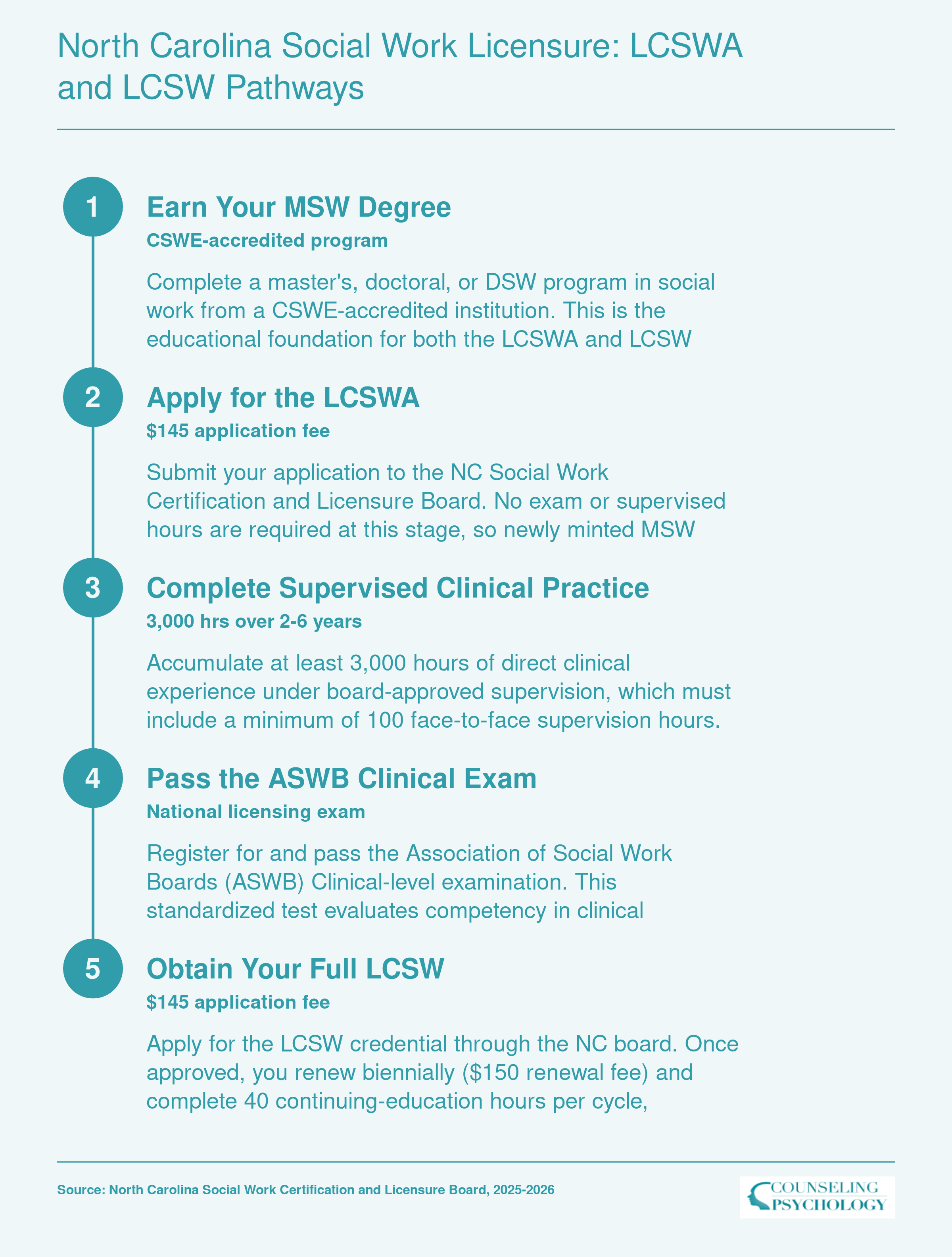
North Carolina Social Work Licensure: LCSWA and LCSW Pathways
The NC Social Work Certification and Licensure Board governs the clinical licensure ladder in North Carolina. After earning a CSWE-accredited MSW, graduates follow a structured path from associate-level practice to full clinical licensure. The entire process typically spans two to six years beyond graduation, depending on how quickly you accumulate supervised hours.
Charlotte-Area Field Placement Sites and Partnerships
Field placement is where classroom theory becomes clinical competence, and in a competitive job market, the quality of your practicum experience can determine both your licensure readiness and how quickly you land your first post-graduation role.
Where Charlotte MSW Students Typically Train
The Charlotte metro offers a genuinely strong ecosystem of placement sites across multiple practice sectors.1 Hospital systems like Atrium Health (now part of Advocate Health) represent high-probability placement environments, offering exposure to medical social work, care coordination, and behavioral health settings.2 Mecklenburg County Department of Social Services runs an established internship program that gives students hands-on experience in child welfare, adult services, and public assistance programs.3 Community organizations such as Crisis Assistance Ministry provide front-line exposure to poverty-related crises, housing instability, and emergency financial assistance. Clinical mental health agencies like ProCure Therapeutic are among the sites that place students in direct counseling and assessment work.4 Healthcare settings that serve veterans are also common across the region, fitting the broader pattern of VA-affiliated and military-adjacent placements that appear throughout the state.2
Placement is not limited to Mecklenburg County. North Carolina MSW programs routinely send students to surrounding counties when appropriate sites are available, so students in the greater Charlotte region should not assume their practicum will be within city limits.5
How UNC Charlotte Handles Placement Coordination
At UNC Charlotte, a dedicated practicum office manages the matching process. During the generalist year, students are matched to sites rather than selecting them independently. Specialist-year placements are not automatically guaranteed, and the list of approved sites shifts over time. The practicum office is the most reliable source for current placement options, and prospective students should contact that office directly rather than relying on informal lists.
Questions to Ask Any Program Before Enrolling
Campus-based programs in Charlotte typically maintain deeper, more active pipelines with local agencies than fully online programs headquartered in other states. Students exploring clinical mental health counseling online programs should weigh this tradeoff carefully, particularly if they need evening or weekend placement hours.
Before committing to a program, ask:
- Coordination support: Does the program match you to sites, or are you responsible for securing your own placement?
- Site approval timelines: How far in advance are placements confirmed, and what happens if a site falls through?
- Schedule flexibility: Are evening and weekend hours available for students who work full time?
- Geographic reach: If local sites fill up, how far outside Charlotte might you be placed?
Admissions Tips and Acceptance Rates for Charlotte MSW Programs
Getting into an MSW program in Charlotte starts with understanding what schools actually look for in applicants. While most programs don't publish MSW-specific acceptance rates, institution-wide admissions data provides a rough gauge of selectivity. For example, UNC Charlotte's overall acceptance rate hovers around 80%, and North Carolina Central University admits approximately 87% of applicants across all programs. These figures suggest that MSW programs in the region are competitive but accessible, though MSW cohorts often apply stricter criteria than the university as a whole.
Core Admissions Requirements
Charlotte-area MSW programs require a bachelor's degree from an accredited institution in any field. You don't need a BSW or social work background to apply to a traditional two-year track. UNC Charlotte's MSW program expects a minimum 3.0 cumulative GPA, while North Carolina Central University requires a 2.75 GPA overall and a 3.0 in your major coursework.13 Neither program requires the GRE for 2025-2026, a shift that has become standard across most MSW programs nationally and removes a significant barrier for working professionals and career changers.
Beyond transcripts, you'll need three letters of recommendation (academic or professional), a personal statement explaining your motivation for social work, and a resume documenting relevant experience. No specific prerequisite courses are mandated at UNC Charlotte, though NCCU and some other North Carolina programs may ask for coursework in biology or statistics.1
Advanced Standing: The Fast Track for BSW Graduates
If you already hold a BSW degree, advanced standing programs compress the MSW timeline from two years to one. UNC Charlotte offers advanced standing to BSW graduates who earned their degree within the past seven years and maintained at least a 3.0 GPA.1 NCCU sets the bar slightly higher, requiring a 3.0 overall GPA and a 3.25 in social work major courses.3 Advanced standing students skip the generalist foundation year and jump directly into advanced clinical or macro coursework, saving time and tuition while accelerating entry into licensed professional counselor practice or licensed clinical social work.
Application Strategies That Strengthen Your File
Admissions committees read hundreds of applications, so clarity and authenticity matter more than polish alone. Tailor your personal statement to the program's concentration areas. If you're drawn to clinical practice with families, discuss specific populations or settings you want to serve; if you lean toward community organizing or policy work, name the macro issues that drive you. Avoid vague commitments to "helping people" and instead cite concrete experiences that shaped your understanding of social systems and justice.
Secure at least one recommendation from a supervisor or mentor in a human services role (volunteer coordination, case management, counseling support, or nonprofit program work) so the committee sees you've tested your interest in applied social work settings. If you're applying straight from undergrad without direct social work exposure, highlight transferable skills from internships, service learning, or campus leadership roles that involved advocacy, cultural competence, or collaborative problem-solving.
Finally, if your undergraduate GPA falls below the stated minimum, consider taking a graduate-level elective as a non-degree student or enrolling in a post-baccalaureate course to demonstrate current academic readiness. Some programs review applications holistically and weigh recent performance more heavily than cumulative averages, especially for applicants who've been out of school for several years.
Frequently Asked Questions About MSW Programs in Charlotte
These are some of the most common questions prospective MSW students ask about programs in the Charlotte area. Each answer draws on the data and details covered in previous sections of this guide.
How to Choose the Right Charlotte MSW Program
Which MSW program in Charlotte will actually prepare you for the career you want? The answer depends on aligning five core factors with your professional goals and personal circumstances.
Match Your Specialization to Your Career Path
Decide early whether you are pursuing clinical practice or macro social work. If you plan to become a Licensed Clinical Social Worker (LCSW) in North Carolina, you need a program that offers a clinical concentration with sufficient supervised field hours. Macro-focused programs prepare you for policy, administration, and community organizing roles but typically do not satisfy the clinical requirements for LCSW licensure. Review each program's concentration offerings and ensure the track you choose maps directly to your intended career.
Verify CSWE Accreditation
CSWE accreditation is non-negotiable if you plan to pursue any level of social work licensure in North Carolina, including the Licensed Clinical Social Worker Associate (LCSWA) and LCSW credentials. Only graduates of CSWE-accredited programs are eligible to sit for the ASWB licensing exams. Before you apply, confirm that the program holds current CSWE accreditation, not candidacy or pre-accreditation status.
Evaluate Format, Cost, and Financial Aid
Compare the total cost of attendance across programs, including tuition, fees, and living expenses if you are relocating. Online and hybrid formats can reduce costs by eliminating commuting and allowing you to continue working, but they may require occasional on-campus intensives. Request detailed financial aid packages from each school and ask about assistantships, scholarships, and employer tuition reimbursement partnerships.
Assess Field Placement Quality and Support
Field placements define your hands-on training. Ask programs about their placement partnerships, the average number of placement sites available, and whether students can propose their own placements. Strong programs maintain relationships with hospitals, mental health agencies, schools, and nonprofit organizations throughout Charlotte and the surrounding region. Inquire about faculty support during placements and whether the program offers a dedicated field coordinator.
Research Cohort Size and Employment Outcomes
Contact admissions offices directly to ask about cohort sizes, faculty-to-student ratios, and recent graduate employment rates. Smaller cohorts often mean more personalized mentorship and easier access to faculty. Request data on where recent graduates are employed and how long it took them to secure positions after graduation. If you are also exploring related disciplines, North Carolina offers strong MFT programs worth considering.
Take the Next Step
Request information from two to three programs that align with your goals. Attend at least one virtual or in-person information session to ask questions and meet faculty. Compare financial aid packages side by side before committing. The right program will balance affordability, clinical training quality, and licensure preparation.