What you’ll learn in this article…
- Twelve ranked CMHC programs near New Orleans range from roughly $7,300 to $21,600 in annual tuition.
- Louisiana requires a CACREP-accredited degree, a passing NCE score, and 3,000 supervised hours for full LPC licensure.
- Mental health counselor jobs are projected to grow 17 percent nationally between 2024 and 2034.
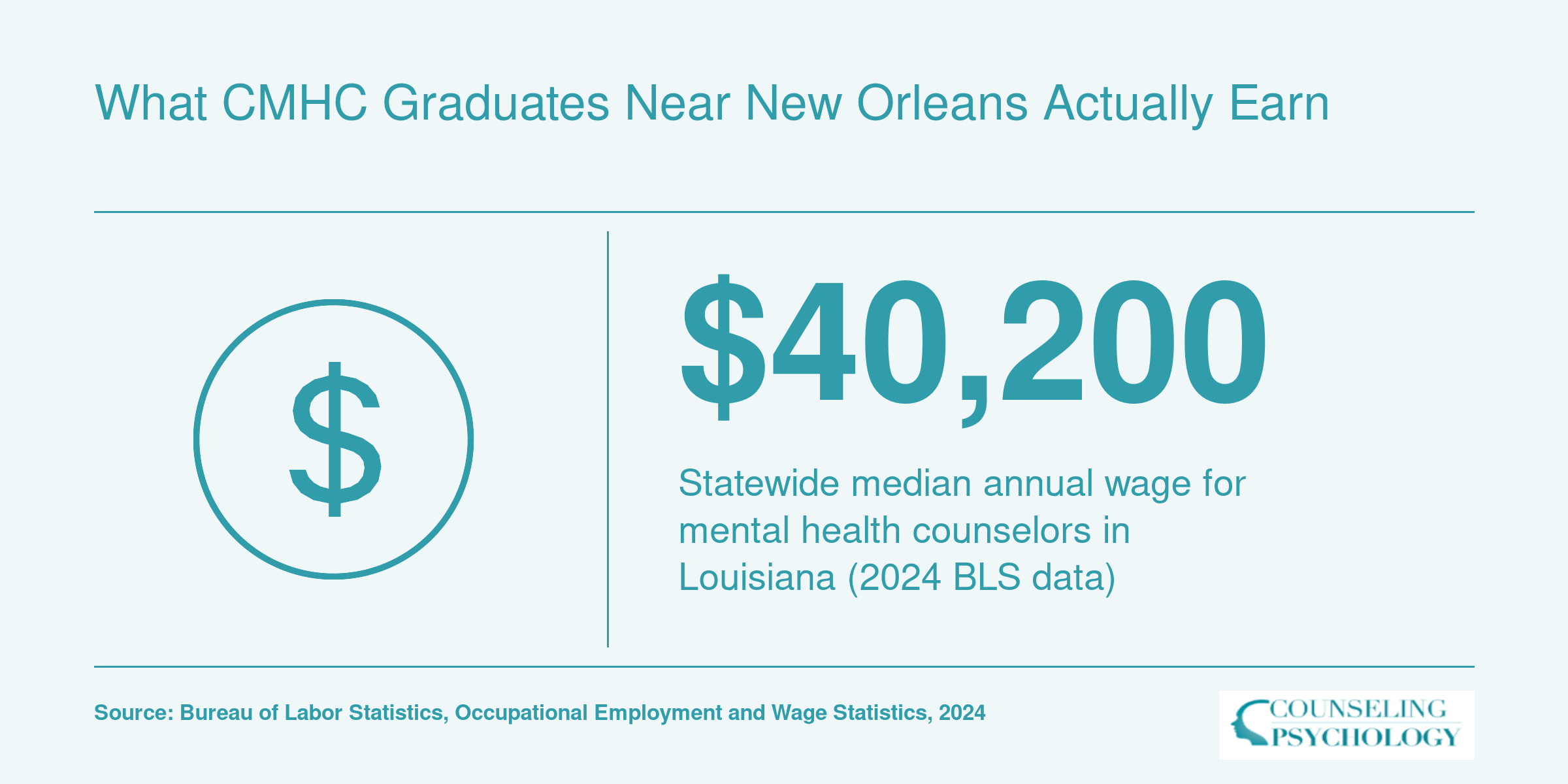
- Louisiana's statewide median annual wage for mental health counselors stood at $40,200 as of the latest BLS data.
Two decades after Hurricane Katrina, New Orleans remains one of the most active markets for licensed professional counselors in the Gulf South. The city's layered behavioral health needs, from ongoing trauma recovery to rising demand for community mental health services, have kept employer postings steady even as national hiring cools in other regions. Yet tuition for CMHC master's programs in Louisiana varies by more than $14,000 a year depending on the school, and not every format fits every schedule.
The 12 programs ranked here run the full spectrum: public flagships, private urban campuses, HBCUs, and hybrid options that let working students stay employed. All prepare graduates for LPC licensure under Louisiana's two-tier credentialing system, but they differ sharply in cost, clinical hour structure, and time to degree. Later sections break down practicum sites across the metro area, compare ROI figures, and walk through the post-graduation licensing timeline.
Best CMHC Master's Programs Near New Orleans
These 12 Louisiana programs span a wide range of costs, formats, and institutional cultures. Annual in-state tuition runs from roughly $7,300 at LSU Shreveport to about $21,600 at Loyola University New Orleans, and delivery options include fully online, hybrid, and traditional campus formats, so students in the Greater New Orleans area can find a program that fits both their budget and their schedule.
- Graduate earnings and debt outcomes
- CACREP accreditation status
- Clinical training depth
- Delivery format and flexibility
- Institutional graduation metrics
- College Scorecard graduate earnings — collegescorecard.ed.gov
- NCES-IPEDS federal institutional data — nces.ed.gov
- Independent program research
- Internal program database

Louisiana State University Health Sciences Center-New Orleans
Housed within LSU's School of Allied Health Professions in downtown New Orleans, this 60-credit CACREP-accredited program trains counselors inside one of the state's premier medical campuses. Classes run both in person and via live Zoom with daytime and evening options, a schedule built for working professionals in the metro area. Interprofessional exposure alongside nursing, rehabilitation, and public health students sets this program apart, and institution-wide median earnings ten years out reach roughly $78,500, the highest among schools on this list. Median graduate debt sits at $19,500.
- CACREP-accredited 60-credit campus program
- Synchronous Zoom and in-person scheduling options
- Evening classes available (typically 5:00 to 8:00 p.m.)
- Interprofessional training with allied health disciplines
- Prepares for NCE certification and LPC licensure
- Comprehensive exam required for degree completion
- Placements in New Orleans medical centers and clinics
Master of Health Sciences in Clinical Mental Health Counseling — On-Campus

Loyola University New Orleans
Loyola's 60-credit Master of Science in Counseling with a Clinical Mental Health Counseling track is rooted in a social justice paradigm shaped directly by the realities of New Orleans, including racial inequity, poverty, and disaster recovery. The program requires 740 hours of supervised clinical training, among the highest totals on this list, with practicum and internship sites drawn from Greater New Orleans hospitals, nonprofits, and community agencies. A hybrid format mixes in-person classes on the Uptown campus with live online sessions, and the institution's 59% graduation rate and 12:1 student-to-faculty ratio reflect a supportive academic environment. Median graduate debt is $26,000, while institution-wide median earnings ten years after enrollment are about $52,900.
- 60-credit CACREP-eligible curriculum
- 740 supervised clinical training hours required
- Hybrid format: in-person plus online synchronous
- Science-practitioner model with elective specializations
- Tailored electives for specific clinical interests
- Training across age groups and cultural backgrounds
- Strong local placement network in Greater New Orleans
Master of Science in Counseling, Clinical Mental Health Counseling — Hybrid

University of Holy Cross
The only New Orleans campus on this list offering a fully online CMHC master's, the University of Holy Cross pairs asynchronous coursework with required residencies held on its Westbank campus. Students accumulate more than 700 clinical hours in Greater New Orleans community agencies, hospitals, schools, and faith-based counseling centers across Orleans and Jefferson Parishes. A 7:1 student-to-faculty ratio, the smallest among ranked programs, translates into close mentorship. Tuition is a flat $15,406 regardless of residency, and median graduate debt is about $27,000.
- CACREP-accredited online program with residency components
- Over 700 clinical experience hours required
- Three-year flexible completion timeline
- Specialization tracks in addictions and family counseling
- Residencies held on the New Orleans campus
- Minimum 3.0 undergraduate GPA for admission
- Research presentation opportunities at national conferences
Master of Arts in Counseling, Clinical Mental Health Counseling — Online

University of New Orleans
UNO's Master of Education in Counseling with a Clinical Mental Health Counseling concentration is purpose-built for working adults in the city. Late-afternoon and evening classes let students keep day jobs, and the 100-hour practicum plus 600-hour internship are completed at Greater New Orleans agencies and schools. In-state tuition of roughly $9,100, combined with a median graduate debt of $18,750 (the lowest among New Orleans campuses on this list), makes UNO one of the most affordable paths to LPC licensure in the metro area. Scholarships and graduate assistantships are open to local applicants.
- 60-credit CACREP-accredited program
- Evening and late-afternoon class schedule
- 100-hour practicum plus 600-hour internship
- Prepares for Louisiana LPC licensure
- Scholarships and assistantships available
- Part-time enrollment option offered
- Clinical placements across Greater New Orleans
Master of Education in Counseling, Clinical Mental Health Counseling — On-Campus

Northwestern State University of Louisiana
Northwestern State's 60-hour MA in Counseling with a Clinical Mental Health Counseling concentration uses a hybrid format that blends online coursework with limited trips to the Natchitoches campus, a practical design for students based in the New Orleans area who prefer to minimize travel. The program is CACREP-accredited and meets all Louisiana LPC licensure requirements. Net price averages about $13,600, and median graduate debt is $25,000. An interview-based admissions process means no specific undergraduate major is required.
- 60-hour CACREP-accredited hybrid program
- Online coursework with limited campus visits
- No specific undergraduate degree required
- Interview-based admissions process
- Prepares for LPC licensure and NCC credential
- Comprehensive exam or thesis/project required
- Meets Louisiana state licensure requirements
Master of Arts in Counseling, Clinical Mental Health Counseling — Hybrid

Louisiana State University and Agricultural & Mechanical College
LSU's 60-credit Master of Education in Counseling with a Clinical Mental Health Counseling concentration combines rigorous academic training with an emphasis on advocacy, social justice, and wellness across the lifespan. The program is CACREP-accredited and requires a 3.0 GPA, GRE scores, and a competitive interview. Institution-wide, LSU holds the highest graduation rate on this list at nearly 69%, and median graduate debt is $20,500. Though based in Baton Rouge, it sits within commuting distance for students on the western edge of the Greater New Orleans metro.
- 60-credit CACREP-accredited campus program
- Minimum 3.0 GPA and GRE scores required
- Emphasis on multicultural competence and advocacy
- Evidence-based counseling practices throughout
- Prepares for Licensed Professional Counselor credential
- Hands-on clinical training opportunities
- Competitive interview-based admissions
Master of Education in Counseling, Clinical Mental Health Counseling — On-Campus

University of Louisiana at Lafayette
UL Lafayette's CMHC master's trains students through a campus-based, CACREP-accredited curriculum with a strong regional identity. Faculty emphasize preparation for practice in South Louisiana's culturally diverse communities, and students gain supervised hours in the university's own Clinic for Counseling and Personal Development, covering individual, family, couples, group, and play therapy. In-state tuition is about $10,200, with median graduate debt of roughly $22,900.
- CACREP-accredited campus program
- On-site clinic covering multiple therapy modalities
- Faculty supervised individual and group counseling
- Training for South Louisiana's diverse populations
- Meets Louisiana LPC licensure requirements
- Ethical practice and ACA Code of Ethics emphasis
- Real-world clinical application from day one
Master's in Counseling, Clinical Mental Health Counseling — On-Campus

McNeese State University
McNeese State offers one of the most affordable CMHC paths in Louisiana, with in-state tuition around $8,500 and out-of-state tuition just $10,000, one of the narrowest resident/nonresident gaps on this list. The campus-based Master of Science prepares graduates for LPC licensure through supervised clinical experiences and coursework focused on practical counseling skills. Median graduate debt is $23,000. Located in Lake Charles, the program primarily serves Southwest Louisiana, though it remains accessible to students willing to relocate or commute.
- Campus-based program preparing for LPC licensure
- Among the lowest tuition on this list
- Supervised clinical experiences included
- Emphasis on diverse career settings
- Bachelor's degree required for admission
- Competitive tuition for out-of-state students too
- Check current catalog for prerequisite details
Master of Science in Clinical Mental Health Counseling — On-Campus

Nicholls State University
Nicholls State's 60-hour Master of Arts in Clinical Mental Health Counseling is CACREP-accredited and prepares students for LPC licensure through a curriculum covering psychopathology, therapeutic interventions, and cross-cultural counseling. Located in Thibodaux, roughly an hour west of New Orleans, it draws students from the River Parishes and the corridor between the city and the Bayou region. In-state tuition is approximately $8,200, and median graduate debt is about $22,700.
- 60-hour CACREP-accredited campus program
- Licensure preparation focus throughout
- Clinical internship experiences included
- Minimum 2.50 undergraduate GPA required
- Training in psychopathology and crisis intervention
- Cross-cultural counseling competencies emphasized
- Accessible from the New Orleans to Bayou corridor
Master of Arts in Clinical Mental Health Counseling — On-Campus

Southeastern Louisiana University
Southeastern Louisiana University's CACREP-accredited Master of Science in Counseling with a Clinical Mental Health Counseling concentration sits along the I-12 corridor in Hammond, making it a realistic commute for students on the Northshore or in the northern reaches of the New Orleans metro. The 60-credit curriculum includes practicum and internship placements across southeastern Louisiana. Median graduate debt is roughly $22,100, and in-state tuition is about $8,800.
- 60-credit CACREP-accredited campus program
- Meets Louisiana LPC licensure requirements
- Practicum and internship in SE Louisiana sites
- Minimum 2.8 undergraduate GPA required
- Nine behavioral studies prerequisite credits
- Professional interview part of admissions
- Diverse counseling specialization tracks available
Master of Science in Counseling, Clinical Mental Health Counseling — On-Campus

Louisiana State University-Shreveport
LSU Shreveport's Master of Science in Counseling with a Clinical Mental Health Counseling concentration carries the lowest net price on this list at roughly $7,000, and a flat tuition rate of about $7,350 regardless of residency. The program follows a practitioner-scientist model with an emphasis on wellness, cultural diversity, and ethics. Though located in Shreveport (roughly five hours from New Orleans), the affordability and flat-rate tuition may appeal to students willing to relocate. Median graduate debt is $22,500.
- Practitioner-scientist training model
- Flat tuition rate for all students
- Lowest net price among ranked programs
- Wellness model and cultural diversity focus
- Ethical considerations woven throughout
- Campus-based program in Shreveport
- Bachelor's degree required for admission
Master of Science in Counseling, Clinical Mental Health Counseling — On-Campus

Southern University and A & M College
Southern University, a historically Black university in Baton Rouge, offers a 60-credit Master of Arts in Clinical Mental Health Counseling that emphasizes cultural sensitivity and ethical practice. Students complete 100 hours of practicum and 600 hours of internship, building hands-on competence across diverse clinical environments. Admission requires a minimum 2.7 GPA, GRE scores, professional references, and a goal statement. Median graduate debt is roughly $29,250, the highest among ranked programs, so prospective students should weigh financial aid options carefully.
- 60-credit program at a historically Black university
- 100 hours practicum plus 600 hours internship
- Culturally sensitive counseling approach
- Minimum 2.7 GPA and GRE scores required
- Professional references and goal statement needed
- Comprehensive mental health training across settings
- Emphasis on ethical practice and diverse populations
Master of Arts in Clinical Mental Health Counseling — On-Campus
How We Ranked These Programs
Not every list of counseling programs is built the same way. Some rely on reputation surveys or editorial gut-checks. This ranking takes a different approach, drawing on federal outcome data to give prospective students a clearer picture of what each program actually delivers.
What Went Into the Scores
Each program was evaluated on four factors: net price (the average cost after institutional and federal aid), graduate earnings outcomes at the program level where available, graduation rate, and median student debt at graduation. These factors were combined into a weighted score designed to surface programs that balance affordability with strong outcomes, rather than simply rewarding prestige.
A few caveats worth knowing upfront. Graduation rates in this analysis reflect institution-wide figures, because program-specific completion data is rarely published at the graduate level. Similarly, net price is an institution-level average after aid, not a personalized estimate. Your actual cost will depend on your financial situation, residency status, and any assistantships or scholarships you receive.
Why CACREP Accreditation Was a Factor
CACREP accreditation carries real weight in Louisiana. The state's Licensed Professional Counselor pathway strongly favors graduates of CACREP-accredited programs, and some supervised-hours requirements differ depending on whether your degree came from an accredited program. Accreditation status was treated as a quality signal in the ranking, though it was not the only one. For a broader look at clinical mental health counseling programs Louisiana, our statewide guide covers additional options beyond the New Orleans metro.
Programs that lack CACREP accreditation are not automatically disqualified from consideration, but students applying to non-accredited programs should verify current Louisiana LPC board requirements before enrolling.
What This Ranking Is Not
This is not a prestige index. A program at a smaller regional university can outscore a more recognizable name if it delivers better outcomes at a lower net cost to students. The goal is to help you find a program that fits your career, your budget, and Louisiana's licensure framework, not to reproduce a brand-name hierarchy. Students exploring other specializations may also want to compare online clinical mental health counseling programs nationally for additional flexibility.
Cost and ROI Comparison Across Programs
The table below compares tuition, estimated net price, median graduate debt, institution-wide median earnings ten years after enrollment, and a simple ROI ratio (ten-year earnings divided by median debt) for each of the 12 programs on our list. Net price figures reflect the institution-wide average after financial aid and may not match what an individual graduate student pays. Program-level first-year earnings are not yet available for these CMHC programs, so the ten-year institutional median serves as the best published proxy. Among these schools, LSU Health Sciences Center in New Orleans stands out with the lowest median debt ($19,500) and the highest ten-year earnings ($78,495), yielding the strongest ROI ratio at roughly 4.0. At the other end of the spectrum, Southern University and A&M College carries the highest median debt ($29,251) paired with the lowest ten-year earnings ($43,371), producing the weakest ratio in the group.
| School | In-State Tuition | Out-of-State Tuition | Inst. Net Price (Avg. After Aid) | Median Graduate Debt | Median Earnings (10 Yr) | ROI Ratio |
|---|---|---|---|---|---|---|
| LSU Health Sciences Center, New Orleans | $13,089 | $25,362 | N/A | $19,500 | $78,495 | 4.03 |
| LSU (Baton Rouge) | $13,027 | $29,962 | $19,151 | $20,500 | $61,251 | 2.99 |
| University of New Orleans | $9,108 | $13,678 | $12,384 | $18,750 | $47,872 | 2.55 |
| LSU Shreveport | $7,349 | $7,349 | $7,022 | $22,500 | $47,477 | 2.11 |
| Southeastern Louisiana University | $8,830 | $21,308 | $13,154 | $22,113 | $46,482 | 2.10 |
| University of Louisiana at Lafayette | $10,184 | $23,912 | $13,530 | $22,902 | $47,089 | 2.06 |
| Loyola University New Orleans | $21,631 | $21,631 | $23,696 | $26,000 | $52,927 | 2.04 |
| McNeese State University | $8,502 | $10,002 | $12,493 | $23,000 | $46,453 | 2.02 |
| Nicholls State University | $8,236 | $9,329 | $12,947 | $22,675 | $45,454 | 2.00 |
| Northwestern State University | $9,758 | $20,546 | $13,606 | $25,000 | $47,021 | 1.88 |
| University of Holy Cross | $15,406 | $15,406 | $15,635 | $26,995 | $49,316 | 1.83 |
| Southern University and A&M College | $10,738 | $17,184 | $20,077 | $29,251 | $43,371 | 1.48 |
What CMHC Graduates Near New Orleans Actually Earn
Program-level earnings data for CMHC master's graduates near New Orleans are not currently published for the schools in this ranking. However, BLS wage figures offer a useful benchmark. Louisiana's statewide median annual wage for mental health counselors was $40,200 in 2024, well below the national median of $59,190. Early-career counselors in the state earned closer to $29,170 (10th percentile), while experienced professionals with specialized caseloads or supervisory roles reached roughly $66,560 at the 90th percentile. These figures reflect all mental health counselors statewide, not just recent graduates, so entry-level pay in the New Orleans metro area may differ.
How to Become a Licensed Professional Counselor in Louisiana
Louisiana operates one of the most structured LPC pathways in the Gulf South, requiring both rigorous academic preparation and extended supervised practice before candidates qualify for full independent licensure. The state maintains a two-tier system: provisional licensure (PLPC) immediately after graduation, followed by a minimum two-year supervised experience period culminating in full LPC status.1 Understanding this timeline is critical for program selection, because CACREP-accredited programs streamline the application process and reduce documentation burdens at every stage. For a broader look at the profession, see our guide on how to become a licensed professional counselor.
Master's Degree Requirements
Louisiana mandates a minimum of 60 semester hours in counseling or a closely related field from a regionally accredited institution.2 The curriculum must cover eight core content areas: counseling theories, human growth and development, psychopathology, counseling techniques, group counseling, career development, assessment, and professional ethics. CACREP-accredited programs (including Loyola New Orleans, William Carey Tradition, and UNO) are designed to meet these requirements by default. Graduates of non-CACREP programs must submit detailed syllabi and course descriptions to the Louisiana LPC Board of Examiners for evaluation, a process that can delay application approval by several months.3 All programs must include a 100-hour practicum and a 600-hour internship with face-to-face supervision built into the academic sequence.
Supervised Experience and the PLPC Period
After earning the master's degree and passing either the National Counselor Examination (NCE) or the National Clinical Mental Health Counseling Examination (NCMHCE), graduates apply for provisional licensure (PLPC).3 The PLPC designation permits supervised clinical practice while accumulating the 3,000 hours required for full LPC status. Of those 3,000 hours, at least 1,900 must be direct client contact, 1,000 may be indirect activities (case documentation, treatment planning, consultation), and candidates must receive a minimum of 100 hours of face-to-face supervision from an LPC Supervisor (LPC-S).2 The supervised experience must span at least two years but cannot exceed six years. Candidates who complete 30 additional graduate semester hours may substitute up to 500 hours of coursework for indirect hours, potentially shortening the clock-time requirement.
Full LPC Licensure and the LPC-S Credential
Once the 3,000-hour requirement is satisfied and all supervision documentation is verified by the Board, candidates apply for full LPC licensure. Full LPCs may practice independently and bill third-party payers. After three years of post-licensure practice, LPCs may pursue the LPC Supervisor (LPC-S) credential by completing Board-accepted supervision training.2 LPC-S status is essential for anyone planning to supervise PLPC candidates or teach in graduate counseling programs. Those interested in the broader landscape of licensed professional clinical counselor degree options may find that Louisiana's requirements align closely with national CACREP standards. No major legislative changes to Louisiana licensure rules have taken effect between 2024 and 2026, though the Board periodically updates supervision log formats and online application portals. The Louisiana LPC Board of Examiners website remains the authoritative source for current rules, application forms, and FAQs.1
Louisiana LPC Licensure Steps at a Glance
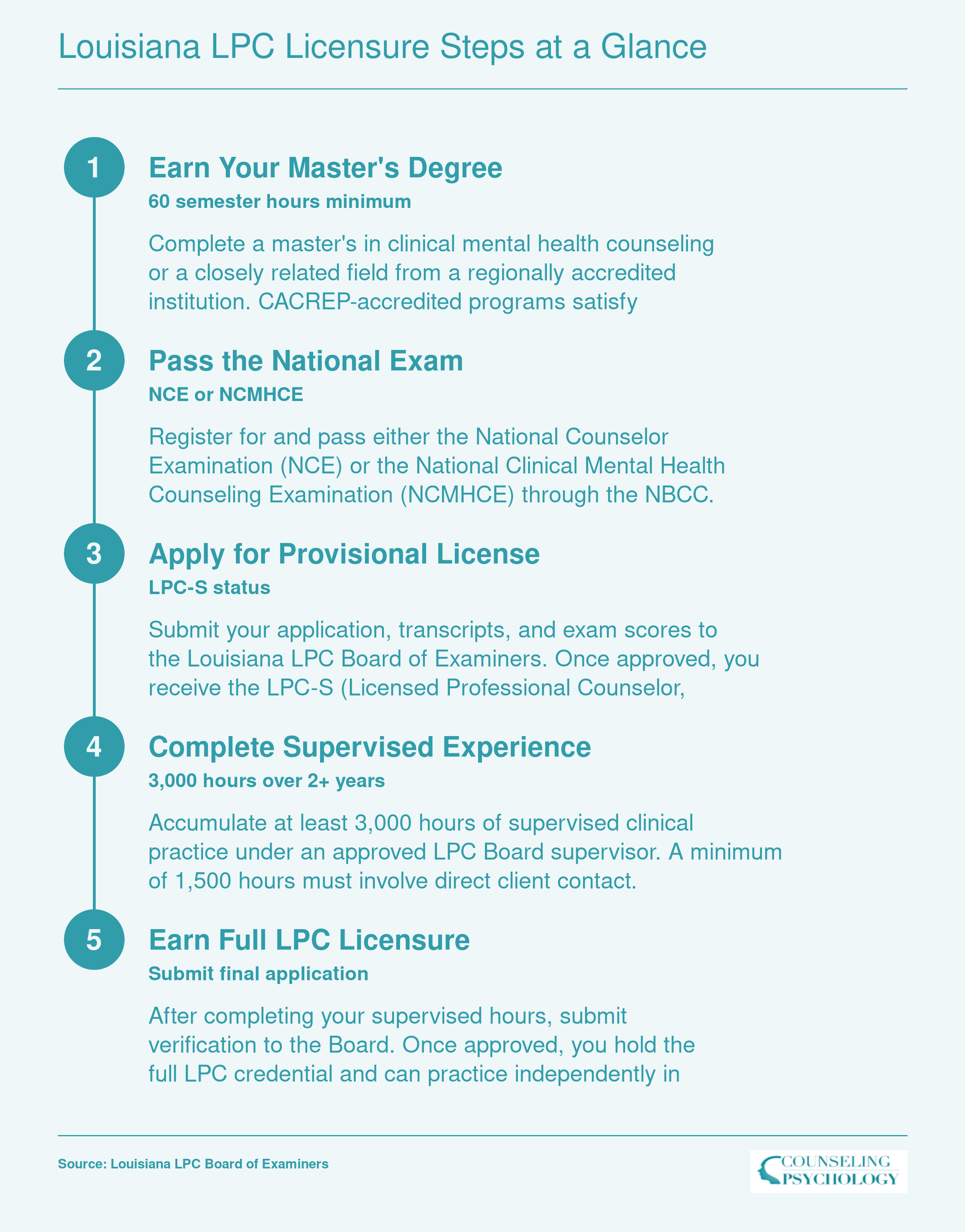
Earning your Licensed Professional Counselor (LPC) credential in Louisiana follows a clear sequence. Graduating from a CACREP-accredited program streamlines the process, as the Louisiana LPC Board of Examiners recognizes CACREP curricula as meeting all coursework requirements without additional review.
Questions to Ask Yourself
Clinical Training and Practicum Opportunities in New Orleans
Metropolitan Human Services District, the region's public behavioral health authority, is just one entry point into a practicum landscape that makes New Orleans unusually rich territory for clinical mental health counseling students. The city's layered history of disaster recovery, cultural diversity, and persistent mental health need means trainees here encounter clinical scenarios that many peers in other metro areas simply do not.
Why Local Practicum Access Matters for Licensure
In Louisiana, the supervised clinical hours you accumulate during your master's program count toward the post-graduation requirements for Licensed Professional Counselor (LPC) credentialing. That means every practicum and internship semester is not just a learning experience; it is licensure currency. Programs that place students at well-supervised sites with diverse caseloads give graduates a head start on the 3,000 supervised post-degree hours the state requires. Choosing a program with strong local site partnerships can shave months off the path from graduation to independent practice.
Where CMHC Students Train in the New Orleans Metro
Several organizations stand out as common training grounds for master's-level counseling students in the area:
- Jewish Family Service of Greater New Orleans: Operates a Behavioral Health Intern Training Center that accepts master's-level counseling and social work students, with a focus on disaster response and trauma-informed care.1
- New Beginnings Behavioral & Family Services: Offers practicum placements across New Orleans, East Jefferson, St. Bernard, and Westbank locations. Students work with children, adolescents, and adults in individual, family, and group therapy settings, with roughly three hours of supervision per week.2
- University of New Orleans Counseling Services: Houses its own on-campus clinic where practicum students (spring and summer semesters) and interns (fall and spring) provide adult counseling grounded in a Solution-Focused Framework.3
- Southeast Louisiana Veterans Health Care System (New Orleans VA): The VA runs APA-accredited training programs emphasizing trauma-focused care, including PTSD and combat trauma. Its current psychology internship is geared toward doctoral-level trainees, but the facility's broader behavioral health services have historically offered exposure opportunities for master's-level students through affiliated rotations.4
- Community mental health centers and post-Katrina recovery organizations: Agencies across the metro continue to serve populations affected by Hurricanes Katrina and Ida, giving students direct experience in long-term community resilience work.
Students drawn to this last category may want to explore the broader community mental health counselor career path, which aligns closely with the disaster-recovery and resilience-oriented work common across the Gulf South.
A Built-In Advantage: Trauma-Informed and Culturally Responsive Training
New Orleans has one of the highest concentrations of need for trauma-informed and culturally responsive mental health services in the Gulf South. For CMHC students, this translates into practicum caseloads that naturally build competencies many employers and licensing boards now prioritize. Working with communities that span Vietnamese, Honduran, Haitian, and historically Black populations, among others, prepares graduates for the demographic complexity of modern clinical practice far better than a textbook exercise ever could.
The practical takeaway: if you are comparing programs, look closely at each school's practicum site list, the number of required clinical hours, and whether supervision arrangements align with Louisiana's LPC requirements. A program embedded in New Orleans' practicum network gives you both the training depth and the professional connections to move efficiently toward licensure.
MA vs MS in Counseling: Which Degree Is Better?
If you have spent any time browsing program listings, you have probably noticed that some schools award a Master of Arts while others confer a Master of Science in clinical mental health counseling. The short answer is that neither degree is inherently superior. What matters far more is program accreditation, your personal career goals, and whether the curriculum prepares you for licensure in Louisiana.
Curriculum and Course Emphasis
Traditionally, MA programs lean toward humanistic and clinical coursework, often requiring more practicum hours and electives in specialized therapy modalities. MS programs sometimes include additional research methods, statistics, or a thesis track. In practice, however, these distinctions have blurred considerably. Many accredited programs now offer both thesis and non-thesis options regardless of degree title. Explore course catalogs on each program's website to compare required credits, clinical hours, and elective flexibility before assuming one label guarantees a heavier research or clinical focus.
Licensure Implications in Louisiana
The Louisiana Licensed Professional Counselors Board of Examiners does not distinguish between an MA and an MS when evaluating LPC eligibility. What the board does require is graduation from a program that meets CACREP standards or its equivalent, along with specified semester hours in core counseling areas. If your program is accredited and covers Louisiana's content requirements, the letters after your name will not affect your path to licensure. When in doubt, contact the admissions office directly to confirm that the curriculum aligns with state requirements.
What Employers Actually Care About
Survey current job postings at community mental health centers, hospitals, and private practices in the New Orleans area. You will find that employers consistently prioritize LPC licensure status, supervised clinical hours, and any relevant specializations over whether your diploma reads MA or MS. Hiring managers want to know that you can see clients independently and that you have hands-on experience. The degree title rarely appears in screening criteria.
Making Your Decision
Choose based on factors you can feel: faculty expertise, practicum site partnerships, scheduling flexibility, and overall cost. If you enjoy research and want the option to pursue doctoral study later, a thesis track may strengthen your application, whether that leads to a doctorate in addiction counseling or another advanced specialization. If you prefer maximizing direct client contact, look for programs with robust internship networks. Either path leads to the same license and the same professional opportunities once you complete your supervised hours.
Admission Requirements and Typical Student Profile
Most CACREP-accredited CMHC programs in Louisiana set a clear floor: a 3.0 undergraduate GPA, a bachelor's degree in any field, and a written case for why you belong in the cohort. The bar is consistent enough that applicants can prepare against it, but each program weights the pieces differently.
GPA, Prerequisites, and the GRE
The 3.0 GPA minimum holds across most Louisiana CACREP programs, including LSU in Baton Rouge. A few schools sit lower: Nicholls State accepts a 2.5 undergraduate GPA and uses a conditional GRE-GPA formula (minimum combined score of 335) for borderline applicants.2 Southeastern Louisiana lists a 2.8 floor, and Southern University Baton Rouge accepts 2.7. University of Holy Cross holds the line at 3.0.
The GRE has largely disappeared as a hard requirement. LSU Baton Rouge, LSUS, Loyola New Orleans, and ULM all waive it.3 Expect prerequisite coursework in introductory psychology, abnormal psychology, and statistics, which most psychology and social work majors will already have. Career changers from unrelated fields often complete these as post-baccalaureate courses before applying. If you are wondering how hard it is to get into grad school for psychology, meeting these prerequisites early gives you a significant advantage.
Application Components
A typical application package includes:
- Personal statement: Your counseling philosophy, relevant experience, and career goals.
- Letters of recommendation: Two to three letters, ideally from faculty or clinical supervisors.3
- Interview: Required at LSUS, Loyola New Orleans, Northwestern State, and Southeastern Louisiana. Treat it as a fit conversation, not a quiz.3
- Transcripts and resume: Standard across all programs.
Who Actually Enrolls
Louisiana CMHC cohorts tend to mix three groups: psychology and social work undergraduates moving directly into graduate study, career changers from teaching, nursing, or ministry, and working professionals using hybrid or evening options like UNO's late-afternoon schedule or ULM's fully online format.
Institutional admission rates give a rough sense of selectivity at the university level, though they do not reflect the graduate program itself. Loyola New Orleans admits 93% of undergraduates, LSU Baton Rouge 73%, and University of Holy Cross 74%. Graduate counseling admissions are typically more competitive than these university-wide figures suggest, since cohort sizes are capped to match practicum supervision capacity.
According to the Bureau of Labor Statistics Occupational Outlook Handbook, mental health counselor roles (SOC 21-1014) are projected to grow 17 percent between 2024 and 2034, far outpacing most occupations. That growth translates to roughly 48,300 job openings each year nationwide, making this one of the most in-demand fields in the country.
Frequently Asked Questions About CMHC Programs in New Orleans
Choosing a clinical mental health counseling master's program is a major decision, and prospective students near New Orleans tend to ask many of the same questions. Below are straightforward answers drawn from Louisiana licensing rules, accreditation standards, and common program structures.