

What you’ll learn in this article…
- Seven CACREP-accredited CMHC programs near Louisville are ranked by net price to reveal true out-of-pocket cost.
- Kentucky requires 60 graduate credit hours plus supervised post-master's experience before you can earn LPCC licensure.
- Online, hybrid, and on-campus formats all demand the same 100 practicum and 600 internship clinical hours.
- Kentucky participates in the Counseling Compact, giving LPCC holders a streamlined path to practice across member states.
Rising demand for licensed clinical mental health counselors in Kentucky has not been matched by an expansion of affordable, CACREP-accredited graduate programs. The result is a marketplace where savvy applicants must reconcile program cost with long-term earning potential.
Among the institutions profiled here, annual tuition ranges from $3,195 to $14,644, a spread that, across a 60-credit master's degree, creates a total cost difference of over $30,000 before factoring in fees or financial aid. For most students, the career arithmetic goes beyond acceptance: it requires measuring graduate debt against the state's pay scale, where median earnings ten years after enrollment can vary by nearly $18,000 depending on the school attended. Students weighing related graduate paths may also want to explore MFT programs in Kentucky for comparison.
Best Affordable Clinical Mental Health Counseling Programs Near Louisville
This ranking prioritizes financial accessibility above all else, ordering Kentucky CMHC programs by net price so you can compare real out-of-pocket cost rather than sticker price. Every program listed holds CACREP accreditation and meets the 60-credit-hour threshold required for Kentucky LPCC licensure. Whether you need a fully online format, a hybrid schedule, or a traditional campus experience, the options below cover the full spectrum for Louisville-area students and working professionals.
- Net price and financial accessibility
- CACREP accreditation status
- Delivery format flexibility
- Institution-level graduation rate
- Program curriculum depth
- NCES-IPEDS federal institutional data — nces.ed.gov
- College Scorecard graduate earnings — collegescorecard.ed.gov
- Internal program database
- Independent program research

Northern Kentucky University
Northern Kentucky University delivers the lowest net price of any public university on this list, making it a standout for cost-conscious students. Its 60-credit CACREP-accredited M.S. in Clinical Mental Health Counseling emphasizes hands-on clinical training with 600 required internship hours. The program aligns directly with the Kentucky Board of Licensure for Professional Counselors, and applicants need at least a 2.75 undergraduate GPA along with 48 semester credits in the liberal arts.
- CACREP-accredited 60-credit master's program
- 600 internship hours in diverse clinical settings
- Aligns with Kentucky LPCC licensure requirements
- 2.75 minimum undergraduate GPA for admission
- Requires 48 liberal arts semester credits
- On-campus delivery in Highland Heights, KY
- In-state tuition around $10,788 per year
Clinical Mental Health Counseling, M.S. — On-Campus

Western Kentucky University
Western Kentucky University pairs a competitive net price with both residential and fully online pathways, giving Louisville-area professionals genuine flexibility. The 60-credit MAE in Clinical Mental Health Counseling does not require GRE or GMAT scores, and the online version uses live synchronous Zoom sessions. Elective tracks in addiction education and play therapy let students tailor the degree to their career goals.
- CACREP-accredited 60-credit-hour curriculum
- No GRE or GMAT required for admission
- Available in residential and fully online formats
- Online courses delivered via live Zoom sessions
- Elective options in addiction and play therapy
- Prepares graduates for LPCC and national certification
- Fall semester start; JUMP early-entry program eligible
Master of Arts in Education in Clinical Mental Health Counseling — On-Campus

Eastern Kentucky University
Eastern Kentucky University keeps in-state tuition under $10,800 and sweetens the deal with free textbooks for enrolled students. The 60-credit M.A. in Clinical Mental Health Counseling uses a hybrid instructional model that blends on-campus and remote coursework, and students can transfer up to 18 credits toward the degree. A 100-hour practicum followed by a 600-hour internship provides extensive supervised clinical experience.
- CACREP-accredited 60-credit-hour program
- Hybrid model blends campus and remote instruction
- Free textbooks included for all students
- In-state tuition approximately $541 per credit hour
- 100-hour practicum plus 600-hour internship
- Up to 18 transfer credits accepted
- Personalized faculty mentoring throughout the program
Master of Arts in Clinical Mental Health Counseling — On-Campus

University of the Cumberlands
University of the Cumberlands offers its fully online 60-credit M.A. in Clinical Mental Health Counseling at $449 per credit hour, with no difference between in-state and out-of-state rates. That flat tuition structure, combined with the lowest median graduate debt on this list at roughly $14,911, makes it especially appealing for students outside Kentucky. Coursework emphasizes multicultural counseling and evidence-based practices, and all practicum and internship components are built into the curriculum.
- Fully online 60-credit CACREP-accredited program
- Flat tuition of $449 per credit hour, all states
- Practicum and internship embedded in curriculum
- Multicultural counseling and evidence-based focus
- 3.0 undergraduate GPA required for admission
- Median graduate debt among the lowest in Kentucky
- Designed for both recent grads and working adults
Master of Arts in Clinical Mental Health Counseling — Online

Lindsey Wilson College
Lindsey Wilson College blends online and on-campus delivery in its CACREP-accredited M.Ed. in Counseling with a Mental Health Counseling concentration. As a private institution with no in-state vs. out-of-state tuition distinction, Lindsey Wilson can be a surprisingly affordable option, and its median graduate debt of about $16,784 stays well below many competitors. The practitioner-focused curriculum includes nine credit hours of supervised clinical instruction covering practicum and internship placements.
- CACREP-accredited 60-semester-hour program
- Online and campus delivery formats available
- Nine hours of supervised clinical instruction
- Covers addiction counseling and clinical diagnosis
- 3.0 GPA required; interview part of admission
- Graduates eligible for provisional licensure
- No in-state vs. out-of-state tuition difference
Master of Education in Counseling, Mental Health Counseling Concentration — Online

University of Kentucky
The University of Kentucky carries a higher net price than the other public schools on this list, but it also boasts the strongest institution-wide graduation rate at 71.4% and the highest median earnings ten years after enrollment. The online M.A. in Counseling with a Clinical Mental Health Counseling concentration is CACREP-accredited and does not require GRE scores. Students benefit from UK's research infrastructure and clinical placement network across central Kentucky.
- CACREP-accredited online program format
- No GRE required; 2.75 minimum undergraduate GPA
- Personal interview and three recommendation letters
- Must maintain 3.0 GPA throughout coursework
- Evidence-based, culturally competent training model
- Strong alumni network across Kentucky
- 71.4% institution-level graduation rate
Master's of Arts in Counseling, Clinical Mental Health Counseling Concentration — Online

Spalding University
Spalding University is the only Louisville-based institution on this list, making it uniquely convenient for local students who want face-to-face instruction without a commute. The CACREP-accredited M.A. in Clinical Mental Health Counseling uses a small-cohort model of roughly 20 students per class, and the program can be completed full-time in four to five semesters or part-time over about three years. Graduates are prepared for roles in hospitals, outpatient facilities, forensic settings, and private practice across the Louisville metro.
- CACREP-accredited 60-credit campus-based program
- Small cohort of approximately 20 students
- Full-time track completes in 4 to 5 semesters
- Part-time option available, roughly 3 years
- On-campus clinic for practicum experience
- 9:1 student-to-faculty ratio for close mentoring
- Prepares graduates for the National Counselor Exam
Master of Arts in Clinical Mental Health Counseling — On-Campus
Tuition & Cost Comparison Across Kentucky CMHC Programs
The table below compares annual tuition rates, estimated net price, median graduate debt, and median earnings ten years after enrollment for seven Kentucky institutions offering CACREP-accredited Clinical Mental Health Counseling master's programs. All figures come from IPEDS and College Scorecard data. Note that net price reflects the institution-wide average after grants and scholarships, not a program-specific estimate, so your actual graduate-level costs may differ. These numbers give you a useful starting point for weighing affordability against long-term earning potential.
| School | In-State Tuition | Out-of-State Tuition | Avg. Net Price | Median Graduate Debt | Median Earnings (10 yr) | Student-to-Faculty Ratio |
|---|---|---|---|---|---|---|
| University of the Cumberlands | $3,195 | $3,195 | $14,107 | $14,911 | $45,036 | 23:1 |
| Northern Kentucky University | $10,788 | $16,350 | $8,191 | $23,000 | $50,220 | 19:1 |
| Lindsey Wilson College | $10,163 | $10,163 | $15,070 | $16,784 | $41,129 | 16:1 |
| Eastern Kentucky University | $10,794 | $14,628 | $11,040 | $22,500 | $45,795 | 17:1 |
| Western Kentucky University | $12,140 | $18,340 | $10,990 | $22,095 | $43,889 | 19:1 |
| Spalding University | $12,530 | $12,530 | $25,491 | $25,250 | $49,438 | 9:1 |
| University of Kentucky | $14,644 | $36,238 | $18,851 | $22,500 | $59,025 | 18:1 |
Questions to Ask Yourself
CACREP Accreditation: Why It Matters for Kentucky Licensure
Will a non-CACREP degree keep me from getting licensed in Kentucky? The short answer is no, but it can make the path considerably longer and more complicated. For many graduates, the difference is enough to steer their choice toward an accredited program from the start.
What Is CACREP Accreditation?
CACREP, the Council for Accreditation of Counseling and Related Educational Programs, is the recognized quality-assurance body for clinical mental health counseling degrees.1 Programs earn accreditation by demonstrating that their curriculum, faculty qualifications, clinical training, and student support meet national standards developed by the counseling profession. For students, a CACREP-accredited master's is a signal that the program has been independently reviewed and deemed rigorous and relevant.
Accreditation and Kentucky's LPCC Licensure
Kentucky's LPCC board does not strictly require a CACREP-accredited degree, but it strongly favors one.2 The state's licensure regulations accept CACREP-aligned coursework as meeting the core content areas, covering key domains like assessment, diagnosis, ethics, and supervised clinical experience, without additional scrutiny. If you graduate from a non-CACREP program, you may need to submit course descriptions, syllabi, and other documentation to prove your curriculum was equivalent. This evaluation process can delay your application and, in some cases, result in the board requiring extra coursework or a longer supervised practice period before you qualify for the national exam. For a broader look at how these requirements compare across states, see our guide to counseling licensure requirements.
Programs with CACREP Status Near Louisville
Several of the affordable programs near Louisville hold CACREP accreditation for their clinical mental health counseling tracks. Lindsey Wilson College's Clinical Mental Health Counseling program is accredited through March 31, 2029.3 The following programs also list CACREP accreditation in their published materials or the CACREP directory: - University of the Cumberlands (Master of Arts in Clinical Mental Health Counseling) - Western Kentucky University (MAE in Clinical Mental Health Counseling) - Northern Kentucky University (MS in Clinical Mental Health Counseling) - University of Kentucky (MA in Counseling, Clinical Mental Health Counseling concentration) - Spalding University (MA in Clinical Mental Health Counseling) - Eastern Kentucky University (MA in Clinical Mental Health Counseling)
Because accreditation statuses and review cycles change, always verify directly on the official CACREP directory before applying.
The Risks of Choosing a Non-CACREP Program
Graduating from a program without CACREP accreditation introduces uncertainty. Even if you secure Kentucky licensure through the equivalency route, later career moves can be hampered. Many employers, especially community mental health counselor roles, VA hospitals, and university counseling centers, prefer or require a CACREP background for hiring or advancement. Additionally, if you relocate out of state, you may discover that the new state's licensure board only accepts CACREP degrees, effectively locking you out of practice without costly additional coursework or retaking the education.
Portability and the Counseling Compact
The Counseling Compact, which is gaining momentum across the country, aims to let clinicians practice in multiple states under a single multistate license. While compact rules are still unfolding, one common thread is that member states gravitate toward consistent educational standards, and CACREP is frequently the benchmark. Holding a CACREP-accredited degree positions you to take full advantage of licensure portability as the compact matures, whereas a non-CACREP degree may create barriers even in states that are otherwise part of the agreement.
Online vs. On-Campus Options for Louisville-Area Students
Louisville-area students pursuing a clinical mental health counseling master's will find three delivery formats across Kentucky programs: fully online, hybrid, and traditional on-campus. The clinical requirements are identical regardless of format. Every CACREP-accredited CMHC program requires 100 practicum hours (at least 40 in direct service) plus 600 internship hours (at least 240 in direct service), along with weekly individual and group supervision. What differs is how you complete coursework, what you pay, and how you secure your field placements.
| Feature | Fully Online | Hybrid | On-Campus |
|---|---|---|---|
| Kentucky Programs in This Format | University of the Cumberlands, University of Kentucky, Lindsey Wilson College | Eastern Kentucky University (hybrid instructional model), Western Kentucky University (residential and online pathways with two mandatory on-campus intensives) | Northern Kentucky University, Spalding University |
| Coursework Delivery | Lectures, discussions, and assignments completed asynchronously or via live virtual sessions | Mix of online coursework with periodic in-person intensives or select campus meetings | All classes held face to face on a set weekly schedule |
| Approximate Per-Credit Tuition (In-State) | Ranges from roughly $449/credit (University of the Cumberlands) to higher rates at University of Kentucky | EKU lists approximately $541/credit for in-state students; WKU tuition starts around $12,140/year | NKU tuition is approximately $10,788/year; Spalding charges roughly $12,530/year (flat rate, in or out of state) |
| Residency or On-Site Requirements | Generally none for coursework, though some programs may require brief orientation visits | WKU requires two mandatory on-campus intensives; EKU blends scheduled campus sessions with online modules | Full campus attendance expected each semester |
| Practicum and Internship Hours | 100 practicum + 600 internship (same CACREP standard) | 100 practicum + 600 internship (same CACREP standard) | 100 practicum + 600 internship (same CACREP standard) |
| How Field Placements Work | Students typically identify and propose local clinical sites near their home; the program's field coordinator reviews and approves the site and supervisor credentials | Similar process to online: students often arrange placements locally with program approval, supplemented by on-campus clinic experiences where available | Programs may maintain established partnerships with Louisville-area agencies and clinics; Spalding, for example, offers an on-campus clinic for early training hours |
| Site Supervisor Requirements | Must hold a master's degree, carry an active license, and have completed supervision training | Same requirements as online: licensed, master's-level, with supervision training | Same requirements across all formats per CACREP standards |
| Scheduling Flexibility | Highest flexibility; well suited for working professionals or students outside the Louisville metro | Moderate flexibility; requires planning around periodic campus visits | Least flexibility; best for students who can commit to a regular campus schedule |
| Cost Consideration for Out-of-State Students | Often a single tuition rate regardless of residency (e.g., University of the Cumberlands charges the same in-state and out-of-state rate) | May charge differential rates; WKU out-of-state tuition jumps to roughly $18,340/year | Out-of-state surcharges apply at public institutions; NKU out-of-state tuition is approximately $16,350/year |
Related Articles
Earning Potential & ROI After Graduation
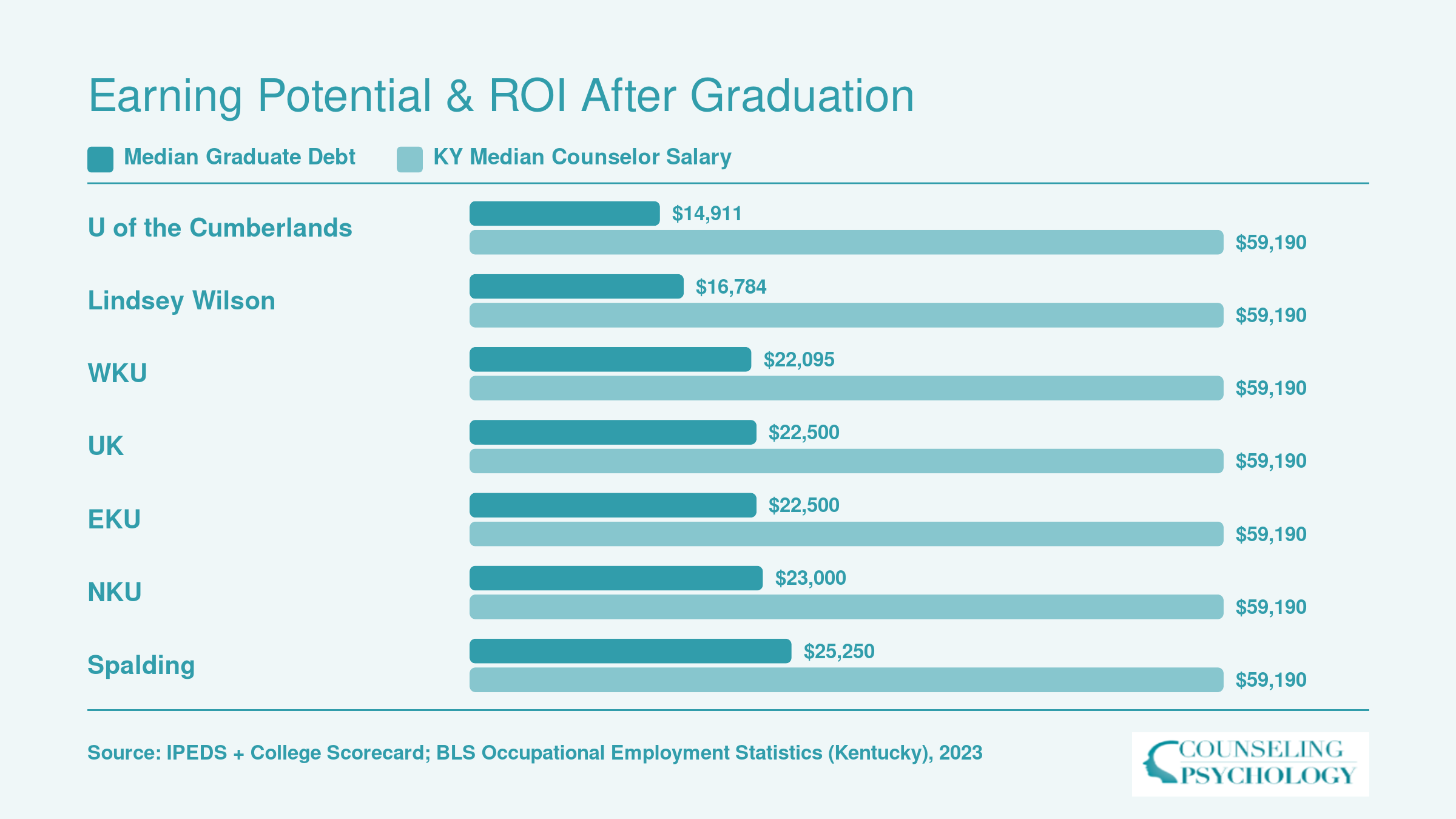
Understanding how graduate debt stacks up against professional earnings is critical when evaluating affordable CMHC programs. Program-level earnings shortly after completion are not yet published for these schools, but institution-wide median graduate debt gives a useful benchmark. Below, each school's median graduate debt is compared against the Kentucky-specific median annual wage for mental health counselors, which the BLS reports at $59,190 (2023 data). With entry-level wages in the state starting around $39,090 at the 10th percentile and experienced counselors reaching $98,210 at the 90th percentile, most graduates can expect to recover their educational investment within the first few years of practice.
Graduate Debt vs. Earnings: A Closer Look at ROI
Comparing median graduate debt against median earnings ten years after enrollment gives you a practical snapshot of long-term return on investment. The ratio below divides median earnings by median debt: a higher number means each borrowed dollar generates more earning power over time. Note that these are institution-wide figures from the College Scorecard, not specific to the CMHC program, since program-level earnings data are not yet available for these schools.
| School | Median Graduate Debt | Median Earnings (10 yr) | Earnings to Debt Ratio | Program Format |
|---|---|---|---|---|
| University of the Cumberlands | $14,911 | $45,036 | 3.02 | Online |
| University of Kentucky | $22,500 | $59,025 | 2.62 | Online |
| Lindsey Wilson College | $16,784 | $41,129 | 2.45 | Online / Campus |
| Northern Kentucky University | $23,000 | $50,220 | 2.18 | Campus |
| Eastern Kentucky University | $22,500 | $45,795 | 2.04 | Campus |
| Western Kentucky University | $22,095 | $43,889 | 1.99 | Campus |
| Spalding University | $25,250 | $49,438 | 1.96 | Campus |
Kentucky LPCC Licensure Pathway for CMHC Graduates
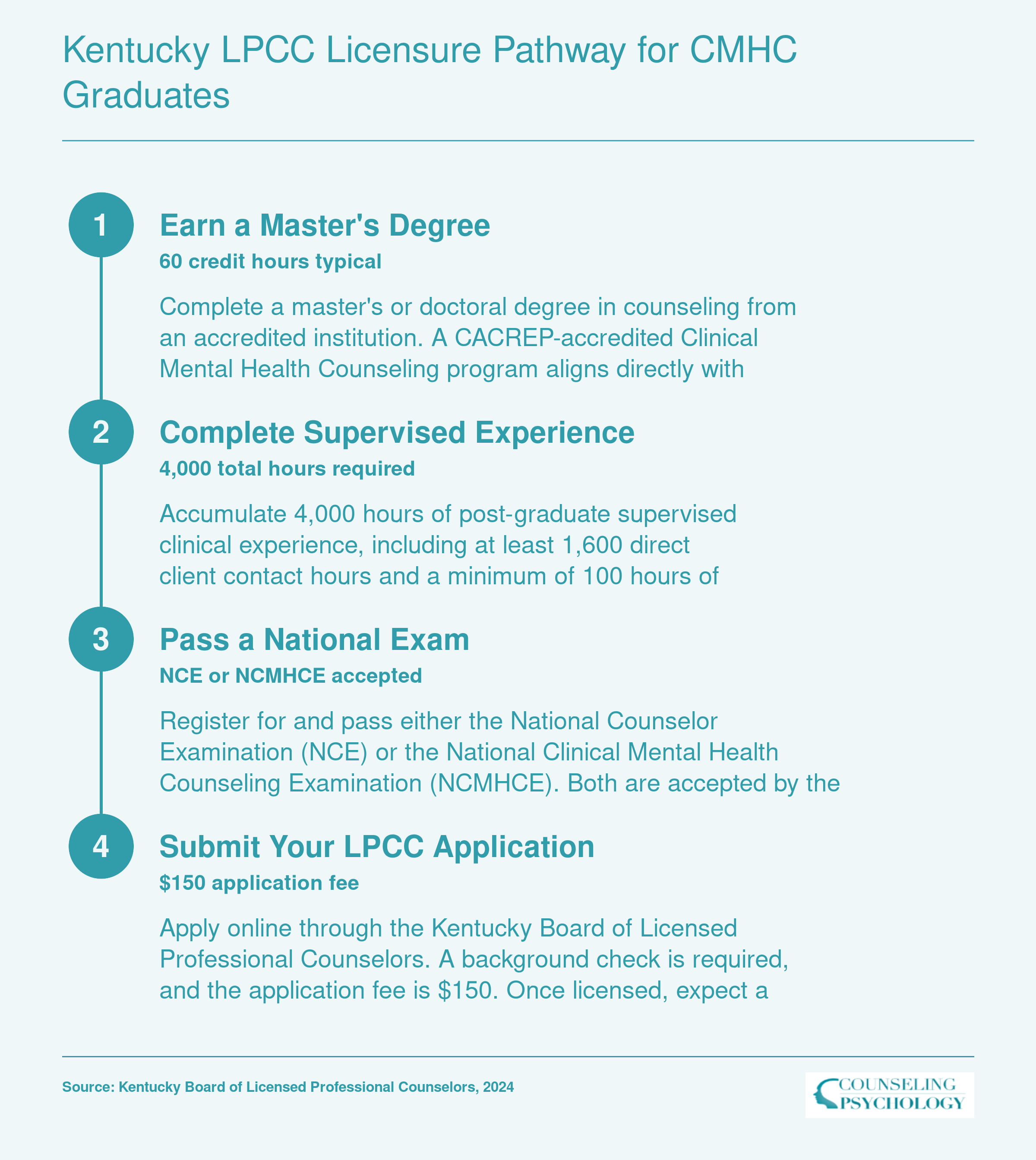
Earning your Licensed Professional Clinical Counselor (LPCC) credential in Kentucky follows a clear sequence after completing your master's degree. Kentucky is also a member of the Counseling Compact, which is currently in effect, giving LPCC holders streamlined options for practicing across state lines.
Admission Requirements & Application Tips
Admission requirements are the specific academic, professional, and personal qualifications you need to demonstrate before enrolling in a clinical mental health counseling master's program near Louisville. These standards help programs assess your readiness for graduate-level training and eventual licensure as a counselor. While each school sets its own criteria, you can take a systematic approach to gather and interpret them.
Where to Find Accurate Requirements
The most reliable source for admission requirements is the program's official website. Look for sections labeled "Admissions," "Prospective Students," or "How to Apply." If details are unclear, contact the graduate admissions office directly. For broader context on the profession, the American Counseling Association website and the Kentucky Board of Licensed Professional Counselors offer insight into the competencies and ethical standards expected of future counselors, which often shape what programs look for in applicants.
Typical Components to Verify
While specifics vary, most programs ask for similar materials. As you research, confirm the following for each Louisville-area school: - GPA minimums: Many programs set a minimum undergraduate GPA, often in the range of 2.7 to 3.0, but some offer provisional admission if you show strength elsewhere. - Test scores: Some programs require the GRE, while others have adopted test-optional policies. Check current requirements, as these can change. - Prerequisite coursework: A few programs expect undergraduate courses in psychology or statistics. Review the catalog to avoid surprises. - Application deadlines: Early deadlines are common for funding consideration. Mark these on your calendar. - Supplemental materials: Expect to submit a personal statement, letters of recommendation, and a resume or CV. Some may request a writing sample or an interview.
Strategies for a Strong Application
Even before you apply, you can strengthen your candidacy. Gain relevant experience through volunteer work, internships, or employment in mental health settings. This not only confirms your interest but also gives you material for your personal statement. When requesting recommendations, choose individuals who can speak to your academic ability and interpersonal skills. As you prepare your application materials, a well-crafted counselor resume can help you present your qualifications clearly. For career outcome data that can inform your program choice, consult the Bureau of Labor Statistics (BLS.gov) for national and state-level earnings and job outlook figures. If you are still exploring counseling schools across the country, comparing admission criteria from multiple institutions can sharpen your sense of what Louisville-area programs expect. Finally, attend virtual or in-person information sessions hosted by programs; these offer direct access to faculty and current students who can explain what makes a competitive application.
How to Choose the Right CMHC Program
Comparing a low-cost regional program against a pricier private university is not as simple as subtracting one tuition figure from another. The smartest approach weighs multiple factors that shape both your educational experience and your financial future after graduation.
Total Cost and Financial Aid
Sticker price tells only part of the story. Request net price estimates from each program you consider, factoring in scholarships, graduate assistantships, employer tuition reimbursement, and federal loans. Calculate what your monthly loan payment would look like under standard ten-year repayment, then compare that figure to early-career counselor salaries in Kentucky. A program costing a few thousand dollars more might actually leave you better off if it offers stronger aid packages or positions you for higher starting wages.
CACREP Accreditation and Licensure Alignment
Kentucky's LPCC licensure path runs smoothest when your degree comes from a CACREP-accredited program. Accredited curricula align with state board requirements, and many employers and clinical supervisors prefer candidates from recognized programs. Verify accreditation status before applying, and confirm that required coursework in diagnosis, treatment planning, and ethics matches what the Kentucky Board of Licensed Professional Counselors expects.
Format Flexibility and Practicum Partnerships
Your life circumstances matter. If you work full-time or have family obligations, hybrid or evening formats may be essential. Equally important are practicum and internship site partnerships. Programs with established relationships at Louisville-area clinics, hospitals, and community mental health centers can place you faster and connect you with supervisors who know the local job market.
Cohort Size and Faculty Support
Smaller cohorts and favorable faculty-to-student ratios translate into more individualized supervision, stronger letters of recommendation, and better preparation for the National Counselor Examination. Ask programs directly about their average cohort size and recent NCE pass rates. Students exploring masters in counseling Ohio programs, for example, will find that nearby states often publish these metrics publicly, giving you a useful benchmark.
Specialization Tracks
If you already know you want to focus on addiction, trauma, or child and adolescent counseling, look for programs offering elective concentrations or certificate add-ons in those areas. Specializations can differentiate you in the job market without requiring additional post-graduate training.
Your Next Step
Request information packets from two or three programs on your shortlist. Once you receive financial aid estimates, compare net costs side by side. Attend a virtual open house or schedule a campus visit to speak with current students and faculty. That firsthand perspective often reveals fit factors no brochure can convey.
Frequently Asked Questions About CMHC Programs in Kentucky
Below are answers to the questions prospective students ask most often about clinical mental health counseling programs in the Louisville area. Where possible, the figures reference data discussed elsewhere in this article.