
What you’ll learn in this article…
- The University of Colorado Denver anchors Denver's in-state ABA options with median graduate debt around $20,500.
- Roughly 6,670 behavior analysts work in the Denver metro area, earning a mean annual wage of $59,100.
- Colorado lacks a separate state licensure for behavior analysts, so BACB certification is the primary credential.
- Most candidates complete the enrollment to BCBA certification timeline in two to three years.
Demand for Board Certified Behavior Analysts in metro Denver has climbed alongside Colorado's expansion of school-based services, early intervention programs, and autism therapy clinics, with roughly 6,670 behavior analysts employed in the Denver-Aurora-Lakewood area as of 2024 BLS data. Mean wages sit at $59,100, fractionally below the national figure, while graduate tuition for BACB-verified coursework varies widely between in-state public options and out-of-state online programs.
That spread creates the central tension for Colorado applicants: the most affordable Verified Course Sequence pathway runs through a single in-state institution, but flexible online programs from outside Colorado often fit working schedules better. Students exploring related Denver-area graduate options, such as master's in counseling in Denver, will find a similarly tight local market. Layered on top is the BACB's evolving fieldwork standard and Colorado's reliance on national certification rather than a separate state license.
Best ABA Programs Near Denver: Our Rankings
The Denver metro area offers a focused but practical set of options for students pursuing Applied Behavior Analysis training. The University of Colorado Denver/Anschutz Medical Campus stands out as the primary in-state institution with BACB-verified ABA coursework at both the master's and graduate certificate levels. Below, we break down what each program offers so you can find the right fit for your career goals and schedule.
- Program accreditation and BACB alignment
- Tuition and institutional net price
- Graduation and retention indicators
- Practicum and fieldwork structure
- Exam preparation and pass rates
- Internal program database
- College Scorecard graduate earnings — collegescorecard.ed.gov
- NCES-IPEDS federal institutional data — nces.ed.gov
- Independent program research

University of Colorado Denver/Anschutz Medical Campus
The University of Colorado Denver/Anschutz Medical Campus is a public research university serving a large, diverse student body in the heart of Denver. With a 17:1 student-to-faculty ratio and an institution-wide net price of roughly $11,900, it provides accessible graduate-level ABA training through its School of Education and Human Development. The university reported a 2024 first-time BCBA exam pass rate of 57% for its ABA master's concentration, and its coursework has been updated to align with the BACB 5th Edition Task List. Median earnings for graduates across the institution reach approximately $64,270 at the ten-year mark, though that figure reflects all programs, not ABA specifically.
- Fully online format with required weekly Zoom sessions
- 30-credit curriculum designed for 21-month completion
- Combines coursework with three 1-credit practicum courses
- Prepares graduates to sit for the BCBA certification exam
- Coursework aligned with the BACB 5th Edition Task List
- In-state tuition approximately $9,298; out-of-state roughly $27,154
- Term-based admission deadlines: April 1, July 1, November 1
- Requires a bachelor's degree, resume, two recommendation letters
- Fully online graduate certificate with weekly online meetings
- Seven sequential 3-credit courses covering ABA fundamentals
- Designed for professionals who already hold a graduate degree
- Prepares completers for the BCBA certification exam
- Minimum 3.0 GPA required; grade of B- or better in each course
- Ideal entry point for career changers with an existing master's degree
- Ethical practices and evidence-based strategies emphasized
Master of Arts in Special Education, Applied Behavior Analysis Concentration — Online
Graduate Certificate in Applied Behavior Analysis — Online
How We Ranked These ABA Programs
Choosing between an affordable program close to home and a nationally recognized degree with flexible delivery can feel like betting on two futures at once. To help you weigh those tradeoffs, we built a ranking framework that balances four pillars: curriculum alignment with the Behavior Analyst Certification Board (BACB) Verified Course Sequence, tuition affordability, institution-wide graduation outcomes, and program format flexibility.
BACB-Aligned Course Sequence Coverage
Every program in this guide offers coursework approved by the BACB under either the Verified Course Sequence (VCS) or a closely aligned graduate curriculum in applied behavior analysis. We confirmed each institution's BACB approval status and the breadth of its course offerings. Single-certificate programs received lower weight than full master's degrees that embed certification prerequisites. If you are exploring certificate-only options, our overview of graduate certificate in applied behavior analysis programs provides additional context.
Tuition Affordability and Net Price
We reviewed both published tuition rates and institution-wide net price data from the College Scorecard. It is important to understand that net price figures reflect the average cost after aid for all undergraduates at a university, not ABA graduate students specifically. Graduate aid packages differ, but these numbers provide a comparative baseline for institutional affordability.
Institution-Wide Graduation Rates
Graduation rates published by the Integrated Postsecondary Education Data System (IPEDS) and the College Scorecard are institution-level metrics, not program-specific. They capture the percentage of first-time, full-time degree-seeking undergraduates who complete within 150 percent of normal time. While not a direct measure of ABA program completion, they signal institutional support infrastructure and student success culture.
Program Format Flexibility
We favored programs offering evening, weekend, or fully online pathways that accommodate working professionals and parents. For a broader look at remote options, see our roundup of online applied behavior analysis programs. Hybrid models that blend asynchronous coursework with in-person practica earned the highest marks for flexibility.
What We Could Not Include: BCBA Exam Pass Rates
Most universities do not publish BCBA exam pass rates, and the BACB does not release school-level performance data. As a result, pass rates are not part of our ranking formula. We strongly encourage you to ask admissions offices directly for their cohort's most recent pass rates and first-attempt success percentages. Transparency on this metric is a hallmark of a confident program.
Colorado ABA Program Comparison Table
The table below puts key cost, outcome, and format details for ABA programs near Denver side by side. Because only one program in the Denver metro area appeared in our vetted dataset, we present its full profile here. Note that institution-level metrics such as graduation rate and median earnings 10 years after entry reflect all undergraduate students at the university, not the ABA program specifically. Program-level earnings and debt figures for this concentration are not yet available through federal reporting.
| Program Detail | University of Colorado Denver / Anschutz Medical Campus |
|---|---|
| Degree Level | Master's (MA in Special Education, Applied Behavior Analysis concentration) |
| Format | Fully online (weekly Zoom meetings required) |
| Credits Required | 30 |
| Recommended Completion Time | 21 months |
| In-State Tuition | $9,298/yr (IPEDS) |
| Out-of-State Tuition | $27,154/yr (IPEDS) |
| Average Net Price (institution level) | $11,900 (College Scorecard) |
| Institution Graduation Rate* | 46.1% (IPEDS) |
| Median Graduate Debt (institution level) | $20,500 (College Scorecard) |
| Median Earnings 10 Yrs After Entry (institution level)* | $64,270 (College Scorecard) |
| Median Earnings 1 Yr After Program Completion | Not yet reported |
| Median Debt at Program Completion | Not yet reported |
| Estimated Monthly 10-Year Loan Payment | Not yet reported |
| Admission Rate | 74.7% |
| Student-to-Faculty Ratio | 17:1 |
| BCBA Exam Preparation | Yes |
Questions to Ask Yourself
BCBA Licensure Pathway in Colorado
Becoming a Board Certified Behavior Analyst in Colorado means earning your certification through the Behavior Analyst Certification Board (BACB), the national credentialing body that sets education, supervised experience, and examination standards. Unlike many states, Colorado does not currently have a state-level behavior analyst license issued by a government agency.1 There is no Colorado licensing board, no state licensing statute, and no DORA (Department of Regulatory Agencies) credential specific to behavior analysts as of 2026.2 A 2020 state sunrise review actually recommended against creating a separate license at that time.3
That said, BACB certification is effectively required to practice in any meaningful professional capacity in Colorado. Medicaid reimbursement for ABA services requires BACB certification, and employers across the Denver metro area treat the BCBA credential as the baseline qualification for supervisory and clinical roles.2
What the BACB Requires
The path to BCBA certification requirements runs through the following steps:
- Degree: A master's degree (or higher) from a regionally accredited institution, with coursework completed through a BACB-approved Verified Course Sequence (VCS).
- Supervised fieldwork: Either 1,500 hours under the Concentrated Supervised Fieldwork model or 2,000 hours under the Standard Supervised Fieldwork model, both completed under a qualified supervisor.
- Examination: Passing the BACB's national certification exam.
- Application fee: The BACB charges $245 to apply for initial certification, with a $215 recertification fee for ongoing renewal.2
All of the programs featured in this guide offer BACB-approved VCS coursework, which is a non-negotiable program feature to look for. If a program's course sequence is not on the BACB's VCS registry, its graduates cannot sit for the exam.
Typical Timeline in Colorado
For most students entering a master's-level ABA program, the path from enrollment to BCBA certification takes roughly two to three years. A full-time student typically completes coursework in 18 to 24 months, with supervised fieldwork hours accumulated concurrently during practicum placements. Once the degree is conferred and hours are logged, the exam application and scheduling process adds another few weeks to months depending on testing availability.
Part-time students or those completing fieldwork outside of embedded practicum placements may take closer to three years or slightly longer.
Colorado-Specific Considerations
Because there is no state licensing layer to navigate, Colorado students deal primarily with the BACB's national standards rather than a separate state application process.1 This simplifies the pathway compared to states where you must first obtain BCBA certification and then apply for a separate state license.
One practical nuance worth noting: Colorado's HB20-1058 allows BCBAs to provide medically necessary behavioral health services in school settings, which has expanded school-based employment opportunities across the Denver area.2 If school-based practice interests you, this legislation has made Colorado a relatively active market for that work.
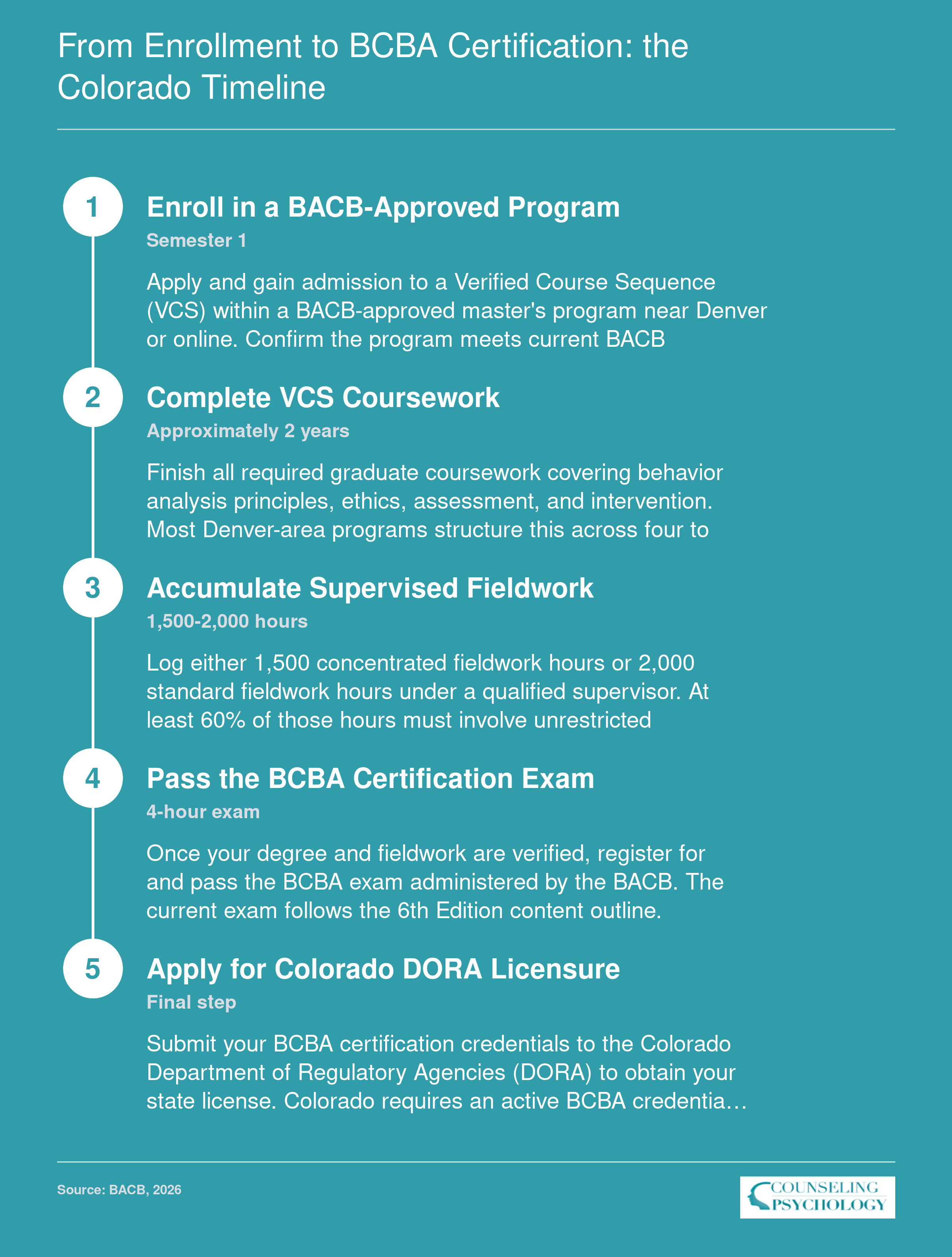
From Enrollment to BCBA Certification: The Colorado Timeline
The path from your first day of graduate coursework to a fully licensed BCBA in Colorado follows a predictable sequence, but the total timeline depends on whether you complete fieldwork alongside your courses or afterward. Most candidates reach the finish line in roughly two to three years.
Online vs. On-Campus ABA Programs in Colorado
Colorado students weighing ABA program formats face real trade-offs between convenience and connection. The Denver metro area has a limited number of on-campus options, which means many students end up choosing online or hybrid programs, sometimes from out-of-state institutions with BACB-approved course sequences. Understanding the practical differences helps you pick the format that fits your life and your career goals.
Pros
- Online programs offer scheduling flexibility that lets working RBTs and other professionals complete coursework around existing jobs.
- Students in online formats can access BACB-approved programs nationwide, expanding choices well beyond the handful of Colorado-based options.
- Total cost is often lower online because you eliminate commuting, parking, and relocation expenses; for example, University of Colorado Denver offers its ABA concentration fully online.
- On-campus programs typically come with established practicum pipelines connecting students to Denver-area clinics, school districts, and hospitals.
- In-person formats provide direct faculty mentorship, spontaneous peer collaboration, and stronger professional networking from day one.
- Hybrid models split the difference: University of Colorado Denver requires weekly Zoom sessions, blending online convenience with real-time interaction.
Cons
- Online students must independently arrange local practicum and fieldwork placements, which can be time-consuming without institutional support.
- Remote learners often miss out on organic peer networking and the study-group culture that on-campus cohorts build naturally.
- On-campus programs lock you into fixed class schedules, making it harder to maintain full-time employment during your degree.
- Fewer ABA-specific on-campus options exist in the Denver metro, so commuting to a physical campus may still mean a long drive or relocation.
- In-state on-campus tuition, combined with housing and transportation costs, can push total program expenses significantly higher than comparable online alternatives.
Career Outlook & Top Employers for BCBAs in Denver
Denver's behavior analysis job market is one of the strongest in the Mountain West, with roughly 6,670 behavior analysts employed in the Denver-Aurora-Lakewood metro area alone as of 2024.
What BCBAs Earn in the Denver Metro
According to BLS data, the median annual wage for behavior analysts in the Denver-Aurora-Lakewood MSA was approximately $59,100 in 2024. Statewide Colorado figures provide additional context: the 25th percentile sat near $47,750 and the 75th percentile reached about $78,350. Those numbers cover all behavior analysts, not just board-certified practitioners. Industry salary surveys suggest that credentialed BCBAs in the Denver metro typically earn higher than the broader occupational median, with reported mean salaries around $89,800 in Denver and $91,100 in Aurora.23 Compensation varies by setting, caseload size, and years of experience, so treat any single figure as a midpoint rather than a guarantee. If you are still weighing whether this credential is the right investment, our breakdown of whether ABA is a good career covers the long-term outlook in more detail.
Who Is Hiring in Colorado
Demand spans several employer types, each offering a distinct work environment:
- ABA therapy providers: Clinics such as Firefly Autism (headquartered in Denver) and Soar Autism Center operate across the metro and regularly post BCBA openings. Smaller boutique practices are also expanding as insurance reimbursement for ABA services grows.
- School districts: Denver Public Schools, Cherry Creek School District, and Jefferson County Public Schools employ behavior analysts to support students with autism spectrum disorder and other developmental needs.
- Hospitals and healthcare systems: Children's Hospital Colorado and UCHealth incorporate BCBAs into multidisciplinary care teams, particularly in pediatric behavioral health.
- Early intervention programs: Colorado's Early Intervention program, administered through Community Centered Boards, funds ABA-informed services for children from birth to age three, creating steady entry-level demand.
The Practicum-to-Job Pipeline
One of the most practical career decisions you will make during your ABA program is where you complete fieldwork. A significant share of new BCBAs in the Denver area accept positions at the same organization where they completed their practicum or supervised experience hours. Supervisors already know your clinical skills, and you already understand the agency's protocols. Treat your practicum placement as a 1,500-plus-hour working interview, not just a graduation requirement. If a particular employer or population interests you, prioritize programs that have established practicum agreements with those sites.
Growth Drivers in Colorado
Nationally, the BLS projects strong growth for behavior analysts over the coming decade. Colorado-specific factors amplify that demand. The state's autism prevalence data continues to trend upward, mirroring national CDC estimates. Colorado's insurance mandate, which requires commercial plans to cover ABA therapy for autism spectrum disorder, sustains a reliable funding stream that keeps clinics hiring. Population growth along the Front Range adds further pressure. School districts expanding their special education departments and early intervention caseloads compound the need for certified professionals.
All of these forces make Denver a market where well-prepared graduates can often field multiple offers, particularly if they built strong practicum relationships and hold their BCBA credential at the time of graduation.
BCBA Salary Snapshot: Denver Metro Area
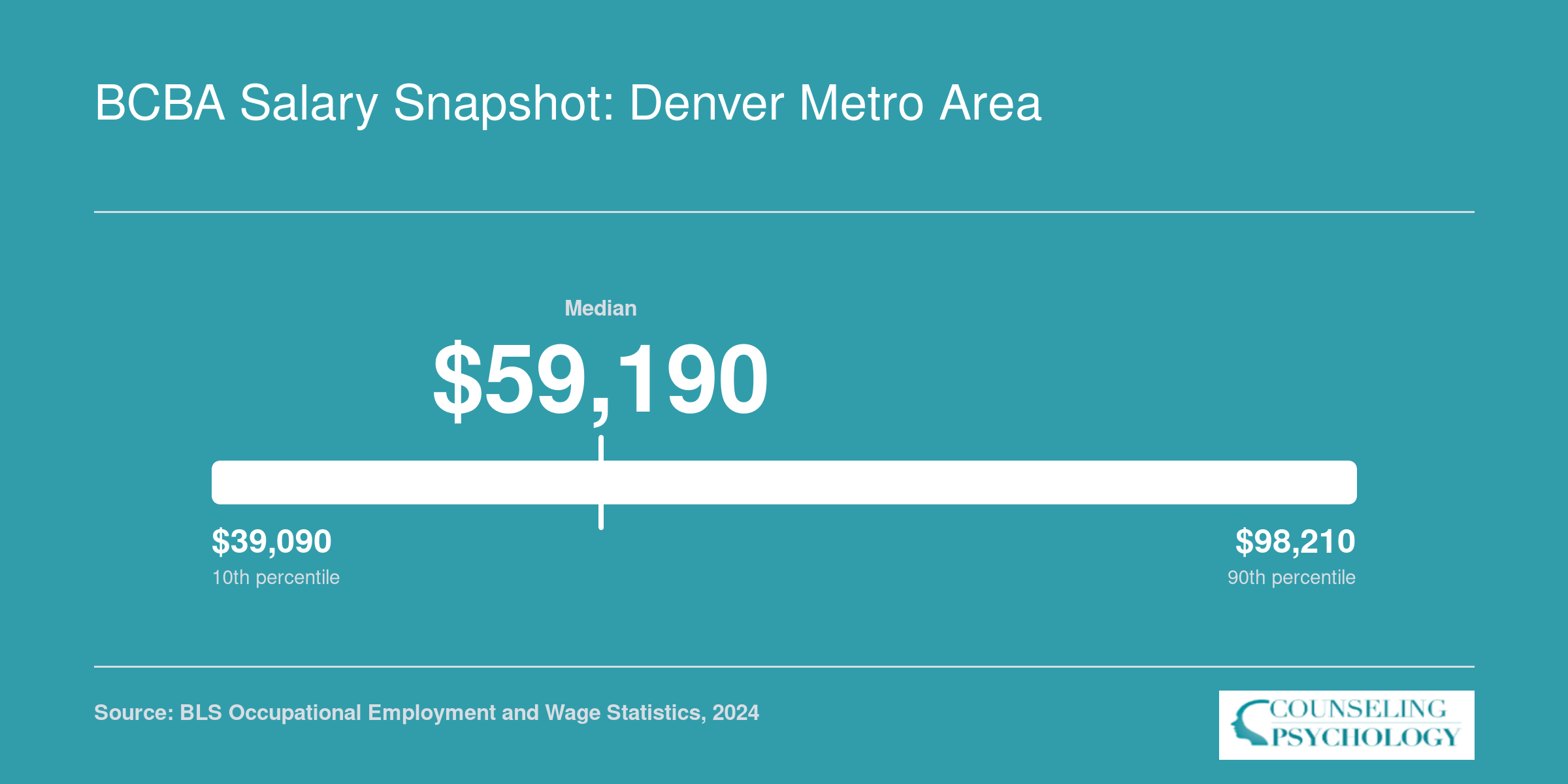
How do behavior analyst salaries stack up in the Denver metro? BLS data shows a mean annual wage of $59,100 for behavior analysts in the Denver-Aurora-Lakewood MSA, which sits just below the national median of $59,190. While Denver-specific percentile breakdowns are not published, the national wage distribution below gives you a clear picture of earning potential across experience levels. Early-career BCBAs nationally start near $39,090, while top earners surpass $98,000.
Financial Aid & Tuition Tips for Colorado ABA Students
Median graduate debt for ABA students at University of Colorado Denver, the state's most affordable BCBA-track program, sits at $20,500, offering a concrete benchmark for expected borrowing in Colorado. Graduate students pursuing applied behavior analysis credentials should understand both state-specific and federal funding pathways, alongside employer-sponsored tuition assistance that has become increasingly common in the ABA therapy industry.
Colorado State Grants and Scholarships
The Colorado Opportunity Scholarship Initiative (COSI), administered by the Colorado Department of Higher Education, targets undergraduate students pursuing their first credential and is generally not available to graduate-level ABA candidates.12 COSI awards, distributed through local institution partners, range from $1,500 to $4,500 per year at institutions like Colorado Mountain College and focus on Colorado residents attending public colleges, making the program inaccessible to most master's-level behavior analysis students.3 Graduate students should instead explore departmental scholarships, graduate assistantships, and research positions within their chosen program, which often provide tuition waivers or stipends in exchange for teaching or research duties.
Employer Tuition Reimbursement in Colorado's ABA Market
Many Colorado-based ABA therapy providers offer tuition reimbursement programs for registered behavior technicians (RBTs) advancing toward BCBA credentials. Companies including Trumpet Behavioral Health and Firefly Autism have historically provided tuition assistance packages ranging from partial course reimbursement to full coverage of approved BCBA coursework for employees who commit to continued employment post-certification. These arrangements typically require employees to maintain full-time or part-time status while enrolled and may include service agreements specifying one to three years of post-graduation employment. Students already working in ABA settings should request details about tuition benefits during hiring negotiations or annual reviews, as these packages can offset the majority of graduate program costs.
Federal Loan Options and Forgiveness Programs
Graduate ABA students can access Federal Direct Unsubsidized Loans (up to $20,500 annually) and Grad PLUS loans (covering the full cost of attendance minus other aid) through the Free Application for Federal Student Aid (FAFSA). Income-driven repayment plans, including Pay As You Earn (PAYE) and Revised Pay As You Earn (REPAYE), cap monthly payments at 10 percent of discretionary income and can provide a manageable path for BCBAs entering lower-paying nonprofit or school district roles. Public Service Loan Forgiveness (PSLF) offers complete discharge of remaining federal loan balances after 120 qualifying payments for BCBAs employed full-time by public school districts, county agencies, or qualifying nonprofit ABA providers. Students planning careers in public schools or early intervention programs should prioritize federal loans over private financing to preserve PSLF eligibility and carefully track employment certification throughout their repayment period.
Many Colorado ABA employers offer tuition reimbursement or stipends to practicum students who commit to post-graduation employment. Before selecting a fieldwork site, ask supervisors and HR departments about these arrangements: they can reduce your out-of-pocket costs and secure a job before you graduate.
How to Choose the Right ABA Program in Denver
Which factors should weigh most heavily when selecting an ABA program in the Denver metro area? Your decision should rest on five concrete pillars: BACB Verified Course Sequence (VCS) approval, total cost of attendance, format flexibility, practicum access within Colorado, and verifiable program outcomes. Not every program labeled as applied behavior analysis will prepare you to sit for the Board Certified Behavior Analyst exam, making careful vetting essential.
Verify BACB Approved Course Sequence Status
Start by confirming that your shortlisted programs hold active BACB VCS approval. The Behavior Analyst Certification Board maintains a public registry of approved course sequences, and only graduates of these sequences meet the coursework requirement for BCBA certification. Some programs offer ABA content without VCS approval, preparing students for roles such as behavior technician or program coordinator but not for independent practice as a BCBA. If you are still weighing whether the field is the right fit, our overview on whether ABA is a good major can help clarify the career landscape. Before submitting an application, cross-reference each program against the BACB directory to confirm its current approval status and ensure the sequence covers all required content areas.
Weigh Total Cost Against Format and Practicum Support
Tuition is only part of the financial picture. Calculate total cost of attendance by adding fees, required materials, and the opportunity cost of time away from work if you enroll full-time on campus. Online and hybrid formats often reduce indirect costs such as housing and commuting, but verify that these formats include robust practicum placement support in the Denver area. Programs should connect you with BCBA supervisors and fieldwork sites in Colorado rather than leaving placement entirely to the student. Contact admissions or program coordinators directly to ask how many practicum sites are available in the metro area, average wait times for placement, and whether the program has partnerships with local ABA agencies, school districts, or clinics.
Request Outcome Data Before You Apply
Program websites rarely publish BCBA exam pass rates or average time to degree, but admissions staff can often provide these figures upon request. Ask each program for first-time pass rates on the BCBA exam over the past two to three years, median time from enrollment to degree conferral, and the percentage of graduates who secure BCBA employment within six months. Programs that decline to share outcome data may lack the infrastructure to track alumni success. Use the comparison table and ranked list earlier in this guide as starting points to narrow your pool, then request detailed outcome metrics from your top three choices to make a final, evidence-based decision.
Common Questions About ABA Programs in Denver
Prospective ABA students in the Denver area tend to ask the same handful of questions before committing to a program. The answers below draw on data points and details covered throughout this article, so you can use them as a quick reference while you finalize your decision.