
What you’ll learn in this article…
- UNM and NMSU offer the only regionally accredited graduate counseling certificates serving the Albuquerque area.
- New Mexico requires a master's degree for LPC or LPCC licensure, so a certificate alone will not qualify you.
- BLS 2024 data for New Mexico shows school counselors earning a median around $54,000 and mental health counselors near $39,000.
- Local programs include practicum placements at Albuquerque child-serving agencies that count toward state pre-licensure hours.
New Mexico's behavioral health workforce gap means school districts and community clinics compete for counselors with child-specific training. A graduate certificate in counseling allows professionals to add that expertise without repeating a full master's program. In Albuquerque, UNM's Advanced Graduate Certificate in Counseling provides a school counseling track for those already on a licensure path; downstate, NMSU's Marriage & Family Therapy certificate emphasizes culturally competent practice across age groups.
Both certificates serve as supplements to, not substitutes for, the qualifying degree New Mexico's licensing boards require. Pair one with a master's and you shorten the pivot into youth-focused counseling roles.
Top Graduate Certificate in Counseling Programs in Albuquerque, Ranked
Albuquerque's counseling certificate landscape is compact but purposeful. The two universities below serve distinct needs: one sits in the heart of the city with a hybrid schedule built for working professionals, while the other anchors southern New Mexico and trains culturally responsive marriage and family therapists. Both are Hispanic-Serving Institutions, a meaningful detail in a metro area where nearly half the population identifies as Hispanic or Latino. Program-level earnings data is not yet available for either certificate, so the institution-wide figures below offer broader context.
- Program relevance to local licensure
- Institutional graduation and retention rates
- Net price and median debt
- Clinical training and practicum access
- Cultural competency and community fit
- College Scorecard graduate earnings — collegescorecard.ed.gov
- NCES-IPEDS federal institutional data — nces.ed.gov
- Independent program research
- Internal program database

University of New Mexico
Located in Albuquerque itself, UNM's Advanced Graduate Certificate in Counseling is purpose-built for practitioners who already hold (or are completing) a CACREP-accredited master's degree and want to add a second specialization. The 12-credit curriculum runs in a hybrid format with evening intensives on campus and online coursework, a schedule that respects the realities of full-time employment. Supervised practicum hours route through local clinical networks, giving students direct exposure to Albuquerque's diverse client populations.
- 12-credit program designed for CACREP master's holders
- School Counseling concentration meets NM licensure standards
- Hybrid delivery: evening intensives plus online coursework
- Minimum 3.0 GPA required with no grade below B-
- In-state tuition roughly $9,860 per year (institutional rate)
- Campus-based practicum connected to local clinical sites
- Clinical mental health focus with family counseling coursework
- Includes supervised internship opportunities in Albuquerque
- Prepares graduates for New Mexico clinical licensure
- Cohort-based format with potential scholarship opportunities
- Hybrid schedule accommodates working professionals
- Designated Hispanic-Serving Institution with diverse cohorts
Advanced Graduate Certificate in Counseling, School Counseling Specialization — On-Campus
Advanced Graduate Certificate in Counseling, Mental Health Counseling Specialization — On-Campus

New Mexico State University
NMSU's Marriage and Family Therapy program trains culturally competent clinicians to serve New Mexico's diverse communities. Although the main campus is in Las Cruces, the program's social-justice orientation and rigorous clinical sequence make it a strong option for students willing to commute or relocate. Schools offering this program have a graduation rate of about 55%, and the institution-wide median debt for graduates sits at roughly $17,095, one of the lower figures among public research universities in the state.
- Culturally competent training with diverse population focus
- Campus-based program at NMSU's Las Cruces location
- In-state tuition approximately $6,605; out-of-state $19,448
- Net price after aid averages around $8,889
- Application deadline February 1 each year
- Requires three letters of reference and psychometric results
- Oral examination component as part of completion
- Part of the Family and Consumer Sciences department
Marriage and Family Therapy (MFT) Graduate Certificate — On-Campus
Child Counseling Focus: Specializations and Course Sequences in Albuquerque
Availability of Child-Focused Certificates in New Mexico
Standalone graduate certificates in child counseling are rare in New Mexico, but several programs offer specialized training through certificate sequences or degree emphases that prepare you for youth-focused clinical work. In Albuquerque itself, no university offers a freestanding graduate certificate in child counseling. Instead, specializations are embedded within broader programs, such as the University of New Mexico's M.A. in Counseling with a School Counseling emphasis.1 This full master's degree integrates child and adolescent content through courses like Human Growth and Development, Assessment and Testing, and School Counseling, paired with a K-12 practicum and internship. For those seeking a certificate rather than a full degree, options elsewhere in the state fill the gap.
Standalone Certificates with a Child Focus
Two notable graduate certificates are available outside Albuquerque. Western New Mexico University (WNMU), in Silver City, offers a 12-credit Infant and Early Childhood Mental Health Graduate Certificate.2 Its coursework supports the requirements to become a Registered Play Therapist and can lead to endorsements as an Infant Family Specialist, Infant Mental Health Specialist, or Infant Mental Health Mentor. The curriculum blends counseling and early childhood education, with courses covering attachment theory, developmental psychology, and play-based interventions. Southwestern College, in Santa Fe, provides a Children's Mental Health Certificate, a 96-hour program totaling $2,250.3 The required course, Attachment: The Heart of Well-Being in Children, anchors the sequence, while five electives covering topics from prevalent behavioral disorders to gender and sexual identity development allow you to tailor the training to your clinical interests. Both certificates are designed for working professionals who can commute or complete hybrid components.
Course Sequence and Skill Building
Whether you pursue a standalone certificate or a specialization within a master's program, the typical child-focused curriculum follows a deliberate progression. You start with foundational theory in human development and attachment, then move to assessment techniques specific to children and adolescents. Intervention courses introduce play therapy, trauma-informed care, and evidence-based practices. A practicum or clinical experience solidifies skills in real-world settings. This scaffolded sequence ensures that you can diagnose, plan treatment, and engage young clients ethically and effectively. Those interested in childhood trauma counseling may find that this progressive training model aligns especially well with their goals.
Comparing Paths: General Counseling vs. Specialized Tracks
A general counseling certificate that includes elective child courses might suffice if your goal is broad clinical practice with some youth clients. However, a dedicated child-focused certificate or emphasis provides deeper competence in developmental psychopathology, family systems, and play-based interventions. This distinction matters for licensure and employment: positions in schools, community mental health agencies, and pediatric settings often require documented training in child and adolescent therapy. If you plan to become a child counselor in New Mexico, a specialized program aligns your credentials with the state's licensure requirements for clinical mental health counseling or school counseling, which expect supervised experience with the relevant age group. Additionally, free non-credit resources such as the Child and Adolescent Mental Health ECHO program at UNM offer ongoing telementoring for child-facing providers.4
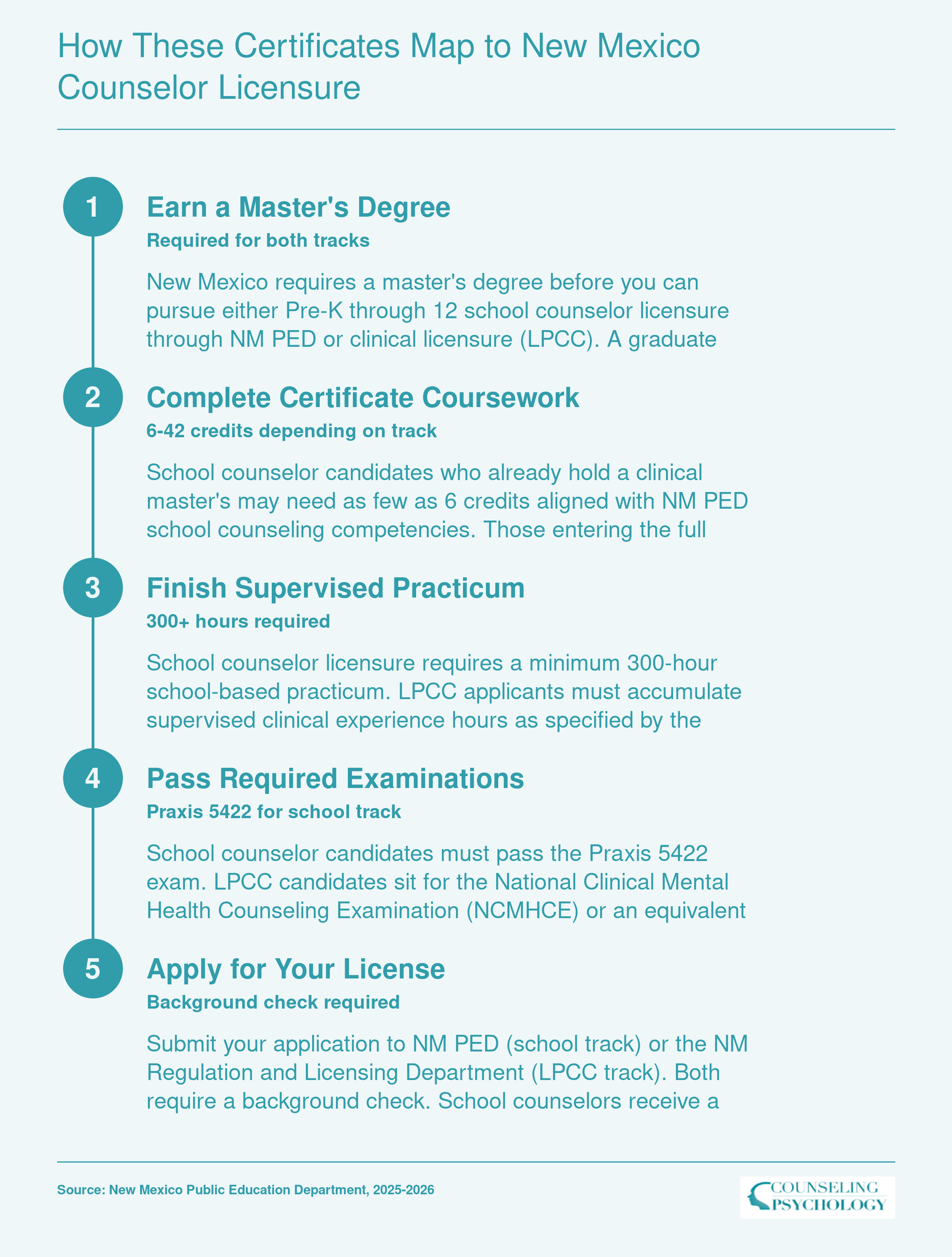
How These Certificates Map to New Mexico Counselor Licensure
A graduate certificate in counseling does not replace a master's degree in New Mexico. For both school counselor and clinical counselor tracks, the state treats the certificate as a supplement that fills specific coursework or competency gaps after you already hold a qualifying master's. Here is how the pathway unfolds for each track.
Questions to Ask Yourself
Tuition, Financial Aid, and ROI Comparison
The table below compares key cost and return metrics for the two graduate certificate in counseling programs ranked in Albuquerque and the surrounding region. A few important notes: the net price figures shown are institution-wide averages drawn from federal data and reflect what typical undergraduates pay after grants and scholarships. Actual out-of-pocket costs for a graduate certificate may differ, sometimes significantly, because graduate students often receive different aid packages. Program-level earnings and debt data are not yet available for these specific certificates, so the earnings and debt columns reflect institution-wide medians reported by the federal College Scorecard.
| School | In-State Tuition | Out-of-State Tuition | Avg. Net Price (Institution-Wide) | Median Graduate Debt | 10-Year Median Earnings | ROI Ratio |
|---|---|---|---|---|---|---|
| New Mexico State University (Las Cruces) | $6,605 | $19,448 | $8,889 | $17,095 | $39,067 | 2.29 |
| University of New Mexico (Albuquerque) | $9,860 | $28,734 | $15,489 | $18,450 | $44,792 | 2.43 |
Related Articles
Child-Focused Practicum Sites in Albuquerque
Albuquerque's counseling certificate programs connect students to a concentrated network of child-serving agencies and clinics where supervised clinical hours directly satisfy New Mexico's pre-licensure requirements. These practicum partnerships range from school-based placements to inpatient behavioral health units, each offering distinct exposure to pediatric populations and trauma-informed practice models.
School-Based and Educational Settings
Albuquerque Public Schools remains the largest practicum partner for students pursuing school counseling credentials, offering placements across elementary, middle, and high schools. Trainees work alongside school counselors on IEP meetings, behavioral intervention planning, and crisis response teams. Supervision typically follows a hybrid model: on-site school counselors provide direct observation and case consultation, while university faculty lead weekly group seminars that integrate developmental theory and ethics. These hours count toward both New Mexico Public Education Department licensure and the supervised experience required for Licensed Professional Clinical Counselor (LPCC) or Licensed Professional Counselor (LPC) pathways. Students exploring best counseling graduate programs in New Mexico will find that most accredited options maintain active agreements with APS sites.
Pediatric Behavioral Health and Crisis Services
The UNM Children's Psychiatric Center serves youth ages two to eighteen and provides inpatient and specialty behavioral health exposure for graduate trainees.1 Students observe intake assessments, participate in multidisciplinary treatment planning, and deliver short-term individual or group interventions under licensed psychologists and clinical counselors. This setting is particularly valuable for students interested in severe psychopathology, psychopharmacology coordination, and intensive family therapy. Supervision is direct and scheduled in real time, with supervisors co-signing session notes and treatment plans.
The New Mexico Children, Youth and Families Department (CYFD) Behavioral Health Services division places students in community-based case management roles and crisis access hubs.2 Trainees gain system-level perspective on child welfare coordination, mandated reporting workflows, and interagency collaboration. Supervision is often indirect, with weekly case reviews rather than live observation, but hours still qualify for LPC licensure provided the site supervisor holds an active New Mexico credential. Additionally, UNM's Project ECHO Child and Adolescent Mental Health program offers telementoring in assessment, diagnosis, psychotherapy, and crisis prevention, giving practicum students supplemental training alongside their direct client hours.3
Community Therapy and Advocacy Centers
Outpatient clinics such as The Treehouse4, CTC Mental Health Services5, Small Steps Child Counseling6, and The Community Lighthouse7 accept certificate students for family and individual therapy practicums. These sites emphasize play therapy, attachment-based models, and culturally responsive practice with diverse Albuquerque families. Students interested in earning a family therapy certificate may find these community placements especially aligned with their coursework. Pegasus Legal Services for Children and local child advocacy centers (Carehouse affiliates) offer trauma-focused placements centered on abuse and neglect response, forensic interviewing, and court liaison work. Students at advocacy centers typically work within multidisciplinary teams that include law enforcement, social workers, and pediatric nurses.
Placement Models and Student Responsibility
Most University of New Mexico certificate programs maintain formal affiliation agreements with these sites and assign placements based on student interest and availability. Smaller or online certificate programs may require students to identify and vet their own practicum sites, then submit affiliation paperwork for program approval. In either case, students must confirm that their site supervisor holds an independently licensed credential recognized by the New Mexico Counseling and Therapy Practice Board and that the supervision plan meets the board's minimum direct-contact hour ratios.
Online National Certificates vs. Local Albuquerque Programs for NM Licensure
The national marketplace for online counseling certificates is more crowded than ever, but a credential that travels well on a résumé may stall at New Mexico's licensure borders. While virtual certificates promise flexibility, they often skip the pieces that make a local program a direct path to practice.
Licensure Alignment with New Mexico Requirements
Local NM programs are built around the state's licensing blueprint. For Licensed Professional Clinical Counselor (LPCC) eligibility, the New Mexico Counseling & Therapy Practice Board requires 48 semester hours of graduate coursework, including 9 semester hours of supervised practicum. Albuquerque-area certificate sequences typically deliver 48 to 60 credits and a structured 300-hour practicum, enough to satisfy both the credit and fieldwork thresholds.2 By contrast, nationally marketed online certificates commonly range from just 12 to 24 semester hours, a fraction of the LPCC minimum. Even when an online program holds CACREP accreditation, that alone does not guarantee its credits will be accepted if the total falls short or if specific state content areas are absent.
For school counseling, the New Mexico Public Education Department (PED) expects 36 to 42 semester hours and a passing score on the Praxis School Counselor exam (test 5422).3 Local programs have secured explicit PED approval, while an out-of-state online certificate rarely carries automatic endorsement.3 Graduates may find themselves petitioning for an individual evaluation, and very often needing to take additional coursework on their own.
Practicum Access and Placement Support
A live practicum is not just a line item; it is the centerpiece of licensure readiness. Local Albuquerque programs maintain partnerships with clinics, schools, and mental health agencies, so students step into vetted placement sites with established supervision structures.2 Online national certificates, however, often treat the practicum as an optional or self-arranged component. If a program even includes a clinical component, it typically lacks boots-on-the-ground staff to secure a site in Albuquerque or verify that the experience meets New Mexico's hour and supervision standards. Without this infrastructure, an online student can lose months searching for a qualifying placement, sometimes never finding one that the board will accept.
Networking Within Albuquerque's Counseling Community
Licensure is not only about credits; it is about professional identity. Face-to-face cohorts, on-site residencies, and local faculty mentors plug students directly into the Albuquerque behavioral health network. Referrals for jobs, postgraduate supervision, and letter-of-recommendation relationships grow out of these daily interactions. An online-only certificate, even from a legitimate institution, rarely replicates that community scaffolding. For someone who intends to practice in New Mexico, missing that regional thread can mean starting from scratch after graduation.
Online Alternatives Worth Investigating
A handful of regionally accredited universities offer nationally available graduate certificates in counseling, including programs affiliated with Capella University or Walden University. These may be regionally accredited and CACREP-aligned, which adds credibility. Still, the core problem persists: no widely marketed national certificate is pre-approved to satisfy LPCC or PED requirements in New Mexico. A student considering such a route should map every course against the board's standards and confirm, in writing, that the university will support a New Mexico practicum. In most cases, stacking a short online certificate on top of an existing master's degree may fill a niche, but relying on it alone for initial licensure is a gamble that local programs are explicitly designed to avoid.
Admission Requirements and Application Tips
Securing admission to a counseling certificate program in Albuquerque requires more than meeting a posted GPA. It means matching your academic background to the specific credential you want. The requirements at leading area institutions like the University of New Mexico are not uniform across all certificates, so which path you qualify for depends heavily on the degree you already hold and your professional goals.
Prerequisites and Degree Requirements
Admission standards hinge on the certificate's target audience. For advanced clinical credentials such as the UNM Advanced Graduate Certificate in Counseling, you must already possess a master's degree in counseling or a closely related mental health field.1 A non-counseling graduate degree will not satisfy the prerequisite, and no option exists to take bridge coursework or gain conditional admission to make up the gap.2 The minimum undergraduate or graduate GPA is 3.0 for all certificate programs.2
By contrast, the Graduate Certificate in Substance Use and Behavioral Addictions Counseling only asks for a bachelor's degree, with no prior graduate work required.3 This makes it a viable entry point for career changers or professionals with bachelor's-level preparation who want to add specialized counseling knowledge, even if their undergraduate degree is in a different area. For the child counseling track you will most often need a counseling master's, so confirming your degree qualifies is the first concrete step. If your interest extends beyond Albuquerque, you may also want to explore child psychology certificate programs offered online for additional flexibility.
Application Timelines and Cohort Start Dates
Timelines differ. The advanced counseling certificate operates on a rolling admissions basis, meaning you can submit materials year-round and receive a decision shortly after your file is complete.2 The substance use certificate has firm deadlines: July 15 for a spring start and December 15 for a fall start.3 Neither program admits students every semester, so aim to have a complete application packet ready at least six to twelve months before your intended enrollment. Requesting transcripts, securing recommendations, and revising your statement on a deliberate timeline will save you from last-minute scrambling.
Documentation and Tips to Strengthen Your File
All programs require official transcripts, a current resume or CV, and a statement of purpose.1 Here are three practical moves to make your application stand out.
- Secure recommendations from clinical supervisors, not just professors. Supervisors who can describe your direct client work, ethical judgment, and readiness for advanced training carry more weight than academic references alone.
- Put child and adolescent counseling at the center of your statement of purpose. Even if the certificate is broader, clearly articulate how the credential will serve your goal of working with children and families. Reference concrete clinical experiences and show you understand the licensure landscape.
- Contact the program advisor early. A 15-minute call or email can clarify whether your background fits the prerequisite and whether any upcoming curriculum changes will affect your plan.
Bridge Options and Provisional Admission
Neither the advanced counseling certificate nor the substance use certificate currently offers bridge coursework or provisional admission for applicants who do not meet the prerequisite degree.23 If you hold a non-counseling master's, the only route into the advanced certificate is to first complete a qualifying counseling master's. For the substance use certificate, however, a bachelor's is sufficient, so applicants from other fields have a clear path in.
What Child Counseling Certificate Graduates Earn in New Mexico
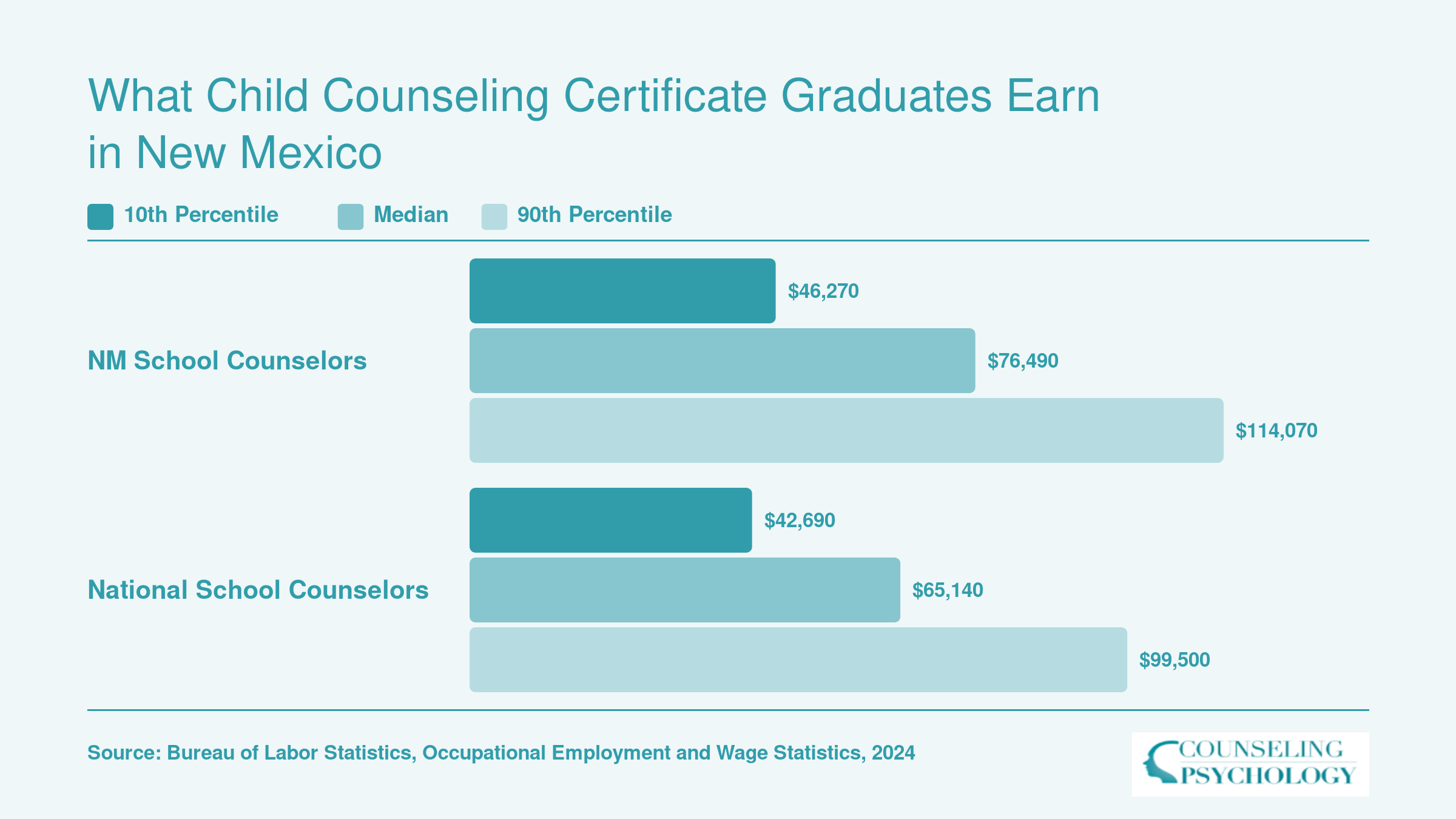
Program-level earnings data for the graduate certificate programs at UNM and NMSU have not yet been published, so the grouped bars below reflect profession-level wage benchmarks instead. According to 2024 BLS data specific to New Mexico, school counselors earn a state median of $76,490, well above the national median of $65,140. Mental health counselors in the state fall in a similar range. How much does an LPC make in New Mexico? Entry-level positions (10th percentile) start near $46,270, while experienced counselors at the 90th percentile reach roughly $114,070. Major Albuquerque employers such as Albuquerque Public Schools (APS), Presbyterian Healthcare Services, UNM Health System, and Hogares Inc. regularly hire graduates with child counseling credentials.
A graduate certificate by itself will not get you licensed as an LPC or LPCC in New Mexico; it supplements or builds on a qualifying master's degree. For PED school counselor licensure, you also need an approved program plus a passing Praxis 5422 score, not the certificate alone.
Frequently Asked Questions About Counseling Certificates in Albuquerque
Prospective students often have practical questions about how graduate certificates in counseling fit into New Mexico's licensure landscape. Below are answers to the most common questions we hear, grounded in current state requirements and program realities.
How to Choose the Right Counseling Certificate Program for You
Which format and timeline will actually get you to your career goal without wasting tuition or time? Start by mapping your immediate constraints against the core decision points: delivery mode, specialization track, and program length.
Online vs. Hybrid Format
Fully online certificates offer maximum schedule flexibility but require strong self-discipline and reliable high-speed internet for synchronous sessions. Hybrid formats that meet on weeknights or occasional Saturdays provide face-to-face practicum supervision and peer networking, which many students find valuable when learning counseling microskills. If you plan to practice in Albuquerque long-term, a local hybrid program often smooths the path to clinical placements at nearby schools, clinics, or youth agencies. If you work full-time or live outside metro Albuquerque, an asynchronous online track may be the only viable route. For a broader look at remote options, explore our guide to counseling certificate programs nationwide.
Child-Specific vs. General Track
A general clinical mental health or school counseling certificate gives you broader preparation but less depth in developmental assessment, play therapy techniques, or trauma-informed care for minors. A child-specific track front-loads those competencies, which accelerates your readiness for K-12 or pediatric clinical settings. Ask yourself: do I already hold a master's in a related field and need only the child coursework, or am I building foundational counseling skills from scratch?
Completion Timeline
One-semester accelerated certificates (typically 12 to 15 credits) assume you can dedicate 20 to 25 hours per week to coursework and practicum. Two- to three-semester programs spread the same credit load across longer calendars, reducing weekly time pressure but delaying your entry into supervised practice or paid positions.
Verify Accreditation and Licensure Alignment
Before you submit a deposit, confirm that the program holds CACREP accreditation or that the New Mexico Counseling and Therapy Practice Board explicitly accepts its coursework toward Licensed Professional Counselor or Licensed Clinical Mental Health Counselor requirements. Not all graduate certificates count as partial fulfillment of a master's degree for licensure purposes. If you are weighing a full master's alongside a certificate, reviewing the best masters in mental health counseling programs can help clarify the credit overlap. Check the board's published standards and ask the program director for a written statement if the website is unclear.
Talk to Advisors at Your Top Two Choices
Contact program advisors at the two programs that best match your schedule and specialization goals. Ask three specific questions: Does the certificate integrate into your master's program if I decide to continue? How does the program support practicum placement in child-serving agencies? Will completing this certificate position me to sit for the National Counselor Examination or any New Mexico licensure exam?
Take the Next Concrete Step
Visit each program's admissions page to review prerequisite transcripts, application deadlines, and required supplemental essays. Register for an upcoming virtual or in-person information session to hear directly from faculty and current students. If you already hold graduate credits from another institution, request a formal degree audit or transfer-credit evaluation so you know exactly how many additional credits you need and what your true out-of-pocket cost will be. Those three actions will move you from research mode to decision mode within two weeks.