
What you’ll learn in this article…
- Ohio State University is the only top-ranked CACREP-accredited CMHC program located directly in Columbus, though several nearby Ohio schools also qualify.
- CACREP accreditation streamlines Ohio LPCC licensure and is required by many employers and third-party payers across the state.
- Becoming an LPCC in Ohio typically takes five to seven years, combining a 60-credit master's degree with 3,000 supervised post-graduate clinical hours.
- Ohio's median annual wage for mental health counselors falls below the national median, so comparing program debt against local earnings is essential.
Columbus is one of Ohio's fastest-growing metros, and demand for licensed mental health counselors in the region reflects that growth. To practice independently as an LPCC in Ohio, you need a master's degree from a CACREP-accredited program, a passing score on the National Counselor Examination, and supervised post-degree clinical hours. That counseling licensure requirement narrows the field considerably.
Twenty-five programs were evaluated across cost, CACREP status, format, and graduate outcomes. In-state tuition among ranked Ohio programs runs from roughly $6,800 to over $19,500 per year, a spread wide enough to change the math on long-term debt significantly.
Columbus sits within commuting or hybrid-program reach of several strong options, and the city itself offers clinical training placements across community mental health centers, hospital systems, and private practice settings that few other Ohio markets can match.
Best LPCC Programs in Columbus for 2026
Ohio offers a strong roster of CACREP-accredited Clinical Mental Health Counseling programs that prepare graduates for Licensed Professional Clinical Counselor (LPCC) status. While only one program on this list sits directly in Columbus, every school listed below meets the Ohio Counselor, Social Worker, and Marriage and Family Therapist (CSWMFT) Board's educational requirements and is accessible to Columbus-area students through in-state tuition, hybrid delivery, or manageable commutes. Program-level earnings data is not yet available for these specific counseling degrees, so we have included institution-wide graduate debt and earnings figures where they can give you a rough value signal.
- CACREP accreditation status
- Institutional graduation and retention rates
- Tuition affordability and net price
- Licensure exam pass rates
- Clinical placement and format flexibility
- Independent program research
- NCES-IPEDS federal institutional data — nces.ed.gov
- Internal program database

Ohio State University
Ohio State is the only school on this list located in Columbus, giving local students direct access to the capital city's clinical training sites. Its Counselor Education program is consistently ranked among the top 10 nationally by U.S. News & World Report, and the university's overall graduation rate of 87.7% is the highest on this list. With in-state tuition around $13,901 and a median institutional graduate debt of $19,976, it pairs elite reputation with relatively manageable costs for Ohio residents.
- Top-rated Counselor Education program with national recognition
- In-person delivery on the Columbus main campus
- Trains students for community, hospital, and private practice settings
- Emphasizes ethical, self-reflective, and culturally competent practice
- Comprehensive mental health training grounded in psychological principles
- Prepares graduates for Ohio LPC and eventual LPCC licensure
Clinical Mental Health Counseling (Master's) — On-Campus

University of Dayton
The University of Dayton pairs a CACREP-accredited CMHC curriculum with a distinctive Ecotherapy Certificate track, one of the few nature-based counseling specializations available in Ohio. Offered at two campus locations across the Dayton region, the program gives students a choice between 2.5-year and 3.5-year completion timelines. The university's overall graduation rate stands at 80.2%, and its institution-wide median earnings ten years after enrollment reach $75,537, the highest among schools on this list.
- CACREP-accredited with 60-credit curriculum aligned to Ohio LPC requirements
- Two completion tracks: 2.5 years (full-time) or 3.5 years (part-time)
- Optional Ecotherapy Certificate embedded within the CMHC degree
- Available at two campus locations across southwest Ohio
- Supervised practicum and internship with professional counselors
- Holistic counseling approach preparing graduates for diverse clinical settings
- Integrates outdoor and nature-based interventions into clinical training
- Builds on the full CACREP CMHC curriculum with specialized electives
- Prepares graduates for both counseling licensure and ecotherapy practice
- Flexible scheduling across two regional sites
- Emphasizes holistic, culturally responsive care
- One of few ecotherapy tracks in an Ohio CACREP program
Clinical Mental Health Counseling (Master's) — On-Campus
Clinical Mental Health Counseling, Ecotherapy Concentration (Master's) — On-Campus

Ashland University
Ashland University stands out as one of the few CACREP-accredited hybrid CMHC programs based in Ohio, combining online coursework with periodic on-campus sessions. That format is a practical choice for Columbus-area students who want flexibility without fully relocating. The 64-credit program reports an 89.6% pass rate on the National Counselor Examination and frames its training within a Christian worldview. Graduate tuition is listed at $8,400, though the institution-wide net price is $21,988 and the overall graduation rate is 60.6%.
- CACREP-accredited, 64-credit-hour hybrid program
- 89.6% NCE pass rate, among the highest reported in Ohio
- Christian worldview integrated into counseling ethics and practice
- Hybrid delivery blends online learning with on-campus intensives
- Meets Ohio LPC educational requirements for LPCC pathway
- Emphasizes multicultural counseling competence and professional ethics
- Field experience placements across diverse clinical settings
Master of Arts in Clinical Mental Health Counseling — Hybrid

Ohio University
Ohio University's campus-based CMHC program in Athens reports a 100% job placement rate within 12 months of graduation, a compelling outcome for students prioritizing employment security. The CACREP-accredited curriculum covers psychopathology, diagnosis, treatment planning, and assessment, mapping directly to the Ohio LPCC scope of practice. In-state tuition runs about $9,720 with a net price of $21,637, and the university's overall graduation rate is 65.4%.
- CACREP-accredited with reported 100% job placement within one year
- Campus-based program on the Athens, Ohio main campus
- Curriculum emphasizes psychopathology, diagnosis, and treatment planning
- Prepares graduates for Ohio LPC licensure and NCC credential
- In-state tuition approximately $9,720, among lower-cost public options
- Individual, couple, and group counseling modalities covered
- Strong focus on professional organization engagement and ethical practice
Clinical Mental Health Counseling (Master's) — On-Campus

Ursuline College
Ursuline College in Pepper Pike offers a distinctive dual-track Master of Arts in Counseling and Art Therapy, which holds both CACREP and CAAHEP accreditation. Graduates can pursue Ohio LPC/LPCC licensure alongside the national Art Therapy Registered-Board Certified (ATR-BC) credential, a combination few programs in the state support. The 8:1 student-to-faculty ratio is the smallest on this list, and evening and part-time scheduling accommodates working professionals. The university's overall graduation rate is 66.7%, with a net price of $16,164.
- Dual CACREP and CAAHEP accreditation for counseling and art therapy
- Prepares students for LPC, LPCC, and ATR-BC credentials
- 8:1 student-to-faculty ratio, the lowest among ranked programs
- Evening and part-time class format for working professionals
- Diverse internship placements across clinical, educational, and healthcare settings
- Year-round course offerings to accelerate time to degree
Master of Arts in Counseling and Art Therapy — On-Campus

Cleveland State University
Cleveland State's 60-credit CACREP CMHC program pairs strong outcome metrics with accessible admissions: it requires no GRE, sets a minimum 2.75 GPA, and reports a 99% program completion rate along with a 95% first-attempt licensure exam pass rate. In-state tuition is about $11,297 with a net price of $14,764, making it one of the more affordable urban options. The university's overall graduation rate is 50.6%, which reflects its open-access mission rather than program-specific completion.
- 60-semester-hour CACREP program with no GRE requirement
- 99% program completion rate and 95% licensure exam pass rate
- In-state tuition around $11,297, net price approximately $14,764
- Covers all eight CACREP core counseling competency areas
- Designed for Ohio Professional Counselor licensure and LPCC pathway
- Minimum 2.75 GPA for admission, two professional recommendations needed
- 75% reported job placement rate post-graduation
Clinical Mental Health Counseling (Master's) — On-Campus

Xavier University
Xavier University's Jesuit-rooted MA in Clinical Mental Health Counseling is the only program on this list explicitly designed to prepare graduates for licensure in Ohio, Kentucky, and Indiana, a significant advantage for anyone considering practice across the tri-state region. The curriculum includes 600 hours of supervised clinical counseling, with evening and weekend scheduling that suits working adults. The university's overall graduation rate is 68.6%, and the 10:1 student-to-faculty ratio supports close mentorship. Net price runs higher at $32,997.
- CACREP-accredited with tri-state licensure preparation (OH, KY, IN)
- 600 hours of supervised clinical counseling experience
- Evening and weekend classes for working professionals
- Multiple start terms: summer, fall, and spring entry
- Grounded in Jesuit tradition of ethical, reflective practice
- Per-credit tuition of $722 with flexible pacing options
- 10:1 student-to-faculty ratio for individualized mentorship
Master of Arts in Clinical Mental Health Counseling — On-Campus

Kent State University
Kent State's 60-credit Clinical Mental Health Counseling M.Ed. balances affordability and flexibility, offering both part-time and full-time study tracks alongside a 600-clock-hour internship. In-state tuition is approximately $12,483, and the university's overall graduation rate sits at 63.7%. The program emphasizes multicultural counseling competence and meets Ohio LPC requirements, positioning graduates for eventual LPCC status. Admission requires a 3.0 undergraduate GPA and a holistic review including interviews.
- 60-credit CACREP-accredited program with 600-hour internship
- Part-time and full-time study options available
- Campus-based delivery at the Kent, Ohio main campus
- Multicultural counseling focus integrated throughout curriculum
- In-state tuition approximately $12,483, among the more affordable publics
- Holistic admissions: 3.0 GPA, interview, and recommendations required
- Prepares graduates for Ohio LPC licensure and LPCC pathway
Clinical Mental Health Counseling M.Ed. — On-Campus

University of Akron
The University of Akron has held continuous CACREP accreditation since 1985, making it one of the longest-accredited counseling programs in Ohio. Its 95 to 100% licensure exam pass rate and 98 to 100% internship placement rate reflect deep, established relationships with northeast Ohio clinical sites. In-state tuition is about $10,125, and the net price of $13,946 is the second-lowest on this list. The university's overall graduation rate is 51.9%, and Akron is listed among Ohio institutions offering hybrid delivery for its counseling program.
- CACREP accredited continuously since 1985
- 95 to 100% licensure exam pass rate across recent cohorts
- 98 to 100% internship placement rate
- In-state tuition around $10,125, net price approximately $13,946
- Hybrid delivery option increases accessibility for Ohio students
- Emphasis on advocacy, social justice, and holistic human development
- Three annual scholarships available for counseling students
Clinical Mental Health Counseling (Master's) — On-Campus
Youngstown State University
Youngstown State offers the lowest-cost path to LPCC eligibility among the programs on this list, with in-state tuition around $6,848 and out-of-state tuition only marginally higher at $7,028. The 60-semester-hour CACREP curriculum includes a 600-hour internship and qualifies graduates for both Ohio Professional Counselor and Professional Clinical Counseling licensure. The university's overall graduation rate is 50.5%, and the net price of $12,767 is the lowest among all ten schools. For budget-conscious students willing to relocate or commute from Columbus, the savings can be substantial.
- Lowest tuition on this list: approximately $6,848 in-state
- 60-semester-hour CACREP-accredited curriculum
- 600-hour internship across multiple clinical placement settings
- Prepares for both Ohio LPC and LPCC licensure
- Focus on cultural competence and evidence-based interventions
- Near-parity in-state and out-of-state tuition ($6,848 vs $7,028)
- Campus-based delivery in Youngstown, Ohio
Master of Science in Education, Counseling (Clinical Mental Health Counseling) — On-Campus
CACREP Accreditation and Why It Matters in Ohio
CACREP accreditation is a quality assurance seal granted to master's and doctoral counseling programs that meet rigorous national standards for curriculum, faculty, and clinical training. In Ohio, the decision to enroll in a CACREP-accredited clinical mental health counseling program can influence your path to licensure as a Licensed Professional Clinical Counselor (LPCC), but it is not always a rigid requirement. Understanding the nuances, and checking the latest rules, can save you time and money.
What is CACREP Accreditation?
The Council for Accreditation of Counseling and Related Educational Programs (CACREP) evaluates graduate counseling programs across the U.S. When a program earns CACREP status, it demonstrates that its coursework covers core areas such as human development, ethics, research, and clinical practice, along with a supervised practicum and internship. For students, this accreditation signals that the program aligns with the educational foundation most state licensing boards expect. If you are exploring masters in counseling Ohio options, filtering by CACREP status is a smart first step.
Ohio Licensure and CACREP: The Current Status
Ohio's Counselor, Social Worker, and Marriage and Family Therapist Board (CSWMFT) does not explicitly require a CACREP degree for LPCC licensure. However, the board's rules, found in the Ohio Revised Code (ORC) chapter 4757, outline two distinct evaluation tracks. Graduates of CACREP-accredited programs generally follow a streamlined application process, with their transcript accepted as evidence of meeting educational requirements. Those from non-CACREP programs must have their courses evaluated individually to ensure they match the board's content area standards. This can mean the board requests additional syllabi, and in some cases, applicants need to complete extra graduate coursework in areas like assessment or professional ethics before being approved to sit for the national counselor examination.
Because legislative and board rule changes occur periodically, including possible updates during the 2025-2026 session, it is critical to consult the CSWMFT Board's official website for the most current licensure rules. Relying on general assumptions or outdated information could lead to unexpected delays.
How to Verify Requirements Before You Apply
Given that state requirements can differ from national trends, prospective students should take a proactive approach: - Visit the CSWMFT Board site: Check the "Laws and Rules" section and recent meeting minutes for any proposed changes to educational requirements. The board's licensure FAQ often addresses CACREP-related questions directly. - Review the Ohio Revised Code: Look at ORC sections 4757.21 to 4757.29, which govern counselor licensure. Pay attention to language about "approved programs" or "equivalent education." Legislative bills that may alter CACREP requirements are typically published with an effective date, so verify whether a new law has taken effect. - Contact accredited programs: Schools with CACREP-accredited clinical mental health counseling tracks, such as the University of Cincinnati and Ohio University, employ faculty and advisors who closely monitor state requirements for their graduates. A brief call or email can clarify whether any recent changes impact your enrollment decision. - Check with national certification bodies: The National Board for Certified Counselors (NBCC) administers the National Counselor Examination (NCE) and the National Clinical Mental Health Counseling Examination (NCMHCE), both accepted by Ohio. NBCC's certification requirements for the National Certified Counselor (NCC) credential include graduation from a CACREP-accredited program or an equivalent pathway. Understanding these rules can matter for portability and exam eligibility if you later pursue licensure in another state.
Additional Steps for Non-CACREP Graduates
If you are considering a non-CACREP program, request a pre-evaluation from the CSWMFT Board before you enroll. Submit the program's course descriptions to see if they align with Ohio's content areas. Some programs, while not CACREP-accredited, design their curriculum to mirror CACREP standards exactly, and board staff can offer guidance on their track record with similar applicants. The American Counseling Association (ACA) also provides state-specific licensure resources and can be a helpful second source.
Navigating licensure requirements means cross-referencing rules from multiple authorities. By confirming the current landscape with both the state board and professional associations, you build a reliable foundation for your career as an LPCC in Ohio.
Questions to Ask Yourself
How to Compare Tuition and ROI Across Columbus LPCC Programs
The table below ranks Ohio clinical mental health counseling programs by ROI ratio, calculated by dividing median earnings ten years after enrollment by median debt at completion. In-state graduate tuition is listed per year; the institution-wide average net price (drawn from federal data) reflects a broad student average, not a personalized estimate of what you will pay. The spread is notable: Ohio University posts the lowest in-state tuition at $9,720 per year, while University of Dayton and Xavier University each top $19,000. Yet higher tuition does not automatically translate to higher post-completion earnings. University of Dayton carries the strongest ROI ratio at roughly 3.25, pairing moderate median debt ($23,250) with the highest median earnings ($75,537). Walsh University, by contrast, shows the least favorable debt-to-earnings picture in this group, with the highest median debt ($27,000) and a median earnings figure of $59,764. Keep in mind that all earnings figures are institution-wide medians reported by the College Scorecard; individual outcomes will vary based on your specialization, clinical setting, geographic location, and years of post-licensure experience. Program-level earnings data are not yet available for these programs.
| School | In-State Tuition (per year) | Out-of-State Tuition (per year) | Avg. Net Price (institution-wide) | Median Debt at Completion | Median Earnings (10 yr) | ROI Ratio |
|---|---|---|---|---|---|---|
| University of Dayton | $19,580 | $19,580 | $29,533 | $23,250 | $75,537 | 3.25 |
| Ohio State University | $13,901 | $42,740 | $17,339 | $19,976 | $60,409 | 3.02 |
| Xavier University | $19,218 | $19,218 | $32,997 | $23,250 | $64,873 | 2.79 |
| Ohio University | $9,720 | $17,712 | $21,637 | $21,056 | $52,581 | 2.50 |
| Miami University (Oxford) | $16,751 | $37,791 | $28,384 | $23,000 | $55,076 | 2.39 |
| Cleveland State University | $11,297 | $21,107 | $14,764 | $21,797 | $52,131 | 2.39 |
| University of Toledo | $17,605 | $29,426 | $17,249 | $22,250 | $50,632 | 2.28 |
| Walsh University | $13,500 | $13,500 | $20,493 | $27,000 | $59,764 | 2.21 |
Related Articles
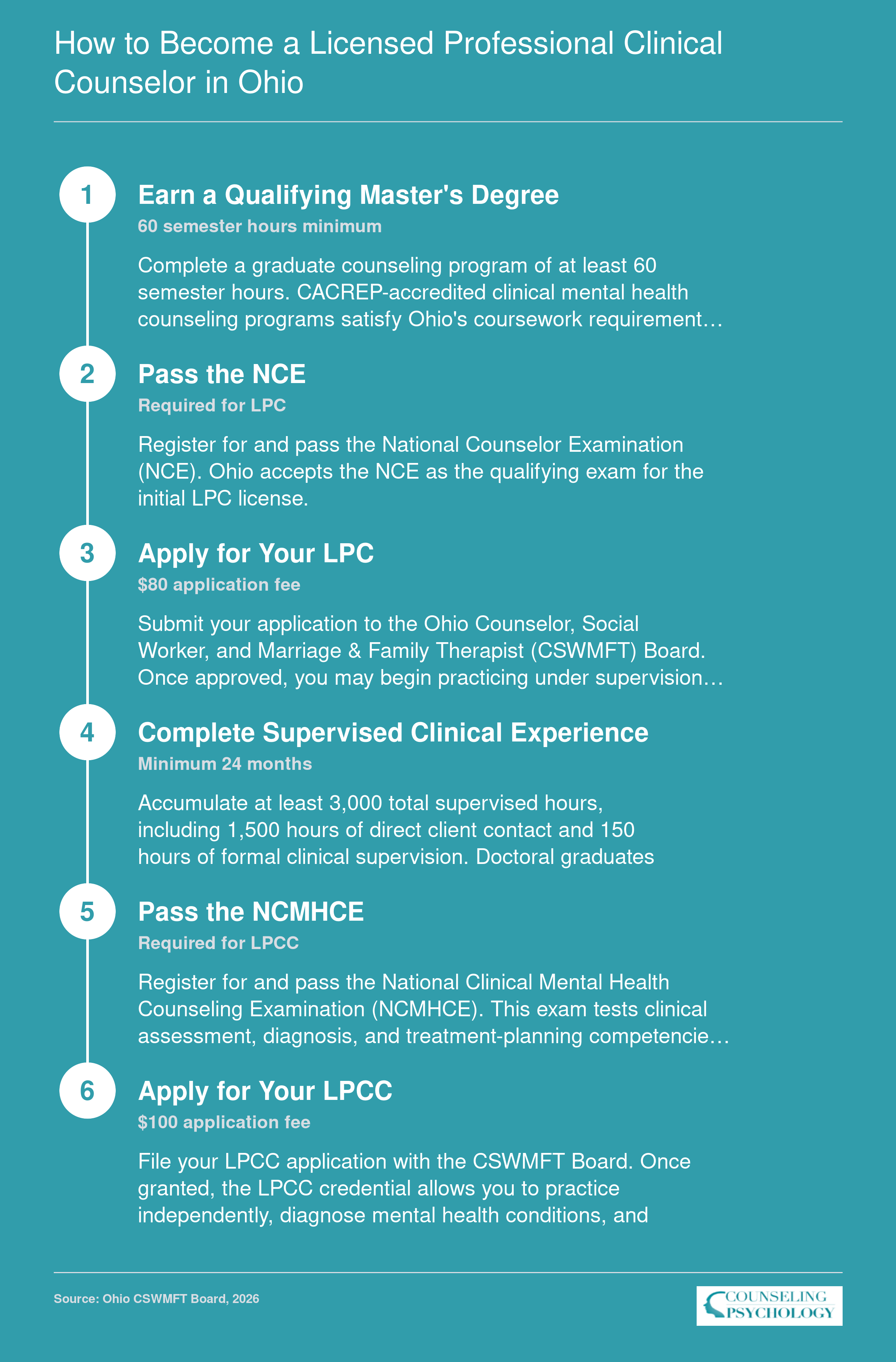
How to Become a Licensed Professional Clinical Counselor in Ohio
Ohio uses a two-tier counseling license structure. You start as a Licensed Professional Counselor (LPC), then advance to Licensed Professional Clinical Counselor (LPCC) after accumulating supervised clinical hours. The LPCC credential authorizes independent practice and clinical diagnosis. Expect the full pathway to take roughly four to five years beyond your bachelor's degree, and budget $180 in total application fees ($80 for the LPC, $100 for the LPCC).
Practicum and Internship Opportunities in Columbus
Clinical practicum and internship hours are the hands-on training experiences that turn classroom knowledge into real counseling competence. In a CACREP-accredited program, you will typically complete a 100-hour practicum (including at least 40 hours of direct client contact) followed by a 600-hour internship (with at least 240 direct-contact hours). Columbus, as Ohio's largest metro area, offers an unusually deep pool of placement sites spanning hospital systems, community agencies, school districts, and specialty clinics.
Major Placement Sites in the Columbus Metro
Several anchor institutions accept graduate counseling trainees on a recurring basis:
- Nationwide Children's Hospital: The Behavioral Health Counselor Trainee Program places students from CACREP-accredited programs in one of the nation's top pediatric hospitals.1 Application deadlines run on a semester cycle, with an October 1 deadline for spring placements and March 1 for summer.
- The Ohio State University Wexner Medical Center: OSU's Counseling and Consultation Service, housed in the Younkin Success Center at 1640 Neil Ave, runs a Counseling Practicum that exposes trainees to a large, diverse college-student population.2
- OhioHealth system: With multiple hospital campuses across central Ohio, OhioHealth's behavioral health units provide exposure to crisis stabilization, inpatient psychiatric care, and integrated primary-care counseling.
- Chalmers P. Wylie VA Ambulatory Care Center: VA Central Ohio Healthcare System offers training rotations that serve veterans dealing with PTSD, substance use disorders, and transition-related stressors. The formally structured internship here is at the doctoral level in psychology; master's-level trainees should confirm current availability directly with the facility.3
- Community agencies: Organizations such as the National Youth Advocate Program focus on youth and family services, with internship slots available for summer and fall terms.4 Serenity Behavioral Health and other local providers also list recurring openings for master's-level counseling interns.5
Populations You Can Serve
Columbus's size and demographic diversity let students tailor placements to their clinical interests. Options range from child and adolescent work at pediatric hospitals, to veterans counseling programs at the VA, to substance use disorder treatment at community behavioral health centers, to crisis counselor roles through local hotlines and emergency departments. College counseling placements are available not only at Ohio State but at several smaller institutions in the metro area.
A Critical Question to Ask Before You Enroll
Placement logistics vary more than most applicants expect. Some programs maintain formal partnerships with specific hospitals and agencies, coordinating your placement from start to finish. Others expect students to identify and secure their own sites. Capital University, for example, does not publicly list its partner sites, so prospective students should ask the program director directly about how placements are arranged and what support is provided.6 During your admissions conversations, ask each program whether internship sites are pre-arranged or self-sourced, how many unique sites are in their active network, and whether the program has relationships with the specific populations you want to serve. The answer can significantly shape both your training quality and your stress level during the busiest semesters of your degree.
Online vs. On-Campus LPCC Programs: What to Expect
Among the ranked LPCC programs serving Columbus students in 2026, the majority are on-campus, but several hybrid options (Capital University, Ashland University, Miami University) and fully online programs (Walsh University, Malone University) give you real alternatives. Your ideal format depends on how you balance work, family obligations, and the kind of learning community you thrive in. Here is what each delivery model brings to the table.
Pros
- Online programs let working professionals set their own study schedules, which is critical if you are juggling a job alongside a 60-credit curriculum.
- Fully online coursework, like Walsh University's or Malone University's, can reduce total costs by eliminating commute expenses and potential relocation to Columbus.
- Online and hybrid formats open the door to CACREP-accredited programs across all of Ohio, not just those within driving distance of Franklin County.
- On-campus programs at schools like Ohio State and Ohio University offer embedded clinical training sites, making practicum placement logistics far simpler.
- In-person cohorts tend to build stronger peer networks organically through shared class time, group supervision, and hallway conversations with faculty.
- Campus-based students often benefit from more direct faculty mentorship, including impromptu advising, research collaboration, and stronger recommendation letters.
- Hybrid programs such as Capital University's combine evening on-campus sessions with online flexibility, splitting the difference for Columbus-area students.
Cons
- Even fully online students must complete practicum and internship hours at approved sites in person, so you still need local clinical placements near Columbus or wherever you live.
- Online learners report that building genuine peer relationships requires more intentional effort, since casual networking does not happen between virtual class sessions.
- Self-paced or asynchronous coursework demands strong self-discipline; without a fixed class schedule, some students fall behind on assignments and readings.
- On-campus programs typically follow rigid semester schedules with daytime or set evening meetings, which can conflict with full-time employment.
- Attending classes in person may increase your total investment once you factor in commuting costs, parking fees, and, for programs outside Columbus, potential housing expenses.
- Campus-based cohort models sometimes offer fewer start terms per year, limiting when you can begin the program compared to rolling online admissions.
What LPCCs Earn in Columbus and Across Ohio
Salary expectations should factor heavily into your program decision. The table below presents wage data for Substance Abuse, Behavioral Disorder, and Mental Health Counselors (SOC 21-1018) at both the Ohio statewide level and nationally, drawn from the Bureau of Labor Statistics. Ohio's statewide median of $56,990 trails the national median of $59,190, but Columbus area wages tend to track somewhat higher than the state figure given the metro area's concentration of hospitals, community mental health agencies, and university counseling centers. Keep in mind that these BLS figures cover the full range of counselors in this occupational group, including those holding an LPC rather than an LPCC. Clinicians who earn the LPCC credential typically command higher compensation because independent practice privileges and the ability to diagnose open doors to private practice revenue, insurance panel reimbursement, and supervisory roles that entry-level licensees cannot access. Program-level median earnings reported on federal scorecards for Columbus-area master's programs can offer a useful reality check: if a program's graduates are earning near or above Ohio's 75th-percentile benchmark within a few years of graduation, that is a strong signal of return on investment. On the growth side, the BLS projects 17% job growth nationally for this occupation between 2024 and 2034, with roughly 48,300 openings anticipated each year. Ohio's behavioral health workforce shortage suggests in-state demand will remain robust through the end of the decade, though state-specific projections should be confirmed through the Ohio Department of Job and Family Services labor market data.
| Wage Metric | Ohio (Statewide) | National |
|---|---|---|
| Total Employment | 16,690 | N/A |
| 25th Percentile | $47,370 | N/A |
| Median (50th Percentile) | $56,990 | $59,190 |
| Mean (Average) | $59,960 | $60,080 |
| 75th Percentile | $67,470 | N/A |
| Projected Job Growth (2024 to 2034) | N/A | 17% |
| Estimated Annual Openings (2024 to 2034) | N/A | 48,300 |
Prospective LPCC students often weigh tuition costs against early-career earnings. While the median first-year graduate salary varies among the ranked Columbus programs, the range offers a useful benchmark for return on investment. Before committing, check each program's latest earnings data to understand how quickly you may recoup your educational expenses in Ohio's counseling job market.
Frequently Asked Questions About LPCC Programs in Ohio
Prospective counseling students in Ohio often have questions about licensure steps, program length, and career options. Below are answers to some of the most common questions, based on current requirements set by the Ohio Counselor, Social Worker, and Marriage and Family Therapist Board.
More Clinical Mental Health Counseling Programs to Consider
Beyond the top-ranked programs, these additional schools offer clinical mental health counseling programs that may fit your needs. Explore these options across Ohio, offering hybrid, online, and on-campus formats.
Central Ohio
- Master of Arts – Clinical Mental Health Counseling
Northeast Ohio
- Master of Arts in Counseling and Human Development (Clinical Mental Health Counseling)
- Clinical Mental Health Counseling
- Master of Arts in Clinical Mental Health Counseling
Northwest Ohio
- Master of Arts in Counseling (Clinical Mental Health Counseling)
- Master of Arts Degree in Counselor Education (Clinical Mental Health Counseling)
Southwest Ohio
- Master of Science in Counseling (Clinical Mental Health)
- Counselor Education-Master of Education (Clinical Mental Health Counseling)
- Counselor Education-Master of Education (School Counseling)
- Counselor Education-Master of Education (Dual Track-Clinical Mental Health Counseling and School Counseling)
- Master of Education in Counselor Education (Clinical Mental Health Counseling)
- Master of Education in Counselor Education (Clinical Mental Health Counseling)
Eastern Ohio
- Master of Arts in Clinical Mental Health Counseling
- Master of Arts in Clinical Mental Health Counseling (Specialized areas of study (varies))