

What you’ll learn in this article…
- In-state tuition across top DFW programs ranges from roughly $6,000 to over $26,000 per year before aid.
- Texas requires 60 graduate semester hours for both the LPC and LPA credentials, though supervised experience differs sharply.
- Several Dallas-area programs now waive GRE requirements, making admission more accessible for working professionals.
- BLS data show Texas psychology salaries vary widely by credential, with licensed roles commanding significantly higher pay.
A master's in psychology is a 30-to-66-credit-hour commitment that, at Texas public universities, can cost anywhere from roughly $6,000 to over $10,000 per year in tuition alone. In the Dallas-Fort Worth metro, demand for licensed counselors and psychological associates continues to outpace the supply of credentialed professionals, yet graduate tuition remains a real barrier for students already managing rent, commutes, and work schedules across the Metroplex.
The tension is straightforward: employers need master's-level talent, but many DFW students cannot justify borrowing $20,000 or more without clear data on what a degree actually returns. Programs that offer hybrid, online, or evening coursework add flexibility, though cost and licensure alignment still vary widely from one institution to the next. The sections below rank the most affordable options, break down tuition and aid, and walk through Texas licensure pathways so you can weigh each program on the metrics that matter most.
The Most Affordable Master's in Psychology Programs Near Dallas, Ranked
Finding an affordable master's in psychology near Dallas means weighing more than sticker price. The programs below span public universities with low in-state tuition and private institutions whose net cost, after aid, can still compete. Several are located within a few hours of the DFW metroplex, while others deliver coursework online or in hybrid formats that eliminate the commute entirely. Institution-wide graduation rates are included as broad context about each school, though they reflect all undergraduates and should not be read as completion rates for any specific graduate program.
- In-state tuition and net price
- Median graduate debt at completion
- Institutional graduation and retention rates
- Program format and flexibility
- Proximity or online access to Dallas
- Independent program research
- Internal program database
- College Scorecard graduate earnings — collegescorecard.ed.gov
- NCES-IPEDS federal institutional data — nces.ed.gov

East Texas A&M University
East Texas A&M University in Commerce is one of the closest public options to the Dallas-Fort Worth metroplex and explicitly markets itself as one of the most affordable colleges near the region. Its M.S. in Psychology uses a hybrid format that blends online coursework with periodic face-to-face sessions, making it practical for North Texas commuters and working professionals. Texas residents pay roughly $3,669 per semester for nine credit hours, and the school-wide median graduate debt sits at $20,500.
- Hybrid delivery mixes online and in-person coursework
- Thesis and non-thesis tracks available
- 36 to 66 total credit hours depending on track
- Texas resident tuition starts around $3,669 per semester
- No foreign language requirement
- Minimum 3.0 undergraduate GPA for admission
- Not currently open to international applicants
- Applies through the centralized ApplyTexas system
Master of Science in Psychology, General Psychology — Hybrid

Texas A&M University-San Antonio
Texas A&M University-San Antonio offers one of the lowest published in-state tuition rates on this list at roughly $6,650 per year, and its average net price of about $11,196 keeps total cost well below many competitors. The campus-based M.S. in Psychology provides thesis and non-thesis tracks across 30 to 36 credit hours. Median graduate debt for students here is approximately $18,401, and alumni report median earnings near $54,338 ten years after enrollment.
- In-state tuition approximately $6,650 per year
- Two tracks: thesis (research-intensive) or non-thesis
- 30 to 36 semester credit hours required
- GRE scores at or above the 40th percentile required
- Minimum 2.75 undergraduate GPA for admission
- Core courses in research methods, statistics, and ethics
- Campus-based program in San Antonio
- Median graduate debt around $18,401
Psychology, Master of Science — On-Campus

University of Houston-Clear Lake
The University of Houston-Clear Lake pairs strong ten-year earnings data with moderate graduate debt. Alumni report median earnings of roughly $59,004 a decade after enrollment, the highest figure among these eight schools, while median graduate debt hovers around $17,831. The campus-based M.S. in Psychology covers social, cognitive, developmental, and neuroscience domains, with optional concentrations in human factors psychology and neuroscience and behavior. No GRE scores are required, and students with a 3.5 GPA receive automatic admission.
- Thesis track or practicum track options
- Optional concentrations in human factors and neuroscience
- No GRE scores required for admission
- 3.5 GPA earns automatic admission
- Prerequisites include an undergraduate statistics course
- Median graduate debt approximately $17,831
- Campus located in the Clear Lake area of Houston
- Prepares graduates for doctoral study or applied careers
Psychology M.S. — On-Campus

Texas A&M University-Texarkana
Texas A&M University-Texarkana carries one of the lowest published in-state tuition figures at about $6,036 per year, translating to a net price near $12,997. The 36-credit-hour M.S. in Psychology is campus-based and emphasizes cognitive, physiological, and statistical methods. The institution-wide graduation rate of roughly 29.6% is the lowest on this list; that number reflects all first-time undergraduates, not graduate students specifically, but it is worth noting as broader institutional context. Median graduate debt is approximately $18,953.
- In-state tuition approximately $6,036 per year
- 36 total credit hours required
- Campus-based delivery in Texarkana
- Covers cognitive and physiological psychology
- Advanced psychological statistics coursework
- GRE and GPA index score required for admission
- Three letters of recommendation needed
- Multiple elective options available
Master of Science in Psychology — On-Campus

Stephen F. Austin State University
Stephen F. Austin State University in Nacogdoches offers an M.A. in Psychology geared toward students preparing for doctoral programs or research-oriented careers. Graduate assistantships are available, which can offset the roughly $7,829 annual in-state tuition. The institution-wide graduation rate of about 53.3% is among the higher marks on this list. Median graduate debt runs around $23,409, higher than some public peers, so prospective students should weigh assistantship opportunities carefully.
- Campus-based program in Nacogdoches
- Thesis and non-thesis options offered
- Graduate assistantships available
- Minimum 3.0 GPA required for admission
- Emphasizes research skills and teaching practicums
- Does not include counseling or therapy training
- Prepares students for doctoral-level study
- In-state tuition approximately $7,829 per year
Master of Arts in Psychology — On-Campus

Houston Christian University
Houston Christian University provides both a campus and a fully online version of its M.A. in Psychology, giving Dallas-area students a realistic remote option from a private institution. The 37-credit-hour program features three tracks: thesis, applied teaching, and applied project. Sticker tuition is notably higher than the public schools on this list, but the net price after institutional aid averages around $20,629. Small class sizes and personalized faculty mentorship are consistent selling points.
- 37 total credit hours
- Three tracks: thesis, applied teaching, applied project
- Small class sizes with faculty mentorship
- No undergraduate psychology prerequisites required
- Completable in two years
- Christian learning environment
- In-person instruction in Houston
- Fully online format for remote learners
- Same 37-credit-hour curriculum as the campus version
- Doctoral-level faculty across all courses
- Research thesis opportunity available
- Minimum 3.0 GPA required for admission
- Does not lead to licensure on its own
- Designed for working professionals
Master of Arts in Psychology (Campus) — On-Campus
Master of Arts in Psychology (Online) — On-Campus

LeTourneau University
LeTourneau University's 39-credit-hour M.A. in Psychology is delivered entirely online, removing geographic barriers for Dallas-area students. The program includes a practicum component and offers a potential pathway toward Licensed Professional Counselor credentials in Texas. Graduate tuition sits at $16,875 per year, and the institution reports an 81% freshman retention rate and a roughly 58.6% graduation rate at the school level. Median graduate debt of about $26,000 is on the higher side, so evaluating scholarship opportunities is important.
- 100% online delivery
- 39 total credit hours
- Includes a practicum experience
- Potential LPC licensure pathway in Texas
- Flexible electives across disciplines
- Christ-centered academic framework
- 11-to-1 student-to-faculty ratio institution-wide
- Suited for working professionals across Texas
Master of Arts in Psychology — Online

Abilene Christian University
Abilene Christian University's M.S. in Psychology is a 36-credit-hour campus program that integrates on-campus clinical training with coursework in counseling, psychological testing, and professional ethics. At roughly $26,424 per year in tuition, ACU has the highest sticker price here, though merit-based scholarships averaging around $9,000 can meaningfully reduce cost. Median graduate debt is approximately $24,250, and alumni earn a median of about $55,736 ten years post-enrollment. No GRE is required for admission.
- 36 total credit hours over three semesters
- On-campus clinical training included
- No GRE required for admission
- Merit-based scholarships averaging around $9,000
- Tuition approximately $1,494 per credit hour
- Licensure preparation available in Texas
- Research conference participation opportunities
- Christian worldview integrated into curriculum
Master of Science in Psychology — On-Campus
How We Ranked These Dallas-Area Programs
Our rankings are built on a transparent, affordability-first methodology that weighs actual net price, debt levels, and financial aid against career outcomes. Every school listed earned its place through a quantitative scoring process, not editorial preference.
Why Affordability Comes First
For many students, cost is the single biggest barrier to a graduate degree. That's why our methodology assigns the heaviest weight to net price (what students actually pay after grants and scholarships), average tuition, median federal student loan debt, and the percentage of students receiving aid. A low sticker price means little if aid is scarce; a program with generous institutional aid can be far more affordable than its published tuition suggests. We pulled these metrics from the most recent federal data available, giving applicants a real-world budget picture.
Earnings and Outcomes Matter
Affordability doesn't exist in a vacuum. A cheaper program that leads to low earnings isn't a value. To balance cost, we factored in earnings outcomes, specifically median earnings one year and four years after attendance, as well as graduation rates and a simple return-on-investment (ROI) ratio that compares typical debt to typical earnings. This ensures that programs not only keep costs down but also deliver on career potential.
What the Data Does (and Doesn't) Measure
It's important to note that some metrics, like graduation rate and net price, are institution-wide averages rather than program-specific. They provide a useful directional signal but can't guarantee the exact experience within a psychology master's program. A university with strong overall outcomes may still have variations across departments, so we encourage you to dig into program-level data when available.
How We Differ from Unranked Lists
Many sites publish lists of "affordable" programs without disclosing their criteria or underlying data sources. You have no way of knowing whether a school was included because it's genuinely affordable or because it simply filled out a form. Our approach is the opposite: every weight and metric is clearly defined, and every figure is verifiable. We don't merely claim affordability; we quantify it, so you can trust that each program on this list represents a real intersection of low cost and strong outcomes.
True Cost Comparison: Tuition, Fees, and Financial Aid
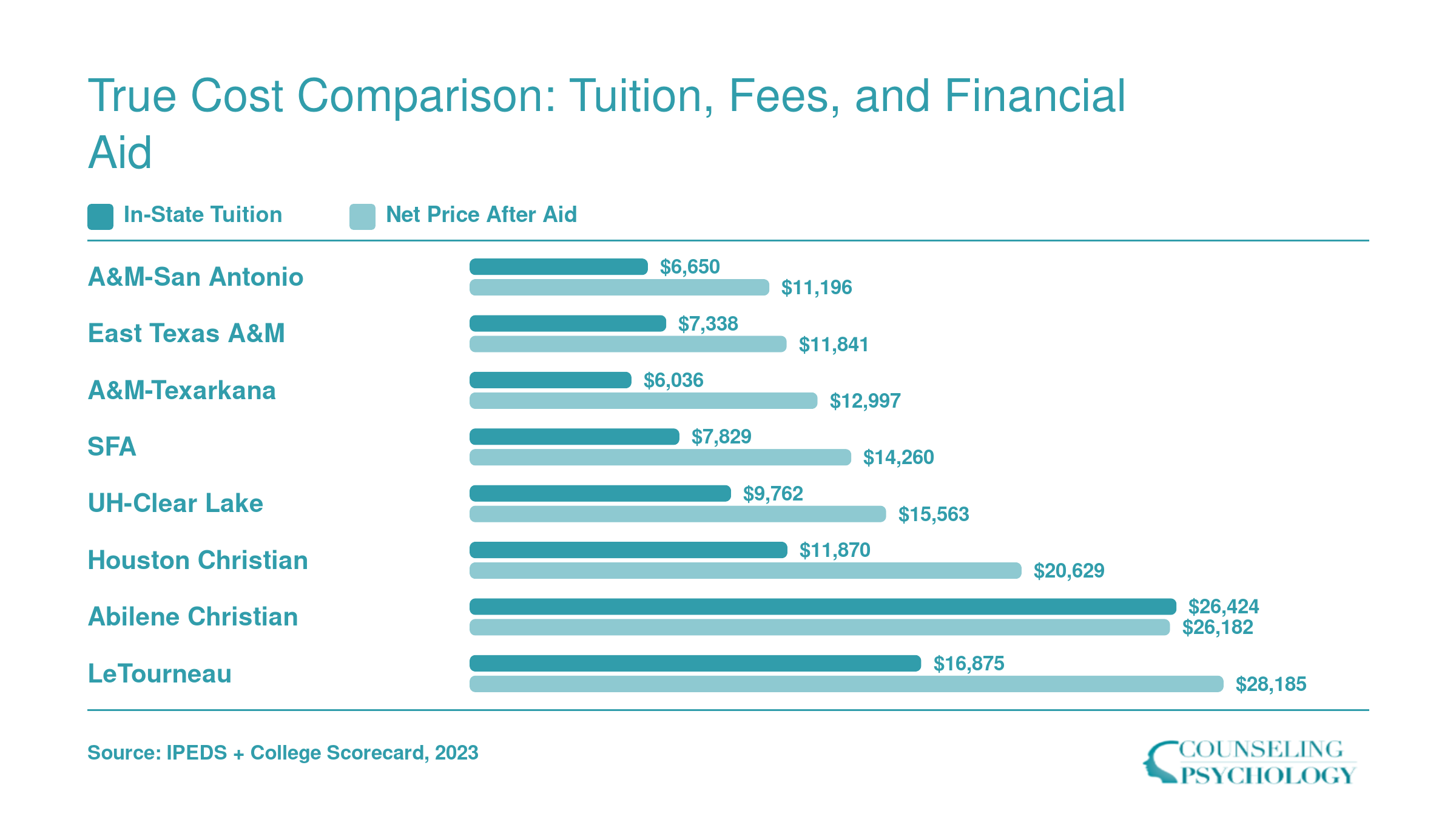
Sticker price tells only part of the story. Across these eight programs, published in-state tuition ranges from roughly $6,000 to over $26,000 per year, but the net price after grants and institutional aid reshuffles the picture considerably. A school with higher tuition may actually cost less out of pocket once aid is factored in, so compare both figures before ruling anything out.
Assistantships, Scholarships, and Tuition Waivers at DFW Psychology Programs
The University of Texas at Dallas provides full tuition scholarships and stipends to its psychology PhD students, setting a benchmark for doctoral funding in the region.1 Master's-level psychology programs in the DFW area typically offer more limited financial support. Prospective students should approach funding research systematically, drawing on multiple information channels to uncover opportunities that may not appear in standard admissions materials.
Start with Department Websites and Graduate Catalogs
Begin your funding search by reviewing each program's psychology department website and graduate catalog. Universities publish assistantship descriptions, scholarship eligibility criteria, and application deadlines in these official documents, though the level of detail varies considerably. Some departments maintain dedicated funding pages that outline teaching assistantship responsibilities, research assistant roles, and annual award amounts, while others provide only brief mentions of financial aid availability. Graduate catalogs often include historical funding data and typical award ranges that can help you gauge what to expect, even if current-year figures are not yet posted.
Contact Graduate Coordinators Directly
Many critical funding details never make it to public websites. Graduate coordinators and department chairs maintain current information about assistantship stipend ranges, the number of positions available each cycle, and any informal funding guarantees for admitted students. A direct email inquiry asking about typical stipend amounts, the percentage of students who receive assistantships, and whether funding is renewable across multiple years can yield specific figures that help you compare programs accurately. These conversations also signal your serious interest and may prompt coordinators to share upcoming scholarship opportunities before they are widely advertised.
Explore External Funding from Professional Associations
The American Psychological Association and the Texas Psychological Association periodically offer scholarships and grants for graduate students pursuing psychology degrees. These awards, while competitive, are open to students across multiple institutions and can supplement institutional aid. APA's APAGS (American Psychological Association of Graduate Students) maintains a scholarship database that aggregates opportunities by degree level and specialty area. State-level associations sometimes prioritize funding for students committed to practicing in underserved Texas communities, aligning financial support with workforce needs. If you are exploring clinical psychology programs in Texas, many of those programs also list external funding resources on their admissions pages.
Cross-Reference Financial Aid Offices and Program Handbooks
University financial aid offices manage tuition waiver programs, emergency grants, and work-study arrangements that exist separately from department-controlled assistantships. Request information about graduate tuition waivers, which can reduce your cost per credit hour substantially even without a stipend attached. Program-specific handbooks, distributed after admission, often list funding sources that do not appear in general recruitment materials, including endowed scholarships restricted to students in particular concentrations or demographic groups.
Questions to Ask Yourself
Career Outcomes and Earnings for Dallas-Area Psychology Graduates
Employer demand for master's-level psychology talent in the Dallas-Fort Worth metro continues to outpace the supply of licensed professionals, creating strong leverage for graduates who position themselves strategically. That said, understanding what these programs actually pay requires looking at two very different data sources, and neither tells the whole story on its own.
Program-Level Earnings: What the Federal Data Shows
Federal program-level earnings for most of the ranked schools are not yet available for their psychology master's programs. When the Department of Education does not report these figures, it typically means the program's cohort was too small or the data has not yet been released for that credential level. What we can say is that institutional median earnings for graduates of these Texas universities (across all programs, not psychology-specific) range from roughly $45,500 at Texas A&M University-Texarkana to approximately $59,000 at the University of Houston-Clear Lake. These figures capture earnings ten years after enrollment and include all degree levels, so they are a rough proxy rather than a precise read on what a psychology master's alone will yield.
BLS Metro Wage Data for the DFW Area
Bureau of Labor Statistics data for the Dallas-Fort Worth-Arlington metro area offers a clearer occupation-level picture. As of May 2023, about 1,380 clinical and counseling psychologists were employed in the DFW metro.1 The 10th-percentile annual wage for that group was $76,160, meaning even lower-earning psychologists in the region cleared that threshold.1 Median and 90th-percentile figures were not disclosed for this metro in the latest release, but the floor alone signals that licensed practitioners in North Texas earn competitively. Industrial-organizational psychologists in the area tend to command even higher compensation, though published metro-specific employment counts for that specialty are limited. Graduates interested in that track can explore industrial organizational psychology master's programs to compare curricula and outcomes.
One important caveat: BLS wages reflect people currently working in the DFW metro, while federal earnings data tracks all program completers regardless of where they relocate. A graduate who finishes a program near Dallas but moves to a lower-cost market will pull the federal median down, while someone who stays in DFW benefits from the metro's higher wage floor.
What Can You Do With a Master's in Psychology in Texas Without a PhD?
Texas offers several career paths that do not require doctoral study:
- Licensed Professional Counselor (LPC): The most common route. A master's in counseling-oriented psychology, combined with supervised clinical hours, qualifies you to sit for the LPC exam.
- Licensed Psychological Associate (LPA): Texas allows master's-level graduates to practice under the supervision of a licensed psychologist, conducting assessments and delivering therapy.
- Behavioral health specialist: Hospitals, integrated care clinics, and community health centers across DFW hire master's-trained professionals for behavioral health roles.
- Industrial-organizational consultant: I-O-focused graduates work in talent analytics, organizational development, and human factors consulting, often at corporate headquarters concentrated in the Metroplex.
- School counselor: With the appropriate credential add-on, psychology graduates can serve in Texas public schools.
- Research coordinator: Academic medical centers like UT Southwestern and corporate research divisions employ master's-level coordinators to manage clinical trials and behavioral studies.
For those leaning toward a clinical or counseling path, reviewing the broader landscape of careers in mental health counseling can help clarify which roles align best with your interests and strengths.
The key takeaway is that your earning trajectory depends less on which affordable program you choose and more on which licensure or career track you pursue after graduation. A counseling-oriented track leading to LPC licensure and an I-O track leading to corporate consulting can diverge by tens of thousands of dollars within a few years, so choose your concentration and practicum placements with long-term goals in mind.
Psychology Salaries in Texas: BLS Wage Data
The Bureau of Labor Statistics tracks wages for several psychology occupations at the state level. The figures below reflect Texas-specific data, not national medians, so they give you a realistic picture of what Dallas-area graduates can expect once fully credentialed. Keep in mind that master's-level practitioners often start closer to the 25th-percentile range, while doctoral-level and experienced professionals push toward the 75th percentile and above.
| Occupation | Total Employed in Texas | 25th Percentile | Median Salary | 75th Percentile | Mean Salary |
|---|---|---|---|---|---|
| Clinical and Counseling Psychologists | 3,410 | $48,760 | $72,320 | $99,050 | $83,830 |
| School Psychologists | 5,140 | $71,240 | $78,150 | $91,880 | $81,210 |
| Psychologists, All Other | 2,160 | $61,740 | $81,830 | $133,240 | $96,040 |
| Industrial-Organizational Psychologists | Not disclosed | $83,290 | $130,630 | $134,990 | $115,960 |
Texas Licensure Pathways: LPC, LPA, and Beyond
The Texas Behavioral Health Executive Council (BHEC) requires 60 semester hours of graduate coursework for both Licensed Professional Counselor (LPC) and Licensed Psychological Associate (LPA) credentials, but the two pathways diverge sharply in supervised experience, exams, and scope of practice. Understanding which master's program aligns with your licensure goal is essential: not every Dallas-area psychology degree qualifies for every credential.
Licensed Professional Counselor (LPC) Requirements
Texas LPC licensure mandates 60 semester hours from a CACREP-accredited or BHEC-approved counseling program, 300 practicum hours (including at least 100 direct client contact hours) during the degree, and 3,000 hours of post-graduate supervised experience. Of those 3,000 hours, at least 1,500 must be direct client hours, typically completed over 18 to 30 months under a board-approved supervisor. Candidates then sit for the National Counselor Examination (NCE) or the National Clinical Mental Health Counseling Examination (NCMHCE).2 For a broader look at the steps involved, our guide on how to become a licensed professional counselor walks through each stage in detail. Programs titled "MA in Counseling Psychology," "MS in Clinical Mental Health Counseling," or "MEd in School Counseling" generally satisfy these requirements, but always verify CACREP or BHEC approval before enrolling. As of January 2026, Texas LPCs track continuing education through CE Broker, requiring 24 hours biennially, including six in ethics, three in cultural diversity, and one in human trafficking awareness.3
Licensed Psychological Associate (LPA) Requirements
The LPA pathway requires a 60-hour master's degree in psychology with specific coursework in psychopathology, assessment, ethics, and statistics. Graduates must pass the Examination for Professional Practice in Psychology (EPPP Part 1), the same national exam used for doctoral-level psychologist licensure. Unlike the LPC, the LPA functions under dependent practice, meaning you must work under the supervision of a fully licensed psychologist. Not all Dallas-area master's programs meet the LPA curriculum standards; programs labeled "MA in Psychology," "MS in Applied Psychology," or "MS in Experimental Psychology" may or may not include the required courses. Contact the BHEC directly or review the program's official licensure disclosure to confirm eligibility.
Which Degree for Which License?
- MA or MS in Clinical Mental Health Counseling: Typically aligns with LPC licensure and CACREP standards.
- MA or MS in Psychology (with clinical/assessment emphasis): May qualify for LPA if coursework includes psychopathology, testing, and supervised practica.
- MA in Counseling Psychology: Can prepare for either LPC or LPA, depending on curriculum design and accreditation.
- MS in Industrial-Organizational or Experimental Psychology: Generally does not meet clinical licensure requirements in Texas.
Adjacent Licensure Options
Some psychology master's graduates pursue Licensed Marriage and Family Therapist (LMFT) or Licensed Clinical Social Worker (LCSW) credentials by completing additional coursework and supervised hours. The LMFT route requires a degree from a COAMFTE-accredited program or equivalent coursework in systems theory and relational therapy, plus 3,000 supervised hours (1,500 direct client contact). The LCSW path requires an MSW and 3,000 hours under a licensed supervisor. While these are not traditional psychology licenses, they offer clinical practice opportunities in similar settings and may appeal to graduates whose program does not align perfectly with LPC or LPA requirements. Students exploring the counseling side of the profession can also review our overview of how to become a mental health counselor for additional context on career entry points.
From Application to License: Steps to a Psychology Career in Texas
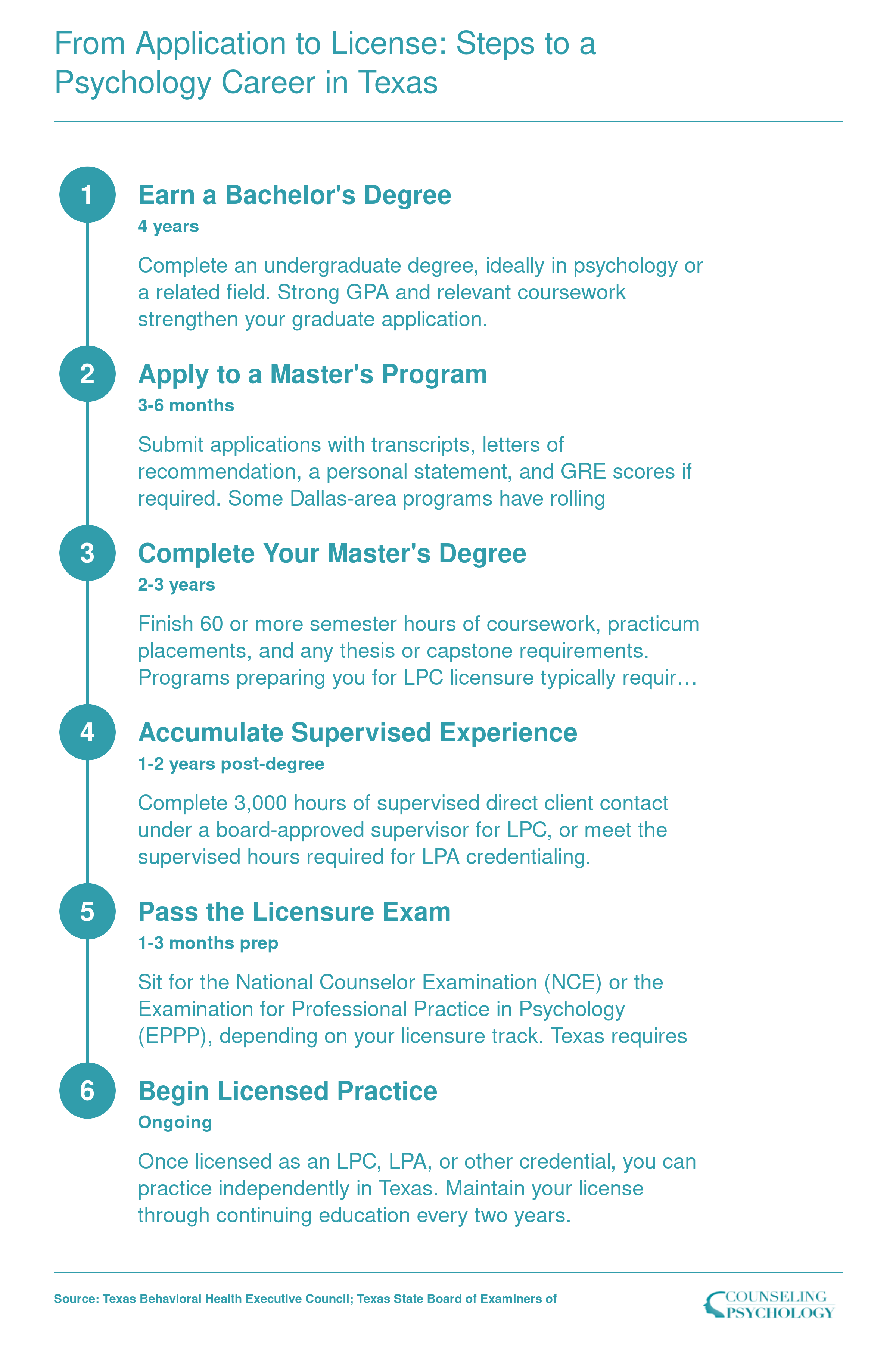
Earning a psychology license in Texas is a structured, multi-stage process. Each step builds on the last, and understanding the full timeline helps you plan your finances, career moves, and personal commitments before you start.
Admission Requirements and Easiest Programs to Get Into
Graduate psychology programs in the Dallas-Fort Worth area have become significantly more accessible over the past several years, with many schools dropping or relaxing standardized test requirements in favor of holistic review.
GPA Minimums Vary More Than You Might Expect
Most DFW-area master's programs in psychology ask for a minimum undergraduate GPA between 2.75 and 3.5, depending on the institution and the degree track. UT Dallas, for example, lists a 3.0 minimum for its Psychology MS, while Texas A&M University-San Antonio sets the bar at 2.75.1 Programs at University of Houston-Clear Lake offer automatic admission at a 3.5 GPA but will individually review applicants with lower numbers. East Texas A&M University (formerly Texas A&M-Commerce) and Stephen F. Austin State University both require a 3.0. If your GPA falls below the stated cutoff, do not assume the door is closed: several schools use a holistic review process that weighs work experience, prerequisite grades, and the strength of your application materials alongside your transcript.
GRE Policies: Test-Optional Is Now Common
The GRE landscape has shifted dramatically. UT Dallas now offers a GRE waiver, and Abilene Christian University does not require the GRE at all.1 University of Houston-Clear Lake also does not require GRE scores. On the other end of the spectrum, the University of Dallas still requires valid GRE scores (taken within the last five years).2 Texas A&M-Texarkana uses a combined GRE/GPA index score for admissions decisions. If avoiding the GRE is a priority, target the growing number of test-optional or test-free programs first.
Rolling Admissions and Flexible Start Dates
Some programs admit on a rolling basis, which means you can apply and receive a decision without waiting for a single annual deadline. Others, like UT Dallas, admit once per year with a February 15 deadline for fall entry.1 Programs with rolling or multiple-start admissions tend to be the most approachable entry points for applicants who need scheduling flexibility.
Beyond GPA and Test Scores
Expect most programs to ask for:
- Letters of recommendation: Typically two or three, with at least one from an academic reference.
- Personal statement or statement of purpose: This is where career-changers can make their case, even with a non-psychology undergraduate degree.
- Prerequisite coursework: The University of Dallas requires General Psychology and Statistics or Experimental Design, each completed with a minimum grade of B.2 Other schools may require an introductory psychology course and a research methods or statistics class. Some, like Houston Christian University, have no psychology prerequisites at all.
- Professional experience: Not universally required, but relevant work or volunteer experience can strengthen an application, particularly at programs that use holistic review.
Is 25 Too Late to Start a Psychology Career?
Absolutely not. Many master's programs in the DFW area are intentionally structured for career-changers and working adults. Evening, hybrid, and online formats (covered elsewhere in this article) exist precisely because a large share of students enroll after spending time in other fields. Starting at 25, 35, or even later is entirely normal. Programs that waive prerequisites or accept applicants without a psychology background, such as Houston Christian University, are especially welcoming to those making a mid-career pivot. Students interested in specialized tracks like health psychology masters programs should note that admission criteria at the master's level follow similar patterns nationwide. The only timeline that matters is yours.
Online, Hybrid, and Evening Options for Working Students
Graduate psychology education in the DFW area has shifted decisively toward flexible delivery formats, driven largely by a student population that is already employed full-time and cannot step away from a career to attend daytime classes.
Campus-Only Programs: Know What You're Signing Up For
Several programs in and around Dallas still run on a traditional in-person schedule. UT Dallas's MS in Psychology is a research-focused, daytime program that admits students in the fall only.1 That structure works well for students who plan to pursue a doctorate and can treat the degree as a full-time academic commitment. It is not designed for the working professional with a 9-to-5 schedule. Similarly, programs like those at East Texas A&M (Commerce) offer a hybrid format, which blends some online flexibility with required campus components, a reasonable middle ground if you live within driving distance and can manage occasional in-person sessions.
Fully Online Programs: Maximum Flexibility, Real Trade-Offs
LeTourneau University's MA in Psychology stands out as a fully online option among the ranked programs, explicitly designed for working professionals. Asynchronous coursework means you set your own study schedule rather than logging in at a fixed time each week. That flexibility has a practical consequence worth acknowledging: fully online programs are accessible to students across Texas and beyond, which can increase competition for seats and, in some cases, for clinical or practicum placement resources.
The more significant trade-off involves licensure. Fully online psychology programs that lack a structured practicum component may not satisfy the supervised-hours requirements the Texas State Board of Examiners of Professional Counselors sets for the Licensed Professional Counselor credential. Before enrolling in any online program, confirm whether practicum placements are arranged by the school, left to the student, or not included at all. Students interested in related Texas licensure paths may also want to explore marriage and family therapy master's programs as an alternative clinical track.
Amberton and the Working-Adult Model
Amberton University's MA in Clinical Mental Health Counseling is purpose-built for DFW professionals. The program runs four sessions per year, offers evening and weekend course options, and supports both online and hybrid attendance.2 Asynchronous coursework gives students the ability to complete readings and assignments around a work schedule rather than rearranging a work schedule around class times. For someone already employed in a human services role who wants to move toward licensure without stepping off a career track, that combination is hard to replicate elsewhere at Amberton's price point.
If your job keeps you in the Dallas area on weekdays, programs structured around evenings, weekends, or asynchronous online sessions are not just convenient; they may be the only realistic path to completing the degree.
MS vs MA in Psychology: Which Degree Is Right for You?
The difference between an MS and MA in psychology comes down to emphasis: science-heavy research training versus theory and applied practice.1 Both degrees open professional doors in the Dallas area, but they prepare you for different roles and licensure pathways.
Curriculum and Structure
An MS in Psychology typically requires a research thesis and builds depth in statistics, experimental design, and data analysis.2 You will spend significant time in labs and learn methods that translate directly to psychometrics, health outcomes research, or doctoral study in clinical or quantitative psychology.
An MA in Psychology leans toward theory, applied humanities, and clinical foundations. Many MA programs offer a non-thesis option, substituting comprehensive exams or capstone projects. Programs like Texas State's MA in Psychological Research blend research training with flexibility, positioning graduates for PhD applications or research coordinator roles without committing to a thesis.4
Licensure Implications in Texas
If your goal is clinical practice, the degree you choose shapes which license you can pursue:
- MA in Counseling or Clinical Psychology: Typically leads to Licensed Professional Counselor (LPC) eligibility, allowing you to provide therapy in community mental health settings, schools, or private practice.1
- MS in Clinical Psychology: Often designed for Licensed Psychological Associate (LPA) candidates, who work under psychologist supervision conducting assessments and treatment in clinical behavioral health roles.1
Neither degree alone qualifies you for full licensure as a psychologist, which requires a doctorate. However, both provide meaningful clinical career paths at the master's level.
Career Trajectories Beyond Licensure
Not every psychology graduate pursues clinical work. MA holders commonly move into case management, student services, HR, organizational development, or policy analysis. MS graduates gravitate toward technical roles: UX research, data analysis in consulting firms, or government research positions where strong quantitative skills command higher salaries.
For PhD preparation, an MS often provides an edge in competitive doctoral programs that prioritize statistics and research methodology. That said, research-intensive MA programs can offer similar preparation if you select coursework and faculty mentorship strategically. Students interested in the organizational side of psychology may also explore industrial organizational psychology masters programs as an alternative pathway.
Making Your Decision
Consider your long-term goals before committing. If you want direct clinical contact through LPC licensure, an MA in counseling or clinical psychology degree programs aligns best. If assessment, research, or doctoral study appeals to you, an MS builds the methodological foundation those paths require. Either way, confirm that your target program meets Texas licensing board requirements before you enroll.
Frequently Asked Questions About Psychology Master's Programs Near Dallas
Prospective students researching affordable psychology master's programs in the DFW area tend to ask many of the same questions. Below are straightforward answers drawn from current program data and Texas licensing requirements.