What you’ll learn in this article…
- Certificate programs near Philadelphia can start around $2,000, while CACREP-accredited master's degrees range from roughly $36,000 to $60,000 total.
- Pennsylvania's four-tier PCB certification ladder lets you stack credentials from a 75-hour certificate up through a CAADC requiring a master's degree.
- The Philadelphia metro area employed about 12,030 substance abuse and mental health counselors as of May 2023, with wages rising at each credential tier.
- PHEAA grants, federal NHSC loan repayment, and employer tuition benefits can significantly reduce out-of-pocket costs for Philadelphia area students.
Pennsylvania's Department of Drug and Alcohol Programs lists substance use counseling among the state's highest-demand behavioral health roles, and the Philadelphia-Camden-Wilmington metro alone employs more than 12,000 substance abuse and behavioral disorder counselors. Workforce shortages persist because credentialed clinicians are not entering the field fast enough to replace those retiring or leaving for adjacent specialties.
Cost is the most common reason students stall before earning a credential that qualifies them for CAADC certification or LPC licensure. The good news: regionally accessible CACREP-accredited master's programs in Pennsylvania, including Waynesburg University at $715 per credit and Carlow University at $1,015 per credit, run well below national private-school averages. Students exploring graduate certificates in addiction counseling will find even shorter, lower-cost entry points.
Pennsylvania's four-tier PCB credential ladder means the degree you pick directly determines which rung, and which salary band, you can reach.
Best Affordable Addiction Counseling Programs Near Philadelphia, Ranked by Cost
Both programs below are CACREP-accredited master's options that prepare graduates for Pennsylvania LPC licensure and CAADC certification, two credentials that open doors across the state's behavioral health system. Because each school is a private institution, tuition does not vary by residency, and both offer 60-credit curricula. We ranked them by net price after financial aid, the single most meaningful cost figure for students weighing affordability.
- Net price after financial aid
- Accreditation and credential alignment
- Pell Grant recipient share
- Delivery format and flexibility
- Institution graduation rate
- NCES-IPEDS federal institutional data — nces.ed.gov
- Internal program database
- Independent program research
- College Scorecard graduate earnings — collegescorecard.ed.gov

Waynesburg University
Waynesburg University delivers what it calls the first CACREP-accredited addictions counseling program in Pennsylvania, and it does so entirely online. With a net price of $18,235 and a Pell Grant recipient share of about 44%, Waynesburg serves a sizable population of aid-eligible students while keeping per-credit costs notably lower than many private peers in the state. The institution-level graduation rate stands at roughly 66%, and its 12:1 student-to-faculty ratio supports accessible mentorship throughout the program.
- CACREP-accredited, first addictions counseling track in PA
- 100% online delivery with 8-week course blocks
- 60 credit hours at $715 per credit
- Full-time completion in approximately 20 months
- Prepares graduates for both LPC and CAADC credentials
- Clinical practice component integrated into curriculum
- Focus on substance use disorders and compulsive behaviors
Master of Arts in Counseling, Addictions Counseling Concentration — Online

Carlow University
Carlow University's MS in Professional Counseling embeds an Addictions Counseling track within a broader CACREP-accredited framework, giving graduates flexibility to practice across multiple counseling settings. Nearly 60% of Carlow's student body receives Pell Grants, one of the highest shares among private Pennsylvania institutions, signaling strong institutional commitment to access. The on-campus program in Pittsburgh carries a net price of $20,786, and graduate assistantship opportunities can further offset costs. Carlow's institution-level graduation rate is approximately 60%, with a 12:1 student-to-faculty ratio.
- CACREP-accredited 60-credit master's program
- On-campus delivery at Carlow's Pittsburgh campus
- Over 700 clinical hours in addiction treatment settings
- Cost per credit: $1,015
- Typical completion window of 2.5 to 3.5 years
- Prepares students for LPC licensure and CAADC certification
- Graduate assistantship options to help offset tuition
- Covers co-occurring disorders and biological addiction bases
MS in Professional Counseling, Addictions Counseling Track — On-Campus
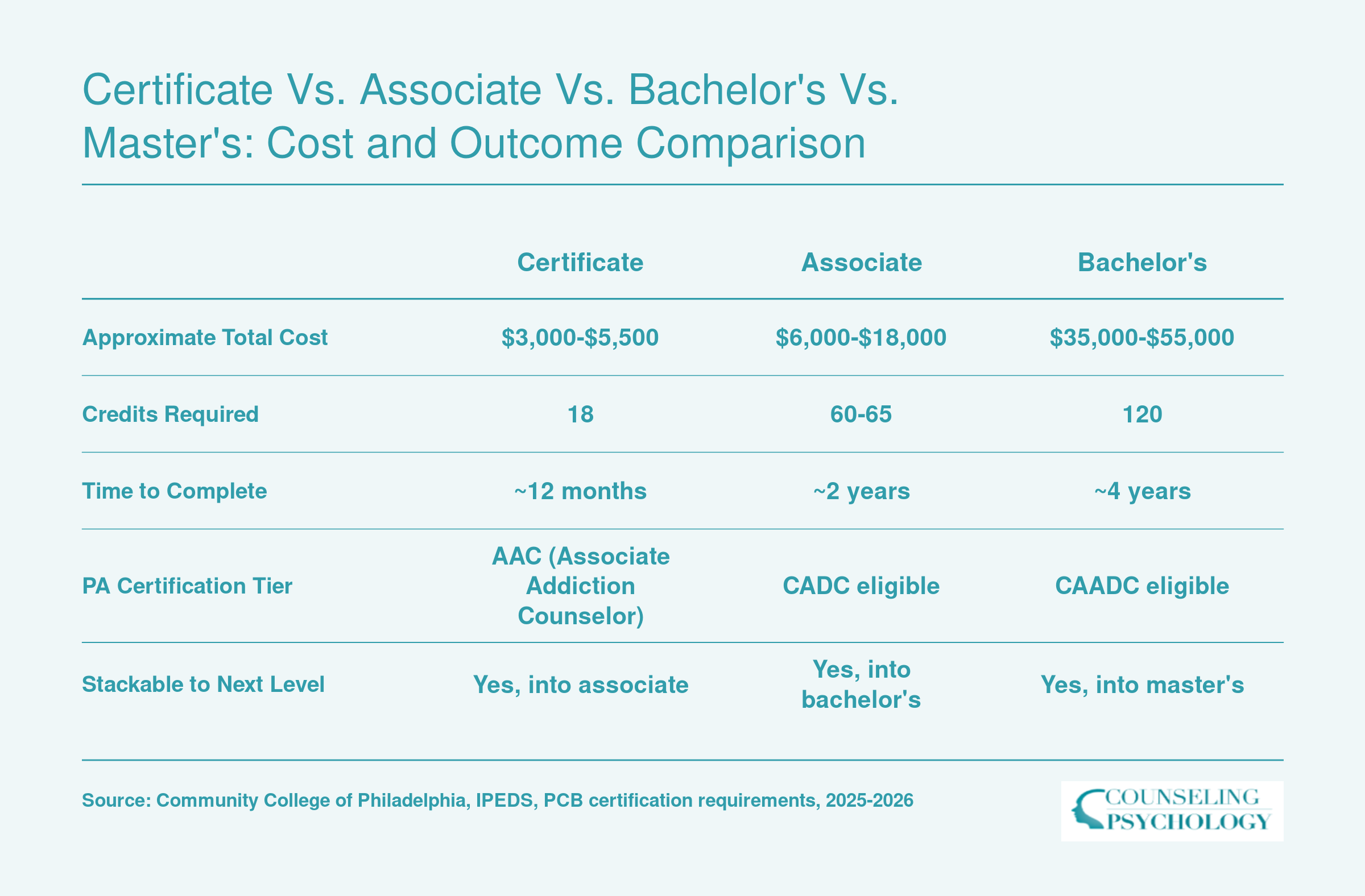
Certificate vs. Associate vs. Bachelor's vs. Master's: Cost and Outcome Comparison
One of the smartest things about addiction counseling education in the Philadelphia area is that credentials stack. You can start with a certificate, ladder into an associate degree, then continue toward a bachelor's or master's without losing credits or momentum. That means cost is not all-or-nothing: each rung opens a new PA certification level and a higher earning ceiling while you work in the field.
How Much Does an Addiction Counseling Degree Cost in Philadelphia?
Choosing an addiction counseling program near Philadelphia means balancing the sticker price against what you'll actually pay after aid and what the credential unlocks in your career. The total cost of an addiction counseling education in the Philadelphia region depends on the credential level you pursue, whether you study at a public or private institution, and how much financial aid you qualify for.
Certificate and Graduate Credential Costs
Addiction counseling certificates offer the shortest path to entry-level practice. Saint Joseph's University offers a 12-credit online Graduate Certificate in Addictions Counseling at $979 per credit, bringing the total program cost to about $11,748 before any alumni discount (Saint Joseph's alumni receive 10 percent off).1 Community College of Philadelphia provides certificate options at lower per-credit rates typical of public two-year colleges, though program-specific tuition varies by format and enrollment intensity.
Master's Degree Program Costs
Master's programs in addiction counseling require a larger upfront investment but prepare graduates for advanced credentials like the LPC and CAADC. Among the most affordable master's in addiction counseling options serving Pennsylvania students, Waynesburg University's 60-credit online MA in Counseling (Addictions Counseling concentration) runs $715 per credit for a total tuition of $16,920. Carlow University's on-campus MS in Professional Counseling with an Addictions Counseling track carries a total tuition of approximately $24,816 for 60 credits ($1,015 per credit). Both programs are regionally accredited and align with Pennsylvania licensure requirements.
Real Cost After Aid and Monthly Repayment Impact
Sticker tuition rarely reflects what students actually pay. At Carlow, the net price after scholarships and federal aid averages $20,786 per year for full-time students, and roughly 60 percent of undergraduates receive Pell Grants, signaling strong institutional aid availability. Waynesburg's average net price sits lower at $18,235 annually. Median graduate debt at completion for Carlow graduates is $25,500, translating to roughly $292 per month over a standard ten-year repayment plan, about the cost of a modest car payment. Waynesburg graduates carry a median debt of $27,000, or approximately $309 monthly.
Philadelphia vs. National Cost Context
Compared to national averages, Philadelphia-area addiction counseling programs offer competitive pricing, particularly at the master's level. Many private master's programs nationwide exceed $30,000 in total tuition, and certificate programs at out-of-state institutions often approach $15,000 or more. Public community colleges in Pennsylvania generally provide the lowest per-credit rates, making certificate pathways especially affordable for students beginning their counseling career.
Why Net Price Matters More Than Tuition
Focus on net price, not published tuition. Pell eligibility, state workforce grants, employer tuition reimbursement, and institutional scholarships can cut your out-of-pocket cost in half or more. Request a financial aid estimate from each program before comparing total costs, and ask whether the school participates in Pennsylvania's workforce development funding streams for behavioral health students.
Questions to Ask Yourself
CADC and PA Credential Pathways: Mapping Degrees to Licensure
A 75-hour certificate gets you in the door; a master's gets you the supervisor's office. Pennsylvania's addiction counseling credentials are stacked as a four-tier ladder administered by the Pennsylvania Certification Board (PCB)1, and the degree you choose determines which rung you can step onto.
The PCB Ladder, Tier by Tier
- CAAP (Certified Associate Addiction Professional): Entry-level. Requires only a high school diploma or GED, 75 hours of addiction-specific education, 6 hours of ethics, 2,000 hours of supervised experience (with 100 hours of direct supervision), and the PCB CAAP exam.2 This is a paraprofessional credential, not a license to practice independently.
- CADC (Certified Alcohol and Drug Counselor): Requires a bachelor's degree, 300 hours of addiction education, 6 hours of ethics, 4,000 supervised hours (200 directly supervised), and the IC&RC ADC exam.3 CADCs can deliver counseling but still work under clinical oversight.
- CAADC (Certified Advanced Alcohol and Drug Counselor): Requires a master's degree in a relevant field, 180 hours of addiction education, 6 ethics hours, 2,000 supervised hours (100 direct), and the IC&RC AADC exam.4 This is the clinical tier.
- CCS (Certified Clinical Supervisor): Requires an existing PCB clinical credential or a master's in a behavioral science, 10,000 hours of experience, 4,000 hours of clinical supervision experience, 200 hours of direct supervision, 30 hours of supervision-specific education, and the IC&RC CS exam.5
Mapping the Ranked Programs to These Credentials
The Community College of Philadelphia's Behavioral Health/Human Services certificate and associate coursework, paired with the required 75 to 300 addiction-education hours, positions graduates squarely for CAAP eligibility and, with continued bachelor's-level study, the CADC pathway. Students exploring a bachelor's degree in addiction counseling should note that Saint Joseph's University's bachelor's-level work in behavioral health or psychology aligns with the CADC's degree threshold, provided they layer in the 300 hours of addiction-specific training (often through PCB-approved continuing education).
To reach CAADC, you need a master's, typically in counseling, social work, or a closely related field. None of the cheapest local certificate or associate options will get you there on their own; they are stepping stones. For a broader look at how each credential abbreviation fits into the profession, our guide to counseling licensure acronyms is a useful reference.
Setting Realistic Expectations
A certificate alone is not a license. It can launch a recovery-support or case-management career and start the supervised-hour clock, but independent clinical practice in Pennsylvania requires the CADC at minimum and the CAADC for advanced clinical and supervisory roles. The CCS, in turn, unlocks formal clinical supervision authority, which is where the higher pay and program-leadership positions live. If you are still weighing whether this field is the right fit, our overview on how to become a substance abuse counselor outlines every step from education through full licensure.
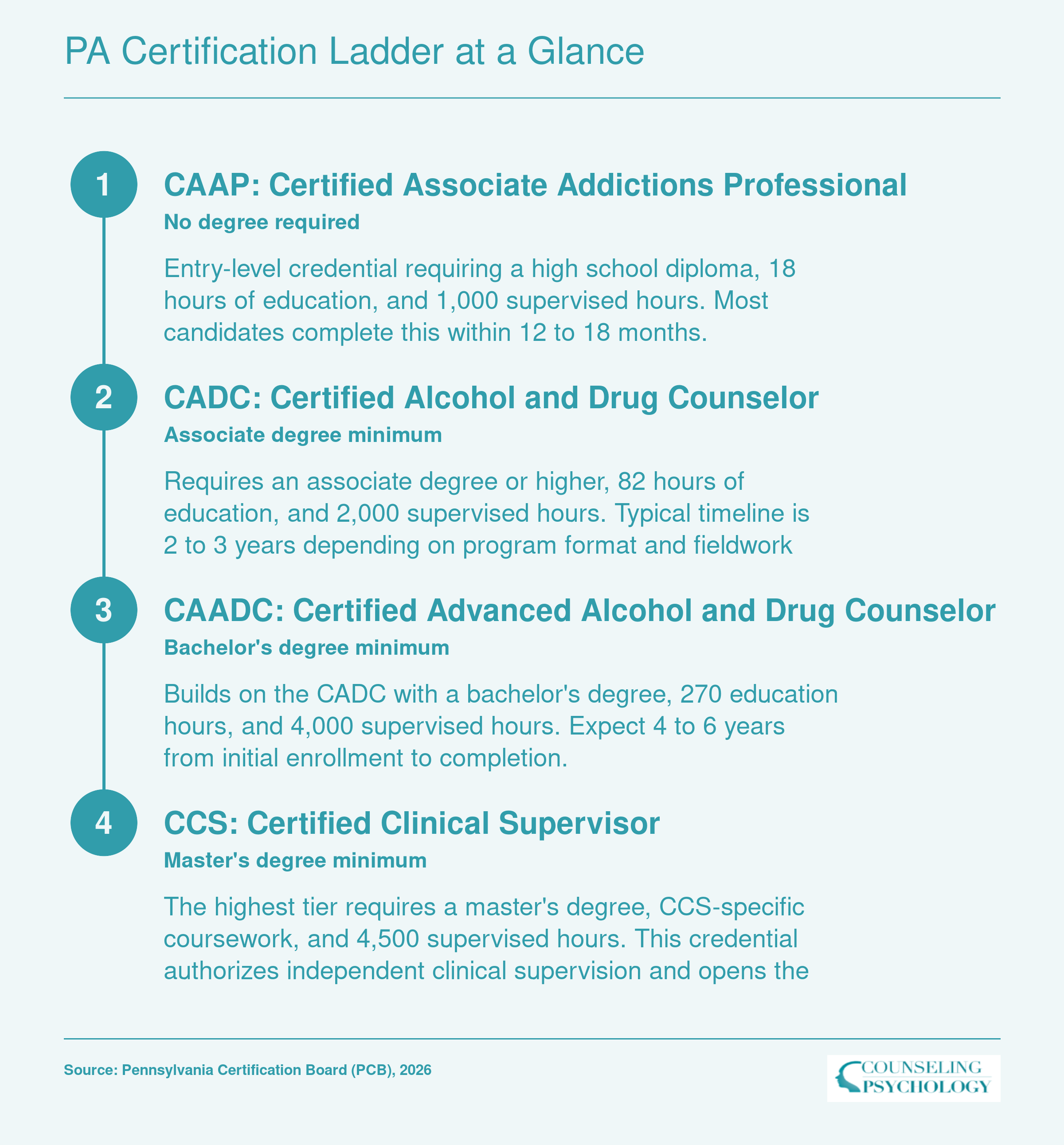
PA Certification Ladder at a Glance
Pennsylvania's substance abuse counseling credentials follow a four-tier progression, each unlocking broader clinical responsibilities, higher earning potential, and greater independence. The career outcomes section below details how each tier maps to salary ranges in the Philadelphia metro area.
Financial Aid, Scholarships, and PA Workforce Funding for Addiction Counseling Students
What financial aid options exist specifically for addiction counseling students in the Philadelphia area? The answer includes a mix of state workforce grants, federal loan repayment programs, and employer tuition benefits, all of which can dramatically lower the out-of-pocket cost of earning your degree or certificate.
Pennsylvania State Workforce Grants and Act 324
Pennsylvania has passed multiple laws to strengthen the behavioral health workforce. Act 54 of 2022 and Act 1 of 2023 laid the groundwork, but Act 324 created dedicated funding streams for recruiting and training substance use disorder professionals.1 While full implementation details are still rolling out through the Pennsylvania Department of Human Services, the 2026-2027 DHS Blue Book prioritizes behavioral health services, signaling continued investment.2 Students should monitor the Pennsylvania Behavioral Health Commission's website for grant cycles that may cover tuition, supervision stipends, or paid internships. Additionally, the Philadelphia Department of Behavioral Health and Intellectual disAbility Services (DBHIDS) offers workforce development grants and training scholarships.1 These local programs often target residents who commit to working in Philadelphia's public behavioral health system after graduation.
HRSA Substance Use Disorder Workforce Programs
At the federal level, the Health Resources and Services Administration (HRSA) runs the Behavioral Health Workforce Education and Training (BHWET) program, which supports students in social work, counseling, psychology, and specifically substance use disorder counseling.3 In 2025-2026, BHWET provides stipends, tuition assistance, and paid internships at approved field placement sites. Many Philadelphia-area universities partner with these grants; ask your program's financial aid office if they participate. HRSA also funds SUD Training Initiatives that integrate addiction treatment into primary care settings, another avenue for clinical placements with financial support.3
NHSC Loan Repayment for Philadelphia Providers
The National Health Service Corps (NHSC) offers loan repayment for licensed behavioral health providers who work in designated Health Professional Shortage Areas (HPSAs). Large portions of Philadelphia qualify, meaning substance abuse counselors employed at eligible sites can receive up to $50,000 in loan repayment for a two-year service commitment. Both CADC- and LPC-level clinicians are eligible, making this a powerful tool if you graduate with federal loans. Unlike some state grants, NHSC repayment is not limited to recent graduates, so it can be used even after you begin your career. For those interested in serving specific populations, roles like community mental health counselor positions often qualify for NHSC placement.
Employer-Sponsored Tuition at Philadelphia Treatment Centers
Several major addiction treatment providers in the Philadelphia region offer education benefits to employees.1 Organizations like Gaudenzia and NET Centers frequently provide tuition reimbursement, paid supervision hours, and even signing bonuses for staff pursuing counseling credentials. Because these employers need qualified counselors, they invest in current employees, whether you work in a support role while studying or join after earning a preliminary certificate. Check with human resources at any behavioral health employer about internal scholarship programs or partnerships with local colleges; some may fully cover the cost of an associate or bachelor's degree relevant to addiction counseling.
FAFSA, Pell Grants, and Affordability at Ranked Programs
Completing the Free Application for Federal Student Aid (FAFSA) remains the critical first step for accessing federal Pell Grants, subsidized loans, and work-study. Many of the affordable programs profiled earlier in this guide enroll a high share of Pell Grant recipients, confirming that these schools actively serve students with financial need. For example, community colleges with addiction counseling certificates typically see 30-50% of their students receiving Pell funds, which can cover the full cost of a certificate program. By stacking a Pell Grant with a state workforce grant, a student can often complete the required coursework with zero tuition burden.
Career Outcomes and Salary Expectations for Philadelphia Addiction Counselors
The Philadelphia-Camden-Wilmington metro area employed roughly 12,030 substance abuse, behavioral disorder, and mental health counselors as of May 2023, making it one of the larger employment hubs for this occupation on the East Coast. The mean annual wage in the metro area was $59,750, which runs slightly above the national median of about $53,710 (based on $25.82 per hour). Pennsylvania's Department of Labor and Industry projected a 7.6% job growth rate for this occupation in the Philadelphia MSA (PA portion) from 2020 to 2030, signaling steady demand. Program-level earnings data for graduates of the specific schools ranked in this article are not yet available at a granular level, so the BLS figures below offer the best current benchmark for what addiction counselors in the region can expect to earn at various career stages.
| Wage Measure | Philadelphia MSA (2023) | Pennsylvania Statewide (2023) | National (2023) |
|---|---|---|---|
| Mean Annual Wage | $59,750 | $61,040 | N/A |
| Median Annual Wage | $56,000 to $60,000 | $58,320 | $53,710 |
| 25th Percentile Annual Wage | N/A | $46,910 | $44,600 |
| 75th Percentile Annual Wage | N/A | $72,800 | $70,120 |
| Mean Hourly Wage | $28.73 | N/A | N/A |
| Total Employment | 12,030 | 26,510 | N/A |
| Projected Job Growth (2020 to 2030, PA portion of MSA) | 7.6% | N/A | N/A |
Online vs. On-Campus: Which Format Saves You More in Philadelphia?
Choosing between online and on-campus addiction counseling programs near Philadelphia is not just about convenience. Each format carries distinct cost implications that can affect your total investment, time to graduation, and ability to secure the clinical hours Pennsylvania requires for certification. Here is how the two options compare, along with a format that often splits the difference.
Pros
- Online programs frequently advertise lower per-credit tuition and eliminate commuting, parking, and relocation expenses entirely.
- Flexible scheduling lets working students maintain income while studying, reducing the need for loans or reduced work hours.
- On-campus programs at PA public institutions unlock in-state tuition rates that can undercut many nationally marketed online degrees.
- Local enrollment makes it far easier to access Philadelphia-area clinical placements arranged through existing school partnerships.
- Attending classes in person builds direct relationships with local employers, supervisors, and peers who become professional references.
- Hybrid formats at area schools often combine online coursework with structured local practicum, offering both flexibility and placement support.
Cons
- Cheap national online programs may require you to locate and secure your own clinical sites in Philadelphia, which can delay graduation by a semester or more.
- Self-arranged practicum placements sometimes involve unpaid site-finding efforts, additional background checks, or affiliation agreement fees that add hidden costs.
- Fully online students miss out on in-person networking events, employer panels, and career fairs hosted by Philadelphia-area schools.
- On-campus programs demand commuting time and transportation costs that add up quickly, especially for students outside the city center.
- Rigid class schedules at brick-and-mortar schools can conflict with work shifts common in entry-level behavioral health positions.
- Some online programs based outside Pennsylvania may not align their curricula with PA certification requirements, potentially requiring extra coursework later.
How to Choose the Best Budget-Friendly Addiction Counseling Program
Choosing an affordable addiction counseling program requires more than comparing tuition sticker prices. Four decision points separate wise investments from costly missteps: accreditation alignment, true total cost, practicum support, and return on investment by credential tier.
Start with Accreditation and Pennsylvania Approval
Before you compare price tags, verify that the program holds the approval needed to count toward your credential. For master's programs in counseling, CACREP accreditation signals quality and meets many licensure standards. At every level (certificate, associate, bachelor's, master's), check that the Pennsylvania Certification Board (PCB) recognizes the curriculum for Certified Alcohol and Drug Counselor (CADC) or Certified Advanced Alcohol and Drug Counselor (CAADC) pathways. An unapproved program, no matter how cheap, can add thousands of dollars and years to your timeline if you must retake coursework or supplement with continuing education after graduation. If you are exploring broader online addiction counseling degrees, the same accreditation checks apply.
Calculate Total Cost of Attendance, Not Just Tuition
Tuition is only the starting line. Add mandatory fees (technology, student services, lab), textbooks and software subscriptions, liability insurance, background checks and fingerprinting, drug screens, travel to practicum sites, and parking or transit passes. If your program runs full-time during the day, factor in lost income or reduced work hours. A $12,000 certificate that demands 30 hours a week on campus may cost you $25,000 in opportunity cost, while a $15,000 evening program lets you keep your paycheck. Request a line-item cost breakdown from the financial aid office before you commit.
Verify Practicum Placement Support
Programs differ sharply in how they handle the 300-plus supervised hours required for Pennsylvania certification. Some maintain partnerships with treatment centers, hospitals, and community agencies and assign you a site. Others expect you to cold-call facilities, negotiate your own memorandum of understanding, and secure a qualified supervisor. Self-placed practicums can add weeks of unpaid search time, travel costs to distant counties, and risk of last-minute cancellations. Ask admissions how many students secured placements within 30 days last year and whether the program covers malpractice insurance during fieldwork.
Map Credential Tier to Salary and Payback Period
A certificate costing $5,000 that qualifies you for a CADC and a median entry salary near $38,000 pays for itself in roughly two months of full-time work. A master's degree costing $40,000 that leads to a CAADC and positions starting near $55,000 carries a longer breakeven horizon, but opens clinical supervisory and administrative roles that certificates cannot reach. Students interested in related clinical paths, such as online clinical mental health counseling programs, will find similar cost-benefit calculations apply. If your five-year goal is private practice or program leadership, the master's investment makes sense. If you need to enter the workforce quickly and plan to ladder up credentials over time, start with the most affordable approved certificate and let employers subsidize the next step. Run the numbers for your timeline, not a generic student's.
Frequently Asked Questions About Addiction Counseling Degrees in Philadelphia
Prospective addiction counseling students in the Philadelphia area tend to ask the same core questions about cost, credentials, and timelines. The answers below reflect current Pennsylvania Certification Board (PCB) requirements and program details verified for 2025 and 2026.