
What you’ll learn in this article…
- A mixed strategy of renting introductory texts and buying clinical references can cut total program textbook costs roughly in half.
- Counseling ethics, theories, and techniques books double as licensure exam prep resources, making them worth owning permanently.
- Open educational resources remain scarce for graduate counseling courses, so most cost savings come from older editions and rentals.
- Online program students often face publisher platform requirements that limit the cost-saving options available to on-campus peers.
Textbooks across a 60-credit CACREP counseling master's program routinely cost between $2,000 and $4,000 when purchased new, making course materials a significant line item on top of tuition that can easily reach $30,000 to $60,000 for the full degree.
The buy-or-rent decision carries consequences that extend well past the final exam. Several core counseling texts, particularly those covering diagnosis, ethics, and multicultural theory, are standard references in clinical practice and appear repeatedly in licensure exam prep. A student who rents every book and returns it at semester's end may spend less upfront but face real gaps when preparing for the NCE, NCMHCE, or state licensing examinations years later. Understanding which counseling specialties are most in demand can also help you prioritize which reference texts to keep.
Graduate counseling students are working within a textbook market that has not shifted toward open access the way undergraduate education has. Major publishers still dominate CACREP-aligned syllabi, which means cost-saving strategies require deliberate planning at the course level rather than broad substitution.
Core Textbooks by CACREP Course Area: What You'll Actually Be Assigned
Across CACREP-accredited counseling programs, the same handful of textbooks show up on syllabus after syllabus, and knowing which ones before your first semester gives you a real shopping advantage. The list below reflects what's most commonly assigned for the 2025-2026 academic year across the eight core curriculum areas defined in CACREP Section 3.1 Your program may substitute, supplement, or skip any of these, so confirm with your course instructor before purchasing. Think of this as a representative map, not a universal syllabus.
The Most Commonly Assigned Titles
- Theories of Counseling: Theory and Practice of Counseling and Psychotherapy by Gerald Corey, 10th edition. Approximate new price: $140 to $160. This is arguably the single most adopted text in counselor education.
- Ethics: Issues and Ethics in the Helping Professions by Gerald Corey, Marianne Schneider Corey, Patrick Callanan, and Janet M. Mallinckrodt, 11th edition. Approximate new price: $110 to $140.
- Assessment and Testing: Assessment Procedures for Counselors and Helping Professionals by Daniel W. Whiston, 9th edition. Approximate new price: $100 to $130.
- Group Counseling: Theory and Practice of Group Counseling by Gerald Corey, Marianne Schneider Corey, and Cindy Corey, 10th edition. Approximate new price: $130 to $160.
- Multicultural Counseling: Counseling the Culturally Diverse: Theory and Practice by Derald Wing Sue and David Sue, 9th edition. Approximate new price: $120 to $150.
- Career Counseling: Career Counseling: A Holistic Approach by Jane L. Swanson and Nadya A. Fouad, 3rd edition. Approximate new price: $100 to $130.
Research methods is the area where adoption varies most widely. Some programs assign a general behavioral sciences research text, others use a counseling-specific volume, and several rely on a packet of journal articles instead of a single book. Ask your faculty advisor before buying anything for that course.
Which Texts Travel Across Programs
The Corey titles dominate. If you go through a CACREP-accredited program, expect to encounter Corey for theories, ethics, and group work, often with the same author across all three courses. Sue and Sue is the near-default for multicultural counseling and has been for two decades. These are the texts you are most likely to see on a friend's syllabus at a different university, which also makes them the easiest to find used or to borrow.
Edition Cycles to Watch
The Corey titles release new editions roughly every three to four years, and Sue and Sue updates on a similar cadence. Whiston's assessment text and the Swanson and Fouad career book move more slowly, with five to seven years between editions. The practical implication: if you are buying used, a one-edition-back Corey or Sue and Sue is usually safe for content but may have shifted chapter numbers, while older editions of the slower-cycling texts are often nearly identical to the current one. Keeping these texts as long-term references can also pay off during counseling licensure exam preparation. Always cross-check the edition your specific instructor requires before you click buy.
Ask Yourself: What Kind of Counseling Student Are You?
Buy vs. Rent vs. Digital: A Side-by-Side Comparison
Buying, renting, and accessing digital versions of your counseling textbooks represent three distinct strategies, each with trade-offs in cost, convenience, and long-term utility. Understanding these options side by side helps you make decisions that align with both your budget and your study habits.
Understanding Your Three Main Options
When you buy a textbook outright, whether new or used, you own it permanently. This means you can highlight, annotate, and return to it years later during licensure exam preparation or clinical practice. New copies carry the highest price tag, while used copies from previous students or resellers offer savings that vary depending on condition and edition. Purchasing makes the most sense for foundational texts you will reference repeatedly throughout your career.
Renting allows you to access a physical or digital copy for a set period, typically one semester. Rental costs are generally lower than purchasing, but you must return the book by a deadline, and any highlighting or notes stay with the physical copy when you send it back. This option works well for courses where the textbook serves a single-semester purpose and has limited long-term reference value.1
Digital access, sometimes called e-textbooks or digital rentals, provides electronic copies you read on a computer, tablet, or phone. Digital options often come at lower price points than print, but access duration varies widely by platform and purchase type. Some digital purchases grant permanent access, while others expire after a semester or a set number of months.
Where to Check Current Pricing
Prices fluctuate by semester, edition, and platform demand, so relying on static averages can mislead your budget planning. For accurate, real-time quotes on your specific titles, visit major platforms directly:
- Chegg: Offers both physical rentals and digital access, with rental periods typically aligned to academic semesters.
- Amazon Textbook Rentals: Provides physical rentals and used purchase options alongside new copies, with pricing that shifts based on availability.
- VitalSource: Specializes in digital textbooks with features like offline reading and annotation tools.
- RedShelf: Another digital-first platform with institutional partnerships that may integrate with your school's bookstore.
Your school's official bookstore website also lists required editions and often shows bundled pricing or inclusive access programs. For broader context on textbook price trends over time, the Bureau of Labor Statistics tracks education-related costs, and professional organizations like the American Counseling Association sometimes recommend core resources.
Evaluating Platform Features for Your Study Habits
Beyond price, the right platform depends on how you study. Students who already rely on technology for coursework may also benefit from exploring AI tools for psychology students that complement digital textbook workflows. If you commute by train or bus, offline access becomes essential, so confirm that your digital platform allows downloads rather than requiring constant internet connectivity. If you are an active reader who marks up every page, robust annotation tools matter, and you should test whether a platform lets you export or retain your notes after access expires.
Access duration is another critical factor. Some digital rentals expire mid-finals week if you miscalculate. Before purchasing, check each platform's terms to ensure your access covers the full semester, including any final exam or paper deadlines.
Build Your Own Comparison Spreadsheet
Static guides cannot account for your specific course list, edition requirements, or regional pricing variations. The most actionable approach is creating a simple spreadsheet with columns for each textbook title, platform, rental price, purchase price, digital price, access duration, and key features like offline reading or annotation export. Populate this for each required text at the start of the semester, and you will have personalized data that reveals your true cost per semester across all options.
This exercise takes about an hour but often uncovers savings you would miss by defaulting to convenience. Over a two-year program, small differences per book compound into meaningful totals.
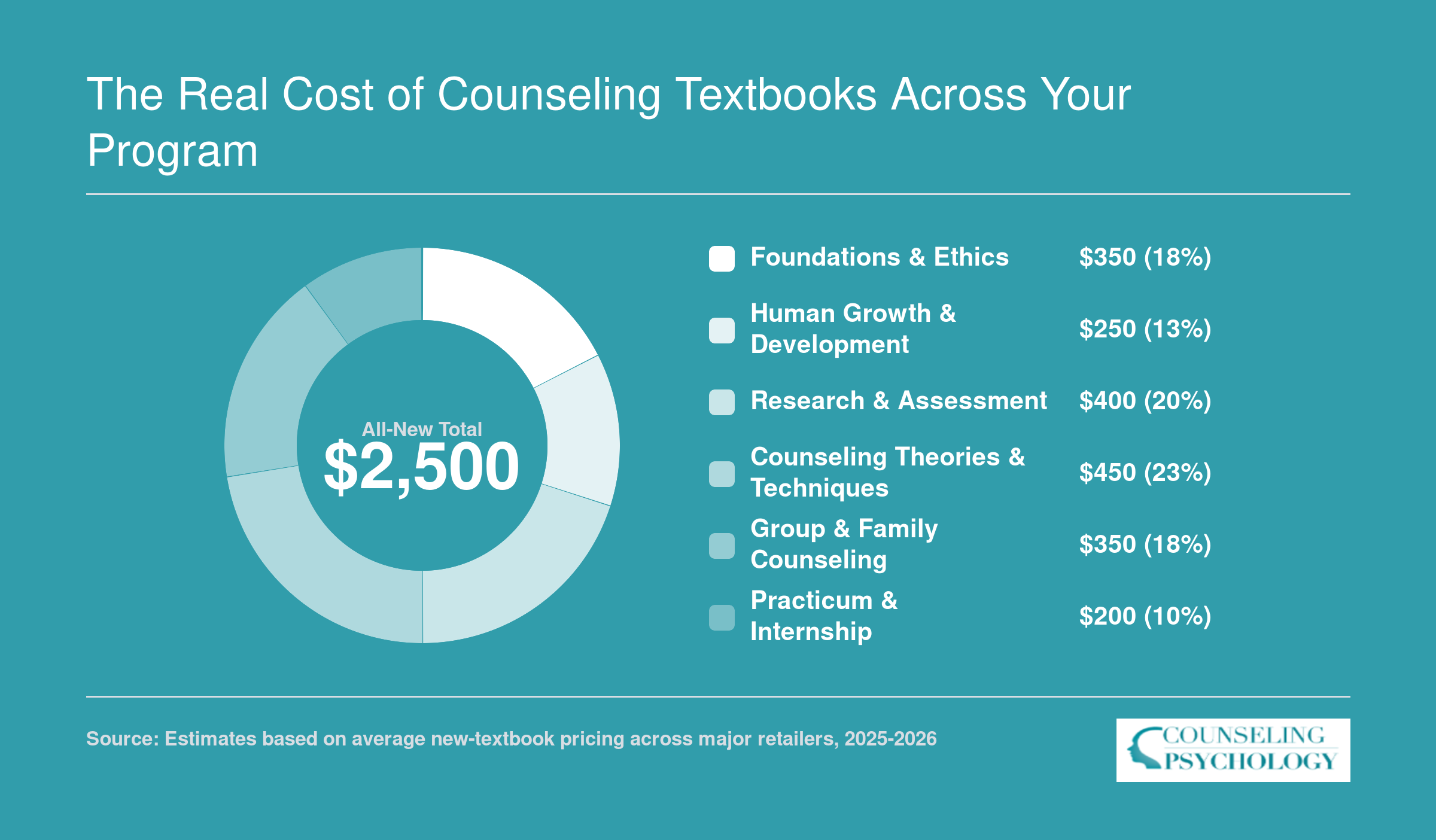
The Real Cost of Counseling Textbooks Across Your Program
A typical CACREP-accredited master's program spans 60 credit hours and roughly 20 courses. Below is an estimated breakdown of total textbook spending by core course area when buying all new. Switching to a mixed strategy of renting introductory texts, buying key clinical references, and using digital options where available can cut this total by 40% or more.
Which Counseling Textbooks Are Worth Owning Long-Term?
Should you keep your counseling textbooks after the semester ends, or sell them back to recoup cash? This decision affects not only your immediate budget but also your clinical preparation for years to come. A recent discussion in the r/counseloreducation subreddit captured the debate: students graduating from CACREP programs shared which books they still reach for in practice and which ones collect dust.1 The consensus points to a clear hierarchy of value, shaped by how often you will reference a text beyond graduation and how well it holds up as licensure exams and diagnostic manuals evolve.
Must-Own Tier: Ethics, Theories, and DSM Companion Texts
Certain textbooks function as lifelong desk references. Ethics texts top this list because ethical dilemmas arise throughout your career, and having a well-annotated copy of the ACA Code of Ethics commentary or a comprehensive casebook saves you from searching online forums when real clients are involved. Counseling theory texts also belong here. Whether your program assigned Corey's *Theory and Practice of Counseling and Psychotherapy* or Capuzzi and Stauffer's *Counseling and Psychotherapy*, these books help you articulate your theoretical orientation during job interviews, supervision, and licensure oral exams.
DSM companion texts, such as study guides or differential diagnosis workbooks, are valuable but timing-sensitive. The DSM-5-TR released in 2022, and when DSM-6 eventually arrives, older companions lose clinical relevance. If you are within two years of taking the National Counselor Examination (NCE) or National Clinical Mental Health Counseling Examination (NCMHCE), keep these books. If graduation is further out, consider renting or buying used, then replacing closer to your exam date.
Situational Tier: Assessment and Group Counseling
Assessment textbooks and group counseling manuals fall into a middle category. If you plan to work in school counseling, career counseling, or private practice settings where you will administer assessments regularly, hold onto texts that catalog instruments and interpret scores. For clinicians in agencies that do not emphasize formal testing, these books are less critical post-graduation. Group counseling texts are useful if you intend to lead therapeutic groups, but many practitioners find that agency training and mft supervised experience materials replace textbook content once they are licensed.
Safe-to-Rent Tier: Research Methods and Electives
Research methods, program evaluation, and career counseling elective texts rarely serve as ongoing references. Reddit community members consistently report never opening these books after finals.1 Renting or buying older editions for these courses frees up funds for the must-own category. Students early in their programs should also watch for common mistakes enrolling online masters counseling, including overspending on textbooks before confirming which editions their instructors actually require. Before you sell any textbook, check with your licensure exam prep provider. Some review courses, such as those offered by the Counselor Exam Preparation (CEP) program or TherapistDevelopmentCenter, recommend specific texts as supplemental study materials. Selling a book in May only to repurchase it in October for exam prep is a costly mistake.
Related Articles
Free and Low-Cost Alternatives: OER, Library Access, and Inclusive Access Programs
Choosing between premium commercial textbooks and free or low-cost alternatives can mean the difference between spending thousands on course materials or investing that money in conference travel, certification exams, or supervised hours. While counseling graduate programs traditionally rely on commercial publishers, a growing ecosystem of open educational resources (OER), institutional library holdings, and inclusive access programs offers practical pathways to reduce costs without compromising academic preparation.
Open Educational Resources for Counseling Students
OER repositories host peer-reviewed, openly licensed materials that faculty and students can access without cost. MERLOT (Multimedia Educational Resource for Learning and Online Teaching) and OER Commons maintain searchable databases where you can filter by discipline and level. Search terms like "counseling," "psychotherapy," "clinical interviewing," or "ethics in mental health" often surface introductory texts, case studies, and multimedia modules. These materials typically carry Creative Commons licenses, meaning you can download, annotate, and share them freely.
While OER coverage at the graduate counseling level remains thinner than in undergraduate general education courses, you may find usable resources for foundational topics such as career development theory, multicultural counseling frameworks, or research methods. Quality varies, so cross-reference any OER text with your syllabus learning objectives and ask your instructor whether a given resource meets accreditation standards for CACREP or state licensure coursework.
Professional Association Resources and Clinical Guidelines
Professional organizations offer another layer of free content that complements or occasionally substitutes for textbooks. The American Counseling Association (ACA) publishes practice briefs, position statements, and ethics updates on its member portal, many of which are accessible without paid membership. The Substance Abuse and Mental Health Services Administration (SAMHSA) provides evidence-based practice toolkits, treatment improvement protocols, and clinical guidelines at no cost. These materials are especially valuable in courses on substance use counseling, trauma-informed care, and community mental health practice.
Bookmark these sites early in your program and check for new publications each semester. Some faculty design assignments around these freely available clinical resources, reducing reliance on commercial texts.
Inclusive Access Programs and Opt-Out Policies
Many universities have partnered with publishers to offer inclusive access programs, which bundle digital textbooks into tuition or course fees at a negotiated discount. You receive automatic access on the first day of class, and the cost appears on your student account rather than at the bookstore checkout. These programs often reduce per-book prices by 30 to 50 percent compared to new retail editions.
However, inclusive access is not always optional by default. Some institutions auto-enroll all students and require you to actively opt out during a narrow window, typically the first week or two of the semester. If you already own a book, prefer print, or found a cheaper alternative, missing the opt-out deadline means paying for access you will not use. Contact your university library, the bookstore, or the Office of Student Financial Services to learn your school's opt-out process, deadline, and refund policy. Check your institution's affordability initiatives webpage for detailed timelines and forms.
Leveraging Your University Library
Your tuition already funds library subscriptions to ebook platforms, academic databases, and course reserves. Many libraries purchase digital or print copies of assigned textbooks and place them on short-term loan, allowing multiple students to access the same title throughout the semester. Ask your liaison librarian whether your required texts are available as e-reserves or through interlibrary loan. Some institutions also participate in consortia that share collections across campuses, expanding your access beyond your home library's holdings. Students who pair these library strategies with online graduate certificate psychology coursework, which sometimes bundles digital materials into program fees, can stretch their budgets even further.
Key Insight: The OER Gap in Graduate Counseling
While open educational resources have dramatically reduced costs for undergraduates, graduate counseling programs remain anchored to proprietary textbooks from major publishers. This means the free alternatives that transformed courses elsewhere are not yet widely available for your core classes, making smart buying and renting decisions your best financial strategy.
Older Editions, International Editions, and Used Books: What's Safe to Buy?
Buying one edition behind can cut your textbook bill by half or more, but the rules differ sharply by course. A 2018 research methods text reads almost identically to its 2023 revision; a 2018 multicultural counseling text does not.
When One Edition Back Is Generally Safe
For courses where the underlying content is stable, the previous edition is usually fine. Page numbers may shift, but the concepts, frameworks, and core citations carry over.
- Research methods and statistics
- Career development and counseling
- General counseling theories (person-centered, CBT, psychodynamic foundations)
- Group counseling fundamentals
- Lifespan development
These texts update mostly to refresh examples, add a few recent studies, and adjust formatting. The conceptual scaffolding stays the same across editions.
When the Latest Edition Really Matters
Some books are tied to evolving professional standards, and an older edition can leave you studying outdated material right before licensure prep.
- Ethics texts: The ACA Code of Ethics revises on a multi-year cycle, and ethics textbooks track those revisions closely. An older edition may reference superseded language on telehealth, social media, or informed consent.
- Multicultural and social justice counseling: Terminology, frameworks (such as the MSJCC), and case examples shift quickly. Older editions can feel dated and may not align with current CACREP standards. If your program holds CACREP vs COAMFTE accreditation, your faculty will likely enforce the newest edition for these courses.
- Assessment and psychopathology: Anything tied to the DSM should match the current DSM-5-TR. Cross-walks from older editions are doable but tedious.
International Editions and Used Books
International editions usually contain the same chapters and pagination as the US version, printed on thinner paper with a different cover. The catch: they often ship without access codes, and some publishers strip end-of-chapter materials. A few professors explicitly prohibit international editions because of licensing concerns, so check the syllabus and email your instructor before ordering one.
Used copies from Amazon Marketplace, ThriftBooks, AbeBooks, and campus bookstore buyback shelves can save 40 to 70 percent off list price. Before you click buy, verify three things:
- The edition number matches what the syllabus requires (or that your professor has approved a substitute)
- The listing notes condition honestly (heavy highlighting, water damage, or missing pages are common)
- The book does not require an unused access code for online homework, quizzes, or simulations
When in doubt, a two-line email to the professor asking whether the previous edition is acceptable will save you a return shipment and a missed reading. If you are still evaluating online counseling degree programs, sorting out textbook policies early can also help you compare total cost of attendance across schools.
Online vs. On-Campus Programs: Do Textbook Needs Differ?
Textbooks That Double as Licensure Exam Prep Resources
The tension every counseling graduate student faces is whether to save money now by renting or to invest in books that might pay off when you sit for licensure exams. Spend too little upfront, and you could be buying pricey prep materials later. Identify the few textbooks that pull double duty, and you can streamline both your master's and your path to the NCE or NCMHCE.
The Textbook-Exam Overlap: Why Course Books Are Your First Prep Tool
CACREP-aligned programs cover the eight core content areas that directly map to the National Counselor Examination (NCE) domains.1 The introductory counseling textbook assigned in your first semester, often Gladding's "Counseling: A Comprehensive Profession" or Erford's "Orientation to the Counseling Profession," lays the foundation for professional identity, history, and ethical standards, mirroring the Professional Orientation and Ethics domain of the NCE.2 Similarly, a theories course built around Corey's "Theory and Practice of Counseling" gives you the theoretical frameworks tested heavily on both the NCE and the NCMHCE.3 Because the exams assess competency in these foundational areas, your course textbooks are essentially your first set of study guides.
The Three to Four Books You Should Own for Exam Prep
Test prep experts and counselor educators consistently name a short list of textbooks worth buying for long-term retention. For the NCE, an introductory text and a theories text are non-negotiable. Gladding or Erford will carry you through multiple domains; Corey will anchor the Helping Relationships section. If your program requires a clinical assessment or diagnosis textbook, that volume becomes critical for the NCMHCE, where case-based simulations demand fluency in diagnostic reasoning.3 No student should be without a current copy of the ACA Code of Ethics, a reference cited across both exams and one you will use throughout your career. For those planning to become a mental health counselor, buying these three to four books (typically an outlay of $150 to $300) means you can skip purchasing separate content reviews that cover the same material.
Complementary Exam Guides: What to Add, Not Substitute
Dedicated exam prep resources like Rosenthal's "Encyclopedia of Counseling" for the NCE or the Mometrix NCMHCE study guide are highly recommended, but they are companions, not replacements.3 The "Encyclopedia" uses a question-and-answer format that assumes you have already internalized core concepts from your coursework. CounselingExam.com and other prep sites similarly point back to the DSM-5-TR, the ACA Code of Ethics, and major theories texts as the primary sources.5 The NBCC also offers official practice tests aligned to its exam domains, which can help you gauge readiness.6 Add these focused prep tools about two to three months before your exam date, but don't sell back your foundational textbooks in anticipation.
Rent the Rest and Pocket the Savings
For the majority of your counseling master's textbooks (specialized texts on addictions, career counseling, or school counseling interventions) renting or using digital access makes financial sense. These subjects may appear on exams, but the detail you need is often already summarized in broader review guides or can be refreshed through free online resources. By purchasing only the three to four exam-critical books and renting everything else, you can cut your total textbook cost by roughly half while still walking into the testing center with the references you truly need.
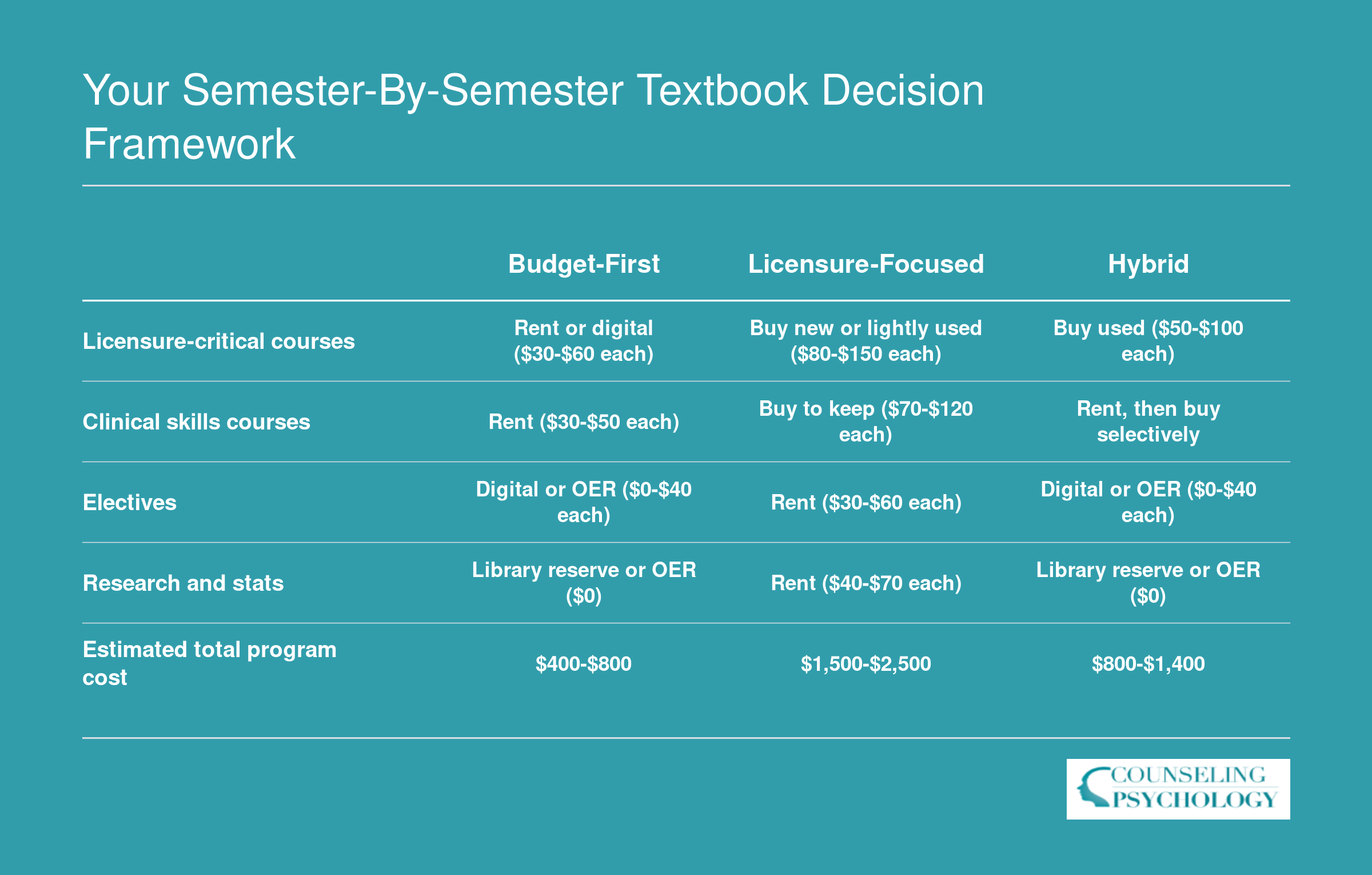
Your Semester-by-Semester Textbook Decision Framework
Not every textbook deserves the same investment strategy. The right approach depends on whether you prioritize keeping costs low, building a licensure-prep library, or blending both. Here is how estimated total program textbook spending breaks down across three common student profiles, along with the recommended action for each course type.