What you’ll learn in this article…
- Augustana University offers South Dakota's primary CSWE-accredited MSW, available in both online and on-campus formats.
- Advanced standing applicants with a BSW can finish most MSW programs in roughly one year instead of two.
- LCSW licensure requires 3,000 supervised clinical hours but significantly increases earning potential and practice independence.
- BLS reports a national median salary of roughly $58,510 for social workers, though South Dakota figures differ.
Rural workforce shortages have pushed South Dakota's social services agencies to recruit more aggressively from MSW programs, yet the state itself has only one CSWE-accredited option. That scarcity means students often look beyond state lines, where online MSW programs from neighboring institutions expand the choices considerably.
The University of South Dakota anchors the in-state pipeline, while regionally accredited online programs from universities in Minnesota, Nebraska, and North Dakota accept South Dakota residents and often honor regional tuition agreements. The practical tension for most applicants is straightforward: balance limited local fieldwork sites against programs designed for distance learners who can complete placements closer to home.
Licensure requirements in South Dakota remain consistent regardless of where you earn the degree, so program choice hinges more on cost, format, and clinical concentration than geography alone.
Best MSW Programs in South Dakota: Rankings & Comparison
South Dakota's MSW landscape is compact: one CSWE-accredited, in-state program dominates the field. That limited supply is actually a strength for students who know what they want, because the University of South Dakota has refined its curriculum around the populations and practice settings that define this state. If you need more variety in concentration, format, or cost, nearby out-of-state online MSW options are covered later in this article.
- CSWE accreditation status
- Net price and tuition context
- Institution-wide graduation rate
- Graduate earnings outcomes
- Program format and accessibility
- NCES-IPEDS federal institutional data — nces.ed.gov
- College Scorecard graduate earnings — collegescorecard.ed.gov
- Independent program research
- Internal program database

University of South Dakota
The University of South Dakota is the state's flagship public research institution in Vermillion, and it houses the only CSWE-accredited MSW program based in South Dakota. The curriculum is built around advanced generalist practice with a deliberate emphasis on rural communities, tribal nations, and agricultural populations, making it a natural fit for students planning to practice locally. With a CSWE accreditation history stretching back to 1974, an accessible online delivery option, and graduate tuition that consistently ranks among the lowest nationally for an MSW, USD serves as the primary pipeline for licensed social workers across the state.
- CSWE-accredited since 1974; fully accredited as of 2024
- 60-credit traditional track for non-BSW holders
- 36-credit advanced standing track for BSW graduates
- Available fully online or through blended delivery in Sioux Falls
- 900 hours of supervised field education required
- Online tuition near $340 per credit with no out-of-state differential
- Path to Licensure program embedded in field education
- Curriculum centers rural, Native American, and agricultural practice
Master of Social Work — Online
How We Ranked South Dakota MSW Programs
A ranking built around prestige scores looks very different from one built around what students actually pay and earn. We chose the second approach, because most prospective MSW students in South Dakota are weighing real tradeoffs around cost, debt, and post-graduation income, not chasing brand names.
What We Weighted Most Heavily
Affordability carries the largest share of the score. We looked at published in-state and out-of-state tuition, net price after typical grant aid, and the availability of graduate assistantships, tuition discounts for in-state residents, and field placement stipends. A program that costs $15,000 less over two years can free a new social worker from years of restrictive loan payments, which matters in a state where mental health and child welfare salaries run below national medians.
CSWE accreditation is a pass/fail gate. Programs without Council on Social Work Education accreditation do not qualify for South Dakota licensure as an LSW or LCSW-PIP, so we excluded any program that lacks current accredited status.
Data Sources and Their Limits
Tuition and enrollment figures come from the federal IPEDS database. Earnings and debt outcomes for program completers come from the U.S. Department of Education's College Scorecard. Accreditation status is verified directly through CSWE's program directory.
A few honest caveats: graduation rates reported by IPEDS are institution-wide, not MSW-specific, so they describe the school's overall student support rather than the social work department alone. Scorecard earnings track federally aided graduates only and reflect a snapshot a year or two after completion, not mid-career pay.
Unlike listicles that simply name schools in alphabetical order or by reputation, every program here was scored against the same transparent criteria.
MSW Tuition & Financial Aid in South Dakota
Tuition transparency varies across MSW programs accessible to South Dakota residents. Augustana University, the state's primary MSW provider, does not publicly list per-credit tuition for its MSW program as of the 2025-2026 academic year, though its other graduate programs can offer a rough benchmark. Always confirm current rates directly with each school's admissions or financial aid office, and check CSWE accreditation status before enrolling. The South Dakota Board of Regents financial aid portal and the NC-SARA website are also useful tools for identifying scholarship opportunities and verifying whether an out-of-state online program can legally operate in your state.
| Institution | Program | Per-Credit Cost (2025-2026) | Tuition Differential for SD Residents | Notes |
|---|---|---|---|---|
| Augustana University | MSW | Not publicly posted | No differential reported | Contact the university directly for current MSW tuition. Other Augustana graduate programs (M.Ed., MBA) are listed at approximately $490 per credit, and the ABA program at $510 per credit, which may serve as a general reference point. |
| University of North Dakota | Online MSW | Verify on UND's Graduate School or Social Work department page | Check for regional tuition agreements (e.g., MHEC or similar) | UND is expected to participate in NC-SARA, which typically allows South Dakota residents to enroll in online programs without out-of-state surcharges. Confirm details on their tuition and fees page. |
| Other Regional Online MSW Programs (NE, IA, MN) | Online MSW | Varies by institution | Check NC-SARA membership and any regional reciprocity agreements | Schools in nearby states often accept SD residents at competitive rates through SARA participation or Midwest Higher Education Compact agreements. Verify CSWE accreditation and per-credit costs on each school's official tuition page. |
Questions to Ask Yourself
Online vs. On-Campus MSW Programs in South Dakota
Choosing between online and on-campus MSW study in South Dakota often comes down to geography, work obligations, and learning style. Both formats lead to the same CSWE-accredited degree, and both require identical supervised field hours for licensure eligibility. The right fit depends on how you balance flexibility against community.
Pros
- Online MSW programs give rural South Dakota students access to quality education without relocating to Vermillion or Sioux Falls.
- Staying employed full time is far easier with asynchronous coursework, a major advantage for working professionals.
- Online enrollment opens the door to CSWE-accredited programs hosted by out-of-state universities, expanding your options considerably.
- On-campus cohorts build strong peer networks and a sense of professional community that can support you throughout your career.
- In-person students benefit from direct faculty mentorship, including spontaneous conversations and research collaboration opportunities.
- On-campus programs often have embedded field placement partnerships with tribal nations, rural health systems, and community agencies across the state.
Cons
- Online students have fewer organic networking moments with classmates and faculty, which can make relationship building more intentional work.
- Field placements for online learners require local coordination, and students in remote areas may need to travel for approved agency sites.
- On-campus options in South Dakota are largely limited to the Vermillion and Sioux Falls areas, which restricts access for students elsewhere in the state.
- Traditional classroom schedules offer less flexibility, making it harder to juggle employment or family responsibilities alongside coursework.
Related Articles
MSW Admissions & Field Education in South Dakota
Standard admissions versus advanced standing: these two entry points define how long your MSW journey will take, and understanding the difference upfront saves a lot of second-guessing later.
Standard Admissions Requirements
Most MSW programs in South Dakota expect applicants to hold a bachelor's degree from a regionally accredited institution, typically with a minimum cumulative GPA around 3.0, though competitive applicants often exceed that threshold. Beyond the transcript, programs request a personal statement describing your professional goals and motivation for graduate study, along with two or three professional or academic references who can speak to your readiness for advanced social work practice. Some programs also require prerequisite coursework in areas like psychology, sociology, or human biology, so it is worth reviewing program-specific requirements before you apply.
The Advanced Standing Track
If you already hold a BSW from a CSWE-accredited program, you may qualify for an advanced standing track that lets you skip the foundation year and move directly into the concentration curriculum. This typically reduces total program length by about one year, an advantage that matters when weighing tuition costs and time away from the workforce. Eligibility generally hinges on a strong undergraduate GPA, recent graduation, and demonstrated field competency at the BSW level.
Field Education: Hours, Placements, and Purpose
Field education is the backbone of any MSW program, and South Dakota programs reflect that. The University of South Dakota structures its field requirement within a range of 500 to 1,000 hours depending on track and concentration, with placements coordinated primarily within South Dakota.1 Students complete supervised practice in settings such as hospitals, school-based programs, rural community health centers, and tribal agencies.
That last category is a genuine differentiator for USD. South Dakota's geography puts students within reach of placement opportunities serving Native American communities, including sites connected to Indian Health Service.2 For students who want to work in reservation communities or rural tribal contexts after graduation, this kind of field exposure is difficult to replicate anywhere else. USD's program explicitly emphasizes both rural practice and Native American community engagement as program priorities, not simply as elective options.2 Students interested in related helping professions may also want to explore counseling education programs in South Dakota for additional graduate options in the state.
Augustana University's MSW is on-campus in Sioux Falls, and while its field placement details are not publicly reported at this time, the program offers distinctive experiential options including a Washington D.C. semester and a Norway study abroad component for students interested in policy or international contexts.3
Whichever program you choose, field education is where classroom theory meets the complexity of real client systems. Treat placement selection as seriously as you treat course selection.
South Dakota Social Work Licensure: From MSW to LCSW
The South Dakota Board of Social Work Examiners oversees every step of the clinical licensure ladder. After earning your MSW, you will move through a structured credentialing sequence before you can practice independently as a Licensed Clinical Social Worker. Here is how the progression works in 2026.
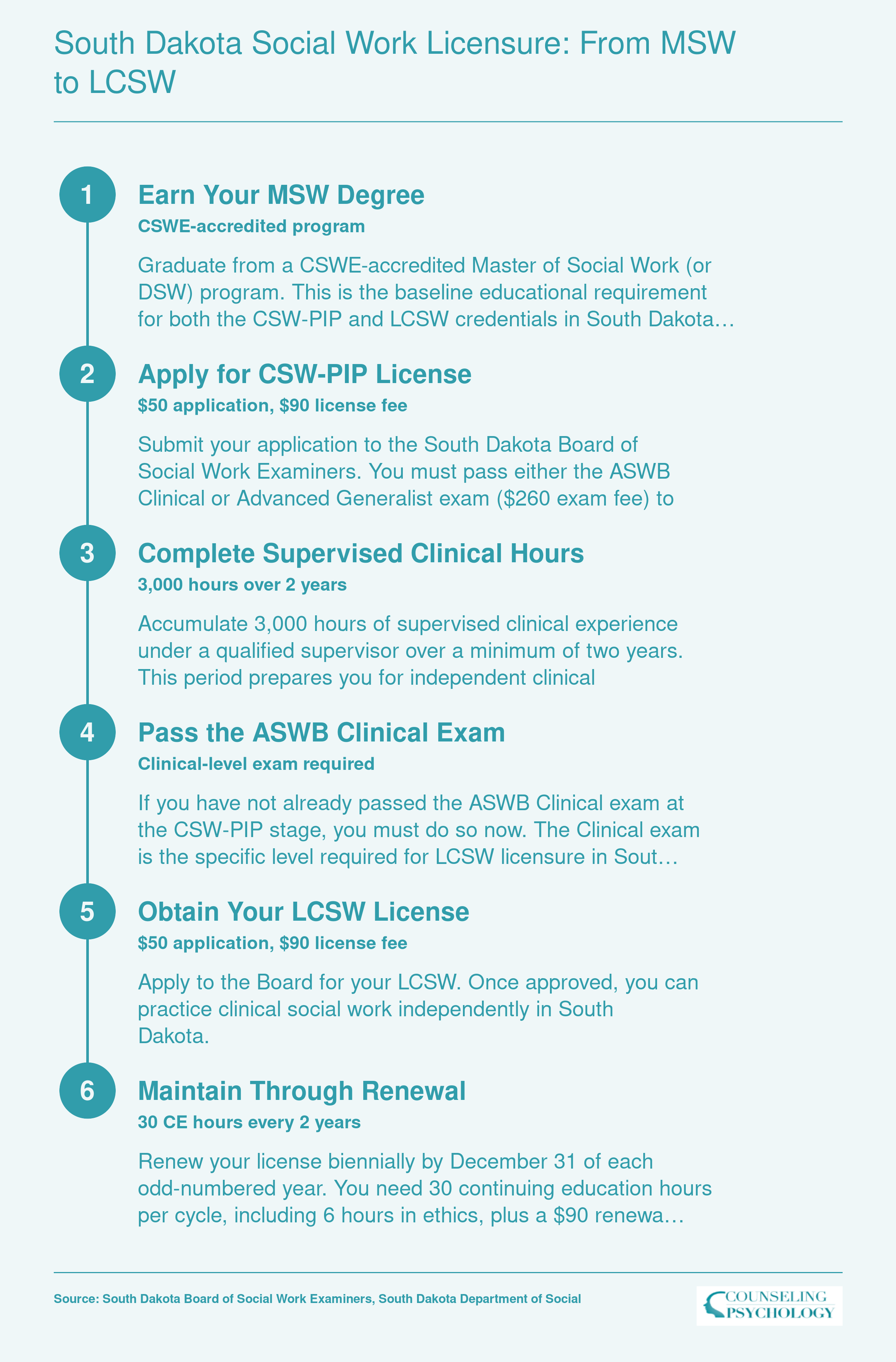
An MSW opens the door to entry-level social work roles, but LCSW licensure is where earning power truly jumps. The 3,000 supervised hours required in South Dakota represent a direct investment in clinical competence, private-practice eligibility, and salaries that can exceed entry-level positions by 30 percent or more. Plan your post-graduation supervision timeline accordingly.
Career Outcomes & Salaries for MSW Graduates in South Dakota
Choosing an MSW program is partly a financial decision, and South Dakota graduates should go in with realistic expectations about both earnings and the cost-of-living context that shapes what those numbers actually buy.
What Program-Level Earnings Data Shows
For the University of South Dakota's MSW program, program-level earnings data from the federal College Scorecard is not yet published for recent completers, which limits how precisely we can describe early-career income for USD-specific graduates. What the institutional data does show is a median graduate debt figure around $23,500, which is notably modest for a master's-level professional program. That relatively low debt load matters when you are entering a field where starting salaries tend to sit in the mid-to-upper $40,000s across much of South Dakota.
What BLS Data Tells Us About South Dakota Social Worker Wages
The Bureau of Labor Statistics publishes state-level wage estimates for social workers in South Dakota through its Occupational Employment and Wage Statistics program, with the most recent data from May 2025.1 Wages vary by specialty, and it is worth knowing where each tracks:
- Child, family, and school social workers (SOC 21-1021): This is the largest employment category in the state, with positions concentrated in county agencies, schools, and the child welfare system.
- Healthcare social workers (SOC 21-1022): Rural hospitals, Indian Health Service facilities, and regional health systems employ graduates in this specialty, often with slightly higher compensation tied to healthcare sector pay scales.
- Mental health and substance abuse social workers (SOC 21-1023): Demand is particularly acute across the state, driven by a well-documented shortage of behavioral health providers in rural and tribal communities.
BLS does report metropolitan-area data for both the Sioux Falls and Rapid City metro areas as of May 2025, though the specific median figures for each specialty in those metros can shift year to year.2 For current numbers, the BLS May 2025 state and metro area wage estimates are the authoritative source to consult directly.
Nationally, BLS projects social work employment to grow by roughly 6 percent from 2024 to 2034, which is on par with the average for all occupations.3 South Dakota's Labor Market Information Center projects similar or stronger local demand, particularly in behavioral health and tribal health settings.4
High-Demand Settings in South Dakota
Several practice areas stand out for MSW graduates entering the South Dakota job market:
- Tribal health and Indian Health Service: The state's nine federally recognized tribes represent a significant and underserved employer base, with chronic shortages of licensed clinical social workers.
- Rural behavioral health: Crisis counseling, outpatient therapy, and community mental health center roles are consistently hard to fill outside of Sioux Falls and Rapid City. Graduates interested in substance abuse counselor degree online options may find that addiction-focused credentials add even more marketability in these areas.
- Child welfare: The Department of Social Services and county offices regularly recruit MSW-level candidates, and the advanced standing pathway at USD can shorten time-to-hire for BSW graduates.
- Rural hospitals and critical access facilities: Healthcare social workers play a central discharge planning and care coordination role in facilities that often cannot recruit from large metro labor pools.
The Cost-of-Living Factor
South Dakota's nominal salaries for social workers are generally below national medians, and that gap is real. The national median wage figures published by BLS are not a reliable proxy for what a South Dakota graduate will earn, so treat national figures as a benchmark rather than a target. What partially compensates is the state's lower cost of housing and daily expenses compared to coastal and large metro markets. A salary in the mid-$50,000s in Sioux Falls carries meaningfully different purchasing power than the same figure would in Denver or Minneapolis. Combined with USD's comparatively low graduate debt, the return-on-investment picture looks more favorable than raw salary comparisons might initially suggest.
Frequently Asked Questions About South Dakota MSW Programs
Prospective MSW students in South Dakota tend to ask many of the same questions about program options, accreditation, and licensure. Below are straightforward answers grounded in the latest available program data for the 2025 to 2026 academic year.