
What you’ll learn in this article…
- Several CACREP-accredited CMHC programs near Newport News rank highly for affordability, with net price weighted at over 40 percent of each score.
- Virginia's three-tier LPC to LPCC licensure pathway typically takes five to seven years from first graduate course to full clinical independence.
- Hampton Roads offers unique clinical placement access through military installations, VA facilities, and community mental health centers.
- Regional counselor wages fall below the national median, making low program debt critical for a strong return on investment.
How much does a CACREP-accredited clinical mental health counseling degree actually cost in Virginia? Across the 13 programs ranked here, in-state tuition ranges from roughly $10,900 to over $31,600 for the full 60-credit curriculum, and effective net prices after aid span from about $14,600 to $30,300. That spread matters in a region where demand for licensed counselors keeps climbing, driven in part by the concentration of active-duty military, veterans, and military families across Hampton Roads.
Newport News sits at the center of that need. Several clinical mental health counseling programs in Virginia operate within commuting range or offer online and hybrid formats that make geography less of a constraint. Still, the practical tension is real: Virginia's three-tier licensure ladder means years of supervised practice before full LPC status, so choosing a program that balances cost, clinical training hours, and licensure alignment is not optional.
Best Affordable LPCC Programs Near Newport News, Virginia
Virginia offers a strong bench of CACREP-accredited clinical mental health counseling programs, and several sit within commuting distance of Newport News or deliver coursework online. The programs below are ranked by a combination of affordability, institutional outcomes, and alignment with Virginia LPC licensure requirements. Net prices and tuition figures reflect institution-wide averages from federal data; graduate-level costs per credit may differ, so always confirm current rates with each admissions office. Program-level earnings at the one-year and four-year marks are not yet published for these programs in federal data, so we focus on institution-wide median earnings and debt figures where available.
- Net price and tuition affordability
- CACREP accreditation status
- Virginia LPC licensure alignment
- Institution-wide graduation outcomes
- Regional clinical placement access
- NCES-IPEDS federal institutional data — nces.ed.gov
- College Scorecard graduate earnings — collegescorecard.ed.gov
- Internal program database
- Independent program research

Old Dominion University
Old Dominion University sits in Norfolk, just across the Hampton Roads Bridge-Tunnel from Newport News, making it the most geographically convenient option on this list. ODU's counseling faculty maintain deep ties with Tidewater-area community mental health agencies, hospitals, and VA facilities, giving local students a strong pipeline for practicum and internship placements. With an in-state net price of $14,638 and median institutional debt of $24,000, it delivers solid affordability for Virginia residents.
- CACREP-accredited 60-credit-hour master's program
- 100 practicum hours plus 600 internship hours required
- Prepares graduates for Virginia LPC licensure
- Faculty with nationally recognized counseling research
- Study abroad and graduate assistantship opportunities
- Diverse clinical practice settings across Tidewater
M.S.Ed. in Counseling, Clinical Mental Health Counseling — On-Campus

Regent University
Regent University in Virginia Beach offers its 60-credit M.A. in Clinical Mental Health Counseling both online and on campus, with a single tuition rate regardless of residency. That flat pricing structure (approximately $730 to $750 per credit hour) removes out-of-state surcharges for distance learners while still giving nearby Newport News students access to Virginia Beach campus clinics. The curriculum integrates biblical principles alongside CACREP standards, a distinctive feature for students seeking faith-integrated training.
- CACREP-accredited with 60 total credit hours
- Available fully online or on the Virginia Beach campus
- Flat tuition rate for in-state and out-of-state students
- Integrates biblical principles with clinical standards
- Structured to meet Virginia LPC licensure requirements
- Multicultural counseling and internship components included
M.A. in Clinical Mental Health Counseling — Online

Virginia Commonwealth University
Virginia Commonwealth University's hybrid M.S. in Rehabilitation and Mental Health Counseling with a Clinical Mental Health Counseling concentration stands out for its dual-credential pathway: graduates can pursue both the Virginia LPC and the Certified Rehabilitation Counselor (CRC) credential. VCU's partnerships with Virginia's Department of Behavioral Health and Developmental Services and regional community services boards extend practicum options into the Hampton Roads area. The institution-wide net price is $23,433, with a median graduate debt of $21,500.
- CACREP-accredited 60-credit hybrid program
- 100 hours of practicum plus 600 internship hours
- Prepares for both Virginia LPC and CRC credentials
- Partnerships with Virginia DBHDS and regional CSBs
- Hybrid format blends on-campus and remote coursework
- Meets Virginia licensure requirements within two years
M.S. in Rehabilitation and Mental Health Counseling, Clinical Mental Health Counseling Concentration — Hybrid

James Madison University
James Madison University's three-year, full-time CMHC program in Harrisonburg emphasizes small, experiential classes and a strong record of board certification eligibility for graduates. JMU's in-state tuition of $13,464 is among the lowest on this list, and its institution-wide graduation rate of 79.7% reflects a well-resourced campus environment. Students may arrange internships in their home communities, potentially including Newport News, with department approval.
- CACREP-accredited 60-credit-hour program
- Three-year full-time format with small class sizes
- On-campus practicum and community-based internships
- Graduates eligible for national Board Certification
- Full-time and part-time enrollment options available
- Experiential learning woven throughout the curriculum
Clinical Mental Health Counseling — On-Campus

Emory & Henry University
Emory & Henry University delivers its 60-credit M.S. in Clinical Mental Health Counseling through a 24-month hybrid format, one of the shorter completion timelines among Virginia programs. The institution's net price of $19,061 reflects generous institutional aid at this private university rooted in Southwest Virginia. While geographically distant from Newport News, the hybrid schedule can reduce travel demands for students willing to commute periodically.
- 60-credit hybrid program completed in 24 months
- Humanistic counseling approach with multicultural emphasis
- Practicum and internship components built into curriculum
- Sticker tuition of $31,680 offset by institutional aid
- Focused on serving Appalachian and rural Virginia communities
- Trains students in addiction, trauma, and crisis counseling
M.S. in Clinical Mental Health Counseling — Hybrid

University of Lynchburg
The University of Lynchburg's CACREP-accredited M.S. in Clinical Mental Health Counseling requires 700 clinical hours and reports a 100% job placement rate for graduates. At roughly $608 per credit, it ranks as one of the more affordable private CMHC options in Virginia. Students can arrange clinical placements across the state with departmental approval, which may include eastern Virginia sites near Newport News.
- CACREP-accredited with 60 total credit hours
- 700 hours of supervised clinical experience required
- Approximately $608 per credit hour
- Reports 100% job placement for recent graduates
- Specialized coursework in trauma and substance use
- Small class sizes with evidence-based curriculum
M.S. in Clinical Mental Health Counseling — On-Campus

Eastern Mennonite University
Eastern Mennonite University runs a cohort-based CMHC master's program at $695 per credit with a 9:1 student-to-faculty ratio, the lowest on this list. EMU's two-track scheduling model accommodates working professionals who may live hours from the Harrisonburg campus. The CACREP-accredited program emphasizes social justice and multicultural awareness, preparing graduates for Virginia LPC licensure.
- CACREP-accredited 60-credit master's program
- Cohort model with two-track flexible scheduling
- Faculty are active, practicing counselors
- Flat $695 per credit for all students
- Completion in two to three years
- Strong social justice and multicultural focus
Clinical Mental Health Counseling — On-Campus

Virginia State University
Virginia State University, a public HBCU in Petersburg, offers both M.Ed. and M.S. tracks within its Counselor Education program, each with a Clinical Mental Health Counseling concentration. In-state tuition of $13,218 makes it one of the most budget-friendly paths on this list, and the institution's mission emphasizes service to urban and minority communities across Virginia. The institution-wide graduation rate of 39.4% reflects the undergraduate population and should not be read as a measure of the graduate counseling program itself.
- Choice of M.Ed. or M.S. degree track
- 60-credit program with practicum and internship
- Public HBCU with low in-state tuition rates
- Multicultural counseling and trauma intervention coursework
- Structured to meet Virginia LPC requirements
- Diagnostic assessment and addictive behaviors training
Counselor Education, Clinical Mental Health Counseling Concentration — On-Campus

George Mason University
George Mason University's 60-credit M.Ed. in Clinical Mental Health Counseling pairs a robust Northern Virginia clinical placement network with competitive in-state pricing ($17,964 tuition). Institution-wide median earnings reach $76,343 at ten years, among the highest on this list, though that figure spans all programs. The Fairfax campus is roughly three hours from Newport News, so this option suits students willing to relocate or who already split time between regions.
- 60-credit program with 700 clinical training hours
- Multicultural counseling perspective embedded throughout
- Prepares students for Virginia LPC licensure
- Part-time and full-time enrollment available
- In-state tuition of $17,964 at a public R1 university
- Clinical sites across Northern Virginia and the DC metro
M.Ed. in Clinical Mental Health Counseling — On-Campus

Radford University
Radford University's M.S. in Counseling and Human Development with a Clinical Mental Health Counseling concentration carries one of the lowest net prices on this list at $14,578 for in-state students. The CACREP-accredited program emphasizes multicultural competencies and community-agency connections across Virginia's smaller cities and rural areas. Its campus sits in southwest Virginia, so Newport News students should plan for distance, though strong in-state affordability may justify the travel.
- CACREP-accredited in-person campus program
- Net price of $14,578 for Virginia residents
- Multicultural counseling and ethical practice emphasis
- Community-agency partnerships across rural Virginia
- Evidence-based clinical training approach
- Prepares graduates for Virginia LPC licensure
M.S. in Counseling and Human Development, Clinical Mental Health Counseling Concentration — On-Campus

William & Mary
William & Mary's M.Ed. in Counseling offers a CACREP-accredited Clinical Mental Health Counseling track with concentrations in Addictions Counseling and Military & Veterans Counseling (the latter delivered online). Located in Williamsburg, about 25 minutes from Newport News, it combines geographic convenience with a prestigious academic environment. Median institutional debt of $18,500 is the lowest among all programs on this list, and the institution-wide graduation rate of 89.4% signals strong student support.
- CACREP-accredited 60-credit on-campus program
- 150-hour practicum plus two 300-hour internships
- Lowest median institutional debt on this list at $18,500
- No prior counseling experience required for admission
- Two-year full-time format with small cohort sizes
- Personalized faculty mentorship throughout the program
- CACREP-accredited 60-credit online program
- Specialized focus on military and veteran populations
- Includes practicum and internship field experiences
- Prepares for Virginia LPC licensure
- Dedicated faculty with military counseling expertise
- Accessible to Hampton Roads students near military bases
M.Ed. in Counseling, Clinical Mental Health Counseling — On-Campus
M.Ed. in Counseling, Military & Veterans Counseling Concentration — On-Campus

Virginia Polytechnic Institute and State University
Virginia Tech's Clinical Mental Health Counseling program operates from the Roanoke campus using a researcher-practitioner training model that prepares graduates to both deliver and evaluate evidence-based interventions. The institution-wide graduation rate of 86.2% and median earnings of $81,698 at ten years are among the strongest metrics on this list, though those figures reflect the full university, not the counseling program alone. Net price runs $24,953, placing it in the mid-range for Virginia public universities.
- CACREP-accredited program on the Roanoke campus
- Researcher-practitioner model with advocacy emphasis
- Strength-based and social justice counseling approach
- Prepares students for Virginia LPC licensure
- In-state tuition of $18,564 at a public R1 institution
- Evidence-based strategies and reflective practice focus
Clinical Mental Health Counseling — On-Campus

Shenandoah University
Shenandoah University's hybrid M.S. in Clinical Mental Health Counseling in Winchester rounds out the list with full-time and part-time enrollment options and 600 internship hours. At a net price of $30,298, it is the most expensive entry here, but students benefit from a 12:1 student-to-faculty ratio and a curriculum that covers trauma-informed care, substance use treatment, and group counseling. The hybrid format can reduce on-campus visits for Newport News residents willing to travel to the northern Shenandoah Valley periodically.
- Hybrid format with full-time and part-time options
- 600 hours of supervised internship experience
- Evidence-based and multicultural counseling training
- 12:1 student-to-faculty ratio for personalized support
- Ethical development and research publication opportunities
- Prepares graduates for Virginia LPC licensure
M.S. in Clinical Mental Health Counseling — Hybrid
How We Ranked These Programs for Affordability and Value
Net price after financial aid accounts for over 40 percent of each program's overall ranking score in this guide, reflecting the reality that affordability often determines whether students can complete their degrees without excessive debt. Understanding exactly what these numbers represent helps you make smarter comparisons.
What Net Price Actually Measures
The net price figures come from the College Scorecard and represent the average amount students at each institution pay after grants and scholarships are subtracted from the sticker price. This is an institution-wide average across all programs and student types, not a guaranteed quote for graduate counseling students specifically. Your actual cost will depend on your financial situation, enrollment status, and the aid packages you negotiate. Use these figures as a comparative baseline, not a precise estimate of your personal expenses.
Tuition data from IPEDS supplements the net price calculations, giving a clearer picture of what full-time graduate students typically pay before aid enters the equation. Where available, program-level debt and earnings data from the College Scorecard provide insight into what graduates of specific counseling programs borrowed and earned after completing their degrees.
Graduation Rates as an Institutional Signal
The graduation rates listed are institution-wide metrics, not specific to clinical mental health counseling cohorts. A strong graduation rate suggests an institution invests in student support services, advising, and retention efforts that benefit all students, including those in demanding graduate programs. A lower rate does not necessarily mean counseling students struggle, but it may indicate fewer institutional resources overall.
Why CACREP Accreditation Matters
Programmatic accreditation from the Council for Accreditation of Counseling and Related Educational Programs serves as a quality marker that directly affects your licensure path. Virginia accepts CACREP-accredited programs as meeting the educational requirements for LPC and LPCC licensure, which can simplify your application and reduce documentation burdens. Non-accredited programs may still qualify, but you should verify course-by-course alignment with state requirements before enrolling. Every program in this ranking holds CACREP accreditation, ensuring graduates meet Virginia's educational standards for clinical licensure.
Virginia LPC/LPCC Licensure: Timeline, Exams, and How These Programs Align
Virginia's pathway to independent clinical practice is structured as a three-tier progression: Resident in Counseling, Licensed Professional Counselor (LPC), and Licensed Professional Clinical Counselor. Understanding this timeline and the requirements at each stage will help you choose a program that aligns with your career goals and sets you up for efficient licensure.
Graduate Degree and Exam Requirements
The Virginia Board of Counseling requires a minimum of 60 graduate semester hours from a CACREP-accredited program (or an equivalent program that covers all 13 core content areas defined by the board). These areas include human growth and development, social and cultural diversity, helping relationships, group counseling, career development, assessment, research and program evaluation, professional counseling orientation and ethical practice, and specialized coursework in your chosen track. All programs featured in the ranking above meet the 60-credit threshold and are either CACREP-accredited or structured to satisfy Virginia's core requirements.
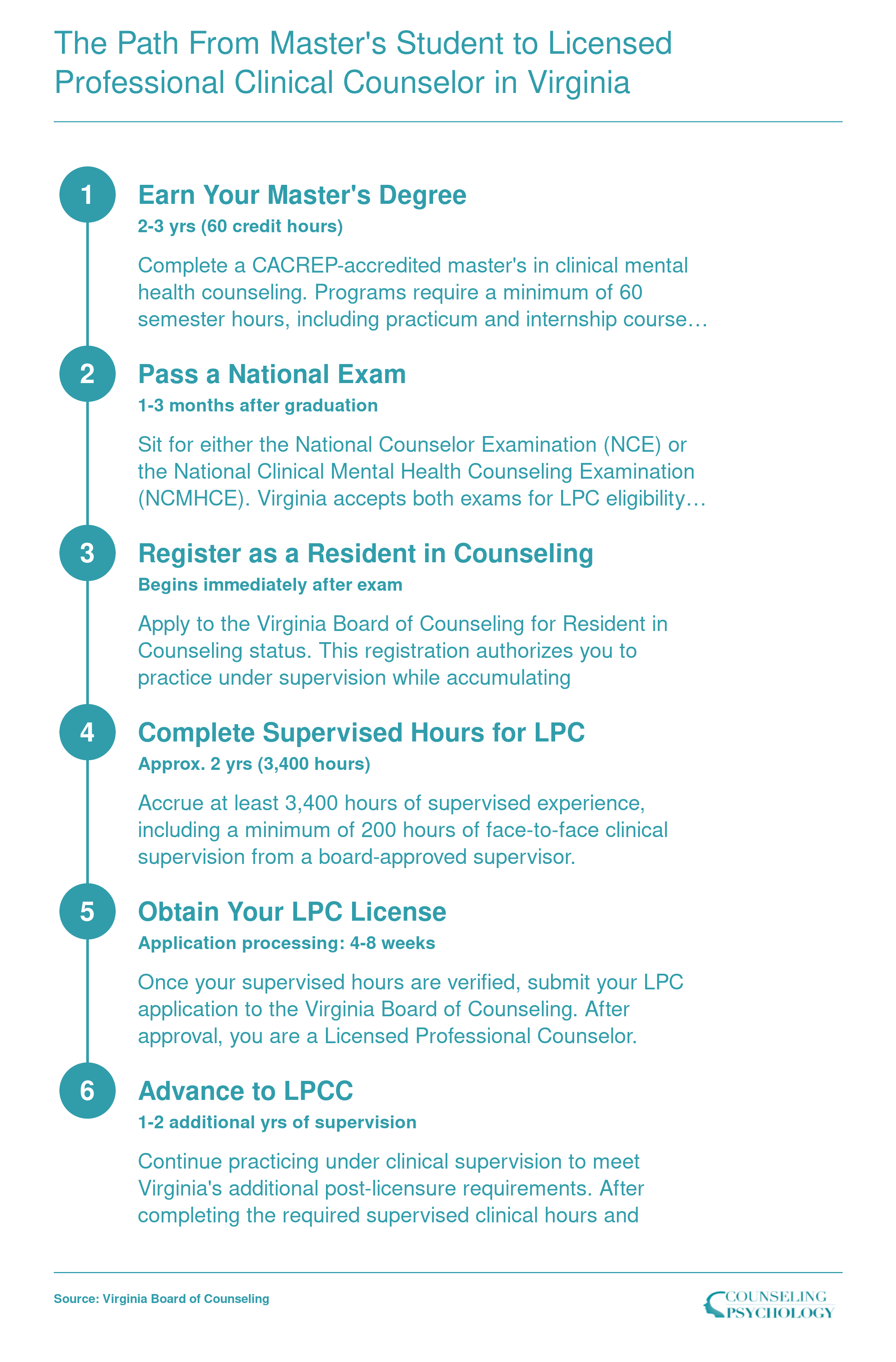
Before you can apply for Resident in Counseling status, you must pass either the National Counselor Examination (NCE) or the National Clinical Mental Health Counseling Examination (NCMHCE).2 Most clinical mental health counseling graduates opt for the NCMHCE because it emphasizes case analysis and clinical decision-making, though the NCE is equally acceptable for Virginia licensure.
The Resident in Counseling (Residency) Phase
Once you have completed at least 30 semester hours and begun practicum or internship (typically in your second year), you can apply for Resident in Counseling status.2 Your graduate program will provide 600 supervised clinical hours, including at least 240 hours of direct client contact. These hours count toward your post-graduate requirement but must be completed under qualified supervision, including 20 hours of on-site and 20 hours of off-site supervision during the internship period.2 Be aware that resident applications typically take 45 to 60 days to process, so plan your timeline accordingly.3
After graduation, Virginia requires 3,400 additional supervised hours over a minimum of 24 months to qualify for full LPC licensure.2 Of those hours, 2,000 must be direct client contact, and you must receive at least 200 hours of face-to-face supervision from an approved LPC or LPCC supervisor. Most residents complete this phase in two to three years, depending on employment setting and caseload volume. For a broader look at the steps involved, our guide on how to become a licensed professional counselor covers the national landscape.
From LPC to LPCC: The Clinical Designation
Virginia does not currently offer a separate LPCC credential. The LPC license itself authorizes independent clinical practice, including diagnosis and treatment of mental health disorders. Some states distinguish between general counseling licenses and clinical designations, but Virginia's LPC encompasses clinical privileges from the outset. This means that once you hold an LPC, you can pursue reimbursement from most insurance panels, open a private practice, and provide the full scope of clinical mental health services without an additional tier of licensure. If you are exploring states that do award a distinct LPCC, our overview of online licensed professional clinical counseling programs compares those options.
Total Timeline: How Long Does It Take?
Expect four to six years from enrollment to full LPC licensure.2 A full-time CACREP program typically takes 24 to 36 months to complete, and the post-graduate residency requires a minimum of 24 months (though many clinicians need 30 to 36 months to accumulate 3,400 hours while balancing employment). Programs that offer robust practicum and internship placements during the degree can shave several months off your residency timeline, because those 600 hours count toward the 3,400-hour requirement and provide a head start on direct client contact. Once licensed, you will also need to complete 20 continuing education hours per year (including 2 hours in ethics) to maintain your LPC on an annual renewal cycle.4
How the Ranked Programs Align with Virginia Requirements
Every CACREP-accredited program in the Hampton Roads area is designed to meet Virginia's coursework and clinical-hour prerequisites. Schools coordinate closely with the Virginia Board of Counseling to ensure that graduates are eligible for Resident in Counseling status immediately upon degree completion and exam passage. Non-CACREP programs that award 60 credits and cover all 13 core areas are also acceptable, but CACREP accreditation simplifies the application process and is often preferred by supervisors and employers. When comparing programs, confirm that the curriculum explicitly addresses Virginia's core content areas and that the clinical training sequence includes the required 600 supervised hours with the correct balance of on-site and off-site supervision.
The Path from Master's Student to Licensed Professional Clinical Counselor in Virginia
Becoming a Licensed Professional Clinical Counselor in Virginia involves a structured credentialing ladder. Each stage builds on the last, and the total timeline from your first graduate course to full LPCC status typically spans five to seven years. Here is how the process unfolds.
Online, Hybrid, and On-Campus Options for Hampton Roads Students
Among the ranked CMHC programs serving Newport News and the broader Hampton Roads area, all three delivery formats are represented: fully online, hybrid, and traditional on-campus. Each format carries distinct trade-offs for flexibility, networking, and clinical training logistics. One non-negotiable applies across the board: CACREP accreditation standards require a minimum of 100 practicum hours (at least 40 in direct client service) and 600 internship hours (at least 240 in direct service), all completed in person at approved clinical sites, regardless of how coursework is delivered.
| Attribute | Online | Hybrid | On-Campus |
|---|---|---|---|
| Programs in the Rankings Using This Format | Regent University (Virginia Beach), plus several nationally available CACREP programs such as William & Mary's online M.Ed. track | Virginia Commonwealth University, Emory & Henry University, Shenandoah University | Old Dominion University, James Madison University, William & Mary (campus track), Virginia Tech, George Mason University, Radford University, University of Lynchburg, Eastern Mennonite University, Virginia State University |
| Flexibility for Working Adults | Highest flexibility; asynchronous lectures let students complete coursework around shift schedules, deployments, or PCS moves | Moderate flexibility; some weeks are online, with periodic on-site intensives or weekend residencies | Least flexible, though several programs offer evening or part-time scheduling to accommodate employed students |
| Fit for Military Spouses and Active-Duty Personnel | Strongest fit; coursework transfers easily across duty stations, and only practicum or internship hours require local placement | Good fit if residency weekends align with military schedules; confirm that intensive sessions can be rescheduled around deployments | Can work for those stationed at nearby installations (Fort Eustis, Joint Base Langley-Eustis, Naval Station Norfolk) but less portable if reassigned |
| Clinical Placement Logistics | Students typically arrange local placements with program support; Hampton Roads offers a dense network of VA medical centers, community mental health agencies, and military family service centers | Programs often help coordinate placements during on-site residency periods; VCU, for example, connects students to Richmond and regional clinical sites | Placements are usually pre-established through university partnerships with area agencies, hospitals, and counseling centers |
| Peer Networking Opportunities | Virtual cohorts and discussion forums; less organic relationship building, though some programs include optional in-person meetups | Blend of online interaction and face-to-face cohort weekends, offering stronger professional bonds than fully online models | Strongest peer connections through daily classroom interaction, study groups, and shared clinical training experiences |
| Typical Schedule Options | Self-paced weekly modules with synchronous sessions often held in the evening to accommodate time zones and work schedules | Mix of asynchronous weeks and scheduled weekend or weeklong intensives, typically once or twice per semester | Most programs offer full-time daytime tracks; some (such as ODU and JMU) also accommodate part-time students with evening course sections |
| In-Person Clinical Requirement | Required: 100 practicum hours plus 600 internship hours must be completed face-to-face at an approved site | Required: same CACREP minimums apply, often integrated into the on-site residency schedule | Required: identical CACREP clinical hour requirements, typically completed at affiliated community or university clinics |
Questions to Ask Yourself
Program-Level Earnings and ROI After Graduation
In the Virginia Beach-Norfolk-Newport News metropolitan area, mental health counselors (SOC 21-1018) earn a median annual wage that falls below the national median for the same occupation, which means local graduates need to weigh program costs carefully against realistic regional pay expectations. Because the BLS does not publish a separate MSA-level figure for this occupation every cycle, the most current local estimates may be several months behind, and you should always verify directly through the BLS Occupational Employment and Wage Statistics tool before making enrollment decisions.
What the Wage Data Actually Shows
For SOC 21-1018 (substance abuse, behavioral disorder, and mental health counselors), the BLS publishes national median, 25th percentile, and 75th percentile annual wages, as well as Virginia statewide figures, and in some survey cycles, Virginia Beach-Norfolk-Newport News MSA estimates. When MSA data is available, it typically shows a spread of roughly $10,000 to $15,000 between the 25th and 75th percentiles, meaning where you work, what setting you choose, and whether you hold full licensure all matter more than which specific accredited program you attended. Marriage and family therapists (SOC 21-1013) represent a smaller portion of local jobs, and BLS MSA-level data for that occupation may not be published separately for the Hampton Roads area in every release cycle. If you are considering the MFT route, reviewing accredited marriage and family therapy programs online can help you compare credential options alongside wage data. Check the Virginia Employment Commission's labor market information portal and the U.S. Department of Labor's CareerOneStop tool for the most current state and MSA breakdowns on both occupations.
Estimating Program-Level ROI
Published wage data gives you the ceiling and floor of what graduates earn regionally, but it does not tell you how a specific program's graduates perform. For that, you need to go directly to each school's program page and look for published graduate outcome reports, employment rates within six to twelve months of graduation, and any loan repayment or debt-to-income data the program voluntarily discloses. Programs accredited by CACREP are increasingly held to transparency standards, but not all publish detailed outcomes. If a program does not report employment outcomes, contact the department directly and ask.
A useful benchmark: if a program's total cost (tuition, fees, and lost income opportunity) exceeds three to four times the regional first-year median salary for licensed counselors, the debt load creates meaningful financial pressure during the early licensure period when supervised hours are still accumulating and full independent practice income is not yet available. Students weighing cost against flexibility may also want to explore best online master's in counseling programs as a point of comparison.
Using Professional Association Resources
The American Counseling Association and the American Association for Marriage and Family Therapy both publish periodic salary surveys that break down earnings by region, years of experience, practice setting, and licensure level. These surveys are not a substitute for BLS data, but they add useful texture, particularly around private practice income and telehealth earnings that wage surveys sometimes undercount. If you are seriously evaluating two or three programs on cost grounds, cross-referencing their published outcomes against ACA or AAMFT regional salary data gives you a more complete picture of realistic return on your investment than tuition numbers alone.
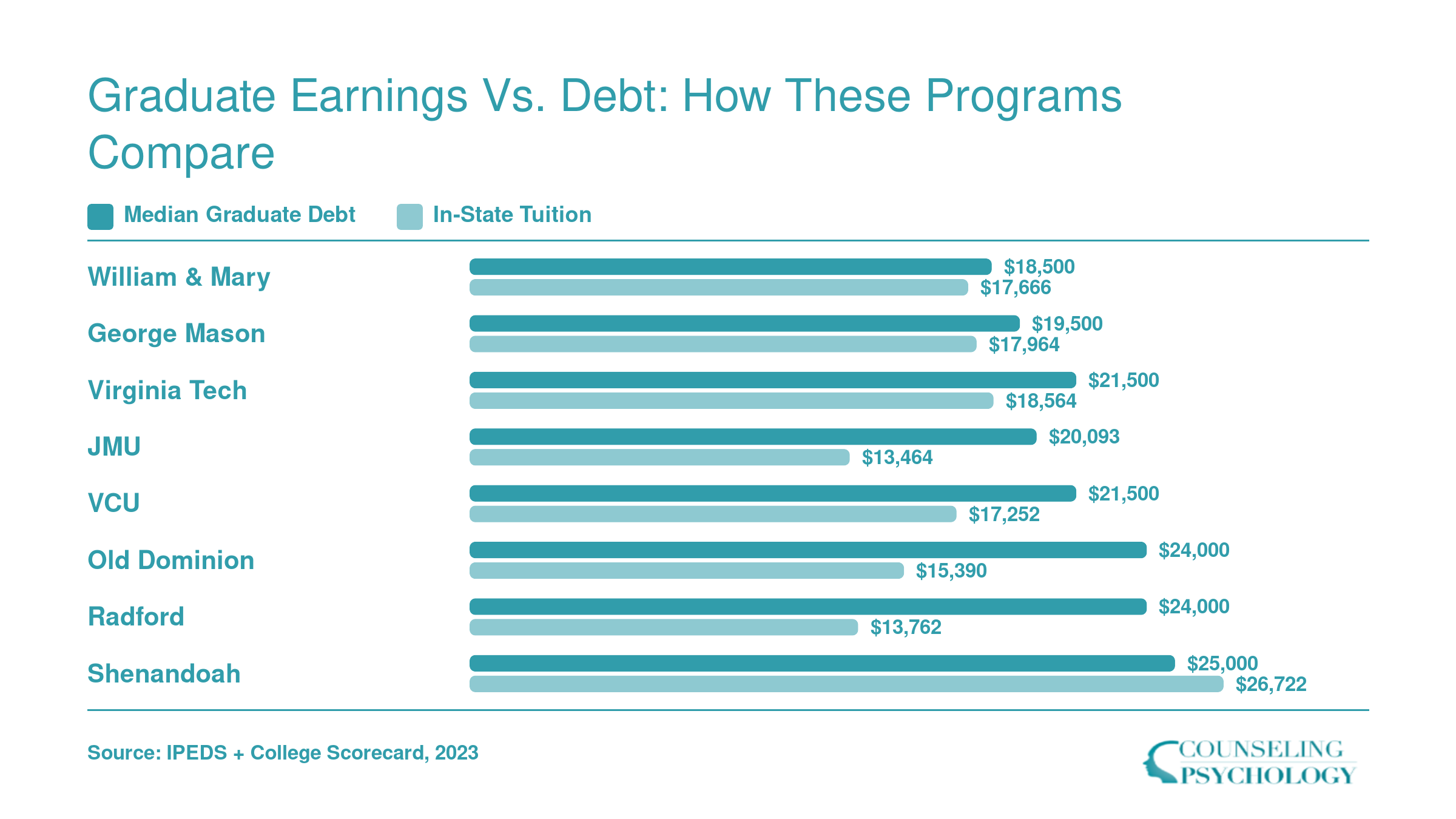
Graduate Earnings vs. Debt: How These Programs Compare
Program-level first-year earnings data is not yet published for these counseling programs, so the chart below uses institution-wide median graduate debt alongside each school's in-state tuition as a proxy for total cost exposure. Lower debt relative to tuition signals stronger financial aid packaging. For a fuller picture of post-graduation ROI, check the earnings and debt discussion in the section above.
Scholarships, Assistantships, and Financial Aid for CMHC Students
Paying entirely out of pocket versus leveraging every available funding source can mean the difference between graduating with manageable debt and carrying a financial burden well into your clinical career. The good news: clinical mental health counseling students have access to a layered set of federal, state, and institutional funding options that many applicants overlook.
Federal Loan Forgiveness and Repayment Programs
Two federal programs deserve special attention from CMHC students planning to work in underserved or community settings after graduation.
- Public Service Loan Forgiveness (PSLF): If you work full time for a qualifying nonprofit or government employer after graduation, PSLF can forgive your remaining federal loan balance after 120 qualifying payments. Many community mental health agencies, VA medical centers, and school districts in the Hampton Roads area qualify. Students interested in agency-based roles can learn more about the path to becoming a community mental health counselor.
- NHSC Loan Repayment: The National Health Service Corps offers loan repayment awards to licensed behavioral health providers who commit to working in designated Health Professional Shortage Areas. Hampton Roads includes several such areas. Check nhsc.hrsa.gov directly for current application cycles and award amounts, as these change annually.
For baseline federal aid eligibility, including subsidized and unsubsidized loans, file your FAFSA through studentaid.gov each year you are enrolled.
Virginia State Programs
Virginia periodically funds loan repayment incentives targeting mental health professionals who serve in high-need regions. The Virginia Department of Health Professions and the Virginia Board of Counseling are the most reliable sources for current program details, because eligibility criteria and funding levels can shift with each legislative session. Bookmark both sites and check them at least once per application cycle.
Military-Connected Students and MyCAA
The Military Spouse Career Advancement Accounts (MyCAA) program can cover up to $4,000 in tuition and fees for eligible military spouses pursuing portable career credentials, including some counseling programs. Students and spouses connected to the military community may also want to explore career options as a veterans counselor. Eligibility varies by institution and program structure, so contact the financial aid office at any school you are considering and verify coverage on the MyCAA website before enrolling.
Professional Association Resources
The American Counseling Association (counseling.org) and the Virginia Counselors Association both maintain compiled lists of scholarships, fellowships, and financial aid opportunities specifically for counseling students. These directories are updated regularly and often include smaller, less competitive awards that fly under the radar. Graduate assistantships, which typically combine a tuition waiver with a modest stipend in exchange for research or teaching support, are another avenue worth exploring at every program on your list. Ask admissions offices directly about availability, because assistantship slots are limited and sometimes awarded on a rolling basis rather than a fixed deadline.
Clinical Placement Sites in the Hampton Roads Region
Where will you actually see clients during your program? That question matters as much as tuition when choosing a CMHC program, because the quality and variety of your practicum and internship experience directly shapes your clinical competence and your resume.
VA and Military-Connected Sites
Hampton Roads is one of the most militarily dense regions in the country, and that geography creates clinical training opportunities that simply do not exist in most metro areas. The Hampton VA Medical Center offers counseling students exposure to outpatient therapy, primary care mental health integration, PTSD and trauma treatment, substance use disorder services, and inpatient and residential care.1 The population served is exclusively veterans, which gives trainees depth in military culture, moral injury, and service-connected mental health conditions. The center maintains formal training programs at the doctoral psychology level, and master's-level counseling students placed there gain experience rarely available outside a major VA facility.1
Joint Base Langley-Eustis (the combined installation formerly known as Fort Eustis and Langley AFB) anchors another tier of military-connected placement. Behavioral health clinics on the installation serve active-duty personnel and their families, covering issues from adjustment disorders and relationship stress to more complex trauma presentations. Students interested in military psychologist requirements will find that training in these settings builds marketable competency with a population chronically underserved by civilian providers.
The Barry Robinson Center in Norfolk extends that military-connected pipeline to children and adolescents, offering residential treatment experience with youth from military families.2
Community and Public Sector Sites
The Hampton/Newport News Community Services Board serves as the region's public safety net for mental health and substance use care. Placements there typically span adult outpatient, child and family services, SUD treatment, and crisis and emergency response.2 Community services boards across Virginia operate under a mandate to serve anyone regardless of ability to pay, so students encounter the full clinical spectrum, including severe mental illness, housing instability, and co-occurring disorders.
Virginia Beach Department of Human Services offers a parallel public-sector experience with adult and child outpatient services, SUD programming, case management, and possible mobile crisis work.2
Outpatient and Specialty Sites
For students seeking outpatient group practice experience, Coastal Virginia Mental Health provides a structured internship requiring 600 total hours, with 240 direct client contact hours, covering individual and group counseling, intake assessments, and treatment planning.3 LifeStance Health, a large multisite outpatient practice operating across the region, is another common placement for students pursuing a generalist outpatient foundation.2
Specialized sites round out the picture. The Center for Sexual Assault Survivors and H.E.R. Shelter (a domestic violence shelter) offer trauma-focused training with survivor populations, a pathway that may appeal to students drawn to childhood trauma counseling. Genesis Counseling Center provides outpatient placements with a faith-integration model. Virginia Beach Psychiatric Center adds inpatient psychiatric experience, including group therapy, risk assessment, and partial hospitalization.2
Why Placement Access Should Influence Your Program Choice
Students enrolled in campus-based or hybrid programs at schools with established regional relationships, such as counseling programs in Virginia, often benefit from built-in practicum pipelines. Program faculty maintain ongoing contacts with site supervisors, and placement logistics are handled through the school. Online-only students, by contrast, frequently must identify and negotiate their own placements, which adds time, uncertainty, and responsibility to an already demanding clinical training phase. Before enrolling, ask any program directly how it supports placement matching in the Hampton Roads area, and whether it has formal agreements with the specific site types you want to work in.
Hampton Roads stands apart in Virginia for CMHC students: affordable programs sit within commuting distance of one of the nation's largest concentrations of military and veteran populations, plus a robust network of community mental health centers, hospitals, and VA facilities. This combination creates exceptional clinical training opportunities and strong post-graduation employment demand that few other metro areas in the state can match.
Frequently Asked Questions About LPCC Programs Near Newport News
Prospective counseling students in the Hampton Roads area tend to ask many of the same questions about timelines, costs, and earning potential. Below are concise, data-grounded answers to the questions we hear most often.