Key Takeaways
- University of the Pacific, several UC campuses, and CSU schools rank among the strongest developmental psychology options within reach of Stockton.
- Starting at San Joaquin Delta College and transferring through California's ADT pathway can save thousands in tuition.
- California does not issue a separate developmental psychology license, so graduates must earn a doctoral degree and complete supervised hours for full psychologist licensure.
- National median pay for psychologists was roughly $92,740 in 2024, though actual earnings vary by degree level, sector, and specialization.
Stockton sits at the intersection of affordable access and elite opportunity for developmental psychology students. The city's Central Valley location puts prospective undergraduates within two hours of UC Davis and UC Berkeley, while graduate candidates can reach UC Irvine, UCLA, and UC San Diego by car in three to four hours. The programs listed here span bachelor's concentrations, terminal master's degrees, and research-focused doctoral tracks at both public and private institutions.
Degree formats are almost entirely campus-based. Only one ranked program, National University's online BA, offers remote instruction, and even it requires substantial independent research work. The rest demand on-site coursework, lab hours, and supervised practicum placements, which tighten your commute calculus if you plan to stay in Stockton while studying.
Tuition spreads are dramatic. In-state bachelor's programs at CSU Sacramento run under $10,000 annually, while USC's doctoral tuition tops $71,000. Net price tells a different story once you factor in grant aid, and median graduate debt at the top UC campuses hovers near $13,000 to $17,500. Career earnings for developmental psychologists hinge on whether you pursue licensure as a clinical psychologist, enter academia, or work in applied settings like early-intervention agencies or policy research.
Best Developmental Psychology Programs Near Stockton, CA
Stockton sits in California's Central Valley with convenient access to both Northern and Southern California research universities. The programs below span the Stockton metro, the broader Bay Area, the Sacramento corridor, and select UC and private campuses statewide. Most are doctoral programs, though a master's option and one undergraduate specialization round out the list for students at different stages of their academic journey. All graduation rates listed reflect institution-wide figures, not program-specific completion. Program-level earnings data are not yet available for these developmental psychology tracks.
- Academic quality and research depth
- Graduation and retention outcomes
- Tuition affordability and financial aid
- Faculty mentorship and student ratios
- Geographic access from Stockton
- College Scorecard graduate earnings — collegescorecard.ed.gov
- Internal program database
- NCES-IPEDS federal institutional data — nces.ed.gov
- Independent program research

University of California-Merced
Located roughly 60 miles from Stockton, UC Merced is the closest UC campus offering a developmental psychology doctoral track. Small cohorts and a strong mentorship model make it especially appealing for Central Valley residents and first-generation students. The institution-wide graduation rate sits at 68.7%, and in-state tuition is among the lowest in the UC system at about $14,753 per year.
- Full-time doctoral program, typically completed in 5 to 6 years
- Developmental psychology concentration with research from day one
- Strong faculty mentorship model with small cohort sizes
- Coursework in research methods, statistics, and professional seminars
- 44% of students finish in five years or less
- Master's degree may be earned en route to the Ph.D.
- No clinical training or standalone master's option offered
Ph.D. in Psychological Sciences, Developmental Psychology Concentration — On-Campus

University of California-Davis
UC Davis, about 65 miles northwest of Stockton, anchors the Sacramento region's developmental research landscape. Its program explores development across the lifespan with concentrations in developmental neuroscience and social development, plus collaborations with the MIND Institute. The institution-wide graduation rate is 85.7%, with in-state tuition near $15,141.
- Research-focused doctoral program covering lifespan development
- Concentration tracks in developmental neuroscience and social development
- Collaboration opportunities with the UC Davis MIND Institute
- State-of-the-art quantitative methods training
- Faculty-student collaboration on experimental and longitudinal research
- Interdisciplinary ties to the Human Development Graduate Group
- Preparation for careers in academia and applied settings
Developmental Psychology Ph.D. — On-Campus

University of California-Berkeley
UC Berkeley's five-year, STEM-designated doctoral program in psychology includes a developmental concentration and guarantees funding for admitted students. The program emphasizes interdisciplinary research spanning neuroscience, education, and social welfare. Berkeley boasts a 92.8% institution-wide graduation rate and an 18:1 student-faculty ratio.
- Five-year funded doctoral program with guaranteed financial support
- STEM-designated degree with interdisciplinary research scope
- Collaborations across neuroscience, education, and social welfare
- No terminal master's degree offered
- Competitive admission (approximately 11% acceptance rate)
- In-state tuition of roughly $15,866 before aid
Ph.D. in Psychology, Developmental Concentration — On-Campus

University of California-Los Angeles
UCLA's developmental psychology area trains independent scholars using advanced tools such as MRI, EEG/ERP, and cross-cultural fieldwork. Faculty specialize in language acquisition, family processes, and neurodevelopment. Most students complete the program in five to six years. UCLA is a designated Hispanic-Serving Institution with a 92.6% institution-wide graduation rate.
- Research-intensive program with 5 to 6 year completion timeline
- Access to MRI, EEG/ERP, and cross-cultural fieldwork methods
- Faculty expertise in language acquisition and neurodevelopment
- Coursework in statistics, methodology, and developmental theory
- Strong research support with engagement beginning in year one
- Hispanic-Serving Institution with robust financial aid resources
Developmental Psychology Ph.D. — On-Campus

University of California-Irvine
UC Irvine offers a Ph.D. in Psychological Science with a developmental psychology concentration. The program pairs students with faculty mentors from the start, and financial support covering tuition and a stipend is provided for the first five years. GRE scores are optional for admission. UCI is a public, Hispanic-Serving Institution with an 86.9% institution-wide graduation rate.
- Developmental concentration within a broader psychological science doctorate
- Five years of financial support including tuition and stipend
- Faculty mentorship and research collaboration from the first year
- GRE scores are optional for applicants
- Normative time to degree is six years
- In-state tuition of approximately $14,827 per year
- Focus on independent research and preparation for academic careers
Ph.D. in Psychological Science, Developmental Psychology Concentration — On-Campus

University of California-San Diego
UCSD's undergraduate specialization in developmental psychology provides a strong scientific foundation for students planning graduate study. Coursework covers social and personality development, language acquisition, and developmental psychopathology. The campus holds an 86% institution-wide graduation rate and is a designated Hispanic-Serving Institution.
- Bachelor's-level specialization within a research university setting
- Covers social, personality, and perceptual development
- Includes coursework in statistics and research lab courses
- Requires foundation in natural sciences and computer programming
- Minimum 2.0 GPA required in upper-division major courses
- Strong preparation for graduate programs in developmental psychology
Psychology B.S. with a Specialization in Developmental Psychology — On-Campus

University of California-Santa Barbara
UC Santa Barbara's Developmental and Evolutionary Psychology doctoral program integrates evolutionary theory with the study of human cognition, moral reasoning, and core knowledge systems. Faculty are linked to the campus Center for Evolutionary Psychology. UCSB is a public, Hispanic-Serving Institution with an 83% institution-wide graduation rate and a 17:1 student-faculty ratio.
- Unique blend of developmental and evolutionary psychology perspectives
- Research on core knowledge systems and cognitive adaptations
- Faculty connected to the Center for Evolutionary Psychology
- Studies in attention, reasoning, memory, and moral cognition
- Rigorous, research-intensive academic environment
- Interdisciplinary collaboration across psychology subfields
Developmental and Evolutionary Psychology Ph.D. — On-Campus

University of Southern California
USC is the only private institution on this list, with a 9:1 student-faculty ratio and a 91.8% institution-wide graduation rate. Its doctoral program in developmental psychology examines biopsychological growth from infancy through adolescence, covering culture, cognition, emotion, and neurodevelopment. The multidisciplinary Los Angeles setting offers access to diverse communities and clinical resources.
- Private research university with a 9:1 student-faculty ratio
- Focus on development from infancy through adolescence
- Multidisciplinary approach spanning culture, cognition, and emotion
- Prepares graduates for academia, research, and consulting roles
- Opportunities for international engagement and community placements
- Net price of approximately $32,740 after institutional aid
Developmental Psychology Ph.D. — On-Campus

University of California-Riverside
UC Riverside's developmental psychology Ph.D. emphasizes hands-on research with options to explore behavioral neuroscience and social/personality psychology. UCR is a public, Hispanic-Serving Institution with broader admission access (76.4% acceptance rate) and in-state tuition near $14,912. The institution-wide graduation rate is 76%.
- Research-oriented doctoral program at a public UC campus
- Opportunities to specialize in behavioral neuroscience areas
- Competitive financial aid and fellowship support available
- No terminal master's degree offered
- Campus-based, collaborative learning environment
- Hispanic-Serving Institution with strong Pell Grant participation
Developmental Psychology Ph.D. — On-Campus

San Francisco State University
San Francisco State University provides the only master's-level developmental psychology option on this list, making it a practical choice for Stockton-area students who want graduate training without committing to a full doctorate. The two-year M.A. covers lifespan development, cross-cultural psychology, and parent-child relationships. SFSU is a public, Hispanic-Serving Institution with in-state tuition of roughly $9,370.
- Two-year master's program requiring 30 total units
- Covers social-emotional development and parent-child relationships
- Advanced research methods and statistical analysis coursework
- Field experience and thesis research components required
- Prerequisite: intermediate statistics
- Multiple seminar topics available across developmental areas
- Most affordable in-state tuition on this list at about $9,370
M.A. in Psychological Science, Developmental Psychology Concentration — On-Campus
How We Ranked These Developmental Psychology Programs
Ranking a list of developmental psychology programs means deciding which numbers matter most to a prospective student, then applying them consistently across every school. We looked at five core factors: net price (what students actually pay after grants and scholarships), graduation rate, post-completion earnings, typical debt at graduation, and the ratio between earnings and debt as a rough return-on-investment signal.
What's institution-wide vs. program-specific
Two of those metrics, net price and graduation rate, are institution-wide averages pulled from the federal College Scorecard. They describe the school as a whole, not the developmental psychology program specifically. A university with a 78% graduation rate doesn't guarantee that figure for psychology majors, but it's a reasonable proxy for overall student support and completion culture.
Earnings data is more granular. Federal earnings figures at the one-year, two-year, and four-year post-graduation marks are tied to specific CIP codes and credential levels, so the numbers you see for a bachelor's in developmental and child psychology reflect graduates of that exact program, not the university average. If you're comparing options beyond a single metro area, our broader guide to online developmental psychology programs covers a wider pool ranked on the same criteria.
Format and transparency
We also verified delivery format at the program level: whether the developmental psychology track is offered online, on campus, or in a hybrid arrangement. Catalog pages and program sites were checked directly rather than relying on broad institutional flags.
The goal throughout is comparability. Every program below is described using the same data points in the same order, so you can line up two schools side by side and see exactly where one beats the other and where it falls short.
Online vs. On-Campus Developmental Psychology Programs Near Stockton
Choosing between online and on-campus study is one of the first practical decisions you will face. Among the developmental psychology programs ranked for the Stockton area, nearly all are campus-based, reflecting the field's heavy reliance on lab work and supervised research. National University stands out as the sole fully online option on our list, while the remaining programs at UC Berkeley, UCLA, UC Davis, UC Merced, and others require in-person attendance. Understanding the trade-offs will help you pick the format that fits your life in the Central Valley.
Pros
- Online programs like National University's BA in Psychology offer flexible scheduling ideal for working students across the Central Valley.
- Studying online removes the long commute from Stockton to campuses in the Bay Area, Los Angeles, or Southern California.
- Online tuition can be lower overall when you factor in eliminated commuting, parking, and housing costs near expensive metro campuses.
- Campus programs provide direct access to developmental research labs, including resources like UCLA's MRI and EEG facilities.
- In-person cohorts build professional networks through daily interaction with faculty mentors and fellow doctoral students.
- On-campus programs at UC Davis and UC Merced offer structured practicum supervision that is difficult to replicate remotely.
- Hybrid arrangements, when available, let students complete coursework online while attending intensive on-site research or practicum blocks.
Cons
- Online developmental psychology degrees at the bachelor's level are available in California, but fully online doctoral programs in this specialty are extremely rare.
- Campus-only programs dominate the ranked list, limiting choices for students who cannot relocate or commute long distances from Stockton.
- On-campus doctoral programs typically require full-time enrollment for five to six years, making part-time work difficult to sustain.
- Online learners may have fewer opportunities for hands-on infant or child observation research that is central to developmental training.
- Campus programs at UC schools outside the Central Valley carry significant housing and cost-of-living expenses on top of tuition.
Related Articles
Tuition and Financial Aid: What Developmental Psychology Programs Near Stockton Actually Cost
Sticker price rarely tells the full story. The net price column below reflects an institution-wide average after grants and scholarships, not a guaranteed quote for any individual student. Your actual cost will depend on your financial aid package, residency status, and enrollment intensity. Program-level debt and monthly repayment figures are not yet available for these developmental psychology programs specifically, so the median debt and estimated monthly payment columns show institution-wide medians reported through College Scorecard. The public vs. private gap is striking: every public university on this list posts a net price under $18,000, while the two private institutions land well above that mark.
| School | In-State Tuition | Out-of-State Tuition | Net Price (Avg. After Aid) | Median Graduate Debt | Pell Grant Recipients |
|---|---|---|---|---|---|
| CSU Sacramento | $8,018 | $20,618 | $9,338 | $15,000 | 80.9% |
| UC Merced | $14,753 | $29,855 | $11,983 | $16,144 | 83.1% |
| San Francisco State University | $9,370 | $19,450 | $12,278 | $15,371 | 76.3% |
| UC San Diego | $15,788 | $47,676 | $12,470 | $15,500 | 72.0% |
| UCLA | $14,476 | $29,578 | $12,548 | $14,000 | 69.9% |
| UC Berkeley | $15,866 | $30,968 | $13,481 | $13,000 | 69.5% |
| UC Irvine | $14,827 | $29,929 | $14,251 | $15,000 | 76.5% |
| UC Riverside | $14,912 | $30,014 | $14,304 | $17,500 | 78.5% |
| UC Davis | $15,141 | $30,243 | $14,741 | $13,000 | 72.2% |
| UC Santa Barbara | $15,124 | $30,226 | $16,109 | $13,993 | 72.8% |
| UC Santa Cruz | $15,410 | $30,512 | $17,890 | $16,666 | 67.1% |
| National University (Private) | $13,284 | $13,284 | $22,878 | $25,000 | 60.4% |
| USC (Private) | $71,515 | $71,515 | $32,740 | $18,000 | 59.3% |
Questions to Ask Yourself
Career Outcomes and Earnings for Developmental Psychology Graduates
Career outcomes in developmental psychology depend heavily on degree level, specialization, and the sector where graduates find work. Understanding what to expect financially, and whether the field offers stable employment, helps you weigh the investment required against realistic returns.
What the Data Shows (and What It Doesn't)
Program-level earnings data for developmental psychology programs at California universities are not yet published in federal reporting systems. This means we cannot compare one-year, two-year, or four-year post-graduation median wages across the specific programs ranked here. What we can examine is institution-wide median earnings ten years after enrollment, which provides a broader sense of long-term outcomes for graduates, though these figures reflect all programs at a university rather than developmental psychology alone.
Among the universities listed, ten-year median earnings for all graduates range from roughly $68,000 at UC Santa Cruz and San Francisco State to over $92,000 at UC Berkeley and USC. These numbers offer general context but should not be read as projections for any single program. Similarly, program-level employment rates and poverty-threshold data are not currently reported for developmental psychology concentrations at these schools.
Is Developmental Psychology in Demand?
Nationally, the Bureau of Labor Statistics projects 6 percent job growth for psychologists between 2022 and 2032, which is slightly faster than average across all occupations.2 The category "Psychologists, All Other" reports a national median annual wage of $117,750 as of 2023, with the 10th percentile earning around $47,450 and the 90th percentile reaching $157,420.1 These figures reflect psychologists across all specialties, not developmental psychology specifically. Students interested in related specializations may also want to explore child psychology certificate programs for additional credential options.
Local wage data for the Stockton-Lodi metro area are not available for this specific occupational category, so prospective students should be cautious about assuming regional salaries will mirror national medians. California's cost of living and employer mix can produce significant variation from national averages.
Making Sense of ROI
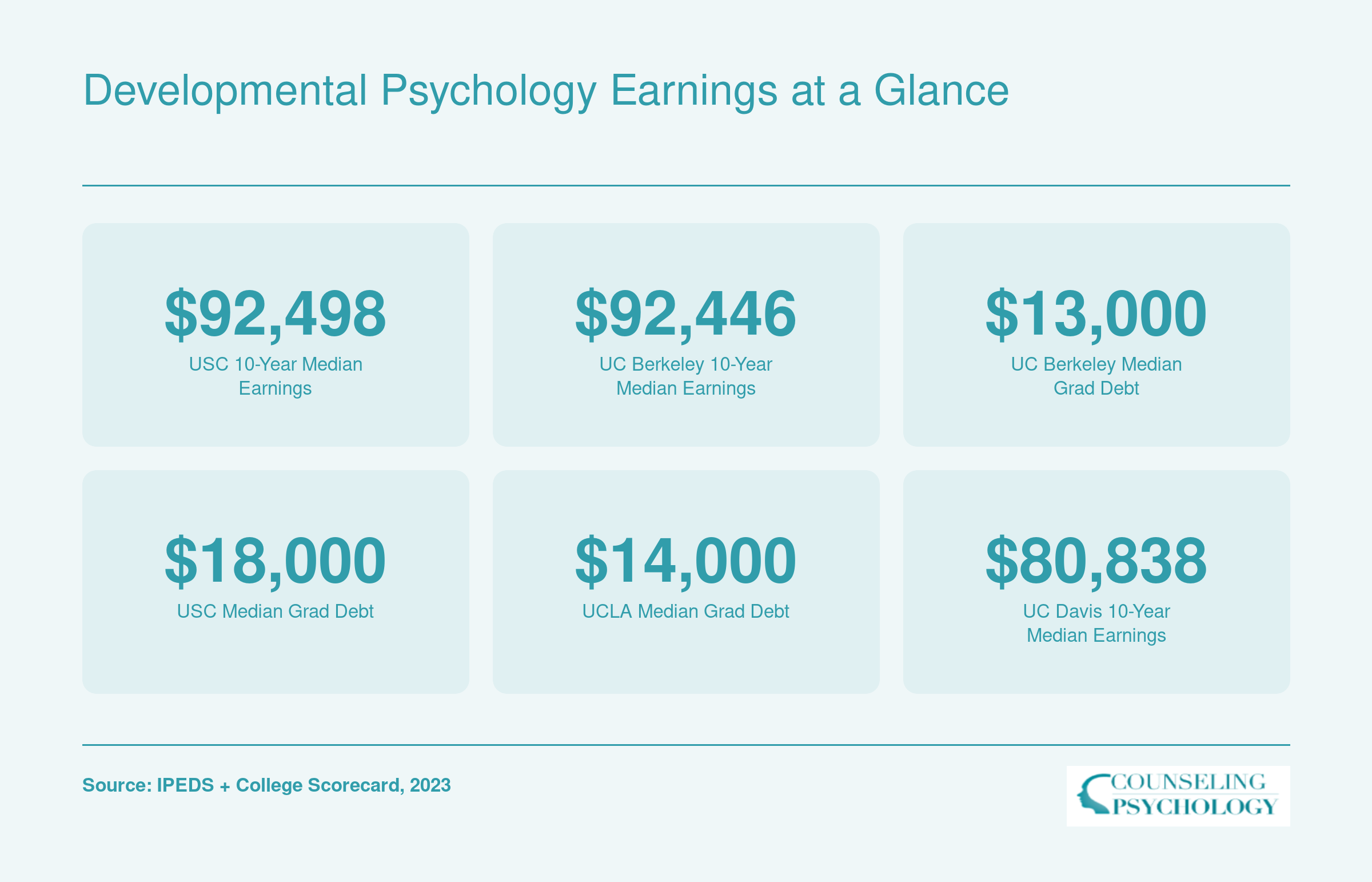
Without program-specific earnings data, a direct return-on-investment calculation is difficult. However, comparing median graduate debt to institution-wide ten-year earnings offers a rough gauge. UC Berkeley, for example, reports median graduate debt of $13,000 against ten-year earnings of $92,446, yielding a favorable ratio. USC's higher debt load ($18,000) still pairs with strong long-term earnings ($92,498). Public universities in the UC system generally carry lower debt burdens, which may improve net outcomes even if starting salaries are modest.
Students considering doctoral programs should note that many UC campuses offer guaranteed funding packages, which reduce or eliminate tuition costs and lessen reliance on loans. This factor meaningfully shifts the financial equation compared to programs without such support.
Developmental Psychology Earnings at a Glance
Program-level earnings data for these developmental psychology programs are not yet published, but institution-wide outcomes and graduate debt figures offer useful context. Here is how the top-ranked schools compare on median earnings ten years after enrollment and typical graduate debt.
How to Become a Developmental Psychologist in California
California's licensure framework for psychologists has remained relatively stable in recent years, but the path still demands serious commitment. Understanding each step early can save you years of frustration.
Developmental psychology is not a separate license category in California.1 It functions as a specialization within the broader psychologist education framework overseen by the California Board of Psychology. That means the licensure steps are the same whether you focus on developmental, clinical, or counseling psychology. Your specialization shows up in your doctoral training, your research focus, and the populations you serve, not in a distinct credential.
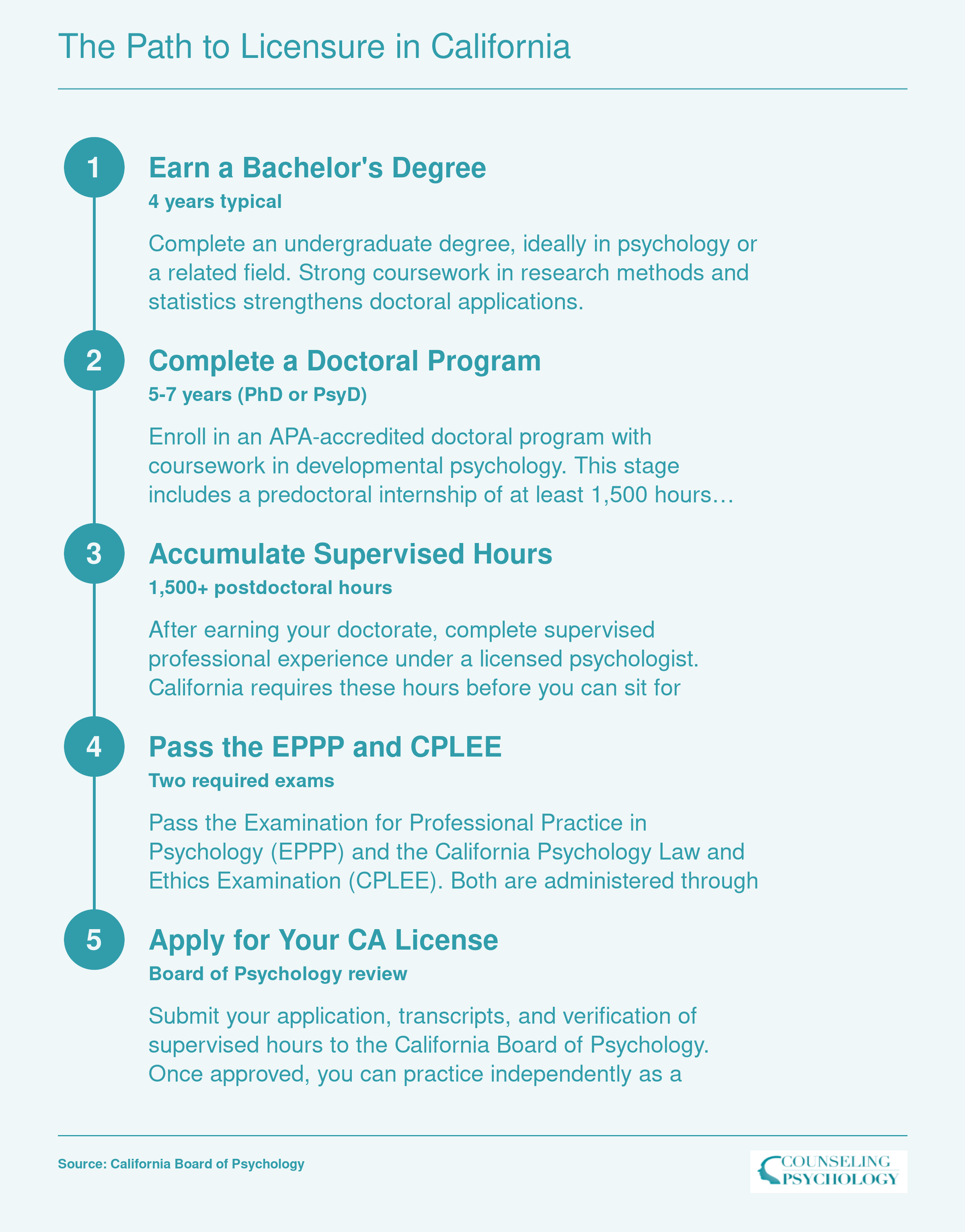
Step 1: Earn a Bachelor's Degree
Most aspiring developmental psychologists start with a bachelor's in psychology, human development, or a related field. Several universities near Stockton offer strong undergraduate psychology programs that fulfill prerequisite coursework for graduate study. Courses in lifespan development, research methods, and statistics are essential building blocks.
Step 2: Complete a Doctoral Program
California requires a doctorate (Ph.D. or Psy.D.) for psychologist licensure.2 A master's degree alone will not qualify you for the psychologist title, though it does open doors to related licensed roles such as Licensed Marriage and Family Therapist (LMFT) or Licensed Professional Counselor. If you are weighing whether a master's or doctoral track fits your goals, this distinction matters: only the doctoral route leads to independent practice as a licensed psychologist.
Among the ranked programs near Stockton, some institutions offer doctoral-level training in psychology or related disciplines, while others focus on master's-level preparation. Choosing the right track depends on whether you are targeting full psychologist licensure or a related counseling credential.
Step 3: Accumulate Supervised Professional Experience
The California Board of Psychology requires 3,000 total hours of supervised professional experience, including 1,500 postdoctoral hours.2 These hours must be completed under a licensed psychologist's supervision and typically span clinical assessment, intervention, and consultation activities relevant to your specialization.
Step 4: Pass the Licensing Exams
California requires two examinations:3
- EPPP (Examination for Professional Practice in Psychology): A 225-question national exam with a passing scaled score of 500.
- CPLEE (California Psychology Laws and Ethics Examination): A 50-question exam covering California-specific statutes and ethical standards.
You will also need to complete a Live Scan fingerprint background check before the Board issues your license.2
Step 5: Obtain and Maintain Your License
The initial license fee is $400, and licenses renew every two years.3 Renewal requires 36 hours of continuing education per cycle, with mandated minimums in specific areas: 6 hours in suicide risk assessment, 4 hours in cultural diversity and social justice, and 4 hours in law and ethics.4
Master's-Level Alternatives
If a doctoral commitment feels too steep, a master's degree can still lead to meaningful work with developmental populations. LMFT and LPCC credentials allow you to provide therapy to children, families, and individuals across the lifespan. Those drawn to younger populations may also want to explore child psychologist degree requirements. Several programs near Stockton offer master's tracks aligned with these licensure paths, which require their own supervised hours and exams but involve a shorter timeline than the doctoral route.
The Path to Licensure in California
Becoming a licensed psychologist in California follows a structured sequence. Each step builds on the last, so planning ahead helps you stay on track and avoid delays.
Practicum and Research Opportunities in the Stockton Region
Finding quality practicum placements can make or break a graduate training experience. Stockton and the surrounding San Joaquin Valley offer surprisingly robust options for developmental psychology students, yet most program guides overlook these local resources entirely. Here is what you need to know about hands-on training in this region.
County Behavioral Health Placements
San Joaquin County Behavioral Health Services operates a paid master's internship program backed by 5.2 million dollars in dedicated funding.1 Interns work full-time under a dedicated field supervisor at county sites or partner organizations. The catch: you must reside in San Joaquin County to qualify. For students already living in Stockton, Lodi, or Tracy, this residency requirement is actually an advantage since it limits competition from out-of-area applicants.
Victor Community Support Services, a nonprofit based in Stockton, also offers paid master's internships.1 This agency works extensively with children and families in the child welfare system, providing direct exposure to developmental assessment, trauma-informed care, and family reunification support. Students interested in childhood trauma counseling will find this placement especially relevant.
School-Based and Educational Placements
The San Joaquin County Office of Education runs a Psychologist Intern position through its Special Education Local Plan Area (SELPA).2 This temporary placement pays approximately 20 dollars per hour and places interns in school settings across multiple districts, including Stockton Unified and Lodi Unified. School-based practicums are particularly valuable for developmental psychology students interested in early intervention, learning disabilities, or child assessment. Those drawn to this path may also want to explore educational psychology degrees as a complementary credential.
Doctoral-Level Internship Options
For students pursuing doctoral training, the California Health Care Facility in south Stockton offers a full-time health-service psychology internship for the 2026-2027 cycle.3 While this state correctional health facility may seem outside the developmental psychology wheelhouse, it provides intensive clinical hours and exposure to forensic assessment, which some developmental psychologists pursue as a specialization.
University Partnerships and Regional Advantages
University of the Pacific and Stanislaus State both partner with San Joaquin County's behavioral health internship initiative, creating built-in pathways for graduate students at these institutions.1 Students benefit from established relationships, streamlined application processes, and faculty who understand local placement sites.
The San Joaquin Valley's diverse, underserved population creates strong demand for bilingual developmental assessment. Students who speak Spanish, Hmong, Tagalog, or Punjabi often find placement supervisors actively recruiting them. This practical advantage translates directly into job prospects after graduation.
Proximity to Sacramento and the Bay Area further expands your options. A 45-minute commute opens access to UC Davis Medical Center, Kaiser facilities, and large urban school districts. Many students complete one local placement and one regional placement to diversify their training portfolio.
Community College Transfer Pathways to Developmental Psychology Programs
Can you start at a community college in Stockton and still end up in a strong developmental psychology or child development program at a four-year university? Absolutely, and for many students this is the smartest route available.
San Joaquin Delta College's AA-T in Psychology
San Joaquin Delta College offers an Associate Degree for Transfer (AA-T) in Psychology built on the CSU Psychology Transfer Model Curriculum.1 The degree is specifically designed to satisfy lower-division requirements for psychology majors at any California State University campus. Core coursework includes introductory psychology, developmental psychology, statistics, and research methods, along with psychology electives.1 Completing the AA-T guarantees CSU admission with junior standing (though not necessarily to a specific campus or major), and it positions you well for programs at nearby schools like CSU Stanislaus and Sacramento State, both of which accept the AA-T in Psychology.3
As of Fall 2025, Delta College transitioned to the Cal-GETC general education pattern, which requires a minimum of 34 units of general education coursework for transfer.2 Students who started under the older IGETC or CSU-GE patterns should check with a Delta College counselor to confirm how their completed courses map to the new framework.
Transferring to the UC System
If you are aiming for a University of California campus, the UC Transfer Admission Guarantee (TAG) program is worth exploring. TAG allows eligible community college students to secure guaranteed admission to participating UC campuses. Not every UC accepts psychology TAG applicants, so verify current TAG eligibility by campus each year. You will need to complete Cal-GETC or IGETC requirements plus the major preparation courses listed on ASSIST, the official database that documents course-by-course articulation between Delta College and every CSU and UC campus.3 Students who plan to pursue a bachelors in developmental psychology after transfer should use ASSIST to confirm which Delta College courses satisfy upper-division prerequisite chains at their target university.
Key Lower-Division Courses That Transfer
Regardless of whether you transfer to a CSU or UC, these courses form the foundation most four-year developmental psychology and child development programs expect:
- Introductory Psychology: The gateway course required virtually everywhere.
- Developmental Psychology: Directly relevant to your intended specialization and often a prerequisite for upper-division work.
- Statistics: Essential for understanding research findings and required by nearly all psychology programs.
- Research Methods: Prepares you for the empirical coursework and thesis projects you will encounter after transfer.
The Financial Advantage
Completing two years of lower-division work at Delta College before transferring can significantly reduce your total degree cost. California community college tuition runs a fraction of what CSU or UC campuses charge per unit, and financial aid options like the California College Promise Grant can reduce that cost even further. For Stockton-area students, living at home while attending Delta College adds another layer of savings that compounds over four semesters.
The practical takeaway: if you are in the Stockton area and interested in developmental psychology, the community college transfer pathway is not a detour. It is a well-mapped, cost-effective route into the same programs your peers enter as freshmen, often with less debt on the other side.
Starting at San Joaquin Delta College and transferring through the ADT pathway can save you thousands in tuition while keeping you on track for a bachelor's in developmental psychology. Use the rankings above to compare final-degree costs and career outcomes before committing, since the right bachelor's program can make a graduate degree and licensure in California far more achievable.
Frequently Asked Questions About Developmental Psychology Programs Near Stockton
Prospective students in the Stockton area often have overlapping questions about program quality, cost, and career viability. Below are concise, fact-grounded answers to the questions we hear most often.
More Developmental Psychology Programs to Consider Near Stockton
In addition to the top-ranked programs, here are more options across California for students interested in developmental psychology. These additional schools offer diverse formats and degree levels.
Sacramento Area
- BA in Child and Adolescent Development (Early Development, Care and Education)
Bay Area
- Psychology Ph.D. (Developmental Psychology)
San Diego Area
- Bachelor of Arts in Psychology (Developmental Psychology)