What you’ll learn in this article…
- Pennsylvania has more than a dozen APA-accredited clinical psychology doctoral programs, one of the highest concentrations nationally.
- PhD programs typically offer stronger funding packages, while PsyD programs accept larger cohorts and emphasize clinical practice.
- Licensure requires a doctoral degree, 3,500 supervised experience hours, and passage of the EPPP exam.
- Nearly all APA-accredited doctoral programs in Pennsylvania remain campus based due to mandatory in-person clinical training.
Research-intensive PhD or practice-focused PsyD: the choice defines your training, your debt load, and your career trajectory, and few states give you as many options on both sides as Pennsylvania. The state hosts more than a dozen APA-accredited clinical psychology doctorate programs, one of the densest concentrations in the country. Annual tuition ranges from roughly $12,600 at public institutions like West Chester University to over $39,000 at private universities like Drexel, a gap that compounds across five to seven years of doctoral study.
That breadth creates a genuinely competitive market for applicants. Programs span the Philadelphia metro, Pittsburgh, University Park, and smaller communities in between, each with distinct faculty strengths, funding structures, and practicum networks. Pennsylvania's licensure requirements, including 3,500 supervised hours and the EPPP, apply regardless of which degree you earn.
Best Clinical Psychology Programs in Pennsylvania: Full Rankings
Pennsylvania is home to a remarkably diverse set of clinical psychology programs, from research-intensive PhD tracks at flagship public universities to practitioner-focused PsyD programs and master's pathways designed for direct entry into licensed practice. The rankings below weigh program cost, institutional graduation rates, post-graduation earnings, and overall return on investment to help you compare options side by side. Because program-level earnings data is not yet available for most of these schools, institution-wide outcomes serve as a useful, if imperfect, proxy.
- Graduate tuition and net price
- Institution-wide graduation rates
- Post-graduation earnings outcomes
- Return on investment ratio
- Program accreditation and format
- Internal program database
- Independent program research
- College Scorecard graduate earnings — collegescorecard.ed.gov
- NCES-IPEDS federal institutional data — nces.ed.gov

University of Pittsburgh-Pittsburgh
The University of Pittsburgh's Clinical Psychology PhD is one of the longest-running APA-accredited programs in the country, holding continuous accreditation since the late 1940s. Its deep integration with UPMC, one of Pennsylvania's premier academic health systems, gives doctoral students unmatched clinical training opportunities across developmental psychopathology, adult psychopathology, and health psychology. Multiple concentration tracks, including Bio-Health and Developmental, let students tailor training to specific populations. A research-scientist model and strong faculty funding record make Pitt especially compelling for students targeting academic or research careers.
- APA and PCSAS accredited since the late 1940s
- Concentrations in Developmental and Bio-Health tracks
- Integrated placements with UPMC health system
- Clinical Psychology Center serves Western PA communities
- Faculty with nationally recognized research portfolios
- Competitive financial aid packages for admitted students
- Training in CBT, interpersonal, and family systems therapies
- Developmental psychology concentration within clinical PhD
- Research-scientist training model with mentored labs
- Multiple faculty-funded research focus areas
- PCSAS clinical science accreditation
- APA accredited with strong match outcomes
- Opportunities for cross-disciplinary collaboration
- Bio-Health Psychology concentration available
- Joint Clinical/Health Programs option
- Connections to UPMC Department of Psychiatry
- Comprehensive neuropsychological and health assessment
- Focus on translational health research
- Cognitive-behavioral and interpersonal therapy training
PhD in Clinical Psychology — On-Campus
PhD in Clinical/Developmental Psychology — On-Campus
PhD in Clinical/Bio-Health Psychology — On-Campus

Pennsylvania State University
Penn State's Clinical Psychology doctoral program operates under a rigorous clinical science framework with dual APA and PCSAS accreditation, a combination held by relatively few programs nationwide. Students choose between Adult and Child Clinical tracks, gaining intensive research experience alongside evidence-based clinical practica in central Pennsylvania agencies. The program explicitly prepares graduates for Pennsylvania psychologist licensure while also positioning them for national academic and research careers. In-state graduate tuition of $26,034 keeps costs well below many private alternatives.
- Both APA and PCSAS accredited
- Adult and Child Clinical specialization tracks
- Research translation into mental health interventions
- Practica in central Pennsylvania health systems
- Preparation for Pennsylvania psychologist licensure
- In-state graduate tuition around $26,034
- Strong emphasis on advanced research methods
- Structured pathway to dissertation and licensure
PhD in Clinical Psychology (Adult and Child tracks) — On-Campus

Temple University
Temple University's Clinical Psychology PhD blends urban-embedded clinical training with a research-intensive curriculum across four psychology specializations. Philadelphia's density of hospitals, schools, and community mental health centers gives Temple students direct access to underserved and diverse populations that few other programs can match. The Developmental Psychopathology concentration is especially well suited for students focused on child and adolescent risk in urban settings. Full tuition remission is possible, and in-state graduate tuition starts at $22,818.
- Fully APA-accredited Clinical Psychology track
- Full tuition remission possible for doctoral students
- Teaching and research assistantships available
- Interdisciplinary research opportunities across Temple
- 32 to 68 total credits depending on specialization
- Licensure preparation built into clinical track
- Seven-year maximum for degree completion
- Concentration in Developmental Psychopathology
- Practica in Philadelphia-area hospitals and schools
- Focus on child and adolescent risk populations
- Interdisciplinary coursework encouraged
- Clinical internship requirement for completion
- Optional Quantitative Methods concentration
PhD in Clinical Psychology — On-Campus
PhD in Clinical Psychology, Developmental Psychopathology — On-Campus

Saint Joseph's University
Drexel's APA-accredited Clinical Psychology PhD stands out for its concentration-specific 800-hour practica in Clinical Child Psychology, Clinical Neuropsychology, and Forensic Psychology, all deeply embedded in Philadelphia's pediatric hospitals, rehabilitation centers, and court systems. The scientist-practitioner model and a dedicated faculty mentorship structure prepare graduates for specialized practice in Pennsylvania's medical and legal infrastructures. Graduate tuition is $39,261, which places Drexel on the higher end among Pennsylvania options, though the depth of specialization may justify the investment for students committed to niche practice areas.
- APA-accredited, five-year full-time program
- 800-hour specialized pediatric practicum
- Partnerships with Philadelphia-area children's hospitals
- Dedicated faculty mentorship model
- Two specialized child psychology courses required
- Comprehensive clinical and research training
- 800-hour neuropsychology practicum experience
- Concentrations in geriatric and pediatric populations
- Comprehensive neuropsychological assessment training
- Multiple neuropsychology research tracks available
- Faculty mentorship with active research programs
- Training in rehabilitation and hospital settings
- Forensic psychology concentration with 800-hour practicum
- Ties to Pennsylvania courts and correctional facilities
- Specialized forensic assessment coursework
- Forensic psychology-focused dissertation expected
- APA-accredited with strong clinical science focus
- Research opportunities in justice-involved populations
PhD in Clinical Psychology, Clinical Child Psychology — Online
PhD in Clinical Psychology, Clinical Neuropsychology — Online
PhD in Clinical Psychology, Forensic Psychology — Online

Drexel University
West Chester University offers one of the most affordable APA-accredited PsyD programs in Pennsylvania, thanks to its status as a state-owned institution. Concentrations in Child and Adolescent Mental Health and Trauma directly address documented provider shortages across the commonwealth. The scholar-practitioner model includes supervised clinical training starting in year one, and its growing network of regional practicum partnerships gives students direct exposure to diverse and high-risk Pennsylvania populations. In-state graduate tuition of $12,652 makes this program especially accessible.
- APA-accredited scholar-practitioner program
- Focus on child and adolescent mental health
- Supervised clinical training from first year
- Culturally competent training emphasis
- Evidence-based assessment and intervention
- In-state graduate tuition around $12,652
- Prepares for Pennsylvania psychologist licensure
- Concentration in trauma-focused clinical practice
- APA accredited with growing practicum network
- Scholar-practitioner model with research integration
- Training with diverse and high-risk PA populations
- Leadership preparation for behavioral health settings
- Adaptive curriculum aligned with evolving PA needs
PsyD in Clinical Psychology, Child and Adolescent Mental Health — On-Campus
PsyD in Clinical Psychology, Trauma — On-Campus

Robert Morris University
Immaculata University's APA-accredited PsyD follows a practitioner-scholar model with small class sizes, evening scheduling for working professionals, and an on-campus Neuropsychology Assessment Clinic that serves surrounding Pennsylvania communities. The program reports a 95% internship placement rate and offers multiple certificates of emphasis. Graduate tuition of $12,780 and a per-credit cost of roughly $990 keep this PsyD among the more affordable private-university options in the state. An embedded M.A. in Clinical Psychology can be earned along the way.
- APA-accredited practitioner-scholar program
- 95% internship placement rate reported
- $990 per credit tuition for graduate study
- Evening course scheduling for working students
- Neuropsychology Assessment Clinic on campus
- Multiple certificates of emphasis available
- Six-year typical completion timeline
- Minimum 3.3 GPA required for admission
- Embedded within PsyD curriculum pathway
- Focus on research, ethics, and diversity
- Includes practicum seminar experience
- Covers assessment and intervention fundamentals
- Prepares students for doctoral continuation
- Campus-based format at Immaculata
Doctor of Clinical Psychology (PsyD) — On-Campus
M.A. in Clinical Psychology — On-Campus

Lehigh University
Lehigh University's Bachelor of Science in Psychology with a Clinical and Behavioral Health concentration provides a strong science-focused foundation for students planning to enter graduate clinical psychology programs. The curriculum integrates math and natural sciences alongside core psychology coursework, positioning graduates for medical, health, and research career paths. With a 10:1 student-to-faculty ratio and an institution-wide graduation rate of 87.9%, Lehigh offers an intimate academic environment, though the $64,980 graduate tuition reflects its private-university pricing.
- Concentration in Clinical and Behavioral Health
- Rigorous science-focused undergraduate curriculum
- Integrates math and natural sciences with psychology
- Preparation for graduate study or health professions
- 10:1 student-to-faculty ratio for close mentorship
- Career paths spanning health, education, and research
B.S. in Psychology, Clinical and Behavioral Health — On-Campus
Saint Joseph's University
Saint Joseph's University delivers a fully online M.S. in Clinical Mental Health Counseling built around Pennsylvania LPC licensure requirements. The 60-credit program includes 700 hours of supervised fieldwork, an optional addiction counseling certificate particularly relevant given PA's ongoing substance use challenges, and flexible pacing that allows completion in about 2.5 years. At $979 per credit, the total cost is competitive with many campus-based alternatives, and the online format lets students complete practicum placements in their own Pennsylvania communities.
- Fully online with local practicum placements
- 60 credits meeting PA LPC requirements
- 700 hours of supervised fieldwork included
- Optional addiction counseling certificate
- $979 per credit tuition rate
- Completable in approximately 2.5 years
- Designed for working professionals
M.S. in Clinical Mental Health Counseling — On-Campus
Robert Morris University
Robert Morris University's B.S. in Psychology with a Clinical Psychology concentration is a campus-based undergraduate program near Pittsburgh that emphasizes early hands-on training. A 120-hour practicum at RMU's RISE Center lets students practice counseling and assessment skills in simulated clinical scenarios before entering the workforce or graduate school. Coursework in abnormal psychology, psychological assessment, and counseling fundamentals builds a solid pre-professional foundation. The institution-wide graduation rate of 65.7% is lower than some peers, but a net price of $23,003 keeps the program financially accessible.
- 120-hour practicum at on-campus RISE Center
- Focus on clinical psychology concentration
- Hands-on counseling and assessment skill building
- Coursework in abnormal psychology and assessment
- Preparation for graduate clinical training
- Simulated client scenarios in RISE Center
B.S. in Psychology, Clinical Psychology — On-Campus

Millersville University of Pennsylvania
Millersville University's M.S. in Clinical Psychology offers two distinct tracks: a 42-credit pre-doctoral path for students headed to PhD or PsyD programs and a 60-credit licensure track designed to meet Pennsylvania LPC requirements. As a public university, Millersville charges in-state graduate tuition of just $12,479, making it one of the most budget-friendly master's-level clinical psychology options in the commonwealth. Students complete internships with regional PA mental health providers and build a strong theoretical and practical foundation for either direct practice or continued doctoral study.
- 42-credit pre-doctoral and 60-credit LPC tracks
- 60-credit track meets Pennsylvania LPC requirements
- In-state graduate tuition around $12,479
- Hands-on internship with PA mental health providers
- Strong theoretical and practical skill foundation
- Campus-based program in Millersville, PA
- Prepares for doctoral study or direct practice
M.S. in Clinical Psychology — On-Campus

Immaculata University
Doctor of Clinical Psychology (Psy.D.) — On-Campus
Clinical Psychology, M.A. — On-Campus
Clinical Psychology, Psy.D. — On-Campus

West Chester University of Pennsylvania
Doctor of Psychology (PsyD) in Clinical Psychology, Child and Adolescent Mental Health — On-Campus
Doctor of Psychology (PsyD) in Clinical Psychology, Trauma — On-Campus
APA-Accredited Clinical Psychology Programs in Pennsylvania
Accreditation is far more than a formality in clinical psychology. State licensing boards across the country increasingly require graduation from an APA-accredited doctoral program as a condition of licensure eligibility, making your choice of program one of the highest-stakes decisions in your training.
Pennsylvania's APA-Accredited Programs at a Glance
As of 2025-2026, eight doctoral programs in Pennsylvania hold APA accreditation from the Commission on Accreditation. Two of those programs also carry PCSAS accreditation.1
| School | Degree | APA Accredited | PCSAS Accredited |
|---|---|---|---|
| Penn State University (University Park) | PhD | Yes | Yes |
| Temple University | PhD | Yes | Yes |
| Lehigh University | PhD | Yes | No |
| Carlow University | PsyD | Yes | No |
| Chatham University | PsyD | Yes | No |
| Holy Family University | PsyD | Yes | No |
| Immaculata University | PsyD | Yes | No |
| Marywood University | PsyD | Yes | No |
Why APA Accreditation Matters
Three practical realities make APA accreditation worth prioritizing. First, Pennsylvania's State Board of Psychology requires completion of a doctoral program that meets recognized accreditation standards, and APA accreditation is the clearest way to satisfy that requirement. Second, the APPIC internship match, which is the gateway to your required pre-licensure internship year, restricts many of its member training sites to students from APA-accredited programs. Graduates from non-accredited programs can face a substantially narrower pool of internship placements. Third, hospital systems, VA medical centers, community mental health centers, and academic employers routinely screen for APA-accredited training when reviewing credentials.
What PCSAS Adds
The Psychological Clinical Science Accreditation System (PCSAS) is a separate accreditor focused specifically on scientist-practitioner PhD programs with strong research training. Penn State and Temple both hold PCSAS accreditation alongside APA recognition.23 For students who plan to pursue research careers, faculty positions, or highly competitive academic internship sites, the PCSAS designation signals rigorous science-focused training. It does not replace APA accreditation for licensure purposes, but it carries weight in research-oriented hiring contexts. Students drawn to research-intensive doctoral training may also want to explore Ph.D. in child psychology programs, which follow a similar scientist-practitioner model in a specialized population area.
Programs Without APA Accreditation
Some master's-level or newer doctoral programs in Pennsylvania operate without APA accreditation. Graduates of those programs can face significant barriers: limited internship site eligibility, potential delays in licensure, and reduced competitiveness for certain employer categories. If you are pursuing a doctoral-level path toward independent practice or a research career, confirming accreditation status before you apply is not optional; it is essential.
Questions to Ask Yourself
PhD vs PsyD Clinical Psychology Programs in Pennsylvania
Pennsylvania offers both PhD and PsyD doctoral pathways in clinical psychology, and choosing between them is one of the most consequential decisions you will make during the application process. The two degrees share the same licensure endpoint but differ sharply in training philosophy, cost structure, cohort size, and post-graduation outcomes. Among the APA-accredited doctoral programs currently operating in the state, roughly half award the PhD and half award the PsyD, so applicants have meaningful options on either side.
| Dimension | PhD in Clinical Psychology | PsyD in Clinical Psychology |
|---|---|---|
| Training Model | Scientist-practitioner (Boulder model): equal emphasis on original research and clinical skill development | Practitioner-scholar (Vail model): primary emphasis on clinical competence, with research training focused on consuming and applying evidence |
| Typical Program Length | 5 to 7 years, including the dissertation and predoctoral internship year | 5 to 6 years, including a clinical dissertation or doctoral project and the internship year |
| Cohort Size | Small, often 4 to 8 students per entering class | Larger, commonly 15 to 30 or more students per entering class |
| Tuition and Funding | Most PA programs offer full tuition remission plus annual stipends ranging from roughly $25,000 to $40,500 for four to five years | Tuition at private PA institutions typically runs $20,000 to $40,000 per year; guaranteed funding is rare, though competitive assistantships or partial tuition offsets may be available |
| Total Out-of-Pocket Cost | Often near zero for tuition during the funded period; students still cover living expenses beyond the stipend | Can exceed $100,000 to $200,000 in cumulative tuition alone, depending on program length and aid received |
| Admissions Selectivity | Highly competitive; acceptance rates at top PA programs often fall below 10 percent of applicants | Still selective, but acceptance rates are generally higher due to larger class sizes |
| Research Expectations | Original empirical dissertation required; students typically co-author peer-reviewed publications during training | Clinical dissertation or applied research project required; publication is encouraged but not always expected |
| APPIC Internship Match Rate (National) | Approximately 85 to 90 percent of applicants match in Phase I nationally | Approximately 75 percent match in Phase I nationally, a gap of 10 to 20 percentage points below PhD rates |
| Typical Career Trajectories | Academic faculty positions, research-intensive hospital or VA roles, combined research-and-practice careers | Direct clinical practice in hospitals, community mental health agencies, group practices, and school-based settings |
Related Articles
Program Costs, Earnings, and ROI Comparison
The table below compares graduate-level tuition, median debt at completion, institution-wide median earnings ten years after entry, and a simple ROI ratio for each program. A few important caveats: program-level earnings at one year and four years post-completion are not yet available for these programs, so the earnings column reflects institution-wide figures from the College Scorecard rather than outcomes specific to clinical psychology graduates. Likewise, the net price figures are institution-wide averages and may not reflect the actual cost of a doctoral or master's program after assistantships, tuition waivers, or program-specific aid. Programs that offer funded positions (such as Duquesne, Temple, and Penn State) may carry substantially lower real costs than the listed tuition suggests.
| Program | Degree Level | Tuition (Annual) | Out-of-State Tuition | Median Debt at Completion | Median Earnings (10 Yr, Institution-Wide) | ROI Ratio |
|---|---|---|---|---|---|---|
| Philadelphia College of Osteopathic Medicine | Doctorate (PsyD) | $32,281 | $32,281 | Not yet reported | $138,767 | Highest |
| Lehigh University | Bachelor's | $64,980 | $64,980 | $21,960 | $105,584 | 4.81 |
| Saint Joseph's University | Master's | $20,048 | $20,048 | $25,500 | $86,881 | 3.41 |
| Drexel University | Doctorate (PhD) | $39,261 | $39,261 | $25,325 | $84,648 | 3.34 |
| Duquesne University | Doctorate (PhD) | $27,612 | $27,612 | $26,244 | $74,742 | 2.85 |
| Immaculata University | Doctorate (PsyD) | $12,780 | $12,780 | $27,000 | $75,701 | 2.80 |
| University of Pittsburgh | Doctorate (PhD) | $27,580 | $46,786 | $24,250 | $66,125 | 2.73 |
| La Salle University | Doctorate (PsyD) | $29,220 | $29,220 | $25,000 | $67,416 | 2.70 |
| Gwynedd Mercy University | Master's | $15,804 | $15,804 | $25,000 | $67,145 | 2.69 |
| Temple University | Doctorate (PhD) | $22,818 | $29,924 | $24,395 | $63,727 | 2.61 |
| West Chester University of Pennsylvania | Doctorate (PsyD) | $12,652 | $17,512 | $23,500 | $61,258 | 2.61 |
| Pennsylvania State University | Doctorate (PhD) | $26,034 | $45,574 | $25,000 | $63,435 | 2.54 |
| Penn State Erie, Behrend College | Master's | $25,356 | $33,698 | $25,000 | $63,435 | 2.54 |
| Penn State Harrisburg | Master's | $25,356 | $33,698 | $25,000 | $63,435 | 2.54 |
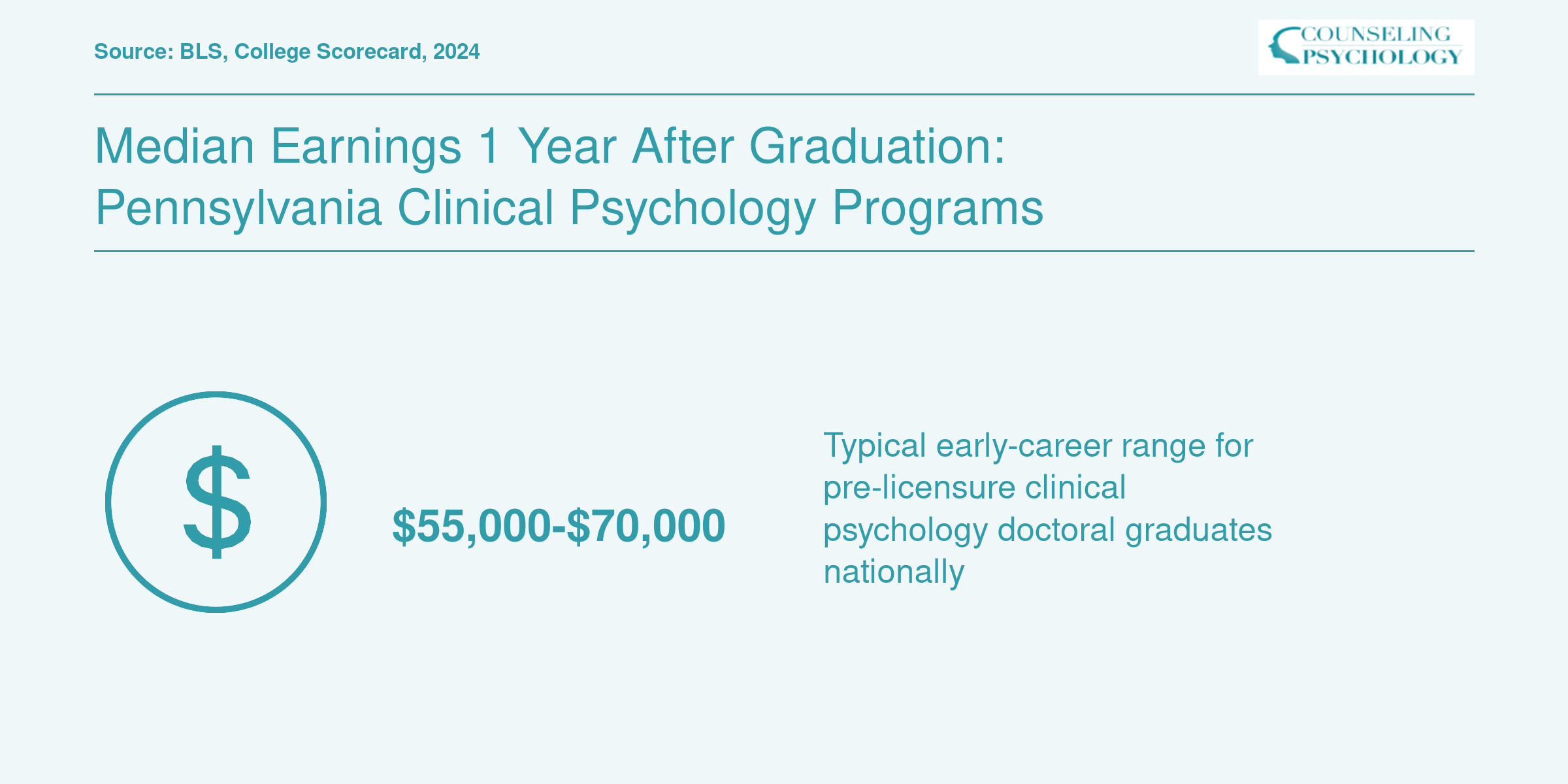
Median Earnings 1 Year After Graduation: Pennsylvania Clinical Psychology Programs
Program-level earnings data one year after completion is not yet published for Pennsylvania's clinical psychology doctoral programs. This is common for doctoral-level psychology training: most graduates are still completing postdoctoral supervised hours and have not yet obtained independent licensure, so their early earnings do not reflect the full salary trajectory of a licensed clinical psychologist.
Internship Match Rates and EPPP Pass Rates for Pennsylvania Programs
Nationally, doctoral students in clinical psychology PhD programs matched to internships at a 95% rate in 2023, while PsyD students matched at 91%.1 Those figures give you a useful baseline, but they are national aggregates, not Pennsylvania-specific numbers, and the gap between a strong program and a struggling one can be far wider than those averages suggest.
Where to Find Program-Level Data
APPIC publishes match statistics going back to 2000, and program-level spreadsheets are available through APPIC Match Statistics.2 The data is organized by individual program rather than by state, so you will need to search for each Pennsylvania school you are considering. One practical limitation: APPIC does not publish a state-level summary, meaning there is no single table showing how Pennsylvania programs performed as a group. You will need to pull each program's row from the spreadsheet yourself.
For EPPP first-time pass rates, the Association of State and Provincial Psychology Boards (ASPPB) publishes score reports at asppb.net. Program-level pass rate data is not always publicly aggregated in one place, so what you find may depend on how recently the reports were updated and whether a given program's cohort was large enough to be reported separately.
Checking Program Websites Directly
Many Pennsylvania clinical psychology programs publish their own outcomes data under headings like "Student Outcomes," "Program Data," or "Admissions." This is often the fastest route to internship match rates and EPPP figures specific to that program's graduates. Some programs update this information annually; others may lag by a year or two, so note the dates on whatever you find.
If a program's website does not post this information, contact the admissions office directly. Admissions coordinators at accredited programs are generally willing to share match and pass rate data, and a direct conversation also gives you a chance to ask about any year-to-year variation in outcomes. If you are also weighing broader clinical psychology doctorate programs, comparing match data across states can add useful perspective.
Putting the Numbers in Context
Internship match rates and EPPP pass rates are meaningful indicators of program quality, but neither tells the whole story on its own. A program with a 100% match rate may achieve that partly by encouraging students to apply broadly or to lower-competition sites. Pair those numbers with accreditation status through apa.org and information from the Pennsylvania Psychological Association at papsy.org to build a fuller picture of what licensure preparation actually looks like at each school.
How to Become a Clinical Psychologist in Pennsylvania
The path from undergraduate student to independently licensed clinical psychologist in Pennsylvania typically spans 8 to 10 years after high school graduation. Pennsylvania requires completion of a doctoral program from an APA- or CPA-accredited institution, 3,500 total supervised experience hours (including 1,750 postdoctoral hours), and passing scores on both the EPPP and the state jurisprudence exam. Here is the credentialing sequence at a glance.
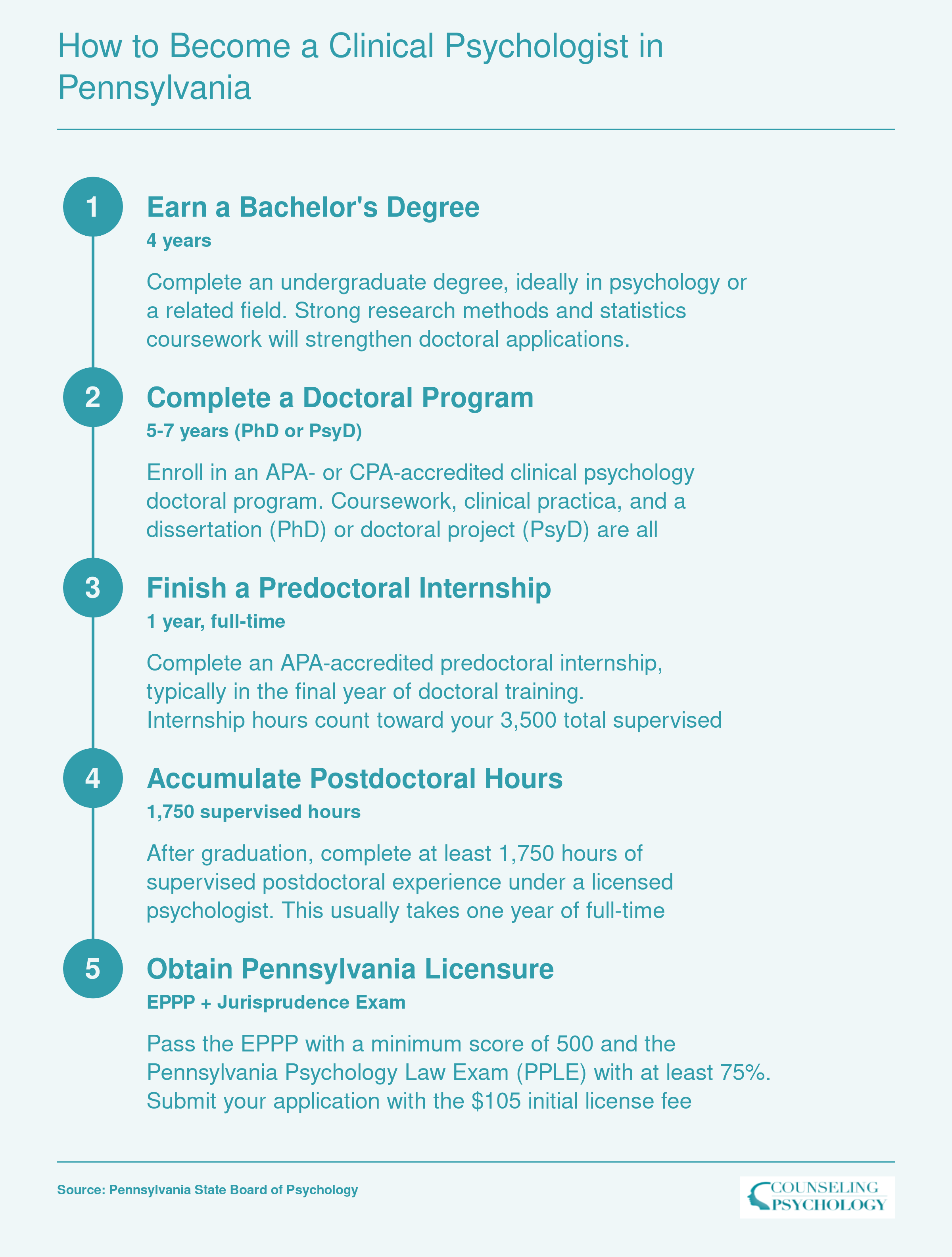
Pennsylvania is home to more than a dozen APA-accredited clinical psychology doctoral programs, one of the highest concentrations in the country. This density gives students many options for research focus and clinical training within the state.
Online and Hybrid Clinical Psychology Programs in Pennsylvania
Most APA-accredited clinical psychology doctoral programs remain campus-based because supervised clinical training, face-to-face practicum, and hands-on assessment labs are central to the scientist-practitioner model. According to the program data, Pennsylvania's doctoral landscape reflects this reality: eight of the nine doctoral clinical psychology programs listed operate exclusively on campus. Only master's-level programs, such as those at Saint Joseph's University, Gwynedd Mercy University, and Waynesburg University, offer fully online or predominantly online formats.
APA's Stance on Clinical Training and Accreditation
The American Psychological Association requires substantial in-person supervised experience for doctoral clinical psychology programs. Core competencies in assessment, psychotherapy, consultation, and ethical practice demand real-time supervision, live observation, and corrective feedback. As a result, APA-accredited PhD and PsyD programs in Pennsylvania, including those at the University of Pittsburgh-Pittsburgh, Pennsylvania State University, Temple University, Drexel University, West Chester University, Immaculata University, Chatham University, Marywood University, Duquesne University, La Salle University, Indiana University of Pennsylvania, Point Park University, and Philadelphia College of Osteopathic Medicine, deliver coursework, practica, and clinical training on campus. Hybrid models may integrate occasional online lectures for didactic seminars, but the clinical core remains face-to-face.
Master's Programs and Fully Online Options
Master's degrees in clinical mental health counseling or related fields are more likely to be offered online. Saint Joseph's University offers a fully online Master of Science in Clinical Mental Health Counseling over 2.5 years with 60 credit hours and 700 supervised fieldwork hours. Gwynedd Mercy University delivers a CACREP-accredited online master's with 100 practicum hours and 600 internship hours. Waynesburg University provides a CACREP-accredited Master of Arts in Counseling entirely online with concentrations in clinical mental health counseling and addictions counseling. These programs meet LPC licensure requirements in Pennsylvania but do not carry APA accreditation and do not lead to psychologist licensure. Students interested in comparing online clinical counseling options nationally can explore online LPCC programs as a broader reference point.
Who Online and Hybrid Formats Serve Best
Online master's programs suit working professionals, career changers, and students in rural Pennsylvania who cannot relocate or commute to Pittsburgh, Philadelphia, or Scranton. They allow asynchronous coursework, evening study, and local practicum placement. However, students aiming for psychologist licensure and independent clinical psychology practice should expect to attend a campus-based doctoral program. Those pursuing doctoral-level study may also want to review counseling doctoral programs to understand the broader landscape of online doctoral options. Hybrid formats that blend online didactics with in-person clinical training are rare at the doctoral level in Pennsylvania and still require regular on-site attendance for supervision, assessment training, and practicum rotations.
How to Choose the Right Clinical Psychology Program
Selecting the right clinical psychology doctoral program means matching your career goals, research interests, and personal circumstances to a program's structure, faculty, and funding model. You will spend five to seven years in this environment, so alignment on training philosophy, clinical opportunities, and mentorship matters at least as much as rankings or prestige.
Verify Accreditation and Licensure Pathways
Start with accreditation status. APA-accredited programs meet national training standards and ensure you are eligible for licensure in all 50 states. Non-accredited programs may restrict your ability to sit for the EPPP or limit mobility across state lines. Check the APA Commission on Accreditation directory and confirm that the program holds full accreditation, not provisional or candidacy status.
Assess Research Fit and Faculty Mentorship
Review faculty profiles and recent publications. Doctoral training is fundamentally an apprenticeship. Look for active labs in your area of interest, whether trauma, neuropsychology, child development, or another specialty. Contact prospective advisors before applying to gauge fit and availability. Programs with small cohorts (four to eight students per year) often provide more individualized mentorship than large programs.
Evaluate Practicum Placement Sites and APPIC Match Rates
Clinical training quality depends on practicum partnerships. Strong programs maintain relationships with hospitals, community clinics, VA facilities, and specialty centers. Review the program's internship match data on the APPIC website. Programs with 90 percent or higher match rates in recent years demonstrate solid preparation and network connections. Low match rates or patterns of students scrambling for internships are red flags.
Compare Funding Packages and Cost of Attendance
PhD programs typically offer tuition remission plus a stipend (often $20,000 to $30,000 annually) in exchange for research or teaching assistantships. PsyD programs more often require tuition payment, though some offer competitive scholarships or graduate assistantships. Calculate total cost over five to seven years and weigh against expected post-doctoral earnings. Programs that leave graduates with six-figure debt require careful scrutiny.
Understand Typical Admission Requirements
Most Pennsylvania programs require a minimum undergraduate GPA of 3.0 overall, with psychology coursework often held to a higher bar. The Philadelphia College of Osteopathic Medicine sets a 3.5 minimum for psychology credits specifically.1 Indiana University of Pennsylvania expects at least 18 credits in psychology.2 Chestnut Hill College requires 12.3 Many programs now operate as test-optional for the GRE; the University of Pennsylvania waived GRE requirements for Fall 2026 applicants.4 Plan to submit three letters of recommendation, typically from faculty or supervisors who can speak to your research or clinical potential. Some programs, including PCOM, prefer at least one letter from a doctoral-level psychologist.1 Clinical or research experience is not always mandatory but strengthens your application considerably. Volunteer hours, lab work, or paid positions in mental health settings demonstrate commitment and readiness.
Visit Programs and Trust Fit
Attend interview days or schedule campus visits if invited. Pay attention to cohort dynamics, lab culture, and how current students describe their experience. Ask about attrition rates, time to degree, and post-doctoral outcomes. Reach out to current students directly; most programs provide contact information. A program that looks ideal on paper may feel misaligned in person, and that intuition matters when you are committing the better part of a decade.
Frequently Asked Questions About Clinical Psychology Programs in Pennsylvania
Choosing a clinical psychology doctoral program raises a lot of practical questions, from accreditation status to total cost. Below are answers to the questions prospective students ask most often, with references to the detailed breakdowns elsewhere in this article.
More Clinical Psychology Programs in Pennsylvania to Consider
Beyond the top-ranked programs, Pennsylvania offers many other clinical psychology programs at various degree levels. Below is a directory of additional schools with their locations, program formats, and distinctive features.
Pittsburgh Area
- Doctor of Psychology (PsyD) in Counseling Psychology
- Ph.D. Clinical Psychology
- Doctorate of Psychology in Clinical Psychology (Community Psychology)
- Doctorate of Psychology (Psy.D.) in Clinical Psychology (Community Psychology)
- Psychology Major with Clinical/Counseling Concentration
Philadelphia Area
- Master of Science in Clinical Mental Health Counseling
- Clinical Psychology (Psy.D.) (General Practice)
- Clinical Psychology (Psy.D.) (Child Clinical)
- Clinical Psychology (Psy.D.) (Clinical Health)
- Doctor of Psychology in Clinical Psychology
- Doctor of Psychology in Clinical Psychology (PsyD)
Northeastern Pennsylvania
- Doctor of Clinical Psychology (Psy.D.)
- Bachelor of Science in Psychology - Clinical Services
- Master of Science in Nursing, Psychiatric/Mental Health
Northwestern Pennsylvania
- Master of Arts in Clinical Psychology
Harrisburg Area
- Clinical Psychology
- Psychology (Clinical Psychology)
West Central Pennsylvania
- Clinical Psychology, PsyD
Southwestern Pennsylvania
- Master of Arts in Counseling (Clinical Mental Health Counseling, Addictions Counseling)