
What you’ll learn in this article…
- Riverside-area students can choose from five nearby health psychology programs spanning bachelor's through doctoral levels.
- Becoming a licensed health psychologist in California typically takes 10 to 14 years after high school.
- Local clinical placements are available at major Inland Empire medical systems, county agencies, and community clinics.
- BLS salary data for the broader psychologists category shows Riverside-area wages that differ from both state and national medians.
The Riverside-San Bernardino-Ontario metro area is home to more than 4.5 million residents, creating steady demand for behavioral health professionals trained to address chronic disease management, trauma, addiction, and health disparities. That demand is met by a mix of University of California campuses within commuting distance, private doctoral programs in Los Angeles and San Diego, and online master's degrees designed for working adults.
Students researching health psychology programs face a practical tension: health psychology phd programs that lead to licensure require substantial time and location commitment, while online master's degrees offer flexibility but rarely satisfy California's psychologist licensing requirements. The programs ranked below cover bachelor's specializations, online master's degrees, and APA-accredited doctoral programs (both PhD and PsyD), with tuition ranging from public UC rates around $15,000 annually to private doctoral programs exceeding $35,000.
California's psychologist licensing pathway requires a doctoral degree, so students aiming for independent practice must weigh program reputation, funding packages, and clinical placement networks against the realities of six-to-eight-year timelines and variable debt loads. The Inland Empire's proximity to top-tier research universities and large medical systems gives applicants access to both rigorous training and diverse practicum sites, but cost and admissions selectivity remain decisive factors.
Best Health Psychology Programs Near Riverside, California
Riverside-area students have several strong options for health psychology training, ranging from research-intensive doctoral programs at UC campuses to flexible online master's degrees designed for working professionals. The programs below span bachelor's through doctoral levels, with most structured to align with California licensure requirements or to prepare graduates for non-clinical careers in public health, wellness, and behavioral medicine. Several of these schools carry Hispanic-Serving Institution (HSI) designation, reflecting the diversity of the Inland Empire and Southern California more broadly.
- Program relevance to health psychology
- Institutional graduation and retention rates
- Financial accessibility and net price
- Regional proximity to Riverside
- California licensure pathway alignment
- College Scorecard graduate earnings — collegescorecard.ed.gov
- Independent program research
- Internal program database
- NCES-IPEDS federal institutional data — nces.ed.gov

University of California-Irvine
UC Irvine offers a PhD in Psychological Science with a dedicated Health Psychology concentration, making it one of the closest doctoral-level options for Riverside residents. The program provides five years of guaranteed funding, including tuition coverage and a stipend, and students benefit from an on-campus medical center that supports clinical and behavioral health research. As an HSI with a 94% retention rate and an institution-wide graduation rate near 87%, UCI combines research rigor with strong student support. Its military-friendly designation is a practical plus given the Riverside area's proximity to March Air Reserve Base.
- Campus-based program with a six-year normative completion timeline
- Five years of financial support covering tuition and providing a stipend
- Faculty mentorship and research collaboration begin in the first year
- GRE scores are optional for admission
- On-campus medical center supports interdisciplinary health research
- Advanced training in statistics and research methodology
- In-state tuition of approximately $14,827 for California residents
PhD in Psychological Science, Health Psychology Concentration — On-Campus

University of California-San Diego
UC San Diego's Psychology B.S. with a Specialization in Human Health provides a strong undergraduate foundation for students planning to pursue graduate work in health psychology. The curriculum blends natural sciences, statistics, and specialized coursework in health behaviors, addiction, and cognitive control. UCSD holds HSI designation and posts an institution-wide graduation rate of 86%, with a net price of roughly $12,470 for aided students. Although located in La Jolla, the UC system's in-state tuition structure makes it an affordable launching point for Riverside-area undergraduates.
- Bachelor's-level program focused on health psychology principles
- Interdisciplinary curriculum spanning biology, statistics, and psychology
- Research-focused upper-division requirements with multiple course options
- Computer programming integrated into the formal skills track
- Located within the La Jolla biomedical research corridor
- In-state tuition of approximately $15,788 for California residents
Psychology B.S. with Specialization in Human Health — On-Campus

University of California-Los Angeles
UCLA's Health Psychology doctoral program trains research scientists investigating connections between psychological processes and physical health outcomes across diverse populations. The program's emphasis on health-disparities research with ethnically and socioeconomically diverse communities mirrors demographic patterns in the Inland Empire. Students access UCLA Health and the Fielding School of Public Health for interdisciplinary collaboration. With an institution-wide graduation rate of nearly 93% and HSI designation, UCLA pairs exceptional academic resources with strong financial support for California residents, though its 9% admission rate makes it highly competitive.
- Research-intensive doctoral program on the UCLA campus
- Emphasis on diverse populations and health-disparities research
- Interdisciplinary access to UCLA Health and public health infrastructure
- Strong biological and methodological training components
- In-state tuition of approximately $14,476 for California residents
- Institution-wide graduation rate of 92.6%
Health Psychology PhD — On-Campus

Palo Alto University
Palo Alto University offers a PhD in Clinical Psychology with a Health Psychology emphasis that prepares graduates to work in integrated healthcare settings. The program focuses on reducing health disparities through culturally sensitive, evidence-based interventions, requiring dedicated health psychology coursework and a dissertation in the field. Its 15:1 student-to-faculty ratio supports close mentoring. Because the program is APA-eligible and California-based, graduates are well positioned for California Board of Psychology licensure. However, the Bay Area location means Riverside students would need to relocate, and tuition runs approximately $50,166 per year.
- Doctoral program with a dedicated health psychology emphasis track
- Three required health psychology courses plus a health-focused dissertation
- Clinical practicum placements in integrated healthcare settings
- Emphasis on cultural humility and reducing health disparities
- Interprofessional training across medical disciplines
- 15:1 student-to-faculty ratio for individualized mentorship
- Tuition of approximately $50,166 per year
PhD in Clinical Psychology, Health Psychology Emphasis — On-Campus

National University
National University delivers both an M.S. in Health Psychology and a PhD in Psychology with a health psychology specialization, both fully online. Headquartered in San Diego with deep roots across Southern California, NU is well suited for Riverside-area working adults and military-connected students who need maximum scheduling flexibility. The master's program can be completed in about 16 months, and a FastForward pathway lets students stack directly into the PhD. The institution-wide graduation rate (approximately 43%) reflects NU's open-access mission serving nontraditional learners, and tuition sits at $16,416 with no application fee. NU holds HSI designation.
- Fully online, 30-credit program completable in roughly 16 months
- Weekly start dates and no application essay required
- Covers stress management, behavioral nutrition, and chronic health topics
- Optional non-clinical internship component
- $0 application fee and no GRE requirement
- FastForward pathway available into the PhD program
- 100% online doctoral program with an estimated 48-month timeline
- One-to-one faculty engagement with personalized research mentoring
- 18 credit hours dedicated to health psychology content
- No group assignments, supporting self-paced progression
- Weekly course start dates for flexible enrollment
- Doctoral faculty across all courses
Master of Science in Health Psychology — Online
PhD in Psychology, Health Psychology Specialization — Online

Touro University Worldwide
Touro University Worldwide, a nonprofit based in nearby Los Alamitos, offers a fully online M.A. in Psychology with a Health Psychology concentration that can be finished in about one year. The program requires no GRE and features six annual start dates with eight-week sessions, making it one of the most accessible options for Riverside professionals balancing work and family. At roughly $9,000 in tuition, it is among the most affordable health psychology master's degrees in California. This degree does not lead to clinical licensure, so it is best suited for careers in health education, wellness program design, or as a stepping stone to a doctoral program. The institution-wide graduation rate is approximately 29%, and its 10:1 student-to-faculty ratio supports close interaction with instructors.
- 100% online with no residency requirement
- Completable in approximately one year
- No GRE required and accelerated admissions process
- Six start dates per year with eight-week sessions
- Tuition of approximately $9,000 per year
- Does not lead to clinical licensure
- 10:1 student-to-faculty ratio
Master of Arts in Psychology, Health Psychology Concentration — Online

The Chicago School at Los Angeles
The Chicago School at Los Angeles offers an APA-accredited Psy.D. in Clinical Psychology with a Health Psychology concentration, structured as a five-year, full-time campus program. Students complete at least 2,000 hours of supervised internship alongside coursework grounded in evidence-based practice and social justice principles. The Los Angeles campus draws on a broad network of Southern California practicum sites, some within commuting distance of Riverside. Tuition is approximately $35,328 per year. Because the Psy.D. is APA-accredited, graduates meet a key prerequisite for California psychologist licensure, making this a viable path for students aiming to practice clinical health psychology in the Inland Empire.
- APA-accredited five-year doctoral program on the LA campus
- Health Psychology available as a concentration within clinical training
- Minimum 2,000-hour supervised internship requirement
- Multiple intervention orientation choices during training
- Southern California practicum network accessible from Riverside
- 11:1 student-to-faculty ratio
- Minimum 3.0 undergraduate GPA required for admission
- Tuition of approximately $35,328 per year
Psy.D. in Clinical Psychology, Health Psychology Concentration — On-Campus
How We Ranked These Health Psychology Programs
What criteria actually separate a strong health psychology program from a mediocre one, and how can you trust that a ranking isn't just opinion dressed up as research?
Federal Data, Not Editorial Gut Feeling
Every program on this list was evaluated using publicly available federal data from the U.S. Department of Education's College Scorecard. That means the numbers driving these rankings are the same ones the government collects from institutions and publishes for consumer use. No survey of department chairs, no prestige weighting, no brand recognition bonus. The goal is to give prospective students a transparent, reproducible basis for comparison.
The Criteria We Weighted
Five factors shaped the overall rankings:
- Affordability: Net price after aid is a core input. A program that costs $60,000 per year demands a very different career trajectory than one that costs $18,000, and the ranking reflects that difference.
- Graduation rate: Scorecard graduation rates are institution-wide figures, not program-specific ones. That distinction matters. A university with a strong overall completion record signals institutional support and student services, but it does not guarantee that the psychology department specifically retains its cohort. We use this figure as a proxy and flag it accordingly.
- Earnings outcomes: Where program-level median earnings data is available through Scorecard, we use it. These figures capture what graduates from specific programs reported earning at one-year and longer post-enrollment intervals, which is meaningfully more relevant than university-wide wage averages.
- Return on investment proxy: Dividing median earnings by median debt load produces a ratio that approximates how manageable repayment looks relative to what graduates actually earn. Programs with stronger ratios rank higher, all else being equal.
- Format and proximity: For students anchored in the Inland Empire, whether a program offers on-campus, hybrid, or fully online instruction matters practically. Distance from Riverside factored into the ranking as a convenience and clinical-access variable.
What the Rankings Cannot Tell You
No federal dataset captures faculty mentorship quality, the strength of a program's clinical partnerships, or how well a curriculum prepares students for California licensure specifically. Those elements require direct outreach to programs. Think of this ranking as a starting filter, one grounded in verifiable data, that narrows a long list to a shorter one worth investigating on your own terms.
Program Comparison: Tuition, Format, and Outcomes
The table below puts key cost, format, and outcome data side by side for the five health psychology programs closest to Riverside. Tuition figures reflect annual rates reported to IPEDS, while median earnings and graduation rates are institution-level data from the College Scorecard. Program-level earnings are not yet available for these programs.
| School | Degree Level | Format | In-State Tuition | Out-of-State Tuition | Net Price | Graduation Rate | Student-to-Faculty Ratio | Median Earnings (10 yr) | Median Graduate Debt |
|---|---|---|---|---|---|---|---|---|---|
| UC San Diego | Bachelor's (B.S., Human Health Specialization) | On Campus | $15,788 | $47,676 | $12,470 | 86% | 19:1 | $84,943 | $15,500 |
| UCLA | Doctorate (Ph.D.) | On Campus | $14,476 | $29,578 | $12,548 | 92.6% | 20:1 | $82,511 | $14,000 |
| UC Irvine | Doctorate (Ph.D., Health Psychology Concentration) | On Campus | $14,827 | $29,929 | $14,251 | 86.9% | 19:1 | $80,735 | $15,000 |
| Touro University Worldwide | Master's (M.A., Health Psychology Concentration) | Online | $9,000 | $9,000 | $19,058 | 28.6% | 10:1 | $40,803 | $25,000 |
| National University | Master's (M.S. in Health Psychology) | Online | $16,416 | $16,416 | $22,878 | 42.9% | 16:1 | $67,548 | $25,000 |
Questions to Ask Yourself
What Degree Do You Need for Health Psychology?
Research-focused PhD programs and practice-oriented PsyD programs both lead to licensure in California, but they differ substantially in training philosophy, funding structure, and career preparation. Understanding this distinction early helps you select the right pathway for your professional goals in health psychology.
The Bachelor's Foundation
Most health psychology careers begin with a bachelor's degree in psychology, though related majors like neuroscience, biology, or public health can also provide adequate preparation. During undergraduate study, focus on research methods, statistics, and biopsychology courses that align with health psychology's emphasis on the mind-body connection. Strong GPA performance and research experience become critical when applying to competitive doctoral programs. If you are still exploring the landscape, a broader look at different types of psychology degrees can help you understand how each level of education maps to specific career outcomes.
Master's Degrees: Optional but Strategic
A master's degree is not required for doctoral admission, but many students pursue one as a stepping stone. Some programs near Riverside offer health psychology masters programs that strengthen your application profile, provide research experience, and help you clarify whether health psychology is the right specialization. These degrees do not qualify you for the psychologist title in California, but they can make you a more competitive doctoral candidate.
PhD vs. PsyD: Two Paths to the Same License
Both PhD and PsyD degrees qualify for psychologist licensure in California, but the training models differ:1
- PhD programs: Emphasize research methodology and academic scholarship. Many offer full tuition waivers plus stipends, expecting students to conduct original research and publish. Training typically takes five to seven years.
- PsyD programs: Focus on clinical practice and applied skills. Most charge tuition comparable to professional schools and can be completed in four to six years. Graduates often enter direct patient care roles rather than research positions.
California's Board of Psychology accepts doctoral degrees from regionally accredited institutions.1 APA accreditation is not strictly required for licensure, though it streamlines the process and is preferred by many employers and internship sites.
California Licensure Requirements
The California Board of Psychology mandates a doctoral degree for independent practice as a psychologist. A master's degree alone does not qualify you to use the psychologist title or practice independently in the state.1
Beyond the doctoral degree, licensure requires 3,000 hours of supervised professional experience. You may complete up to 1,500 hours during predoctoral training and must complete at least 1,500 hours postdoctorally. Predoctoral hours must be earned within 30 months, and postdoctoral hours have the same time limit unless you complete all experience postdoctorally, which extends the window to 60 months.1
You must also pass two examinations: the Examination for Professional Practice in Psychology (EPPP) and the California Psychology Law and Ethics Examination (CPLEE).1 Additionally, California requires specific coursework in human sexuality, alcohol and chemical dependency, child abuse assessment, partner abuse assessment, aging and long-term care, and suicide risk intervention.
Stepping-Stone Programs in the Ranking
Some programs featured in this guide offer bachelor's or master's degrees rather than doctoral training. These serve as preparation for doctoral study, not as licensure endpoints. If your goal is to become a licensed health psychologist in California, plan your education with the doctoral degree as your destination, using undergraduate and master's programs strategically along the way.
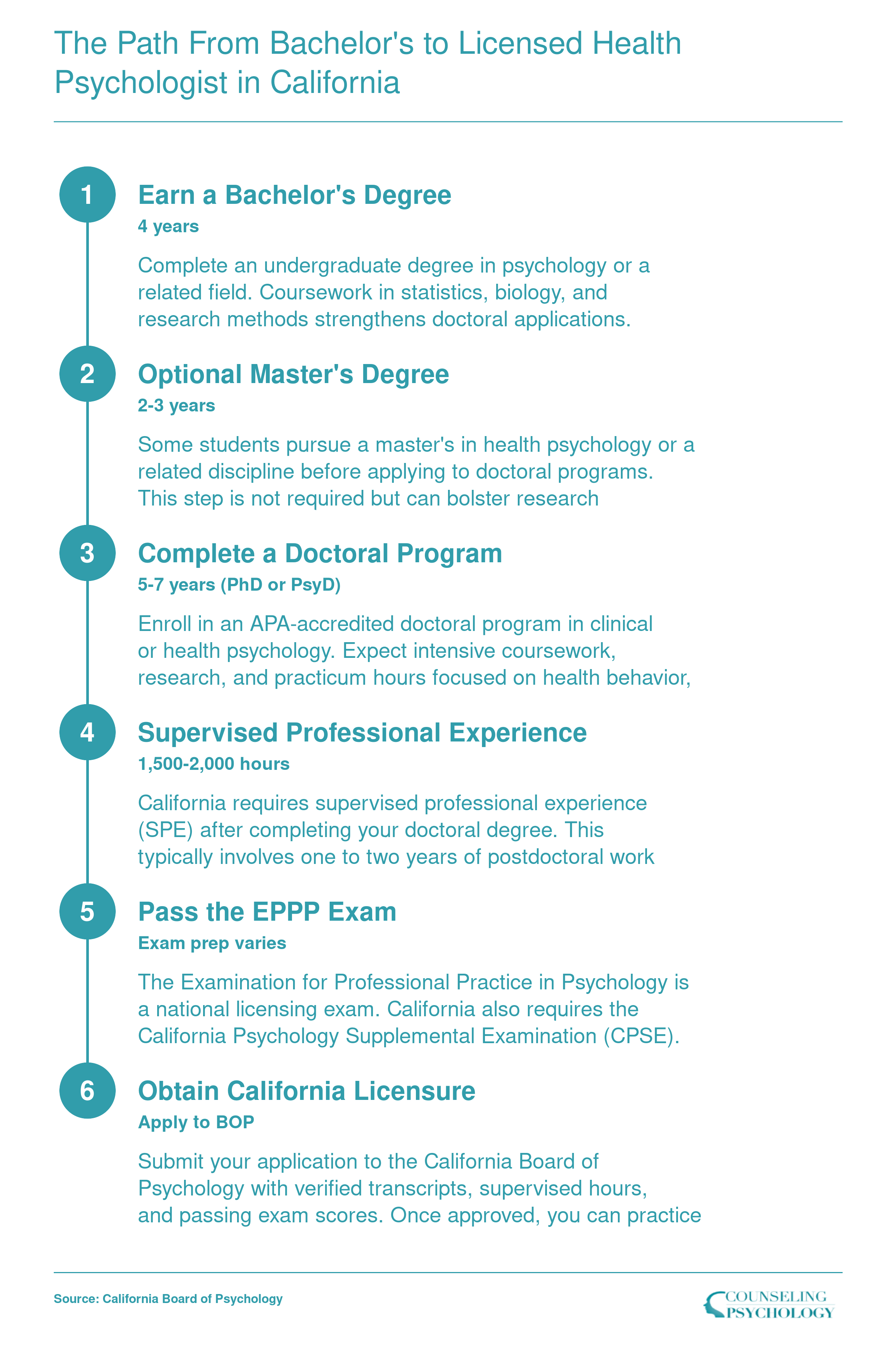
The Path from Bachelor's to Licensed Health Psychologist in California
Becoming a licensed health psychologist in California requires a structured series of academic and professional milestones. Each stage builds on the last, and the total timeline typically spans 10 to 14 years after high school graduation.
Clinical Placements and Training Sites in the Riverside Area
Which hospitals and clinics around Riverside actually take health psychology practicum students? The Inland Empire has a denser training network than most applicants realize, anchored by a few large medical systems and a long tail of county agencies and community clinics.
Major Hospital and Medical Center Sites
Four systems do most of the heavy lifting for health psychology training in the region:
- Loma Linda University Medical Center: A primary training hub with practicum slots across integrated primary care, behavioral medicine, oncology, and rehabilitation psychology. Loma Linda's School of Behavioral Health maintains formal practicum site listings.1
- VA Loma Linda Healthcare System: Strong for integrated primary care mental health, health behavior coaching, pain management, and inpatient consult-liaison rotations. VA sites are also among the most reliable pipelines into APA-accredited internship.
- Kaiser Permanente Riverside and Fontana: Both campuses host practicum students working in behavioral medicine, chronic disease management, and outpatient psychiatry.
- Riverside University Health System Behavioral Health: The county's public behavioral health arm, with rotations spanning outpatient clinics, crisis services, and integrated care embedded in safety-net medical settings.
Public Sector and Community Placements
Beyond the major hospitals, county and community sites widen the rotation menu considerably. San Bernardino County Department of Behavioral Health and Patton State Hospital both run formal internship programs, with Patton offering forensic and severe mental illness exposure that is hard to find elsewhere.23 SAC Health System, a federally qualified community health center, places trainees in integrated primary care serving uninsured and underinsured populations. Community providers like The Wylie Center, Victor Community Support Services, Option House, and Tessie Cleveland Community Services Center round out options for trainees interested in community mental health counseling, family services, and trauma-focused work. Riverside County Office of Education hosts school-based practica for students leaning toward pediatric health psychology.
Why HPSA Status Matters
Much of Riverside and San Bernardino County carries federal Health Professional Shortage Area (HPSA) designations for mental health. That status pulls federal training dollars into local clinics, which in turn opens up more funded practicum and internship slots than you would find in a saturated metro. It also makes graduates eligible for loan repayment through programs like the NHSC Loan Repayment Program once licensed, in exchange for service at qualifying sites.
One caution: site availability changes year to year, and not every program on your shortlist holds an active MOU with every site listed above. Confirm specific partnerships with each program's training director before you assume a placement is on the table.
Related Articles
Career Outlook and Salaries for Health Psychologists in the Inland Empire
What can a health psychologist actually earn working in the Riverside-San Bernardino-Ontario region, and is the local job market strong enough to support a long career? The honest answer involves some national benchmarks, a regional workforce story, and a few caveats about how granular the wage data really gets.
What the Wage Data Shows
The Bureau of Labor Statistics tracks clinical and health psychologists under a broader category (SOC 19-3039, Psychologists, All Other), and the most recent national figures from May 2023 give the clearest picture:1
- National median annual wage: $117,750
- 25th percentile: $76,550
- 75th percentile: $138,280
- 10th to 90th percentile range: $47,450 to $157,420
- Total national employment: roughly 14,480
BLS does not always publish a separate, reliable MSA-level breakout for this specific occupation code in the Riverside-San Bernardino-Ontario metro, and the figures above are national, not Riverside-specific. California psychologists generally earn above the national median because of higher cost-of-living adjustments and stronger licensure protections, but readers should treat any single Inland Empire number cautiously unless they pull it directly from current BLS OEWS tables for the MSA.
PhD vs. PsyD Earnings
A common question: does the degree letter change the paycheck? In clinical practice, median earnings for PhD and PsyD holders tend to land in a similar range. The differences show up at the edges. PhD graduates often have a stronger pathway into academic, research, and federally funded positions, where salary ceilings can be higher but entry is competitive. PsyD graduates typically finish coursework and supervised hours faster and move into licensed clinical roles sooner, which can mean two or three additional years of full clinical salary that partly offsets any long-term gap.
Local Demand and Workforce Shortages
Both Riverside and San Bernardino counties contain federally designated Mental Health Professional Shortage Areas (HPSAs), and the region's behavioral health departments have been expanding integrated care, school-based services, and Medi-Cal supported programs. For health psychologists trained to work across primary care, chronic disease management, and behavioral medicine, that translates into steady hiring at FQHCs, county clinics, and hospital systems. Demand is unlikely to soften in the next decade, and clinicians willing to work in underserved zip codes may qualify for loan repayment through state and federal programs.
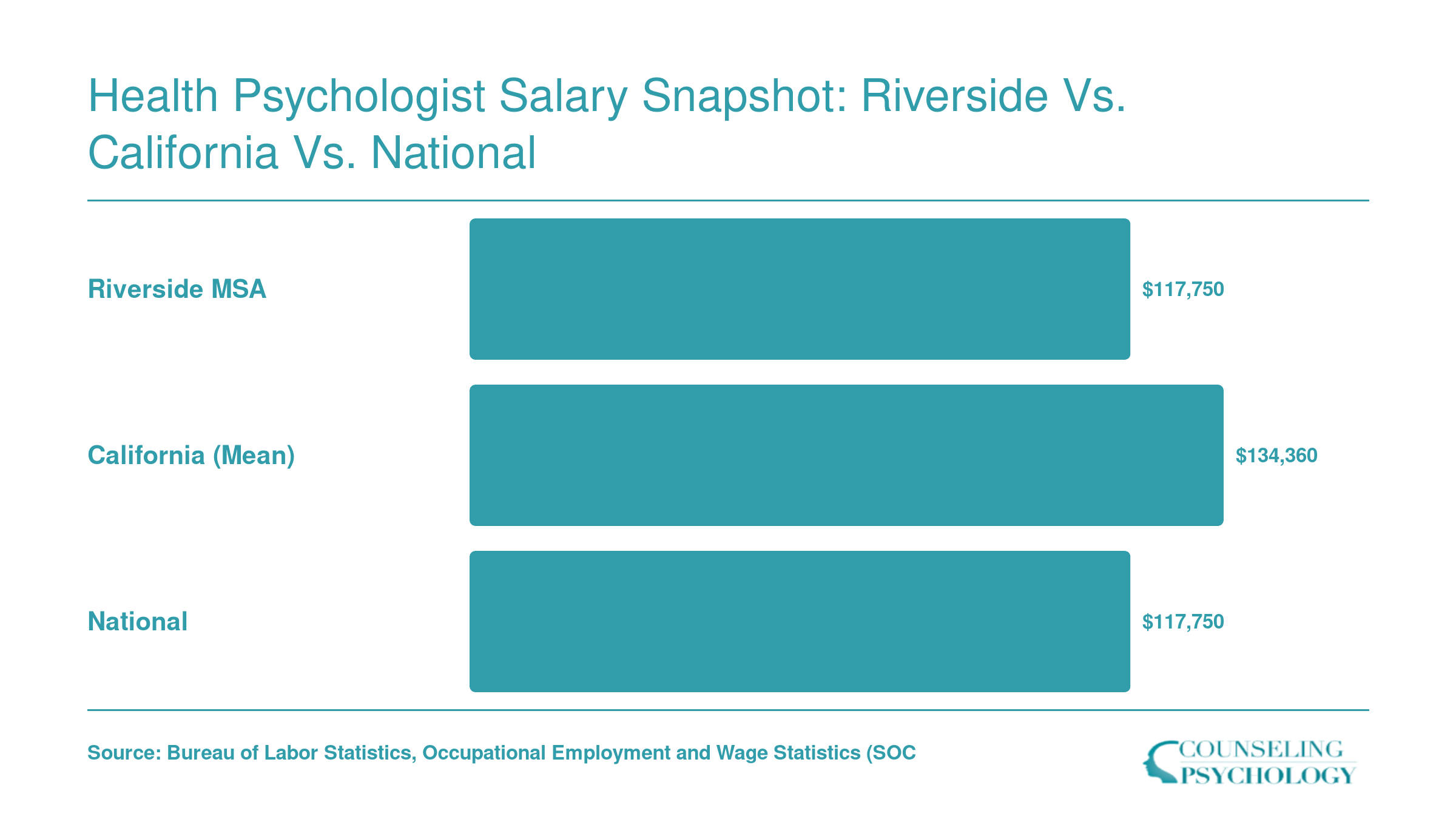
Health Psychologist Salary Snapshot: Riverside vs. California vs. National
Salary data for health psychologists can be difficult to pin down because the BLS groups these roles under broader occupational categories. The figures below use the "Psychologists, All Other" classification (SOC 19-3039), which captures health psychologists but also includes other specialty areas. Treat these as approximate benchmarks rather than precise health-psychology-only wages.
Online vs. On-Campus Health Psychology Programs for Riverside Students
Choosing between online and on-campus formats is one of the most consequential decisions Riverside students face when pursuing a health psychology degree. Both paths can lead to licensure in California, but each comes with trade-offs that affect your timeline, budget, and clinical training. Keep in mind that the California Board of Psychology requires supervised clinical hours regardless of how you complete your coursework, so online students must still arrange local practicum placements.
Pros
- Online programs offer scheduling flexibility that lets working professionals in Riverside continue earning while completing coursework.
- Studying online opens access to APA-accredited programs outside Southern California without the cost of relocating.
- Online students can save significantly on housing, commuting, and campus fees compared to living near a campus in the Inland Empire.
- On-campus programs make coordinating clinical placements far easier because faculty often have established relationships with local training sites.
- Face-to-face mentorship from faculty and stronger cohort bonds are consistently cited advantages of on-campus doctoral programs.
- On-campus students typically build deeper professional networks through lab work, conferences, and day-to-day interaction with peers.
Cons
- Online students still need to secure in-person practicum and internship sites near Riverside, which requires self-directed planning and local outreach.
- Programs that lack APA accreditation may draw extra scrutiny from the California Board of Psychology, potentially complicating the licensure process.
- Limited organic networking in online programs can make it harder to find research collaborators, mentors, and post-doctoral opportunities.
- On-campus programs often require rigid class schedules that are difficult to balance with full-time employment or family obligations.
- Relocating to or commuting across Southern California for an on-campus program can substantially raise total costs when factoring in housing and transportation.
- Doctoral programs, which are strongly preferred for health psychology licensure, are more commonly offered in traditional on-campus formats, narrowing online options.
Admissions Tips and Preparation for Health Psychology Programs
Doctoral admissions in health psychology have grown more competitive over the past several years, partly because the field itself has expanded into medical settings, public health systems, and integrated care models that did not exist at scale a decade ago. Understanding exactly what programs want before you build your application saves significant time and reduces the risk of a mismatch between your profile and a program's expectations.
Start with Program Websites Directly
The most reliable admissions information lives on each program's own pages. Loma Linda University's doctoral programs in psychology and the University of California, Riverside each maintain admissions sections that list current GPA expectations, whether the GRE is required or optional, prerequisite coursework, and application deadlines. These pages are updated more frequently than third-party aggregators, so check them close to the cycle you plan to apply. A GPA range that applied three years ago may not reflect what the incoming cohort looks like today.
For a broader comparison across many programs at once, the American Psychological Association maintains an online Graduate Study in Psychology database. It lets you filter by degree type, specialty area, and state, and it pulls standardized data directly from programs. It is a practical starting point for comparing prerequisite requirements and deadline windows side by side before you invest time in any single application.
Know What Doctoral Programs Typically Expect
Most health psychology PhD and PsyD programs in Southern California look for a combination of the following:
- Undergraduate GPA: Most programs cite a preferred minimum around 3.0 to 3.3, though competitive applicants often sit higher.
- GRE policy: Policies vary widely. Some programs have dropped the GRE requirement entirely; others still request it or treat it as optional but reviewable. Check each program individually.
- Prerequisite coursework: Expect requirements in statistics, research methods, and general psychology. Some programs also want biological sciences or abnormal psychology.
- Research or clinical experience: Documented hours in a research lab, clinical setting, or community mental health context strengthen any application considerably.
- Personal statement and letters of recommendation: Programs read these carefully. Specificity about why health psychology, and why that particular program, matters more than generic language about helping people.
Go Beyond the Website
For anything a website leaves unclear, contact the program's admissions coordinator by email or phone. Ask about typical timelines for decisions, whether they offer informational sessions, and whether sample application materials or FAQs are available. Most coordinators are responsive and appreciate direct, well-prepared questions.
If you are still exploring adjacent specializations, you may find it helpful to compare cognitive psychology masters programs or look into applied psychology careers to see how related fields overlap with health psychology training. The Bureau of Labor Statistics at BLS.gov provides a useful overview of the psychologist occupation broadly, including work settings and general job functions. It is a reasonable starting point for understanding the field, but it does not carry program-specific admissions criteria. Use it alongside professional directories and program handbooks rather than as a substitute for either.
Frequently Asked Questions About Health Psychology Programs
Prospective students exploring health psychology programs near Riverside often share similar concerns about program quality, costs, and career outcomes. Below are answers to the most common questions, drawn from current program data and industry standards.