
What you’ll learn in this article…
- Jacksonville State, UAH, and Auburn offer the three most affordable ABAI-verified ABA programs near Montgomery.
- Alabama now counts 653 credentialed behavior analysts, signaling strong and growing local demand for ABA professionals.
- BCBA exam pass rates vary dramatically across Alabama programs, making cohort size and preparation model key factors.
- State licensure as an LBA is required to practice in Alabama, separate from earning BCBA national certification.
Demand for Board Certified Behavior Analysts has grown faster in Alabama than the state's credentialed workforce can absorb, and the gap is most visible in underserved regions around Montgomery. Earning that credential requires completing a verified master's-level ABA program, passing the national BCBA examination, and obtaining an Alabama Licensed Behavior Analyst credential before practicing independently.
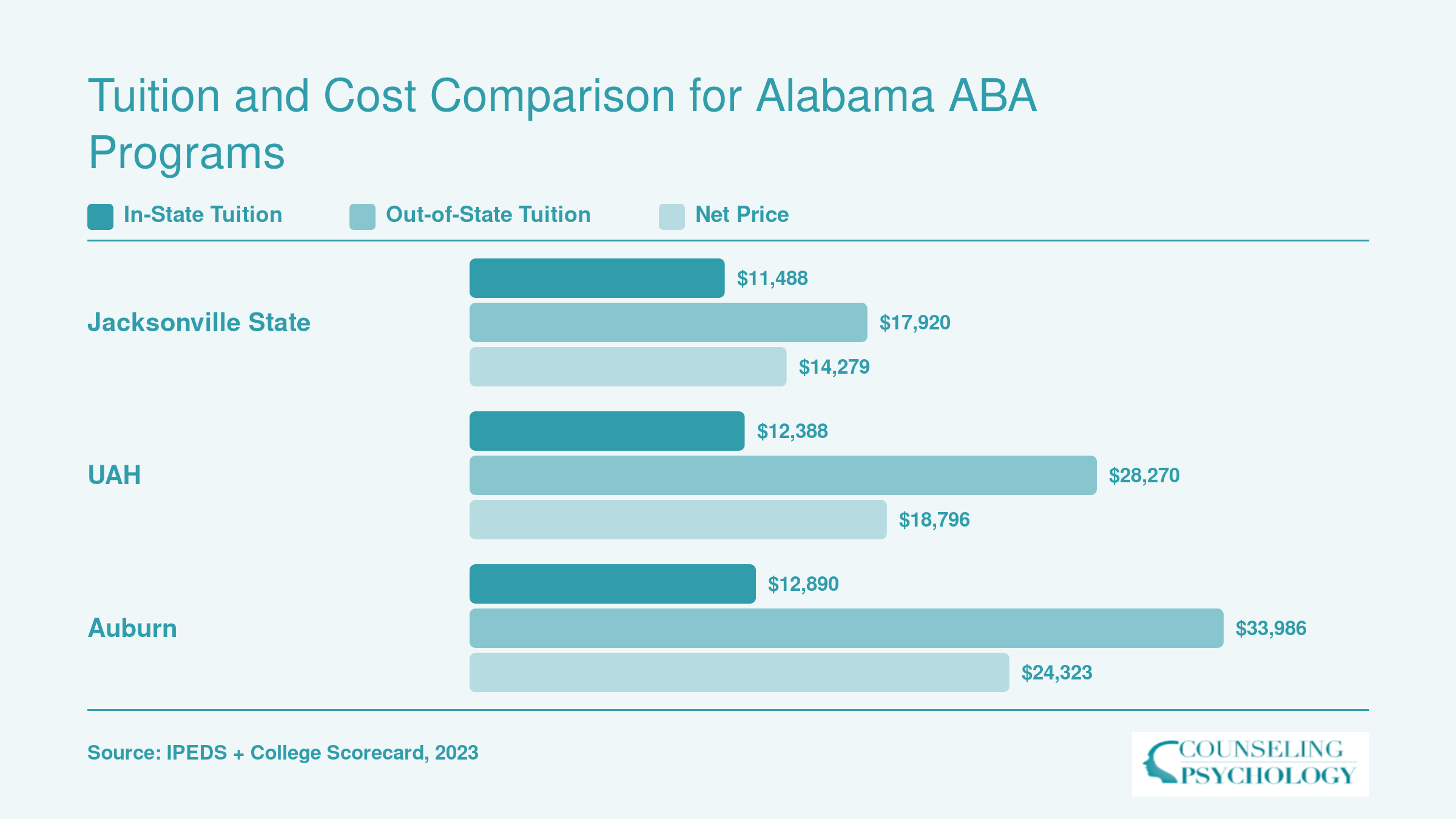
Cost is where many prospective students stall. In-state tuition for the three ranked programs near Montgomery ranges from roughly $11,500 to $12,900 per year, but net price after institutional aid varies considerably. Auburn University's effective net price runs closer to $24,000 annually, while Jacksonville State University students pay approximately $14,300 after grants. For students weighing a two-year master's commitment against income foregone during full-time study, those differences compound quickly.
All three programs hold verification through the Association for Behavior Analysis International, which is the accreditation standard the BCBA examination requires. That floor matters: without it, coursework hours may not count toward certification eligibility, regardless of institutional reputation. In a field where the credential defines the career, program verification is not a secondary consideration.
Best Affordable ABA Programs Near Montgomery, Alabama
Affordability is the primary lens we used to build this list. Net price, which accounts for institutional financial aid and grants, carries the heaviest weight in our ranking because sticker-price tuition alone rarely reflects what Alabama students actually pay. Each of the three programs below is a BCBA-aligned master's degree offered at a public Alabama university, and all three sit within reasonable reach of Montgomery for students willing to commute, relocate, or take advantage of flexible scheduling.
- Net price after financial aid
- In-state and out-of-state tuition
- Institution-wide graduation rate
- Program format and flexibility
- BCBA exam preparation quality
- NCES-IPEDS federal institutional data — nces.ed.gov
- College Scorecard graduate earnings — collegescorecard.ed.gov
- Internal program database
- Independent program research

Jacksonville State University
Jacksonville State University delivers the lowest net price of any ABA master's program in Alabama, making it the standout option for cost-conscious students. Situated in the northeast part of the state, JSU serves a large proportion of Pell Grant recipients (69%), signaling robust financial aid infrastructure. Its M.S. in Applied Behavior Analysis pairs experimental and applied coursework with local practicum placements, and its curriculum is verified by the Association for Behavior Analysis International.
- In-state tuition approximately $11,488; net price around $14,279
- Curriculum verified by ABAI, aligning with BCBA exam requirements
- Combines experimental and applied behavior analysis coursework
- Local practicum sites provide supervised, hands-on clinical hours
- BCBA supervision available through program faculty
- Research facility access supports capstone and thesis projects
- Community service projects integrated into the curriculum
- Institution-wide graduation rate of 54.7%
M.S. in Applied Behavior Analysis — On-Campus

University of Alabama in Huntsville
The University of Alabama in Huntsville created its ABA master's explicitly to address growing demand for qualified behavior analysts across Alabama and the Southeast. UAH delivers coursework through online evening classes, letting students maintain full-time or part-time employment while earning their degree, a feature that meaningfully lowers the total cost of attendance. No GRE is required for admission, removing another expense barrier. Recognized as a Tier 2A program by ABAI, UAH blends ethical practice, cultural awareness, and supervision skill development across a structured 36-credit, five-semester plan.
- In-state tuition approximately $12,388; net price around $18,796
- Online evening course delivery supports working students
- No GRE required, reducing application costs
- Minimum 36 credit hours; completable in five semesters full-time
- ABAI Tier 2A recognition supports employer credibility
- Emphasis on ethical guidelines and cultural awareness
- Designed for educators, counselors, and social workers transitioning to ABA
- Institution-wide graduation rate of 64.3%
Master of Science in Applied Behavior Analysis — On-Campus

Auburn University
Auburn University's on-campus ABA master's carries a higher net price than the other two options but pairs that investment with an 82% institution-wide graduation rate and a reported 100% BCBA exam pass rate over the past five years. The 24-month, full-time program includes diverse clinical internships across Alabama community settings and culminates in a capstone research project. Financial assistance is available, and ABAI accreditation reinforces the degree's standing with employers statewide.
- In-state tuition approximately $12,890; net price around $24,323
- Reported 100% BCBA exam pass rate over the past five years
- Full-time, 24-month on-campus structure with clear timeline
- Diverse clinical internship placements throughout Alabama
- Capstone research project required for graduation
- Accredited by ABAI with five full-time faculty members
- Financial assistance options available to admitted students
- Institution-wide graduation rate of 82%
Master of Science in Applied Behavior Analysis — On-Campus
How We Ranked These ABA Programs
How do you tell which budget-friendly ABA program near Montgomery will actually lead to a stable career in behavior analysis? We built this ranking to surface options that balance a low net price with signals you can trust, including post-graduation earnings and accreditation benchmarks.
Affordability: The Heaviest Factor
Montgomery-area students often juggle work and family responsibilities, so cost matters. We looked at net price, what you pay after grants and scholarships, rather than sticker price, and tracked in-state versus out-of-state tuition differences, which can shift the total by thousands each year. Program-level federal loan debt per graduate was also weighted heavily: lower typical borrowing points to a program that doesn't saddle you with excessive repayment burdens.
Graduation Rates Signal Student Support
We included each institution's overall graduation rate as a broad quality indicator. A college where students persist and finish tends to provide consistent advising, accessible faculty, and reliable course scheduling, all essential when you're balancing an ABA sequence with a practicum or full-time job. Because the data isn't broken out for individual programs, treat this as a campus-wide snapshot rather than a guarantee for a single major.
Earnings Data as an ROI Proxy
To estimate return on investment, we used program-level median earnings from the College Scorecard: one, two, and four years after completion. These figures help distinguish programs whose graduates move into reasonably paying positions without long delays. Whether you plan to sit for the BCBA exam immediately or build experience as an RBT, steady early-career income strengthens the case for a local, low-cost program. For a broader look at how online applied behavior analysis programs compare nationally, our separate ranking provides additional context.
Accreditation and Course Sequences
ABAI verification and BACB-approved course sequences matter for certification eligibility, but they aren't baked into the raw dataset. We spot-checked every contender against current listings to make sure the curriculum aligns with the Qualifying Coursework Requirements. If a program lacked that alignment, it simply didn't make the cut, regardless of price or earnings metrics. Students who only need the coursework component may also want to explore a graduate certificate in applied behavior analysis as a lighter-weight alternative.
Tuition and Cost Comparison for Alabama ABA Programs
Sticker price rarely tells the full story. Net price, the amount students actually pay after grants and scholarships are applied, can differ dramatically from published tuition. A school's Pell Grant recipient share offers useful context: a higher percentage signals that the institution enrolls more students with significant financial need, which often correlates with stronger institutional aid packages. Among these three Alabama master's-level ABA programs, median graduate debt clusters in the $20,700 to $22,200 range, translating to roughly $210 to $230 per month on a standard 10-year repayment plan.
Questions to Ask Yourself
BCBA Exam Preparation and Pass Rates for Alabama Programs
Choosing between a small, intensive cohort and a larger online program can shape your entire exam preparation experience, and Alabama happens to offer strong examples of both models. The pass rates coming out of the state's verified ABA programs dramatically outperform the national average, but understanding why requires a closer look at program structure, supervision, and mentorship.
How Alabama Programs Stack Up Against the National Average
The national first-time BCBA exam pass rate sat at just 54 percent in 2024, with retake candidates passing at an even lower 25 percent.1 Those numbers make the results from Alabama programs all the more striking. Auburn University's on-campus ABA program posted a 100 percent first-time pass rate in 2025, and the University of Alabama in Huntsville's online ABA program matched that mark in 2024 with all 10 of its first-time candidates passing.2 When a program consistently clears that bar, it signals something meaningful about how students are being prepared.
Auburn's Small-Cohort Advantage
Auburn's program admits roughly six students per year, a cohort size it has maintained from 2021 through 2025.3 That tight enrollment creates a faculty-to-student ratio that most larger programs simply cannot replicate. Every student in the cohort has completed the 24-month program during that span, giving Auburn a 100 percent graduation rate across multiple years.2
Small cohorts matter for exam readiness in several concrete ways:
- Direct faculty mentorship: With only six students, faculty can identify knowledge gaps early and tailor review sessions rather than relying on standardized test prep alone.
- Structured practicum supervision: Students accumulate supervised fieldwork hours within a framework where supervisors know each candidate's clinical strengths and weaknesses intimately.
- Peer accountability: A small group tends to study collaboratively, and when everyone around you is preparing seriously, the collective momentum is hard to ignore.
Factors That Drive Higher Pass Rates
Across both Auburn and UAH, several program-level features correlate with their exam outcomes:
- Embedded exam prep coursework: Rather than treating the BCBA exam as an afterthought, these programs integrate content review tied to the BACB task list directly into their curricula.
- Supervised fieldwork hours: Both programs require candidates to complete the full complement of supervised experience before sitting for the exam, ensuring no one tests prematurely.
- Faculty with active research agendas: Instructors who publish and practice in behavior analysis bring current, applied knowledge into the classroom, which aligns with how the exam tests conceptual and practical competence.
If you are still exploring the path to certification, our guide on BCBA certification requirements breaks down the steps in detail.
What This Means for Your Decision
A 100 percent pass rate from a six-person cohort and a 100 percent pass rate from a ten-person cohort are both encouraging, but they carry different implications. Auburn's on-campus model offers the kind of hands-on, relationship-driven preparation that benefits students who thrive with close supervision. UAH's online format shows that a well-designed remote program can produce equally strong exam results for students who need geographic or scheduling flexibility. Students weighing both options may also want to compare broader applied behavior analysis masters programs across the country to see how Alabama stacks up nationally.
Before committing, ask each program directly about its most recent BACB-reported pass rates, the number of candidates those rates represent, and how supervision is structured during fieldwork. Those three data points tell you more about exam readiness than any marketing brochure ever will.
Career Outcomes and Earnings After Graduating from an Alabama ABA Program
Investing in a master's degree always involves a calculation: how long before the credential pays for itself, and what does the job market actually look like on the other side? For Alabama ABA graduates, the honest answer requires separating what the data confirms from what it leaves open.
What the Earnings Data Shows
Program-level earnings figures for Auburn University, University of Alabama in Huntsville, and Jacksonville State University are not yet available from federal scorecard reporting. Because these are specialized graduate programs with relatively small cohorts, outcome data has not been published at the program level. That absence does not reflect poor outcomes; it reflects reporting thresholds for smaller programs. The institution-wide median earnings at Auburn (around $65,000 for graduates roughly a decade post-entry) and UAH (around $62,000) do offer a rough orientation, though those figures cover all graduates across all majors, not ABA specifically.
Alabama Wage Data for Behavior Analysts
The Bureau of Labor Statistics tracks behavior analysts under two occupational codes (SOC 21-1019 and 19-3039), and May 2025 data covers Alabama statewide.1 For the Montgomery metro area specifically, employment figures are suppressed in the BLS dataset, meaning the sample is too small to report reliably at that geographic level. Statewide figures for Alabama behavior analysts are available, though the BLS notes that Alabama employment in these categories is concentrated enough that wage percentiles should be interpreted cautiously. A BCBA in Alabama can realistically expect earnings that climb with experience and caseload setting, with school-based roles typically at the lower end and clinic or home-based intensive programs at the higher end.
Regional Demand Signals
What the data suppression in Montgomery actually reflects is a market still scaling up rather than a saturated one. Across Alabama, school districts have faced growing demand for qualified behavior analysts as Medicaid-funded ABA therapy has expanded under autism benefit mandates. Birmingham and the broader metro corridor tend to show the highest concentration of open BCBA postings at any given time, but Montgomery and the surrounding counties have seen clinic growth from regional ABA providers expanding service areas.
For graduates willing to commute or work hybrid caseloads across central Alabama, the near-term demand picture looks favorable. Earning potential grows meaningfully with BCBA certification, supervision credentials (BCaBA or BCBA doctoral programs online pathways), and experience in high-acuity settings. The degree is a floor, not a ceiling.
Alabama is now home to 653 credentialed behavior analysts at the BCBA and BCaBA levels, a reflection of the field's steady expansion across the state. This growing workforce supports both the demand for ABA services and the viability of local training programs preparing the next generation of certificants.
Alabama Licensure and Certification Requirements for Behavior Analysts
Practicing as a behavior analyst in Alabama means holding a state-issued license, not just a national certification. The two are related but distinct, and understanding the difference matters before you invest time and tuition in any ABA program.
The Licensed Behavior Analyst (LBA) Credential
Alabama's Licensed Behavior Analyst credential is issued through the Alabama Behavior Analyst Licensure Advisory Council, which operates under the Alabama Department of Mental Health.1 To qualify, you need:
- Degree: A master's degree at minimum, typically in applied behavior analysis, psychology, or a closely related field.
- National certification: Active BCBA certification from the Behavior Analyst Certification Board.
- Supervised experience: At least 2,000 hours under independent supervision, or 1,500 hours under a concentrated supervision model. Both meet the BCBA's current standards as of 2026.2
- Coursework: Completion of the BCBA's required 315 verified course hours in behavior analysis.
- Background check: A criminal background check is required as part of the application.
- Ethics: You must adhere to the BACB Ethics Code, which Alabama has formally adopted.
Once licensed, you renew every two years. Licenses expire December 31, and the renewal deadline is December 15. Missing that window triggers a $50 late fee.1 Renewal also requires 32 continuing education units per BCBA cycle.3
Alabama Medicaid and Insurance Coverage for ABA
Alabama Medicaid covers ABA therapy for individuals with an autism diagnosis, which is meaningful for practitioners building a caseload and for families weighing affordability.2 Prior authorization is typically required, so providers need to document medical necessity before services begin.
Private insurance in Alabama also mandates ABA coverage through age 18, with annual benefit caps that vary by age group: $40,000 for children ages 0 through 9, $30,000 for ages 10 through 13, and $20,000 for ages 14 through 18.2
Families Seeking Compensation Through Waiver Programs
Parents who want to be compensated for caring for a child with autism sometimes ask whether Alabama has self-directed or Home and Community-Based Services waiver options. Alabama does operate Medicaid HCBS waivers for individuals with developmental disabilities, and some of those programs include self-direction components that can allow family members to serve as paid support workers under specific conditions. Eligibility, availability, and program rules change, so families should contact the Alabama Department of Mental Health directly for current enrollment status and requirements. Those exploring whether this field aligns with their goals may also want to review whether ABA is a good major before committing to a program.
Reciprocity With Neighboring States
Alabama does not have formal reciprocity agreements with Georgia, Tennessee, Florida, or Mississippi. However, because licensure in all five states requires active BCBA certification as a baseline, your BCBA credential travels with you.2 You would still need to apply separately in any state where you want to practice, but holding an Alabama LBA demonstrates you have already cleared the national certification hurdle, which simplifies the process in most neighboring jurisdictions.
Online vs. On-Campus ABA Program Options in Alabama
All three ranked programs near Montgomery, including Jacksonville State University, the University of Alabama in Huntsville, and Auburn University, are structured as on-campus master's degrees. That means students in the Montgomery area currently lack a nearby in-state online ABA option from these schools, though national online programs verified by ABAI can fill that gap. Here is how the two formats compare for Alabama students.
Pros
- Online programs offer scheduling flexibility that lets working professionals in Montgomery complete coursework evenings and weekends without relocating.
- Total costs can be lower online because you eliminate commuting, campus fees, and the opportunity cost of leaving a job.
- Online enrollment opens access to ABAI-verified programs nationwide, not just those within driving distance of Montgomery or Auburn.
- On-campus programs like Auburn's M.S. in ABA include built-in clinical internship placements, removing the burden of finding your own practicum sites.
- Face-to-face supervision at schools like UAH and Jacksonville State makes it easier to accumulate the required fieldwork hours under qualified BCBAs.
- Campus-based cohorts create peer networks that often lead to job referrals and professional collaboration after graduation.
Cons
- Online students must independently locate and arrange supervised practicum placements in the Montgomery area, which can be time-consuming and competitive.
- Without a structured campus cohort, online learners may miss out on peer support and the professional relationships that grow from in-person collaboration.
- On-campus programs limit your options to commuting range; Auburn is roughly an hour from Montgomery, and Huntsville is over three hours away.
- Attending classes on campus full time carries a higher opportunity cost for students who need to maintain employment while earning their degree.
- Some on-campus programs require daytime attendance, which conflicts with typical work schedules and reduces earning potential during the program.
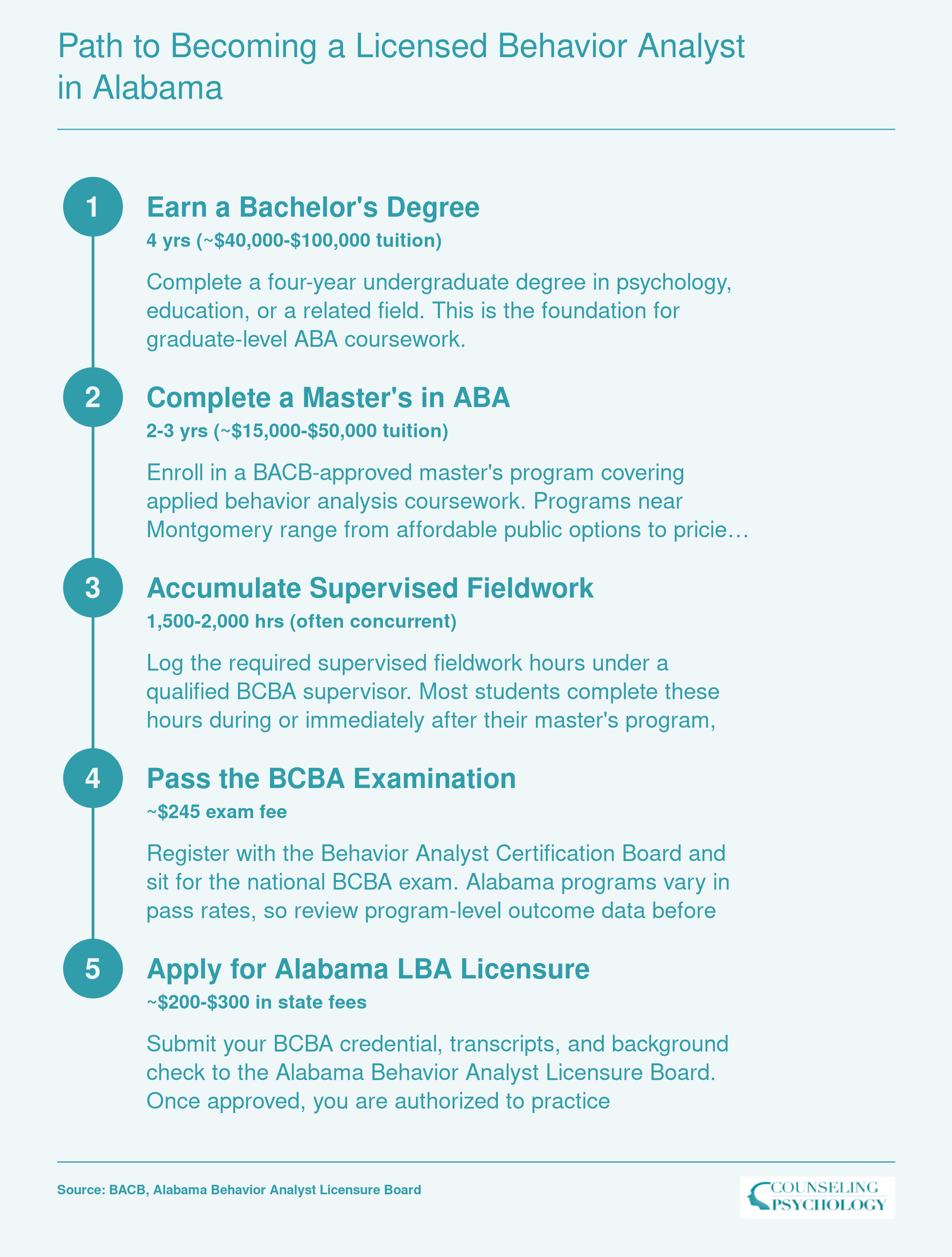
Path to Becoming a Licensed Behavior Analyst in Alabama
From your first undergraduate course to holding an Alabama Licensed Behavior Analyst (LBA) credential, the journey typically spans six to eight years. Here is each milestone, the approximate time it takes, and where the biggest expenses land.
Frequently Asked Questions About ABA Programs Near Montgomery
These are some of the most common questions prospective students and families ask about applied behavior analysis programs and services in the Montgomery, Alabama area. Where possible, answers reference specific cost and outcome data covered earlier in this article.