
What you’ll learn in this article…
- Keene State College and Rivier University are the two low cost school counseling programs nearest Manchester, NH.
- New Hampshire requires a master's degree and supervised field experience for school counselor certification but no standardized exam.
- Public Service Loan Forgiveness can erase remaining federal loan balances after 120 qualifying payments in a public school district.
- BLS data show New Hampshire school counselor wages trail the national median, though strong regional demand is fueling new openings.
How much does a master's in school counseling actually cost near Manchester, NH, and which programs are accredited?
In-state graduate tuition at Keene State College runs approximately $12,456, while Rivier University's online M.Ed. in School Counseling is priced at roughly $13,375 in total program tuition, making both options among the more accessible graduate pathways in the region. The field in southern New Hampshire is narrow: only two programs consistently surface as affordable, accredited options within reasonable distance of Manchester, and both lead to the master's degree required for NH school counselor certification.
Online delivery, as Rivier's program demonstrates, has expanded access considerably for working adults and those without easy commuting range to a campus. For anyone still exploring the broader profession, it helps to understand how to become a counselor before committing to a specific program. New Hampshire requires a master's degree, supervised internship hours, and a state credentialing application, so program structure directly affects licensure readiness, not just cost.
Best Low Cost School Counseling Programs Near Manchester, NH
Manchester-area students pursuing a career in school counseling have two accessible, budget-friendly graduate options within New Hampshire. Both programs align with state and national standards for school counselor certification, though they differ meaningfully in format, cost structure, and campus experience. The institution-level average net price figures listed below reflect aid-adjusted estimates across all students at each school and should not be read as a guaranteed individual quote.
- Tuition and net price affordability
- Program format and flexibility
- Alignment with licensure standards
- Institutional graduation and retention rates
- Graduate earning potential
- Independent program research
- Internal program database
- NCES-IPEDS federal institutional data — nces.ed.gov
- College Scorecard graduate earnings — collegescorecard.ed.gov

Rivier University
Rivier University is a private institution in Nashua, roughly 15 miles south of Manchester, offering an online M.Ed. in School Counseling designed around working professionals. Its 600-hour, New Hampshire-based internship gives students practical placements close to home, and the program is structured so graduates qualify for licensure in all 50 states. With a 14:1 student-to-faculty ratio and a mission rooted in its Catholic heritage, Rivier pairs affordability (graduate tuition of $691 per credit for 2024-25) with personalized academic support. The institution-wide average net price is $28,082 after aid, and median earnings for graduates ten years out sit at $52,248.
- Online coursework with a 600-hour in-state internship
- Tuition listed at $691 per credit for the 2024-25 year
- Three-year timeline: two years coursework, one year internship
- No entrance exam (e.g., GRE) required for admission
- Graduates eligible for school counselor licensure in all 50 states
- Emphasis on cultural competence and analytical skill building
- Military-friendly institution with support for veteran students
- Combines theory and hands-on practice in diverse counseling roles
M.Ed. in School Counseling — Online

Keene State College
Keene State College, part of the University System of New Hampshire, offers a campus-based Master's in School Counseling about 90 minutes west of Manchester. As a public institution, Keene State provides a notable tuition advantage for in-state residents: $12,456 per year compared with $14,058 for out-of-state students at the graduate level. The institution-wide average net price is $17,887 after aid, making it one of the most cost-conscious pathways into school counseling in the state. With a 60.1% institution-wide graduation rate, a 17:1 student-to-faculty ratio, and median earnings of $54,368 ten years after enrollment, Keene State presents a solid return on investment for New Hampshire residents.
- Campus-based program aligned with state and national standards
- In-state graduate tuition of $12,456 per year (IPEDS)
- Focus on educational leadership and school improvement skills
- Curriculum covers assessment, research, and curriculum development
- Post-master's certification pathway for existing degree holders
- Special education integration opportunities within coursework
- Designed for both current educators and career changers
- Military-friendly designation with veteran support services
Master's in School Counseling — On-Campus
Total Program Cost Comparison: Side-by-Side Breakdown
The table below puts Keene State College and Rivier University side by side on the metrics that matter most when you are budgeting for a master's in school counseling near Manchester, NH. A few important caveats: the graduation rate shown is the institution-wide undergraduate figure reported to IPEDS, not a rate specific to the graduate school counseling program. Likewise, the net price listed is an annual average across all students at each institution and will vary based on your individual financial aid package. Estimated total program costs are calculated by multiplying per-credit tuition by estimated credit hours; actual costs will vary once mandatory fees, textbooks, and practicum expenses are included.
| Metric | Keene State College | Rivier University |
|---|---|---|
| Location | Keene, NH | Nashua, NH |
| Program Format | Campus-based | Online |
| Degree Offered | Master's in School Counseling | M.Ed. in School Counseling |
| Annual Tuition (In-State) | $12,456 | $13,375 |
| Annual Tuition (Out-of-State) | $14,058 | $13,375 |
| Per-Credit Cost (Approx.) | N/A | $691 |
| Estimated Total Credits | 48 | 48 to 60 |
| Estimated Total Tuition (In-State, 48 Credits) | Approx. $24,912 (based on two years at in-state rate) | Approx. $33,168 (48 credits at $691) |
| Estimated Total Tuition (60 Credits) | Approx. $24,912 to $31,140 (varies by annual billing) | Approx. $41,460 (60 credits at $691) |
| Average Net Price (Institution-Wide) | $17,887 | $28,082 |
| Institution-Wide Graduation Rate | 60.1% | 51.7% |
| Student-to-Faculty Ratio | 17:1 | 14:1 |
| Median Graduate Debt (All Programs) | $25,749 | $26,956 |
| Median Earnings 10 Years After Entry | $54,368 | $52,248 |
| Program Duration | 24 to 36 months | Approximately 36 months |
Questions to Ask Yourself
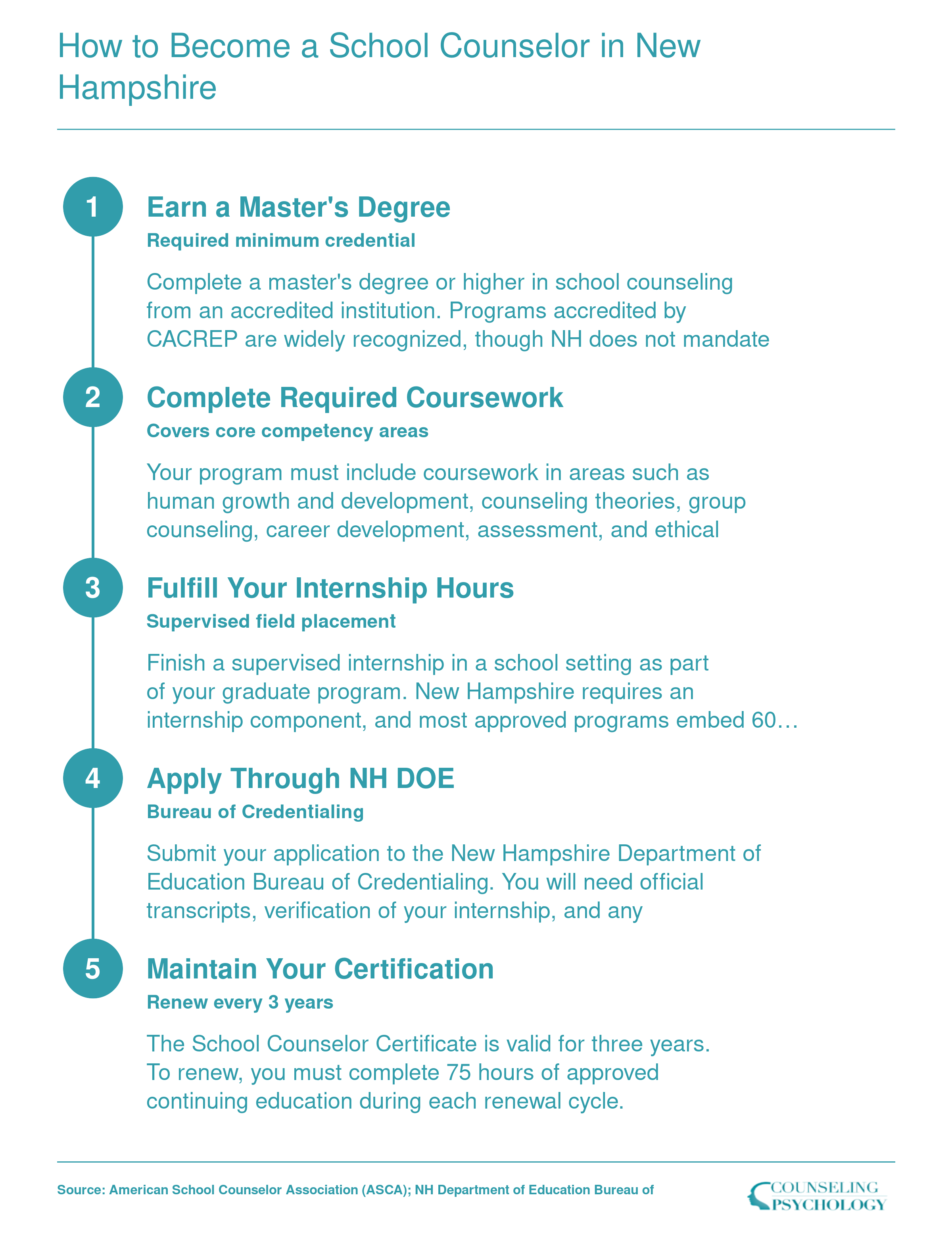
How to Become a School Counselor in New Hampshire
New Hampshire issues a three-year School Counselor Certificate through the Department of Education Bureau of Credentialing. The pathway centers on a master's degree in school counseling, supervised field experience, and a state application. No standardized exam is currently required. Here is the step-by-step sequence for 2025-2026.
School Counselor Salary and Career Outcomes in NH
School counseling in New Hampshire is navigating a period of elevated demand as schools expand mental health services, though wage growth has been uneven across regions and remains slightly behind the national median for the profession.
New Hampshire School Counselor Salaries: Statewide and Regional
New Hampshire employed approximately 2,350 school and career counselors in 2023, according to the Bureau of Labor Statistics.1 The mean annual wage for counselors in the state was $60,720, just below the national median of $61,710. While statewide figures provide a baseline, salaries vary significantly by location. Within the Boston-Cambridge-Nashua metropolitan statistical area, which includes New Hampshire's Nashua region, the mean annual wage climbs to $82,060, reflecting the higher cost of living and stronger funding in the greater Boston economy. Nationally, the 10th percentile of school counselors earns about $40,140, while the 90th percentile reaches $100,050, indicating that experienced professionals can substantially increase their earnings over time.1 These occupational averages set a realistic expectation for those entering the field in New Hampshire, and students exploring best counseling programs in New Hampshire will want to weigh these numbers against program costs.
Earnings Outlook for Graduates of Affordable Programs
Prospective students often want to know what they can specifically expect after completing a low-cost program. For the two featured programs, Keene State College and Rivier University, the most recent federal College Scorecard data does not yet publish program-level earnings for school counseling graduates. However, broader institutional metrics offer a rough proxy. At Keene State, former students who received federal financial aid earn a median of $54,368 ten years after entering college. At Rivier, that figure is $52,248. These numbers encompass all majors and degree levels, so they do not isolate school counseling graduates; actual counseling salaries may differ. As more granular outcomes data become available through the Scorecard, prospective students will gain a clearer picture of early- and mid-career pay for these specific programs.
Balancing Cost and Career Return
The total net price for in-state students at Keene State sits around $17,887, while Rivier's typical net price is about $28,082. Even without precise starting salary figures, the modest tuition of these programs suggests a reasonable return on investment. If a new counselor earns near the 40th percentile of the occupation, roughly $50,000, the cost of the degree could be recouped in a handful of years, especially with disciplined loan repayment. For those who secure positions in higher-wage areas like the Manchester-Nashua corridor, the payback period shrinks further. The relative affordability of these accredited pathways makes them an attractive entry point into a profession with solid job stability and rising demand across New Hampshire.
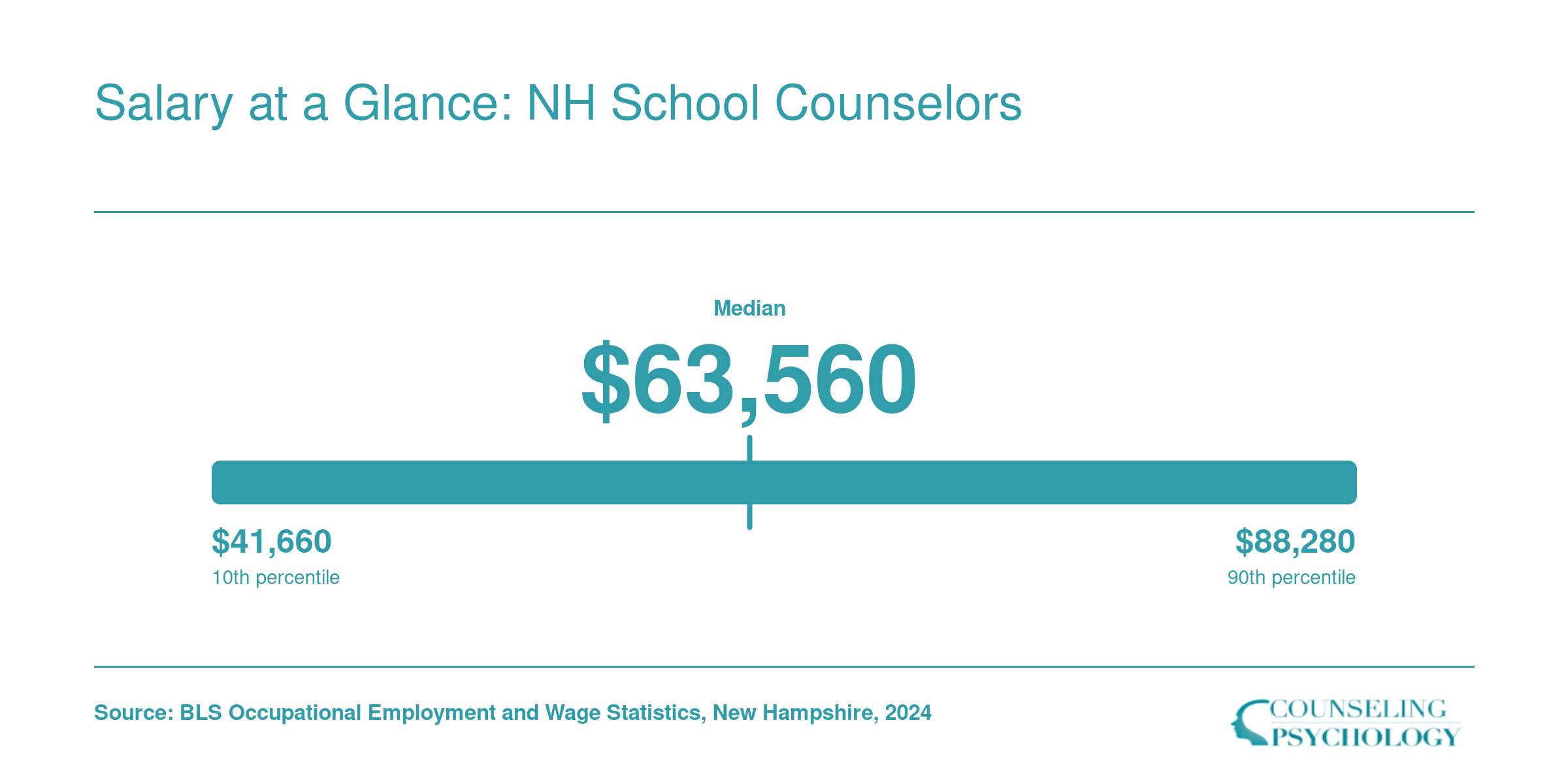
Salary at a Glance: NH School Counselors
New Hampshire school counselors earn across a wide range depending on experience and district. Entry-level counselors typically fall near the 10th to 25th percentile, while those with a decade or more of experience and advanced responsibilities often reach the 75th to 90th percentile. The median represents what a mid-career counselor in the state can reasonably expect.
Online vs. Hybrid vs. On-Campus: Which Format Fits Your Life?
Choosing between delivery formats is one of the most practical decisions you will make when selecting a school counseling program. Both ranked programs near Manchester offer master's degrees in school counseling, but they take very different approaches: Keene State College runs an on-campus program, while Rivier University delivers its M.Ed. in School Counseling online. Because New Hampshire requires supervised practicum and internship hours in actual school settings, every student, regardless of format, needs a local placement. Here is how the two formats (plus hybrid options you may encounter at other institutions) stack up across the dimensions that matter most.
| Dimension | Online (e.g., Rivier University) | Hybrid (Mixed Delivery) | On-Campus (e.g., Keene State College) |
|---|---|---|---|
| Cost Implications | Rivier charges roughly $691 per credit with flat in-state and out-of-state graduate tuition, which can keep total costs lower for students who avoid relocation and commuting expenses. | Costs typically fall between fully online and fully on-campus, though on-site residency weekends may add travel and lodging. | Keene State's in-state graduate tuition is among the lowest in New Hampshire, but students commuting from Manchester face a roughly 90-mile drive each way, adding fuel and time costs. |
| Schedule Flexibility | Coursework is asynchronous or scheduled around evening sessions, making it realistic for working professionals or those with family commitments. Rivier's three-year timeline lets students pace themselves. | Offers moderate flexibility; most lectures are online, but periodic campus visits are required, usually on weekends or during brief residencies. | Set class meeting times on the Keene campus. Best for students who can attend daytime or evening sessions in person and benefit from face-to-face faculty access. |
| Practicum Logistics for Manchester-Area Students | You still need supervised hours in a school building. Rivier, located in Nashua, helps arrange placements, and Manchester School District, Nashua School District, and Concord School District all accept practicum students. Living near Manchester gives you strong placement options despite studying online. | Same supervised-hour requirement applies. Hybrid students typically coordinate placements through their program's field office and can use any approved southern NH district. | Keene State's field placement network centers on western NH, so Manchester-area students should confirm early whether the program can facilitate placements closer to home. Manchester and Concord districts have accepted practicum students in recent years. |
| Peer Interaction and Networking | Discussion boards, virtual cohort meetings, and group projects provide connection, but organic networking is more limited than sitting in a shared classroom. Practicum sites offer an in-person counterbalance. | Residency weekends create concentrated networking windows, and online forums sustain the cohort between visits. Many students find this a productive balance. | Regular classroom interaction, study groups, and campus events build strong peer relationships. Keene State's 17:1 student-to-faculty ratio supports close mentoring. |
| Technology Requirements | Reliable broadband, a current laptop, webcam, and familiarity with a learning management system are essential. Rivier provides tech orientation for incoming students. | Same baseline tech needs as online, plus any software required for on-site sessions. Students should budget for a portable setup they can bring to campus. | Campus computer labs and library resources reduce the personal tech burden. Students still need a laptop for assignments and field documentation. |
Financial Aid, Scholarships, and Loan Forgiveness for NH School Counselors
Graduate tuition does not have to be a barrier to entering school counseling, especially in New Hampshire, where a combination of federal programs, state scholarships, and employer benefits can significantly reduce what you actually pay out of pocket. The key is knowing which levers to pull and when.
Federal Loans and Repayment Programs
As a graduate student, you can borrow up to $20,500 per year in federal Direct Unsubsidized Stafford Loans and cover remaining costs with Grad PLUS Loans (which require a credit check but have no fixed annual cap beyond cost of attendance). These federal loans matter because they keep you eligible for income-driven repayment (IDR) plans such as SAVE, PAYE, or IBR, all of which cap monthly payments at a percentage of your discretionary income.
More importantly, school counselors employed by public school districts, which account for the vast majority of K-12 positions in New Hampshire, qualify for Public Service Loan Forgiveness (PSLF). After 120 qualifying monthly payments under an IDR plan while working full time for a qualifying employer, your remaining federal loan balance is forgiven tax-free. If you plan to spend your career in public education, this program alone can erase tens of thousands of dollars in debt. A separate section of this article digs deeper into how PSLF works and common mistakes to avoid.
New Hampshire Scholarships Worth Exploring
The New Hampshire Charitable Foundation is one of the state's largest scholarship sources, distributing roughly $8 million annually to about 2,000 recipients, with individual awards ranging from $250 to $7,500 and an average near $4,600.1 Graduate students are eligible, though the application deadline typically falls in early April, so planning ahead is essential. Granite Edvance, another statewide organization, administers approximately $750,000 in scholarship funding each year and maintains a searchable database that can surface awards matched to your field and circumstances.2
Neither of these sources is limited to school counseling students, but both regularly fund education-related graduate programs. Check the NHCF scholarship application portal and Granite Edvance scholarship search early in your program search.
How Well Do Local Programs Serve Financially Constrained Students?
One useful indicator is the share of undergraduates receiving Pell Grants at a given institution, which signals how much of the student body comes from lower-income backgrounds and, by extension, how oriented the school's financial aid office may be toward need-based support. Among the low-cost programs profiled in this article, Rivier University's Pell share sits at about 46 percent, while Keene State College's is roughly 36 percent. These figures apply to the undergraduate population and are not a direct measure of graduate aid, but institutions with higher Pell shares tend to have more robust need-based aid infrastructures overall.
Actionable Steps to Lower Your Costs
- Apply for institutional scholarships early. Many graduate programs allocate merit and need-based awards on a first-come, first-served basis. Submit your FAFSA and any program-specific scholarship applications as soon as they open, ideally several months before your intended start term.
- Ask about graduate assistantships. GA positions often include a tuition waiver plus a small stipend. Even if a school counseling program does not advertise assistantships, departments in education or student affairs sometimes have openings that counseling students can fill.
- Check your employer's education benefits. If you are already working in a New Hampshire school district, ask HR whether the district offers tuition reimbursement or tuition assistance for staff pursuing counseling credentials. Some districts cover a portion of graduate coursework for employees who commit to staying in the district for a set number of years after completing the degree.
- Stack benefits strategically. You can combine employer tuition assistance, a state scholarship, and federal IDR or PSLF eligibility. None of these programs are mutually exclusive, and layering them can cut your effective out-of-pocket cost dramatically over the life of the degree and repayment period.
School counselors employed in public school districts may be eligible for Public Service Loan Forgiveness: after 120 qualifying payments, any remaining federal loan balance can be forgiven, often tens of thousands of dollars. This fundamentally alters the long-term affordability equation of your program.
What to Look for in a Low Cost School Counseling Program
Finding an affordable program is only half the equation. A low sticker price means little if the program leaves you unprepared for licensure or unable to secure quality field placements. Before committing, evaluate these critical factors.
CACREP Accreditation: The Gold Standard
The Council for Accreditation of Counseling and Related Educational Programs sets the benchmark for school counseling education nationwide.1 While New Hampshire does not require CACREP accreditation for school counselor licensure, the credential is strongly recommended by the state and recognized by licensing boards across the country.
Currently, Plymouth State University offers the only CACREP-accredited school counseling program in New Hampshire.3 Antioch University New England has accreditation pending, and Rivier University does not hold CACREP status. This matters for two reasons: CACREP programs meet rigorous curriculum and supervision standards, and accreditation simplifies reciprocity if you ever relocate. Four states (Florida, Kentucky, North Carolina, and Ohio) now require CACREP credentials for licensure, and that number may grow.
Practicum and Field Placement Support
Ask pointed questions about how the program handles practicum and internship placements. Does the department maintain formal partnerships with Manchester-area school districts, or will you be cold-calling principals on your own? Programs with established district relationships save students significant time and stress. They also tend to produce stronger employment networks after graduation.
Licensure Exam Pass Rates
A program's Praxis School Guidance and Counseling pass rate is one of the clearest signals of instructional quality. Unfortunately, New Hampshire programs do not currently publish this data publicly. If pass rates are not listed on a program's website, request them directly from the admissions office. A cheap program with poor exam outcomes is no bargain; you will pay again in retake fees and delayed entry into the workforce.
Request a True Total Cost Estimate
Per-credit tuition figures tell only part of the story. Before enrolling, ask for a comprehensive cost of attendance estimate that includes:
- Tuition: The base rate for all required credits.
- Fees: Technology fees, student activity fees, and graduation charges add up quickly.
- Books and materials: Graduate-level textbooks can cost several hundred dollars per semester.
- Practicum-related expenses: Background checks, liability insurance, travel to placement sites, and professional attire.
Two programs with identical per-credit rates can differ by thousands of dollars once these extras are factored in. Get the full picture in writing before making your decision.
Frequently Asked Questions
Below are answers to common questions about pursuing a school counseling career in New Hampshire, including program costs, licensure steps, salary expectations, and more. Where possible, figures reflect data discussed earlier in this article.