What you’ll learn in this article…
- Boston-area sport psychology master's programs ranked here were sorted by net price, not sticker price, after weighting financial aid data.
- A master's qualifies graduates for CMPC certification or Massachusetts mental health counselor licensure, but not the title psychologist.
- Springfield College graduate assistantships can offset roughly $15,000 to $18,000 in tuition per academic year.
- Boston's concentration of pro teams and Division I programs gives local graduates a practicum and salary edge over national averages.
Boston anchors one of the densest concentrations of professional sports franchises, NCAA Division I programs, and rehabilitation hospitals in the United States, yet Massachusetts offers fewer than a handful of dedicated master's programs in sport and exercise psychology. The most affordable options in the metro typically run from a net price of $24,402 at Boston University to $30,587 at Springfield College, a spread that narrows considerably once graduate assistantships, fellowships, and institutional aid come into play.
Format matters less for total cost than for fieldwork logistics. Both BU and Springfield deliver coursework entirely on campus, front-load 700-plus clinical hours into the curriculum, and maintain partnerships with local teams and athletic departments. That structure lowers the time and expense of securing supervised practica, a real advantage when the alternative is hunting down placements independently.
The two schools profiled here meet the curricular requirements for both Massachusetts mental health counselor licensure and the Association for Applied Sport Psychology's Certified Mental Performance Consultant credential. Graduates aiming for the psychologist title must pursue a counseling doctoral program, because state law reserves that designation for PhD and PsyD holders.
Most Affordable Sports Psychology Master's Programs Near Boston, Ranked
We weighted net price, institutional outcomes, and financial accessibility to surface the programs that deliver the most value per tuition dollar in the Boston metro. Massachusetts has surprisingly few dedicated sport psychology master's programs, so the options below represent the full landscape of specialized, degree-granting pathways available to students in or near Boston. Both schools sit in the state, but they occupy very different price points and prepare graduates for different career tracks.
- Net price after institutional aid
- Institutional graduation and retention rates
- Clinical and certification pathways offered
- Program format and accessibility
- Graduate debt relative to earnings
- College Scorecard graduate earnings — collegescorecard.ed.gov
- Internal program database
- NCES-IPEDS federal institutional data — nces.ed.gov
- Independent program research

Springfield College
Springfield College is the only institution in Massachusetts that offers dedicated master's degrees in sport and exercise psychology, making it the default in-state choice for cost-conscious students. The college houses both a campus and a fully online pathway under the same 36-credit framework, giving applicants flexibility without leaving the state. With an institution-wide graduation rate of 74.2% and a student-to-faculty ratio of 11:1, Springfield pairs small-cohort attention with a Human Performance Lab that anchors applied coursework.
- 36-credit program with fall-only start each September
- Choose a thesis track (MS) or applied consulting track (MEd)
- Full-time, on-campus format completed in about two years
- Hands-on training in Springfield's Human Performance Lab
- Anatomy and Exercise Physiology listed as prerequisites
- Priority application deadline of January 10
- Fellowships and institutional scholarships available
- Two academic letters of recommendation required
- 36-credit, 100% asynchronous online delivery
- 7-week and 15-week course blocks for scheduling flexibility
- Full-time students can finish in approximately 18 months
- 135-hour applied internship with remote supervision
- Rolling admissions for domestic applicants
- Part-time enrollment option available
- Interdisciplinary curriculum spanning psychology and physiology
MEd/MS in Sport and Exercise Psychology (Campus) — On-Campus
MEd in Sport and Exercise Psychology (Online) — On-Campus

Boston University
Boston University's EdM in Counseling with a Sport/Performance Psychology concentration is a clinically intensive, 74-unit program that prepares graduates for both Massachusetts mental health counseling licensure and Certified Mental Performance Consultant (CMPC) eligibility. While BU's listed tuition of $67,626 per year is among the highest in the region, institutional aid brings the net price to roughly $24,402, and the institution posts an 88.7% graduation rate with a 10:1 student-to-faculty ratio. Median graduate debt across the university sits at $23,250, a figure that pairs with institution-level median earnings of $83,238 ten years after enrollment to suggest strong long-term earning potential for graduates willing to invest more upfront.
- 74-unit program requiring two years of full-time study
- Includes a required summer session between first and second year
- 700+ clinical training hours plus sport psychology internships
- Meets content requirements for CMPC certification
- Qualifies graduates for MA mental health counseling licensure
- Focus on child, adolescent, and young adult populations
- Part-time option available, though it extends the timeline
- Electives drawn from across the wider university
EdM in Counseling, Sport/Performance Psychology Concentration — On-Campus
How These Rankings Were Built
Selecting a program based on sticker price alone tells one story; factoring in actual out-of-pocket costs after grants and scholarships tells another. These rankings prioritize the second approach, weighting net price and financial aid metrics heavily so prospective students can compare what they are likely to pay rather than what catalogs advertise.
Data Sources and Vintage
All cost, aid, and graduation figures come from the U.S. Department of Education's College Scorecard and IPEDS databases. The data vintage reflects the 2023-24 reporting year, the most recent available at publication. Because federal reporting lags by roughly 18 months, readers should verify current tuition schedules directly with admissions offices.
What Net Price Actually Means
Net price represents the average cost of attendance minus the average grant and scholarship aid awarded to first-time, full-time undergraduates. Graduate-level breakdowns are not published at the program level, so this figure serves as a proxy for institutional generosity. It is not a guaranteed quote; individual aid packages vary based on FAFSA results, merit awards, and assistantship opportunities.
Institutional vs. Program-Level Metrics
Graduation rates listed are institution-wide, not specific to sport psychology or any single master's concentration. Federal data does not isolate completion rates by program, so these figures reflect the broader campus environment and student support infrastructure.
Eligibility Criteria
Only regionally accredited institutions offering a master's degree in sport psychology, performance psychology, or a closely related concentration qualified for inclusion. Programs housed within counseling, kinesiology, or applied psychology departments were eligible provided the curriculum emphasized sport and performance applications. Certificate-only offerings and doctoral programs were excluded from this particular list.
Questions to Ask Yourself
Online vs. On-Campus: Comparing Delivery Formats for Boston-Area Sport Psychology Programs
Boston-area programs span fully online, fully on-campus, and hybrid formats. Boston University and Springfield College deliver their sport psychology coursework primarily on campus, while options like the University of Western States offer a fully online master's. William James College blends both, pairing online didactics with in-person intensives. The format you choose shapes your budget, your professional network, and your access to one of the country's richest sports markets.
Pros
- Online tuition is often lower per credit, and you avoid the steep cost of Boston-area rent, parking passes, and MBTA commuting fees.
- Working coaches or athletic trainers can complete online coursework around existing team schedules without relocating or cutting hours.
- Online enrollment opens doors to accredited programs well beyond a 90-minute commute radius, expanding your options if local seats are limited.
- On-campus students can tap Boston's dense concentration of Division I programs, pro franchises, and sports medicine clinics for practicum rotations.
- In-person cohorts tend to develop tighter peer relationships that translate into referral networks once you enter the workforce.
- Regular face-to-face meetings with faculty who consult for collegiate or professional teams help you develop applied skills through observation and real-time feedback.
Cons
- Remote learners often must identify and secure their own supervised fieldwork sites, which can be time-consuming if you live outside a major metro area.
- Online formats limit casual hallway conversations with classmates and guest speakers, reducing the organic mentorship that on-campus students absorb.
- On-campus attendance in Boston means budgeting for some of the highest housing costs in the Northeast, which can add thousands per semester to your total outlay.
- Fixed weekday class times at campus-based programs can conflict with the irregular hours common in coaching, personal training, or part-time clinical work.
- Regardless of delivery format, anyone pursuing Massachusetts mental health licensure must complete supervised clinical hours in person, so a purely remote path has limits.
Related Articles
Admission Requirements and Typical Program Timelines
Most sports psychology master's programs share a common set of admission requirements, though specifics vary by institution. A minimum GPA of 3.0 on a 4.0 scale is standard across programs at schools like Saybrook University and Adler University.12 Some programs, such as CSU Long Beach's Kinesiology M.S. with a Sport, Exercise, and Performance Psychology option, also expect applicants to hold a related undergraduate major.3 The good news for applicants is that many programs no longer require standardized test scores: GRE or other entrance exams are increasingly waived across the field.4
Beyond GPA and test requirements, expect to submit a personal statement, letters of recommendation, and a current resume. Programs with a clinical or applied psychology orientation may also request a writing sample or relevant professional experience.
Program timelines are relatively compact compared to doctoral tracks. Credit requirements typically range from 36 to 40 credits. Seton Hall University's MA in Psychological Studies with a Psychology of Sport and Exercise concentration, for example, requires 36 credits.5 Saybrook University's MS in Sport Performance Psychology calls for 40 credits and is designed to be completed in roughly 24 months.1 Most full-time students finish within two years, while part-time options may extend the timeline to three years or more. When evaluating programs, pay close attention to whether the curriculum includes practicum or fieldwork hours, as these can affect your total time to completion.
Practicum Sites and Fieldwork in the Boston Sports Ecosystem
Finding supervised hours on your own versus having a program with established placement networks is a distinction that shapes your entire fieldwork experience. In the Boston metro, that gap matters less than almost anywhere else in the country, because the concentration of professional franchises, Division I athletic departments, and research hospitals is genuinely difficult to match.
Professional and Collegiate Placements
Boston's professional sports landscape gives graduate students access to organizations that many peer cities simply cannot offer. The Celtics, Red Sox, Bruins, and New England Revolution all maintain sports science and athlete wellness staff, and graduate interns have historically found footing in those environments through program connections or direct outreach. On the collegiate side, Boston University, Boston College, and Northeastern University each operate NCAA Division I athletic programs with performance support staff who periodically work with graduate students on mental performance initiatives.
For students whose interests lean toward rehabilitation and adaptive sport, Spaulding Rehabilitation Hospital in Charlestown, part of Mass General Brigham, runs a structured adaptive sports internship program with placements available in spring, summer, and fall.1 Interns commit to at least 10 weeks at a minimum of 16 hours per week, working across therapeutic recreation and general adaptive sports tracks.1 That structure makes it a realistic option for building hours toward both CMPC certification and, if you are pursuing a counseling track, LMHC licensure in Massachusetts.
Clinical and Specialty Settings
Beyond the playing field, clinical placements round out a competitive portfolio. The VA Boston Healthcare System offers psychology training rotations, including Rehabilitation Psychology and Behavioral Medicine, with longstanding partnerships with Boston University and Harvard Medical School.2 Placement priority tends to favor students from those affiliated programs, so students from other schools should inquire early and directly. Private practices focused on sport and performance psychology, such as Grow Wellness Group, also accept master's-level interns in sport and performance psychology as well as counseling and social work, with explicit attention to logging hours that count toward CMPC requirements.3 If you are still mapping out the full credentialing path, our guide on how to become a sports psychologist covers the steps from degree selection through certification.
A Note for Online Students
Typical supervised hour requirements for sport psychology master's programs fall in the 200-to-400-plus range, depending on whether the degree also pursues counseling licensure eligibility. Boston's density of qualifying sites shortens the placement search considerably for students living in the metro. Online students, however, should plan carefully. Most programs require you to arrange local practicum agreements independently, and if you are based outside the Boston area, identifying sites that meet both your program's criteria and CMPC or licensure standards takes considerably more legwork.
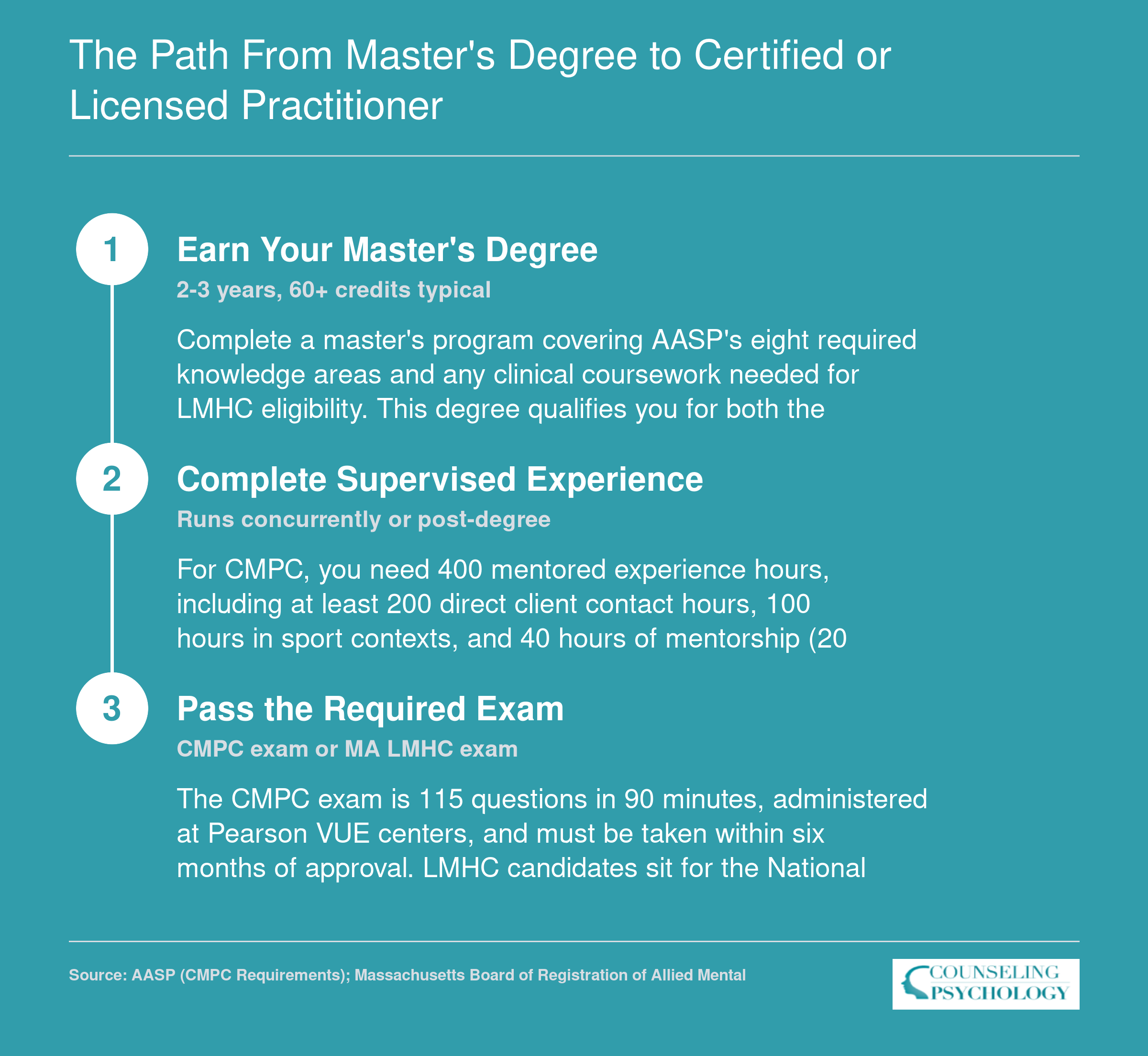
The Path from Master's Degree to Certified or Licensed Practitioner
A master's in sport psychology opens two main credentialing tracks, but neither grants the title "psychologist," which Massachusetts law reserves for doctoral-level practitioners. Below is the typical sequence from graduation to practice-ready status.
CMPC Certification and Massachusetts Licensure: What a Master's Qualifies You For
Clinical counseling and sport performance consulting represent two distinct credential tracks, and which one you pursue shapes everything from the courses you take to the clients you can legally serve. Understanding the difference before you enroll saves you from discovering midway through a program that it does not qualify you for your intended license or certification.
The CMPC Route: Sport Science Focused
The Certified Mental Performance Consultant credential, awarded by the Association for Applied Sport Psychology, is the primary professional mark for practitioners who work with athletes on performance-related concerns. Eligibility requires a master's degree in sport science, kinesiology, psychology, or a closely related field, along with AASP-approved coursework covering topics such as sport psychology theory, research methods, and ethics. Candidates must also complete a supervised mentorship of 400 hours with an approved mentor, then pass the CMPC examination.
Most sport psychology master's programs in the Boston area are designed with this credential in mind. If your goal is to consult with teams, individual athletes, or athletic departments on focus, confidence, motivation, and performance anxiety, the CMPC track is typically the more direct path.
The LMHC Route: Clinical Counseling in Massachusetts
Becoming a Licensed Mental Health Counselor in Massachusetts is a different and more clinically intensive undertaking. The state requires a master's degree totaling at least 60 credits, with coursework distributed across 10 defined content areas at three credits each. After graduation, candidates must accumulate 3,360 hours of supervised clinical experience, including at least 960 direct client contact hours and 130 hours of supervision (at least 75 of which must be individual supervision). The post-master's period runs a minimum of two years and cannot exceed eight. The qualifying exam Massachusetts currently requires is the NCMHCE.
If you are exploring the broader landscape of counseling masters programs in Massachusetts, you will notice that most clinically oriented degrees are already built around these requirements. Here is the critical detail: most sport psychology master's programs fall in the 36-to-48 credit range and are not structured around the 10 clinical content areas the state specifies.2 That means many sport psychology graduates do not meet the academic prerequisites for LMHC licensure without additional coursework. If the LMHC is your goal, verify explicitly that a program's curriculum satisfies Massachusetts requirements as outlined in 262 CMR 2.00 before you commit.
The Title Question: Can a Master's Make You a "Sports Psychologist"?
This comes up constantly, and the answer matters legally. In Massachusetts, the title "psychologist" and the title "sport psychologist" are both restricted to practitioners who hold a doctoral-level license. Practicing under either label with only a master's degree violates state law, regardless of your training or experience.
What a master's does allow: you can practice as a CMPC working with athletes on mental performance, or as an LMHC providing clinical mental health counseling services, potentially including sport-focused clientele. Both are legitimate and in-demand roles. Neither carries the protected "psychologist" title.
The bottom line for program selection is straightforward. Decide which credential you are working toward before you apply, then confirm with the admissions office that the specific program you are considering either meets AASP coursework standards for CMPC eligibility or satisfies Massachusetts's 60-credit clinical curriculum requirement for the LMHC. Programs vary more than their marketing language suggests.
What Sport Psychology Graduates Earn, and Whether the Degree Pays Off
How much do sport psychology master's graduates actually earn, and does the investment pencil out against tuition and debt?
Program-Level Earnings Data
For the programs ranked in this article, program-specific median earnings after graduation are not yet available through federal reporting. That means we cannot point to a single dollar figure and say "graduates of this exact program earned X." What we can do is frame the investment side clearly. Boston University's EdM in Counseling with a Sport/Performance Psychology concentration carries listed tuition of roughly $67,600 per year, while Springfield College's MEd/MS in Sport and Exercise Psychology comes in around $33,700 per year. On the debt side, institutional median borrowing sits at about $23,250 for BU graduates and $26,250 for Springfield graduates across all programs, though individual figures will vary by financial aid package and enrollment timeline.
What BLS Wage Data Tells Us
Sport psychology is a niche field, so the Bureau of Labor Statistics does not track it as a standalone occupation. The closest proxy occupations are Substance Abuse, Behavioral Disorder, and Mental Health Counselors (SOC 21-1018) and Psychologists, All Other (SOC 19-3039).
For mental health counselors specifically in the Boston-Cambridge-Newton metro area, the median annual wage was $60,780 as of May 2023, with a mean of $65,330. That compares favorably to the national median of $59,190 reported for 2024. The Boston metro employed nearly 11,000 workers in that category, reflecting strong local demand.
Psychologists classified under "All Other" tend to earn more, but reliable Boston-metro figures for that narrower group are harder to pin down. Nationally, the category trends well above the counselor median, especially for practitioners who hold doctoral credentials or work in specialized consulting roles. For a broader look at pay benchmarks across specializations, see our counselor salary breakdown.
Is a Master's in Sports Psychology Worth It?
The honest answer depends on three things: the credential you pursue after graduation, the setting you work in, and how deliberately you use Boston's sports infrastructure.
Graduates who obtain the Certified Mental Performance Consultant (CMPC) credential or a Massachusetts mental health counseling license tend to command higher fees and more stable employment than those who finish the degree without a professional credential. Private practice and consulting with professional or collegiate teams generally pay more than entry-level positions in college athletics departments or community organizations.
Boston-area salaries for counselors and psychologists tend to run above national medians, which partly reflects higher cost of living but also reflects the density of professional teams, Division I programs, and sports medicine facilities that create demand for performance psychology services. Graduates who tap into that ecosystem, whether through the Red Sox, Celtics, Boston College, or the region's many sports rehab clinics, position themselves at the higher end of the earning range.
- Strongest ROI scenario: You credential (CMPC, LMHC, or both), land practicum contacts in the Boston sports scene, and build a private or consulting practice.
- Moderate ROI scenario: You work as a mental health counselor in a clinical or educational setting, earning near the Boston-metro median of roughly $61,000.
- Weakest ROI scenario: You complete the degree without pursuing licensure or certification, limiting your scope of practice and earning potential.
The degree pays off most clearly when you treat it as a launching pad for credentialing rather than a terminal endpoint.
Choosing a low net price program in the Boston area gives budget-conscious applicants a distinct advantage: access to professional sports teams, Division I athletic departments, and rehabilitation centers for practicum placements, combined with metro salaries that typically exceed national medians. This combination of reduced upfront cost and stronger earning potential creates a return on investment difficult to match in smaller markets.
Practical Ways to Lower Your Total Cost
A graduate assistantship at Springfield College can waive up to 12 credits of tuition per academic year, which at typical private-school sport psychology rates translates to roughly $15,000 to $18,000 in avoided tuition annually.1 That single line item is the largest cost-cutter available to most master's students near Boston, and it is worth treating as a separate, earlier application than the academic one.
Pursue Assistantships Aggressively, and Apply Early
Springfield College offers two graduate assistantships specifically tied to its sport and performance psychology program, with a separate application process and a 12-credit tuition waiver per year plus a stipend for working in athletics or research.1 Two slots is competitive, so submit materials as soon as the application window opens. Boston University's EdM in Counseling, Sport/Performance Psychology Concentration runs 74 credits over 24 months full-time and offers merit-based scholarships with a January 15 priority deadline; applicants who miss that date often miss the funded cohort entirely.2
Stretch the Timeline, Stack Outside Funding
If full-time study isn't realistic, a three-year part-time pace cuts per-semester tuition bills by roughly a third and frees evenings or weekday hours for paid work. A few area programs accommodate evening or part-time formats, though sport psychology cohorts are typically structured around full-time study, so confirm pacing options with each program directly.
Other stackable sources of funding:
- Employer tuition reimbursement: Hospitals, universities, and larger athletic organizations frequently cover $5,250 per year tax-free. If you already work in athletics, healthcare, or higher ed, ask HR before you enroll, not after.
- AASP and state-level scholarships: The Association for Applied Sport Psychology lists grants and student awards each cycle; amounts are modest but accumulate.
- GI Bill benefits: Veterans enrolled in accredited programs can offset most or all tuition; confirm each program's VA certification.
- In-state residency for public options: If you're considering a Massachusetts public institution, establishing residency before enrollment can save several thousand dollars per year versus out-of-state rates.
The American Board of Sport Psychology also runs internships and fellowships that, while not full tuition replacements, add paid supervised experience to the ledger.3