
What you’ll learn in this article…
- Two South Florida institutions offer accredited online forensic psychology master's programs near Miami.
- Becoming a licensed forensic psychologist in Florida typically takes 8 to 12 years of education and training.
- Florida's psychologist job growth is projected to outpace the national average through the next decade.
- Miami forensic psychologists work across courts, corrections, crisis response, and private consulting practices.
Miami's sprawling federal district court, five-county correctional footprint, and multilingual population have made it one of the busiest forensic psychology markets in the Southeast. The city hosts high-volume drug courts, immigration hearings, juvenile detention centers, and federal pre-trial facilities, all of which rely on forensic evaluations, competency assessments, and expert witness testimony. Yet only two accredited institutions near Miami currently offer forensic psychology graduate programs, and both deliver their curricula online.
The competition for seats is real. Applicants weigh limited local options against the logistical demands of pursuing an out-of-state doctorate, the eight- to twelve-year timeline to independent licensure in Florida, and starting salaries that vary widely depending on whether you enter the public defender's office, a state correctional facility, or private consultation.
Forensic psychology in Miami is not a credential you earn by degree alone. The city's courts expect bilingual capacity, cultural competency with Caribbean and Latin American populations, and familiarity with federal sentencing guidelines. Those realities shape which program you choose and how quickly you can move from classroom to courtroom.
Top-Rated Forensic Psychology Programs Near Miami, Florida
Two accredited institutions near Miami offer online master's-level forensic psychology programs that prepare graduates for careers across Florida's courts, correctional systems, and crisis-response networks. Both are headquartered in the South Florida metro, giving local students easy access to campus resources even though coursework is delivered online. Below, we break down what each program offers, what it costs, and who it fits best.
- Program relevance and specialization
- Institution graduation and retention rates
- Net price after financial aid
- Faculty expertise and format flexibility
- Regional career alignment
- NCES-IPEDS federal institutional data — nces.ed.gov
- College Scorecard graduate earnings — collegescorecard.ed.gov
- Independent program research
- Internal program database

Nova Southeastern University
Nova Southeastern University, based in Fort Lauderdale, is a large private research institution with a well-established College of Psychology. Its forensic psychology offerings draw on faculty expertise in law, disaster response, and clinical assessment. The institution reports an overall graduation rate of about 63% and a 16:1 student-to-faculty ratio, reflecting moderate class sizes for a university of its scale. Ten years after enrollment, the institution-wide median earnings figure reported by the College Scorecard is $59,209.
- 100% online format designed for working adults
- 36 total credit hours required to complete the degree
- No GRE required for admission
- Empirically based curriculum tied to courts and corrections
- Faculty includes recognized forensic psychology experts
- Concentration targets legal, judicial, and law enforcement careers
- Approximate average net price after aid: $30,371 per year
- Institution-wide graduation rate: approximately 63%
- 100% online master's program with flexible scheduling
- 36 credit hours covering crisis response and forensic assessment
- No GRE required, broadening access for diverse applicants
- Faculty experts spanning psychology, law, and emergency response
- Directly relevant to South Florida hurricane and disaster contexts
- Prepares graduates for roles on crisis and first-responder teams
M.S. in Forensic Psychology, Forensic Psychology in the Legal System — Online
M.S. in Forensic Psychology, Mental Health Workers, First Responders, and Disaster Teams — Online

Florida National University
Florida National University is a private institution in Hialeah, placing it squarely within the Miami metro area. Its Master of Forensic Psychology is a 36-credit online program covering criminal psychology, victimology, forensic assessment, and court-related practice. The university's institution-wide graduation rate is roughly 31%, so prospective students should investigate support services and completion timelines carefully. The approximate average net price after aid is $23,043 per year, offering a lower sticker cost than many regional alternatives.
- Fully online format with 36 required credit hours
- Coursework spans criminal psychology, victimology, and courts
- Includes a capstone project and research methods training
- Covers clinical and forensic assessment techniques
- Prepares graduates for law enforcement and correctional roles
- Located in Hialeah with on-campus support available locally
- Approximate average net price after aid: $23,043 per year
- Institution-wide graduation rate: approximately 31%
Master of Forensic Psychology — Online
What Is Forensic Psychology?
Forensic psychology sits at the intersection of legal systems and mental health, but it is often confused with clinical psychology or criminal profiling. At its core, this specialty applies psychological principles and research methods to criminal, civil, and family court proceedings. Practitioners evaluate individuals involved in the justice system, consult with attorneys and judges, and deliver expert testimony to clarify complex behavioral questions. Unlike the dramatic portrayals on television, most forensic psychologists spend their time conducting structured interviews, reviewing records, and writing detailed reports, not chasing suspects.
Forensic Psychology vs. Related Fields
The differences are important for anyone exploring career paths. Clinical psychology focuses primarily on diagnosis and treatment of mental health conditions within a therapeutic relationship. Forensic psychology, by contrast, serves the court's need for objective information, not the client's emotional well-being. Criminology examines crime as a social phenomenon (patterns, causes, and prevention at the population level), while forensic psychologists zoom in on individual functioning. And criminal profiling, made famous by pop culture, represents only a tiny, highly specialized niche; most forensic psychologists never build a profile. Students interested in that adjacent track can learn more about criminal psychologist requirements. Understanding these distinctions helps students select the right graduate program and avoid a mismatch of expectations.
What Forensic Psychologists Do
The daily work is varied and requires both clinical skill and legal knowledge. Common activities include:
- Competency evaluations: determining whether a defendant can understand the charges and participate in their own defense.
- Risk assessments: estimating the likelihood of future violence or reoffending to inform sentencing, parole, or civil commitment decisions.
- Expert testimony: explaining psychological findings to judges and juries in plain language so they can weigh the evidence appropriately.
- Victim advocacy and support: working with victims of crime or abuse to provide coping strategies and prepare for court appearances.
These tasks demand rigorous training in assessment tools, ethics, and state and federal law. Many forensic psychologists also consult on child custody disputes, immigration proceedings, or workplace discrimination cases. Students who want to build this foundation can explore forensic psychology master's programs designed for courtroom-focused careers.
Why Miami Is a Distinct Market
Miami's legal landscape creates unique opportunities for forensic psychologists. A large, bilingual population means practitioners who speak Spanish and understand Latin American cultural contexts are in especially high demand for family court and immigration evaluations. The city's immigration court consistently carries one of the heaviest caseloads in the country, generating steady work in asylum evaluations and hardship waivers. Meanwhile, the U.S. District Court for the Southern District of Florida handles a high volume of federal criminal cases, from narcotics trafficking to fraud, requiring ongoing competency and sanity assessments. These factors combine to make Miami a robust market for forensic psychology professionals who can navigate both clinical and courtroom demands.
How to Become a Forensic Psychologist in Florida
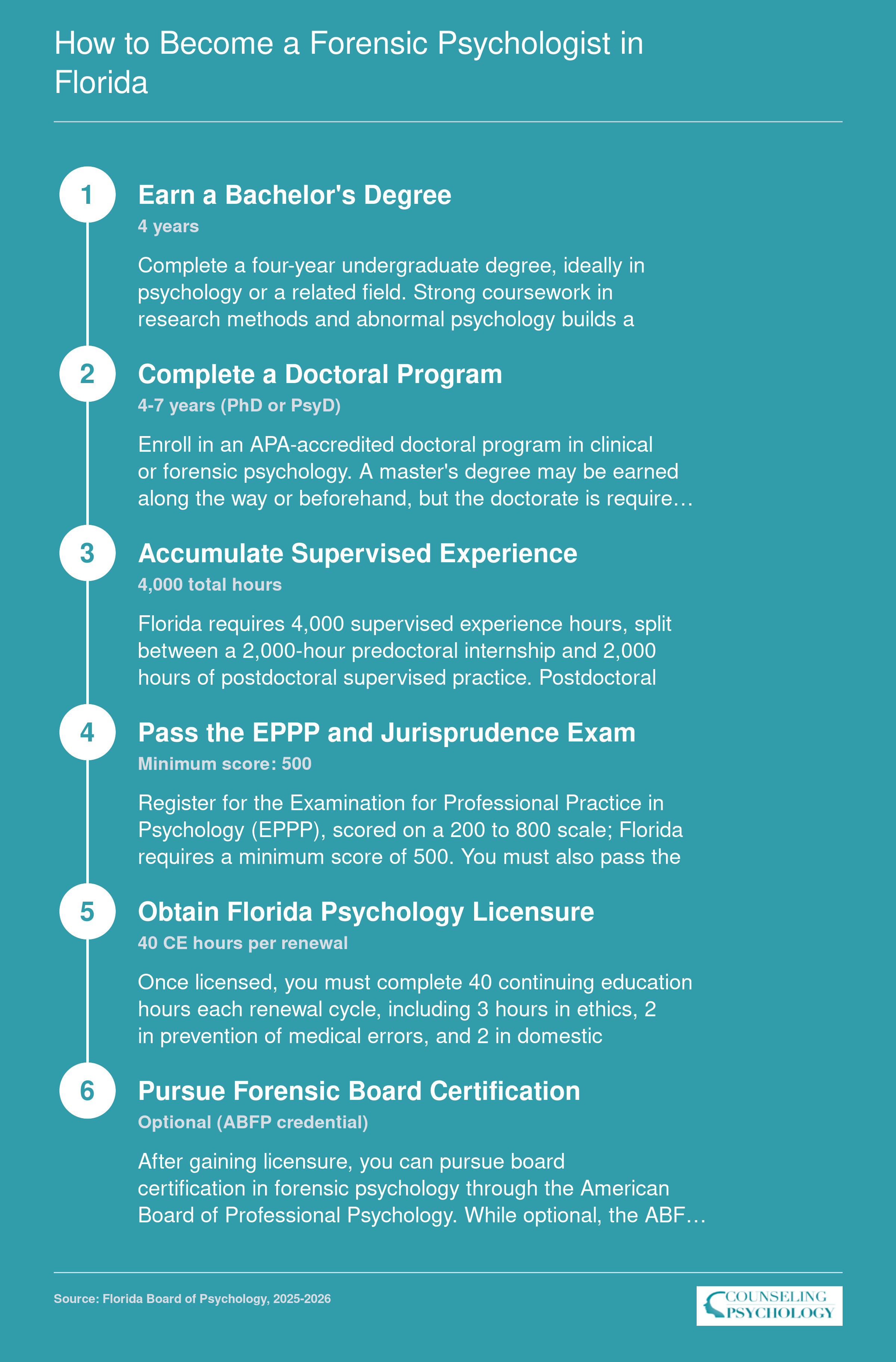
Becoming a licensed forensic psychologist in Florida is a multistep process that typically spans 8 to 12 years from the start of your bachelor's degree to independent practice. Florida does not issue a separate forensic license; instead, you earn general psychology licensure and then build forensic expertise through specialized training, postdoctoral work, and optional board certification.
Questions to Ask Yourself
Forensic Psychologist Salary in Miami and Florida
Compensation for forensic psychologists can vary significantly depending on geography, experience, and practice setting. The table below presents the most recent BLS wage estimates for the "Psychologists, All Other" category, which includes forensic specialists, at both the Florida statewide and national levels. Note that MSA-level data specific to the Miami-Fort Lauderdale area was not published for this occupation in the most recent BLS release, so statewide figures serve as the closest available proxy. Forensic psychologists who build a reputation for expert testimony, conduct private evaluations for courts, or consult on high-profile cases often earn well above these medians, though such premium earnings are not captured in standard BLS survey data.
| Geographic Area | Total Employment | 25th Percentile | Median Annual Wage | 75th Percentile | Mean Annual Wage |
|---|---|---|---|---|---|
| Florida (Statewide) | 1,120 | $86,940 | $123,610 | $145,560 | $117,450 |
| United States (National) | 14,480 | $76,550 | $117,750 | $138,280 | N/A |
Cost and Earnings: How Miami-Area Programs Compare
Understanding the full financial picture is essential before committing to a forensic psychology program. The table below compares published tuition, the institution-wide average net price after financial aid, median debt at graduation, and broader institutional earnings data for the two Miami-area schools offering forensic psychology master's degrees. Program-level earnings at the one-year and four-year marks are not yet available for either program, so the table includes each school's institution-wide median earnings at ten years as a general reference point. Nova Southeastern University shows a notably stronger return on investment ratio (approximately 2.4) compared to Florida National University (approximately 1.2), which is worth weighing carefully against each program's total cost.
| School | Annual Tuition (Program) | Avg. Net Price After Aid (Institution-Wide) | Median Graduate Debt | Median Earnings at 10 Years (Institution-Wide) | Approx. ROI Ratio |
|---|---|---|---|---|---|
| Nova Southeastern University | $24,830 | $30,371 | $24,250 | $59,209 | 2.4 |
| Florida National University | $22,168 | $23,043 | $27,554 | $33,928 | 1.2 |
Career Opportunities for Forensic Psychologists in Miami
Pursuing a career through the public sector versus building a private practice represents the central fork in the road for forensic psychologists in Miami. Both paths offer substantial professional rewards, and many practitioners ultimately blend the two, maintaining court contracts while accepting private referrals for evaluations and expert testimony.
Court Systems and Judicial Appointments
The Eleventh Judicial Circuit of Florida, which serves Miami-Dade County, relies heavily on forensic psychologists as independent contractors.1 Practitioners conduct competency evaluations, sanity assessments, and risk analyses for criminal defendants. Miami-Dade's problem-solving courts, including mental health court, drug court, and jail diversion programs, also staff forensic specialists to guide treatment recommendations and monitor participant progress.2 The U.S. District Court for the Southern District of Florida adds federal caseloads involving white-collar crime, immigration matters, and interstate offenses that require psychological expertise.
Correctional and Community Settings
Miami-Dade Corrections and Rehabilitation Department employs psychologists within its detention facilities, addressing inmate mental health crises, reentry planning, and violence risk screening.3 For those interested in state-level work, the Florida Department of Corrections operates facilities across the region, offering internship pathways through sites such as the Zephyrhills correctional unit.4 On the community side, the Miami-Dade County Community Action and Human Services Department sponsors APA-approved internships and hires practitioners who coordinate care for justice-involved populations.4 The Institute for Child and Family Health in Miami also serves as an APA-approved internship site, blending forensic and clinical work with court-referred families.4 Professionals interested in the forensic psychologist requirements needed to qualify for these roles should plan their education early.
Private Practice and Expert Witness Work
South Florida's legal market sustains robust demand for private forensic evaluators. Child custody assessments, immigration psychological evaluations, and personal injury cases generate steady referral streams. Firms like FC PsychExperts and Florida Forensic Psychology, whose team has over 15 years of combined experience, provide evidence-based assessments and expert testimony across criminal and civil matters.5 Family Forensic Services of Florida partners with local universities to train the next generation while serving court-involved families.6 Those considering advanced training may explore a doctorate in forensic psychology to strengthen their candidacy for expert witness roles.
Law Enforcement Consulting
Miami-Dade Police Department engages forensic psychologists for fitness-for-duty evaluations, threat assessment consultations, and Crisis Intervention Team training.4 Federal agencies, including the FBI Miami field office and Homeland Security Investigations, contract specialists for behavioral analysis, interview strategy, and personnel screening. Practitioners drawn to this niche can learn more about the police psychologist career path.
The Bilingual Advantage
Fluency in English and Spanish sets candidates apart in a market where nearly 70 percent of residents speak Spanish at home. Courts, correctional facilities, and private attorneys actively seek evaluators who can conduct assessments in both languages, reducing reliance on interpreters and improving diagnostic accuracy. This linguistic edge strengthens employability across every sector, from federal agencies to family law practices.
Forensic Psychology Job Outlook in Florida
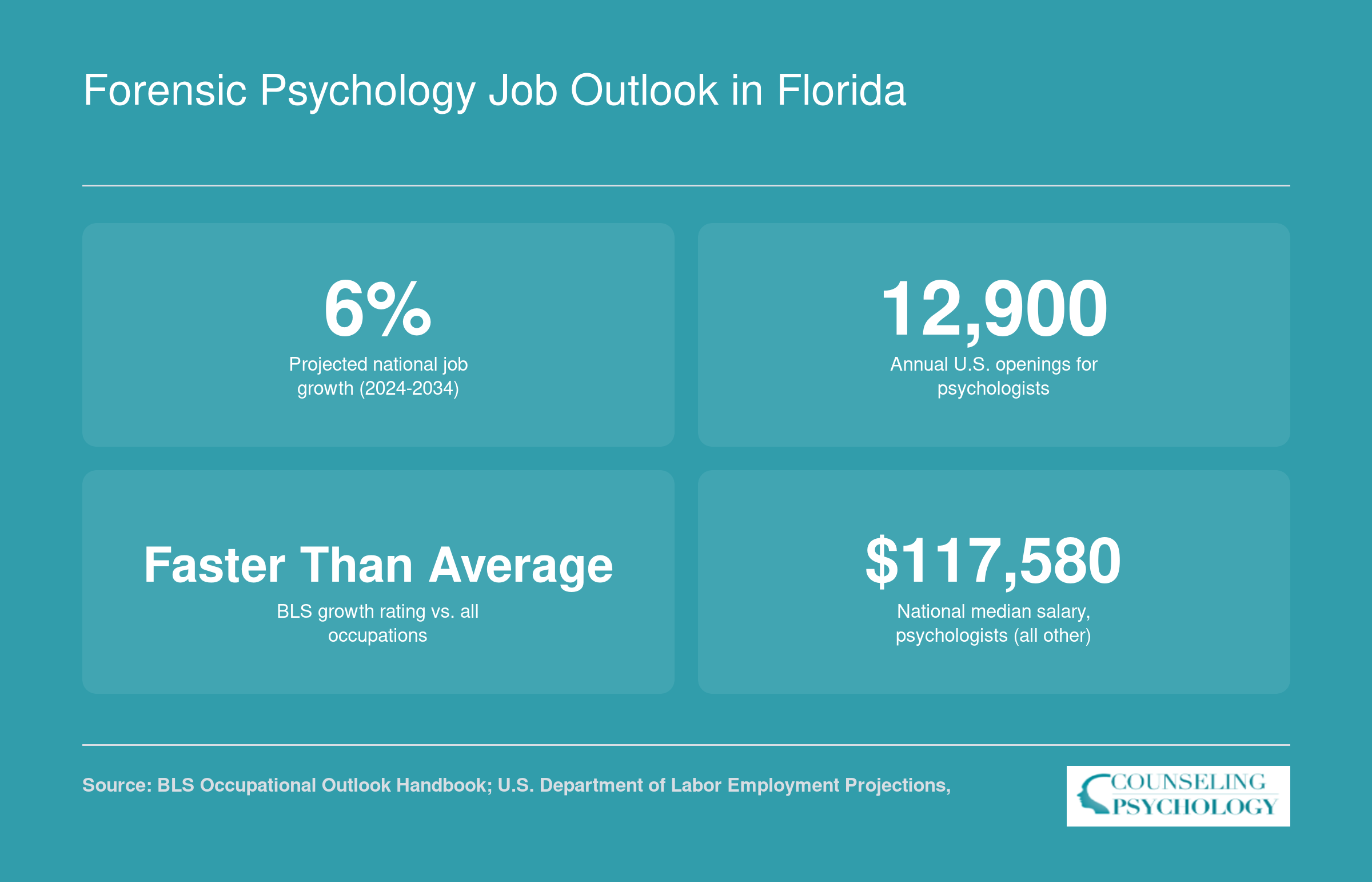
Demand for psychologists continues to climb both nationally and across Florida, driven by growing interest in criminal justice reform, mental health awareness, and expert testimony in legal proceedings. While Florida-specific projections for forensic psychologists are not published separately, the broader psychologist category offers a useful benchmark.
Online vs. On-Campus Forensic Psychology Programs in Florida
Choosing between online and on-campus formats is a practical decision that hinges on your schedule, career stage, and clinical training needs. Both delivery modes can lead to the same degree, but the day-to-day experience and networking opportunities differ significantly. Among the programs ranked on this page, Nova Southeastern University and Florida International University offer primarily on-campus instruction, while several others provide hybrid or fully online options that broaden access for students outside the Miami metro area.
Pros
- Online programs offer scheduling flexibility that lets working professionals complete coursework around existing job commitments.
- Tuition and living costs may be lower online, especially when you can study from home and skip a campus relocation.
- Online enrollment opens access to accredited programs well beyond Miami, expanding your choices across Florida and nationally.
- On-campus students benefit from direct, in-person practicum placements with Miami-area courts, forensic units, and correctional agencies.
- Face-to-face faculty mentorship on campus often leads to stronger recommendation letters and collaborative research opportunities.
- Campus-based cohorts build local professional networks that can accelerate job placement in South Florida's legal and clinical systems.
Cons
- Online students may struggle to arrange the supervised clinical contact hours that forensic psychology licensure in Florida requires.
- Remote learners can miss informal networking with judges, attorneys, and agency supervisors who frequently visit campus programs.
- On-campus programs typically demand a rigid class schedule, making it difficult to maintain full-time employment during graduate study.
- Relocating to attend an on-campus program near Miami adds housing and transportation costs that can significantly increase total expenses.
- Some online formats rely heavily on asynchronous discussion, which may limit real-time skill-building in forensic interviewing and assessment techniques.
How to Choose the Right Forensic Psychology Program
The forensic psychology field is maturing, and Miami's unique blend of criminal justice institutions and diverse communities demands that graduates enter the workforce with more than a degree. They need a tested skill set and a clear licensure trajectory. Selecting a program is not just about finding a forensic concentration; it's about evaluating how each component of a doctorate aligns with Florida's regulatory landscape and the realities of local forensic practice.
Accreditation That Opens Doors in Florida
Regional accreditation is the nonnegotiable floor for any graduate degree: Florida's licensure board mandates a regionally accredited doctoral program for psychologists. APA accreditation, while not required by law, is the standard for clinical and counseling psychology programs. Although the APA does not accredit forensic psychology doctorates as a distinct category, many strong forensic tracks live within APA-accredited clinical or counseling programs.2 If you are weighing options statewide, our guide to best clinical psychology programs in Florida can help you identify APA-accredited programs with forensic concentrations. Graduating from an APA-accredited program streamlines licensure: it automatically satisfies the board's substantial equivalency review, avoids the added paperwork and uncertainty of a manual evaluation, and protects your ability to later practice in other states. Non-APA programs can still lead to Florida licensure, but they demand extra scrutiny and carry a higher risk of portability problems down the line.
Clinical Training with Local Forensic Footprints
Hands-on experience in real forensic settings is what turns coursework into competence. Look for programs that maintain established connections with Miami-area courts, correctional facilities (such as the Miami-Dade County jail system), forensic hospitals like the South Florida State Hospital, or community-based forensic clinics. APA expectations for forensic training include practicum placements in jails, prisons, forensic hospitals, or court clinics, so a program that can guarantee access to these sites offers a critical edge.2 Also confirm that the program provides support in securing an APA- or APPIC-member predoctoral internship, a Florida licensure requirement. The quality and proximity of these placements not only sharpen your skills but often lead directly to postdoctoral roles and career opportunities.
Faculty Who Practise What They Teach
Forensic psychology is a practice profession, and the mentors you learn from shape your early career. Prioritize programs whose faculty include active forensic practitioners or researchers, specifically psychologists who conduct competency evaluations, consult with attorneys, or publish on the intersection of law and mental health. Check for board certification in forensic psychology (ABPP), recent publications in the psychology-law literature, or leadership in the American Psychology-Law Society. Faculty with deep local ties can facilitate your access to specialized practicum sites and postdoctoral residencies, while their professional networks often become your job market.
Structure, Support, and Licensure Exam Readiness
Beyond curriculum content, practical program elements influence your likelihood of success. Smaller cohort sizes typically translate to more individual mentorship and earlier involvement in research or clinical work. Ask whether the program requires a traditional dissertation or offers a capstone or applied project; while a dissertation can strengthen research skills, a capstone might shorten time to degree if your focus is practice. Most critically, examine how the curriculum prepares you for the Examination for Professional Practice in Psychology (EPPP). APA-accredited programs align coursework with EPPP domains, but extra study resources or review modules can boost first-time pass rates. Finally, confirm whether the program can steer you toward an APA-accredited forensic postdoctoral residency, which is becoming the expected gateway to forensic specialization and board certification.2
Frequently Asked Questions About Forensic Psychology Programs in Miami
These are some of the most common questions prospective students ask about pursuing forensic psychology in the Miami area. Each answer draws on current Florida licensing rules, salary data, and program details covered throughout this article.