
What you’ll learn in this article…
- CACREP-accredited school counseling programs near Raleigh range widely in net price, making cost comparison essential before applying.
- North Carolina requires 600 supervised clinical hours for school counselor licensure through a CACREP-aligned program.
- NC's student-to-counselor ratio of 437:1 far exceeds the recommended 250:1, signaling strong job demand statewide.
- Several programs offer fully online or hybrid formats designed for working educators who cannot leave the classroom.
A master's in school counseling in North Carolina typically requires 60 credit hours, a supervised internship in K-12 settings, and passage of the Praxis exam before you can apply for state licensure. The financial spread across programs is wide: in-state graduate tuition ranges from roughly $6,900 a year at UNC Pembroke to over $39,000 at Wake Forest, with net prices for the full set of ranked programs falling between about $10,260 and $28,719 annually.
That range matters because North Carolina's student-to-counselor ratio remains well above national recommendations, signaling steady hiring demand but also meaning your return on a degree hinges partly on how much debt you carry into a public-school salary. If you are weighing options across the state, exploring masters in school counseling online programs can help you compare costs and formats beyond the Raleigh metro.
Best School Counseling Programs Near Raleigh, NC
North Carolina offers a strong bench of CACREP-accredited school counseling programs, and several sit right in the Research Triangle or deliver coursework online so Raleigh-area students can earn their degree without relocating. The ranking below weighs affordability most heavily, factoring in net price and financial-aid metrics alongside institutional graduation rates and program quality indicators. All graduation rates cited are institution-wide figures, not program-specific, because program-level completion data is not publicly available for most of these schools.
- Net price and tuition affordability
- Financial aid availability
- Institution-wide graduation rate
- Program accreditation and format
- Geographic accessibility from Raleigh
- NCES-IPEDS federal institutional data — nces.ed.gov
- College Scorecard graduate earnings — collegescorecard.ed.gov
- Internal program database
- Independent program research

University of North Carolina at Chapel Hill
UNC Chapel Hill's 14-month, cohort-based M.Ed. in School Counseling is among the most intensive accelerated options in the state. With an institution-wide graduation rate above 91% and a net price of roughly $11,655, it combines flagship academic strength with strong affordability for in-state students. Located just 30 minutes from Raleigh in the Triangle, the program places interns directly in North Carolina public schools, giving graduates a clear path to K-12 licensure.
- 14-month intensive format with cohort-based structure
- 60-credit curriculum aligned with ASCA National Model
- Yearlong internship embedded in NC public schools
- CACREP accredited with K-12 licensure eligibility
- Strengths-based approach emphasizing cultural competence
- Pathway to Licensed Clinical Mental Health Counselor status
Master of Education in School Counseling — On-Campus

University of North Carolina at Pembroke
UNC Pembroke consistently ranks among the cheapest school counseling programs in the state, with in-state per-credit costs around $237 to $238. Its 60-credit M.A.Ed. blends online, hybrid, and face-to-face formats, a genuine advantage for Raleigh-area students who want to minimize relocation costs. Both CACREP and CAEP accredited, the program prepares graduates for K-12 licensure through advocacy-centered coursework and supervised field experience.
- Estimated total in-state tuition around $14,267
- Online, hybrid, and face-to-face delivery options
- 60 credit hours with CACREP and CAEP accreditation
- Evidence-based practices and data-driven advocacy focus
- Practicum and internship in K-12 settings
- Minimum 2.7 undergraduate GPA for admission
Master of Arts in Education in Professional School Counseling — Hybrid

North Carolina A & T State University
North Carolina A&T is a historically Black university in Greensboro offering a CACREP-accredited M.S. in School Counseling with flexible evening classes that accommodate part-time and full-time schedules. At under $500 per credit hour for in-state students, it sits firmly in the budget-friendly tier. The university also houses a Ph.D. in Counselor Education and Supervision with concentrations in rehabilitation counseling, trauma-informed care, and cultural diversity, giving master's graduates a clear pipeline if they pursue doctoral work.
- CACREP-accredited with flexible evening class times
- Part-time or full-time enrollment options
- Covers eight core counseling competency areas
- Individualized learning paths for each student
- Fall-only admission cycle
- Under $500 per credit hour for in-state residents
- Three concentration tracks available on campus
- Specializations in trauma-informed care and cultural diversity
- Rehabilitation counseling focus within doctoral curriculum
- Prepares graduates for educator and leadership roles
- Research emphasis on social justice and advocacy
- Campus-based delivery in Greensboro
Master of Science in School Counseling — On-Campus
Doctor of Philosophy in Counselor Education and Supervision — On-Campus

Western Carolina University
Western Carolina University's hybrid M.A.Ed. in School Counseling pairs classroom instruction with 750 hours of hands-on field experience. Total program cost estimates come in around $26,460 for in-state students, placing WCU in the mid-range of affordable NC options. Graduates qualify for both K-12 school counselor licensure and eligibility for Licensed Clinical Mental Health Counselor Associate credentials, expanding career flexibility after graduation.
- 60-hour hybrid program with CACREP accreditation
- 750 hours of supervised field experience required
- Crisis intervention and career counseling coursework
- K-12 licensure plus LCMHC-A eligibility
- Blends in-person and distance learning components
- Focuses on counseling children and adolescents
Master of Arts in Education in School Counseling — Hybrid

University of North Carolina at Charlotte
UNC Charlotte houses both a campus-based M.A. in School Counseling and a fully online post-master's certificate for counselors who already hold a graduate degree and want to add school counseling licensure. With in-state tuition under $500 per credit hour, UNC Charlotte lands among the most budget-friendly public options statewide. The 12-credit online certificate is particularly useful for Raleigh-area professionals who want to pivot into K-12 settings without stepping away from their current roles.
- Campus-based program preparing K-12 licensed counselors
- Social justice and multicultural advocacy emphasis
- Developmental, collaborative, and equitable services focus
- CACREP accredited with strong faculty mentoring
- In-state tuition under $500 per credit hour
- Located in Charlotte with access to large school districts
- 100% online delivery with 12 credit hours
- 300-hour internship aligned with ASCA standards
- Designed for professionals holding a counseling master's
- Prepares for NC school counselor licensure
- Flexible schedule for working professionals
- Summer start date each year
- Campus-based doctoral program with school counseling focus
- Multicultural competence and ethical practice emphasis
- Dissertation research and clinical requirements included
- Financial aid and graduate funding options available
- Prepares for higher education and leadership careers
- Specific admission criteria with faculty interview
Master of Arts in School Counseling — On-Campus
Post-Master's Certificate in School Counseling — Online
Counselor Education and Supervision, Ph.D. — On-Campus

Appalachian State University
Appalachian State's 60-semester-hour Professional School Counseling program is repeatedly cited as one of the most affordable in North Carolina, with estimated total costs around $17,940 to $29,770 depending on fee assumptions. Courses are delivered on campus in Boone with electives in areas like play therapy and substance abuse counseling. As a UNC System school, Raleigh residents qualify for the same competitive in-state tuition.
- 60-semester-hour, CACREP-accredited curriculum
- On-campus delivery with multicultural perspective
- K-12 school counselor licensure preparation
- Elective options in play therapy and substance abuse
- Emphasis on ethical standards and interpersonal skills
- Includes practicum and supervised internship hours
Professional School Counseling — On-Campus

North Carolina State University at Raleigh
NC State is the only major school counseling program physically located in Raleigh, making it the most geographically convenient option on this list. Its M.Ed. in School Counseling offers both on-campus and a three-year, part-time online cohort, the latter ranked among the top 20 nationally by U.S. News for online education programs. Even online students must complete practicum and internship hours in NC public schools, and Raleigh's access to Wake County and surrounding districts makes local placements straightforward.
- 60-credit program with on-campus and online tracks
- Three-year part-time online cohort starting each May
- No GRE required for admission
- CACREP accredited with NC licensure eligibility
- Practicum and internship in NC K-12 public schools
- Minimum 3.0 GPA and three recommendation letters required
- Campus-based doctoral program at NC State
- Focus on multiculturalism, advocacy, and leadership
- CACREP accredited with dissertation research requirement
- GRE scores required for doctoral admission
- Prepares for faculty and supervisory roles
- 60 graduate credit hours beyond master's degree
Master of Education in School Counseling — Online
Counseling and Counselor Education, Ph.D. — On-Campus

East Carolina University
East Carolina University offers both a campus-based M.S. in Counselor Education with a school counseling concentration and a fully online graduate certificate for licensed counselors adding school credentials. ECU's estimated total tuition hovers around $17,980 for in-state students, keeping it in the lower-cost UNC System cluster. The online certificate requires only 12 credit hours plus a 600-hour internship, making it one of the more efficient add-on credentials available.
- CACREP accredited with school counseling concentration
- Campus-based delivery in Greenville, NC
- Meets NC licensure requirements for K-12 counselors
- Flexible elective studies across counseling domains
- Eligible to sit for National Counselor Examination
- Culturally competent training with diverse faculty
- Fully online, 12-semester-hour program
- 600-hour internship aligned with NC licensure standards
- Designed for professionals with existing counseling master's
- Follows ASCA National Model framework
- Efficient pathway to school counselor credentialing
- Strong fit for working counselors statewide
- 61 semester hours with CACREP accreditation
- Financial support and individualized study plans
- Focus on leadership, research, and publishing
- Advanced internship and comprehensive exam requirements
- Rehabilitation and clinical counseling specialization options
- Prepares graduates for higher education faculty roles
Master of Science in Counselor Education, School Counseling — Online
Graduate Certificate in School Counseling — Online
Counselor Preparation and Research, Ph.D. — On-Campus

North Carolina Central University
North Carolina Central University in Durham sits just minutes from Raleigh and offers one of the most affordable CACREP-accredited school counseling master's programs in the state, with costs estimated under $500 per credit hour. The 60-hour M.A. is available in both online and campus formats, a practical combination for working Triangle residents. As an HBCU, NCCU brings a distinct emphasis on community engagement and equitable access to its counselor training.
- 60-hour CACREP-accredited program
- Online and campus delivery options available
- Under $500 per credit hour for in-state students
- K-12 school counseling licensure preparation
- Durham location minutes from Raleigh
- 3.0 GPA and GRE scores required for admission
School Counseling, M.A. — Online

Gardner-Webb University
Gardner-Webb University is a private institution in Boiling Springs that delivers its 60-credit M.A. in School Counseling through a hybrid of in-person and online coursework. While private, its net price of about $17,674 remains competitive with several public alternatives. The curriculum aligns with the ASCA National Model and includes an accelerated admission track for undergraduate psychology majors, an unusual perk that can shorten time to degree.
- 60-credit, CACREP-accredited hybrid program
- Aligns with ASCA National Model standards
- Accelerated admission option for psychology majors
- Includes practicum and internship in school settings
- Covers counseling theory, ethics, and human differences
- Emphasizes developmental and preventative services
Master of Arts in School Counseling — Hybrid

Lenoir-Rhyne University
Lenoir-Rhyne University in Hickory offers both a campus-based M.A. in Counseling with a school counseling concentration and a 12-credit graduate certificate for students already enrolled in its clinical mental health track. The certificate replaces two electives, making the add-on credential relatively seamless. As a private institution, its net price is higher than most public peers, but financial aid is available for eligible students.
- 61 credit hours delivered on campus in Hickory
- Prepares for NCC certification and NC state licensure
- Courses in counseling theories and child development
- Practicum and internship experiences included
- Requires B or higher in key licensure courses
- Limited summer entry available
- 12 credit hours added to clinical mental health degree
- Two courses replace required CMHC electives
- Internship component for hands-on school experience
- Leads to NC school counselor licensure eligibility
- Financial aid available for eligible students
- Campus-based format at Lenoir-Rhyne
Counseling, M.A., School Counseling Concentration — On-Campus
Graduate Certificate in School Counseling — On-Campus

Wake Forest University
Wake Forest University in Winston-Salem rounds out the list as a high-profile private option with a 10:1 student-faculty ratio and an institution-wide graduation rate near 89%. Its M.A. in Counseling with a school counseling concentration is CACREP accredited and designed for working professionals, combining online coursework with in-person practicum and internship. The net price of roughly $28,719 makes it the costliest program here, but graduates benefit from the university's strong alumni network and national reputation.
- 60 semester hours with CACREP accreditation
- Online coursework designed for working professionals
- Practicum and internship in K-12 school settings
- 10:1 student-faculty ratio for close mentoring
- Covers human development, ethics, and counseling techniques
- Prepares for licensure in North Carolina and beyond
Master of Arts in Counseling, School Counseling Concentration — Online
Cost Comparison: Tuition and Net Price Across NC Programs
Tuition sticker prices only tell part of the story. The net price column below reflects the average annual cost after grants and scholarships, as reported to the federal government through IPEDS and the College Scorecard. Because most of these are public universities, in-state residents can save substantially, but net price varies widely depending on each school's financial aid packages. All figures are annual and institution-level, not specific to the school counseling program.
| School | In-State Tuition | Out-of-State Tuition | Net Price | Median Graduate Debt | Student-to-Faculty Ratio |
|---|---|---|---|---|---|
| UNC Pembroke | $6,928 | $19,987 | $10,260 | $25,000 | 14:1 |
| NC A&T State University | $8,368 | $21,168 | $10,846 | $27,000 | 20:1 |
| UNC Chapel Hill | $12,751 | $31,408 | $11,655 | $14,000 | 15:1 |
| Western Carolina University | $7,876 | $18,595 | $13,315 | $21,868 | 16:1 |
| NC Central University | $7,638 | $20,946 | $15,359 | $28,250 | 16:1 |
| UNC Charlotte | $8,037 | $23,072 | $15,435 | $21,500 | 21:1 |
| East Carolina University | $7,658 | $20,807 | $15,739 | $22,750 | 17:1 |
| Appalachian State University | $8,570 | $25,241 | $16,836 | $20,231 | 16:1 |
| NC State University | $12,101 | $32,874 | $17,303 | $20,121 | 15:1 |
| Gardner-Webb University | $12,125 | $12,125 | $17,674 | $24,222 | 12:1 |
| Lenoir-Rhyne University | $13,020 | $13,020 | $20,689 | $26,000 | 15:1 |
| Wake Forest University | $39,141 | $39,141 | $28,719 | $21,500 | 10:1 |
Questions to Ask Yourself
Online vs. On-Campus: Flexible Formats for Working Professionals
Most students entering school counseling programs in North Carolina are already working in education, whether as teachers, paraprofessionals, or instructional aides. The format you choose can make or break your ability to finish your degree without leaving the classroom. Here is how the two main delivery models stack up across the NC programs in our ranking.
Pros
- Online programs at NC State, NC Central, Wake Forest, UNC Charlotte, and East Carolina let you keep your teaching job and study evenings or weekends on your own schedule.
- No relocation required with online delivery, a real advantage when programs like NC State or Wake Forest sit hours from Raleigh yet offer full CACREP-accredited coursework remotely.
- Hybrid options at UNC Pembroke, Western Carolina, and Gardner-Webb blend online convenience with periodic on-campus intensives, giving you face-to-face skill practice without a daily commute.
- On-campus cohorts at UNC Chapel Hill, NC A&T, and Appalachian State build strong peer networks and direct faculty mentoring that can open doors to practicum placements and job referrals.
- Structured campus schedules, like UNC Chapel Hill's 14-month intensive model, help students maintain momentum and finish faster than self-paced alternatives.
- Face-to-face programs simplify practicum coordination because faculty often have established relationships with nearby K-12 partner schools.
Cons
- Online learners frequently report feeling isolated from classmates and faculty, and the format demands consistent self-discipline to stay on track across 60 credit hours.
- Fully online programs still require in-person practicum and internship hours in a local school, so you will need to arrange your own site placement if no regional coordinator is available.
- On-campus programs at places like Appalachian State (Boone) or Western Carolina (Cullowhee) limit your geographic options and may require relocation if you live in the Raleigh area.
- Commuting to a campus adds gas, parking, and time costs that can rival tuition savings, especially for evening classes several nights a week.
- Hybrid schedules can be unpredictable, requiring occasional weekend or summer residencies that complicate family and work commitments.
CACREP Accreditation and NC Licensure: What You Need to Know
Understanding the relationship between program accreditation and state licensure requirements is essential before you commit to a school counseling program. North Carolina has specific pathways you must follow to work in K-12 schools, and choosing a CACREP-accredited program can simplify that journey considerably.
What CACREP Accreditation Means for Your Career
The Council for Accreditation of Counseling and Related Educational Programs sets rigorous standards for counselor education. While North Carolina does not explicitly require CACREP accreditation for school counselor licensure, the state licensing board and most school districts strongly prefer graduates from accredited programs.1 CACREP programs must meet specific benchmarks for curriculum design, clinical training hours, and faculty qualifications, which translates to better preparation for the realities of K-12 counseling work.
One practical advantage emerges if you ever relocate: CACREP graduates typically face fewer hurdles when seeking licensure in other states. Many states have reciprocity agreements or streamlined pathways specifically for candidates who completed CACREP-accredited training. Without that accreditation, you may need to complete additional coursework or supervised hours before another state will grant you a license. If you are exploring the broader profession, understanding how to become a counselor can provide helpful context for where school counseling fits within the field.
Step-by-Step Path to NC School Counselor Licensure
North Carolina licenses school counselors through the Department of Public Instruction rather than a separate counseling board.2 Here is the standard pathway:
- Complete an approved program: You must earn a master's degree in school counseling from an accredited or state-approved institution, including a K-12 school internship component.1
- Pass the required exam: The Praxis School Counselor exam (test code 5422) is mandatory, with a minimum passing score of 159 points. If you took older versions of the test before August 2023 (codes 0420 or 5421), different score thresholds applied.3
- Submit your application: Apply online through the NCDPI Online Licensure System with a $70 application fee.2
- Receive your Initial Professional License: New graduates typically receive the IPL, which allows you to begin working in North Carolina schools.1
Initial Licensure vs. Continuing License Renewal
The Initial Professional License is your entry point, but it is not permanent. After meeting experience requirements and demonstrating professional competence, you can advance to the Continuing Professional License, which remains valid for five-year cycles.1
Renewal requires completing 8 continuing education credits every five years. These break down into specific categories: 3 discipline-specific credits, 2 digital learning credits, and 3 general professional development credits. If you earn National Board Certification, that credential fulfills all 8 renewal credits for the cycle.1
For out-of-state candidates, North Carolina may issue a Continuing Professional License directly if you meet testing requirements or hold National Board Certification.1 This pathway makes NC relatively accessible for experienced counselors relocating from other regions.
Related Articles
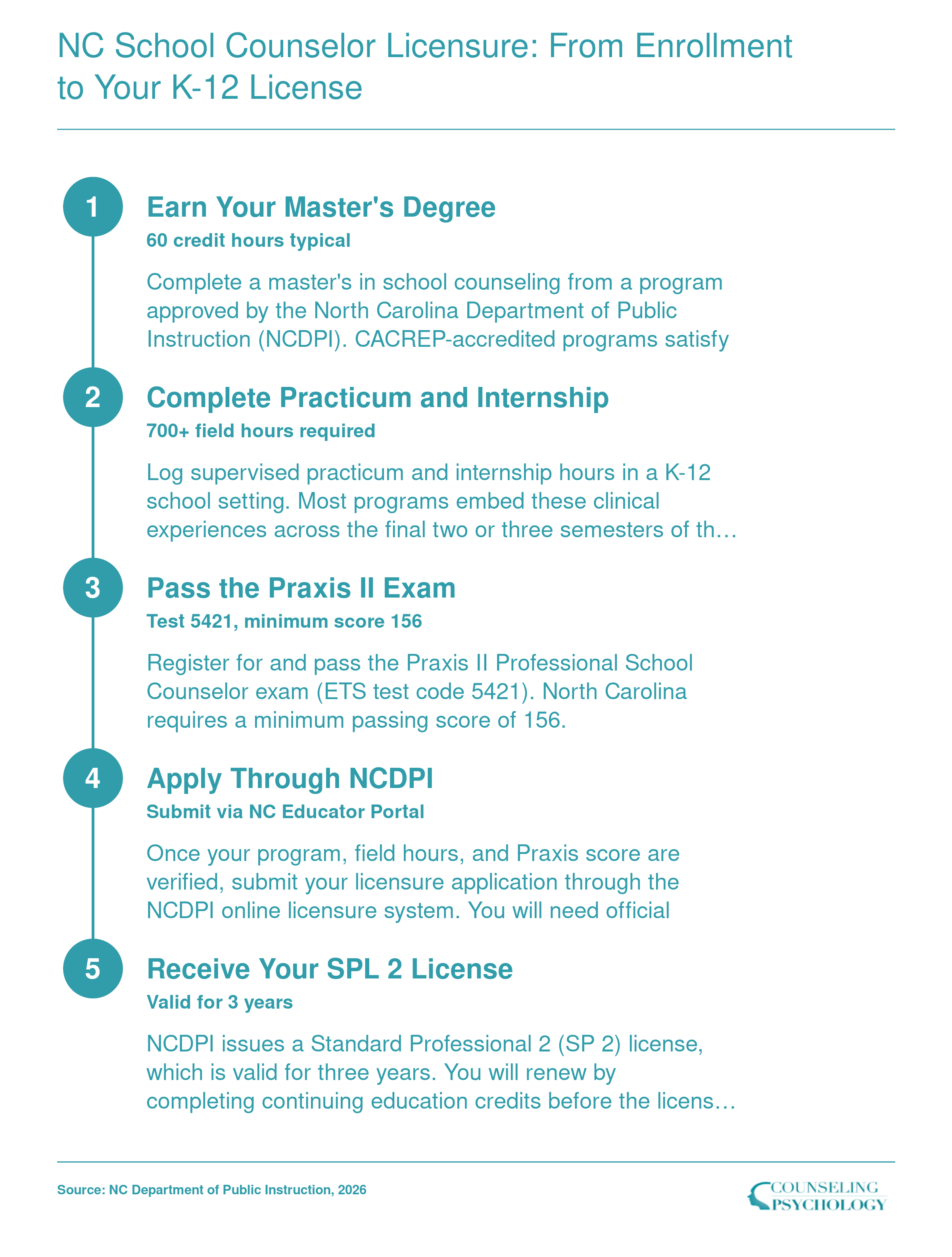
NC School Counselor Licensure: From Enrollment to Your K-12 License
Earning your school counselor license in North Carolina follows a clear, sequential path. Each step builds on the one before it, so understanding the full timeline helps you plan coursework, fieldwork, and exam prep without surprises.
Earnings and Career Outcomes After Graduation
Investing in a master's degree means weighing what you will owe against what you will realistically earn in the first few years. For school counseling graduates in North Carolina, the honest answer involves both encouraging salary data and a reminder that public school pay scales vary considerably by district and experience level.
What School Counselors Earn in North Carolina
According to the Bureau of Labor Statistics (2024 data), the median annual wage for school and career counselors in North Carolina is $57,100.1 The range is wide: the bottom tenth percentile earns around $38,580, while the top tenth reaches $74,840.1 Wages in the Raleigh-Durham-Cary MSA are not separately published in the most recent BLS release at the occupational level for this role, so the statewide figure is the most precise benchmark available from that source. The national median for the same occupation is $65,140, meaning North Carolina sits somewhat below the U.S. midpoint, which is typical for a state where public-sector salaries trend modestly.
For context, the national median for high school teachers is $64,580, for middle school teachers $62,970, and for elementary teachers $62,340.3 North Carolina school counselors at the median earn less than those national teacher benchmarks, but those are national figures, not North Carolina teacher figures. Within the state, school counselors tend to hold comparable or slightly higher salaries than classroom teachers at similar experience levels, partly because counselor positions often carry a supplement above the standard teacher pay scale in many NC districts.
Program-Level Earnings Data
Program-specific earnings outcomes for the NC school counseling programs featured in this article are not yet available through federal reporting channels. That gap is worth flagging plainly: without program-level data, it is not possible to say whether graduates of NC State, UNC Chapel Hill, or Appalachian State land jobs faster or earn more at the one-year or four-year mark. What is available are institution-wide earnings figures, which blend outcomes across all graduate programs and are therefore a rough proxy at best for any single degree. Students weighing broader masters in counseling programs in North Carolina may find the same data limitation applies across the state.
Debt-to-Earnings as a Quick ROI Check
Even without program-level earnings data, you can sketch a basic return-on-investment picture using institutional median graduate debt figures and the $57,100 statewide counselor median. Several programs in this comparison carry median graduate debt in the $20,000 to $28,000 range. At $57,100 per year, a counselor devoting 10 percent of gross income to loan repayment could retire a $25,000 balance in roughly four to five years under a standard repayment plan, before accounting for Public Service Loan Forgiveness, which many school counselors qualify for after ten years of payments while employed by a public school district.
The programs with the lowest net costs, including UNC Pembroke, Western Carolina, and NC A&T, tend to show lower institutional debt levels as well, which meaningfully improves that ratio for students who borrow to cover program costs. At the higher-tuition end, Wake Forest's net price after aid brings actual borrowing closer to the midfield range for many students, though it still warrants careful comparison.
The core takeaway: North Carolina school counselor salaries are livable but not high by national standards. The strongest financial case for these programs depends less on which program you choose and more on how aggressively you minimize debt, whether through in-state public university pricing, employer tuition assistance, or PSLF eligibility planning before you even enroll.
The American School Counselor Association recommends a student-to-counselor ratio of 250:1, but North Carolina's actual average sits at 437:1 for the 2024-2025 school year, according to ASCA's national staffing data. That means NC counselors juggle nearly 75% more students than the recommended caseload.
Practicum and Internship Expectations in North Carolina
Online programs offer flexibility, but on-campus programs may provide more robust site placement networks. When it comes to clinical training, however, both formats must meet the same rigorous field-experience requirements if they carry CACREP accreditation.
CACREP Clinical Hour Requirements
All CACREP-accredited school counseling programs require a minimum of 700 total clinical hours: 100 hours in practicum and 600 hours in internship.12 These hours do not overlap, meaning practicum hours cannot count toward the internship total.3 Within the practicum, at least 40 hours must be direct service (face-to-face work with students).1 During the internship, at least 240 of the 600 hours must be direct service.2 The practicum spans a minimum of eight weeks and includes weekly individual supervision (one hour) and group supervision (1.5 hours).45 The internship follows the same supervision model, with group sessions capped at 12 students and individual supervision maintaining a 1:6 faculty-to-student ratio.5
NC Licensure Alignment
North Carolina's Department of Public Instruction accepts CACREP clinical hour standards as the threshold for school counselor licensure eligibility. Programs approved by the state align their practicum and internship structures with CACREP benchmarks, so graduates of any CACREP-accredited program in North Carolina will have completed the clinical hours necessary to apply for their initial license. There are no additional state-mandated hour requirements beyond the CACREP minimums. If you are comparing programs nationally, our guide to CACREP accredited online school counseling programs can help you benchmark what different institutions offer.
K-12 Site Placements
School counseling interns typically rotate through multiple grade-level settings during their 600-hour internship. Most programs place students in at least two of the three K-12 bands: elementary, middle, and high school. This exposure ensures that graduates can work effectively across developmental stages and meet diverse student needs. Practicum placements may focus on a single setting, but the internship is designed to broaden experience. You will work under a credentialed school counselor at each site, gaining hands-on practice in individual counseling, group facilitation, classroom guidance, crisis intervention, and college and career readiness programming.
Placement Support for Online Students
If you are considering an online program, ask how the department supports site placement in your geographic area. Some programs maintain partnerships with school districts across the state and can facilitate introductions, while others require students to identify and secure their own placements with program approval. Distance learners near Raleigh often have an easier time arranging placements due to the concentration of public and charter schools, but students in rural regions should confirm that the program has a track record of supporting remote cohorts. During your admissions interview or program tour, request specifics: Does the program provide a placement coordinator? Are there memoranda of understanding with Wake County or nearby districts? Knowing the level of institutional support can make the difference between a smooth clinical experience and months of logistical stress.
Admission Requirements and Application Tips
Admission requirements for master's in school counseling programs specify the academic credentials, supporting documents, and professional experiences each university expects before you can begin coursework. Understanding these requirements early helps you build a stronger application and avoid last-minute surprises.
GPA Minimums and Academic Prerequisites
Most North Carolina graduate programs in school counseling require a minimum undergraduate GPA between 2.75 and 3.0 on a 4.0 scale, though competitive applicants often exceed these thresholds. Some programs at UNC Chapel Hill, NC State, and UNC Greensboro expect foundational coursework in psychology, human development, or education. If your undergraduate degree was in an unrelated field, check whether the program requires prerequisite courses or allows conditional admission while you complete them. For a broader look at what selective admissions processes involve, our guide on how hard it is to get into grad school for psychology breaks down common benchmarks.
GRE Policies and Test-Optional Trends
GRE requirements vary significantly across North Carolina institutions. Several programs have adopted test-optional or test-flexible policies in recent years, while others still require official scores. Visit each university's official admissions page directly to confirm current testing requirements. These pages are updated more frequently than third-party databases and reflect the most accurate policies for upcoming application cycles.
Letters of Recommendation and Professional Experience
Expect to submit two to three letters of recommendation, typically from academic instructors, supervisors, or professionals who can speak to your interpersonal skills and readiness for graduate-level counseling work. Prior K-12 experience is often preferred but not always required. Many programs value applicants who have worked with children or adolescents in tutoring, mentoring, teaching, or youth program roles. Review program handbooks or departmental FAQs to understand what kinds of experience carry the most weight.
Verifying Information and Getting Answers
Admissions pages can occasionally contain outdated or vague information. When something is unclear, contact the graduate admissions office or the counseling program coordinator directly via email. They can clarify conflicting details about deadlines, document requirements, or prerequisite waivers. Professional associations like the North Carolina School Counselor Association and CACREP also publish resources on accreditation standards and typical program expectations, which can help you benchmark what different institutions require.
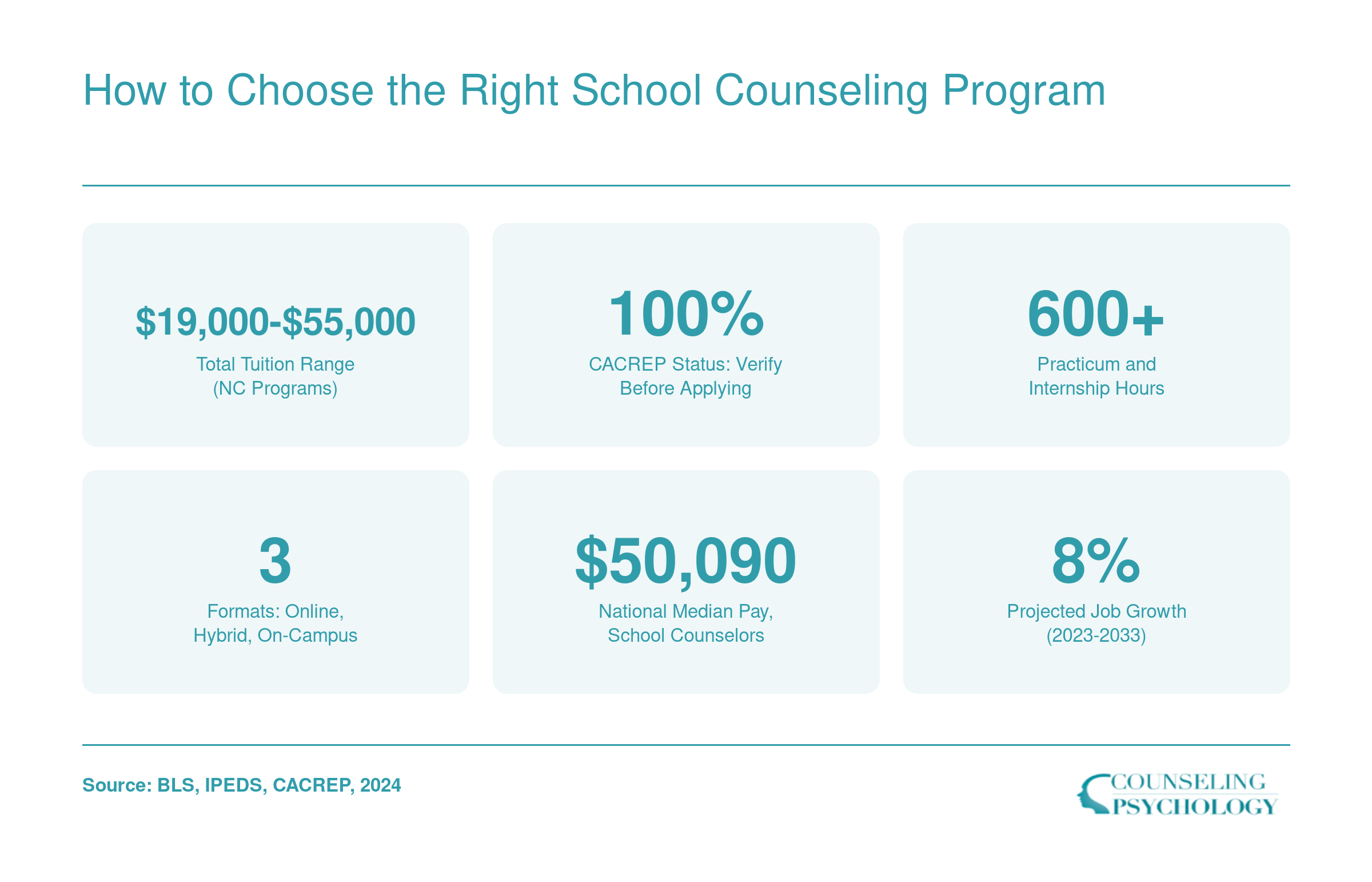
How to Choose the Right School Counseling Program
Selecting the right school counseling program comes down to a handful of measurable factors. Weigh these benchmarks side by side to narrow your list. Total cost and format set the practical boundaries, while CACREP accreditation and practicum support determine how smoothly you move from coursework to licensure, and post-graduation earnings signal the return on your investment.
Frequently Asked Questions About School Counseling Programs in NC
Choosing a school counseling program raises practical questions about cost, format, accreditation, and what comes after graduation. Below are answers to the questions prospective students in North Carolina ask most often.