
What you’ll learn in this article…
- Hawaii has no COAMFTE accredited MFT programs, so most students earn their degrees through online programs.
- Hawaii accepts regionally accredited MFT master's degrees for LMFT licensure, not just COAMFTE approved programs.
- LMFT candidates need 33 semester hours of MFT coursework plus 1,000 hours of supervised postgraduate clinical experience.
- MFT salaries in Hawaii exceed the national median, though the state's high cost of living offsets some of that advantage.
Hawaii has no COAMFTE-accredited MFT programs operating within the state, a straightforward fact that shapes every graduate school decision for aspiring therapists on the islands. Chaminade University in Honolulu offers an MFT-focused master's program, but students seeking COAMFTE-accredited training must look to online programs based elsewhere in the country.
The practical tension here is real: Hawaii's licensure board accepts graduates from regionally accredited programs alongside COAMFTE-accredited ones, which opens a wider pool of online options. However, applicants must understand exactly which documentation the Hawaii Department of Commerce and Consumer Affairs requires before enrolling anywhere.
For context on compensation, Hawaii MFT wages exceed the national median, though the state's cost of living substantially offsets that advantage. Choosing a program with strong completion rates and manageable tuition is not an abstract concern for Hawaii residents; it is a financial calculation with long-term consequences.
Best Online MFT Programs for Hawaii Students
Hawaii has limited in-state options for marriage and family therapy graduate education, which means many aspiring therapists look to nationally available online programs. The programs below are ordered by a quality composite that weighs student outcomes, affordability, and completion rates, so this is not simply a list of the cheapest or fastest options. Every program listed accepts students from Hawaii and can be completed remotely, though some require brief on-campus intensives or local clinical placements. Hawaii students should verify that any program they choose meets the state's LMFT educational requirements, including the 60-credit-hour threshold and supervised clinical hours, before enrolling.
Details
- Internal program database
- College Scorecard graduate earnings — collegescorecard.ed.gov
- NCES-IPEDS federal institutional data — nces.ed.gov
- Independent program research

Northwestern University
Northwestern University delivers a fully online Master of Science in Marriage and Family Therapy through a COAMFTE-accredited curriculum that can be completed in 21 to 36 months. The program caps live online classes at 15 students and requires 400 hours of clinical fieldwork, offering the kind of intensive, small-group training typically associated with on-campus cohorts. With a 95.1% institution-wide graduation rate and no GRE requirement, it combines elite academic infrastructure with practical accessibility for distance learners in Hawaii.
- Fully online COAMFTE-accredited master's program
- Completable in 21 to 36 months
- Live online classes capped at 15 students
- 400 hours of supervised clinical fieldwork
- No GRE required for admission
- Out-of-state tuition approximately $54,655 per year
- Placement specialists help arrange local fieldwork
Master of Science in Marriage and Family Therapy — Online

California State University-Northridge
California State University, Northridge offers a COAMFTE-accredited Master of Science in Marriage and Family Therapy designed around an accelerated eight-week course format, with most students finishing in under two years. The hybrid program prepares graduates for both LMFT and LPCC licensure. At roughly $19,062 in annual out-of-state tuition, CSUN delivers one of the most affordable accredited MFT master's degrees available to Hawaii residents.
- COAMFTE-accredited master's degree
- One course at a time, eight-week format
- Completable in under two years
- Prepares for both LMFT and LPCC licensure
- Out-of-state tuition approximately $19,062 per year
- Net price approximately $7,021
- Year-round scheduling available
Master of Science in Marriage and Family Therapy — Hybrid

University of Southern California
The University of Southern California's online Master of Science in Marriage and Family Therapy is a 60-unit, cohort-based program that emphasizes cultural humility, evidence-based practice, and social justice. Delivered through USC Rossier, the program reports a 92% clinical exam pass rate among graduates and offers competitive scholarships ranging from $15,000 to $30,000. Hawaii students benefit from a rigorous 24-month curriculum backed by a 91.8% institution-wide graduation rate.
- 60-unit cohort-based online program
- Full-time track completable in 24 months
- Scholarships from $15,000 to $30,000 available
- 92% clinical exam pass rate reported
- Emphasis on cultural humility and equity
- Out-of-state tuition approximately $71,515 per year
- Fieldwork and supervised clinical practice included
Master of Science in Marriage and Family Therapy — Online

University of South Florida
The University of South Florida offers a 15-credit-hour Graduate Certificate in Marriage and Family Therapy geared toward licensed mental health professionals who want to add systemic therapy skills. This hybrid certificate is not a standalone path to LMFT licensure, so Hawaii students should treat it as a supplement rather than a primary degree. USF's strong institutional profile, with a 76.8% graduation rate and a net price near $9,812, makes it an affordable way to deepen clinical specialization.
- 15-credit-hour graduate certificate
- Designed for already-licensed mental health professionals
- Hybrid delivery with online components
- Systemic therapy approach to families and couples
- Out-of-state tuition approximately $21,126 per year
- Does not independently meet LMFT licensure requirements
- Six required credits plus nine elective credits
Graduate Certificate in Marriage and Family Therapy — Hybrid

Moody Bible Institute
Moody Bible Institute provides a Graduate Certificate in Marriage, Family, and Couples Counseling that integrates faith-based perspectives with clinical mental health training. The program is designed for professionals who already hold a master's degree and want specialized knowledge in couple and family systems. Tuition of approximately $9,702 per year makes it one of the lowest-cost options on this list, though Hawaii students should note this is a certificate rather than a full licensure-qualifying degree.
- Post-master's certificate for licensed professionals
- Hybrid format with online and campus options
- Approximately $539 per credit hour
- Biblical integration with clinical practice
- Faculty-led group interview required for admission
- Focuses on marriage, family, and couples counseling
- Does not independently qualify for LMFT licensure
Certificate in Marriage, Family, and Couples Counseling — Hybrid

University of Oregon
The University of Oregon's Couples and Family Therapy program awards a Master of Science through a 90-credit, COAMFTE-accredited curriculum that includes 350 direct client contact hours. A cohort model admits 22 to 24 students annually, and the program offers a Spanish Language Specialization for students interested in serving bilingual populations. Out-of-state tuition runs approximately $33,379 per year, positioning UO as a mid-range investment with strong clinical depth.
- 90-credit COAMFTE-accredited master's program
- 350 direct client contact hours required
- Cohort model with 22 to 24 students per year
- Spanish Language Specialization available
- Clinical training at the Center for Healthy Relationships
- Out-of-state tuition approximately $33,379 per year
- Community externship placements included
Couples and Family Therapy, Master of Science — Hybrid

Western Kentucky University
Western Kentucky University's Marriage, Couple, and Family Counseling master's program carries CACREP accreditation and uses a hybrid format that blends online coursework with hands-on clinical training at the on-campus Talley Family Counseling Center. At approximately $18,340 in out-of-state tuition, WKU offers a relatively affordable path to licensure preparation. Hawaii students should confirm that the CACREP-accredited curriculum aligns with Hawaii's specific LMFT educational standards.
- CACREP-accredited master's program
- Hybrid format with online and campus components
- Clinical training at the Talley Family Counseling Center
- Out-of-state tuition approximately $18,340 per year
- Net price approximately $10,990
- Prepares graduates for marriage and family therapy licensure
- Financial support options may be available
Marriage, Couple, and Family Counseling, Master's — Hybrid

Texas Woman's University
Texas Woman's University offers a COAMFTE-accredited Master of Science in Marriage and Family Therapy that most students complete in about three years. The hybrid program fulfills Texas licensure board requirements and includes a thesis option for research-oriented students. With out-of-state tuition near $15,900 per year and no GRE requirement, TWU provides an accessible entry point, though Hawaii students will need to verify alignment with Hawaii's own LMFT requirements.
- COAMFTE-accredited hybrid program
- Most students complete in approximately three years
- No GRE or letters of recommendation required
- Thesis option available for research track
- Out-of-state tuition approximately $15,900 per year
- Net price approximately $11,963
- On-campus interview required for admission
Master of Science in Marriage and Family Therapy — Hybrid

Oregon Institute of Technology
Oregon Institute of Technology delivers a Master of Science in Marriage and Family Therapy with three distinct concentrations: Medical Family Therapy, Substance Use Disorder Treatment, and Integrated Behavioral Healthcare. The hybrid program emphasizes rural mental health and multicultural competence, qualities that resonate with Hawaii's own underserved communities on neighbor islands. Out-of-state tuition is approximately $36,164 per year.
- Hybrid M.S. with three concentration options
- Medical Family Therapy concentration available
- Substance Use Disorder Treatment concentration available
- Integrated Behavioral Healthcare concentration available
- Emphasis on rural mental health and multicultural competence
- Trauma-informed care woven throughout curriculum
- Out-of-state tuition approximately $36,164 per year
Marriage and Family Therapy, Master of Science — Hybrid

Prescott College
Prescott College offers a CACREP-accredited Master of Science in Counseling with a Marriage, Couple, and Family Counseling concentration. The 60-credit hybrid program is mostly online, requiring only a three-day campus residency, which makes it logistically manageable for Hawaii-based students. A social justice lens runs through the curriculum, and post-graduate certificate options let graduates add specialty credentials after completing the degree.
- 60-credit CACREP-accredited hybrid program
- Mostly online with a three-day campus residency
- Approximately $830 per credit hour
- Social justice integrated throughout the curriculum
- Post-graduate certificate options available
- Human Sexuality Counseling concentration also offered
- Prepares graduates for professional counselor licensure
Master of Science in Counseling, Marriage, Couple, and Family Counseling Concentration — Hybrid
Why Hawaii Students Often Choose Online MFT Programs
Hawaii students seeking marriage and family therapy training face a straightforward reality: no COAMFTE-accredited MFT programs currently operate in the state.1 Chaminade University in Honolulu offers a Master of Science in Marriage and Family Therapy program that prepares graduates for LMFT licensure, but as of 2025 it does not hold COAMFTE accreditation.2 For students seeking a COAMFTE-accredited credential, valued by many employers and required for some clinical settings, online programs from mainland institutions represent the most practical path forward.
The In-State Alternative: CMHC at UH Hilo
The University of Hawaii at Hilo offers a Clinical Mental Health Counseling (CMHC) program that leads to Licensed Mental Health Counselor (LMHC) credentials rather than LMFT. While both licenses prepare graduates for clinical practice, the training focus differs: CMHC programs emphasize individual counseling and diagnostic skills across diverse populations, while MFT programs center on relational and systems-based therapy with couples and families. Students drawn to systemic, relationship-focused work typically find MFT training a better fit, and that means looking beyond Hawaii's borders. For a broader overview of the profession, including education and licensure expectations, see our guide on how to become a marriage and family therapist.
Practical Advantages of Online MFT Training
Online COAMFTE-accredited programs eliminate the need to relocate to the mainland for two or more years, saving tens of thousands in housing, travel, and living expenses. Students remain embedded in Hawaii's communities, often completing their required clinical practicum and internship hours with local supervisors approved by their program and Hawaii's licensing board. This arrangement allows students to build professional networks in the state where they intend to practice, rather than establishing connections on the mainland and starting over after graduation.
Online formats also open access to a far wider range of COAMFTE-accredited programs than any single geographic region could offer. Students can compare curricula, specializations, faculty expertise, and cost structures across dozens of programs, selecting the best fit for their clinical interests and career goals.
Licensing Board Flexibility
Hawaii's licensing board accepts MFT degrees from regionally accredited programs, not only COAMFTE-accredited ones, for LMFT licensure eligibility. This policy means students have multiple viable pathways, but COAMFTE accreditation remains the gold standard for employers, especially those affiliated with hospitals, military installations, and national counseling organizations. The accreditation distinction matters less for state licensure but significantly more for career mobility and employer credibility.
How to Become a Marriage and Family Therapist in Hawaii
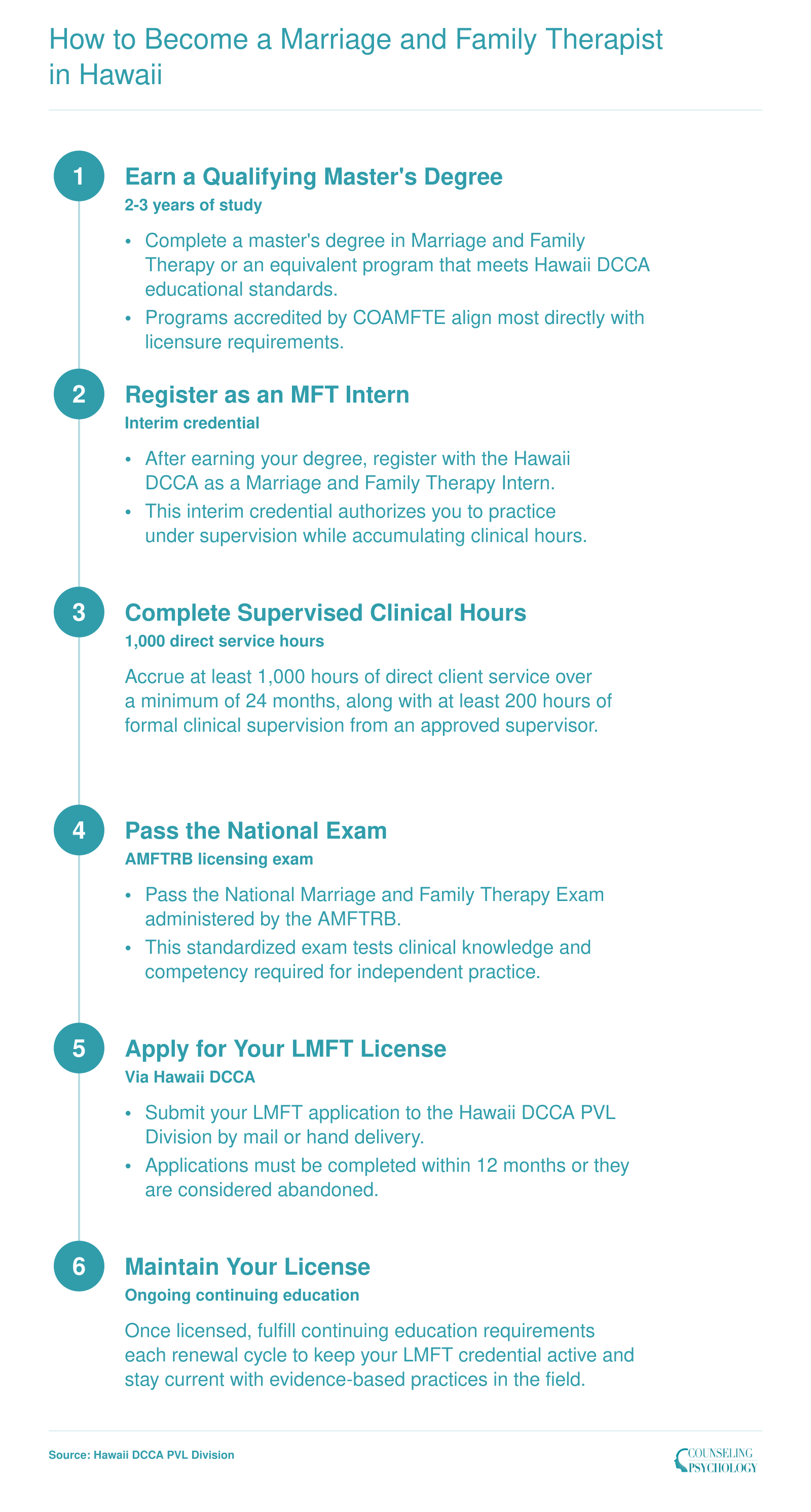
Becoming a Licensed Marriage and Family Therapist (LMFT) in Hawaii follows a structured pathway regulated by the Hawaii Department of Commerce and Consumer Affairs (DCCA). Each step below reflects current DCCA requirements, from your graduate education through active licensure.
Hawaii LMFT Licensure Requirements
Hawaii requires 33 semester hours (or 44 quarter hours) in a master's or doctoral program to qualify for the Licensed Marriage and Family Therapist (LMFT) credential, governed by Hawaii Revised Statutes Chapter 451J and Hawaii Administrative Rules Title 16 Chapter 88.1 These requirements set clear benchmarks for education, supervised experience, and examination before independent practice is permitted.
Educational Requirements
Candidates must earn a graduate degree from an accredited institution in marriage and family therapy or a related field. The 33-semester-hour curriculum must include at least 9 semester hours (12 quarter hours) in marriage and family studies, 9 semester hours (12 quarter hours) in marriage and family therapy, 9 semester hours (12 quarter hours) in human development, 3 semester hours (4 quarter hours) in professional ethics, and 3 semester hours (4 quarter hours) in research.1 Programs must also include a 300-hour practicum. Hawaii recognizes AAMFT Clinical Fellows as having automatically satisfied education and experience requirements, providing an alternative pathway for those holding that credential.1
Supervised Clinical Experience
After completing the degree, candidates must accumulate 1,000 hours of direct client contact within a minimum two-year supervised practice period. Supervision itself totals 200 hours and must be provided by an LMFT licensed for at least two years or another licensed mental health professional who has held AAMFT Clinical Fellow status for at least two years.1 For a broader look at what these post-degree hours involve across states, see our guide to LMFT supervision hours. Supervisors may work with up to six supervisees simultaneously. While Hawaii does not offer a formal provisional license, candidates may practice under the title "MFT Intern" during this accumulation phase, using an exemption in the statute that permits supervised work before full licensure.2
Examination and Application
All applicants must pass the National Marriage and Family Therapy Examination, administered by the Association of Marital and Family Therapy Regulatory Boards, with a fee of $220.2 Once the exam is cleared, candidates submit an application to the Hawaii Department of Commerce and Consumer Affairs with a $50 application fee and a license fee that was $396 as of the most recent published schedule in 2023.1 The application packet requires official transcripts, documentation of supervised hours (including supervisor attestations), exam scores, and a background check. Processing times vary, but applicants should expect several weeks for review once all materials are submitted. Hawaii does not administer a separate state jurisprudence exam; the national examination is the sole required test for LMFT licensure.2
Questions to Ask Yourself
Do you already have a clinical site or supervisor connection in Hawaii for your practicum hours?
Are you drawn to couples and family systems work, or does individual-focused clinical mental health counseling better match your goals?
Can your schedule handle synchronous class sessions that may be set in mainland time zones?
COAMFTE Vs. Regionally Accredited MFT Programs: What Hawaii Requires
Accreditation debates in marriage and family therapy have intensified as more students weigh specialized program approval against regional institutional standing. Hawaii operates under a dual-track framework that gives prospective MFT students meaningful flexibility, but that flexibility comes with documentation responsibilities that vary by program type.
What COAMFTE Accreditation Means
The Commission on Accreditation for Marriage and Family Therapy Education grants program-specific recognition to graduate degrees that meet rigorous curricular, faculty, and clinical training standards in marriage and family therapy.1 COAMFTE accreditation sits on top of institutional regional accreditation and signals that a program's coursework, practicum structure, and supervision model align with national MFT standards. For students, a COAMFTE-accredited degree offers pre-validated coursework, meaning state boards recognize the curriculum without additional course-by-course review.
Hawaii's Licensure Requirement: Regional Accreditation Plus MFT Coursework
Hawaii does not require COAMFTE accreditation for LMFT licensure. Under HRS Chapter 451J and HAR Chapter 16-88, the state accepts a master's or doctoral degree in marriage and family therapy or a related field from any regionally accredited institution.3 The DCCA Marriage and Family Therapist Program evaluates applications based on coursework content, not program-specific accreditation status. Chaminade University, for example, holds WASC regional accreditation and DCCA approval, and its graduates qualify for Hawaii licensure without COAMFTE standing.4
Documentation Requirements for Non-COAMFTE Graduates
Students graduating from regionally accredited programs without COAMFTE designation must submit additional materials to demonstrate equivalency. Hawaii requires official transcripts, a course-by-course worksheet mapping degree coursework to state content areas, catalog descriptions for each class, and practicum verification showing direct client contact hours, supervision hours, and clinical setting details.5 This documentation process is straightforward but demands careful record-keeping during graduate study.
Portability Considerations for Future Relocation
Some states mandate COAMFTE accreditation outright, restricting licensure pathways for graduates of regionally accredited-only programs. Students who anticipate moving out of state after graduation should verify destination-state requirements before enrolling. For a broader look at the profession's requirements and career trajectory, review our guide on how to become a family therapist. A COAMFTE degree simplifies interstate mobility, while a regionally accredited degree without COAMFTE standing may require additional coursework, supervised hours, or examination to qualify for licensure in stricter jurisdictions.
Cost and ROI of Online MFT Programs for Hawaii Students
For Hawaii students pursuing an online MFT degree, return on investment deserves extra scrutiny. Hawaii consistently ranks among the highest cost-of-living states in the nation, so every tuition dollar matters. The table below sorts programs by graduate tuition (lowest first) and includes institution-wide net price estimates, median graduate debt, and an ROI ratio based on the institution's median earnings at ten years relative to median debt. Note that program-level earnings after completion are not yet available for these MFT programs specifically; the median earnings shown are institution-wide, national figures from the College Scorecard, not Hawaii-specific salaries. Net price figures are also institution-wide averages and may differ from what a graduate student actually pays.
| School | Graduate Tuition (Out-of-State) | Approx. Net Price (Institution-Wide) | Median Graduate Debt | Median Earnings (10 yr, National) | ROI Ratio (Earnings / Debt) |
|---|---|---|---|---|---|
| Cal State Northridge | $19,062 | $7,021 | $13,872 | $59,115 | 4.3 |
| Texas Woman's University | $15,900 | $11,963 | $19,218 | $56,544 | 2.9 |
| University of South Florida | $21,126 | $9,812 | $17,988 | $57,743 | 3.2 |
| California Lutheran University | $22,046 | $30,109 | $21,669 | $68,712 | 3.2 |
| University of Oregon | $33,379 | $22,182 | $20,139 | $61,324 | 3.0 |
| Oregon Institute of Technology | $36,164 | $15,706 | $22,500 | $72,273 | 3.2 |
| Drexel University | $39,261 | $38,509 | $25,325 | $84,648 | 3.3 |
| Syracuse University | $48,132 | $38,793 | $26,000 | $79,164 | 3.0 |
| Northwestern University | $54,655 | $29,167 | $15,000 | $89,363 | 6.0 |
| University of Southern California | $71,515 | $32,740 | $18,000 | $92,498 | 5.1 |
MFT Salary and Job Outlook in Hawaii
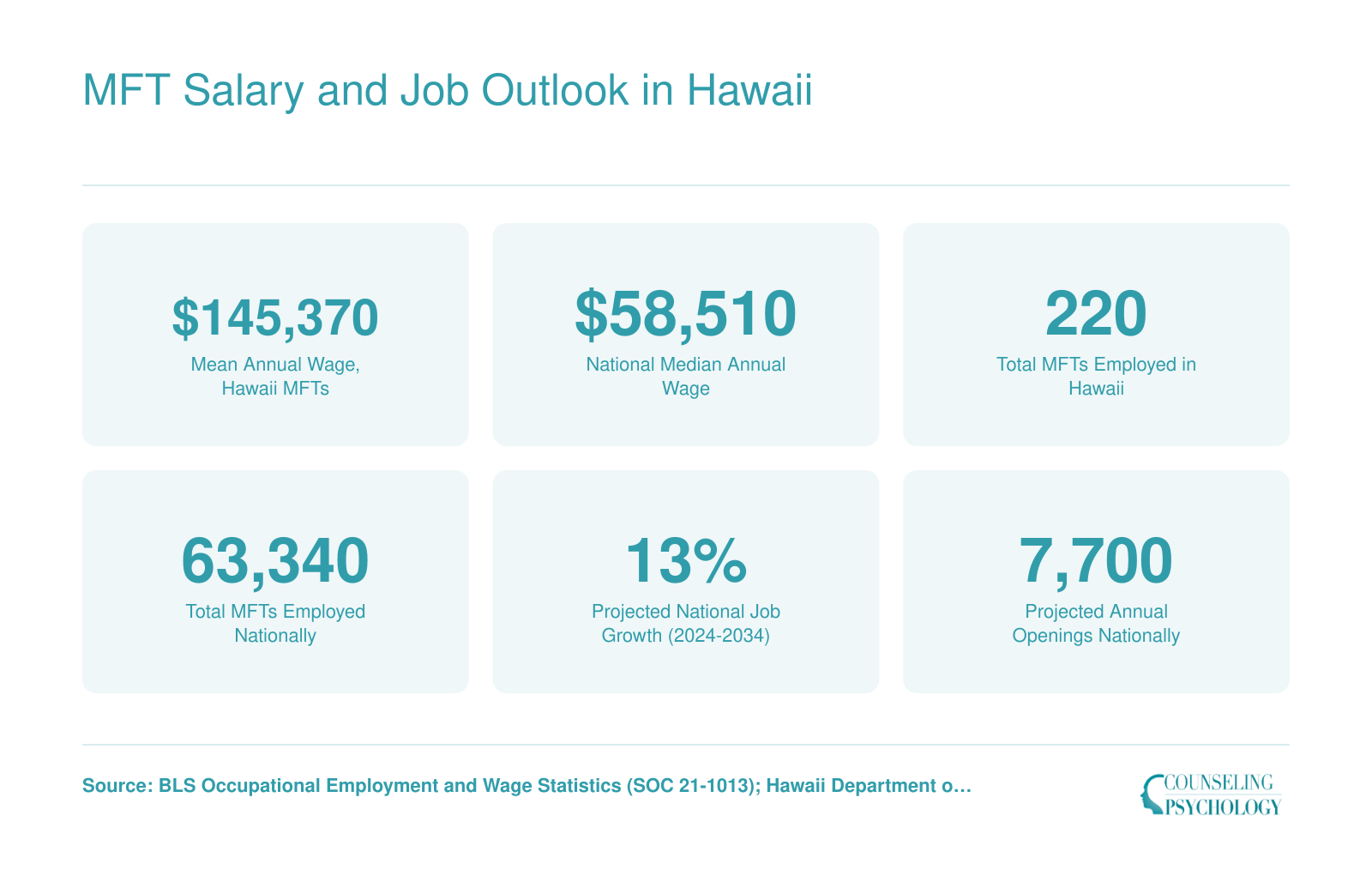
Hawaii's marriage and family therapy workforce is small but notably well compensated. According to the most recent state wage data, the mean annual wage for MFTs in Hawaii significantly exceeds the national median, though Hawaii's high cost of living absorbs a meaningful share of that difference. MFTs across the islands work in private practice, community mental health centers, and military-affiliated behavioral health programs, the last of which reflects Hawaii's substantial military presence.
LMFT Vs. LMHC: Choosing the Right Licensure Path in Hawaii
Hawaii students entering the mental health field face an important decision early in their education: pursue licensure as a Marriage and Family Therapist or as a Mental Health Counselor. Both credentials lead to rewarding clinical careers, but they differ in scope, training emphasis, and local educational access.
Scope of Practice and Clinical Focus
The LMFT license, governed by HRS 451J, authorizes practitioners to provide marital and family therapy.1 This credential emphasizes systemic approaches, treating individuals within the context of their relationships and family dynamics. LMFTs commonly work with couples, blended families, parent-child conflicts, and multigenerational issues.
The LMHC license, governed by HRS 453D, authorizes mental health counseling with a broader individual focus.2 Licensed Mental Health Counselors often specialize in areas like anxiety, depression, trauma, career counseling, or substance use. While LMHCs can certainly work with families, their training centers on individual psychopathology and counseling theory rather than systems-based interventions.
Education and Supervised Experience Requirements
Both licenses require a master's or doctoral degree with a minimum of 48 graduate credits.3 After completing their degree, candidates for either license must accumulate 3,000 hours of supervised post-degree experience, a process that typically takes two to four years depending on employment settings and weekly client hours.2
The examination requirements differ by license type. LMFT candidates must pass the MFT National Examination administered by the AMFTRB, while LMHC candidates must pass the National Counselor Examination.2
For the LMHC pathway specifically, Hawaii requires 100 hours of face-to-face supervision and 300 hours of client contact during the graduate program itself.2
In-State Program Availability
One practical consideration that often tips the scales for Hawaii residents is local program access. The University of Hawaii at Hilo offers a counseling program that prepares graduates for LMHC licensure, providing an in-state option for students who prefer on-campus learning or want to complete fieldwork within Hawaii's communities.
No COAMFTE-accredited MFT program currently operates in Hawaii, meaning LMFT candidates must complete their education through online or distance programs. For students who prioritize staying local for their graduate education, the LMHC pathway offers a clear convenience advantage. Those leaning toward the LMHC route may also want to explore broader counseling careers to understand the full range of specializations available with that credential.
Making the Right Choice
Consider these factors when deciding between pathways:
- Career vision: Do you see yourself working primarily with couples and families, or do you want flexibility to specialize in individual mental health concerns?
- Practice settings: LMFTs frequently work in private practice, family service agencies, and community mental health centers. LMHCs appear across similar settings but also commonly work in college counseling centers, substance abuse programs, and employee assistance programs.
- Educational logistics: Are you comfortable completing your degree online, or does having an in-state campus option significantly impact your decision?
Both licenses lead to meaningful clinical work and similar earning potential in Hawaii. The choice ultimately depends on which therapeutic approach resonates with your professional goals and which educational path fits your circumstances.
Hawaii has no in-state COAMFTE accredited MFT programs, but dozens of nationally accredited online programs accept Hawaii residents and prepare you fully for LMFT licensure. Your path to becoming a licensed marriage and family therapist is absolutely achievable from the islands. Focus your planning on two key decisions: choosing between COAMFTE and regionally accredited programs, and securing a qualified local supervisor for your clinical hours.
Frequently Asked Questions About MFT Programs for Hawaii Students
Below are answers to the most common questions prospective MFT students in Hawaii ask when researching programs, licensure, and career outcomes. Each answer draws on the details covered throughout this guide.
- Are there any COAMFTE-accredited MFT programs in Hawaii?
- As of 2026, there are no COAMFTE-accredited MFT programs physically located in Hawaii. However, several nationally accredited online programs from mainland institutions accept Hawaii residents and satisfy the state's educational requirements for licensure. Hawaii does not mandate COAMFTE accreditation specifically, so regionally accredited programs with equivalent MFT coursework can also qualify you for the LMFT credential.
- Can I complete an MFT degree online and get licensed in Hawaii?
- Yes. Hawaii accepts master's degrees in marriage and family therapy from regionally accredited institutions, including online programs. You will still need to complete practicum and internship hours, which typically require in-person client contact at an approved site in Hawaii or another state. After graduating, you must fulfill the state's supervised clinical experience and pass the required licensing examination.
- What are the LMFT licensure requirements in Hawaii?
- Hawaii requires a master's or doctoral degree in marriage and family therapy (or a closely related field) with specific MFT coursework, a minimum of 1,000 hours of supervised clinical experience completed post-degree under an approved supervisor, and a passing score on the MFT national licensing examination. Applicants must also submit to a background check and apply through the Hawaii Department of Commerce and Consumer Affairs.
- How much do marriage and family therapists make in Hawaii?
- According to BLS data, the national median annual wage for marriage and family therapists was approximately $58,510 as of the most recent reporting period. Hawaii-specific salary figures can differ due to the state's higher cost of living. State-level wage estimates from the BLS, when available, should be consulted for a more accurate picture. Earnings vary based on setting, experience, and whether you work in private practice or agency roles.
- What is the difference between LMFT and LMHC in Hawaii?
- The Licensed Marriage and Family Therapist (LMFT) credential focuses on relational and systemic therapy, treating couples and families as interconnected units. The Licensed Mental Health Counselor (LMHC) credential emphasizes individual counseling across a broader range of mental health concerns. Each license requires a different master's degree focus, distinct supervised experience standards, and a separate national exam. Your choice should align with the population and clinical approach you prefer.
- How to become a mental health therapist in Hawaii?
- To practice as a mental health therapist in Hawaii, you typically need a master's degree in counseling, marriage and family therapy, or a related field from a regionally accredited institution. After completing your degree, you must accumulate supervised clinical hours as outlined by the Hawaii licensing board, then pass the appropriate national examination. The specific license you pursue (LMFT, LMHC, or clinical social work) determines the exact coursework and exam required.
- Can I complete my supervised clinical hours in Hawaii while enrolled in an out-of-state online program?
- In most cases, yes. Many online MFT programs allow students to arrange practicum and internship placements in their home state, including Hawaii. You will need to confirm that your program approves the site and that your clinical supervisor meets both the program's and Hawaii's requirements. Coordinating early with your program's field placement office is essential, as clinical sites on the islands can be limited in some areas.
More Online MFT Programs Available to Hawaii Students
For Hawaii students looking beyond our top 10 ranked programs, the following online and hybrid MFT programs offer additional pathways to licensure. These schools welcome out-of-state students and provide flexible formats designed for distance learners.
- Master of Science in Counseling (Marriage and Family Therapy)
- Master of Science in Counseling (Play Therapy)
- Master of Science in Counseling (Adventure Therapy)
- M.A. in Marriage and Family Therapy
- Master of Arts in Marriage and Family Therapy
- MS Marriage and Family Therapy
- Couple and Family Therapy
- Marriage & Family Therapy, MS
- Master of Science in Counseling (Clinical Mental Health Counseling)
- M.A. in Marriage, Couple, and Family Counseling
- Master of Arts in Marriage, Couple & Family Counseling
- MS in Counseling Psychology (MFT)
- Master of Science in Counseling Psychology with an emphasis in Marital and Family Therapy (Psychological Trauma)
- Master of Science in Counseling Psychology with an emphasis in Marital and Family Therapy (Attachment Theory)
- Marital and Family Therapy (Family Court Mediation)
- MS in Marriage and Family Therapy
- M.A. in Marriage and Family Therapy
- Marriage and Family Therapy, M.A. Online
- M.A. in Marriage and Family Therapy
- Post-Baccalaureate Certificate in Marriage and Family Therapy
- Post-Baccalaureate Certificate in Marriage and Family Therapy (Child and Adolescent Family Therapy)
- Post-Baccalaureate Certificate in Marriage and Family Therapy (Couple Therapy)
- Master of Family Therapy (Trauma and Addiction)
- Master of Family Therapy (LGBT and Specific Populations)
- Certificate of Graduate Studies in Marriage, Couple & Family Counseling