

What you’ll learn in this article…
- Idaho State University is the only campus-based MFT program in the state, making online options essential for most students.
- Idaho LMFT licensure requires a 60 semester hour master's degree plus roughly two years of post-graduate supervised practice.
- Program costs range from about $15,000 to over $40,000, while early career MFT earnings in Idaho hover near $45,000 to $50,000 annually.
- COAMFTE accreditation streamlines Idaho licensing, but the board also accepts regionally accredited programs meeting specific coursework requirements.
Idaho currently has one in-state master's program explicitly designed for marriage and family therapy licensure, which means prospective students face a binary choice: enroll at Idaho State University or consider online programs based out of state. That constraint sharpens the importance of understanding which out-of-state degrees satisfy Idaho's licensing board and what flexibility you actually have around clinical training and supervision.
The Idaho Board of Professional Counselors and Marriage and Family Therapists requires 60 semester hours minimum, plus specific coursework in relational theory, assessment, ethics, and supervised clinical practice. Programs that meet these standards come in two formats: campus-based (rare in Idaho) and online, where the bulk of coursework happens remotely but practicum and supervision still occur in your community. Both formats lead to the same credential, but only if the program's curriculum aligns with state rules.
National accreditation from COAMFTE simplifies that alignment substantially. Idaho recognizes COAMFTE-accredited degrees as meeting its academic requirements, which eliminates guesswork about course titles and content coverage. Without that accreditation, you bear the burden of proving equivalency to the board, a process that can delay your application and add costs.
Top-Ranked Marriage and Family Therapy Programs for Idaho Students
Idaho has a small in-state universe for marriage and family therapy graduate education, with just one campus-based program specifically designed around the state's licensure framework. That limited selection makes it especially important to evaluate your options carefully and to consider how online or regional programs might round out your choices. Below, we profile the standout Idaho-based MFT program and what it offers students pursuing licensure in the Gem State.
- Net price and tuition affordability
- Graduation and retention rates
- Licensure alignment with Idaho rules
- Delivery format and campus access
- Clinical training requirements
- NCES-IPEDS federal institutional data — nces.ed.gov
- College Scorecard graduate earnings — collegescorecard.ed.gov
- Internal program database
- Independent program research

Idaho State University
Idaho State University is the state's primary option for students seeking a campus-based MFT-focused graduate degree. The university's Master of Counseling program with a Marriage, Couple, and Family Counseling specialty is CACREP accredited and built around Idaho's 60-credit-hour educational requirement for licensure. Classes are available on both the Pocatello and Meridian campuses, giving students in different parts of the state a realistic commuting option. With a net price around $12,193 and median graduate debt near $20,039, ISU represents a relatively affordable path into the profession, though its institutional graduation rate of roughly 39% signals that students should plan proactively for academic support and timely completion.
- CACREP accredited program meeting Idaho LPC educational standards
- Minimum 60 semester credit hours of graduate coursework required
- Available on both Pocatello and Meridian campuses
- Practicum and internship in mental health and community settings
- 1,000 supervised clinical hours with 400 direct client contact hours
- Curriculum covers family systems theory and multicultural counseling
- Applications accepted through January 15 with possible secondary admissions
- At least four semesters of full-time graduate study required
Master of Counseling, Marriage, Couple, and Family Counseling Specialty — On-Campus
Common Questions About MFT Programs and Licensure in Idaho
Prospective MFT students in Idaho often have overlapping questions about program accreditation, admissions requirements, and the path to licensure. Below are answers to some of the most common questions, drawn from current Idaho licensing rules and national accreditation standards.
Choosing an MFT Program: Accreditation, Format, and Licensure Fit
Picking an MFT program in Idaho comes down to four practical questions: Is it accredited in a way Idaho recognizes? Do the courses and clinical hours match what the board expects? Can you actually complete the practicum from where you live? And will the faculty and training sites prepare you for the kind of clients you want to see? Get those four right and the rest is logistics.
COAMFTE vs. CACREP: Both Work in Idaho
Under IDAPA 24.15.01, the Idaho Board of Professional Counselors and Marriage and Family Therapists accepts MFT degrees accredited by either COAMFTE (the Commission on Accreditation for Marriage and Family Therapy Education) or CACREP (the Council for Accreditation of Counseling and Related Educational Programs). Both pathways lead to the same LMFT license. Graduates of non-accredited programs can still qualify if the board determines the curriculum is substantially similar, but that route requires submitting syllabi for review and adds time to the process.
The practical difference: COAMFTE programs are built specifically around systemic family therapy and tend to align more cleanly with MFT licensure content areas. CACREP MFT specializations also satisfy Idaho's requirements but sit inside a broader counseling framework. Either way, you will need at least 60 semester hours from a regionally accredited institution, covering MFT studies, MFT therapy, human development, research, ethics, and mental health. If you are still exploring the broader path to licensure, our guide on how to become a marriage and family therapist walks through national requirements step by step.
Faculty, Placements, and Idaho's Rural Reality
Look closely at faculty research areas and the program's clinical training network. Programs with faculty who specialize in rural mental health, substance use, or trauma map well to the populations Idaho clinicians actually serve. Practicum placement support matters even more here than in denser states: Idaho students need 300 supervised hours, including 150 with couples and families, and finding sites outside the Boise, Idaho Falls, and Coeur d'Alene corridors can be genuinely difficult.
Online Programs and Idaho Board Approval
Idaho accepts online MFT degrees, but the board does not publish a pre-approved list. Before enrolling in any out-of-state online program, request a transcript and syllabus review confirmation from the program and verify the curriculum maps to Idaho's required content areas. Online students must still arrange local, in-person clinical placements: confirm the program will help you secure an Idaho site, or you may be left coordinating supervision and contracts on your own.
Related Articles
Questions to Ask Yourself
Online MFT Degrees That Meet Idaho Licensure Standards
An online MFT degree delivers the same rigorous marriage and family therapy curriculum as an on-campus program through a digital platform, allowing you to complete coursework remotely. For Idaho students, this format is often a necessity rather than a convenience, because the state offers very few in-person MFT programs that hold the required accreditation.
Why Online Programs Fill a Gap in Idaho
Idaho has historically had limited options for campus-based, COAMFTE- or CACREP-accredited marriage and family therapy training. The shortage of in-state programs means many residents must look to out-of-state schools for a viable path to licensure. Online MFT degrees eliminate the need to relocate, providing access to high-quality training that aligns with Idaho's educational standards. The Idaho Board of Professional Counselors and Marriage and Family Therapists accepts distance education, clearing the way for remote learners who meet all other requirements.
Accredited Online Programs for Idaho Residents
Several COAMFTE-accredited online programs openly welcome Idaho students. These include Abilene Christian University's Online MMFT, Alliant International University's Online MA in Marriage and Family Therapy, and Syracuse University's online MA in MFT. Each program meets the academic standards recognized by the Idaho licensing board. However, because Idaho requires a minimum of 60 semester hours with specific content distribution (9 semester hours in MFT studies, 9 in MFT therapy, 9 in human development, 6 in mental health competency, 3 in research, 3 in professional ethics, and a 6-semester-hour practicum/internship), you should verify that the program's curriculum maps onto those exact credit areas. CACREP-accredited online clinical mental health counseling programs with a marriage and family emphasis may also satisfy Idaho's educational criteria, but confirm the fit with Idaho's coursework breakdown before enrolling.
Arranging Your Clinical Placement
All Idaho-licensed MFT candidates must complete a supervised practicum with 300 direct client hours, 150 of which must be with couples or families. Online programs typically employ field placement coordinators who help you identify approved sites near your Idaho community. Still, you should expect to take an active role in locating a site and securing an Idaho-licensed LMFT supervisor. Once you graduate, you will need to complete 3,000 hours of post-degree supervised experience (2,000 direct) over at least two years. A strong placement during your program can serve as a bridge into those post-graduate hours.
Idaho's Stance on Distance Education
The Idaho Board of Professional Counselors and Marriage and Family Therapists does not impose extra hurdles for online degrees. As long as your program holds COAMFTE or CACREP accreditation and is offered by a regionally accredited institution, the board treats it the same as an on-campus program. There are no state-specific rules that restrict out-of-state online training, and Idaho does not require a separate approval process for distance education programs. This makes the online route a straightforward option for those who want to earn a nationally recognized degree without leaving the state.
Idaho MFT Tuition and Cost Breakdown
Idaho State University is currently the only institution in Idaho offering a campus-based master's-level Marriage and Family Therapy program. The table below breaks down its published tuition rates, estimated net price after financial aid, and graduate debt figures drawn from federal data sources. Keep in mind that the net price shown is an institution-level average across all programs and student profiles; your actual cost will depend on your residency status, financial aid package, and enrollment timeline. Compared to national averages for graduate counseling programs, which often run $15,000 to $25,000 per year in net cost at public universities, Idaho State University's estimated net price of roughly $12,193 per year positions it on the lower end of the spectrum, a meaningful advantage for students mindful of long-term debt. The median graduate debt at completion of approximately $20,039 is also notably below the national median for master's-level counseling graduates, helping keep monthly repayment manageable relative to expected earnings in the field.
| Cost Category | Idaho State University |
|---|---|
| In-State Tuition (Annual) | $11,522 |
| Out-of-State Tuition (Annual) | $30,632 |
| Average Net Price After Aid (Institution Level) | $12,193 |
| Median Graduate Debt at Completion | $20,039 |
| Median Earnings 10 Years After Entry | $45,608 |
| Pell Grant Recipients | 67.6% |
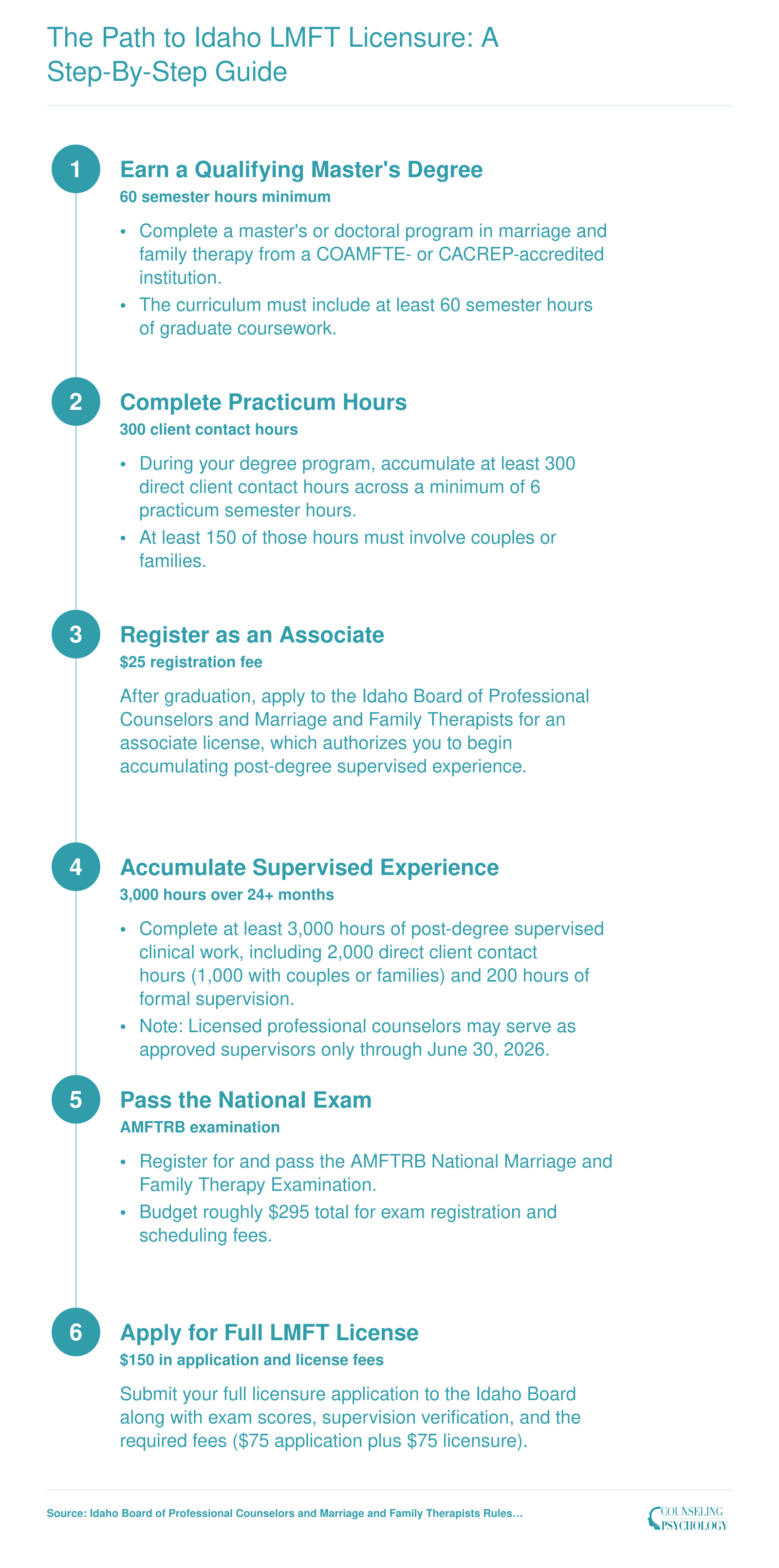
The Path to Idaho LMFT Licensure: A Step-By-Step Guide
From your first graduate class to holding a full LMFT license, the Idaho pathway typically spans about four to five years. Plan on roughly two to three years for a qualifying master's degree (60 semester hours minimum), followed by approximately two years of post-degree supervised practice. Understanding each milestone in advance helps you choose a program that keeps you on track and avoids costly delays.
What Idaho's LMFT Licensing Rules Mean for Your Program Choice
Idaho's licensing requirements should act as a filter when you evaluate MFT programs. Every course, practicum hour, and supervision arrangement you complete in graduate school either moves you toward licensure or leaves a gap you will have to fill later. Understanding the rules now saves time and money after graduation.
Practicum and Curriculum Alignment
Idaho requires 3,000 hours of post-degree supervised experience, with at least 2,000 of those hours consisting of direct client contact with couples, families, and individuals using a systemic or MFT framework.1 That supervised phase must span a minimum of two years.1 Because all of these hours are post-degree, your graduate practicum and internship hours do not count toward the 3,000-hour total. However, a program that front-loads substantial clinical training, especially with couples and families, prepares you to hit the ground running once you begin accumulating post-degree hours. When comparing programs, look at how many practicum hours the curriculum guarantees, what populations you will work with, and whether the clinical sites emphasize relational and systemic modalities.
The Associate License Phase and Qualifying Supervision
After earning your master's degree, you will apply for a provisional or associate-level registration that allows you to practice under supervision while accruing your 3,000 hours.2 Your supervisor must be a board-approved professional who has completed at least 15 hours of supervision training.3 Idaho accepts supervisors who hold an LMFT, LCPC, LCSW, psychologist, or psychiatrist credential, which gives you more flexibility than states that limit supervision to LMFTs only.2 For a broader look at what the supervised practice phase entails across different states, see our guide to LMFT supervision hours. Still, choosing a supervisor with strong MFT expertise is wise, since your direct client contact must be grounded in systemic and family therapy models.
The AMFTRB National Examination
Idaho requires passage of the national MFT examination administered through the Association of Marital and Family Therapy Regulatory Boards. The exam covers core MFT competencies: the practice of marriage and family therapy, ethical and legal considerations, and contemporary professional issues. You register directly through the AMFTRB portal and schedule a seat at a testing center. Many graduates sit for the exam during their supervised experience phase so they can apply for full LMFT licensure as soon as their hours are complete. Programs with dedicated exam-prep resources or study groups can give you an edge, so ask about that support before enrolling.
Reciprocity and Endorsement for Out-of-State Therapists
Idaho does not offer automatic reciprocity, meaning you cannot simply transfer an existing LMFT license from another state and begin practicing immediately.2 The state does, however, allow licensure by endorsement. Under this pathway, you submit documentation showing that your education, supervised experience, and examination history meet Idaho's standards.2 The Idaho Division of Occupational and Professional Licenses reviews each application individually. If you are already licensed elsewhere and considering a move, confirm that your original program and supervision hours align with Idaho's specific requirements, particularly the 2,000 direct client contact hours in a systemic framework. Gaps in documentation or framework mismatch are the most common reasons endorsement applications stall.
Idaho MFT program costs typically range from roughly $15,000 to over $40,000 depending on the institution, while early career earnings for marriage and family therapists in the state hover near $45,000 to $50,000 annually. The Bureau of Labor Statistics reports Idaho's median MFT salary at approximately $51,130, suggesting graduates can recoup their educational investment within a few years of entering practice.
MFT Salary and Job Outlook in Idaho
Idaho's behavioral health workforce shortage has put upward pressure on counselor and therapist wages across the state, and MFTs are part of that broader picture. Still, pinning down a precise Idaho-specific salary figure for marriage and family therapists requires going directly to the source data, because public-facing summaries often blend MFTs with related counseling occupations.
What the National Numbers Tell Us
The Bureau of Labor Statistics reports that marriage and family therapists nationally earned a median annual wage of $58,510 in May 2023, with the middle 50% of workers earning between $45,250 and $78,440. The top 10% earned more than $104,710, while the bottom 10% earned less than $39,090. Nationally, MFTs hold roughly 70,000 jobs, and BLS projects employment to grow about 12 to 13 percent from 2024 to 2034, faster than the average for all occupations.
For context on a closely related field, Idaho's mental health counselors earned a median annual wage of $65,240 in 2023, with a typical range of $43,550 to $85,960.3 That figure sits above the national median for mental health counselors ($59,190), which suggests Idaho's broader behavioral health labor market is competitive.3 MFT wages in Idaho may track similarly, but they are not identical, and you should not assume the counselor figure equals the therapist figure.
Where to Find Idaho-Specific MFT Data
For current Idaho wage data on marriage and family therapists specifically, go to the BLS Occupational Employment and Wage Statistics page at bls.gov/oes and search for SOC code 21-1013 with Idaho selected as the geography. The same tool lets you filter by metropolitan area, so you can compare wages in the Boise-Nampa metro against nonmetropolitan regions of the state, which often differ noticeably.
For long-term employment projections, the Idaho Department of Labor publishes occupation-level forecasts at labor.idaho.gov. Their projections page breaks out expected job openings and growth rates over a ten-year horizon, which is more useful for planning than national figures alone.
Additional Salary Context
Professional associations sometimes publish member salary surveys that capture nuances the BLS misses, such as private practice income, supervisor stipends, and rural pay differentials. The American Association for Marriage and Family Therapy (aamft.org) and the Idaho division (idahoaamft.org) are worth checking for these supplemental snapshots. If you are still exploring the profession and want a fuller picture of what the career path entails, our guide on how to become a marriage counselor covers licensure timelines, education requirements, and more.