
What you’ll learn in this article…
- Mississippi requires a full master's degree for LMFT licensure, so graduate certificates alone do not qualify.
- The University of Southern Mississippi offers the state's only COAMFTE accredited MFT program.
- Mississippi employs roughly 180 MFTs statewide, and demand is expected to grow through 2030.
- COAMFTE accredited online programs from other states can meet Mississippi Board standards with careful verification.
In-state options versus out-of-state programs: that is the first practical decision Mississippi students face when pursuing a master's in marriage and family therapy. Unlike states with multiple COAMFTE-accredited programs competing for applicants, Mississippi has only a handful of in-state options, which pushes many students to evaluate programs across state lines or in online formats.
The Mississippi Board of Examiners for Social Workers and Marriage and Family Therapists sets the education standards that determine whether a degree qualifies you to pursue LMFT licensure. Graduates need a qualifying master's degree before they can log supervised clinical hours, which means the program you choose shapes your entire licensure timeline.
COAMFTE accreditation is the clearest signal that a program meets those standards, and for Mississippi students, confirming that alignment upfront prevents costly detours after graduation.
Top MFT Programs in Mississippi for 2026
Mississippi has limited options for in-state marriage and family therapy graduate training, but the program available stands out for its strong clinical outcomes and direct alignment with state licensure requirements. Below, we highlight the top MFT program in Mississippi based on verified outcomes data, accreditation status, and program-level strengths. Because only one in-state institution currently offers a COAMFTE-accredited MFT program, students should weigh this option carefully against online or out-of-state alternatives covered elsewhere in this article.
- Post-completion earnings and debt
- Accreditation and licensure alignment
- Clinical training hours and placement
- Employment and exam pass rates
- Institutional graduation and retention
- Internal program database
- Independent program research
- NCES-IPEDS federal institutional data — nces.ed.gov
- College Scorecard graduate earnings — collegescorecard.ed.gov

University of Southern Mississippi
The University of Southern Mississippi in Hattiesburg is the state's primary destination for COAMFTE-accredited marriage and family therapy training. The program reports a 100% national MFT exam pass rate over the past six years and a 96% employment rate within three months of graduation, making it a strong pipeline into Mississippi's licensed therapist workforce. Students complete over 300 hours of direct therapy services through both the on-campus training clinic and community-based placements across the region, gaining hands-on experience with Mississippi families. The institution-wide graduation rate is 49.1%, though that figure reflects all undergraduate and graduate programs rather than the MFT cohort specifically.
- COAMFTE-accredited master's program, 60 credit hours minimum
- Full-time track completable in two years; part-time in three to four
- 500 client contact hours required, including 200 relational therapy hours
- 100 supervision hours required, 50 with raw data review
- In-state tuition approximately $9,998; out-of-state approximately $11,998
- Graduate assistantships and tuition waivers available as funds permit
- Application deadline February 15; interviews begin that same month
- GRE scores, three recommendation letters, and personal interview required
- Campus-based graduate certificate option at the same COAMFTE-accredited program
- Includes 300 hours of direct therapy services across clinical settings
- Designed for students building MFT competencies alongside or after a degree
- Priority application deadline December 1; slots fill quickly
- Minimum 2.75 undergraduate GPA required for admission
- 6:1 student-to-faculty ratio in the MFT program
- Located in Hattiesburg with community clinical placement opportunities
Marriage and Family Therapy, M.S. — On-Campus
Marriage and Family Therapy Graduate Certificate — On-Campus
Why COAMFTE Accreditation Matters for Your Mississippi MFT License
Accreditation in the mental health field is not a single standard, and the differences between credentialing bodies have real consequences for whether you can get licensed after graduation.
What COAMFTE Is and Why It Stands Apart
The Commission on Accreditation for Marriage and Family Therapy Education (COAMFTE) is the specialized accreditor for MFT-specific graduate programs. Its standards are built around systemic and relational theory, supervised clinical training in couple and family modalities, and coursework that maps directly onto what licensing boards expect of a practicing marriage and family therapist.
Regional accreditation, by contrast, evaluates the institution as a whole and says relatively little about the content of any particular program. CACREP (the Council for Accreditation of Counseling and Related Educational Programs) accredits counseling master's programs online, some of which include MFT-related coursework, but its primary focus is the counseling profession rather than marriage and family therapy specifically. The distinction matters because states set their own rules about which credential pathways they recognize.
Mississippi's Requirements Are Stricter Than Many States
The Mississippi Board of Examiners for Social Workers and Marriage and Family Therapists governs LMFT licensure in the state, and its position on program accreditation is clear: COAMFTE accreditation is required. The Board does not accept CACREP-accredited programs as an equivalent pathway, and it does not allow applicants to substitute equivalent coursework completed outside a COAMFTE-accredited program. In other words, there is no workaround. If your degree comes from a program without COAMFTE standing, you will not meet the Board's education requirement for licensure in Mississippi, regardless of how many MFT-related courses you completed.
Beyond program accreditation, candidates must hold at least a master's or doctoral degree and complete supervised clinical experience that includes at least 500 client contact hours over a minimum of 12 months, with at least 200 of those hours focused on relational work.2
Why the Limited In-State Supply Changes the Calculus
Very few graduate programs in Mississippi hold COAMFTE accreditation, which creates a practical problem for students who want to stay close to home. That scarcity is precisely why online programs from out-of-state institutions with COAMFTE standing deserve serious consideration. A COAMFTE-accredited online program, wherever it is based, satisfies the Mississippi Board's education requirement in the same way an in-state program would. The accreditation is portable: the license follows the credential, not the geography of the school.
Questions to Ask Yourself
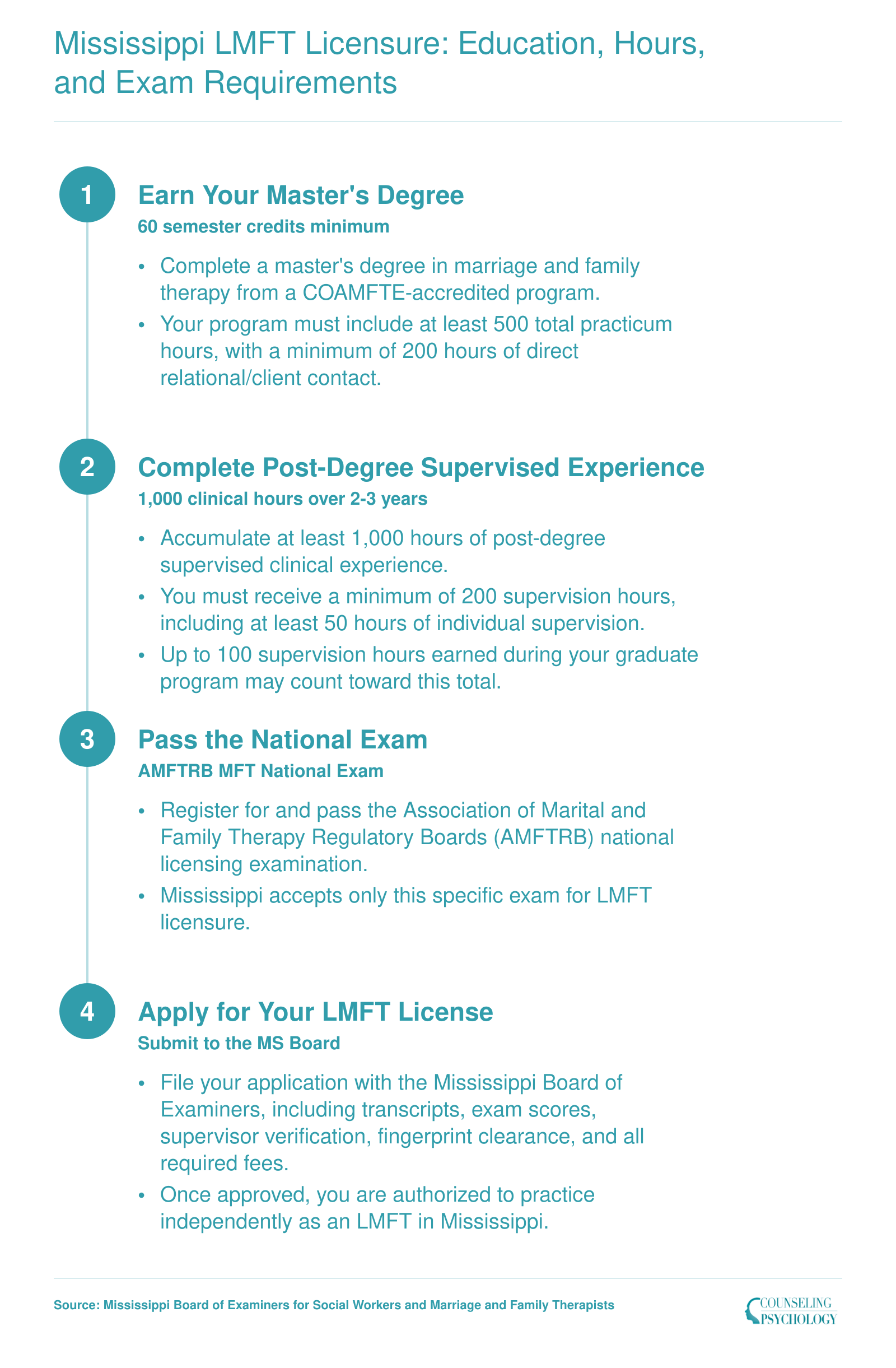
Mississippi LMFT Licensure: Education, Hours, and Exam Requirements
Earning your Licensed Marriage and Family Therapist (LMFT) credential in Mississippi follows a structured pathway set by the Mississippi Board of Examiners for Social Workers and Marriage and Family Therapists. The Board requires approved supervisors to hold at least four years of post-licensure experience. Budget for a $25 application fee, a $100 supervision plan review fee, a $25 initial license fee, and a $50 fingerprint fee.
Related Articles
Online and Out-Of-State MFT Programs That Meet Mississippi Board Standards
Geography no longer limits where you earn your MFT degree, but it does shape the due diligence you need to do before enrolling.
Start With the Official COAMFTE Directory
The most reliable starting point is the program directory at coamfte.org, which lists every accredited and candidate-status program in the United States. Once you pull up the directory, filter for online or distance-education delivery formats. Not every accredited online program accepts students in every state, and a handful have enrollment restrictions tied to state authorization agreements. Before you submit an application, contact the admissions office directly and ask two specific questions: first, whether the program is authorized to enroll Mississippi residents, and second, whether the program provides any assistance placing students in supervised clinical practicum sites within Mississippi.
That second question matters more than most prospective students realize. Programs such as those offered through institutions like Northcentral University (now part of National University), Capella University, Fairfield University, and Touro University have appeared in conversations among Mississippi students exploring online options, but practicum placement policies vary considerably from program to program and are rarely spelled out in detail on a program's public-facing website. Some programs maintain regional coordinator networks and can actively help you identify a clinical site near your home. Others expect students to locate their own supervisors and simply review placements for compliance. Knowing which model a program uses before you enroll saves significant stress down the road.
Neighboring States as an Accessible Alternative
For students willing to commute or relocate, campus-based programs in Alabama, Louisiana, Tennessee, and Arkansas may offer options worth exploring. Each of those states has at least one institution that has held or pursued COAMFTE accreditation. Check the licensing board websites for each state, since those boards often publish lists of approved programs as part of their licensure application guidance. Cross-reference anything you find there against the live COAMFTE directory, because accreditation status can change.
If you move to a neighboring state to complete a campus program, verify Mississippi's residency and reciprocity rules with the Mississippi State Board of Examiners for Licensed Professional Counselors before you commit. Requirements for LMFT supervision hours and acceptable supervision credentials may differ slightly from what your out-of-state program was designed to meet.
Using Professional Resources Wisely
The AAMFT state chapter for Mississippi can be a useful informal resource. Chapter members often know which online programs have a track record of placing students in Mississippi settings, and that peer knowledge is hard to find anywhere else.
No directory, association website, or article can substitute for a direct conversation with both the program admissions team and the Mississippi licensing board. Program details change, accreditation statuses shift, and board requirements are periodically updated. Treat every source as a starting point, and confirm the specifics before you sign an enrollment agreement.
MFT Graduate Certificates: Options and Limitations for Mississippi Students
Can you earn a graduate certificate in marriage and family therapy in Mississippi and use it toward licensure, or do you need the full master's degree? This is a critical question for anyone weighing shorter educational pathways into the field.
No In-State Graduate Certificate Options
Mississippi currently has no university-based graduate certificate programs in marriage and family therapy. The state's only COAMFTE-accredited program, at the University of Southern Mississippi, offers a full master's degree but not a standalone certificate. For Mississippi residents who want a certificate, whether to explore the field, add a specialization, or fill gaps in a related degree, the options exist exclusively online through out-of-state institutions.
Online Post-Master's Certificates Available to Mississippi Residents
Two accredited universities offer online post-master's certificates in MFT that Mississippi residents can access:
- Northcentral University: Offers a Post-Master's Certificate in Marriage and Family Therapy entirely online. The program requires a prior master's degree and is not a stackable credential; courses taken cannot be applied toward a master's degree at the university.2
- National University: Also provides an online Post-Master's Certificate in Marriage and Family Therapy. Like Northcentral's, it is designed for professionals who already hold a master's and does not lead directly to a master's degree.3
Both certificates assume foundational graduate coursework is already complete and are best suited for individuals seeking to deepen their clinical knowledge or meet specific educational requirements after earning a master's.
Why a Certificate Alone Won't Lead to Licensure
The Mississippi Board of Examiners requires a master's degree in marriage and family therapy or a closely related field that meets COAMFTE standards for LMFT licensure. A post-master's certificate does not satisfy this requirement on its own. The board's regulations are clear that the core clinical training must come from a qualifying graduate degree. Even a certificate earned from a COAMFTE-accredited program will not substitute for the master's degree itself.
Stacking Pathways: Can a Grad Cert Lead to a Full Master's?
None of the online post-master's certificates currently available to Mississippi students are designed to stack into a full master's program. They are terminal add-on credentials. If you hold only a bachelor's degree and your goal is LMFT licensure, the most direct and recognized path remains a COAMFTE-accredited master's program or an online master's in counseling programs from an accredited institution that meets Mississippi's educational standards. Without that master's foundation, a graduate certificate will leave you with a credential but no license.
In Mississippi, a graduate certificate in marriage and family therapy is not enough to qualify for LMFT licensure on its own. The state requires a full master's degree to begin the supervised hours process. A certificate can be a useful way to explore the field or fill coursework gaps, but plan on completing a master's program before applying for your license.
MFT Degree Levels and What Admissions Committees Expect
A marriage and family therapy degree comes in three main levels: a master's degree (the standard credential for LMFT licensure), a counseling doctoral programs option such as a PhD or DMFT (for those pursuing research, supervision, or academic roles), and a post-graduate certificate (a shorter add-on credential, not a substitute for the master's). For Mississippi licensure, the master's is the entry point. Doctoral and certificate programs serve specialized purposes and have their own admissions logic.
What Master's Programs Typically Look For
Admissions committees at COAMFTE-accredited MFT master's programs tend to evaluate a consistent set of materials. Specifics vary by school, but the common ground includes:
- GPA: Most programs set an undergraduate minimum around 3.0, though some accept lower with strong supporting materials.
- GRE: Many programs have moved test-optional or dropped the GRE entirely in recent admissions cycles. Reformed Theological Seminary's MFT track in Jackson is one Mississippi-area option to verify directly, as GRE policies for 2025-2026 may differ from prior years.
- Prerequisite coursework: Undergraduate psychology, sociology, or human development courses are commonly expected, though a non-psychology bachelor's is rarely disqualifying if the rest of the application is strong.
- Letters of recommendation: Usually two or three, ideally from faculty or clinical supervisors who can speak to your readiness for graduate-level clinical work.
- Personal statement and interview: Fit with the systemic, relational orientation of MFT matters as much as academic metrics.
Verify Directly Before You Apply
Requirements change year to year. Always confirm current standards on each program's official admissions page or by contacting the admissions office. For broader context on the profession and accredited program listings, the American Association for Marriage and Family Therapy (AAMFT) is the authoritative source, and the Bureau of Labor Statistics (BLS.gov) provides general educational requirements and industry outlook data.
Job Market and Salary Outlook for MFTs in Mississippi
Mississippi employs roughly 180 marriage and family therapists statewide, according to the most recent Bureau of Labor Statistics data available for the state. That is a small but meaningful workforce, and the numbers reflect both the state's population size and the reality that many rural Mississippi counties have no licensed counselors registered with a National Provider Identifier at all. Major employers include the state's regional community mental health centers, hospital systems such as Baptist Health and Merit Health, school districts operating behavioral health programs, and a growing number of private practices. Since January 2024, MFTs have been eligible for Medicare reimbursement nationwide, which has opened a new revenue stream for clinicians in private practice and may help drive demand in Mississippi's aging rural communities. Nationally, the Bureau of Labor Statistics projects above-average job growth for marriage and family therapists over the coming decade, and Mississippi-specific demand drivers include persistent rural mental health workforce shortages, ongoing discussions around Medicaid expansion, and state loan repayment incentive programs designed to attract behavioral health professionals to underserved counties. Keep in mind that the BLS state wage figures below represent Mississippi specifically and should not be confused with national medians, which tend to run higher.
| Wage Percentile | Mississippi Annual Wage (MFTs) |
|---|---|
| 25th Percentile | $50,410 |
| Median (50th Percentile) | $51,260 |
| Mean (Average) | $51,480 |
| 75th Percentile | $52,680 |