
What you’ll learn in this article…
- South Dakota requires COAMFTE accreditation for LMFT licensure, so CACREP alone does not qualify.
- Kairos University hosts the state's only in-state MFT program, while WRGP and online options expand access.
- BLS suppresses South Dakota MFT wage data due to low employment numbers, but rural demand remains strong.
- Federal loan repayment through the National Health Service Corps is available to MFTs in designated shortage areas.
South Dakota hosts a single COAMFTE-accredited MFT program on a public university campus, a reality that pushes many prospective students toward online or out-of-state options. State licensure rules demand a degree from a COAMFTE-accredited program or its approved equivalent, making accreditation status the first filter when comparing programs. Tuition differences across in-person and online formats can reach five figures, and out-of-state providers often charge the same rate regardless of residency. The steepest cost lies not in tuition, but in choosing a program that later fails to satisfy the Board's educational criteria, delaying licensure by a year or more.
Top MFT Programs for South Dakota Students, Ranked
This ranking was built with South Dakota students in mind. Rather than recycling a national list, we evaluated programs based on their accessibility to SD residents, alignment with state LMFT licensure requirements, tuition transparency, and graduate outcomes. Because only one COAMFTE-accredited MFT program is physically headquartered in South Dakota, the pool is narrow but highly focused. Students who need additional options should explore online programs that explicitly accept South Dakota applicants and satisfy the state's education standards for licensure.
- State licensure alignment
- Accreditation type and status
- Total cost of attendance
- Clinical training accessibility
- Graduate outcome availability
- Internal program database
- NCES-IPEDS federal institutional data — nces.ed.gov
- Independent program research

Kairos University
Kairos University, based in Sioux Falls, is the only institution in South Dakota offering a COAMFTE-accredited Master of Arts in Marriage and Family Therapy. The program integrates psychology and theology through live synchronous online coursework, while clinical practicum hours are arranged locally, making it feasible for students across the state. Formerly offered through Evangelical Seminary, the program now operates under the Kairos University umbrella and explicitly meets South Dakota's educational requirements for LMFT licensure.
- COAMFTE-accredited online program based in Sioux Falls, SD
- 65 credit hours at $400 per credit ($26,400 total)
- Live synchronous video courses with a 9:1 student-faculty ratio
- Localized clinical internship yielding 300 to 500+ client contact hours
- New cohorts launch each fall semester
- Integrates psychological theory with theological frameworks
- Meets South Dakota LMFT education requirements
- 84.6% admission rate with flexible, self-paced study options
Master of Arts in Marriage and Family Therapy — Online
Side-By-Side: Tuition, Credits, and Admissions for Sd-Accessible MFT Programs
Cost differences between MFT programs accessible to South Dakota students can stretch into the tens of thousands of dollars, making a careful side-by-side comparison one of the most consequential steps you can take before applying.
Comparison Table
Below is a snapshot of the key financial and admissions data points for programs South Dakota residents most commonly evaluate. Where a program has not published exact figures, the field is noted accordingly.
| Program | Format | Credit Hours | Est. Per-Credit Cost | Est. Total Tuition | Min. GPA | GRE Required | Application Deadline |
|---|---|---|---|---|---|---|---|
| South Dakota State University (SDSU) M.S. in MFT | On-campus, cohort | 48 | Contact program | Contact program | 3.0 | No | Varies by year |
| Kairos University M.A. in MFT | Online/hybrid | 60 | Contact program | Contact program | 2.5 | No | Rolling |
| Capella University M.S. in MFT (online) | Fully online | 70+ quarter credits | ~$475 per quarter credit | ~$33,000+ | 2.3 | No | Rolling, multiple starts |
| National University (formerly Northcentral) M.A. in MFT (online) | Fully online | 60 | ~$475 per credit | ~$28,500+ | 2.5 | No | Rolling, monthly starts |
Tuition estimates reflect published or commonly cited rates for the 2025-2026 and 2026-2027 academic years. Actual costs vary with fees, residency status, and any institutional rate changes. Always confirm directly with the admissions office.
Where the Cost Spreads Hit Hardest
The sticker price gap between a state university option and a national online program can exceed $10,000 or more once you factor in required credit hours. Programs built on a quarter-credit system, such as Capella, may list a lower per-credit rate but require more total credits, which narrows the apparent savings. Meanwhile, SDSU and Kairos keep required credits closer to the 48-to-60-semester-credit range typical of COAMFTE-aligned curricula, which can translate to a lower overall bill.
Fees that fall outside tuition, such as clinical placement coordination, technology fees, and residency travel for hybrid programs, deserve equal scrutiny. Ask each program for an itemized cost-of-attendance estimate rather than relying on per-credit math alone. If you are weighing MFT against other counseling master's programs online, the same cost-comparison logic applies.
GRE Waivers Across the Board
One trend works in applicants' favor: none of the programs listed above currently require the GRE for admission. SDSU dropped the requirement several cycles ago, and both Kairos and the major online programs have followed suit. This removes a significant barrier in both cost and preparation time, particularly for career changers who may be years removed from standardized testing.
GPA Floors and What They Signal
Minimum GPA requirements range from 2.3 at Capella to 3.0 at SDSU. A lower floor does not necessarily mean easier admission. Competitive applicants to SDSU, for example, typically present GPAs well above the stated minimum, along with relevant clinical or volunteer experience. Programs with rolling admissions and lower GPA thresholds often compensate with more extensive prerequisite coursework or longer degree plans.
Before you fixate on a single number, reach out to program coordinators. Many will review transcripts informally and let you know where you stand, saving you an application fee if the fit is not right.
Questions to Ask Yourself
COAMFTE Vs. CACREP: Which MFT Accreditation Counts in South Dakota?
The South Dakota Board of Examiners for Counselors and Marriage and Family Therapists requires that an applicant's graduate program hold COAMFTE accreditation, or an equivalent recognized by the Board.1 CACREP accreditation, which is common among counseling programs, does not satisfy that requirement in South Dakota. This single distinction can determine whether your degree qualifies you for licensure in the state, so it is worth understanding before you apply anywhere. For a broader overview of the licensure pathway, see our guide on how to become a marriage and family therapist.
What COAMFTE Accreditation Means in Practice
COAMFTE, the Commission on Accreditation for Marriage and Family Therapy Education, evaluates programs specifically on MFT training standards: clinical hours, supervision models, systems theory coursework, and faculty qualifications. A COAMFTE-accredited degree signals to licensing boards that your training was built around the MFT scope of practice, not adapted from a general counseling curriculum. San Diego State University's M.S. in Marriage and Family Therapy holds COAMFTE accreditation, making it one of the few programs accessible to South Dakota students that clears this bar directly.
Why CACREP Does Not Transfer Here
CACREP accredits graduate counseling programs, including some that offer MFT specializations. In many states, a CACREP-accredited program can lead to licensure as a licensed professional counselor or licensed mental health counselor. South Dakota does not extend that recognition to MFT licensure.1 If you complete a CACREP program hoping to sit for the South Dakota LMFT exam, the Board is unlikely to accept your application. This is not a technicality that boards routinely waive. It is a structural part of the licensure statute.
Regional Accreditation Alone Is Not Enough
Some prospective students assume that a regionally accredited university automatically produces a degree that satisfies any state board. For MFT licensure in South Dakota, that assumption is incorrect. Regional accreditation (from bodies like HLC or SACSCOC) is a baseline requirement for most graduate programs, but it does not substitute for the program-level review that COAMFTE conducts. A school can be fully regionally accredited while offering an MFT program that the South Dakota Board will not recognize.
Your Action Step Before Applying
Before submitting an application to any program, confirm its accreditation status directly:
- COAMFTE directory: Search by program name or institution at the COAMFTE website to verify current accreditation standing.
- CACREP directory: Useful for confirming counseling accreditation, but remember that CACREP status alone does not meet South Dakota's MFT requirement.
- SD Board contact: If a program's status is unclear or listed as "candidate" rather than fully accredited, contact the South Dakota Board of Examiners directly to ask whether that specific program qualifies.
Accreditation status can change. A program that was accredited when you enrolled may face review, and a candidate program may not achieve full accreditation before you graduate. Checking the directory at the time you apply, and again before you begin your LMFT supervision hours, protects your investment in the degree.
Earning Your MFT Degree Online From South Dakota
Distance education offers a practical pathway for South Dakota residents who need flexibility or live far from the state's single on-campus MFT program. Fully online MFT degrees are available to SD residents, and when they carry COAMFTE accreditation, they satisfy the educational requirements for licensure in the state. Kairos University is a leading example: its Master of Arts in Marriage and Family Therapy is delivered primarily through live online classes and is designed explicitly to meet South Dakota LMFT licensing standards. Prospective students should understand what "online" really means in a clinical training program. While coursework is completed remotely, every MFT degree requires substantial face-to-face practicum and internship hours with real clients under licensed supervision. Those clinical experiences must happen in person, often in your local community.
Clinical Training Logistics in a Rural State
Finding and securing a practicum site in South Dakota, particularly in rural areas with limited mental health infrastructure, can be one of the most challenging parts of an online MFT degree. Kairos addresses this through a collaborative placement model: students act as active partners in identifying potential sites, and the program vets and approves each one. Faculty provide individual placement assistance, and Kairos has established partnerships with sites such as Sioux Falls Psychological Services and Stronghold Counseling Services. Each site must meet specific requirements, including audio or video recording capabilities or live observation, and supervisors must be appropriately licensed and trained in systemic practice. Site supervisors work alongside faculty-led peer group supervision to ensure clinical competency. For students in sparsely populated counties, telehealth practicum options and regional mental health centers may expand the pool of available placements, though not every program allows telehealth client contact during training.
Comparing the Online Experience to On-Campus Formats
Online MFT programs typically feature smaller cohorts, asynchronous discussion boards, and regularly scheduled live video seminars. Flexibility is the headline benefit: you can attend class from home, maintain employment, and care for family obligations. However, the trade-offs include less spontaneous peer interaction and the need for strong self-direction. South Dakota State University's on-campus MFT program offers daily face-to-face faculty access, structured clinic hours, and a built-in peer community. Online learners must be more proactive in seeking mentorship and networking, though many report that faculty responsiveness and virtual cohort bonds are stronger than expected. Students exploring broader options may also want to compare marriage and family therapy master's programs in other states to weigh cost, format, and clinical training structures.
State Authorization and SARA Considerations
South Dakota participates in the State Authorization Reciprocity Agreement (SARA), which simplifies the process for out-of-state online programs to enroll SD residents. Most regionally accredited, SARA-compliant programs can legally serve South Dakota students without additional state approvals. Before enrolling, confirm that your chosen program holds both COAMFTE accreditation and SARA membership. A small number of states and programs remain outside SARA, and their degrees may not be recognized for South Dakota licensure purposes. Always verify eligibility with the South Dakota Board of Examiners for Counselors and Marriage and Family Therapists before you sign an enrollment agreement.
Related Articles
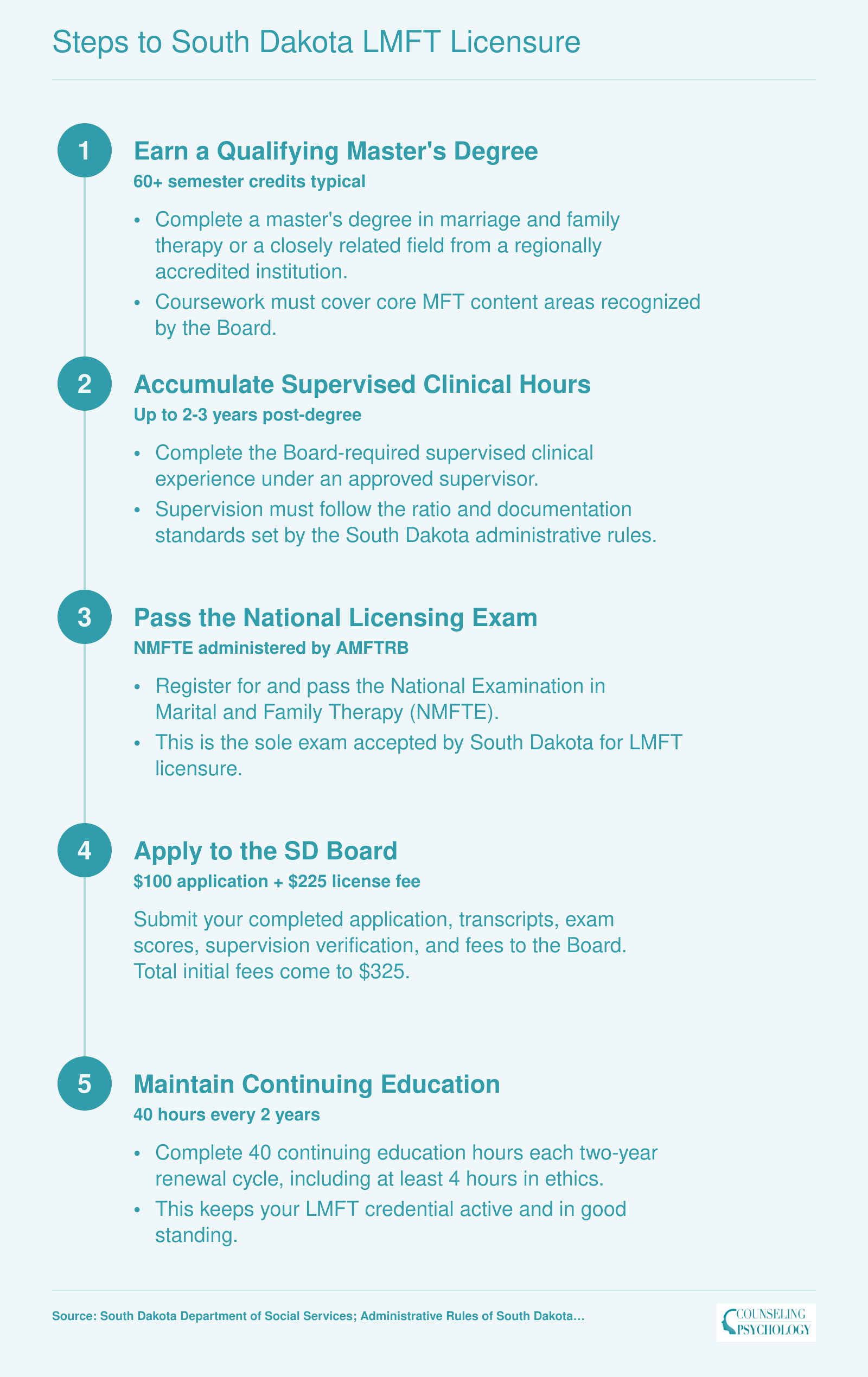
Steps to South Dakota LMFT Licensure
Becoming a Licensed Marriage and Family Therapist in South Dakota follows a structured path overseen by the SD Board of Examiners for Counselors and Marriage and Family Therapists. Here is the sequence from graduate school through independent practice.
MFT Graduate Certificates and Post-Master's Pathways for SD Students
South Dakota does not currently host an in-state graduate certificate program in marriage and family therapy, but online options from outside universities fill the gap.
Online Certificate Options for South Dakota Residents
National University offers a fully online Post-Master's Certificate in Marriage and Family Therapy that South Dakota residents can complete asynchronously in about 12 months.1 The program is designed for those with a related graduate degree and aligns with COAMFTE educational standards, though you should confirm current accreditation status directly with the university. The University of Nebraska-Lincoln also offers a campus-based Medical/Family Therapy Graduate Certificate, though online access is not available. Always verify program delivery mode and state authorization before applying.
When a Post-Master's Certificate Makes Sense
A post-master's certificate is most practical for career changers: professionals who already hold a counseling, social work, psychology, or related graduate degree but lack the MFT-specific coursework required for licensure. These certificates typically focus on systems theory, relational diagnosis, and clinical interventions that bridge the gap between a general mental health background and the specialized competencies the South Dakota Board of Examiners will evaluate course by course. If your master's is in a non-MFT field and you want to pursue LMFT licensure, a certificate can provide the additional credits without requiring a second full degree. Professionals exploring related credentials may also consider a counseling graduate certificate to compare scope and content.
Verify SD Board Acceptance Before Enrolling
The South Dakota Board of Examiners for Counselors and Marriage and Family Therapists does not grant LMFT licensure based solely on a graduate certificate. You must hold a qualifying master's or doctoral degree, and the Board reviews transcripts individually to determine whether certificate coursework fulfills deficiency areas. Contact the Board early and share the certificate program's curriculum for a preliminary evaluation. Enrolling without this step risks spending time and money on a program that won't count toward licensure. If possible, select a certificate that mirrors COAMFTE content areas to maximize your chances of meeting South Dakota's educational standards.
MFT Salary and Job Market in South Dakota
The BLS currently suppresses state-level wage and employment data for marriage and family therapists in South Dakota because the occupation employs fewer than the reporting threshold in the state, making individual data points identifiable. This lack of published figures reflects the small but growing footprint of the MFT workforce across the state. For context, the national median annual wage for MFTs stood at $63,780 in 2024, with the middle 50 percent earning between $50,130 and $80,480.2 Given South Dakota's lower cost of living relative to coastal states and major metropolitan areas, salaries in this range can offer considerable purchasing power, particularly outside Sioux Falls and Rapid City.
Employment Landscape and Geographic Distribution
Nationally, the BLS projects 13 percent job growth for MFTs from 2024 to 2034, translating to approximately 7,700 annual openings. South Dakota participates in this trend, with demand concentrated in the state's two largest cities but distributed across rural counties through community mental health centers, tribal health services, and small private practices. Sioux Falls and Rapid City anchor the majority of full-time clinical positions, but licensed MFTs increasingly serve smaller communities through hybrid arrangements that combine in-person clinic hours with telehealth outreach. The state's geographic size and low population density make rural postings common, and practitioners willing to serve underserved areas often find faster job placement and lower competition.
Employer Types and Emerging Channels
Common employers include Avera Behavioral Health, Monument Health, the South Dakota Department of Social Services, county community mental health counselor agencies, schools integrating behavioral support staff, and tribal health clinics operated by the Great Plains Tribal Chairmen's Health Board and individual nations. Private practice remains a significant pathway after accrual of supervised hours and licensure, especially in markets where few MFTs practice. Telehealth has expanded employment options dramatically since 2020, allowing clinicians to serve clients across the state without relocating, and several South Dakota insurers now reimburse telehealth sessions at parity with in-person visits. This shift has opened stable employment for new graduates who can balance clinical autonomy with geographic flexibility. For those exploring related paths, the broader landscape of counseling careers offers additional context on where MFT skills translate.
Cost of Living Context
While published South Dakota MFT salaries are not available, the state's median household income in 2024 hovered near $63,000, and housing costs in rural counties remain well below the national average. A starting MFT salary in the low-to-mid $50,000 range, typical for community mental health center hires, supports a middle-class standard of living in most of the state, and experienced clinicians in private practice or supervisory roles can approach or exceed the national 75th percentile over time.
South Dakota's rural landscape creates persistent demand for MFTs willing to serve underserved communities. Therapists who practice in designated shortage areas can tap federal loan repayment through the National Health Service Corps, and the state's growing acceptance of telehealth lets you reach clients across vast distances, helping offset the lower base salaries common outside metro hubs.
Common Questions About MFT Education and Licensure in South Dakota
Prospective MFT students in South Dakota often have questions about accreditation, costs, and licensing requirements. Below are answers to some of the most common questions, grounded in current program details and state regulations.