
What you’ll learn in this article…
- Maine has no COAMFTE-accredited MFT program, so students rely on online or nearby New England institutions.
- The state board does not require COAMFTE accreditation, accepting transcript-based review of qualifying coursework instead.
- Maine's median annual LMFT wage reached $68,670 in 2024, surpassing the $63,780 national median reported by BLS.
- Licensure requires a master's degree, two years of supervised clinical experience, and a passing score on the AMFTRB exam.
Maine has no COAMFTE-accredited MFT programs in-state, but that does not block your path to licensure. Unlike many states, Maine evaluates MFT applications course by course rather than requiring COAMFTE accreditation, which opens the door to online programs and New England regional options that meet the statutory content areas. The tension is practical: you will need to research transcript requirements carefully and often piece together supervised hours through local agencies while enrolled in a distance program.
This creates both flexibility and complexity. You can enroll in high-quality online master's programs or drive to nearby states for in-person training, but you carry the burden of ensuring your coursework aligns with Maine's 12 content-area checklist. The state's median MFT wage of $68,670 in 2024 exceeds the national figure, yet the job market remains small. Most LMFTs in Maine work in outpatient clinics, private practice, or community mental health centers, where referrals often favor the more widely recognized LCPC or LCSW credentials.
Best MFT Programs for Maine Students
Maine does not currently have any in-state marriage and family therapy graduate programs, so residents pursuing LMFT licensure will need to look beyond state lines. The programs below are ranked by overall value, factoring in post-graduation earnings, institutional cost, and graduate debt load. Each one accepts students from Maine and can be completed online or in a hybrid format, though clinical placement logistics vary significantly from program to program. Maine requires a 60-credit master's or doctoral degree, at least 900 practicum hours (360 direct client contact), and passage of the national MFT exam plus a state jurisprudence exam, so confirming that a given program's curriculum aligns with these benchmarks is essential before enrolling.
- Graduate earnings after completion
- Net price and cost of attendance
- Median graduate debt load
- Program accreditation and format
- Licensure pathway alignment
- Internal program database
- Independent program research
- College Scorecard graduate earnings — collegescorecard.ed.gov
- NCES-IPEDS federal institutional data — nces.ed.gov

Northwestern University
Northwestern's fully online Master of Science in Marriage and Family Therapy carries COAMFTE accreditation, which aligns directly with Maine's educational expectations for LMFT applicants. The program explicitly supports clinical placements in students' home communities through dedicated placement specialists, making it one of the most logistically feasible options for someone living in Maine. Small class caps of 15 students per session and a 6:1 student-to-faculty ratio at the institutional level signal strong mentorship. The median graduate debt of $15,000 is notably low for a private research university of this caliber, and institution-wide median earnings reach approximately $89,400 ten years after enrollment.
- Fully online, COAMFTE-accredited MFT degree
- Completable in 24 to 36 months
- No GRE required for admission
- 400 hours of supervised clinical fieldwork
- Placement specialists help arrange local sites
- Live online classes capped at 15 students
- 25 graduate-level courses in systemic therapy
Master of Science in Marriage and Family Therapy — Online

University of Southern California
USC's Rossier School of Education delivers its Master of Science in Marriage and Family Therapy entirely online, with fieldwork completed in the student's state of residence. That structure allows Maine residents to arrange local practicum hours while studying under a nationally recognized faculty. The program is built around California's licensure model, so Maine applicants should verify course-by-course equivalency with the state board before enrolling. Institution-wide median earnings sit near $92,500 ten years out, with median graduate debt around $18,000.
- Fully online delivery through USC Rossier
- Fieldwork arranged in student's home state
- Two-year full-time completion timeline
- Covers cultural humility and telehealth practice
- Prepares graduates for national licensure exam
- Bachelor's degree required for admission
- No separate California residency requirement
Master of Science in Marriage and Family Therapy — Online

California State University-Northridge
CSUN offers a COAMFTE-accredited Master of Science in Marriage and Family Therapy delivered in a hybrid, accelerated format where students take one course at a time across eight-week blocks. Because the program holds COAMFTE accreditation, it satisfies the educational standard Maine references for LMFT applicants. Out-of-state students pay non-resident tuition (roughly $19,000 per year), but the institution-wide median graduate debt of approximately $13,900 is one of the lowest on this list. Median earnings ten years after enrollment are about $59,100 institution-wide.
- COAMFTE and IACSTE accredited program
- One-course-at-a-time, eight-week format
- Completable in under two years
- Covers family therapy theory, ethics, and research
- Prepares for both LMFT and LPCC licensure tracks
- Diversity awareness training embedded in curriculum
- Community-based clinical placement component
Master of Science in Marriage and Family Therapy — Hybrid

Texas Woman's University
Texas Woman's University delivers a COAMFTE-accredited Master of Science in Marriage and Family Therapy through a hybrid model, with campuses in Denton, Dallas, and Houston. Most students finish in about three years, and no GRE is required. Because the curriculum is mapped to Texas board requirements, Maine applicants will want to confirm that course content and clinical hours translate under Maine's LMFT rules. The institutional net price hovers around $11,960 for undergraduates, and median graduate debt is approximately $19,200.
- COAMFTE-accredited hybrid program
- Typical completion in roughly three years
- No GRE or letters of recommendation required
- Thesis option available for research-minded students
- Prepares for national MFT licensure exam
- Fall and spring admission cycles
- On-campus interview as part of admissions
Master of Science in Marriage and Family Therapy — Hybrid

University of South Florida
The University of South Florida offers a 15-credit Graduate Certificate in Marriage and Family Therapy designed for professionals who already hold a clinical license or are license-eligible. This certificate does not satisfy Maine's 60-credit degree requirement for LMFT licensure on its own; it functions as supplemental systemic-therapy training for clinicians such as LCPCs or LCSWs who want to deepen their family-therapy skills. Institutional median graduate debt is about $17,990, and median earnings ten years out are roughly $57,700.
- 15-credit post-master's certificate
- Six required credits plus nine elective credits
- Targets already-licensed mental health professionals
- Systemic therapy approach to relationship disorders
- Hybrid delivery with online components
- Does not independently qualify for LMFT licensure
- Compatible with social work and counseling backgrounds
Graduate Certificate in Marriage and Family Therapy — Hybrid

Western Kentucky University
Western Kentucky University's CACREP-accredited Marriage, Couple, and Family Counseling master's program trains students through hands-on clinical work at the on-campus Talley Family Counseling Center combined with online coursework. CACREP accreditation is recognized by many counseling boards, though Maine's LMFT board would need to evaluate WKU's specific curriculum for MFT-licensure equivalency. The institutional net price is about $10,990, with median graduate debt near $22,100. This program may be a stronger fit for students who also want the option of pursuing a counseling license.
- CACREP-accredited master's program
- Hybrid format blending online and campus work
- Clinical training at Talley Family Counseling Center
- Prepares for marriage and family therapy practice
- Direct experience with couples, families, and individuals
- Financial support options through the department
- Housed in the Dept. of Counseling and Student Affairs
Marriage, Couple, and Family Counseling (Master's) — Hybrid

University of Oregon
The University of Oregon's Couples and Family Therapy program awards a COAMFTE-accredited Master of Science and requires 90 credits, placing it well above Maine's 60-credit minimum. Students complete 350 direct client-contact hours through the Center for Healthy Relationships and community externships. However, this is a cohort-based, in-person-heavy program in Eugene, so Maine residents would likely need to relocate for two to three years. A Spanish Language Specialization is also available. Median graduate debt runs about $20,140, and institutional median earnings are roughly $61,300 ten years out.
- COAMFTE-accredited, 90-credit master's degree
- 350 direct client-contact hours required
- Small cohort model of 22 to 24 students
- Clinical training at Center for Healthy Relationships
- Community externship placements in Oregon
- Bachelor's degree in any discipline accepted
- Noncompetitive, inclusive learning culture
- Same COAMFTE-accredited 90-credit structure
- Prepares students to counsel in Spanish
- 150 relational-system clinical hours included
- Social justice and inclusion curriculum focus
- Co-therapy and reflecting team opportunities
- Live and digital supervision formats
Couples and Family Therapy (Master of Science) — Hybrid
Couples and Family Therapy, Spanish Language Specialization — Hybrid

Prescott College
Prescott College's CACREP-accredited Master of Science in Counseling with a Marriage, Couple, and Family Counseling concentration uses a low-residency hybrid model: mostly online coursework plus a three-day on-campus colloquium. That limited-residency structure makes it one of the more accessible options for Maine residents who cannot relocate. The social-justice-oriented curriculum and elective tracks (including a Human Sexuality Counseling focus) align with community mental health priorities in rural and underserved areas. Institutional net price is about $22,580, and median graduate debt sits near $16,300.
- CACREP-accredited, 60-credit program
- Hybrid with only a three-day campus residency
- $830 per credit hour
- Social justice integrated throughout curriculum
- Priority application deadlines in October and May
- Post-graduate certificate options available
- Prepares graduates for professional counselor licensure
- Same CACREP-accredited 60-credit framework
- Focus on sexuality counseling competencies
- Low-residency hybrid delivery model
- Interdisciplinary and student-centered approach
- Elective coursework broadens clinical scope
- Compatible with family counseling career paths
Master of Science in Counseling, Marriage, Couple, and Family Counseling — Hybrid
Master of Science in Counseling, Human Sexuality Counseling — Hybrid

John Brown University
John Brown University offers a CACREP-accredited Master of Science in Counseling with a Marriage and Family Therapy concentration, along with Adventure Therapy and Play Therapy tracks. The Christ-centered program uses a hybrid format with over 70% of coursework available online or on weekends, but clinical practica are completed at JBU's partner clinics primarily in Arkansas. Maine students pursuing LMFT licensure would need course-by-course board review. Institutional net price is roughly $20,400, with median graduate debt around $21,250.
- CACREP-accredited, 60-credit program
- Hybrid with 70%+ online and weekend coursework
- 100 practicum hours plus 600 internship hours
- No GRE or application fee required
- 100% clinical placement rate reported
- Classes capped at 24 students
- Faith-integrated counseling curriculum
- Same 60-credit CACREP-accredited structure
- Adventure-based therapeutic modalities
- Hybrid delivery for working professionals
- 82% NCE pass rate for 2024 to 2025
- 91% job placement rate reported
- Clinical work at JBU community clinics
- Play therapy specialization within 60 credits
- CACREP accredited through 2032
- Weekend and online class scheduling
- Prepares for LPC and LMHC licensure
- Bachelor's degree with 2.75 GPA required
- Faculty interview as part of admissions
Master of Science in Counseling, Marriage and Family Therapy — Hybrid
Master of Science in Counseling, Adventure Therapy — Hybrid
Master of Science in Counseling, Play Therapy — Hybrid

Moody Bible Institute
Moody Bible Institute's Graduate Certificate in Marriage, Family, and Couples Counseling is a faith-integrated credential aimed at professionals who already hold a master's degree in a clinical field. It is not accredited by COAMFTE or CACREP and does not independently meet Maine's LMFT educational requirements. For Maine clinicians already licensed under another credential, such as LCPC or LCSW, the certificate could serve as continuing education in biblically informed family therapy. The institutional net price is about $22,220, and median graduate debt is approximately $18,150.
- Post-master's certificate for licensed clinicians
- Campus and online delivery options available
- $539 per credit hour
- Biblical integration throughout coursework
- Faculty group interview required for admission
- Specialized family and couples counseling focus
- Not designed as a standalone LMFT pathway
Certificate in Marriage, Family, and Couples Counseling — Hybrid
MFT Education Options in Maine: In-State, Online, and Nearby
Maine presents a genuine challenge for aspiring marriage and family therapists: as of 2026, the state has no graduate programs accredited by the Commission on Accreditation for Marriage and Family Therapy Education (COAMFTE). That gap does not mean you cannot become a licensed MFT in Maine. It does mean you need to be strategic about which program you choose, because the Maine Board of Counseling Professionals evaluates every applicant's transcript on a course-by-course basis. A degree that looks similar on paper can lead to very different outcomes at the licensing stage depending on how well its curriculum maps to Maine's required competency areas.
In-State Counseling Programs Worth Considering
Maine has roughly ten graduate counseling programs, and two of the most established hold CACREP accreditation, a credential the Maine board recognizes. The University of Southern Maine offers a Master's in Counseling with a Clinical Mental Health Counseling concentration, delivered on campus.3 Husson University, based in Bangor, offers an M.S. in Clinical Mental Health Counseling, also on campus and CACREP-accredited.4 Neither program is an MFT program in the strict sense, but graduates who supplement their coursework with MFT-focused electives or supervised clinical hours in relational therapy may still qualify for Maine licensure, provided their transcript review clears the board's requirements. If you are leaning toward one of these programs, it is worth contacting the Maine board directly before you enroll to confirm how your planned coursework will be evaluated.
Online COAMFTE-Accredited Programs for Maine Residents
For students who want the clearest path to licensure, a COAMFTE-accredited online program is often the most reliable option. Three programs currently enrolling Maine residents stand out:
- National University: Offers an M.A. in Marriage and Family Therapy fully online, with total program costs estimated between $35,000 and $55,000 for the 2025, 2026 academic year.
- University of Wisconsin-Superior: Delivers an M.S. in Marriage and Family Therapy online at a lower price point, with estimated total costs of $25,000 to $40,000.
- Northcentral University: Provides an M.A. in Marriage and Family Therapy online, with estimated costs ranging from $40,000 to $60,000.
All three carry COAMFTE accreditation, which signals that their curricula meet the field's core training standards. Online formats also give Maine students the flexibility to complete clinical hours at approved sites within the state.
Nearby New England Programs for Maine Commuters
For students willing to cross the border, southern New Hampshire and central Vermont offer accessible alternatives. The University of New Hampshire and Plymouth State University both offer on-campus M.S. programs in Marriage and Family Therapy, with estimated costs ranging from $25,000 to $55,000 depending on the school and residency status. Neither currently lists COAMFTE accreditation in the available data, so prospective students should verify accreditation status directly with each program before applying.
Antioch University New England in Keene, New Hampshire offers a COAMFTE-accredited Ph.D. in Couple and Family Therapy in a hybrid format, making it a realistic option for Maine residents who can manage periodic on-site residencies. Total program costs are estimated between $60,000 and $90,000, reflecting the doctoral level of study.
No matter which path you choose, bring your prospective program's course catalog to the Maine board early in your planning process. A transcript review conversation before you enroll is far less costly than discovering a curriculum gap after you graduate.
Questions to Ask Yourself
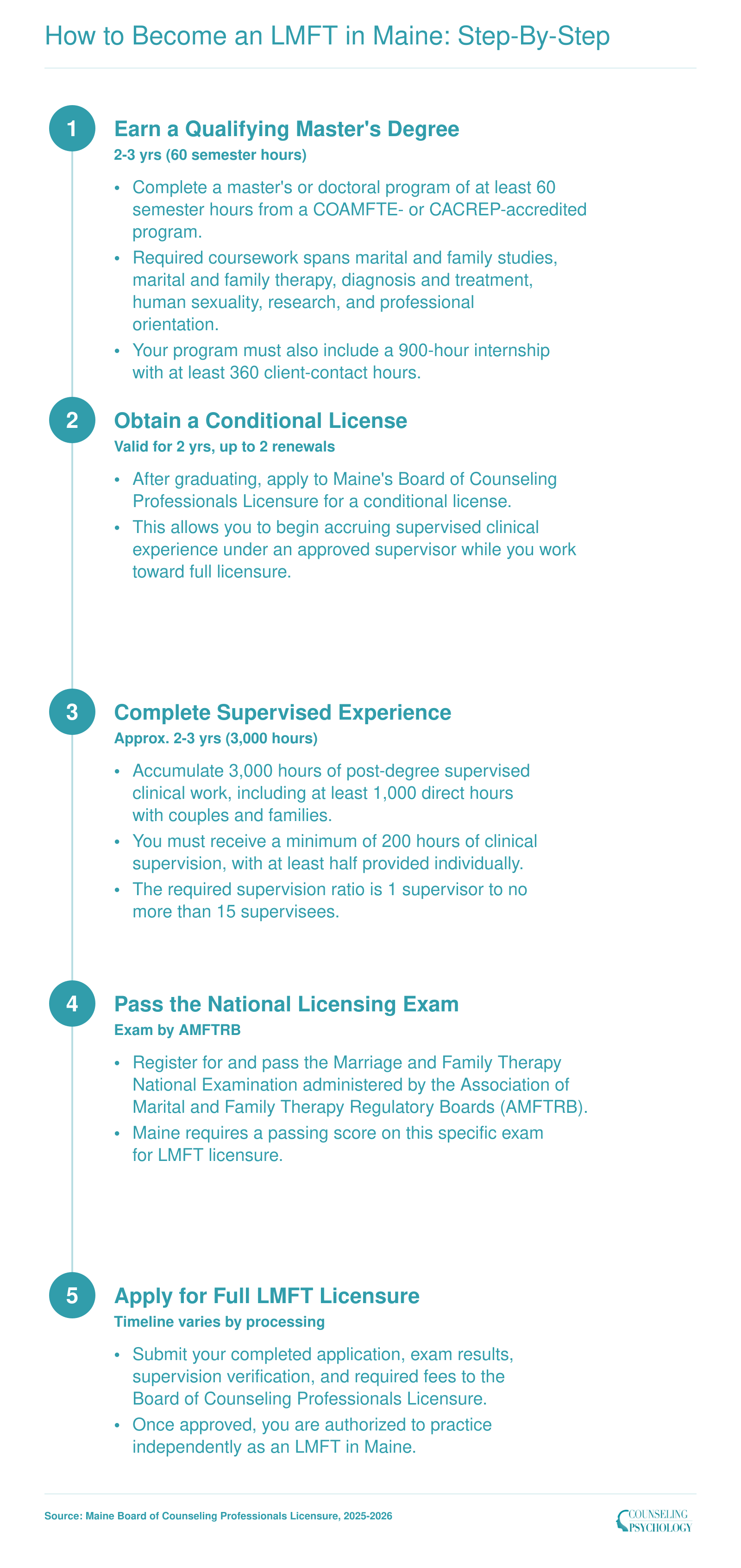
How to Become an LMFT in Maine: Step-By-Step
Earning your Licensed Marriage and Family Therapist (LMFT) credential in Maine requires a structured progression through graduate education, supervised clinical practice, and a national licensing exam. Here is a realistic timeline so you can plan your path from enrollment to full licensure.
Maine LMFT Licensure Requirements in Detail
Maine demands one of the more rigorous licensure pathways in New England, requiring candidates to complete specific graduate coursework, extensive supervised practice, and a national examination before earning the Licensed Marriage and Family Therapist credential.
Graduate Education Requirements
The Maine Board of Counseling Professionals requires a minimum of 60 semester hours of graduate coursework for LMFT licensure.1 Your degree does not need to be titled "Marriage and Family Therapy" specifically, but the curriculum must cover MFT core content areas. These typically include family systems theory, human development across the lifespan, psychopathology, assessment and diagnosis, professional ethics, and research methods. Programs accredited by COAMFTE automatically satisfy these content requirements, while graduates of CACREP-accredited clinical counseling programs may need to document equivalent MFT-focused coursework.
Your graduate program must also include a substantial practicum component: 900 total practicum hours, with at least 360 hours of direct client contact. Finding quality practicum placements in Maine can be challenging, particularly for students in rural areas where clinical sites are limited. Community mental health centers often serve as reliable partners, and an increasing number of programs now accept telehealth-based placements, which can expand options for students outside the Portland or Bangor corridors.
Post-Degree Supervised Experience
After completing your degree, Maine offers two tracks for supervised clinical experience. The standard track requires 3,000 total hours of supervised work, including at least 1,000 hours of direct client service, completed over a minimum of two years. Throughout this period, you must receive at least 200 hours of clinical supervision from a board-approved supervisor, maintaining a ratio of at least one hour of supervision for every 15 hours of client contact.1
An alternate track exists for those whose graduate programs did not meet all requirements. This pathway increases the supervised experience to 4,000 total hours, with 1,500 direct service hours and 300 supervision hours. Your supervisor must meet the Board's specific qualifications, including current Maine LMFT licensure, sufficient clinical experience, and completion of supervisor training.1 Out-of-state supervision may count toward your hours if your supervisor holds equivalent credentials and the Board approves the arrangement in advance.
Examination and Application Process
Maine requires passage of the Association of Marital and Family Therapy Regulatory Boards (AMFTRB) national examination. Most candidates apply for a conditional license while accumulating supervised hours, allowing them to practice under supervision before completing all requirements.
The fee structure includes a $200 conditional license application fee and a $250 full license application fee. A criminal background check costs an additional $21. Board review typically takes several weeks, though processing times can vary depending on application volume and documentation completeness.
Timeline to Full Licensure
From start to finish, the path to LMFT licensure in Maine typically spans seven to eight years. This includes four years for a bachelor's degree, two to three years for a master's program with 60 graduate credits and 900 practicum hours, and a minimum of two additional years accumulating post-degree supervised experience. Students who pursue part-time graduate study or who take longer to complete their supervised hours should plan accordingly. Detailed requirements and application forms are available through the Maine Board of Counseling Professionals licensing portal.
Accreditation: COAMFTE Vs. CACREP and What Maine Accepts
Maine is one of a minority of states that does not mandate COAMFTE accreditation for MFT licensure candidates. Instead, the Maine Board of Counseling Professionals Licensure evaluates your transcript course by course against statutory content areas. That distinction matters: it widens your program options well beyond the short list of COAMFTE schools.
What COAMFTE and CACREP Actually Are
COAMFTE stands for the Commission on Accreditation for Marriage and Family Therapy Education. It is the specialty body that accredits MFT-specific master's and doctoral programs under the American Association for Marriage and Family Therapy. Its standards are tightly built around systemic and relational therapy training. If you are still exploring the broader landscape, our overview of how to become a marriage and family therapist covers the full licensure pathway from degree selection to exam.
CACREP, the Council for Accreditation of Counseling and Related Educational Programs, accredits broader counseling programs, including clinical mental health counseling, school counseling, and, at some universities, marriage, couple, and family counseling concentrations. A CACREP program with an MFT track can satisfy Maine's coursework requirements if the curriculum hits the board's content areas. Students who want to keep their options open sometimes compare MFT tracks against counseling master's programs online to see which credential best fits their career goals.
The Two Layers of Accreditation
Think of accreditation as stacked:
- Institutional (regional) accreditation: The baseline. The university itself must be regionally accredited (for example, by NECHE in New England) for any degree to count toward Maine licensure.
- Programmatic accreditation: A second layer of quality control specific to the field. COAMFTE or CACREP signals that the program meets discipline standards, but in Maine it is a strong preference rather than a hard rule.
The One Step You Should Not Skip
Before you enroll anywhere, contact the Maine Board of Counseling Professionals Licensure directly with the program's course catalog and ask whether the curriculum will satisfy the LMFT educational requirements. Get the answer in writing. Programs change course titles, drop electives, and revise practicum hours; a CACREP or even COAMFTE label does not guarantee that a specific cohort's transcript will line up with Maine's content areas. A short email exchange now can prevent thousands of dollars of remedial coursework after graduation.
MFT Degree Levels and Graduate Certificates
MFT education in the United States is organized into three tiers, and understanding where each one fits will save you time and tuition dollars on the path to LMFT licensure in Maine.
Master's Degrees: The Standard Licensure Pathway
A master's degree is the workhorse credential for LMFT licensure. Maine requires at least 60 semester hours of graduate coursework, including 9 credits in marital and family studies, 9 credits in marriage and family therapy, plus specific coursework in diagnosis and treatment, human sexuality, research and evaluation, and professional orientation. Programs must also build in supervised clinical training: at minimum, a 900-hour internship with 360 hours of direct client contact. A 60-credit CACREP-accredited master's is automatically accepted by the Maine licensing board, and COAMFTE-accredited MFT master's degrees meet the content requirements as well.
Doctoral Programs: Academic and Advanced Practice
Doctoral degrees in MFT (PhD or DMFT) are not required for licensure. They are designed for clinicians who want to teach in MFT programs, conduct research, supervise other therapists, or develop deep expertise in a specialty area such as medical family therapy or systemic supervision. Most practicing LMFTs in Maine never pursue a doctorate.
Graduate Certificates: A Supplement, Not a Shortcut
A post-master's MFT counseling graduate certificate is short, focused coursework, typically 12 to 18 credits, designed for professionals who already hold a qualifying master's in counseling, social work, or a related field. They are most useful for LCPCs or LCSWs who want to add MFT competency or work toward LMFT eligibility by filling specific course gaps.
National University offers a fully online Post-Master's Certificate in Marriage and Family Therapy, typically 12 to 18 quarter credits, completable in about 12 months, with total program costs in the $7,000 to $12,000 range.2 The University of Southern Maine offers a 15-credit Post-Master's Certificate of Advanced Study in Counselor Education that may help fulfill Maine counseling licensure requirements.3
Importantly, Maine does not accept a graduate certificate as a substitute for a qualifying master's degree. A certificate can supplement an existing 60-credit master's to close coursework gaps, but on its own it will not make you eligible to sit for the LMFT exam.
LMFT Vs. LCPC Vs. LCSW in Maine: Which License Fits Your Goals?
Marriage and family therapy, clinical counseling, and clinical social work: three distinct licensure paths in Maine, each designed for a different professional focus. Understanding their training, scope, and career outcomes helps you pick the one that aligns with your goals.
Training and Degree Requirements
Each license starts with a specialized graduate degree. LMFT candidates complete a master's in marriage and family therapy, typically from a program accredited by the Commission on Accreditation for Marriage and Family Therapy Education (COAMFTE). These programs are built around systemic and relational frameworks. Licensed Clinical Professional Counselors (LCPCs) earn a master's in counseling or a closely related field, usually 60 credits from a CACREP-accredited or equivalent program.1 Licensed Clinical Social Workers (LCSWs) must hold a Master of Social Work (MSW) from a program accredited by the Council on Social Work Education (CSWE), requiring 60 to 65 credits.2 Because counseling programs are widely available, the LCPC has become the most common mental health license in Maine, offering a path many find accessible.
Supervised Experience and Exams
Post-degree requirements vary. Maine LCPCs must complete 3,000 hours of supervised clinical experience and pass either the National Counselor Examination (NCE) or the National Clinical Mental Health Counseling Examination (NCMHCE).1 LCSWs face a slightly higher bar: 3,200 supervised hours and the ASWB Clinical Examination.3 LMFT candidates complete their own set of LMFT supervision hours, often comparable to the other tracks, and then sit for the national MFT exam administered by the Association of Marital and Family Therapy Regulatory Boards (AMFTRB). While all three require substantial post-master's experience, the LCPC's combination of lower required hours and a choice of exams can sometimes speed up the licensure timeline.
Scope of Practice and Work Settings
Where you want to work matters as much as how you get licensed. LMFTs focus on relational and systemic therapy, making them the go-to professionals for couples counseling, family therapy, and any setting where relationship patterns are central. Many LMFTs thrive in private practice or specialized family service agencies. LCPCs deliver individual and group psychotherapy, and they appear across the widest range of settings, including community mental health centers, schools, hospitals, and private practices. Those interested in the LCPC track can learn more about what it takes to become a licensed professional counselor. LCSWs share many of those settings but also operate in roles that blend clinical care with case management, policy, and advocacy. A critical advantage for LCSWs in Maine is broader insurance panel acceptance: many insurers readily credential LCSWs, which can simplify building a private-practice caseload. If your heart is set on working exclusively with couples and families, the LMFT path is the most direct. If you want maximum job flexibility and the ability to pivot into non-therapy roles, the LCPC or LCSW route may serve you better.
Choosing the Right Fit for Your Career Goals
For mid-career changers, this decision often hinges on your ultimate "why." If you feel a strong pull toward systemic family work and want to be recognized as a relationship expert from day one, an LMFT program is your clearest fit. If you value versatility and want the license that is most common across Maine's mental health workforce, making it easier to find supervision and job openings, the LCPC offers a balanced, straightforward path. If you see yourself moving between therapy, hospital discharge planning, school social work, or policy advocacy, the LCSW's broad scope and insurance advantages tip the scales. All three licenses allow you to provide psychotherapy in Maine, but the training emphasis and career trajectories differ. Align your license with the daily work you most want to do.
If your primary goal is treating couples and families, the LMFT license is purpose-built for that. But in Maine's relatively small job market, an LCPC or LCSW can offer wider career flexibility, and you can still build a practice focused on family therapy.
Maine LMFT Salary, Job Outlook, and Practice Settings
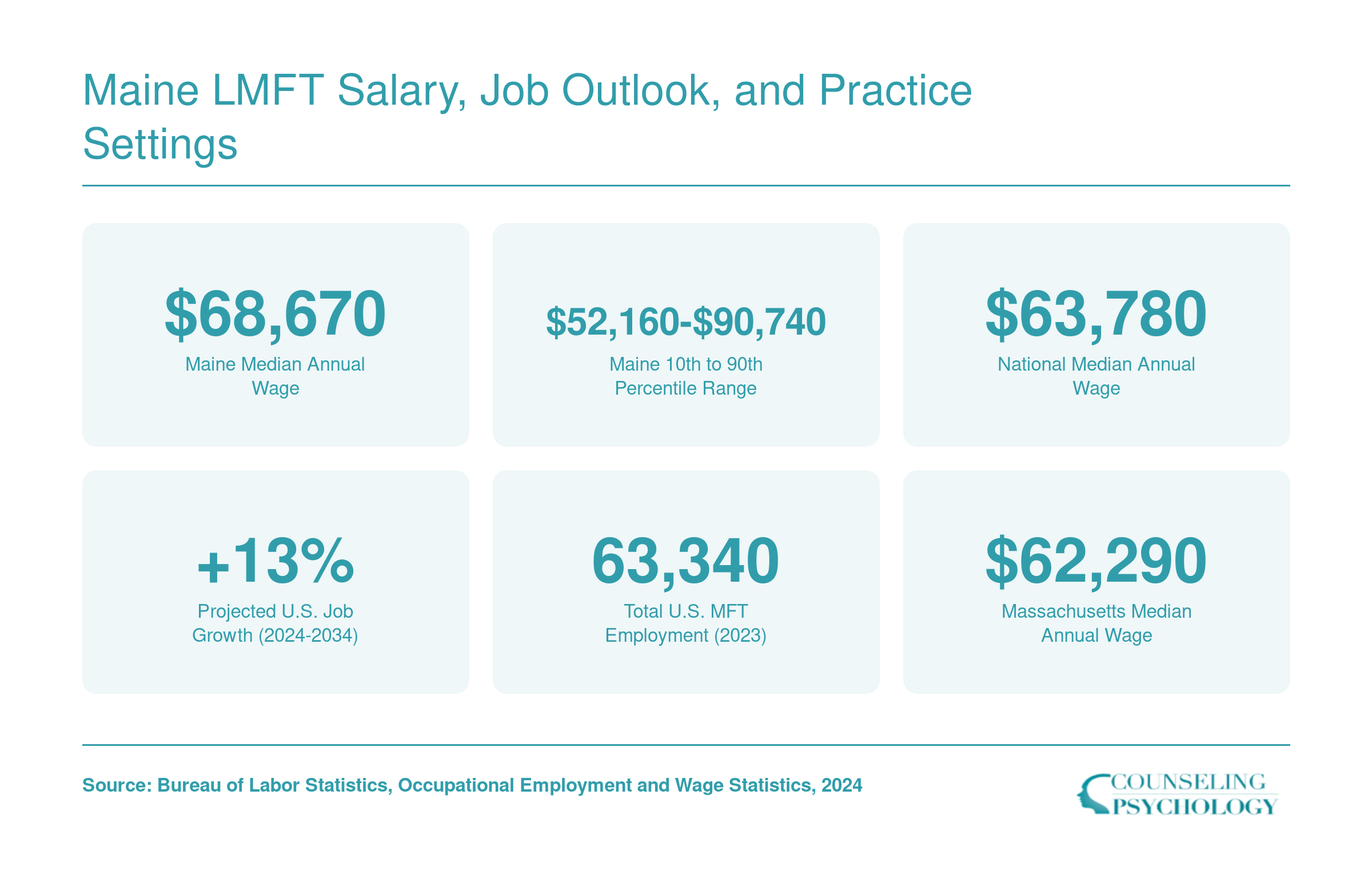
Maine offers licensed marriage and family therapists a median wage that outpaces both the national figure and several neighboring New England states. According to BLS data, Maine's median annual wage for MFTs was $68,670 in 2024, compared to $63,780 nationally, $62,290 in Massachusetts, and $61,060 in Vermont. Common practice settings across the state include community mental health centers, private practice, hospitals, school-based behavioral health programs, and a growing number of telehealth positions that extend services into Maine's rural communities.
Frequently Asked Questions About MFT Programs in Maine
Prospective MFT students in Maine often have questions about program availability, licensure timelines, and how online or out-of-state education fits into the process. Below are answers to the most common questions, drawn from current Maine licensing board rules and program offerings.