
What you’ll learn in this article…
- No COAMFTE-accredited MFT master's programs exist in Vermont as of 2026, so most residents enroll online or in nearby New England schools.
- Vermont LMFT licensure requires a graduate degree, 3,000 hours of supervised clinical experience, and a passing score on a national exam.
- The path from bachelor's degree to independent LMFT practice in Vermont typically takes 7 to 10 years.
- Vermont's in-state counseling master's programs can lead to LMFT licensure with careful course planning and additional MFT-specific electives.
Vermont has no COAMFTE-accredited Marriage and Family Therapy master's programs within its borders as of 2026, and none have been announced. That leaves aspiring LMFTs in the state with a clear choice: pursue a fully online COAMFTE program, enroll in a nearby regional program in New England or upstate New York, or complete a graduate certificate after earning a counseling master's.
Each pathway comes with its own set of tradeoffs. COAMFTE accreditation is not legally required for Vermont LMFT licensure, but it streamlines the credential review process and is strongly preferred by most employers and supervisors. Online programs solve the geography problem but require students to arrange local clinical placements independently. Graduate certificates offer speed and cost savings for already-licensed counselors but demand careful vetting to ensure Vermont's Allied Mental Health Practitioners Board will accept the coursework. For a comprehensive overview of the profession, our guide on how to become a family therapist covers the typical steps from education through licensure.
The state's small population and limited mental health infrastructure mean most MFT students will complete at least part of their training out of state or online, and most will need to navigate licensure requirements without the benefit of an in-state program liaison.
Are There MFT Programs in Vermont?
Vermont has no COAMFTE-accredited Marriage and Family Therapy master's programs within its borders as of 2026, and none have been announced.1 That is a significant gap, but it is far from a dead end for aspiring Licensed Marriage and Family Therapists in the state.
What COAMFTE Accreditation Means
COAMFTE, the Commission on Accreditation for Marriage and Family Therapy Education, is the specialized accrediting body recognized by the U.S. Department of Education for MFT programs. Programs that hold this accreditation have been reviewed against rigorous standards covering curriculum design, clinical training, faculty qualifications, and student outcomes. In many states, graduating from a COAMFTE-accredited program is the simplest route to licensure because the degree is presumed to meet all educational requirements. A check of the COAMFTE program directory confirms that no Vermont institution currently holds or is pursuing this accreditation.1
Vermont Does Not Require COAMFTE Accreditation for Licensure
Here is where the picture brightens considerably. Vermont's Office of Professional Regulation does not restrict LMFT licensure to graduates of COAMFTE-accredited programs.2 Instead, the state evaluates applicants on whether their education meets specific content and hour thresholds. Those thresholds include a minimum of 48 semester credits of graduate coursework (with at least 36 within the degree itself), at least 18 semester hours in MFT and systems theory, 6 semester hours in systems perspective coursework, and 500 hours of supervised clinical internship.2 Applicants must also demonstrate coursework in MFT therapy skills, treatment modalities, human growth and development, social and cultural foundations, ethics, research methods, and DSM-based diagnosis. The state may request course syllabi to verify compliance. This coursework-based pathway means graduates of non-COAMFTE programs, including many regionally accredited online MFT degrees, can qualify. For a broader look at the profession, our guide on how to become a marriage and family therapist covers the typical steps from education through licensure.
Three Viable Pathways for Vermont Residents
Given the regulatory landscape, prospective MFTs in Vermont generally pursue one of three routes:
- Online MFT master's programs: Several regionally accredited universities offer fully online MFT degrees designed to meet common state licensure requirements, including Vermont's 48-credit and clinical-hour thresholds.
- Graduate certificates in MFT: Licensed counselors who already hold a master's degree can add MFT-specific coursework through a graduate certificate, potentially qualifying for LMFT licensure without completing a second full degree.
- Vermont counseling master's programs as a foundation: Institutions such as the University of Vermont and Vermont State University offer counseling-related graduate programs. While these are not MFT degrees, they can provide a solid clinical foundation. With supplemental MFT and systems theory coursework to meet the state's 18-credit requirement, graduates of these programs may be able to build a pathway toward LMFT eligibility.
Why Vermont Actually Needs Telehealth-Trained MFTs
Vermont's small population and rural geography create persistent gaps in mental health access. Therapists trained in telehealth delivery are especially valuable in communities where the nearest in-person provider may be an hour or more away. Many online MFT programs now integrate telehealth competencies into their curricula, which means students who earn their degrees remotely are often well prepared to serve exactly the populations that need them most. The absence of a local COAMFTE program is a practical inconvenience, not a professional barrier, and the flexibility Vermont's licensure rules provide makes the state more accessible to aspiring MFTs than many people assume.
Best Online and Regional MFT Programs for Vermont Residents
Vermont has no in-state MFT degree programs, so residents pursuing LMFT licensure must look to online or regional options that satisfy the state's coursework and clinical-hour requirements. The programs below accept students from across the country, and most allow clinical fieldwork to be completed locally in Vermont. We prioritized COAMFTE-accredited programs (which align most cleanly with Vermont's qualifying-degree standard), then included strong CACREP-accredited and other options that may meet Vermont's "related field" pathway when coursework is carefully planned. Program-level earnings data is not yet available for most of these programs, so cost comparisons rely on institutional-level figures.
- Accreditation aligned with VT licensure
- Clinical practicum flexibility
- Graduate debt and net price
- Online or hybrid delivery format
- Relevance to Vermont LMFT pathway
- College Scorecard graduate earnings — collegescorecard.ed.gov
- NCES-IPEDS federal institutional data — nces.ed.gov
- Independent program research
- Internal program database

Northwestern University
Northwestern's fully online MS in Marriage and Family Therapy is one of only a handful of COAMFTE-accredited programs delivered entirely online. Classes are capped at 15 students, creating a small-cohort feel despite the distance format. For Vermont residents, the 400-hour clinical fieldwork component can be arranged at local sites, making it a practical choice for students who want to stay in-state while earning a nationally recognized MFT degree.
- COAMFTE-accredited, fully online delivery
- Completable in 24 to 36 months
- 400 hours of clinical fieldwork in student's community
- Live online class sessions, max 15 students per section
- No GRE required for admission
- 25 graduate-level courses covering systemic therapy
Master of Science in Marriage and Family Therapy — Online

University of Southern California
USC's online MS in Marriage and Family Therapy is designed around California's rigorous LMFT standards, which means graduates typically exceed the minimum coursework Vermont requires. The program arranges fieldwork in the student's home state, so Vermont residents can complete clinical hours locally. Tuition at USC runs higher than most online peers, but the program's national reputation and emphasis on cultural humility and telehealth practice can support career mobility.
- Online program with fieldwork completed in student's state
- Structured around California LMFT requirements (broadly portable)
- Full-time track designed for completion in about two years
- Prepares students for both national and state licensure exams
- Emphasizes telehealth, cultural humility, and community mental health
- Bachelor's degree required; personal statement and transcripts needed
Master of Science in Marriage and Family Therapy — Online

California State University-Northridge
Cal State Northridge offers a COAMFTE-accredited MS in Marriage and Family Therapy in a hybrid, accelerated format that lets students take one course at a time in eight-week blocks. The program also carries IACSTE accreditation. Out-of-state tuition is moderate compared to private alternatives, and the institution's median graduate debt is among the lowest in this group. Vermont applicants should confirm whether the hybrid schedule requires periodic on-campus attendance in California.
- COAMFTE and IACSTE accredited
- One-course-at-a-time, eight-week accelerated format
- Can be completed in under two years
- Prepares graduates for LMFT and LPCC licensure
- Covers family therapy theories, ethics, diversity, and assessment
- Hybrid delivery; verify on-campus requirements for out-of-state students
Master of Science in Marriage and Family Therapy — Hybrid

Texas Woman's University
Texas Woman's University delivers a COAMFTE-accredited MS in Marriage and Family Therapy through a hybrid format with campuses in Denton, Dallas, and Houston. The program explicitly prepares students for the national MFT licensure exam, which is the exam Vermont's Board typically accepts. Most students complete the degree in about three years. Out-of-state tuition remains relatively affordable for a COAMFTE program, and the curriculum was updated as recently as February 2026.
- COAMFTE accredited; updated curriculum as of early 2026
- Hybrid delivery across multiple Texas campuses
- Designed around national MFT licensure exam preparation
- Typical completion timeline of approximately three years
- No GRE or letters of recommendation required
- Thesis option available for research-oriented students
Master of Science in Marriage and Family Therapy — Hybrid

University of Oregon
The University of Oregon's Couples and Family Therapy program is COAMFTE-accredited and requires 350 direct client contact hours, giving graduates a well-documented clinical record that simplifies Vermont Board review. A cohort model admits 22 to 24 students each year, and the optional Spanish Language Specialization can be especially valuable for serving Vermont's growing Spanish-speaking communities.
- COAMFTE-accredited, 90-credit MS program
- 350 direct client contact hours built into curriculum
- Cohort model with 22 to 24 students per year
- Clinical training at the Center for Healthy Relationships
- Spanish Language Specialization track available
- No prerequisite degree-specific requirements for admission
Couples and Family Therapy — Hybrid

Prescott College
Prescott College's CACREP-accredited MS in Counseling includes a Marriage, Couple, and Family Counseling concentration that may qualify under Vermont's "related field" pathway for LMFT licensure with careful course selection. The program's limited-residency hybrid design requires only a brief three-day campus visit in Arizona each term, letting Vermont students complete most work from home. A social-justice curriculum and an optional Human Sexuality Counseling focus round out the offerings.
- CACREP accredited; 60-credit program at $830 per credit
- Mostly online with a three-day campus colloquium per term
- Marriage, Couple, and Family Counseling concentration
- Social-justice-oriented curriculum
- May meet Vermont's related-field LMFT pathway with careful planning
- Priority application deadlines in October and May
- Same CACREP-accredited 60-credit framework
- Focus on sexuality-affirming family and couples work
- Limited-residency hybrid format
- Potential fit for LGBTQ-affirming Vermont agencies
- Post-graduate certificate options available
- Elective courses allow additional specialization
Master of Science in Counseling, Marriage, Couple, and Family Counseling — Hybrid
Master of Science in Counseling, Human Sexuality Counseling — Hybrid

Western Kentucky University
Western Kentucky University's CACREP-accredited Marriage, Couple, and Family Counseling master's program uses a hybrid format and includes hands-on training at the on-campus Talley Family Counseling Center. Because it is a counseling degree rather than a standalone MFT degree, Vermont applicants would need to document that their coursework and internship hours align with the state Board's related-field requirements. In-state tuition is low, and even the out-of-state rate is competitive.
- CACREP accredited; hybrid delivery format
- Clinical training at Talley Family Counseling Center
- Prepares for marriage and family therapist licensure
- Out-of-state tuition competitive with private online programs
- May qualify under Vermont's related-field LMFT pathway
- Department of Counseling and Student Affairs
Marriage, Couple, and Family Counseling — Hybrid

John Brown University
John Brown University's CACREP-accredited MS in Counseling offers an MFT concentration alongside distinctive Adventure Therapy and Play Therapy tracks. The hybrid program runs 70% or more online with weekend on-campus sessions in Arkansas, though the in-person clinical component still requires travel. JBU reports a 100% clinical placement rate and a 91% job placement rate. The program is designed primarily for LPC/LMHC licensure, so Vermont students interested in LMFT would need to carefully align their coursework with the state Board's related-field standard.
- CACREP accredited through 2032; 60 credit hours
- Hybrid: 70%+ online/weekend, face-to-face clinical work
- 100 practicum hours plus 600 internship hours
- No GRE or application fee required
- Designed for working professionals with flexible scheduling
- Christ-centered academic framework
- Unique experiential therapy emphasis
- Hybrid delivery with weekend campus sessions
- Well suited to Vermont's outdoor and wilderness therapy culture
- 100% clinical placement rate reported
- 82% NCE pass rate for 2024 to 2025 cohort
- CACREP accredited; same 60-credit structure
- Child and adolescent therapy specialization
- Hybrid format with face-to-face clinical requirements
- Prepares for LPC and LMHC licensure in most states
- Strong fit for Vermont youth and family service roles
- Same CACREP-accredited 60-credit program framework
- Classes capped at 24 students
Master of Science in Counseling, Marriage and Family Therapy — Hybrid
Master of Science in Counseling, Adventure Therapy — Hybrid
Master of Science in Counseling, Play Therapy — Hybrid

University of South Florida
The University of South Florida offers a 15-credit Graduate Certificate in Marriage and Family Therapy aimed at already-licensed mental health professionals who want to add systemic family therapy skills. This certificate does not independently qualify holders for LMFT licensure in Vermont, but it can be a practical add-on for Vermont-licensed counselors, social workers, or psychologists looking to deepen their couples and family therapy competencies.
- 15-credit program: 6 required and 9 elective credits
- Designed for already-licensed mental health professionals
- Focuses on systemic approaches to family and relationship therapy
- Does not meet standalone LMFT licensure requirements
- Hybrid delivery format
- Targets counselors, social workers, and clinical psychologists
Graduate Certificate in Marriage and Family Therapy — Hybrid

Moody Bible Institute
Moody Bible Institute's Graduate Certificate in Marriage, Family, and Couples Counseling is a faith-integrated program for professionals who already hold a master's degree and clinical license. Like the USF certificate, it will not satisfy Vermont's LMFT degree requirement on its own, but it can supplement existing credentials with specialized family counseling training grounded in a biblical framework.
- For professionals who already hold a master's degree
- Campus and online options at $539 per credit hour
- Faith-based, biblical integration approach
- Clinical mental health training with family counseling focus
- Faculty group interview required for admission
- Does not independently qualify for LMFT licensure
Certificate in Marriage, Family, and Couples Counseling — Hybrid
Questions to Ask Yourself
MFT Graduate Certificates: A Faster Path for Licensed Counselors in Vermont
Speed versus depth is the core tradeoff here: a graduate certificate in marriage and family therapy can add specialized MFT coursework to an existing master's degree in far less time than a full second degree, but whether Vermont recognizes that path toward LMFT licensure is a question you must answer before enrolling.
How Vermont Approaches Graduate Certificates
Vermont's Allied Mental Health and Human Services Practitioners Board oversees LMFT licensure in the state. The board's position on graduate certificates used as supplemental coursework (meaning certificates pursued after an already-completed master's degree) is something you need to verify directly with the board before committing to any program. Licensing policies can change, and what an admissions counselor tells you is no substitute for written confirmation from the board itself. Visit the board's official website, review its current rules on post-master's education, and consider submitting a written inquiry so you have a documented response.
Finding Programs That Accept Vermont Residents
Several universities offer online post-master's or counseling graduate certificate programs in marriage and family therapy that are marketed to working professionals. When evaluating any program, your first stop should be the university's state authorization or out-of-state residency page. Schools are required to obtain authorization to enroll students in states where they are not physically located, and not every program is approved for Vermont residents. Look for language that specifically lists Vermont as an approved enrollment state, and contact the program's admissions office to confirm current status.
The American Association for Marriage and Family Therapy (AAMFT) is another practical resource. AAMFT can provide guidance on which certificate programs align with the coursework standards relevant to MFT licensure and can point you toward state-specific licensing requirements that complement its own training standards.
Doing the Research Before You Commit
A few concrete steps can save you significant time and tuition:
- Check the source: Review the Vermont Allied Mental Health Board's website for any published guidance on post-master's certificate coursework and LMFT eligibility.
- Verify enrollment eligibility: Confirm that any program you are considering holds state authorization for Vermont residents before applying.
- Consult AAMFT: Reach out to the association directly for guidance on certificate programs and how they interact with Vermont's licensing framework.
- Use professional forums: Communities of licensed MFTs often discuss which certificate routes have been accepted by state boards, providing informal but useful context alongside official sources.
A graduate certificate can be a genuinely efficient path for a counselor who already holds a relevant counseling degree and wants to gain focused MFT training. The key is confirming the regulatory fit for Vermont before you invest.
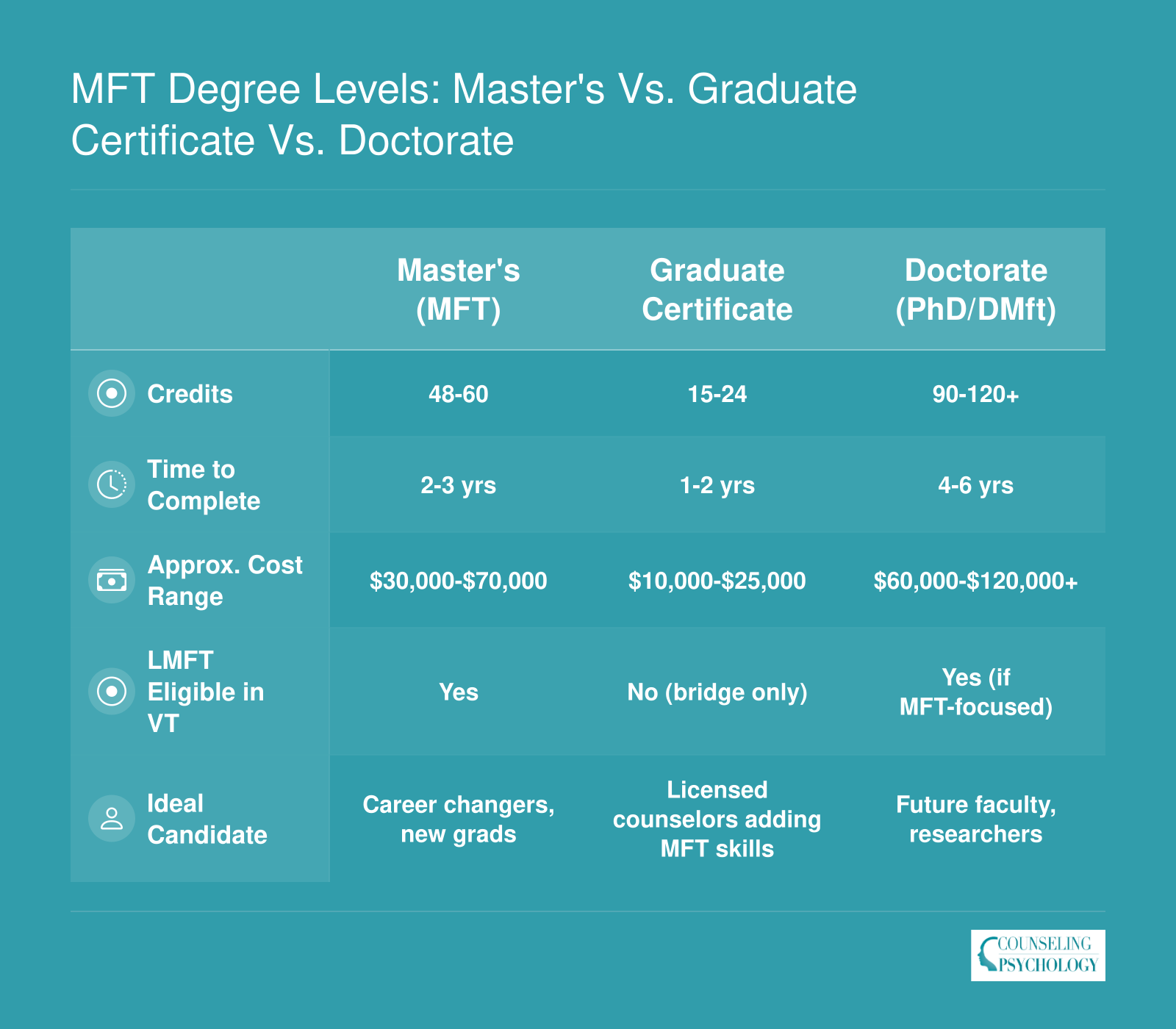
MFT Degree Levels: Master's Vs. Graduate Certificate Vs. Doctorate
The master's degree is the standard path to LMFT licensure in Vermont and across the United States. A graduate certificate in marriage and family therapy serves as a bridge credential, letting already-licensed mental health professionals (such as LPCs) add MFT competencies without completing a full degree. The doctorate is geared toward those pursuing faculty positions, advanced research, or clinical leadership roles.
Vermont LMFT Licensure Requirements Explained
To become a licensed marriage and family therapist (LMFT) in Vermont, you must complete a graduate degree, accrue supervised clinical hours, and pass a national examination. The process is overseen by the Vermont Office of Professional Regulation and the Allied Mental Health Board, which sets the standards to ensure clinicians are prepared to work with couples, families, and individuals.
Education and Clinical Training Requirements
Your journey begins with a master's or doctoral degree that includes at least 48 semester hours of graduate coursework. While the state does not mandate COAMFTE accreditation, your program must align with Vermont's curriculum standards.3 At least 36 semester hours must be earned within the degree itself, and at least 18 semester hours must cover systemic marriage and family therapy content areas such as family systems theory, couples therapy, and assessment. As part of your graduate training, you must complete a supervised practicum or internship totaling no less than 500 direct client contact hours with individuals, couples, and families.2 This hands-on experience is typically integrated into your degree program and supervised by a qualified clinical supervisor.
Post-Degree Supervised Experience
After earning your degree, you must complete a minimum of 3,000 hours of post-degree supervised work experience over at least two years.2 This total breaks down into 2,000 hours of direct clinical service and up to 1,000 hours of indirect activities such as case management, record keeping, and professional development. Importantly, at least 1,000 of the direct service hours must be specifically with couples and families.2 You must also receive 100 hours of clinical supervision, including at least 50 hours of individual supervision. Vermont limits the ratio of client contact to supervision hours to no more than 30:1, ensuring you get adequate guidance as you build competence.
Examination Requirements
Vermont requires passage of the National Marital and Family Therapy Examination, developed by the Association of Marital and Family Therapy Regulatory Boards. This computer-based test assesses your knowledge of clinical theory, assessment, intervention, and ethics. Depending on your application, the Board may also require a jurisprudence exam covering Vermont-specific laws and rules governing the practice of marriage and family therapy.2 You should confirm this requirement when you submit your application.
Application Process and Fees
To apply for LMFT licensure, you submit a completed application, official transcripts, verification of supervised experience hours, and exam scores to the Vermont Office of Professional Regulation. The application fee is $175, and once licensed, you must renew every two years with a renewal fee of $285.3 Renewal also requires continuing education, so plan to stay current with evolving best practices. If you are exploring other counseling careers alongside the MFT path, understanding each credential's renewal obligations will help you plan ahead.
Licensure by Endorsement for Out-of-State LMFTs
If you hold an active LMFT license in another state, Vermont offers a licensure by endorsement pathway. You generally need to provide proof that your original licensure requirements were substantially equivalent to Vermont's, including education, supervised experience, and examination. In many cases, licensees who have been in active practice for a certain period may qualify without retaking exams. The Board reviews each application individually, so contact the Office of Professional Regulation for the most current endorsement criteria.
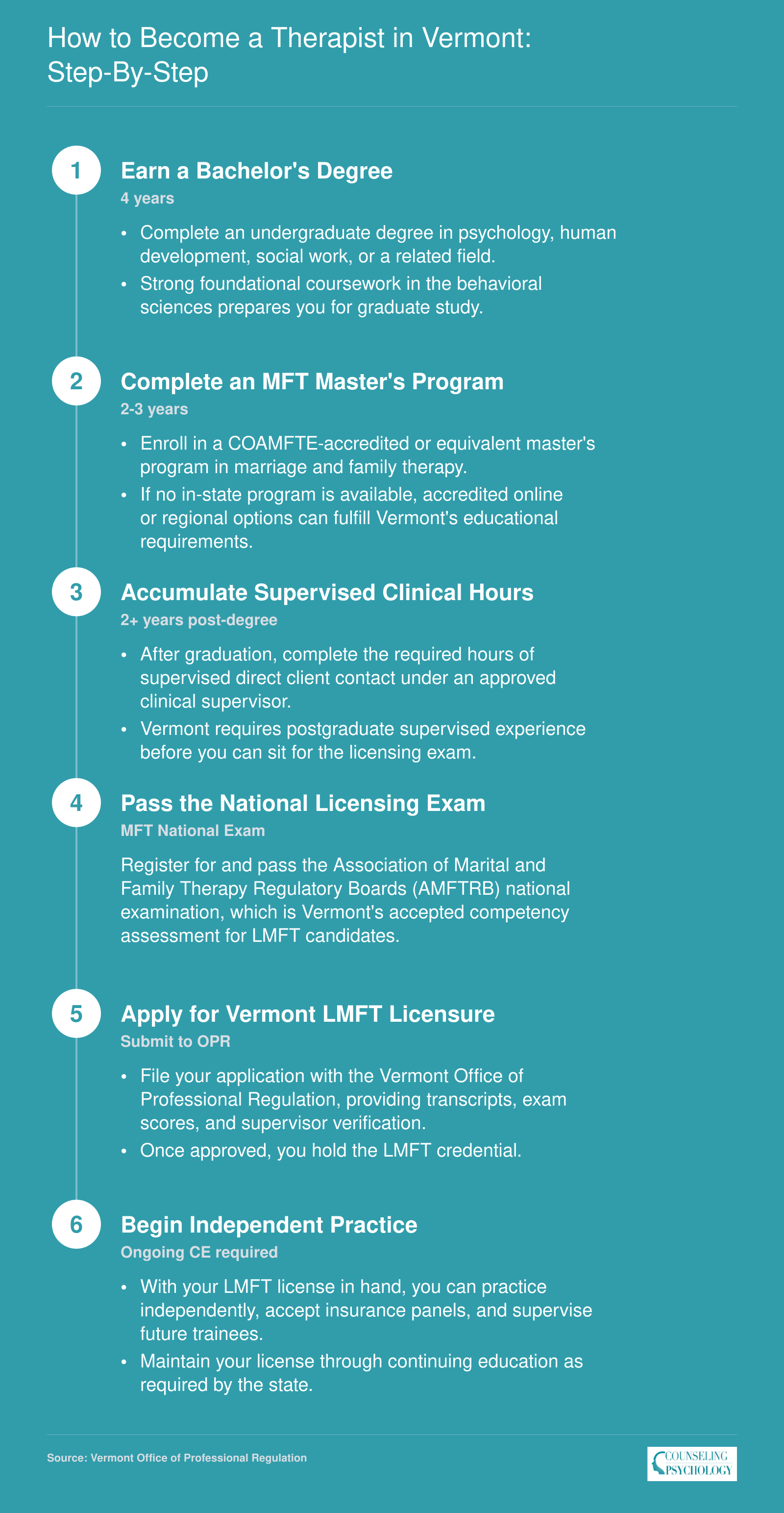
How to Become a Therapist in Vermont: Step-By-Step
From your first undergraduate course to independent clinical practice, the path to becoming a Licensed Marriage and Family Therapist in Vermont typically spans 7 to 10 years. The fastest realistic route requires about seven years: four for a bachelor's degree, two to three for a master's, and two or more for supervised postgraduate experience. Here is the credentialing ladder at a glance.
Can Vermont Counseling Programs Lead to LMFT Licensure?
More counseling graduates are exploring cross-licensure pathways than ever before, and Vermont's in-state master's programs can serve as a solid foundation for LMFT licensure, even though neither was designed specifically for that credential. The key is understanding exactly where the overlap exists and where you will need to fill gaps.
How UVM's Clinical Mental Health Counseling Program Stacks Up
The University of Vermont's Clinical Mental Health Counseling master's program covers several content areas that align with Vermont's LMFT coursework requirements.1 Graduates will find direct overlap in human development, psychopathology, and marital or couples therapy. Family systems theory receives partial coverage, meaning some foundational concepts appear in the curriculum but likely not at the depth or breadth a dedicated MFT program would provide. One notable gap: the program does not include coursework in human sexuality, which is a standard requirement for LMFT licensure in most states, including Vermont.
Vermont State University's Counseling Program
Vermont State University's Clinical Mental Health Counseling master's program offers strong coverage of family systems content, which gives graduates a meaningful head start toward LMFT eligibility.2 Human development and psychopathology are likely covered directly, while marital and couples therapy content appears to receive partial treatment. Like UVM, the program does not appear to include a dedicated human sexuality course. Graduates of either program will leave with a well-rounded clinical counseling education but will still fall short of full LMFT coursework requirements on their own.
Estimating the Credit Gap
Based on the curricular overlap at both institutions, a graduate of either program would typically need an additional 9 to 15 credits of MFT-specific coursework to satisfy Vermont's LMFT requirements.1 A reasonable middle estimate is around 12 credits. The specific number depends on how the Vermont Allied Mental Health Board evaluates your transcripts on a course-by-course basis, which is the standard review process.
The missing areas generally include:
- Advanced family systems theory or family therapy techniques
- Human sexuality
- Additional marital or couples therapy content (particularly for UVM graduates)
- Specialized MFT ethics or professional identity coursework, depending on what your program covered
The Bridge Strategy
One practical approach is to complete your Vermont counseling master's degree, then add an MFT graduate certificate to close the remaining gaps. Several accredited programs offer these counseling certificate programs online, and at 9 to 15 credits, this path is typically faster and more affordable than enrolling in a standalone MFT master's program. You earn a recognized counseling degree from a local institution, build clinical experience in Vermont's job market, and layer on the MFT-specific coursework as a targeted supplement.
This strategy can also keep your options open. With both a counseling master's and MFT-specific training, you may qualify for both LPC and LMFT credentials, broadening your scope of practice and marketability. For a deeper look at the licensure steps involved, our guide on how to become a couples counselor outlines the general requirements.
Verify Before You Enroll
Before committing to any bridge plan, contact the Vermont Allied Mental Health Board directly. Course-by-course transcript evaluation is common, and the Board's interpretation of what counts toward LMFT requirements may differ from your own reading of the rules. Ask the Board to review your planned coursework, including any certificate program you are considering, before you spend tuition dollars. A quick verification call can save you from discovering a gap after you have already graduated.
LMFT Salary and Job Outlook in Vermont
Licensed marriage and family therapists in Vermont can expect compensation that is broadly competitive with national figures, though state-specific salary data for this occupation is limited in publicly available federal datasets.
What We Know About LMFT Wages
The Bureau of Labor Statistics reports a national median annual wage of $58,510 for marriage and family therapists as of 2023. Nationally, wages at the 10th percentile sit around $39,090, while those at the 90th percentile reach approximately $104,710. Vermont-specific median wages for MFTs are not consistently published by the BLS in every reporting cycle, likely because the state's total MFT employment base is small enough that reliable estimates are difficult to produce. When Vermont data has appeared in federal sources, it has generally clustered near or slightly below the national median, consistent with the state's overall cost-of-living profile and the size of its behavioral health workforce.
Across roughly 63,340 MFTs employed nationally in 2023, Vermont accounts for a very small share. Prospective LMFTs should interpret this not as a lack of opportunity but as a reflection of the state's population and the tendency for mental health services in rural New England to be delivered by professionals holding multiple credential types, such as those who also qualify as a licensed professional counselor.
How Vermont Compares to Neighboring States
Among New England and adjacent states, Massachusetts and New York typically report higher median MFT wages than the national figure, driven by larger metropolitan labor markets and higher costs of living. New Hampshire and Maine tend to report medians closer to or modestly below the national level, similar to what available evidence suggests for Vermont. If maximizing early-career earnings is a priority, candidates willing to commute to the Burlington metro area or to serve clients across state lines via telehealth may find higher-paying opportunities without relocating.
Top Employment Settings in Vermont
MFTs in Vermont work across several core settings:
- Private practice: The most common path for experienced LMFTs, offering both autonomy and the potential for higher hourly rates once a caseload is established.
- Community mental health centers: Vermont's network of designated agencies employs a significant number of licensed therapists, including MFTs, often with benefits packages and loan repayment eligibility.
- Hospitals and integrated health systems: Facilities such as the University of Vermont Medical Center incorporate family therapists into behavioral health and primary care teams.
- Schools: School-based mental health programs, particularly in rural districts, represent a growing employment niche for MFTs trained in child and adolescent work.
Looking Ahead
Demand for licensed therapists in Vermont has been rising steadily, fueled by expanded insurance coverage for mental health services, growing acceptance of telehealth, and ongoing workforce shortages in rural areas. While precise job-growth projections for MFTs in Vermont should be checked against the latest state labor market data, the broader national outlook is favorable. The combination of an aging existing workforce and increasing public demand for family-centered therapy positions LMFTs well for stable employment in the state through the remainder of the decade.
In most states, including Vermont, LMFT and LPC salaries are comparable for employed positions. However, MFTs who specialize in couples and family therapy often command higher per session rates in private practice settings due to their specialized focus. Review the salary table above for specific figures, and remember that your choice between LPC and LMFT credentials should be driven by your clinical interests and preferred client populations, not salary alone.
Frequently Asked Questions About MFT Programs and Licensure in Vermont
Below are answers to the questions prospective MFT students in Vermont ask most often. Each response is grounded in current licensure rules, program availability, and labor market data so you can plan your next steps with confidence.