What you’ll learn in this article…
- Most biogerontologists need a Ph.D. in biology, genetics, or a related life science, taking roughly 10 years of post-secondary training.
- BLS projects 4 to 10 percent growth for biological scientists through 2033, with the strongest demand in biotech hubs.
- No state licensure is required for research roles, though certifications like ACRP or RAC can strengthen industry applications.
- Top paying states for biological scientists include Rhode Island, Alaska, and North Carolina based on BLS median wage data.
Biogerontology is the laboratory science of why bodies age: the molecular, cellular, and genetic mechanisms behind senescence, not the clinical practice of geriatric medicine or the sociological study of aging populations. The distinction matters because the training paths diverge sharply. Biogerontologists hold PhDs in molecular biology, genetics, or biochemistry and work at the bench, not the bedside.
Demand for this expertise is climbing fast. The United Nations projects the global population aged 65 and older will exceed 1.6 billion by 2050, and private capital has followed, with longevity-focused biotech firms like Altos Labs and Calico drawing billions in research funding.
The practical tension for entrants is timeline versus payoff: a research career typically requires 9 to 12 years of post-secondary training before independent investigation begins.
What Does a Biogerontologist Do?
The Buck Institute for Research on Aging is currently developing an FDA-grade Intrinsic Capacity Score through its THRIVE initiative, a project that illustrates the kind of translational work biogerontologists tackle daily.1 At its core, biogerontology is the scientific study of why and how organisms age, spanning cellular senescence, telomere shortening, caloric restriction pathways, senolytic drug candidates, and the genetic drivers that accelerate or slow biological aging at both the molecular and organismal level.
Day-to-Day Work Across Settings
What a biogerontologist actually does on any given day depends heavily on where they work.
- Academic labs: A principal investigator at a university research center splits time between designing experiments, writing federal grant applications, publishing in peer-reviewed journals, and mentoring graduate students. The University of Michigan's Research Training in Biogerontology Program, for example, supports trainees investigating genetic control of aging in mice, muscle aging, stem cell decline, and aging genetics in fruit flies and C. elegans.2
- Biotech and pharma: At companies like Calico Labs or the Biogerontology Research Foundation, researchers operate inside drug development pipelines.3 Their focus tilts toward preclinical screening of compounds that clear senescent cells, designing clinical trial protocols, and analyzing biomarker panels that measure biological age.
- Government and policy research: Scientists in the NIA Intramural Research Program or similar agencies manage longitudinal cohort studies, develop public health policy recommendations, and curate large-scale aging datasets that other researchers depend on.
Job titles in the field vary widely. Postings may list roles as Aging Biology Researcher, Senescence Scientist, or Principal Investigator in Geroscience, but the underlying discipline is the same.
Research Tools and Techniques
Biogerontologists rely on a well-established toolkit. Model organisms, particularly C. elegans, Drosophila, and genetically modified mice, remain central because their relatively short lifespans allow researchers to observe aging trajectories within practical timeframes. On the molecular side, CRISPR gene editing enables precise manipulation of aging-related genes, while single-cell RNA sequencing reveals how gene expression shifts in individual cells as tissues grow older. Biomarker panels measuring epigenetic clocks, inflammatory markers, and metabolic indicators help quantify biological age versus chronological age.
An Inherently Interdisciplinary Field
Biogerontology does not exist in a silo. Researchers routinely collaborate with geneticists refining animal models, pharmacologists screening senolytic compounds, data scientists building predictive models from large omics datasets, and clinicians translating bench findings into geriatric counseling and care protocols. Stanford University's Longevity and Healthy Aging Pilot Awards for 2026 to 2027 reflect this cross-disciplinary ethos, funding projects that bridge basic aging biology with clinical application.4
The typical employer for biogerontologists in the United States remains academic medical centers, though the rapid growth of longevity-focused biotech firms is steadily expanding the private-sector landscape.2 Regardless of setting, the through line is the same: understanding the mechanisms of aging well enough to intervene in them.
The Path to Becoming a Biogerontologist
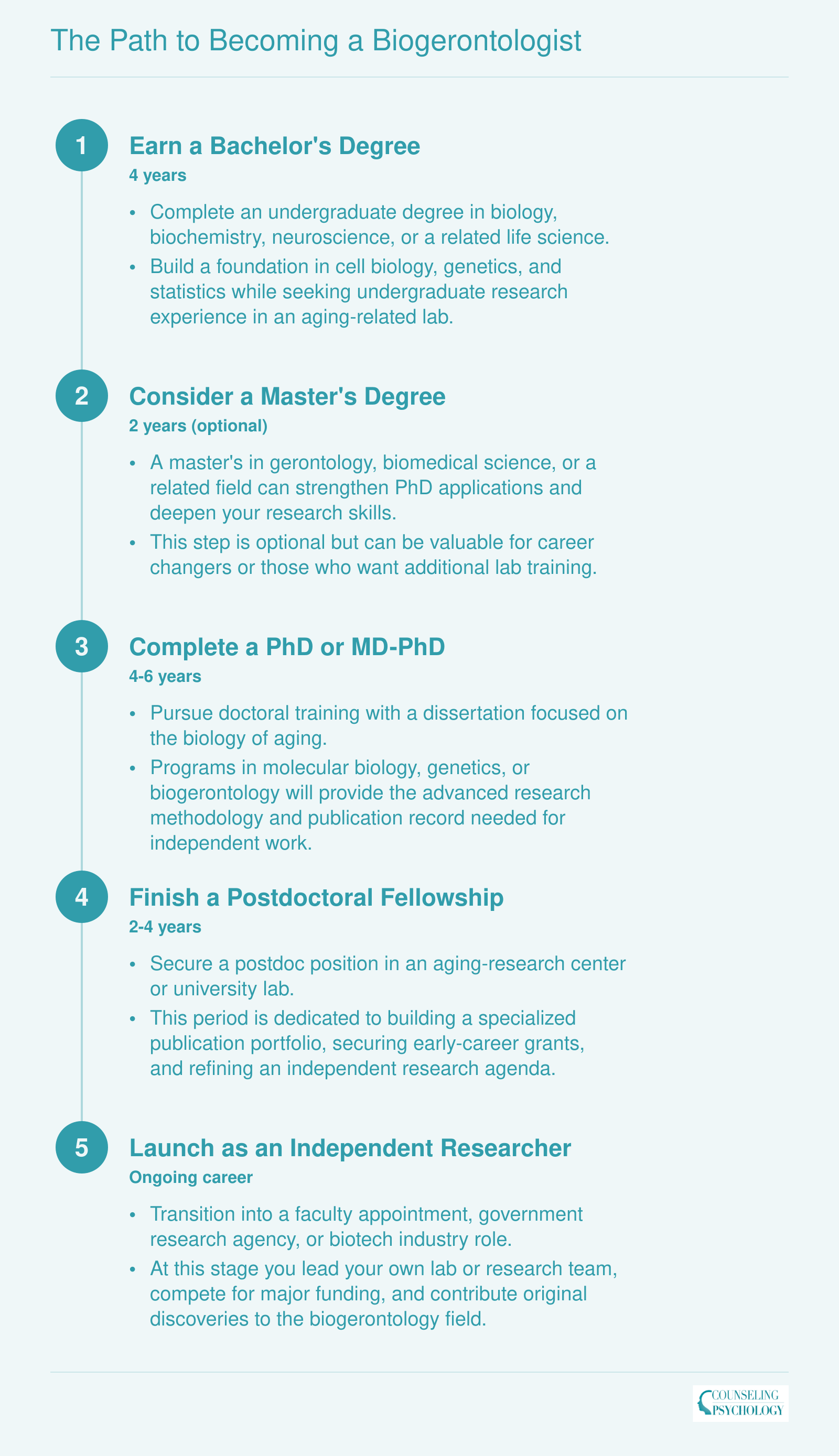
Most biogerontologists follow a research-intensive academic track that builds progressively from undergraduate study to independent investigation. The timeline below outlines each major milestone, the typical duration, and what you should accomplish before moving to the next stage.
Biogerontologist Education Requirements
What degree do I need to become a biogerontologist? The educational path into biogerontology is a sequence of increasingly focused training because the field sits at the intersection of multiple life sciences. The first step is a strong undergraduate foundation, and from there, advanced degrees determine the level of independence and research leadership you can achieve.
Bachelor's Degree in a Foundational Science
There is no standalone bachelor's program in biogerontology. Aspiring researchers instead major in biology, biochemistry, molecular biology, or neuroscience. These disciplines provide the cellular, genetic, and physiological knowledge essential for studying aging processes. Laboratory experience gained through research assistantships or independent projects during undergrad is especially valuable for admission to competitive graduate programs.
Master's vs. PhD: Different Career Ceilings
A master's degree in biology, gerontology, or a related field can qualify you for research-associate roles in academic labs, pharmaceutical companies, or biotech startups. However, a PhD is effectively required for principal investigator positions, independent grant proposals, and tenure-track faculty appointments. The doctoral credential signals both deep expertise and the capacity to design and lead original studies, the core of a biogerontology career beyond technical execution.
Doctoral Programs and Specialization in Aging
Since few universities offer a specific "biogerontology PhD," students typically enter through biology, genetics, or biomedical sciences doctoral programs. Specialization occurs by selecting a dissertation advisor who studies aging, whether focusing on telomere dynamics, senescence, metabolic regulation, or neurobiology of aging. This advisor-driven model means it is crucial to identify faculty with active aging research labs when applying. Coursework builds on molecular and systems-level biology, while the dissertation launches a long-term research agenda.
Postdoctoral Training and Fellowship Funding
After completing a PhD, a postdoctoral position of two to four years in a lab dedicated to aging research is the standard next step. This period sharpens technical skills, builds a publication record, and develops grant-writing abilities. Securing prestigious fellowships, such as those offered by the National Institute on Aging (NIA) or the American Federation for Aging Research (AFAR), significantly enhances a candidate's competitiveness for independent positions. Postdoctoral work remains the primary gateway to becoming a fully autonomous biogerontologist.
Best Majors and Coursework for Biogerontology
Some students enter biogerontology through a broad biological sciences major and specialize later; others commit early to a tightly focused track like genetics or biomedical engineering. Both routes work, but the coursework you stack along the way matters more than the major label on your diploma.
Undergraduate Majors That Feed Into Aging Research
A handful of majors map cleanly onto the questions biogerontologists ask:
- Molecular biology: Builds the foundation for studying cellular senescence, DNA damage repair, and the molecular hallmarks of aging.
- Biochemistry: Trains you in the metabolic pathways (mTOR, sirtuins, AMPK) that dominate longevity research.
- Genetics: Directly relevant for studying heritable longevity traits, telomere biology, and model organisms like C. elegans and Drosophila.
- Neuroscience: A strong fit if you want to focus on age-related cognitive decline, Alzheimer's, or Parkinson's research.
- Biomedical engineering: Useful for the translational side, including tissue engineering, regenerative medicine, and drug delivery systems for older patients.
Core Undergraduate Courses to Prioritize
Regardless of major, load up on cell biology, genetics, organic chemistry, and biochemistry. Add biostatistics early: aging research is data-heavy, and you will need to read regression models and survival curves fluently. If your university offers an introductory gerontology or biology-of-aging elective, take it. Those courses are rarer than you might expect and signal genuine interest to graduate admissions committees.
Graduate-Level Specialization
Doctoral coursework is where you actually become a biogerontologist. Look for programs offering biology of aging, epigenetics, immunosenescence, and pharmacology of aging. Computational biology and bioinformatics have become essential. Modern aging research relies heavily on multi-omics datasets, and you will be uncompetitive without coding and analysis skills (Python or R at minimum). Students drawn to the genetics side of aging may also find value in exploring genetic counseling programs, which offer complementary training in translating complex genomic data for clinical applications.
Get Into a Lab Early
The single most useful thing you can do as an undergrad is join a research lab, ideally one studying aging, longevity, age-related disease, or even basic cell biology in model organisms. Two or three years of bench experience produces strong recommendation letters, possible authorship, and the technical fluency that separates competitive PhD applicants from everyone else.
Top Universities and Programs for Biogerontology Training
Biogerontology training programs are graduate-level pathways that prepare students to study the biological mechanisms of aging, whether through dedicated gerontology schools, doctoral programs in related biomedical fields, or research concentrations at aging-focused institutes. Because biogerontology sits at the intersection of molecular biology, genetics, physiology, and clinical science, the strongest programs typically combine rigorous laboratory training with access to aging-specific research centers and faculty.
Leading Degree-Granting Programs
The USC Leonard Davis School of Gerontology remains one of the most recognized names in the field. Its M.S. in Gerontology can be completed on campus or online, with coursework explicitly framed around aging, longevity, and population health.1 For students who want a terminal master's degree with strong academic credentials, this program offers both flexibility and prestige.
The University of Massachusetts Boston has maintained a longstanding gerontology identity, offering M.S. and certificate pathways alongside doctoral-related training. Its accessible graduate options make it a practical choice for students balancing work or geographic constraints.
Penn State University houses doctoral research in biobehavioral health with a strong emphasis on aging and life-course questions. Students here benefit from an interdisciplinary framework connecting healthspan research to broader behavioral and biological sciences.
Research-Intensive Doctoral Training
Several institutions excel at embedding biogerontology training within larger biomedical research ecosystems:
- University of Michigan: The Institute of Gerontology anchors aging research across multiple graduate departments. U-M's position as a top-ranked research university makes it a common destination for doctoral students seeking mentorship in aging biology.2
- Albert Einstein College of Medicine: The Institute for Aging Research offers particularly strong biomedical and translational training, benefiting from its placement within a medical school environment.
- University of Washington: Cross-disciplinary aging research connects to clinical geriatrics and population health, making this a strong fit for students interested in translational applications.
- University of Florida: A large research university with substantial geroscience activity and healthspan-related programs across its health sciences colleges.3
- UC San Diego: Especially notable for mechanistic aging research, neuroscience of aging, and translational geroscience within a research-intensive medical ecosystem.
- UT Health San Antonio: The Glenn Biggs Institute for Alzheimer's and Neurodegenerative Diseases provides focused training in aging-related disease biology with a translational emphasis.
Specialized Institute Training
The Buck Institute for Research on Aging stands apart as a dedicated aging-biology institute rather than a traditional university. It partners with universities to provide doctoral research training, and its singular focus on the biology of aging makes it an ideal setting for students who want immersive laboratory experience in geroscience. Keep in mind that the Buck Institute does not grant degrees independently, so students pursue formal credentials through affiliated university programs.
When evaluating programs, look beyond rankings to consider faculty research alignment, funding sources such as NIA training grants, and whether the program culture emphasizes the specific aging questions that interest you most.
Questions to Ask Yourself
Biogerontology Career Paths and Work Settings
Choosing between the intellectual freedom of academia and the rapid innovation (and higher salaries) in biotech is the central tradeoff for many aspiring biogerontologists. Your career path will determine not just your day-to-day work but also the pace of discovery you engage with and the impact you can have on human healthspan. Today, opportunities span from traditional university labs to venture-backed startups, and each setting offers distinct roles and rewards.
Academic Research
Universities and independent research institutes remain the foundation of biogerontology research. Tenure-track faculty positions, such as Assistant, Associate, or Full Professor, allow you to lead your own lab and pursue long-term studies. For example, the Buck Institute for Research on Aging has recruited for a faculty role in reproductive biology of aging.1 Postdoctoral fellowships are the typical entry point after a PhD, providing a few years of mentored research before seeking permanent positions. These roles emphasize publishing, grant writing, and training the next generation of scientists.
Biotech and Pharma
Private-sector demand for aging biology experts has surged. Companies like Calico Life Sciences and other anti-aging biotech companies hire Research Scientists in Aging Biology to explore fundamental mechanisms. Altos Labs seeks Scientists in Cellular Reprogramming, while Unity Biotechnology focuses on senescence biology. Other notable employers include Retro Biosciences (Research Associate, Aging Biology), NewLimit (Research Scientist, Epigenomics), Rejuvenate Bio (Scientist, Gene Therapy), and Life Biosciences (Scientist, In Vivo Pharmacology). These roles often offer competitive salaries and the chance to translate discoveries into therapeutics more quickly than in academia.
Government and Nonprofit
The National Institute on Aging (NIA) employs Investigators to study cellular senescence and aging, among other topics.3 The Department of Veterans Affairs hires specialists in geriatrics and gerontology, including research positions. Nonprofit organizations like the SENS Research Foundation and Glenn Foundation affiliates also support aging research. Government and nonprofit roles typically provide stable funding, a focus on public health impact, and opportunities to influence science policy.
The Longevity Industry Explosion
The number of companies in the aging sector has grown to at least 30.4 Venture capital has fueled a wave of startups targeting senolytics, NAD+ metabolism, and cellular reprogramming. This has created job categories that barely existed a decade ago, including roles at companies like Altos Labs and Rejuvenate Bio. For scientists, this means an expanding landscape of opportunities from bench research to clinical translation.
Beyond the Bench
Not every career path requires a pipette. Science communicators interpret biogerontology findings for the public and policymakers. Bioethics consultants help shape the ethical frameworks for anti-aging interventions. Medical Science Liaisons bridge the gap between pharmaceutical companies and clinical practitioners in the longevity space. Regulatory affairs specialists navigate the evolving approval pathways for aging therapeutics. These roles allow you to stay connected to the science while working outside the lab.
Licensing, Certifications, and Professional Credentials
Biogerontologists working in research settings do not need state licensure to practice. Unlike clinical gerontologists, physicians, or nurses who must obtain state-issued licenses before treating patients, biogerontology researchers operate under institutional oversight rather than regulatory boards. This distinction means your career path focuses on building research credentials and professional affiliations rather than preparing for licensing examinations.
Research Certifications That Matter
While no license is required, several certifications strengthen your professional profile and may be mandatory depending on your research focus:
- Certified Clinical Research Professional (CCRP): If your work involves human subjects in clinical trials, this credential demonstrates competency in research ethics, protocol design, and regulatory compliance.
- IACUC Certification: Researchers conducting animal studies must complete Institutional Animal Care and Use Committee training before working with laboratory animals. Your employing institution will require this before you can begin any animal-based aging research.
- CITI Program Training: The Collaborative Institutional Training Initiative covers human subjects research ethics and is standard at most universities and research institutions. Expect to renew this certification periodically throughout your career.
The MD-PhD Exception
Biogerontologists who pursue combined MD-PhD training and intend to see patients alongside their research work must obtain medical licensure in their practicing state. This typically involves passing USMLE examinations and completing residency training. The dual credential allows you to conduct translational research while directly treating aging-related conditions, a path that overlaps with fields like geriatric counselor careers in some clinical settings.
Professional Associations Worth Joining
None of the major biogerontology associations offer formal certification programs, but membership provides substantial career benefits.1
- Gerontological Society of America (GSA): The largest interdisciplinary organization in aging research, offering annual conferences, publication opportunities, and career development resources.
- American Aging Association (AGE): Focused specifically on biological aging mechanisms, this society connects bench scientists studying longevity and age-related disease.
- International Association of Biomedical Gerontology (IABG): Provides global networking opportunities and access to international research collaborations.
The American Society on Aging offers professional certificate programs in areas like Equity and Justice in Gerontology, Ageism and Culture in Gerontology, and Innovation and Social Impact in Gerontology, though these target practitioners rather than laboratory researchers.2 For those interested in supplementary credentials, the University of Arizona's Graduate Certificate in Innovations in Aging carries accreditation through the Association for Gerontology in Higher Education and can lead to certification through the National Association of Professional Gerontologists.3
Biogerontologist Salary and Job Outlook
Because biogerontology sits at the intersection of several life-science disciplines, no single BLS category captures every professional in the field. The table below shows national median wages and projected growth rates for the occupations most closely aligned with biogerontology work. For the most current figures, check the Bureau of Labor Statistics Occupational Outlook Handbook pages for medical scientists and biological technicians, and look up the broader biological scientists group (SOC 19-1020 and 19-1029) for additional projections that are typically refreshed every two years. Salary aggregators such as PayScale, Glassdoor, and Salary.com let you filter by job title (try 'biological scientist' or 'aging researcher') and years of experience, breaking results into early-career (0 to 4 years), mid-career (5 to 9 years), and senior (10+ years) bands. Organizations like the American Aging Association and the Gerontological Society of America publish specialized salary surveys and maintain career resource pages worth consulting, and your university career center or alumni network can surface real-world compensation data specific to biogerontology roles.
| Occupation | National Median Annual Wage | Projected Job Growth Rate | BLS Data Year |
|---|---|---|---|
| Medical Scientists | $100,590 | 9% | 2024 |
| Biochemists and Biophysicists | $103,810 | 7% | 2022 |
| Animal Scientists | $69,390 | 6% | 2022 |
| Biological Technicians | $52,000 | 3% | 2024 |
| Life, Physical, and Social Science Occupations (All) | $78,980 | N/A | 2024 |
Highest-Paying States and Metro Areas for Biological Scientists
Because the BLS does not track biogerontologists as a separate occupation, the closest proxy is the Biological Scientists, All Other category (SOC 19-1029). The table below ranks the 25 highest-paying states by median annual wage. Rhode Island, Alaska, and North Carolina top the list, though total employment in some of these states is modest. Larger research hubs such as New York, Texas, and North Carolina combine strong pay with deeper job markets.
| State | Total Employment | Median Annual Wage | 25th Percentile Wage | 75th Percentile Wage | Mean Annual Wage |
|---|---|---|---|---|---|
| Rhode Island | 110 | $98,990 | $80,480 | $124,430 | $103,850 |
| Alaska | 420 | $98,220 | $76,750 | $114,590 | $97,490 |
| North Carolina | 3,020 | $97,020 | $77,650 | $122,000 | $102,330 |
| Colorado | 900 | $96,680 | $74,380 | $112,780 | $98,970 |
| Washington | 1,870 | $96,120 | $76,120 | $118,790 | $102,690 |
| Pennsylvania | 2,600 | $95,640 | $73,470 | $111,630 | $95,920 |
| Hawaii | 350 | $94,700 | $80,660 | $110,430 | $95,520 |
| New York | 2,610 | $93,070 | $78,110 | $124,080 | $110,640 |
| Georgia | 1,520 | $91,890 | $76,670 | $101,070 | $89,880 |
| Utah | 510 | $89,860 | $72,550 | $104,620 | $92,590 |
| Arizona | 620 | $88,610 | $68,890 | $106,420 | $98,910 |
| Indiana | 850 | $87,050 | $65,310 | $135,700 | $100,330 |
| Wyoming | 210 | $87,050 | $74,960 | $95,640 | $84,890 |
| South Carolina | 280 | $86,940 | $71,500 | $108,160 | $95,640 |
| Oregon | 720 | $85,840 | $64,500 | $99,800 | $85,280 |
| Montana | 520 | $84,640 | $59,950 | $95,640 | $81,120 |
| Mississippi | 360 | $84,610 | $61,960 | $107,240 | $89,070 |
| Maine | 260 | $84,550 | $79,610 | $106,390 | $97,920 |
| Virginia | 1,950 | $83,370 | $70,300 | $101,500 | $94,040 |
| District of Columbia | 900 | $82,760 | $61,080 | $141,050 | $108,570 |
| West Virginia | 240 | $82,760 | $61,960 | $98,550 | $82,510 |
| New Hampshire | 240 | $82,450 | $69,960 | $104,770 | $89,180 |
| Kansas | 430 | $81,780 | $66,570 | $94,200 | $83,040 |
| Michigan | 900 | $81,200 | $64,190 | $111,930 | $88,620 |
| Texas | 2,600 | $81,020 | $62,470 | $107,260 | $90,180 |
Biogerontology roles cluster in biotech hubs such as Boston/Cambridge, the San Francisco Bay Area, San Diego, and the Research Triangle, plus near major research universities. Relocating to these regions often unlocks the best opportunities. While remote or academic positions exist elsewhere, the highest concentration of labs, startups, and funding is here, and geographic flexibility can greatly enhance your career trajectory.
How to Transition Into Biogerontology From a Related Field
What skills do you need to pivot into biogerontology from molecular biology, neuroscience, or another life science?
The good news is that most researchers who enter biogerontology come from adjacent disciplines rather than training in aging science from day one. Your existing expertise likely provides a strong foundation, and with targeted effort over one to three years, you can build the aging-specific knowledge and connections that complete the transition.
What You Already Bring and What Gaps to Fill
Each feeder discipline offers distinct advantages:
- Molecular biology: You understand gene expression, DNA repair mechanisms, and cellular pathways. Focus on learning how these processes change with age and the specific hallmarks of aging such as genomic instability and telomere attrition.
- Neuroscience: Your knowledge of neural circuits and cognition transfers directly to neurodegeneration research. Fill gaps in systemic aging processes and how peripheral aging influences brain health.
- Immunology: Immunosenescence and inflammaging represent major research areas. Strengthen your understanding of cellular senescence and how immune decline intersects with other aging hallmarks.
- Pharmacology: Drug development skills are highly valued. Add coursework in geroscience interventions, including senolytics, rapamycin analogs, and NAD+ precursors.
- Psychology: Particularly relevant for cognitive aging research. Bridge into biological mechanisms through courses in neurobiology of aging and biomarker assessment.
Concrete Bridge Strategies
Several practical approaches can accelerate your transition:
- Audit or enroll in graduate courses. The University of Arizona offers its Innovations in Aging Graduate Certificate fully online, requiring 13 credits over approximately 12 months with interdisciplinary coverage of aging biology.1
- Take free foundational courses. The Buck Institute provides a Biology of Aging Online Course at no cost, offering an accessible introduction to geroscience principles.2
- Volunteer in an aging-focused lab. Even a few hours weekly helps you learn techniques, understand research priorities, and build relationships with principal investigators.
- Attend professional conferences. The Gerontological Society of America annual meeting and American Geriatrics Society conferences connect you with established researchers and emerging opportunities.
- Apply for NIA training grants. The F31 Predoctoral Fellowship supports early-stage investigators, while T32 Training Grants fund eligible trainees at participating institutions.
Entry Points Without a PhD
If you hold a bachelor's or master's degree and want to enter biogerontology without committing immediately to doctoral training, research coordinator and lab manager positions at aging research centers offer excellent stepping stones. These roles build technical skills, expose you to grant writing, and create mentorship relationships that often lead to graduate program recommendations or direct research contributions.
Certificate Programs as Stepping Stones
Online certificates provide structured learning for working professionals. The American Society on Aging partners with USC to offer several online certificates covering topics from innovation and social impact to equity and justice in gerontology.4 While these emphasize social gerontology more than bench science, they demonstrate commitment and broaden your perspective. For deeper biological training, USC's Master of Science in Aging Biology (a 24-month residential program) or the fully funded USC Geroscience PhD provide rigorous pathways, though the doctoral program requires at least one year of prior research experience.5
The Bottom Line for Career Changers
You do not need prior aging research experience to enter biogerontology. Starting in an adjacent laboratory role, completing a certificate, or attending a summer institute in geroscience can establish your credentials within one to three years. The field actively welcomes researchers who bring diverse methodological training, so your background in a related discipline is an asset rather than a limitation.
Frequently Asked Questions About Biogerontology Careers
Biogerontology sits at the intersection of biology, medicine, and aging science, so prospective students often have practical questions about training timelines, earning potential, and day-to-day work. Below are answers to the questions we hear most often.
Medical Degree (MD) and MD-PHD Pathways to Biogerontology
A medical degree opens a distinct route into biogerontology, one centered on patient contact, clinical trials, and translational research rather than the bench-science focus typical of a pure PhD path. Physicians who specialize in aging bring a direct understanding of how biological processes play out in real human bodies, a perspective that complements laboratory work in powerful ways.
The MD-Only Path
The MD route to biogerontology follows the standard medical school trajectory: earn a bachelor's degree with pre-med prerequisites (biology, chemistry, physics, and mathematics), sit for the MCAT, complete four years of medical school to earn the Doctor of Medicine credential, and then enter a residency.1 From there, a fellowship in geriatric medicine or a structured program in clinical research on aging is the most direct way to specialize. Some physicians also pursue a master's degree in clinical research to sharpen their study-design and statistical skills without committing to a full doctoral program.1
This path suits those drawn to patient care, clinical trial leadership, or translational work that moves discoveries from the lab into medical practice. MDs in aging research frequently serve as principal investigators on large clinical studies, bridge basic science findings to therapeutic development, or treat patients while asking research questions at the same time.
The MD-PhD Dual Degree
The MD-PhD combines clinical training with rigorous doctoral research, typically requiring seven to eight years to complete.2 Students alternate between medical coursework and dissertation research, graduating with both credentials and the skills to operate as physician-scientists becoming psychiatrists , though the two careers differ sharply in focus. Programs such as the one at the University of Maryland have developed specific tracks for those interested in gerontology,2 and the Association of American Medical Colleges notes that MD-PhD graduates are well positioned to lead independent research laboratories while maintaining clinical practice.3
Physician-scientists with this dual degree often run their own labs, compete for National Institutes of Health funding, and see patients, roles that place them at the intersection of discovery and application in aging biology.
Choosing Between the Two
The practical difference comes down to where you want to spend most of your time. MD graduates who add research training through fellowships or a master's degree can contribute meaningfully to aging science without the extended dual-degree timeline.1 MD-PhD graduates gain the depth needed to lead independent research programs. Neither path is superior in isolation; the right choice depends on whether your primary drive is clinical care, scientific discovery, or a genuine commitment to both.
Explore Careers
- Become a Behavior Interventionist
- BCaBA
- BCBA
- Child Psychologist
- Clinical Psychologist
- Cognitive Neuroscientist
- Cognitive Psychologist
- Comparative Psychologist
- Consumer Psychologist
- Counseling Psychologist
- Criminal Psychologist
- Cultural Psychologist
- Forensic Psychologist
- Air Force Psychologist
- Applied Psychologist
- Army Psychologist
- Educational Psychologist
- Engineering Psychologist
- Environmental Psychologist
- Experimental Psychologist
- Navy Psychologist
- Neurologist
- Neuropsychologist
- Personnel Psychologist
- Physiatrist
- Police Psychologist
- Positive Psychologist
- Psychiatrist
- Psychological Anthropologist
- Psychometrician
- Registered Behavior Technician (RBT)
- Rehabilitation Psychologist
- School Psychologist
- Social Psychologist
- Spiritual Psychologist
- Sports Psychologist