
What you’ll learn in this article…
- Maine has only two CSWE-accredited MSW programs, both at public universities with competitive in-state tuition rates.
- UNE offers the state's only fully online MSW, while USM provides a hybrid format requiring some campus attendance.
- Maine social workers earn 7% to 15% above national median wages across all three major practice specialties.
- Advanced standing tracks let BSW holders finish in roughly one year, cutting total credit requirements nearly in half.
How much does a CSWE-accredited MSW actually cost in Maine, and can you complete one without relocating to Portland or Orono? With only two in-state CSWE-accredited programs, both housed within the University of Maine System, options are limited but competitively priced. In-state graduate tuition starts below $10,000 per year at the University of Southern Maine.
Maine's rural geography makes flexible delivery formats more than a convenience. For students in Aroostook County or the Downeast coast, a fully campus-based program can mean a 200-mile commute. Blended and online tracks have made the degree far more accessible, though field placement logistics remain the biggest variable, especially outside southern Maine's agency corridor. This guide breaks down costs, program formats, advanced standing options, financial aid, and licensure steps so you can identify the MSW path that fits your location and budget.
Best MSW Programs in Maine: Rankings & Comparison
Maine has just two CSWE-accredited MSW programs, but both are public universities with in-state pricing that undercuts many regional alternatives. Our ranking weights affordability, net price after aid, and institutional financial-aid metrics, so the school that stretches a student's dollar furthest rises to the top. Graduation rates cited below are institution-wide figures reported by IPEDS, not MSW-specific completion rates.
Details
- NCES-IPEDS federal institutional data — nces.ed.gov
- College Scorecard graduate earnings — collegescorecard.ed.gov
- Internal program database
- Independent program research

University of Southern Maine
Located in Portland, the University of Southern Maine delivers its 61-credit MSW through in-person, hybrid, and low-residency formats, giving students genuine flexibility without leaving the state. The program is CSWE-accredited, qualifies graduates for Maine LMSW or LMSW-CC licensure and MHRT/C certification, and requires two 9-month field internships embedded in community agencies. With a net price of roughly $13,596 and no GRE requirement, USM is the more affordable of Maine's two options and a practical choice for students who want to keep costs low while studying close to the state's largest metro area.
- 61 credit hours with full-time (2 yr) or part-time (3-4 yr) pacing
- Offered in campus, hybrid, and low-residency delivery modes
- Accelerated pathway available for recent BSW graduates
- Two 9-month field internships at community agencies
- CSWE-accredited, qualifies for Maine LMSW/LMSW-CC licensure
- No GRE required; 3.0 GPA and 18 liberal arts credits needed
- Up to 30 transfer credits accepted from prior coursework
- November 15 application deadline; PhD-trained faculty
Master of Social Work — On-Campus

University of Maine
The University of Maine in Orono is expanding access to its MSW program with a fully online track launching in 2026: the regular three-year online cohort starts Fall 2026, and an Advanced Standing two-year cohort begins Summer 2026. The campus and hybrid options remain available as well. UMaine's program is CSWE-accredited, emphasizes alignment with the NASW Code of Ethics, and incorporates field internships into every pathway. At a net price of about $17,510, it costs somewhat more than USM, but the institution-wide graduation rate of 54.9% and retention rate of 83% signal strong student support infrastructure.
- Available in campus, hybrid, and fully online formats
- Online regular track (3 yr) launching Fall 2026
- Advanced Standing online track (2 yr) launching Summer 2026
- Advanced Standing requires BSW earned within the last 7 years
- CSWE-accredited with integrated field internships
- No GRE or MAT required; minimum 3.0 GPA preferred
- Introductory statistics course is a prerequisite
- International applicants accepted with TOEFL/IELTS/PTE scores
Master of Social Work (MSW) — On-Campus
How Much Does an Online MSW Cost in Maine?
Tuition varies significantly across Maine's MSW programs depending on the school, delivery format, and whether you qualify for in-state rates. The table below compares published per-credit costs and estimated total program costs for a traditional 60-credit track and an approximately 30-credit advanced standing track. Note that University of New England (UNE) does not currently offer a CSWE-accredited MSW program, so it is excluded from this comparison. Fees, textbooks, and field placement expenses are not included in these estimates. Based on available data, the University of Southern Maine's online MSW offers the lowest per-credit rate for Maine residents, making it the most affordable option for students who can keep costs close to the base tuition rate.
| School | Format | Per-Credit Cost (2025-2026) | Est. Total Cost (60 Credits) | Est. Total Cost (Advanced Standing, ~30 Credits) | Notes |
|---|---|---|---|---|---|
| University of Southern Maine | Online (base tuition rate) | $526 | $31,560 | $15,780 | Total per-credit cost with fees is approximately $625; 61 credits required for the traditional track |
| University of Maine | On-Campus | $573 | $34,380 | $17,190 | Orono campus; in-state graduate rate |
| University of Maine | Online | $626 | $37,560 | $18,780 | Delivered through UMaine Online; single rate regardless of residency |
Questions to Ask Yourself
Are you a BSW graduate within the last five to seven years?
Can you travel to campus for occasional residencies, or do you need fully asynchronous coursework?
Where will you complete your 900-plus field hours?
Online Vs. Campus MSW Programs in Maine
Can you get an MSW fully online in Maine? Yes. The University of New England (UNE) offers a fully online, CSWE-accredited MSW with no required campus visits, making it the only Maine-based option that works entirely from a distance. The University of Southern Maine (USM) in Portland uses a blended model mixing in-person and online coursework, while the University of Maine (UMaine) in Orono delivers its MSW primarily on campus with some hybrid elements. Your geography within the state, especially if you live in rural northern or western Maine, will likely determine which format fits best.
| Feature | UNE (Fully Online) | USM (Blended / Low-Residency) | UMaine (Primarily On-Campus) |
|---|---|---|---|
| Delivery Mode | 100% online; no on-campus requirements | Combination of in-person sessions in Portland and online coursework | Campus-based in Orono with select hybrid course options |
| Synchronous vs. Asynchronous | Primarily asynchronous, allowing flexible weekly scheduling | Mix of scheduled in-person class meetings and asynchronous online modules | Primarily synchronous, scheduled classroom sessions during the academic week |
| Required On-Campus Visits | None | Periodic in-person meetings at the Portland campus | Regular attendance expected at the Orono campus |
| Typical Weekly Time Commitment | 15 to 20 hours (coursework plus field hours), scheduled on your own timeline | 15 to 25 hours including designated in-person days and independent study | 20 or more hours including fixed class times and field placement hours |
| Field Practicum Structure | Local placement arranged in your community; virtual field simulation option also available | Two 9-month field internships arranged in the greater Portland region or statewide | Field internships coordinated through the Orono program, typically in central or northern Maine |
| Best Fit for Rural Maine Students | Strong fit: no travel required, placements can be arranged locally | Workable if you can travel to Portland periodically, though distance is a factor for Aroostook or Washington County residents | Best suited for students already near the Orono area or willing to relocate |
| Best Fit for Portland-Area Students | Convenient, though you miss in-person networking with local faculty | Ideal: in-person sessions are held in Portland, and field sites are plentiful in the metro area | Requires a roughly two-hour commute or relocation to Orono |
| CSWE Accreditation | Yes | Yes | Yes |
| Advanced Standing Available | Yes, for BSW graduates | Yes, accelerated pathway for BSW graduates | Yes, for qualified BSW graduates |
Advanced Standing MSW Options in Maine
For students who already hold a BSW, advanced standing programs represent one of the most practical ways to accelerate into licensed practice without repeating coursework you have already mastered.
What Advanced Standing Actually Means
Advanced standing admits students with a CSWE-accredited BSW directly into the concentration year of the MSW, bypassing the foundation curriculum. Instead of completing a full two-year program, qualifying students finish in roughly one year or slightly longer depending on the school. The core eligibility standard across all three Maine programs is a BSW earned within the last seven years, typically paired with a minimum GPA requirement.
Program-by-Program Breakdown
Each Maine school structures its advanced standing track a bit differently:
- University of Southern Maine: Requires 33 credits (versus 61 for the traditional track), a 3.0 minimum GPA, and a BSW from within the past seven years. The program runs 12 months and includes 500 field hours. This track is delivered in-person.1
- University of New England: The fully online advanced standing option requires 30 credits, spans 16 months, and includes 560 field hours. BSW recency is also capped at seven years. This is the only Maine advanced standing path available entirely online.2
- University of Maine: Advanced standing students complete 46 credits rather than the full traditional load. The campus track finishes in 12 months; the online-blended version runs 24 months. Both include 500 field hours, and the seven-year BSW recency rule applies here as well.3
The Cost Savings Case
The financial argument for advanced standing is straightforward. At USM, shaving 28 credits off the 61-credit traditional program eliminates a significant portion of tuition. At UNE, going from a standard credit load down to 30 credits produces a comparable reduction. UMaine's advanced standing track trims fewer credits relative to its traditional program, so the savings are more modest there but still meaningful.
For students deciding between formats, UNE's online advanced standing track stands out as the only option in Maine that combines remote delivery with an accelerated timeline. Students weighing related helping professions in the state may also want to explore MFT programs in Maine. USM and UMaine's campus-based advanced standing paths suit students who prefer in-person instruction or who live within commuting distance of Portland or Orono.
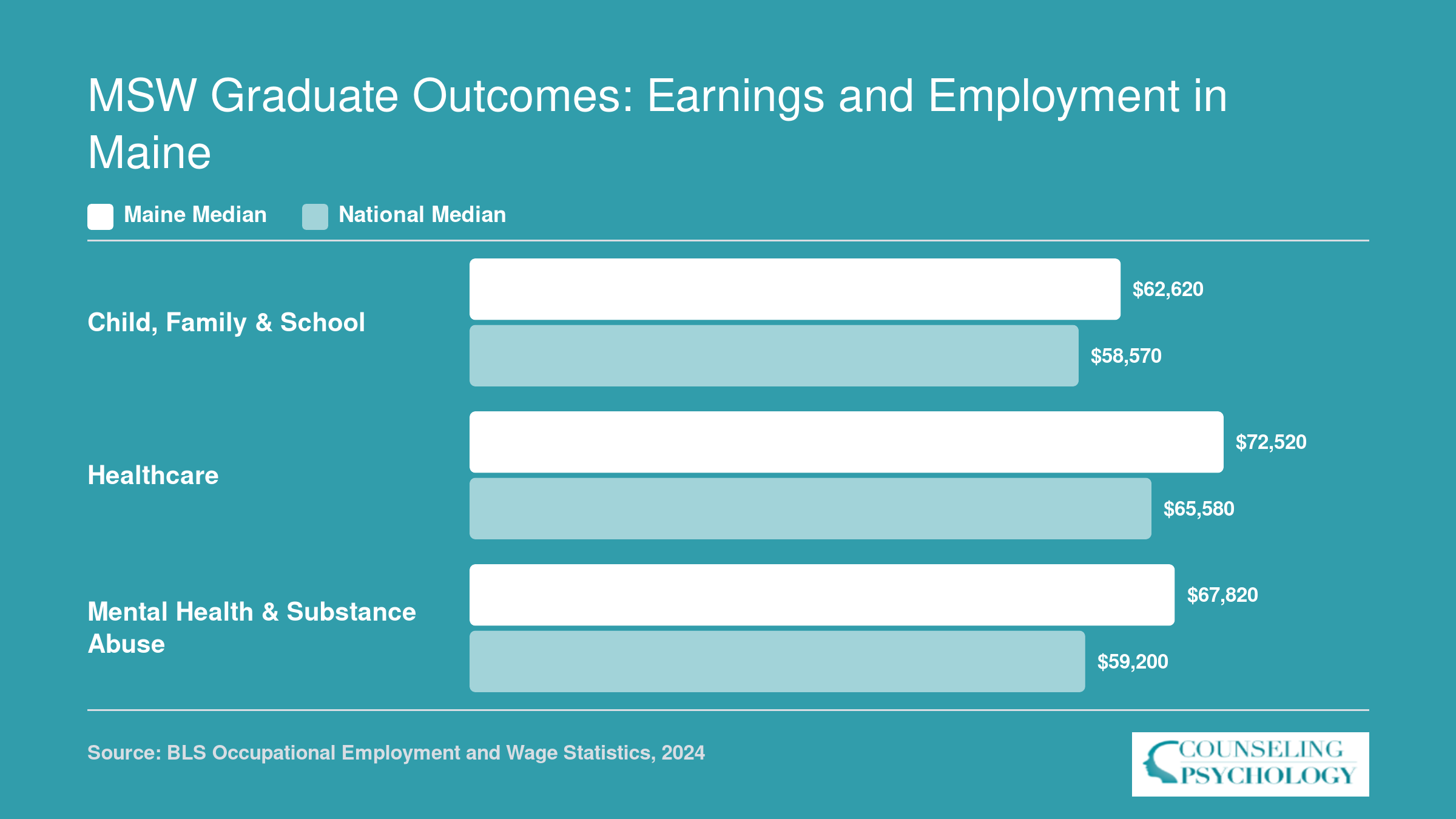
MSW Graduate Outcomes: Earnings and Employment in Maine
Is an MSW worth it financially in Maine? The state's social workers consistently earn more than their national counterparts. Maine's median wages for all three major social work specialties run 7% to 15% above national medians, according to 2024 BLS data. Program-level earnings and employment figures for individual Maine MSW programs are not yet available, but the statewide wage picture offers a strong signal. With median graduate debt at the University of Southern Maine sitting around $19,060, even an entry-level social work salary in Maine can make that investment manageable within a few years.
Scholarships, Stipends, and Loan Forgiveness for Maine MSW Students
The Maine Community Foundation offers a Mental Health Graduate Scholarship specifically for students enrolled at the University of Maine or the University of Southern Maine, making it one of the few awards in the state explicitly designed for MSW candidates.1 While exact award amounts for that fund vary year to year, the foundation also administers county-specific scholarships (Washington County and Aroostook County, among others) that graduate students can layer on top of program-level aid.
Maine-Specific Scholarships and Stipends
Several additional options are worth investigating:
- Title IV-E Child Welfare Stipends: Maine's Department of Health and Human Services has historically partnered with in-state MSW programs to fund students who commit to working in public child welfare after graduation. Stipend amounts fluctuate with state budget cycles, so contact your program's financial aid office for current figures.2
- Prosperity Maine Scholarship: This award covers full tuition for eligible Maine residents, though it is not limited to social work.3
- New Mainers Scholarship: Administered through the Maine Community Foundation and the Finance Authority of Maine, this program awards up to $10,000 to immigrant and refugee students pursuing higher education in the state.3
- Hagan International Scholarship: Open to students across fields, this award can reach $15,000, which would offset a significant share of MSW tuition at either UMaine or USM.3
University-specific aid, including graduate assistantships and need-based grants, varies by institution. Always file the FAFSA early and ask the program coordinator about departmental funding.
Federal Loan Forgiveness and Repayment Programs
Public Service Loan Forgiveness remains one of the most valuable long-term benefits for social workers. After 120 qualifying monthly payments while employed full-time by a government agency or qualifying nonprofit, remaining federal loan balances are forgiven.2 Given that a large proportion of MSW graduates in Maine work in nonprofit behavioral health agencies, hospitals, or state government, many will meet the employer requirement without changing jobs. Professionals interested in related community mental health counselor roles will find that PSLF applies broadly across helping professions.
Licensed clinical social workers who practice in federally designated Health Professional Shortage Areas can also apply for the National Health Service Corps Loan Repayment Program.4 NHSC awards have historically ranged from $50,000 to over $75,000 in exchange for a two-to-three-year service commitment. Several rural counties in Maine qualify, so licensed clinical social workers willing to serve underserved communities may be able to eliminate a substantial portion of their student debt through this route.
Putting It Together
Stacking state scholarships, university aid, and federal forgiveness programs can dramatically reduce the real cost of an MSW. Start applications early, confirm current eligibility criteria directly with each funding source, and factor loan forgiveness timelines into your post-graduation career planning.
For online MSW students in Maine, the coursework may fit easily into your schedule, but coordinating a field placement is the program's heaviest logistical lift. Rural areas have fewer agency options and qualified supervisors, so start planning your placement early, contacting your school's field office well before the term, to avoid roadblocks.
Field Placement Logistics for Online MSW Students in Maine
Traditional in-person fieldwork and virtual simulation placements represent two distinct paths to meeting your clinical hour requirement, each with its own logistical footprint. While most Maine MSW programs converge around a 900-hour field education requirement, how you log those hours, where you complete them, and who secures the placement site can vary significantly.
Understanding MSW Field Hour Requirements
The standard MSW field curriculum consists of two placements: a generalist foundation (typically 400 hours) and a specialist or clinical placement (500 hours), totaling 900 hours.1 Advanced standing students who enter with a BSW move directly into a single clinical placement of 500 hours. The University of New England's online MSW follows this model, and other Maine programs like those at USM and UMaine set similar benchmarks, though you should confirm exact hour totals with each program.
Placement Models and Who Finds the Site
At UNE, the online MSW uses a student-initiated placement approach with strong school support.1 You are responsible for identifying and securing your own agency, but the field education team helps with resources, approvals, and troubleshooting. Three completion models offer flexibility:
- Traditional: 32 weeks of part-time field work alongside coursework.
- Block: A concentrated 16-week full-time placement.
- S.O.S. (Simulated Online Supervision): A 32-week fully virtual simulation that replaces some or all in-person clinical hours.2
For the traditional and block models, you'll be matching with community agencies, which can be challenging in rural areas. The S.O.S. model changes the equation entirely by providing a structured, online field experience.
Rural Challenges and the Virtual Simulation Solution
Maine's geography creates real barriers for field placements. Outside the Portland and Bangor corridors, limited agency availability and long travel distances can stall progress. UNE's S.O.S. model directly addresses this gap.2 Students complete clinical hours through immersive, web-based simulations with virtual clients and live supervision, eliminating the commute and site search. It's a viable alternative for rural Mainers or those with scheduling constraints, though it may not replace every hour for all students. Check the program's current S.O.S. capacity and requirements before committing.
Completing Placements Outside Maine
If you are an out-of-state student enrolled in a Maine online MSW program, you can typically complete field placements in your home state. UNE permits this, provided you secure an approved agency and your state's authorization and licensing requirements are met.1 The field education office works with you to ensure the placement aligns with Maine's curriculum standards, but you'll need to handle the local coordination. Always confirm state-specific eligibility before enrolling, as some programs may have restrictions.
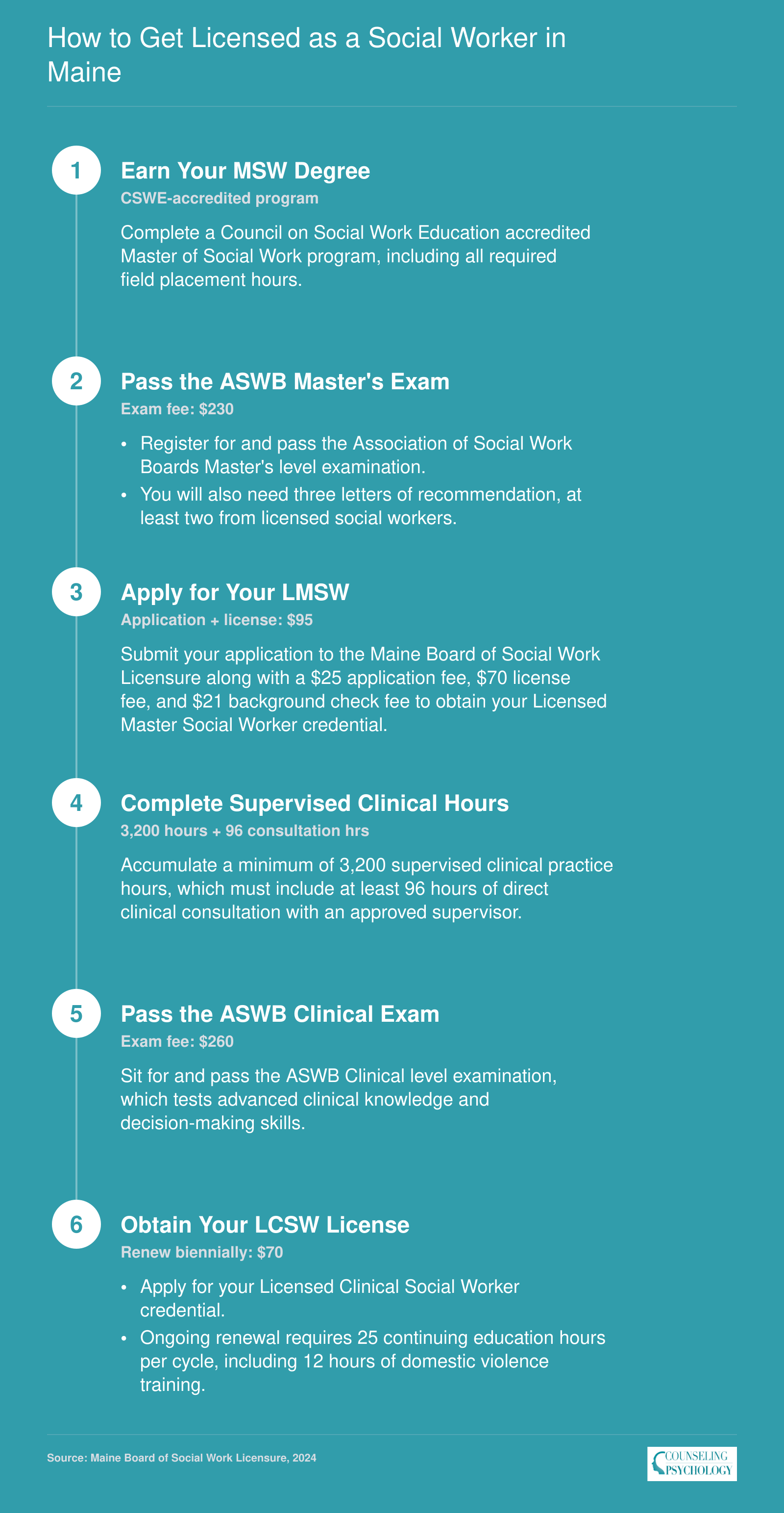
How to Get Licensed as a Social Worker in Maine
The Maine Board of Social Work Licensure oversees the credentialing process for social workers statewide. Below is the step-by-step progression from MSW graduate to fully licensed clinical practitioner. The counselingpsychology.org licensure overview covers state-by-state nuances in greater detail.
Admissions Requirements for Maine MSW Programs
Getting into an MSW program is rarely about a single metric, but the balance between your academic record, your professional readiness, and your timing can make or break an application cycle. Here is what to expect across Maine's primary MSW options for fall 2026 entry.
GPA and Prerequisite Coursework
Both the University of Southern Maine and the University of Maine require a completed bachelor's degree for their standard MSW tracks.12 Neither program publishes a rigid minimum GPA cutoff on its admissions page, though a cumulative GPA of 3.0 or above is a common benchmark for competitive MSW applicants nationally. Programs weigh your overall academic trajectory, so an upward trend in later coursework can offset a slower start. USM's standard track requires 61 credits, a detail that matters for planning because it signals a longer, more intensive curriculum than the 30-to-40-credit programs you may see elsewhere.3 Students eyeing advanced standing at USM need a BSW completed within the past seven years, while UMaine's advanced standing track similarly requires a BSW.42
Prerequisite courses in the liberal arts and social sciences (human biology, introductory psychology, statistics) are typical expectations, though specific requirements should be confirmed directly with each program's admissions office.
GRE Policies
Neither USM nor UMaine requires the GRE for MSW admission as of the fall 2026 cycle.12 This aligns with a broader shift across social work education: most CSWE-accredited programs have dropped the exam in favor of holistic review.
Personal Statement and References
Expect to submit a personal statement describing your motivation for social work, relevant lived or professional experience, and the populations or practice areas you hope to serve. Programs typically ask for two to three professional or academic reference letters. Choose recommenders who can speak to your interpersonal skills and commitment to social justice, not just your academic performance.
Application Deadlines
Timelines differ meaningfully between the two schools:
- USM: Application deadline of November 15, 2025 for fall 2026 entry. This is an early deadline, so plan to have all materials ready well in advance.1
- UMaine Online MSW: Priority deadline of November 15, 2025, with a final deadline of January 1, 2026 for fall 2026. Applying by the priority date improves your chances for financial aid consideration.2
Because both schools set November deadlines, prospective students should begin gathering transcripts, drafting personal statements, and requesting reference letters no later than early fall. Rolling or late review is not guaranteed at either institution, so treating the earliest posted deadline as your target is the safest approach.
Frequently Asked Questions About MSW Programs in Maine
These are some of the most common questions prospective MSW students in Maine ask. Each answer draws on the program details, cost comparisons, and licensure steps covered earlier in this article.
- What is the most affordable online MSW program in Maine?
- Based on per-credit tuition rates, the University of Maine (UMaine) typically offers some of the lowest costs for in-state residents pursuing an MSW. However, online programs from out-of-state institutions sometimes match or undercut that rate. Review the cost comparison table earlier in this article for a side-by-side breakdown of total tuition across available options.
- Can you get an MSW fully online in Maine?
- Yes. Several programs allow Maine residents to complete all coursework online. Field placements, however, must be completed in person at an approved agency, usually in your local community. The University of Southern Maine and select CSWE-accredited out-of-state programs offer fully online coursework paired with locally arranged field hours, as outlined in the field placement section above.
- Is an MSW worth it financially?
- For most graduates, yes. Social workers in Maine earn a median salary that compares favorably with the cost of an MSW, particularly for those who qualify for Public Service Loan Forgiveness or state-based loan repayment programs. The earnings and employment infographic earlier in this article breaks down typical salaries and employment rates for MSW holders working in Maine.
- How many credits is the University of Southern Maine MSW program?
- The University of Southern Maine's traditional MSW program requires 62 credits. Students who hold a BSW from a CSWE-accredited program may be eligible for advanced standing, which reduces the total to roughly 33 to 37 credits. Credit requirements and advanced standing eligibility are detailed in the advanced standing section above.
- What are the licensure requirements for social workers in Maine?
- Maine offers multiple license tiers through the Maine Board of Social Worker Licensure. After earning your MSW, you can apply for a Licensed Master Social Worker (LMSW) credential. The Licensed Clinical Social Worker (LCSW) designation requires additional supervised clinical hours (typically around 2,000) and passing a clinical-level exam. The licensure infographic earlier in this article walks through each step.
- What is the best online school for a Master's in social work in Maine?
- The University of Southern Maine is the most prominent in-state option and holds CSWE accreditation, which is essential for licensure. Some Maine residents also enroll in well-regarded out-of-state online programs. The rankings section at the top of this article evaluates programs on accreditation status, cost, and graduate outcomes to help you compare your options.