
What you’ll learn in this article…
- The Virginia Consortium Program in Clinical Psychology is the only APA-accredited doctoral program based directly in the Norfolk area.
- PsyD programs in Virginia typically cost two to three times more than PhD programs but finish roughly a year sooner.
- Norfolk's military installations and VA Medical Centers create forensic and veterans' care practicum sites rarely matched elsewhere.
- Virginia licensure requires a doctoral degree, a one-year predoctoral internship, postdoctoral hours, and a passing EPPP score.
Clinical psychology doctoral programs in Virginia require five to seven years of full-time training, a predoctoral internship, and at least two years of postdoctoral supervised practice before you can sit for the EPPP and earn licensure in the Commonwealth. That timeline, combined with tuition that ranges from roughly $8,700 to over $37,000 per year depending on the school and residency status, makes program selection a high-stakes decision.
Norfolk and the broader Hampton Roads area offer something unusual: proximity to Naval Station Norfolk, multiple VA medical centers, and state forensic facilities that double as practicum sites. The Virginia Consortium Program in Clinical Psychology, a collaborative between Old Dominion University and Norfolk State University, is one of the few joint-institution doctoral models in the country and is APA-accredited. Nearby, Regent University runs a PsyD with a 100% internship match rate, while UVA, VCU, and Virginia Tech anchor the state's research-intensive PhD options farther inland. Students interested in the military behavioral health pipeline may also want to learn how to become a military psychologist, given the region's dense concentration of defense installations.
Best Clinical Psychology Programs Near Norfolk, Virginia, Ranked
Norfolk and the surrounding Hampton Roads region sit at the center of a surprisingly strong cluster of clinical psychology training options, from APA-accredited doctoral consortia to practitioner-focused PsyD programs and master's-level stepping stones. The programs below were evaluated on accreditation status, training model, institutional outcomes, cost, and proximity to Norfolk's clinical training sites. Program-level earnings data are not yet available for most of these programs, so institution-wide figures are used where relevant.
- Accreditation and licensure preparation
- Training model and practicum depth
- Institutional graduation and retention rates
- Net price and graduate debt levels
- Regional clinical placement access
- Internal program database
- Independent program research
- College Scorecard graduate earnings — collegescorecard.ed.gov
- NCES-IPEDS federal institutional data — nces.ed.gov

Old Dominion University
Old Dominion University is one of two institutional homes of the Virginia Consortium Program in Clinical Psychology, making it the most geographically immediate doctoral option for Norfolk-area students. The consortium's scientist-practitioner PhD follows a 4+1 format with four years of coursework and research plus a predoctoral internship year, and admitted cohorts are small (roughly six students per year), which translates to intensive mentorship. Full funding, including tuition waivers and annual stipends, substantially offsets the listed in-state tuition of approximately $15,390. With a 13:1 student-faculty ratio and practicum placements across Hampton Roads mental health centers, hospitals, and rehabilitation facilities, ODU provides deep local clinical immersion.
- Joint Virginia Consortium program with Norfolk State University
- Scientist-practitioner model with research from day one
- Full tuition waiver and stipend for four residency years
- Predoctoral internship completes the five-year sequence
- Cohort of roughly six students admitted each year
- Practicum sites span hospitals, clinics, and rehab centers
- Strong emphasis on ethics, diversity, and empirically supported therapies
- 13:1 student-faculty ratio across the university
Clinical Psychology (PhD) — On-Campus

Norfolk State University
Norfolk State University is the other institutional partner in the Virginia Consortium Program in Clinical Psychology, an APA-accredited PhD that trains students across both NSU and ODU campuses in downtown Norfolk. As a historically Black university, NSU brings a distinctive commitment to cultural diversity, community-engaged research, and serving underrepresented populations. The 115-credit-hour curriculum spans up to seven years, with extensive practicum rotations in mental health centers, hospitals, and community agencies throughout the region. In-state tuition sits near $13,412, and the institution-wide median graduate debt is $29,000.
- APA-accredited joint program with Old Dominion University
- 115 total credit hours across coursework, practicum, and internship
- Scientist-practitioner training model emphasizing diversity
- Four to six students admitted per annual cohort
- Diverse practicum settings across Hampton Roads
- Seven-year maximum completion timeline
- Minimum 3.0 GPA required for admission
- Active clinical training structure with dedicated faculty contacts
Clinical Psychology (PhD) — On-Campus

Regent University
Regent University, located minutes from Norfolk in Virginia Beach, offers an APA-accredited PsyD in Clinical Psychology built on a practitioner-scholar model that integrates clinical skill-building with a Christian worldview. The program reports a 100% internship match rate, a metric that signals strong preparation for the supervised-practice year required before licensure. At 116 credit hours beyond a bachelor's degree, the five-year curriculum is intensive, and the net price of roughly $19,923 is competitive among private doctoral programs in Virginia. Schools offering this program have a graduation rate of approximately 56.9%.
- APA-accredited with 100% internship match rate
- Practitioner-scholar model over five full-time years
- 116 credit hours required beyond a bachelor's degree
- Clinical placements begin in the second year
- Full-year predoctoral internship included
- Prepares graduates for Virginia state licensure
- Scholarships available to offset roughly $19,923 net price
- Minimum 3.0 undergraduate GPA and 18 psychology credits required
Doctor of Psychology (PsyD) in Clinical Psychology — On-Campus

University of Virginia
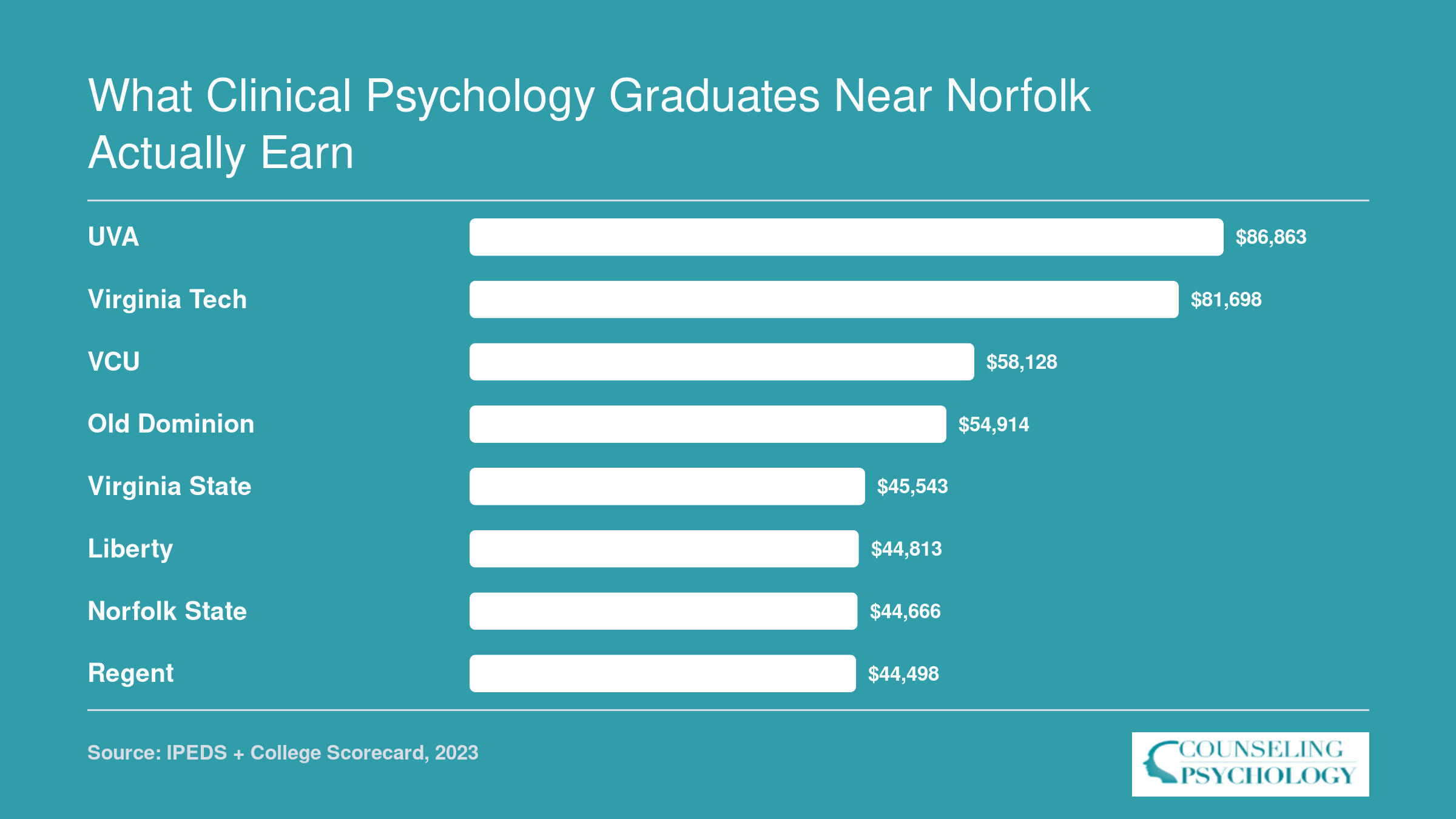
The University of Virginia's PhD in Clinical Psychology is dual-accredited by APA and PCSAS through 2033, placing it among a small group of programs nationally that carry both credentials. UVA follows a clinical-scientist training model across a five-year timeline that includes a full-year internship, and it has dropped the GRE requirement to broaden its applicant pool. A separate Clinical and School Psychology PhD focuses on children and adolescents through a strength-based developmental lens. Schools offering these programs have a graduation rate of 95.6%, and the institution-wide ROI ratio of roughly 4.96 is the highest on this list, driven in part by median earnings of $86,863 ten years after enrollment.
- Dual APA and PCSAS accreditation through 2033
- Clinical-scientist model with five-year completion timeline
- No GRE scores required for admission
- Full-year clinical internship in final year
- Multiple faculty research areas and diverse therapeutic orientations
- In-state tuition approximately $23,526; net price around $21,565
- Median institutional graduate debt of $17,500
- APA-accredited combined doctoral program
- Scientist-practitioner training with 72 required credits
- Focus on children, adolescents, and youth development
- Interdisciplinary, strength-based perspective
- Comprehensive financial support package included
- Full-time, in-person program with integrated research and clinical work
PhD in Clinical Psychology — On-Campus
Clinical and School Psychology (PhD) — On-Campus

Virginia Commonwealth University
Virginia Commonwealth University in Richmond offers a PhD in Clinical Psychology with two distinct concentrations: Behavioral Medicine and Clinical Child. Both tracks are APA-accredited, follow a scientist-practitioner model, and require full-time study that includes an empirical master's thesis, a dissertation, and an APA-approved internship. Practicum placements begin in the fourth year at approved Richmond-area sites, giving students hands-on experience with diverse, often underserved populations. In-state tuition is approximately $17,252, and the institution-wide net price is $23,433, with a median graduate debt of $21,500.
- APA-accredited scientist-practitioner program
- Concentration in clinical health psychology and prevention
- Fourth-year practicum at approved Richmond-area sites
- Empirical master's thesis plus doctoral dissertation required
- Evidence-based treatment training for diverse populations
- Full-time study with 3.0 minimum undergraduate GPA for admission
- APA-accredited with Clinical Child concentration
- Emphasis on developmental psychopathology and underserved youth
- Scientist-practitioner training with clinical practicum
- Prepares graduates for careers across academic and applied settings
- Diversity and cultural competence woven throughout curriculum
- Full-time residency required through completion
Doctor of Philosophy in Clinical Psychology, Behavioral Medicine — On-Campus
Doctor of Philosophy in Clinical Psychology, Clinical Child — On-Campus

Virginia Polytechnic Institute and State University
Virginia Tech's Clinical Science PhD, accredited by both APA and PCSAS, is unapologetically research-focused, training students to advance mental health understanding through empirical investigation and innovative technologies. The program does not require GRE scores and evaluates applicants holistically, looking for candidates committed to scientific rigor. Located in Blacksburg (roughly three hours from Norfolk), it is best suited for students willing to relocate for elite research training. Schools offering this program have an 86.2% graduation rate, and the institution-wide ROI ratio of approximately 3.80 reflects strong post-graduation earnings relative to cost.
- Dual APA and PCSAS accreditation
- Research-oriented with evidence-based intervention training
- No GRE requirement; holistic admissions review
- Multiple clinical training sites available
- In-state tuition approximately $18,564; net price around $24,953
- Median institutional graduate debt of $21,500
- Prepares graduates for academic and translational research careers
Clinical Science (PhD) — On-Campus

Liberty University
Liberty University's PsyD in Clinical Psychology is a 126-credit-hour, campus-based program in Lynchburg that integrates scientific clinical practice with a Christian worldview. Students can begin clinical placements in their second year and complete a full-year internship before graduation, with a master's degree awarded along the way. The program accepts up to 39 transfer credits, which can shorten the timeline for students entering with prior graduate work. The net price of approximately $29,357 is the highest on this list, and the institution-wide ROI ratio of roughly 1.83 suggests graduates should plan carefully around debt.
- 126 total credit hours with embedded master's degree
- Clinical placements begin in the second year
- Up to 39 graduate transfer credits accepted
- Full-year predoctoral internship required
- Christian worldview integrated throughout the curriculum
- Graduate assistantships available to offset costs
- Prepares graduates for state licensure as clinical psychologists
Doctor of Psychology (PsyD) in Clinical Psychology — On-Campus

Virginia State University
Virginia State University, an HBCU in Petersburg, offers both a Master of Science in Psychology with a Clinical Psychology concentration and a newer PhD in Clinical Health Psychology that uses a biopsychosocial framework. The master's program prepares students for roles in agencies, hospitals, and correctional settings and can serve as a stepping stone toward doctoral study or Licensed Professional Counselor credentials. The doctoral program is still seeking APA accreditation, an important detail for applicants who need that credential for licensure. In-state tuition is approximately $13,218, and the net price of roughly $15,840 is among the most affordable options on this list.
- Clinical Psychology concentration with practicum experience
- Prepares graduates for LPC pathway or doctoral study
- Training for agency, hospital, and correctional settings
- Campus-based program blending theory and practice
- Focus on social change and community impact
- Advisors guide students through program and career planning
- Five-year, full-time doctoral program
- Biopsychosocial approach to health psychology
- Currently seeking APA accreditation
- Includes a one-year predoctoral internship
- Emphasis on diversity and serving underrepresented communities
- Strong psychology background and GRE scores required for admission
Master of Science in Psychology, Clinical Psychology — On-Campus
PhD in Clinical Health Psychology — On-Campus
Why Norfolk and Hampton Roads for Clinical Psychology
Norfolk and Hampton Roads form a clinical psychology training hub that is too often overlooked, offering a density of real-world training sites, particularly in military, forensic, and veterans' care, that surpasses many larger markets.
A Military-Focused Clinical Pipeline
The region hosts an extraordinary concentration of military installations: Naval Station Norfolk, the world's largest naval base; Joint Base Langley-Eustis; and Fort Eustis. These installations generate constant demand for behavioral health services, including trauma treatment, family reintegration counseling, and substance use interventions. Doctoral students in clinical psychology find a steady pipeline of practicum placements here that expose them to active-duty populations and their unique mental health needs.
VA Medical Center: A Flagship Training Site
The Hampton VA Medical Center serves as a major clinical training partner for psychology doctoral programs. Students rotate through PTSD clinical teams, primary care mental health integration, and polytrauma care units, gaining experience with evidence-based protocols that are central to VA care. The facility's focus on interdisciplinary care and its role as a teaching hospital create a fertile environment for supervised clinical work that aligns with scientist-practitioner training.
Forensic Opportunities Across the Region
Hampton Roads houses a rare mix of forensic settings. Eastern Virginia Medical School operates forensic psychiatry sites where psychology students can observe and practice forensic evaluations. State correctional facilities, the Hampton Roads Regional Jail, and local court systems offer additional practicum slots for competency assessments, risk evaluations, and court-involved therapy. This breadth of forensic exposure is uncommon outside major metropolitan clusters and especially valuable for those targeting forensic psychology. Students interested in this track should also review the forensic psychologist requirements needed at the national level.
The Virginia Consortium: A Unique Collaborative Model
The Virginia Consortium Program in Clinical Psychology is a joint effort among Old Dominion University, Norfolk State University, and Eastern Virginia Medical School.1 It is APA-accredited and follows a scientist-practitioner model across a 4+1 year program length. The consortium admits a tight cohort of just six students per year, backed by over 60 supervisors across the three institutions.2 This multi-university structure means trainees access combined faculty expertise, research labs, and clinical sites that no single program could offer on its own. Recent cohort data show that 53% of admitted students already hold a master's degree, 34% identify as minority, and the mean age is 28 years.3 Students considering a doctorate in forensic psychology will find that the consortium's forensic practicum network is a natural complement to specialized doctoral work.
An Underestimated Metro for Clinical Psychology Training
Compared to the higher-profile training environments of northern Virginia or Richmond, Hampton Roads delivers a less crowded, high-contact experience with remarkable clinical diversity. The region's cost of living, coupled with its dense network of military, medical, and forensic placements, makes it a strategic choice for doctoral students who want broad training without the competitive pressures of larger metro areas. For those searching for clinical psychology programs near Norfolk, Virginia, this corner of the state deserves a hard look.
PsyD vs. PhD Programs in Virginia: Which Path Is Right for You?
Both the PsyD and the PhD in clinical psychology qualify you for licensure as a Licensed Clinical Psychologist in Virginia, and both can carry APA accreditation. The real differences come down to training philosophy, research expectations, program length, and cost. Below is a side-by-side look at how these two pathways compare, with Virginia-specific examples drawn from programs ranked on counselingpsychology.org.
| Dimension | PhD in Clinical Psychology | PsyD in Clinical Psychology |
|---|---|---|
| Training Model | Scientist-practitioner or clinical-scientist model. Virginia examples include UVA (clinical scientist), VCU (scientist-practitioner with a behavioral medicine concentration), the Virginia Consortium (NSU/ODU, scientist-practitioner), and Virginia Tech (clinical science, PCSAS accredited). | Practitioner-scholar model emphasizing direct clinical skill from day one. Virginia examples include Regent University and Liberty University, both offering practice-focused PsyD curricula. |
| Research Requirements | Original empirical dissertation required. Programs like Virginia Tech and UVA expect students to publish peer-reviewed research throughout training. | Typically a doctoral clinical project or applied dissertation. Research is part of the curriculum, but the emphasis tilts toward clinical application rather than generating new data. |
| Typical Time to Degree | 5 to 7 years, including a predoctoral internship year. The Virginia Consortium lists a seven-year completion timeline; UVA targets five years. | 4 to 6 years. Regent University's PsyD is structured as a five-year, full-time program (116 credit hours). Liberty's PsyD requires 126 credit hours. |
| Average Cost and Debt | Funded PhD programs at public universities (UVA, VCU, Virginia Tech, ODU) often provide tuition waivers and annual stipends, keeping median graduate debt between roughly $17,500 (UVA) and $29,000 (Norfolk State). Still, out-of-state tuition at a public school can exceed $35,000 per year before aid. | Limited assistantships mean students shoulder more tuition. Regent's listed tuition is about $17,869 per year; Liberty's is roughly $8,730 per year. Median institutional graduate debt at these private schools ($24,500 to $24,534) can land in the same range as some public PhD programs, countering the assumption that PsyD always costs more. |
| Funding Availability | Most APA-accredited PhD programs in Virginia offer full tuition waivers plus a stipend. ODU, for instance, advertises fully funded tuition with an annual stipend for its clinical psychology PhD students. | Funding is more limited. Graduate assistantships exist (Liberty notes assistantship availability), but full tuition waivers are uncommon. Students should plan for substantial out-of-pocket costs or federal loans. |
| Typical Career Trajectory | Opens doors to academic faculty positions, research-intensive hospital roles, VA medical centers, and private practice. Graduates from research-heavy programs often pursue postdoctoral fellowships before entering independent practice. | Graduates move quickly into applied clinical roles: community mental health agencies, group practices, forensic settings, school systems, and integrated care teams. Academic research careers are possible but less common. |
| Virginia Licensure | Qualifies for Virginia Licensed Clinical Psychologist credential after supervised postdoctoral hours and passing the EPPP. | Qualifies on the same terms. Virginia's Board of Psychology does not distinguish between PsyD and PhD holders for licensure eligibility. |
Questions to Ask Yourself
Forensic Psychology Tracks and Specializations in Virginia
Forensic psychology sits at the intersection of clinical practice and the legal system, covering competency evaluations, criminal risk assessments, expert testimony, and treatment in correctional settings. If you are drawn to this subspecialty, Virginia offers pathways at both the doctoral and postdoctoral levels, though formal forensic concentrations within PsyD and PhD programs are relatively limited. Knowing where to look and whom to ask can make the difference between cobbling together a handful of electives and building a coherent forensic portfolio.
Formal Forensic Training Options in Virginia
Most clinical psychology doctoral programs in the state do not list a dedicated forensic track in their official catalogs. George Mason University offers a Forensic Psychology Concentration at the undergraduate level, but its clinical psychology doctoral program does not currently advertise a parallel graduate specialization.1 For students already holding a doctorate, the University of Virginia School of Medicine provides an APA-accredited Forensic Psychology Fellowship.2 This postdoctoral program allocates roughly 80 percent of training time to clinical work and 20 percent to didactics, with placements at Western State Hospital and the Institute of Law, Psychiatry, and Public Policy (ILPPP). Western State Hospital operates an inpatient forensic evaluation service, while ILPPP functions as an interdisciplinary hub for forensic psychology, forensic psychiatry, and mental-health law scholarship.3
Digging Deeper Into Program Resources
Because published program descriptions sometimes lag behind actual course offerings, prospective applicants should take several proactive steps:
- Review curriculum pages: Check the websites of Regent University, Radford University, Virginia Consortium Program in Clinical Psychology, and George Mason for elective courses labeled forensic assessment, psychology and law, or criminal behavior.
- Contact admissions or faculty: Inquire directly about informal forensic specialization routes, including supervised practicum hours at forensic hospitals, correctional facilities, or court-based clinics in the Hampton Roads and Richmond corridors.
- Explore professional directories: The American Psychology-Law Society (AP-LS) maintains resources on training programs and practicum sites nationwide, and the Virginia Psychological Association can point you toward local forensic supervisors and continuing-education opportunities.
Building a Competitive Forensic Portfolio
Even without a formal track, you can assemble meaningful forensic experience during your doctoral years. Seek practicum placements at state forensic hospitals such as Western State or Central State, volunteer with reentry programs, or pursue independent research on topics like eyewitness memory or risk prediction. For a broader look at clinical forensic psychology doctoral programs across the country, national rankings can help you benchmark Virginia's offerings against peer institutions. Demonstrating sustained engagement with forensic populations and legal contexts strengthens applications for competitive postdoctoral fellowships like UVA's ILPPP program and signals to future employers that you possess both clinical competence and an understanding of the legal arena.
Program Costs, Debt, and Return on Investment Compared
Doctoral training in clinical psychology is a major financial commitment, so comparing costs across Virginia programs is essential before you apply. The table below uses published tuition rates and institution-wide financial metrics from IPEDS and the College Scorecard. Net price figures reflect an institution-wide average after grants and scholarships for all students, not a per-student quote specific to clinical psychology doctoral candidates. Program-level earnings data (such as median salary one or four years after completion) are not yet available for these programs, so we include institution-wide median earnings at ten years and an approximate return-on-investment ratio to give you a starting point for gauging long-term payoff.
| School | In-State Tuition | Out-of-State Tuition | Approx. Net Price (Institution-Wide) | Median Graduate Debt | Median Earnings at 10 Years | ROI Ratio |
|---|---|---|---|---|---|---|
| University of Virginia | $23,526 | $37,628 | $21,565 | $17,500 | $86,863 | 4.96 |
| Virginia Commonwealth University | $17,252 | $32,470 | $23,433 | $21,500 | $58,128 | 2.70 |
| Virginia Tech | $18,564 | $35,092 | $24,953 | $21,500 | $81,698 | 3.80 |
| Old Dominion University | $15,390 | $36,174 | $14,638 | $24,000 | $54,914 | 2.29 |
| Liberty University | $8,730 | $8,730 | $29,357 | $24,500 | $44,813 | 1.83 |
| Regent University | $17,869 | $17,869 | $19,923 | $24,534 | $44,498 | 1.81 |
| Virginia State University | $13,218 | $24,860 | $15,840 | $26,500 | $45,543 | 1.72 |
| Norfolk State University | $13,412 | $25,826 | $15,282 | $29,000 | $44,666 | 1.54 |
What Clinical Psychology Graduates Near Norfolk Actually Earn
Program-level earnings data for clinical psychology graduates at these Virginia schools are not yet published in federal outcome trackers. However, institution-wide median earnings at ten years after enrollment offer a useful proxy for comparing the long-term return across schools. The figures below reflect all graduates at each university, not just clinical psychology completers. For context, the BLS reports a national median annual wage for clinical psychologists of roughly $96,100; Virginia-specific figures may differ, so treat these institution-wide medians as a broader baseline rather than a direct salary forecast for licensed clinicians.
Accreditation, Licensure, and EPPP Pass Rates in Virginia
Choosing a clinical psychology doctoral program without clear APA accreditation is a high-stakes gamble, one that can block your path to licensure in Virginia.
Why APA Accreditation Is Non-Negotiable
APA accreditation signals that a program meets rigorous training standards, directly affecting your internship match prospects, employer trust, and licensure eligibility. The Virginia Board of Psychology requires a doctoral degree from a program accredited by APA, CPA, or PCSAS for the Licensed Clinical Psychologist (LCP) credential.1 Graduates of non-accredited programs face additional scrutiny, longer application processes, and, in many states, outright ineligibility. In competitive job markets like Hampton Roads, a degree from an accredited program is often the minimum screen for clinical positions in hospitals, VA medical centers, and private group practices. If you are still weighing your options nationally, reviewing clinical psychology doctorate programs can help you benchmark what accredited programs typically offer.
Virginia's Licensure Blueprint: Steps to the LCP
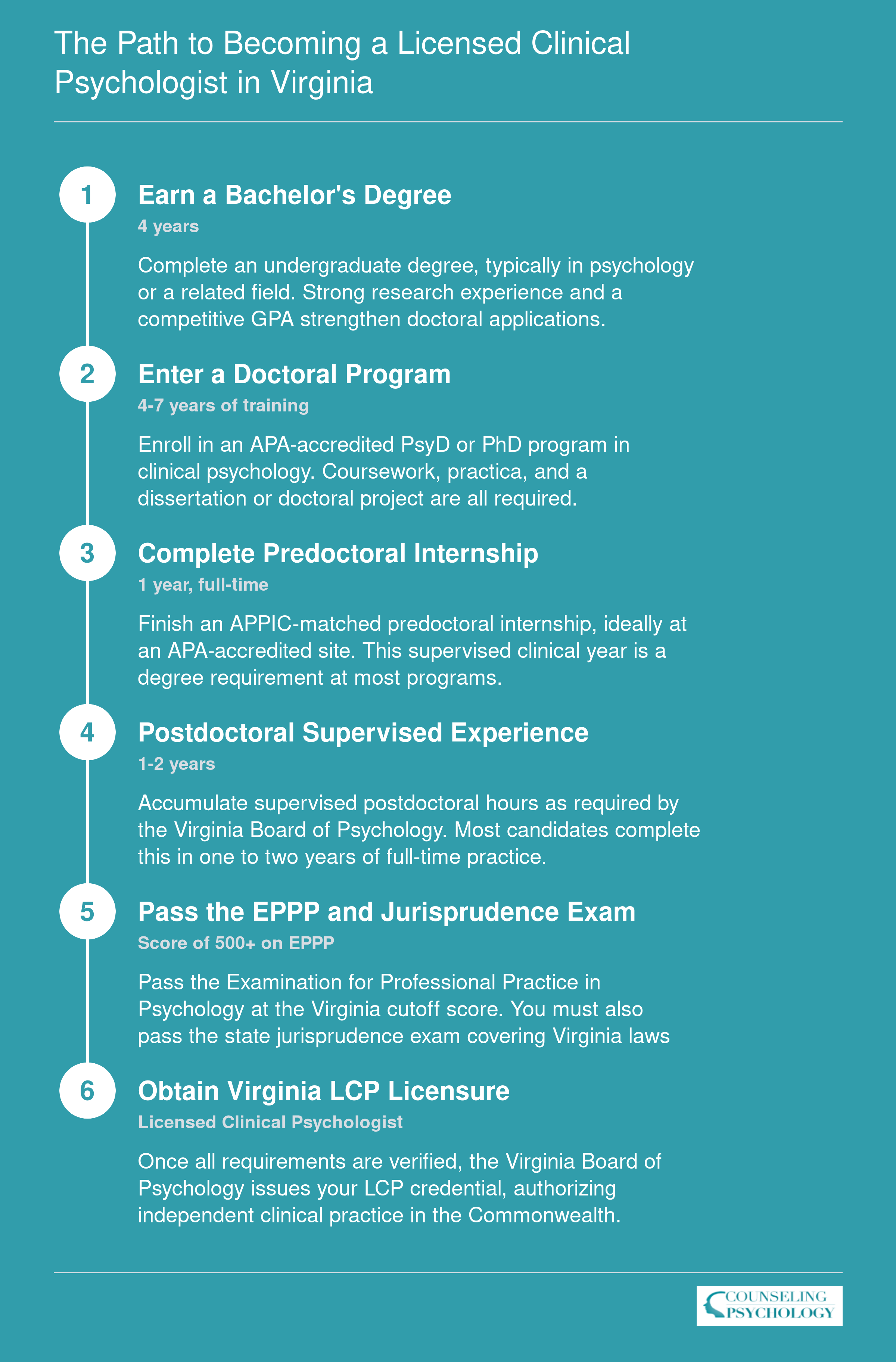
Virginia's path to the LCP involves several clear mandates beyond the doctoral degree:1
- Supervised Experience: 1,500 hours of postdoctoral supervised practice, typically accrued over one to two years. Internship hours do not count toward this total.
- Examination: A passing scaled score of 500 on the EPPP Part 1 (Knowledge), a 225-item multiple-choice test. As of 2026, Virginia does not require the EPPP Part 2 (Skills).
- Jurisprudence Exam: An online, open-book test covering Virginia laws and regulations. It must be taken after the EPPP, just before license issuance.
- Practicum Training: At least 9 semester hours of practicum during the doctoral program.
- Supervision Ratio: Postdoctoral supervision must maintain a ratio no more intense than 1 supervisor per 8 trainees.
These requirements are non-negotiable and enforced by the Virginia Board of Psychology. Missing even one element can delay licensure by months or years.
EPPP Pass Rates: What the Data Shows (and What's Missing)
Prospective students often want a program-by-program EPPP pass rate comparison, but Virginia programs do not report current pass rates publicly. The last comprehensive dataset from ASPPB covers years up to 2017, leaving a significant gap for today's applicants. Among older data, University of Virginia and Virginia Commonwealth University historically posted pass rates above the national average, but fresh figures are unavailable. This lack of transparency frustrates informed decision-making, making it essential to ask programs direct questions about recent graduate outcomes during interviews.
LCP vs. LPC: Clarifying the Confusion
A common misunderstanding conflates the Licensed Clinical Psychologist with the Licensed Professional Counselor. LPCs in Virginia can practice at the master's level after earning a counseling degree from a CACREP-accredited program and completing 3,400 hours of supervised experience. Clinical psychologists, by contrast, hold a doctoral degree and complete far more intensive assessment, diagnosis, and therapy training. If your goal is psychological testing, neuropsychological evaluation, or independent practice across a broader scope, the LCP route is mandatory. Choosing the right graduate program from the start prevents costly detours.
Unaccredited Programs: A Risky Shortcut
A few doctoral programs in Virginia operate without APA accreditation, including some well-known Christian universities and newer for-profit options. While these schools may advertise strong clinical training, graduates often hit a wall when applying for licensure. Virginia's Board may demand a review of the program's equivalency, a process that can add months of paperwork and expense. Even if licensure is eventually granted, employers in health systems and government agencies typically reject non-APA graduates. The cost of a degree from an unaccredited program often outweighs any perceived savings on tuition or time.
The Path to Becoming a Licensed Clinical Psychologist in Virginia
Earning your license as a clinical psychologist in Virginia is a multistep process that typically spans 8 to 12 years from the start of your bachelor's degree to full licensure. Each stage builds on the last, so understanding the full sequence helps you plan realistic timelines and milestones.
How to Choose the Right Clinical Psychology Program Near Norfolk
APA accreditation is the single non-negotiable criterion when evaluating doctoral programs in Virginia. Completing a program without it creates serious barriers to licensure in the Commonwealth, and the Virginia Board of Psychology expects graduates to have trained in accredited programs. Confirm current accreditation status directly with the APA before applying, not just by reading a program's marketing materials.
Five Factors Worth Weighing Carefully
Beyond accreditation, five considerations tend to separate a good fit from a poor one:
- PsyD vs. PhD alignment: PhD programs like those at VCU and UVA emphasize research training and typically fund students through assistantships.12 PsyD programs are designed for students whose primary goal is clinical practice. Neither path is superior, but the mismatch between training model and personal goals is a common source of dissatisfaction.
- Specialization access: If forensic psychology interests you, ask programs directly whether they have established forensic practicum placements in Hampton Roads. That information is rarely published in a convenient place online.
- Practicum sites in the region: The Hampton Roads area includes VA medical centers, community mental health agencies, and hospital systems. Ask admissions coordinators which sites your cohort has used in recent years and how placements are assigned.
- Cost and funding reality: Tuition and funding structures vary considerably across Virginia programs. Stipend amounts, fee waivers, and the realistic timeline to degree all affect total debt.
- Format flexibility: This is an area where Virginia doctoral programs in clinical psychology offer limited options for working professionals. VCU, UVA, the Virginia Consortium, George Mason, and Virginia Tech all require full-time enrollment. UVA specifies a minimum of five years of full-time study, including a one-year internship.2 If part-time or evening scheduling is a firm requirement, the current landscape in Virginia does not support that at the doctoral level in accredited programs.
Questions to Ask Before You Apply
Programs publish some outcome data in their Student Admissions, Outcomes, and Other Data documents, but several useful figures are harder to surface.2 When you contact programs, ask specifically about internship match rates for recent cohorts, average cohort size, and the share of students who secured forensic or specialty placements if that track matters to you. Students drawn to forensic work may also want to explore clinical forensic psychology doctoral programs for a broader view of training options. These conversations also signal to faculty that you have done substantive research.
The Virginia Consortium Model
The Virginia Consortium Program in Clinical Psychology draws on faculty and resources from multiple institutions simultaneously. That structure gives students broader exposure than a single-campus program can offer, but it also requires comfort with split affiliations, coordinating across institutions, and a more distributed sense of professional community. For students who thrive with variety and cross-institutional collaboration, that design is a genuine asset. For those who prefer a tightly cohesive single-program identity, the fit may feel less natural. If you are weighing other doctoral specializations alongside clinical training, our guide to counseling psychology phd programs provides helpful comparison points.
Career Outlook for Clinical Psychologists in the Norfolk Area
The Hampton Roads region offers clinical psychologists a distinctive job market shaped by one of the largest military installations in the world, multiple VA Medical Centers, state forensic facilities, and a growing private practice landscape. Graduates of APA-accredited programs, especially those with forensic or military behavioral health practicum experience, are well positioned to compete for these roles. The salary data below, drawn from BLS reporting for the Virginia Beach-Norfolk-Newport News metropolitan area, Virginia statewide, and the nation, reflects 2023 figures, the most recent available at the time of publication.
| Geographic Level | Median Annual Wage (2023) | Mean Annual Wage (2023) | Estimated Employment (2023) | Projected Job Growth |
|---|---|---|---|---|
| Virginia Beach-Norfolk-Newport News MSA | $101,810 | N/A | 280 | N/A |
| Virginia (statewide) | $87,110 | $105,480 | Not disclosed by BLS | N/A |
| United States (national) | $96,100 | N/A | 71,730 | About 11% through 2034 |
Frequently Asked Questions About Clinical Psychology Programs in Virginia
Prospective doctoral students often have overlapping questions about program quality, cost, licensure, and specialization options in Virginia. Below are answers to the most common questions, many of which connect to topics covered in greater detail earlier in this article.