What you’ll learn in this article…
- UCCS offers the most affordable clinical psychology MA in the Denver area with three distinct program tracks.
- Colorado LPC licensure requires 2,000 supervised post-master's hours over a minimum of two years.
- MA graduates typically enter counseling roles, while doctoral degrees unlock full psychologist licensure and higher salary ceilings.
- No Colorado institution currently offers a fully online MA in clinical psychology that leads to licensure.
Graduate clinical psychology training in Colorado typically runs between $15,000 and $27,000 per year, depending on residency status and program structure. Denver itself has only one institution offering a dedicated clinical psychology master's track within reasonable commuting distance: the University of Colorado Colorado Springs (UCCS) MA program. That program posts in-state tuition near $15,700 and out-of-state near $27,200 annually, placing it at the lower end of the regional cost spectrum.
Affordability matters more than ever, but cost alone should not drive the decision. The UCCS program, for example, is explicitly not designed for terminal master's-level licensure as an LPC or LAC. It prepares students for clinical psychology doctorate programs rather than independent clinical practice. That structural difference shapes everything from curriculum design to post-graduation outcomes.
Colorado also does not license master's-level psychologists. Graduates seeking independent clinical roles must pursue either the Licensed Professional Counselor (LPC) track, which requires accredited counseling coursework and 2,000 supervised hours, or continue into a doctoral program to become a licensed psychologist. Knowing which credential you need, and which programs qualify you for that path, is the most cost-effective filter you can apply before enrollment.
Best Affordable Clinical Psychology Programs in Denver
Denver-area students searching for affordable clinical psychology graduate training will find a focused set of options. The University of Colorado Colorado Springs stands out as the most cost-effective path, offering three distinct program tracks under one MA umbrella. While UCCS is located about an hour south of Denver, it functions as a regional feeder into Colorado doctoral programs and remains the most budget-friendly clinical psychology master's option in the broader metro area. This is a curated list of Denver-area program offerings rather than an exhaustive national ranking.
- Net price and tuition affordability
- Program format and structure
- Specialization and concentration options
- Institutional graduation outcomes
- Career pathway alignment
- NCES-IPEDS federal institutional data — nces.ed.gov
- College Scorecard graduate earnings — collegescorecard.ed.gov
- Independent program research
- Internal program database

University of Colorado Colorado Springs
UCCS delivers a scientist-practitioner MA in Clinical Psychology that blends rigorous research training with hands-on clinical practicum, all within a two-year, 47-credit-hour framework. The program is explicitly designed as preparation for doctoral study rather than standalone licensure, making it an appealing launchpad for students who want affordable master's-level training before pursuing a PhD or PsyD at institutions like CU Denver or CU Boulder. With an institution-wide graduation rate of about 47% and a 15:1 student-to-faculty ratio, UCCS offers accessible class sizes at a public-university price point. Practicum experiences are integrated into the standard curriculum with no documented add-on fees, keeping total costs contained.
- 47 credit hours with a scientist-practitioner curriculum
- On-campus format in Colorado Springs, about 70 miles from Denver
- Research thesis required as part of degree completion
- Practicum placements in both research and clinical settings
- In-state tuition and fees near $15,700; out-of-state around $27,200
- Median graduate debt of $20,000 per College Scorecard data
- Designed as doctoral preparation, not for LPC licensure in Colorado
- Covers psychopathology, clinical interviewing, and cognitive assessment
- Same 47-credit-hour structure as the general clinical track
- Campus-based program with faculty expertise in aging populations
- Practicum placements aligned specifically with geropsychology focus
- Thesis must address a topic within the geropsychology subfield
- Adult-focused curriculum emphasizing clinical skills for older adults
- Specialization embedded in core MA, no extra tuition or added years
- Shares the 47-credit-hour, two-year timeline of the general track
- On-campus delivery with faculty specializing in trauma research
- Practicum experiences tailored to trauma-informed clinical settings
- Thesis research must center on trauma psychology topics
- No separate practicum fees documented beyond standard registration
- Prepares students for trauma-focused doctoral study, not LPC licensure
MA in Clinical Psychology (General Track) — On-Campus
MA in Clinical Psychology, Geropsychology Concentration — On-Campus
MA in Clinical Psychology, Trauma Psychology Concentration — On-Campus
Tuition and Cost Comparison Across Denver Clinical Psychology Programs
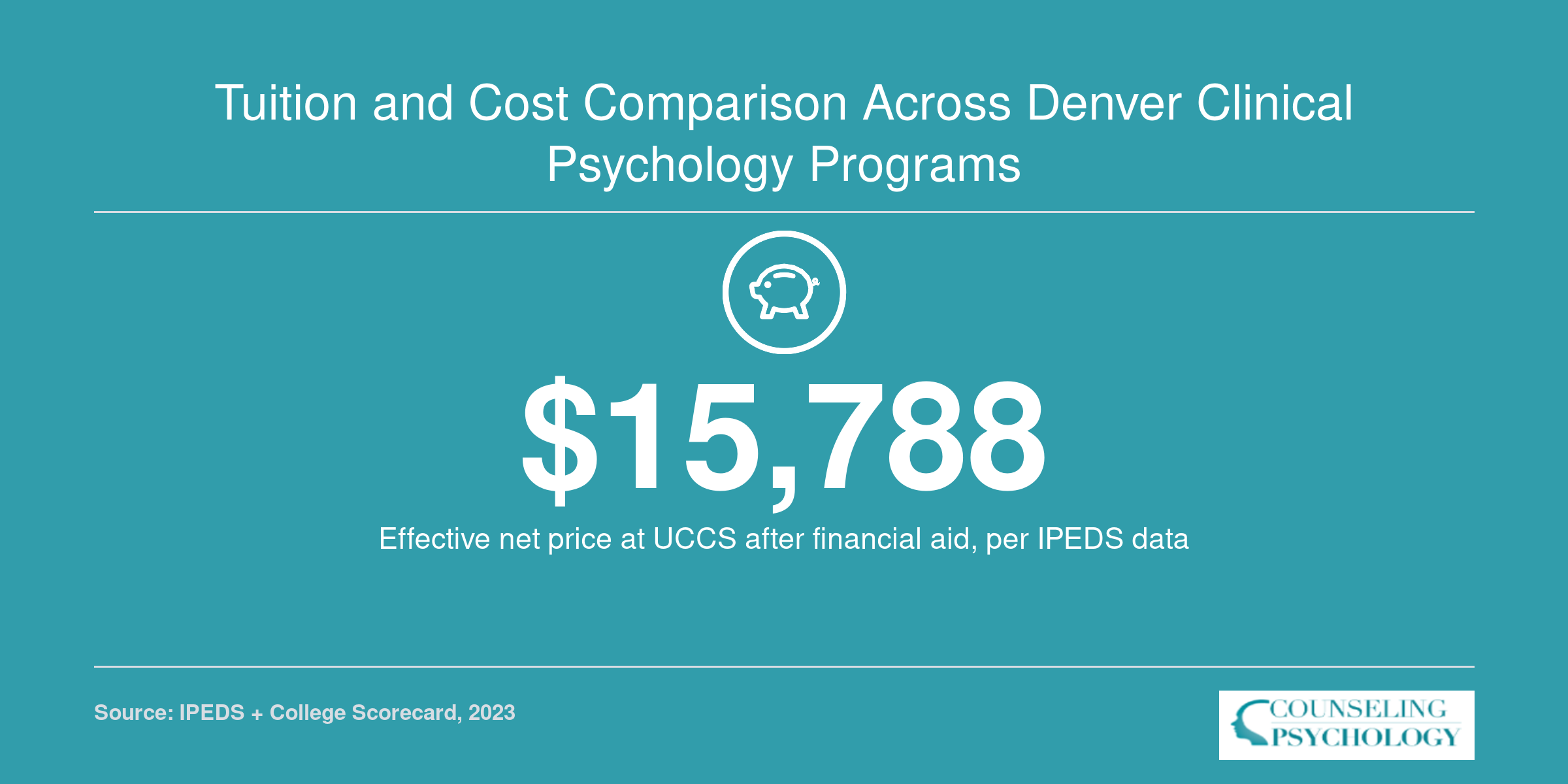
Sticker tuition rarely tells the full story. After institutional aid, grants, and scholarships are applied, the net price students actually pay is often significantly lower than the published rate. For the UCCS Clinical Psychology MA, for example, the effective net price is roughly comparable to in-state tuition, even though out-of-state rates run nearly $12,000 higher. Program-level debt and monthly repayment figures for this program are not yet published, but the institution-wide median graduate debt of $20,000 offers a useful reference point.
MA vs. PsyD vs. PhD: Cost, Time, and Outcome Differences
Choosing between an MA, PsyD, and PhD in clinical psychology is ultimately a decision about cost tolerance, career ceiling, and how long you can afford to be in school. Denver area students have access to affordable MA options, but understanding how those programs stack up against doctoral tracks is essential before committing. Here is a side by side look at the three pathways using real cost and outcome data.
| Factor | MA in Clinical Psychology | PsyD in Clinical Psychology | PhD in Clinical Psychology |
|---|---|---|---|
| Typical Duration | 2 to 2.5 years | 5.5 years (median) | 6 years (median) |
| Total Tuition Range | $15,700 to $27,200 (e.g., UCCS in state vs. out of state) | $150,000 to $257,000+ (e.g., George Fox at $151,580; William James College at $257,280) | $0 in most funded programs |
| Stipend or Funding | Limited assistantships; no guaranteed stipend | Stipends are rare; most students are self funded | $18,000 to $32,000 annual stipend plus tuition waiver |
| Typical Graduate Debt | Around $20,000 (College Scorecard, UCCS) | $100,000 to $450,000 | Minimal to none in funded programs |
| Licensure Ceiling in Colorado | Licensed Professional Counselor (LPC) or Certified Addictions Counselor (CAC) | Licensed Psychologist | Licensed Psychologist |
| Scope of Practice | Therapy, counseling, community mental health | Therapy, psychological testing, diagnosis, supervision | Therapy, testing, diagnosis, supervision, academic research |
| Career Settings | Community agencies, private practice (under supervision initially), schools, nonprofits | Hospitals, private practice, group practices, VA settings | Universities, research labs, hospitals, private practice |
| Institutional Example (Denver Area) | UCCS: 47 credit hours, scientist practitioner model, on campus | University of Denver GSPP: estimated $180,000 to $200,000 total | Varies; fully funded spots are competitive statewide |
Admission Requirements for Denver Clinical Psychology Programs
The GRE has rapidly moved from near-universal requirement to optional at many clinical psychology graduate programs, yet a handful of Denver-area programs still maintain distinct testing expectations. Understanding the shifting terrain of prerequisites, GPA thresholds, and application materials is essential for applicants planning a 2025-2026 launch.
Standard GPA and Prerequisite Courses
Most Denver-area MA programs in clinical psychology recommend a cumulative GPA of 3.3 for competitive admission, though published minimums can dip to 3.0.1 For example, the University of Colorado Denver MA in Clinical Psychology lists a 3.0 minimum but advises that successful candidates typically present a 3.3 or higher.2
Prerequisite coursework follows a consistent template across Colorado programs. Applicants should expect to see requirements for: - Introductory Psychology: Foundational understanding of the field. - Research Methods: Exposure to experimental and correlational designs. - Statistics: Competency in quantitative analysis. - Abnormal Psychology or Psychopathology: Familiarity with diagnostic frameworks.
At CU Denver, the exact prerequisite list includes Introductory Psychology, Research Methods, Statistics, and Psychopathology. The University of Colorado Colorado Springs (UCCS) MA program additionally seeks upper-division psychology courses along with those core four.1 A bachelor's degree in psychology or a closely related field is typical, but many programs accept students without an undergraduate psych major provided the prerequisites are completed before or shortly after enrollment.
The GRE Landscape in Denver for 2025-2026
Testing requirements now vary sharply by institution. The CU Denver MA in Clinical Psychology is an outlier: it still mandates the Psychology GRE Subject Test (clinical subtest) at the 50th percentile or above, and no waiver is available. In contrast, the UCCS Clinical Psychology MA requires no GRE or subject test at all.1 Doctoral programs in the area also reflect this split: the University of Denver PsyD in Clinical Psychology and CU Denver's PsyD in School Psychology are both test-optional for the current cycle.45
This patchwork means each applicant must check program websites carefully. A student targeting only master's-level licensure might bypass the GRE entirely by selecting programs like UCCS, while those eyeing the CU Denver MA will need to budget time for subject test preparation. If you are still exploring broader options, our guide to masters in clinical psychology programs covers national alternatives worth considering.
What About Admissions Selectivity?
Admissions selectivity can be difficult to gauge for graduate programs because many schools report only university-wide acceptance rates. Institutionally, UCCS admits roughly 97% of undergraduate applicants, but master's-level clinical psychology cohorts may be far smaller and more curated. Program-specific acceptance data are not publicly available for most Denver institutions, so prospective students should contact departments directly for the most current picture of cohort size and selectivity.
Pulling Together a Strong Application
Beyond transcripts and test scores, application packages for Denver clinical psychology MA programs typically require: - Letters of recommendation: Two to three, ideally from academic sources familiar with your research or clinical potential. - Statement of purpose: A focused essay linking your experiences to the program's training model and your career goals. - Resume or CV: Highlighting relevant volunteer, research, or work experience.
Some programs, especially those following a scientist-practitioner model (like CU Denver and UCCS), weigh research experience heavily, so even a semester in a lab can strengthen a file. Students who may eventually pursue a doctorate should also review clinical psychology doctorate programs to understand how master's-level preparation aligns with PhD or PsyD expectations. Deadlines cluster in early winter for fall admission, and reviewing requirements now ensures you have time to complete any missing prerequisites or sit for required exams.
Career Outcomes and Earnings After Graduation
Graduates of Denver-area clinical psychology master's programs enter a job market where credential level directly determines both role eligibility and salary ceiling. Understanding these distinctions helps you set realistic expectations and plan your career trajectory from the outset.
What MA Graduates Actually Earn in Colorado
Program-level earnings data from federal scorecards for the University of Colorado Colorado Springs clinical psychology MA program is not yet published, meaning we cannot cite specific one-year, two-year, or four-year post-graduation median earnings for these graduates at this time. When this information becomes available, it will offer the clearest picture of what students from this particular program earn after completing their degrees.
For broader context, we can look at Bureau of Labor Statistics occupational wage data. The 2025 Denver-Aurora-Lakewood MSA wage estimates are the most recent available, though 2026 data has not yet been published.1 Mental health counselors, the most common role for MA-level psychology graduates pursuing licensure as an LPC, typically earn less than doctoral-level clinical psychologists. Nationally, clinical and counseling psychologists (a category that primarily captures doctoral-level practitioners) earned a median annual wage of $90,130 as of May 2022, with the middle 50 percent earning between $62,070 and $126,240.2
MA-Level Roles vs. Doctoral-Level Positions
The earnings gap between master's and doctoral credentials in clinical psychology is substantial:
- Licensed Professional Counselors (LPC): MA graduates in Colorado typically pursue LPC licensure, which authorizes them to provide mental health counseling services. Counselor salaries in the Denver metro area generally fall below the median for doctoral-level psychologists.
- Licensed Clinical Psychologists: This credential requires a doctoral degree (PhD or PsyD), supervised experience, and passing the EPPP examination. The national median of $90,130 reflects this higher bar of entry, with top earners at the 90th percentile reaching $168,790 annually.2
- Entry-Level Variance: At the 10th percentile nationally, clinical psychologists earn approximately $42,760, illustrating that even doctoral holders face significant variation based on setting, experience, and specialization.2
Students interested in comparing master's-level pathways across the helping professions may also want to explore MFT programs in Colorado, which prepare graduates for a different licensure track with its own earning profile.
Employment Outcomes for Denver Graduates
Employment rates and poverty-threshold metrics for the UCCS clinical psychology MA program are not currently reported in available federal data. These figures, when published, would indicate what percentage of graduates secured employment within one year and how many earned above the federal poverty line.
For prospective students weighing these programs, the key takeaway remains clear: an MA in clinical psychology from a Denver-area institution positions you for counselor-level roles with corresponding salaries, while doctoral programs unlock the licensed psychologist title and its higher earning potential. Graduates who want to broaden their options can also consider counseling master's programs online, which may offer additional flexibility and specialization. The MA pathway offers faster entry into the workforce at lower tuition cost, but career advancement into senior clinical or supervisory roles may eventually require doctoral study.
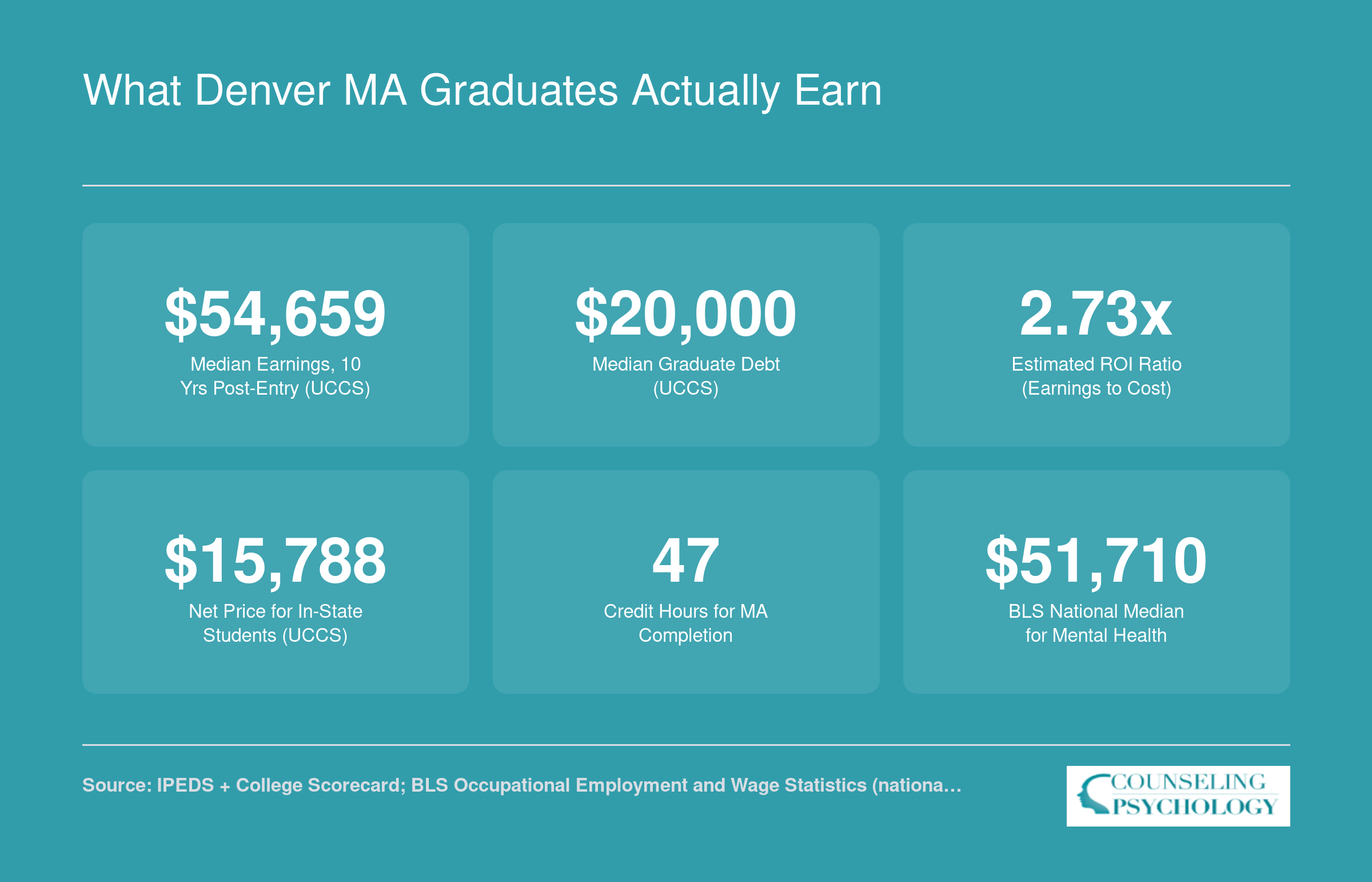
What Denver MA Graduates Actually Earn
Program-level earnings data for clinical psychology MA completers in the Denver area are not yet published, but institution-wide and regional labor market figures give a useful financial snapshot. MA holders in clinical psychology typically enter counseling roles such as mental health counselor or marriage and family therapist, where starting salaries are lower than those available to doctoral graduates who qualify for licensed psychologist positions.
Financial Aid, Assistantships, and Funding Options for MA Students
Most competitors gloss over funding at the master's level, so let's fill that gap. The reality is that MA clinical psychology students rely heavily on loans, part-time work, and creative stacking of smaller aid sources.1 Full funding packages comparable to what doctoral students receive are rare at Denver-area programs, but workable options do exist if you know where to look.2
Assistantships and Tuition Waivers
Graduate assistantships (GA/TA positions) are the single best way to offset tuition, though competition is stiff. At the University of Denver, assistantships come with a stipend and a tuition waiver, but the waiver is only available when a stipend is awarded, and slots are limited.2 CU Denver offers part-time assistantships for its MA in Clinical/Health Psychology, yet full tuition waivers are much less common there, and most students end up covering costs through loans and out-of-pocket payments.2 Apply for assistantships the moment your admissions offer arrives; waiting even a few weeks can take you out of the running.
Federal Loan Options and Repayment Strategies
Graduate students are eligible for Direct Unsubsidized Loans (up to $20,500 per year) and Grad PLUS Loans for remaining costs. After graduation, income-driven repayment plans such as SAVE, PAYE, or IBR can cap monthly payments at a percentage of discretionary income. If you plan to work in community mental health counseling, a nonprofit clinic, or a government agency, Public Service Loan Forgiveness (PSLF) can discharge remaining balances after 120 qualifying payments. This pathway is especially relevant in Colorado, where behavioral health agencies serving underserved populations often qualify as PSLF employers.
Colorado-Specific Aid
Colorado offers the Colorado Graduate Grant through participating institutions, which provides need-based support for resident graduate students. The state has also expanded behavioral health workforce development grants through the Behavioral Health Administration, targeting students entering high-need disciplines like clinical psychology. Check with your program's financial aid office for current allocations, as these funds shift year to year.
Employer Tuition Reimbursement
Don't overlook employer-sponsored benefits. Several major Denver-area health systems and community mental health centers offer tuition reimbursement for employees pursuing relevant graduate degrees. Students already working in behavioral health or a related field, including those exploring clinical mental health counseling masters programs in Colorado, can meaningfully reduce their net cost through these arrangements.
Pell Grant Indicators at Area Institutions
Pell Grants are awarded to undergraduates, not graduate students, but the share of Pell recipients at a school signals the institution's commitment to serving students with financial need. At UCCS, for instance, roughly 58% of undergraduates receive Pell Grants. This is an institution-wide figure rather than a program-specific one, but schools with high Pell percentages often maintain stronger need-based aid infrastructure at all levels, including robust financial aid advising for graduate students.
The bottom line: plan to piece together multiple funding sources rather than waiting for a single large award. Start applications early, talk to each program's financial aid office before committing, and factor loan repayment strategy into your decision from day one.
Licensure Pathways for MA Clinical Psychology Graduates in Colorado
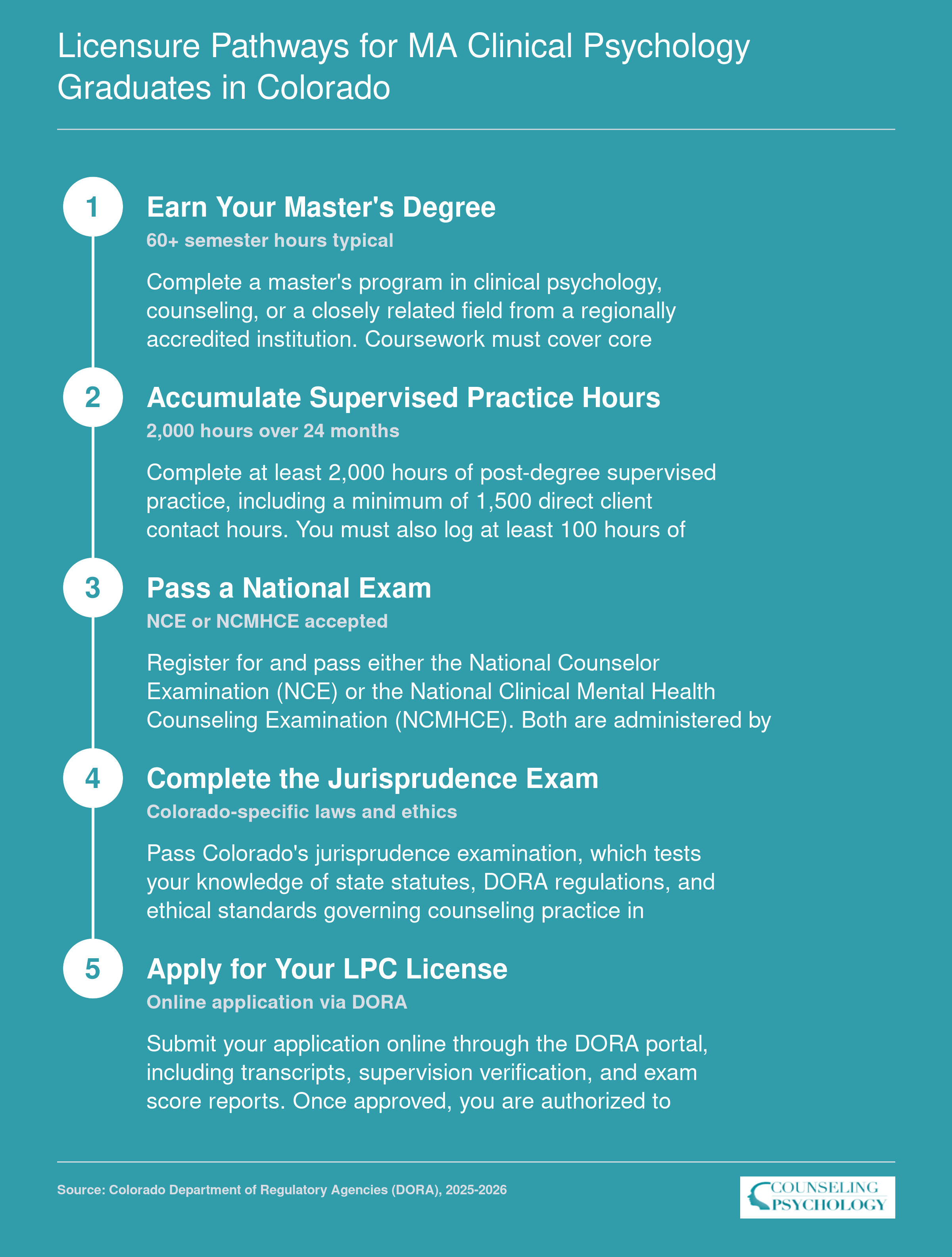
Colorado does not grant full psychologist licensure or a limited-practice psychologist credential to master's-level holders. The primary clinical pathway for MA clinical psychology graduates is the Licensed Professional Counselor (LPC) license, issued by the Colorado Department of Regulatory Agencies (DORA). Here is the step-by-step sequence.
Licensure Details: LPC, CAC, and Psychologist Routes in Colorado
Colorado requires 2,000 hours of post-master's supervised practice for Licensed Professional Counselor (LPC) licensure, with at least 1,500 hours in direct client contact and a minimum of 100 supervision hours over at least two years.1 This supervised experience is the primary pathway for MA clinical psychology graduates seeking independent practice in Colorado.
Can You Become a Licensed Psychologist with a Master's Degree in Colorado?
No. Colorado does not offer a master's-level limited psychologist license. Full licensure as a psychologist in Colorado requires a doctoral degree (PhD or PsyD) in psychology, plus an additional 3,000 supervised hours post-doctorate. MA holders cannot call themselves psychologists or practice independently under that title, regardless of their clinical training. The LPC credential is the appropriate terminal license for master's-level clinicians.
Colorado LPC Supervision Requirements
Your 100 supervision hours must include at least 50 hours of individual supervision.1 Supervisors must hold an active LPC, psychologist, LCSW, or LMFT license in Colorado, have at least three years of post-licensure experience, and complete six hours of supervisor training plus three hours of continuing education annually.34 If you use multiple supervisors, at least half of your total supervision hours must come from an LPC with five years of experience.6 This 3-3-4 rule (three years' experience, three hours of continuing education, four different supervisors maximum) protects the integrity of your supervised hours.4
Once you complete your hours, you must pass either the National Counselor Examination (NCE) or the National Clinical Mental Health Counseling Examination (NCMHCE), plus the Colorado Mental Health Jurisprudence Exam.2
Certified Addictions Counselor (CAC) Pathway
MA clinical psychology graduates interested in substance use treatment can pursue Certified Addictions Counselor (CAC) credentials through the Colorado Department of Human Services. CAC levels (CAC I, II, III) have lower supervised-hour requirements than LPC licensure and focus specifically on addiction counseling. A CAC III credential requires 6,000 hours of supervised experience but allows independent practice in addiction treatment settings. Many MA holders pursue both LPC and CAC credentials to expand their employability in integrated behavioral health environments. If you are considering this route, learning how to become an addiction counselor can help you map out the required steps.
Reciprocity and Portability
Colorado is a member of multiple licensure compacts, but LPC reciprocity varies by state. Most states recognize Colorado's LPC through endorsement processes that require additional jurisprudence exams and background checks. States with similar 60-credit master's degree requirements and 2,000-hour thresholds typically grant reciprocity fastest. If you plan to relocate or practice in multiple states, verify specific portability agreements with your target state's licensing board before completing your Colorado hours.
Online and Hybrid MA Clinical Psychology Options in Colorado
Most prospective students searching for fully online MA clinical psychology programs in Colorado quickly discover a limited landscape. As of 2026, no Colorado-based institution offers a fully online master's in clinical psychology that leads directly to master's-level licensure.1 The on-campus programs at UCCS and CU Denver, profiled earlier, require in-person attendance for coursework and practicum placements.23
Are There Online Clinical Psychology Master's Programs in Colorado?
The short answer is no, not in the traditional clinical psychology sense. Colorado Christian University offers a 100% online MS in Psychology, but it is a general psychology degree without the supervised clinical hours or diagnostic training required for licensure as a psychologist or professional counselor.4 Similarly, the University of Arizona Global Campus (formerly Ashford) provides an online MA in Psychology, but it lacks a clinical emphasis and does not include practicum requirements.1
For students seeking both flexibility and a path to Colorado licensure, the closest option is clinical mental health counseling, not clinical psychology. Colorado Christian University and Adams State University both offer online MA programs in Clinical Mental Health Counseling that are CACREP-accredited. These programs deliver coursework asynchronously but require students to complete practicum and internship hours in person at local approved sites, typically within the student's own community.
Out-of-State Online Options Accessible to Colorado Residents
Pepperdine University offers an online MA in Clinical Psychology that accepts students nationwide, including Colorado. The program's coursework is delivered online, but students must arrange in-person practicum placements at sites near their home location.5 Capella University similarly offers an online MS in Clinical Mental Health Counseling with local practicum requirements.
Practicum and Clinical Hour Requirements
Regardless of the delivery format, all programs leading to licensure in Colorado mandate supervised, face-to-face client contact hours. Even fully online coursework cannot replace this hands-on training. Expect 600 to 1,000 supervised clinical hours across practicum and internship, completed at approved mental health agencies, hospitals, or private practices. Online programs coordinate these placements but leave responsibility for securing local sites primarily to the student.
If flexibility is essential, hybrid counseling programs offer a middle path. If traditional clinical psychology training is the goal, plan for an on-campus MA or wait to pursue a doctoral program with residential requirements.
How to Choose the Right Affordable Clinical Psychology Program
The cheapest program on paper can turn out to be the most expensive choice if it leaves you ineligible for licensure or underqualified for the jobs you want.
Accreditation: Know Which Standard Applies to Your Degree
For master's-level counseling programs, CACREP accreditation is the credential that matters most. Colorado's LPC licensure board recognizes CACREP-aligned curricula, and many employers specifically seek graduates from CACREP-accredited programs. APA accreditation, by contrast, applies to counseling doctoral programs (PsyD and PhD) and internship sites. If you are pursuing a master's degree, do not let APA accreditation on a school's website substitute for CACREP status on the specific program you plan to enroll in.
Before you submit an application, pull up Colorado's LPC licensure requirements and compare them line by line against the program's required coursework. Programs that fall just short of a required course area can cost you additional post-graduation coursework, supervised hours, and time.
Clinical Training Quality Matters as Much as Price
Look beyond tuition at the practicum structure. Ask programs directly how many supervised clinical hours students accumulate before graduation, what types of placement sites are available, and what the student-to-faculty ratio looks like in practicum supervision groups. A program that places you in high-quality community mental health or integrated care settings builds your resume while you are still enrolled.
Calculate the Full Cost of Attendance
Tuition is one line item. The real cost includes:
- Housing and transportation: Practicum sites may not be near campus, and Denver's cost of living is significant.
- Supervision fees post-graduation: Colorado requires supervised hours toward LPC licensure after you graduate, and licensed supervisors typically charge for their time.
- Program fees and materials: Some programs add per-credit technology or clinical training fees that inflate the total well beyond advertised tuition rates.
ROI Depends on What You Can Earn and What License You Can Obtain
A program priced at $10,000 less than a competitor means little if its graduates consistently struggle to pass licensure exams or cannot access the supervision networks that lead to full licensure. When comparing programs, weigh earnings outcomes and licensure passage rates alongside sticker price. Salary and licensure data published by industry sources can help you benchmark realistic outcomes before you commit to a program.
Frequently Asked Questions About Clinical Psychology Programs in Denver
Denver-area students exploring affordable clinical psychology graduate programs often share the same set of practical questions. Below are concise, data-informed answers to the most common concerns about cost, licensure, earnings, and admissions.
Pursuing an affordable clinical psychology degree in Denver means navigating a small but workable set of programs, where net price after aid matters far more than the tuition listed on a school's website. The UCCS MA stands out as the most cost-effective option in the region, but the right choice depends on which licensure path you intend to follow. A program that does not align with Colorado's LPC requirements will cost you time and money regardless of its sticker price.
Use the ranking and cost comparison earlier on this page to narrow your list, then contact admissions offices directly to ask about current net price, assistantship availability, and clinical placement support. Students still weighing whether a master's degree is the right credential, or whether doctoral training better fits their goals, can revisit our overview of clinical psychology doctorate programs for a broader comparison. Program pages and admissions counselors can clarify details that published data cannot. Start those conversations now, before application deadlines arrive.