What you’ll learn in this article…
- Bay Area counseling program costs range from roughly $6,067 at CSU Stanislaus to $58,098 at Pepperdine, a 9.5x spread.
- CACREP accreditation is critical for license portability if you might practice outside California.
- Most Bay Area programs require 600 to 700 supervised clinical hours before graduation.
- California LPCC licensure typically takes 5 to 7 years from the start of a graduate program.
California now requires 3,000 supervised clinical hours and two licensing exams to become a Licensed Professional Clinical Counselor, making the choice of graduate program, practicum network, and specialty track directly consequential for both licensure timeline and early-career earnings. The Bay Area hosts a competitive training landscape: ten ranked programs span public and private institutions, campus-based and fully online formats, and tuition ranging from roughly $7,000 to over $58,000 in net annual cost.
The practical challenge prospective students face is not simply finding a program, but aligning degree type, licensure pathway, and clinical training model with career goals. Some programs prepare graduates for LPCC licensure, others for LMFT (including MFT programs in California), and a few offer dual-track options. Accreditation matters: CACREP-accredited programs simplify interstate reciprocity, while California-compliant non-CACREP programs serve students who plan to stay in-state.
Demand for mental health professionals in the Bay Area remains strong across community clinics, school settings, and private practice, but the credential you earn shapes your scope of practice, reimbursement rates, and hiring pool. Choosing between a counseling psychology master's and a clinical psychology doctorate, or between LPCC and LMFT tracks, determines not just what you study but where you can work and how quickly you can build supervised hours toward full licensure.
Program Cost and ROI: Which Bay Area Counseling Programs Deliver the Best Value?
The cost gap between the most and least expensive counseling psychology programs in this comparison is significant: Pepperdine University's institution-wide average net price sits near $58,098, while CSU Stanislaus comes in around $6,067, roughly a 9.5x spread. Despite that difference, median graduate debt across these schools falls within a tighter band of roughly $13,540 to $23,691. Note that the net price figures shown are institution-wide averages from federal data and reflect aid across all students; your individual cost will depend on your program, enrollment status, and financial aid package. Program-level earnings after graduation are not yet available for these counseling psychology programs, so the table below uses institution-wide median earnings at 10 years post-entry as a proxy for long-term return.
| School | In-State Tuition | Avg. Net Price | Median Graduate Debt | 10-Year Median Earnings (Institution-Wide) | ROI Ratio |
|---|---|---|---|---|---|
| Santa Clara University | $31,694 | $50,062 | $19,162 | $109,183 | 5.70 |
| UC Santa Barbara | $15,124 | $16,109 | $13,993 | $74,915 | 5.35 |
| CSU Stanislaus | $9,766 | $6,067 | $13,540 | $63,188 | 4.67 |
| San Francisco State University | $9,370 | $12,278 | $15,371 | $68,077 | 4.43 |
| CSU Fresno | $8,865 | $7,000 | $14,505 | $61,244 | 4.22 |
| Sonoma State University | $10,148 | $12,885 | $16,705 | $65,986 | 3.95 |
| CSU Chico | $9,996 | $14,480 | $16,552 | $64,172 | 3.88 |
| Pepperdine University | $44,056 | $58,098 | $23,510 | $82,939 | 3.53 |
| Chapman University | $39,868 | $46,555 | $20,500 | $70,070 | 3.42 |
| Saint Mary's College of California | $38,500 | $30,378 | $23,691 | $78,812 | 3.33 |
Questions to Ask Yourself
Counseling Psychology vs. LPCC vs. LMFT: Choosing the Right California Pathway
Which license should you pursue if you want to practice therapy in California: psychologist, LPCC, or LMFT?
This is one of the most consequential decisions you'll make before applying to graduate programs, because the three pathways lead to different licenses, training models, and career trajectories. A common source of confusion: counseling psychology graduate programs can mean either doctoral programs that lead to psychologist licensure or master's programs that prepare you for clinical counselor licensure. Understanding the distinctions will save you time, money, and frustration.
Counseling Psychology: The Doctoral Route to Psychologist Licensure
A counseling psychology degree at the PhD or PsyD level trains you to become a licensed psychologist in California. These programs typically require five to seven years of full-time study, including coursework, clinical practica, a doctoral dissertation or capstone, and a one-year pre-doctoral internship. Upon graduation and completion of 3,000 supervised hours post-doctorate, you sit for the Examination for Professional Practice in Psychology (EPPP) and the California Psychology Law and Ethics Exam to earn your psychologist license.
Licensed psychologists hold the broadest scope of practice in California. You can diagnose mental disorders, provide individual and group therapy, conduct psychological and neuropsychological testing, and work in diverse settings from private practice to hospitals, universities, and research institutions. The doctoral pathway is research-intensive and prepares you for academic, clinical, and consulting roles.
LPCC: Master's-Level Clinical Counseling
The Licensed Professional Clinical Counselor credential is California's master's-level license for clinical mental health counseling. LPCC programs typically require 60 semester units and two to three years of full-time study.1 After graduation, you must complete 3,000 hours of supervised experience over a minimum of 104 weeks, then pass the National Clinical Mental Health Counseling Examination (NCMHCE) and the California LPCC Law and Ethics Exam.1
LPCCs diagnose and treat mental and emotional disorders across the lifespan.3 Your scope includes individual, couples, and family therapy, though testing is restricted per state regulations.3 CACREP-accredited programs streamline the LPCC licensure path in California and improve interstate portability, making it easier to transfer your license if you move. Many Bay Area programs hold CACREP accreditation, and choosing one can simplify post-graduate supervision and reciprocity. For a broader look at the profession, our guide on how to become a licensed professional counselor covers the national landscape.
LMFT: Master's-Level Marriage and Family Therapy
The Licensed Marriage and Family Therapist track also requires a master's degree, typically 60 units and two to three years. Post-graduation, you complete 3,000 supervised hours over at least 104 weeks, then pass the California LMFT Clinical Exam and the California LMFT Law and Ethics Exam.2
LMFTs diagnose mental disorders and provide therapy to individuals, couples, and families, with a curriculum grounded in systems theory and relational dynamics.2 The scope overlaps substantially with LPCC, but LMFT training emphasizes relational and family systems perspectives, making it a strong fit if you plan to work primarily with couples, families, or children in relational contexts.
How to Decide
Choose the doctoral counseling psychology route if you want the psychologist title, plan to conduct psychological testing, or aspire to academic or research careers. Choose LPCC if you want a clinical counseling master's program online or on-campus with strong CACREP portability and a focus on individual mental health across settings. Choose LMFT if relational and family systems work aligns with your clinical interests. All three licenses allow independent practice in California; your choice hinges on training philosophy, time commitment, and career goals.
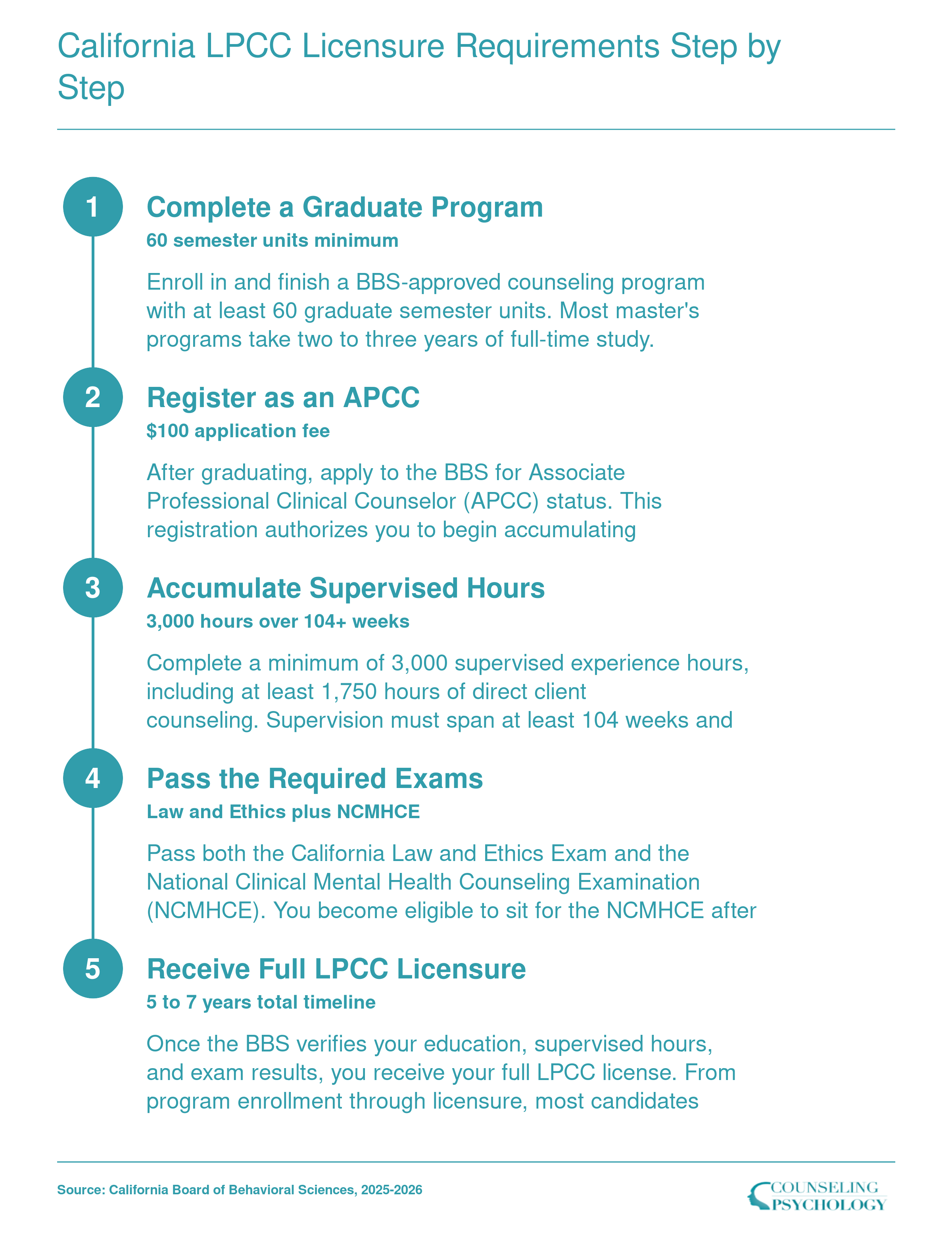
California LPCC Licensure Requirements Step by Step
Earning your Licensed Professional Clinical Counselor (LPCC) credential in California is a structured process that typically spans 5 to 7 years from the start of your graduate program to full licensure. Each stage has specific requirements set by the California Board of Behavioral Sciences (BBS). Here is the sequence you should plan for as of 2025-2026.
Graduate Earnings and Career Outcomes in the Bay Area
Master's-level counselors and doctoral-level counseling psychologists both find strong demand in the San Francisco Bay Area, but the gap between the two credential tiers shows up clearly in long-term compensation.
What Program-Level Earnings Data Tells Us
For most Bay Area counseling psychology master's programs, program-specific earnings figures (such as median salary one year or four years after graduation) are not yet available through federal reporting. That means prospective students cannot directly compare, say, Santa Clara University graduates against San Francisco State University graduates on post-completion wages at the program level. Until those data are published, occupation-level wage statistics from the Bureau of Labor Statistics offer the most reliable proxy.
Occupation-Level Wages in the San Francisco Metro Area
According to BLS data for the San Francisco metropolitan area (covering substance abuse, behavioral disorder, and mental health counselors under SOC 21-1018), the mean annual wage was approximately $72,950 as of May 2023.1 That figure sits well above both the California statewide median of $61,310 and the national median of $53,710 for the same occupation category.2 The local wage range is wide:
- 10th percentile: roughly $46,430, typical for early-career or associate-level clinicians still accruing supervised hours.
- 90th percentile: roughly $104,690, representing experienced licensed counselors in supervisory roles, private practice, or specialized settings.
California statewide, the 90th percentile climbs even higher, to about $118,970 (2024 data), reflecting the premium that certain metro markets and clinical niches command.
Master's vs. Doctoral Earnings Gap
Most graduates of the programs listed in this guide, including those at Santa Clara University, Saint Mary's College of California, Notre Dame de Namur University, and San Francisco State University, earn a master's degree that qualifies them for LPCC or LMFT licensure. These master's-level clinicians typically land within the BLS wage bands described above. For a broader look at counselor salary with masters credentials nationwide, occupation-level data confirm a meaningful gap between degree tiers. Doctoral-level counseling psychologists generally earn higher salaries because they can bill at psychologist rates, conduct psychological testing, and hold positions in academic or research settings that require a doctorate. Those interested in pursuing that higher credential can explore counseling doctoral programs to understand the investment involved. While precise Bay Area figures for doctoral counseling psychologists are harder to isolate (BLS groups them with other psychologist categories), national data suggest a premium of 20% to 40% above master's-level counselor medians, depending on setting and years of experience.
Job Growth Outlook
The demand picture reinforces the financial case for entering this field. BLS projects a 16.8% growth rate nationally for substance abuse, behavioral disorder, and mental health counselors between 2024 and 2034, considerably faster than average across all occupations.2 California, with over 54,660 professionals employed in this category as of 2023, is one of the largest state-level markets for these roles.3 The Bay Area's concentration of community mental health agencies, integrated health systems, school districts, and private practices means graduates of nearby programs often secure clinical placements and employment without relocating.
Keep in mind that individual outcomes depend heavily on licensure type, clinical specialty, practice setting, and negotiation. Graduates who pursue dual LPCC and LMFT licensure or add specialized credentials in areas like trauma or substance use disorders tend to move toward the upper end of the wage distribution faster. The California counseling salary landscape rewards both credential depth and clinical versatility.
Clinical Training and Specializations at Bay Area Programs
Bay Area counseling programs typically require 600 to 700 supervised clinical hours before graduation, structured as sequential practicum and fieldwork rotations. Students begin with on-campus training clinics, then advance to community partner sites where they work under licensed supervision. This progression ensures exposure to diverse clinical populations and the evidence-based modalities required for California licensure. Programs like San Francisco State University's M.S. in Counseling embed students in community mental health centers, schools, and substance abuse clinics across the Bay Area, while Santa Clara University's M.A. in Counseling Psychology offers specialized tracks in correctional psychology and couples counseling, reflecting the region's demand for both forensic and relational expertise.
Concentrations and Specialty Tracks
Several Bay Area programs list formal concentrations that align with regional workforce needs. San Francisco State University offers a career counseling specialization that prepares students for school and community-based career development roles.1 Santa Clara University provides a correctional psychology emphasis, training students to work in California's criminal justice and reentry systems. The California Institute of Integral Studies emphasizes holistic and multicultural counseling, integrating somatic and transpersonal methods alongside traditional clinical training. Students interested in clinical mental health counseling online programs may also want to compare on-campus Bay Area options with flexible distance formats. These concentrations allow students to tailor practicum placements and elective coursework to their intended career path, whether working with Latinx families, LGBTQ+ youth, trauma survivors, or individuals navigating substance use disorders.
Why Practicum Site Quality Matters
The quality and diversity of practicum partnerships directly affect both licensure readiness and early-career competitiveness. California's Board of Behavioral Sciences requires that supervised experience occur under a qualified, board-approved supervisor and that trainees demonstrate competence across a range of presenting issues. Bay Area programs benefit from proximity to safety-net hospitals, multilingual community clinics, K-12 school districts, and specialty centers serving immigrants, veterans, and unhoused populations. Graduates who have worked with child and adolescent populations, for instance, may pursue roles such as child abuse counselor positions in community agencies. This geographic advantage means students graduate with documented hours in high-acuity settings, a credential that strengthens applications for postgraduate associateship positions and accelerates the path to independent licensure.
What About UCSF?
UCSF does not offer a standalone counseling psychology or clinical psychology master's or doctoral degree program.2 The university operates an APA-accredited doctoral internship and postdoctoral fellowship through its Clinical Psychology Training Program, which accepts only students already enrolled in APA-, PCSAS-, or CPA-accredited doctoral programs elsewhere.2 UCSF also runs a specialized child clinical psychology internship3, but neither program confers a graduate degree. Prospective students seeking a degree in counseling or clinical psychology should look to other Bay Area institutions such as the University of San Francisco (which holds APA accreditation for its PsyD program, though currently listed as inactive)4, San Francisco State University, or Santa Clara University.
Programs for Working Professionals and Career Changers
Balancing a full-time job, family obligations, or a mid-career pivot with graduate school is a real constraint, not a footnote. Several Bay Area programs build their schedules around this reality, while others assume you can be on campus during business hours. Knowing the difference before you apply saves you from a 60-credit headache.
Programs Built Around Evening and Weekend Schedules
A handful of regional programs explicitly cater to working adults:
- University of San Francisco MA in Counseling Psychology: Late afternoon and evening blocks on the SF campus (3:45 to 9:50 p.m.), with a 3-year extended track and a 6-week summer intensive option. USF actively recruits career changers with relevant professional experience.1
- San Francisco State MS in Clinical Mental Health Counseling: Part-time enrollment is permitted in this 60-credit program, with daytime, late-afternoon, and evening sections. Two academic-year field placements still require daytime availability, so plan ahead.2
- Notre Dame de Namur MS in Clinical Psychology (MFT): Late afternoon, evening, and weekend classes, with part-time pacing built in for working adults.3
- Saint Mary's College of California MA in Counseling: Evening and weekend classes across 2 to 3.5 year tracks.
- California Institute of Integral Studies: Weekend-format concentrations (Community Mental Health, Integral Counseling Psychology on-campus and hybrid) plus low-residency options in Expressive Arts Therapy and the hybrid Integral track. Weekend students must reside in CA, OR, NV, or WA; Expressive Arts requires California residency.4
Hybrid and Online Formats Worth a Look
Fully online California-based options exist if commuting is off the table. Pepperdine's online MA in Clinical Psychology (MFT emphasis) is built for distance learners and meets California LMFT and LPCC requirements. Vanguard University offers both online and on-campus formats for its MS in Clinical Psychology. When evaluating any online program, confirm CACREP accreditation status if you intend to pursue LPCC licensure, and verify that the program is approved by the California Board of Behavioral Sciences (BBS) for the license you want. If you are weighing marriage and family therapy master's programs nationally, these same checkpoints apply.
Advice for Career Changers
Most California counseling programs do not require an undergraduate psychology major. Programs like CIIS list only a couple of prerequisite psychology courses, which you can knock out at a community college before applying.4 Admissions committees at USF, NDNU, and CIIS routinely admit applicants from teaching, healthcare, nonprofit, ministry, and corporate backgrounds. What they want is evidence that you understand the work: volunteer crisis-line hours, peer-support roles, or relevant professional experience usually weigh more than your undergraduate GPA from a decade ago. Exploring the broader landscape of types of counseling degrees can also help career changers identify which credential aligns best with their goals.
CACREP accreditation should top your priority list if you might practice outside California. While the Board of Behavioral Sciences licenses LPCCs based on California requirements, most other states require or strongly prefer CACREP credentials for license reciprocity. Choosing a CACREP program now, even if it costs more or requires a longer commute, protects your career mobility for decades.
Frequently Asked Questions About Counseling Psychology in San Francisco
Prospective students exploring counseling psychology in the Bay Area often have overlapping questions about specific schools, licensure timelines, and program differences. Below are direct, fact-based answers to the questions we hear most often.
More Counseling Psychology Programs to Consider Near San Francisco
Beyond the top-ranked programs listed above, the following schools offer counseling psychology degrees that may be of interest to Bay Area students. These programs are presented alphabetically by region for easy browsing.
Bay Area
- MA in Counseling Psychology
- MA in Counseling Psychology (Integral Psychology)
- MA in Counseling Psychology (Somatic and Yoga Psychology)
- Master of Science in Clinical Psychology (Marriage and Family Therapy)
- Master of Science in Clinical Psychology (Licensed Professional Clinical Counseling)
- Master of Science in Clinical Psychology (Consulting & Applied Psychology)
- Master of Arts in Counseling Psychology
- Master of Arts in Counseling (Clinical Mental Health Counseling)
Central Coast
- Counseling Psychology - MA
Central Valley
- Psychology M.S. - Counseling Track
- Master of Arts in Counseling with Pupil Personnel Services (PPS) Credential
- Master of Arts in Counseling: Professional Clinical Counselor (PCC)
Greater Los Angeles
- M.A. Clinical Mental Health Counseling
- M.A. Clinical Mental Health Counseling
- Master of Science in Counseling/Clinical Mental Health Counseling
- Master of Science in Counseling/Marriage, Family and Child Therapy
North State
- MS in Psychology (Counseling Psychology)
San Diego Area
- Master of Arts Degree in Counseling Psychology (California) (Marriage and Family Therapist Option)
- Master of Arts Degree in Counseling Psychology (California) (Combined MFT/LPCC (Licensed Professional Clinical Counselor) option)