
What you’ll learn in this article…
- Liberty University’s Psy.D. in Clinical Psychology received initial APA accreditation on May 27, 2026.
- Contingent status is full accreditation for graduates, meeting licensure requirements in all U.S. states.
- The decision signals faith-integrated training now holds equal standing at the highest levels of the profession.
On May 27, 2026, the American Psychological Association granted initial accreditation on contingency status to Liberty University's Psy.D. in Clinical Psychology, the first faith-integrated doctoral program at the university to earn this designation. The decision confirms that a curriculum built on a Christian worldview can satisfy the APA's rigorous training standards for health service psychologists.
For practitioners in clinical psychology, counseling, social work, and marriage and family therapy, the accreditation has concrete implications: it opens pathways to competitive internships, federal employment, and smoother licensure across state lines. Students who previously had to choose between a faith-aligned training environment and the professional advantages of an APA-accredited degree may no longer face that trade-off.
In a field where accreditation status shapes everything from internship match rates to licensure mobility, Liberty's move into the APA fold marks a real expansion of opportunity, and one that other Christian institutions will be watching closely.
What Happened: Liberty's PsyD Receives Initial APA Accreditation
The mental health field is increasingly recognizing that doctoral programs grounded in a faith perspective can meet the highest professional standards, a shift underscored by Liberty University's latest achievement. On May 27, 2026, the Commission on Accreditation of the American Psychological Association granted initial accreditation on contingency to Liberty's residential-only Doctor of Psychology (Psy.D.) in Clinical Psychology program.1 Hosted in the School of Behavioral Sciences, the program now joins the roster of APA-accredited doctoral programs.
The Accreditation Milestone
The APA's own description of the program highlights how it integrates faith and science. It stated that the curriculum "prepares graduates to serve as health service psychologists who are equipped to deliver evidence-based, best-practice interventions with professionalism, compassion, and integrity within a Christian worldview."1 This language confirms that the program's religious foundation did not preclude it from satisfying the APA's rigorous quality benchmarks.
Dean Dr. Kenyon Knapp called the accreditation "a nationally peer reviewed process which is the gold standard in psychology," reflecting the program's commitment to training skilled clinicians. The decision comes after a multi-year evaluation of the program's curriculum, faculty, training sites, and student outcomes.
Immediate Career Impacts
For students, the change is more than symbolic. Dr. Jeff McNeil, director of the doctoral program, explained that "this accreditation will help our students secure competitive internships and access federal employment, including the military."1 Many high-quality internships, especially those in Veterans Affairs medical centers and other federal settings, require attendance at an APA-accredited program. Students interested in those pathways can learn more about becoming an army psychologist and the specific steps involved. Similarly, licensure boards in most states mandate graduation from an accredited program, so this status removes a significant barrier for Liberty Psy.D. graduates.
Broader Context for the School of Behavioral Sciences
Liberty's School of Behavioral Sciences already offers a range of residential and online degrees spanning counseling vs psychology vs social work, all taught from a Christian worldview. While each program's accreditation is distinct, the Psy.D.'s APA recognition elevates the school's doctoral offerings and may strengthen the credibility of its entire training ecosystem. Prospective students can now point to an accredited clinical psychology doctorate that weaves faith into every aspect of preparation, from coursework to supervised practice.
What Does 'Accredited, on Contingency' Actually Mean?
When the American Psychological Association (APA) awards "accredited, on contingency" status to a doctoral program, it means the program has cleared a rigorous initial review and now meets the quality benchmarks required to train health service psychologists.1 It is a standard, temporary designation, the first formal stage in the accreditation lifecycle, not a caution or warning sign. This status confirms that Liberty University's Psy.D. program has demonstrated sound curriculum, faculty, and resources, but must now gather and report outcome data for its graduates before earning full accreditation.
The APA's Accreditation Tiers: Contingency, Full, and Probation
To avoid confusion, it helps to distinguish the three main accreditation statuses. Full accreditation is what established programs hold after several years of demonstrated student outcomes, site visits, and compliance with all standards. "Accredited, on contingency" sits one step below: it is granted to newly approved programs that have not yet produced enough outcome data to prove long-term effectiveness.2 It is a probationary period for gathering evidence, not a penalty. Probation, in contrast, is a sanction imposed on programs that have fallen out of compliance with APA standards.2 Contingency status signals a healthy, developing program; probation signals a program in need of correction. Understanding the difference is essential for students evaluating doctoral programs, just as verifying online psychology program accreditation is essential for those considering bachelor's-level study.
The Path from Contingency to Full Accreditation
The timeline from contingency to full accreditation follows a structured sequence. A doctoral program typically has a maximum of three years to achieve full status.1 During this window, Liberty must submit annual reports, undergo a mandatory second site visit, and, most critically, provide outcome data from its first cohorts, including internship match rates, licensure exam pass rates, and employment statistics.1 Currently, the program is required to submit only partial outcome data; full accreditation requires a complete set of outcomes.2 The Commission on Accreditation (CoA) reviews these materials and may grant full accreditation, extend the contingency period, or, in rare cases, withdraw accreditation if standards are not met.
What This Means for Current and Future Students
Students graduating from a program with "accredited, on contingency" status graduate from an APA-accredited program. That designation carries the same weight for licensure applications and employment eligibility as graduating from a fully accredited program. The APA's policies include grandfathering protections: if a program fails to achieve full accreditation, students who enrolled while it held contingent status are still considered graduates of an accredited program for licensure purposes. The CoA also requires programs to establish teach-out plans to protect students in the unlikely event of withdrawal. In short, enrolling now does not put a student's credentials at risk.
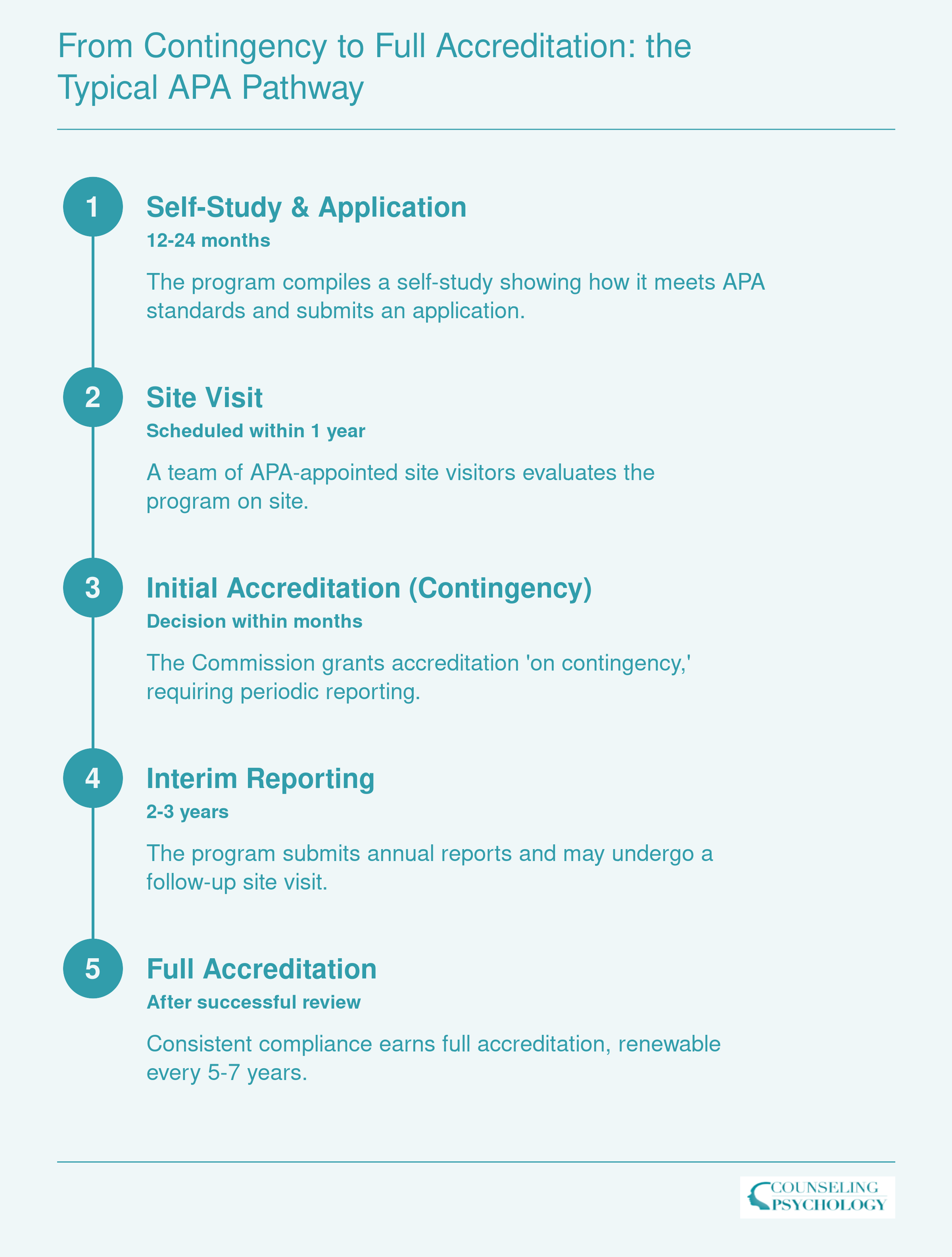
From Contingency to Full Accreditation: The Typical APA Pathway
When a program earns initial APA accreditation 'on contingency,' it has met core quality standards and enters a monitored period before achieving full accreditation. This pathway is the same for all newly accredited doctoral programs in clinical psychology.
How APA Accreditation Affects Licensure Eligibility by State
Does a degree from a program with initial APA accreditation on contingency status meet the education requirement for psychologist licensure? For students considering Liberty University's newly accredited PsyD, this is the crucial question. The short answer is yes: a contingent designation still counts as APA-accredited for licensure purposes in virtually all states. Understanding why this is the case, and where exceptions might matter, can help you plan a smooth path to practice.
Contingent Accreditation and Licensure: What's the Connection?
When the APA Commission on Accreditation (CoA) grants initial accreditation on contingency, it means a program has demonstrated it meets all foundational standards but remains under closer monitoring for a defined period.1 The APA itself treats this status as equivalent to full accreditation for a graduate's eligibility in licensure, internship matching, and employment settings where accreditation is required.2 State licensing boards follow the lead of the national accreditor: they look for "APA- or CPA-accredited" and do not typically distinguish between full and initial or contingent status. The Association of State and Provincial Psychology Boards (ASPPB) guidelines reinforce this, indicating that "accredited" encompasses programs in initial or provisional stages.2
State Requirements: APA-Only vs. Alternative Pathways
While the federal overview is consistent, individual states set their own licensure rules. A handful of jurisdictions explicitly require graduation from an APA-accredited doctoral program. As of the latest published board regulations, these include:1
- Georgia: APA-accredited doctoral program required.
- Hawaii: APA-accredited doctoral program required.
- Massachusetts: APA-accredited doctoral program required.
- Oklahoma: APA-accredited doctoral program required.
- Pennsylvania: APA-accredited doctoral program required.
- Tennessee: APA-accredited doctoral program required.
- Texas: APA-accredited doctoral program required.
For these states, a degree from Liberty's PsyD, even while on contingency, appears to satisfy the education eligibility criterion because the program is officially recognized by the APA CoA. In contrast, several large states allow regionally accredited doctoral programs as an alternative. Examples include:1
- California: Regionally accredited doctoral program meets the threshold.
- New Jersey: Regionally accredited doctoral program acceptable.
- New York: Regionally accredited doctoral program acceptable.
- Wisconsin: Regionally accredited doctoral program acceptable.
Additionally, many states accept programs designated by the ASPPB/National Register or Canadian Psychological Association as equivalents.2 This means that even if a program were not APA-accredited, there are often alternate routes. However, for students aiming at the strictest states, APA accreditation, whether full or contingent, remains the clearest and most portable credential.
How State Boards Interpret Initial Accreditation
State board regulations rarely use language like "contingent" or "initial" when describing educational requirements. Instead, they simply require "APA accreditation." Because the APA CoA itself does not label initial accreditation as a lesser category for licensure purposes, boards consistently accept graduates from these programs. The American Board of Professional Psychology (ABPP) also considers APA or CPA accreditation at the time the degree is granted as meeting the education prerequisite for board certification, further demonstrating that initial status carries full weight.3 Students exploring other doctorate in counseling pathways should note that accreditation standards vary by discipline and credential type.
Steps to Confirm Your Program's Eligibility
Even with clear national guidance, it is wise to confirm directly with your intended state licensing board before enrolling. Rules can change, and some states may have additional internship or postdoctoral requirements that go beyond the degree. When contacting a board, ask specifically: "Does your board treat a doctorate from a program with initial APA accreditation on contingency as meeting the education requirement?" Document the response for your records. This proactive step ensures there are no surprises when it is time to submit your application. For prospective students still weighing program options, learning how to evaluate online counseling degree programs can also help you make a well-informed decision.
The program's 'accredited, on contingency' status is full accreditation for students. Graduates enjoy the same licensure and employment recognition as from fully accredited programs. The contingency label refers only to the program's ongoing review timeline, not your credential's standing.
Implications for Internships and Federal Employment
For doctoral students in clinical psychology, the internship application experience splits sharply between those who attend APA-accredited programs and those who do not. Without that accreditation stamp, students face closed doors at many of the most competitive training sites and across large segments of the federal workforce. Liberty University's newly awarded initial accreditation, even with its contingent status, fundamentally changes what internships and career paths are available to its Psy.D. graduates.
The APPIC Match: Why Accreditation Matters
The Association of Psychology Postdoctoral and Internship Centers (APPIC) coordinates the national internship match, and a majority of its member sites require applicants to come from doctoral programs that hold APA or Canadian Psychological Association (CPA) accreditation. This requirement is linked to what APPIC calls "DPA" status, meaning the program must be accredited or have completed an initial site visit.3 Liberty's accreditation places the Psy.D. squarely in the DPA category, unlocking access to the full list of APPIC-member psychology internships.
The match process remains competitive. In Phase I of the 2026 APPIC match, 3,513 applicants were placed, but 845 students went unmatched, and 456 positions remained unfilled, with 67% of those unfilled slots located at accredited programs.2 These numbers show that while many seats are available, match success is not guaranteed, and program accreditation is increasingly a baseline expectation rather than a differentiator. Over time, APA-accredited programs must demonstrate they consistently place at least 75% of their students into accredited internships, a benchmark that Liberty will now need to track and report as cohorts progress.1
Federal Employment: A Gate Kept by APA Accreditation
Federal agencies that employ psychologists, including the Department of Veterans Affairs, the Department of Defense, and the Bureau of Prisons, explicitly require graduation from an APA-accredited doctoral program as a condition of employment. The same standard applies to many competitive civilian internships at VA medical centers and military treatment facilities. Because Liberty's "accredited, on contingency" status is a recognized form of APA accreditation, graduates are now eligible for positions that were previously inaccessible. Students interested in military psychology careers, such as becoming an air force psychologist, will benefit directly from this new eligibility.
Dr. Jeff McNeil, director of Liberty's doctoral program, noted that accreditation "will help our students secure competitive internships and access federal employment, including the military." That access is especially meaningful for students drawn to faith-integrated training who may also feel called to serve in public sector settings, where the need for mental health professionals is acute.
What Prospective Students Should Watch For
Because the program's accreditation is brand new, internship match rate data for Liberty's Psy.D. is not yet available. This is typical of newly accredited programs, and it means that students applying in the next one to two years should ask direct questions: How are the first cohorts performing in the match? What supports does the program provide for securing APA-accredited internships? How does the program prepare students for the federal hiring process? For students weighing their options across program types, understanding the differences between a doctorate degree in psychology can help clarify what each credential offers. As data accumulates, these metrics will offer a clearer picture of how effectively Liberty's training translates into career outcomes.
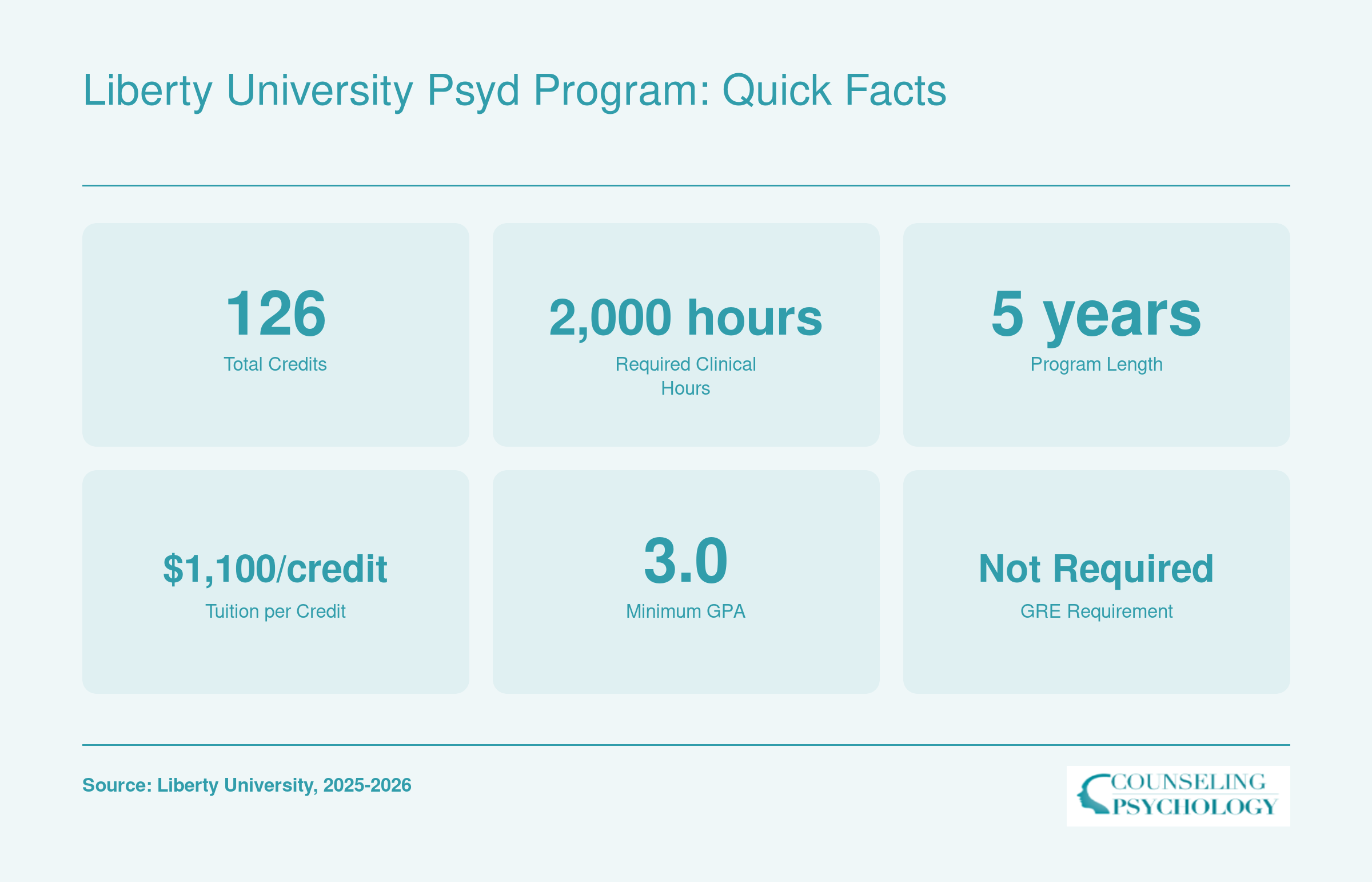
Liberty University PsyD Program: Quick Facts
Liberty University's PsyD in Clinical Psychology is a residential-only, faith-integrated program that recently earned APA initial accreditation on contingency. Here's a quick look at the program's structure and requirements.
Related Articles
Faith-Integrated Training Meets APA Standards: What This Signals for the Field
Liberty University's Psy.D. accreditation marks a watershed moment that validates faith-integrated clinical training as fully compatible with the discipline's highest professional standards. The American Psychological Association's decision signals that a program built on an explicitly Christian worldview can meet the rigorous, secular benchmarks demanded of all doctoral programs.
A milestone for faith-integrated training
For decades, practitioners and educators have debated whether professional psychology can embrace religious commitments without compromising empirical rigor. The APA Commission on Accreditation's grant of initial accreditation, on contingency, to a program that weaves science, practice, and Christian faith throughout its curriculum demonstrates that the conversation is shifting. Rather than diluting classroom content or clinical preparation, Liberty's integrated model has been recognized as educationally sound. This matters because it opens doors for graduates who want to practice as health service psychologists without leaving their faith at the laboratory door, and it affirms that evidence-based, best-practice interventions can be delivered with professionalism, compassion, and integrity within a Christian worldview.
Why it matters for counseling, social work, and MFT
The ripple effects extend well beyond clinical psychology. Many mental health professionals in counseling, marriage and family therapy, and social work collaborate with psychologists in integrated care settings, schools, hospitals, and federal agencies. An APA-accredited Psy.D. produced by a faith-based institution sets a precedent that robust, spiritually sensitive training is not inherently lower quality. For master's-level clinicians considering doctoral study, or for social workers and counselors who encounter faith-based psychological reports and treatment plans, this accreditation reassures them that a Christian worldview can coexist with top-tier professional preparation. It also signals to employers, including the military and Veterans Health Administration, that graduates from such programs are prepared to meet the same competency standards as those from traditional secular universities.
Resolving the false dichotomy
Some in the field have long viewed faith-based training and APA accreditation as mutually exclusive, worrying that a religious perspective might introduce bias or dilute scientific method. Liberty's achievement shows the opposite: a program can require courses in theology and spiritual integration while still instilling deep competence in assessment, intervention, and research. Faculty mentors supervise students in delivering culturally responsive care that acknowledges clients' spiritual dimensions, which research increasingly shows is valued by many clients. For students drawn to this intersection of faith and clinical practice, exploring a career as a spiritual psychologist can clarify how spiritually informed competencies translate into professional roles. Far from being a barrier, intentional integration can enhance therapeutic rapport and address a dimension of diversity often overlooked in secular training models.
A growing but select group
Liberty joins a small cohort of faith-based universities whose doctoral programs hold APA accreditation. Fuller Theological Seminary, Wheaton College, Regent University, and Biola University all offer accredited clinical psychology programs taught from a Christian perspective. That these institutions have maintained accreditation for years, and that Liberty's was granted after thorough review, suggests the profession is increasingly comfortable with theologically informed training as long as it meets universal quality benchmarks. Students exploring faith-based graduate education may also consider a doctorate in biblical counseling as a complementary pathway. For prospective students, this means greater choice: they no longer have to decide between a rigorous, licensure-ready education and a program that takes their faith seriously. As the network of accredited, faith-integrated programs grows, the field may begin to see more collaboration between religious and secular training sites, enriching the discipline as a whole.
How Liberty's New Accreditation Compares to Established APA PsyD Programs
In the past two years, at least seven clinical PsyD programs have received initial APA accreditation, adding to a national pool of more than 700 accredited doctoral psychology programs. Liberty University's October 2025 accreditation decision places it alongside recent entrants like Western Kentucky University (November 2024), Southern Utah University (November 2025), and Northwest Nazarene University (February 2026).2 While each program holds the same accreditation status, differences in format, faith orientation, and emerging outcomes data offer context for prospective students.
Accreditation Status and Timeline
All recently accredited programs, including Liberty's, hold initial accreditation on contingency. This means each program submitted a comprehensive self-study, hosted a site visit, and met the APA's standards for curriculum, faculty, and training. The designation is a data-gathering phase during which programs demonstrate ongoing compliance before moving to full accreditation. For context, full accreditation typically takes three to five years after initial status is granted, provided no major concerns arise.
Program Format and Credit Load
APA-accredited clinical psychology doctorate programs are primarily residential, as the accreditor does not accredit fully online doctoral programs in clinical psychology. Liberty's program is residential only, and the other recently accredited programs follow a similar in-person model, though some may offer hybrid coursework. Credit-hour requirements range from roughly 90 to 120 semester hours across programs, a reflection of the APA's broad design standards rather than a specific mandate. Exact credit totals for each program can be found on the respective university websites.
Faith Integration as a Distinguishing Feature
Among the newest accredited programs, Liberty and Northwest Nazarene both integrate Christian faith into their training models. Liberty's APA self-study report notes that the program "prepares graduates to serve as health service psychologists… within a Christian worldview." Northwest Nazarene's program shares a similar faith-based mission. In contrast, programs at public institutions like Western Kentucky University and Southern Utah University operate from a secular, scientist-practitioner framework. For students seeking APA-accredited training that explicitly connects clinical practice with religious conviction, Liberty's accreditation substantially expands the available options. Those drawn to faith-integrated mental health careers may also explore related paths such as a doctorate in pastoral counseling.
Outcomes Data Availability
APA requires all accredited programs to publish a standardized "Student Admissions, Outcomes, and Other Data" document, covering internship match rates, licensure exam pass rates, and time to degree completion. For newly accredited programs, this data is often not yet published because the first cohorts have not reached internship or graduation milestones. As of mid-2026, Liberty's program has not publicly released full outcomes data, though the department states that the initial accreditation will "help students secure competitive internships." Prospective applicants should request each program's most recent outcomes document directly, bearing in mind that early data can reflect a small number of participants and may not represent long-term trends.
Questions Prospective Students Should Ask Before Enrolling
Is a faith-integrated clinical psychology doctorate really a viable path to licensure and competitive internships? Liberty's APA accreditation confirms it is. "Accredited, on contingency" is the standard starting point for all newly accredited programs, not a warning sign, and graduates enjoy full recognition for licensure and federal employment. For prospective students, the next step is practical: contact Liberty's program office for the latest internship match and licensure outcomes, then verify state-board requirements directly. The broader takeaway is that rigorous clinical training and a Christian worldview are not in tension. APA's decision expands options for students who want to pursue doctoral psychology within a values-aligned framework, signaling a maturing space where faith-integrated programs meet the highest professional standards.